Welcome Guest ( Log In | Register )

7 Pages « < 4 5 6 7 >Bottom

Outline · [ Standard ] · Linear+

 STPM 2014/2015

views
     
Critical_Fallacy
post Jan 29 2015, 09:00 AM

∫nnộvisεr
Group Icon
VIP
3,713 posts

Joined: Nov 2011
From: Torino
QUOTE(RED-HAIR-SHANKS @ Jan 28 2015, 11:55 PM)
On the final post(Post#720) of the previous page, I couldn't prove that user posted image. Where were my errors? I redid it again and again, but I failed to get to the solution. It's frustrating.
The essence of mathematics is not to make simple things complicated, but to make complicated things simple.

- S. Gudder
Critical_Fallacy
post Jan 29 2015, 05:32 PM

∫nnộvisεr
Group Icon
VIP
3,713 posts

Joined: Nov 2011
From: Torino
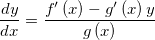
QUOTE(RED-HAIR-SHANKS @ Jan 29 2015, 05:08 PM)
Pardon me for my ignorance, but, do you meant it to be like this?

Let user posted image,
∴ Differentiation of y is:
user posted image
user posted image
user posted image
Kawan,

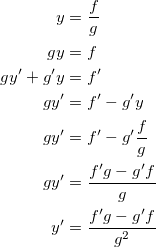
You've just re-derived Quotient rule. icon_rolleyes.gif

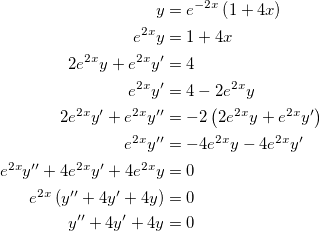
When facing differentiation problem, you need to decide whether it is more efficient to use direct differentiation or implicit differentiation. Implicit differentiation in this case makes things complicated (for human) due to the nature of derivatives of trigonometric functions. For solving by hand, implicit differentiation is more suitable for polynomial functions.

user posted image
Critical_Fallacy
post Jan 29 2015, 05:57 PM

∫nnộvisεr
Group Icon
VIP
3,713 posts

Joined: Nov 2011
From: Torino
QUOTE(regan96 @ Jan 29 2015, 02:35 PM)
i choose to do adat resam for pa
My suggestions: icon_idea.gif

(1) Understanding Cultural Heritage: Learning from 1 MALAYSIA

(2) Extremism: A Threat to Cultural Diversity in Malaysia

(3) Contemporary Perspectives on Cultural Practices in Malaysia

(4) When Ways of Life Collide: Rethinking Cross-Cultural Approaches to Malaysian Harmony

This post has been edited by Critical_Fallacy: Jan 29 2015, 05:59 PM
Critical_Fallacy
post Jan 30 2015, 12:47 AM

∫nnộvisεr
Group Icon
VIP
3,713 posts

Joined: Nov 2011
From: Torino
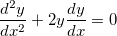
QUOTE(Krevaki @ Jan 29 2015, 11:31 PM)
Well, I think you have the solution by now but just out of academic interest, here's how I would go about it.
user posted image
Differentiating,
user posted image
Just differentiate once more and it's done.
Genius! thumbup.gif
Critical_Fallacy
post Feb 5 2015, 05:17 PM

∫nnộvisεr
Group Icon
VIP
3,713 posts

Joined: Nov 2011
From: Torino
QUOTE(daehii @ Feb 5 2015, 04:58 PM)
Help me please~  sad.gif  [attachmentid=4331390]
What kind of help do you require?

Can you at least get dy/dx? sweat.gif
Critical_Fallacy
post Feb 5 2015, 06:03 PM

∫nnộvisεr
Group Icon
VIP
3,713 posts

Joined: Nov 2011
From: Torino
QUOTE(RED-HAIR-SHANKS @ Feb 5 2015, 05:44 PM)
I've stuck in this question before. Here, let me give you a hint that will kick-start your momentum in solving this question:

Multiply both the LHS and RHS of the equation by user posted image.

I think I know why you're having a trouble with this question because I was having the same problem too. There are possibly many ways for you to solve it, either by multiplying the user posted image into the parentheses, or by using product rule. But, I've done it using both said methods and I still couldn't prove the equation albeit going through a lot of steps. The thing here is that you have to know which is the simplest method that you can execute in order to arrive at the correct solution. chocobo7779 taught me this, and it's called Occam's Razor.
So you also knew about Occam's Razor. It is the mentality thing. sweat.gif

Most Malaysian students are taught to work out the given problem directly, without recognizing the root of the problem and find a workaround to it. chocobo7779's method was commendable. icon_rolleyes.gif
Critical_Fallacy
post Feb 5 2015, 06:58 PM

∫nnộvisεr
Group Icon
VIP
3,713 posts

Joined: Nov 2011
From: Torino
QUOTE(RED-HAIR-SHANKS @ Feb 5 2015, 05:44 PM)
But, I've done it using both said methods and I still couldn't prove the equation albeit going through a lot of steps.
user posted image
Critical_Fallacy
post Feb 16 2015, 08:53 PM

∫nnộvisεr
Group Icon
VIP
3,713 posts

Joined: Nov 2011
From: Torino
QUOTE(RED-HAIR-SHANKS @ Feb 14 2015, 02:37 AM)
Krevaki, I got a tiny problem here. So this is the question: user posted image

But the answer that got was π-2, and not π+2. This is my working:
You can verify your answer at Wolfram Alpha. icon_idea.gif

Just copy and paste the LaTeX code.

user posted image
Critical_Fallacy
post Feb 17 2015, 05:53 PM

∫nnộvisεr
Group Icon
VIP
3,713 posts

Joined: Nov 2011
From: Torino
QUOTE(RED-HAIR-SHANKS @ Feb 17 2015, 04:20 PM)
Question:
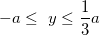
First problem(i)-If user posted image, show that user posted image for all real values of x.

Second problem(ii)-Sketch the graph for y in the case when a=6.
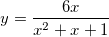
As shown in (i), the function f(x) = 6x / (x² + x + 1) is bounded between –6 ≤ y ≤ 2 for all real values of x. The minimum y = –6 occurs at x = –1, and the maximum y = 2 occurs at x = 1.

The basic technique to sketch the graph of a rational function is to find the asymptotes and the intercepts. However, this method doesn't work well for the function f(x) in this question. Therefore, you need to employ the gradient method.

(1) Obtain the gradient:

dy/dx = f'(x) = –6(x² – 1) / (x² + x + 1)².

(2) Find the turning points (local extrema) of the gradient. These points mark the maximum steepness at certain x values.

x = –1.5321, –0.3473, 1.8794

(3) Calculate f'(x) and f(x) for a set of selected x values: [–2, –1.5321, –1, –0.5, –0.3473, 0, 0.5, 1, 1.8794, 2]

xf'(x)f(x)
–2.0000–2.0000–4.0000
–1.5321–2.4534–5.0642
–1.00000.0000–6.0000
–0.50008.0000–4.0000
–0.34738.8230–2.6946
0.00006.00000.0000
0.50001.46941.7143
1.00000.00002.0000
1.8794–0.36961.7588
2.0000–0.36731.7143

(4) Plot the graph using the data and by tracing the slopes.

user posted image
Critical_Fallacy
post Feb 20 2015, 03:17 AM

∫nnộvisεr
Group Icon
VIP
3,713 posts

Joined: Nov 2011
From: Torino
QUOTE(RED-HAIR-SHANKS @ Feb 19 2015, 03:33 PM)
It is definitely wrong, I've been taught on showing whether a given polynomial is a continuous function on interval [x₁, x₂], but I couldn't figure out the way to find the value of the solution within the interval.
The way you interpreted Chocobo's challenge was misguided.

The challenge becomes crystal clear when it is rephrased:

Find the (positive) root of the Cubic equation h(x) = x³ – 6x – 1, such that it lies in the interval [2, 3].

So, by the IVT, you will just need to plug and play with the cubic equation h(x) for any value x within the interval [2, 3] until you get h(x) = 0. Technically, you can determine all the 3 coordinates (roots) if you are able to identify the correct intervals from the graph (not from hand sketch). icon_idea.gif

By the way, since x³ – 6x – 1 is already a transformed cubic equation (see Tschirnhausen Transformation), you can solve the cubic analytically using using Cardano's Formula. icon_rolleyes.gif

This post has been edited by Critical_Fallacy: Feb 20 2015, 03:27 AM
Critical_Fallacy
post Feb 20 2015, 06:04 PM

∫nnộvisεr
Group Icon
VIP
3,713 posts

Joined: Nov 2011
From: Torino
QUOTE(RED-HAIR-SHANKS @ Feb 20 2015, 03:08 PM)
I'm not learning all of them though. I'm having trouble with numerical methods of cubic equation for now so I'll just stick to that.
Since Cardano's formula is not covered in STPM, you can simply use CASIO fx570 to get the roots of the cubic equation. Unless you are instructed to apply Newton-Raphson's method to find the root, I believe you can just use the built-in feature in the CASIO calculator. STPM Pure Math is still relatively straightforward. icon_rolleyes.gif
Critical_Fallacy
post Feb 20 2015, 06:30 PM

∫nnộvisεr
Group Icon
VIP
3,713 posts

Joined: Nov 2011
From: Torino
QUOTE(RED-HAIR-SHANKS @ Feb 20 2015, 01:42 PM)
I've looked around for Cardano's Formula, and I'm learning on how to use it. However, my workings reached to a stalemate when I was calculating for u³+v³.
Stick to STPM Math as what Just Visiting By advised. Cardano's formula is intended for those who are into the real "Pure Maths", by which a cubic equation is solved analytically.

In fact, I'm more worried about the way you interpret the math problems like the third (iii) problem. The techniques you apply to solve a problem reflect your understanding of what the question requires you to do.

While (iii) was designed to test your algebraic manipulation skill and your critical thinking skill to relate the cubic equation to the rational function, did you realize that (iii) also could be solved by obtaining the roots of x³ – 6x – 1 = 0? unsure.gif

This post has been edited by Critical_Fallacy: Feb 20 2015, 06:37 PM
Critical_Fallacy
post Feb 20 2015, 09:43 PM

∫nnộvisεr
Group Icon
VIP
3,713 posts

Joined: Nov 2011
From: Torino
QUOTE(RED-HAIR-SHANKS @ Feb 20 2015, 07:13 PM)
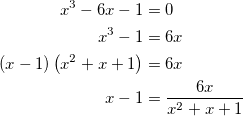
I haven't got the clue on which equation to pick, and most importantly, I never truly fathom on why x³ – 6x – 1 = 0 is picked in this case, instead of user posted image.

No, I did not realize that.
It doesn't matter which equation you pick.

user posted image

Because it is derived from the fundamental cubic equation f(x) = 0, they all have the same set of solutions.

user posted image

Check the intersections of the graphs.

user posted image

This post has been edited by Critical_Fallacy: Feb 20 2015, 09:45 PM
Critical_Fallacy
post Feb 22 2015, 01:01 AM

∫nnộvisεr
Group Icon
VIP
3,713 posts

Joined: Nov 2011
From: Torino
QUOTE(RED-HAIR-SHANKS @ Feb 21 2015, 10:33 PM)
No, I don't think I answered your question correctly, and if anything, I totally misinterpreted your previous question.
THe solution provided by chocobo7779 is similar to the Bisection method—simple but slow to converge.

From the practical side, because the cubic function is continuously differentiable, Newton–Raphson method (covered in STPM) is highly recommended.

user posted image

To answer chocobo7779's challenge without using calculus, I have modified an optimization method (to find the extremum) to locate the root that is known to exist within a certain interval.

user posted image

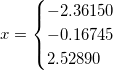
The results converge to 2.5289 (4 d.p).
Critical_Fallacy
post Feb 22 2015, 01:32 PM

∫nnộvisεr
Group Icon
VIP
3,713 posts

Joined: Nov 2011
From: Torino
QUOTE(RED-HAIR-SHANKS @ Feb 22 2015, 11:19 AM)
Oh, thank you for your solution. But, it looks much complex than the Bisection method and Newton–Raphson method.
This is the full version algorithm of chocobo7779's method. It requires at least 50 iterations and a series of tests to arrive at the accuracy of 5 decimal places. Compared to the Modified Golden Section Search, the rate of convergence is much slower. Of course, both cannot beat Newton–Raphson method. sweat.gif

user posted image
Critical_Fallacy
post Apr 13 2015, 12:25 AM

∫nnộvisεr
Group Icon
VIP
3,713 posts

Joined: Nov 2011
From: Torino
QUOTE(scgoh123 @ Apr 9 2015, 09:40 PM)
Critical_Fallacy RED-HAIR-SHANKS Can you show some light on how to deal with part (b)? Since most of us are having problem here.

Here's the question:
user posted image
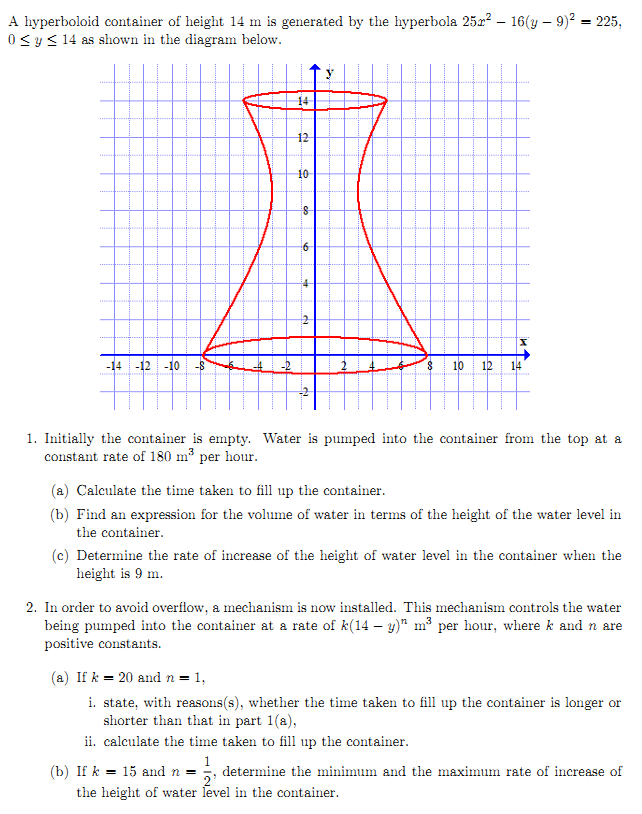
This problem is related to the Nuclear Cooling Tower or Hyperboloid Structure.

If you are referring to 1(b), you can simplify the problem by shifting the y-axis.

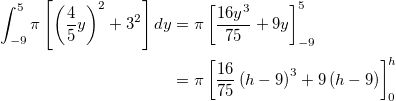
Using the Disk Method, you should obtain something like this:

user posted image

where h is the height of the water level. icon_rolleyes.gif
Critical_Fallacy
post Apr 13 2015, 12:29 AM

∫nnộvisεr
Group Icon
VIP
3,713 posts

Joined: Nov 2011
From: Torino
QUOTE(daehii @ Apr 11 2015, 06:40 PM)
Is that supposed to be a demand or a question?

a question..  smile.gif
Clue #1: Find a way to make this substitution: user posted image

Clue #2: Use Trigonometric Identities (after solving Clue #1). icon_idea.gif
Critical_Fallacy
post Apr 13 2015, 01:56 PM

∫nnộvisεr
Group Icon
VIP
3,713 posts

Joined: Nov 2011
From: Torino
QUOTE(scgoh123 @ Apr 9 2015, 09:40 PM)
Here's the question:
user posted image
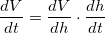
For 2(b), using the Chain Rule, user posted image, find

(i). user posted image

(ii). user posted image

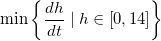
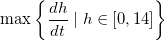
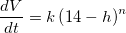
Since user posted image is given and user posted image can be obtained from the derivative of 1(b), the rest is Algebra and you can find the extrema on the closed interval user posted image.

For completeness, you should also determine the height of the water level at which the minimum and maximum of dh/dt occur. icon_rolleyes.gif
Critical_Fallacy
post Apr 13 2015, 02:33 PM

∫nnộvisεr
Group Icon
VIP
3,713 posts

Joined: Nov 2011
From: Torino
scgoh123

For 2(b), I've got this. The max (1.22 m/hr) occurs around the bottleneck (8.36 m) of the Hyperboloid Container. Does it make sense to you? sweat.gif

user posted image

When you get user posted image, it all goes back to the quadratics. laugh.gif

user posted image

For your info, the dh/dt does not have a minimum in the calculus sense, but it contains an Infimum, which is the greatest lower bound on h ∈ [0, 14]. You can imagine that, as the water level is approaching 14 m, the flow rate dV/dt ≈ 0, causing the water level to increase extremely slow (to prevent overflow), and therefore dh/dt ≈ 0. It is inaccurate to put exactly dh/dt = 0, because that means the flow control valve is turned off completely (dV/dt = 0). Since dV/dh is non-zero, the Chain Rule becomes indeterminate. The argument of 2(b) is built on the assumption that the water is being pumped continuously into the cooling tower until it stops at the water level 14 m. Naturally, when you stop pumping water, the water level stops increasing.

Please note that in this case, the maximum is also the Supremum (the least upper bound) of the set.

This post has been edited by Critical_Fallacy: Apr 13 2015, 05:20 PM
Critical_Fallacy
post Apr 13 2015, 09:16 PM

∫nnộvisεr
Group Icon
VIP
3,713 posts

Joined: Nov 2011
From: Torino
QUOTE(scgoh123 @ Apr 13 2015, 07:00 PM)
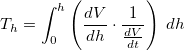
The problem that i had faced is when I tried to substitute h=14 into the differential equation that I have obtained, the time taken is infinity. The container will never be filled. So how do I calculate the time taken to fill up the container?
Was that really a problem? hmm.gif

I believe that I've given an explanation in the previous post.

You could check your answer for h = 13.9 m and h = 13.99 m, to test the convergence of the result . icon_idea.gif

To make the problem more interesting, the parameters in part 2(b) should be chosen carefully k = 28 and n = 0.5, as both take roughly the same time (15.2 hours) to fill up the container up to the water level 13.9 m. But the nonlinear control mechanism in 2(b) will fill up the container 100% by 17 hours.

user posted image

In reality, the process will be terminated (turn off the valve) if time taken to fill the container exceeds the expected time. The MRO (maintenance, repair, and overhaul) team will carry out the Fault Detection and Diagnosis manually on the system. Modern systems usually have the Fault-Tolerant Control System installed to minimize downtime of a system.

This post has been edited by Critical_Fallacy: Apr 13 2015, 09:39 PM

7 Pages « < 4 5 6 7 >Top
 

Change to:
| Lo-Fi Version
0.0469sec    0.82    7 queries    GZIP Disabled
Time is now: 19th December 2025 - 06:17 AM