Welcome Guest ( Log In | Register )

Bump Topic Topic Closed RSS Feed
8 Pages  1 2 3 > » Bottom

Outline · [ Standard ] · Linear+

 4 Critical Signs of a Bubble Market V2, Is Malaysia in a bubble?

views
     
TScybermaster98
post Jan 15 2014, 10:06 AM, updated 12y ago

Look at all my stars!!
*******
Senior Member
4,440 posts

Joined: Jan 2010
From: Kuala Lumpur


Continuation from Version 1 which was quite a hot topic with 2646 posts and 135,824 views since 15 Nov 2013:

https://forum.lowyat.net/topic/3031756


The collapse of the US housing market bubble emphasizes how important it is to figure out what property is really worth, from a fundamental perspective. Make sure you’re not over-paying!

There are 4 yardsticks to avoid buying in bubble markets:

•Price to Rent Ratio (or Yield)
•Relative Prices
•Affordability
•Price of new builds


VALUATION TOOL 1: THE PRICE TO RENT RATIO

The gross rental yield) is the housing parallel to the price/earnings ratio. Here is a set of rules of thumb for the housing market:

VALUATION YARDSTICKS FOR THE HOUSING MARKET

PRICE/RENT RATIO GROSS RENTAL YIELD (%)
5 20 Very undervalued
6.7 15 Very undervalued
8.3 12 Undervalued
10 10 Undervalued
12.5 8 Borderline undervalued
14.2 7 Fairly priced
16.7 6 Fairly priced
20 5 Borderline overvalued
25 4 Overvalued
33.3 3 Overvalued
40 2.5 Very overvalued
50 2 Very overvalued

But there are exceptions to this. When strong future growth in value is expected e.g in areas where transport infrastructure is being upgraded then relatively weak present earnings can be acceptable.

There are several good reasons why people should pay attention to the 'valuation parameters':

Higher rental yields push the housing market higher

If rental yield levels are high, this will tend to mean that the interest cost of buying a house is low, compared to the cost of renting a house:

•Potential buyers will pay less to borrow from the bank (in order to buy) than they pay when renting a house. Many will move from being renters to buyers.
•Entrepreneurs will find it makes sense to buy houses to make money, i.e., buy in order to rent them out.

Both these factors put upward pressure on house prices.

Lower rental yields put downward pressure house prices

If rental yield levels are low, this will tend to mean that the interest cost of buying a house is high, compared to the cost of renting a house:

•Potential buyers will find that to buy a house involves paying much more to the bank, than it costs to rent a house. Buyers, especially first-time buyers, may have difficulty financing housing. Banks will be worried about over-lending at loan-to-income ratios which mean that a slight increase in interest rates will mean financial crisis for the borrower.
•Entrepreneurs will find that buying-to-let won't pay.

The house price can be viewed as a kind of circle, with houses prices moving from yields of (say) 4% to 11%

•Yields shifting down to 4% would represent danger.
•Yields rising to 11% would signal opportunity.


VALUATION TOOL 2: RELATIVE PRICES

People tend to actively look for cheaper and better alternatives. Where houses are very highly priced, people will seek more affordable alternatives. So if you’re buying property that’s amazingly expensive on a sqaure foot basis compared to its surrounding developments – BEWARE!


VALUATION TOOL 3: AFFORDABILITY

If house prices are so high that few people can actually afford to buy them, then their value will likely fall in future. A reasonable measure of value is a country’s GDP per capita. In a country where the ratio of house prices to GDP/capita is high, it’s a fair bet that houses are overvalued.

Relative to GDP/Capita levels:
•House prices in Luxembourg, Belgium, Norway, Denmark and Austria seem cheap.
•House prices in the UK, Italy, France and the Netherlands seem comparatively expensive.


VALUATION TOOL 4: PRICE OF NEW BUILDS

If house prices are much higher than the cost of building (construction costs), developers are motivated to put up buildings. So when you see a rush by developers to build, that’s a danger sign. As new supply comes into the housing market, that tends to put pressure on prices. So when house prices are far greater than new-build costs, it's a very clear signal that prices are likely to come down.

SUSjolokia
post Jan 15 2014, 11:24 AM

So Hot It Burns..!!!
*******
Senior Member
3,274 posts

Joined: May 2013


Bros Cybermaster98 signature thread kena hijacked already. .lol

http://beta.malaysiakini.com/biz/251794

Hey3 look like the situation is worst then our prediction, Stagnation may turn ugly. .hehe
TScybermaster98
post Jan 15 2014, 11:31 AM

Look at all my stars!!
*******
Senior Member
4,440 posts

Joined: Jan 2010
From: Kuala Lumpur


QUOTE(jolokia @ Jan 15 2014, 11:24 AM)
Bros Cybermaster98 signature thread kena hijacked already. .lol

http://beta.malaysiakini.com/biz/251794
What u mean? i dont understand
OPT
post Jan 15 2014, 12:32 PM

Wee wang wang
*******
Senior Member
2,065 posts

Joined: Feb 2011
Slowdown in property launches in M'sia

by angie ng

PETALING JAYA: Property launches and sales will soften this year, as the market gravitates towards the actual impact of the 2014 budgetary measures, property consultants concur.

Managing director of property consultancy VPC Alliance Malaysia Sdn Bhd James Wong said with the cooling measures in Budget 2014, sales volumes would drop and the property market would soften, particularly the sales of condominium prices ranging from RM750,000 to RM1mil, which are targeted at foreigners.

He said property launches were expected to slow down compared with 2013 and some launches might even be delayed or scaled down, if effective demand was not there.

Wong expected more affordable homes to be introduced this year, with properties near the proposed mass rapid transit and light rail transit extension lines set to be popular.

“Although the landed residential sector is expected to be resilient with stable growth, especially property within gated and guarded enclaves, sales of residential properties to foreigners would be slow as a result of the budget measures. Transactions in condominiums would slow down, with a possible price correction.

“The abolition of the developer interest-bearing scheme (DIBS) and other freebies is expected to reduce the volume and value of the transactions in the primary market, and new property launches may be affected, as without the DIBS, many potential housebuyers may not be qualified to purchase houses. Overall, the housing market would moderate, with a reduction in property transactions and prices,” Wong said.

According to CB Richard Ellis Malaysia executive director Paul Khong, the minimum RM1mil limit for foreigners would affect the mid-range residential sector, and potential buyers would tend to defer their decision to buy. The imposition of the full real property gains tax will have a blanket effect on curbing speculation across all sectors and impact the take-up rate.

“It has been a quiet start this year and most developers are deferring their launches till the later part. With the Chinese New Year coming up end-January, it is traditionally a quiet period for the property sector. More project launches are expected to come through in or after the second quarter,” Khong observed.

After a relatively quiet first-half and the market finding its equilibrium, he said more action was expected in the second half of the year.

He pointed out that developers would have to work harder this year to attract sales, and many might consider marketing their projects overseas and incorporating innovative and lifestyle concepts into their projects.

“Good and innovative packages plus value-for-money features in property projects would go far in 2014,” Khong conceded.

He said one of the property hotspots would be Medini@Iskandar where new projects like I Medini Walk (by Singapore’s Tang Group of Companies) and Avira (Eastern & Oriental Bhd) both near Legoland would be entering the market soon.

Many developers will be looking at the Medini area, as it is a special international zone with various taxes/benefits, including an exemption of the RM1mil minimum price limit imposed on foreigners.

Read it all here:
http://www.thestar.com.my/Business/Busines...dget-this-year/
norman05051984
post Jan 15 2014, 12:33 PM

Casual
***
Junior Member
443 posts

Joined: Jun 2010


AT LAST VERSION TWO ALREADY
OPT
post Jan 15 2014, 12:33 PM

Wee wang wang
*******
Senior Member
2,065 posts

Joined: Feb 2011
And here:

http://www.thestar.com.my/Business/Busines...14-to-be-tough/


Cautiously optimistic outlook with property developers in Iskandar expecting tough 2014


by zazali musa


JOHOR BARU: The “feel-good” factor that was prevalent in 2012 and 2013 for the property market in Iskander Malaysia is unlikely to continue this year following property cooling measures introduced by the Government in the last quarter of last year.

Property developers are rather cautiously optimistic on the market outlook for 2014 and are anticipating it to be a tough year for many.

Johor Real Estate and Housing Developers Association (Rehda) branch chairman Koh Moo Hing said the Year of the Horse would be more challenging and that developers must be well-prepared to face the worst.

“I assume that many of our members will adopt the wait-and-see approach in the first-quarter of 2014, to see the real impact from the (property cooling) measures,’’ Koh told StarBiz.

He said the measures were not something new as other countries would also resort to similar measures to ensure locals were not sidelined and denied from owning houses.

Koh said 2013 was the best year for 30 odd members of Johor Rehda who participated in the Malaysian Property Exposition (Mapex) held here in May and November.

He said these members raked in a combined RM3bil in sales over a one-month period.

“It would an achievement if they could repeat the sales figure again for this year’s events,” he added.

The 30-day period starting from the first day of Mapex is the benchmark used by Rehda to determine the value of sales by participating developers.

“Johor Mapex to be held in April will give a clearer picture on the Iskandar property outlook and how developers are coping with the uncertainties and challenges,’’ said Koh.

He said developers would be ready to face the tough year ahead and adapt well as they had experienced the ups and downs in the industry over the years and emerged stronger. Koh said that speculators would be phased out gradually from the property market with the implementation of the measures with owner-occupier buyers dominating the market. “This year’s launches will see between 100 and 200 units with more developers opting for landed houses as demand for them is still strong in Iskandar,’’ he said.

KGV International Property Consultants (M) Sdn Bhd director Samuel Tan Wee Cheng concurred with Koh that the market would see more serious buyers.

But he said buyers would be more cautious on the new policies – the real property gains tax (RPGT) and the hike in ceiling price from RM500,000 to RM1mil for foreign property buyers.

“Prices of houses will continue to go up this year, determined by the policies and escalating costs of labour and building materials,’’ said Tan.

He said it was matter of time buyers especially first-time house owners decided whether to continue waiting or make the kill before the prices move up north.

Tan said if the prices continued to go up, more buyers would go for the secondary market where prices were between 20% and 30% cheaper compared with new launches.

“For instance, the average selling price for a new double-storey link house in Iskandar is RM800,000 per unit, but if you look around in the secondary market, you’ll be paying RM600,000 for it,’’ he said.

Tan said landed houses in the secondary market came with generous land size and bigger floor area plus ready amenities and facilities within the neighbourhood or the development.

He said if this could prompt developers to lower the selling prices of their new launches to attract potential buyers and also offer no-frills houses to cut costs.

Tan said foreign buyers would continue to buy properties in Medini, Nusajaya as there was no restriction to foreign ownership in the area and they were not subject to the RPGT regime.

SP Setia Bhd divisional general manager Hoe Mee Ling said many uncertainties in both global and domestic market might affect the property market in the first-half of 2014.

She said among the issues were the pressure of increasing costs as a result of skilled labour shortage, reduction in subsidies beginning with petrol last September and electricity tariff adjustment in 2014 and policy changes.

“However, challenges always come with opportunities and there are still positive factors in the Iskandar property market,’’ said Hoe.

She said the fundamental demand for properties in Iskandar would remain high and strong as long as developers could adapt to their products to suit this demand.

Hoe said the outlook was still good as properties fetched good yields and were the best hedge against inflation.
Balrog
post Jan 15 2014, 01:06 PM

New Member
*
Junior Member
25 posts

Joined: Mar 2013
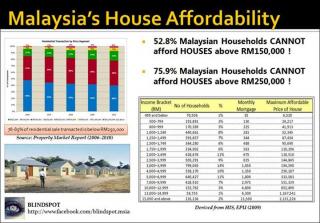
Malaysia household income and mortgage repayment ability.

https://www.facebook.com/photo.php?fbid=778...elevant_count=1


Attached thumbnail(s)
Attached Image
OPT
post Jan 15 2014, 02:18 PM

Wee wang wang
*******
Senior Member
2,065 posts

Joined: Feb 2011
QUOTE(Balrog @ Jan 15 2014, 01:06 PM)
Malaysia household income and mortgage repayment ability.

https://www.facebook.com/photo.php?fbid=778...elevant_count=1
*
Good info... cool2.gif
MishimaZ
post Jan 15 2014, 02:25 PM

Getting Started
**
Junior Member
269 posts

Joined: Feb 2011
As a home owner and also an engineer in the construction industry, I learned on the costs etc etc and at the same time see how the market had escalated bullishly because more and more are built for "investments" purposes instead.

I had experienced developments where the Quantity Surveyor (many don't know what they are and do despite of claiming of their interests in property and construction) that they have to submit marked up costings to banks so that those money enter their own pockets la.... Then the developers go to enjoy at nightclubs or go Genting and waste up those cash giving money on their sexbomb to gamble lo.... People say black money, but black money can come from everywhere la. Btw gosh... you guys pay a premium to enrich developers today so that they can hump your daughters and wives in the future while your bald thinking on making ends meet.

Many idiots always argue on land prices and availability and prices subjected to location and amenities like MRT/LRT etc surrounding (which is partially true) but there are many points to counter which then turn into "Don't complaint, want cheap go Kajang lah... Bukit Beruntung lah...." instead of coming out with factual arguments on why things will and should UUU BY FOLDS when the majority of Malaysians is still eating kangkongs unlike themselves; working in KLCC mah..... We understand if your buy for own stay okay, but not for flipping now.

To conclude the rise of prices in illogical manner is due to speculation la. Speculative behaviour associated with them tend to cause financial crises, which lead to lower growth, higher unemployment and higher government debt, which we are seeing in our country. But some people say Malaysia will be a banking hub ma.... See how by then lo... As if banks are the sole field that generate money for the country. sweat.gif sweat.gif sweat.gif
Showtime747
post Jan 15 2014, 02:35 PM

Look at all my stars!!
*******
Senior Member
4,258 posts

Joined: Nov 2012
QUOTE(Balrog @ Jan 15 2014, 01:06 PM)
Malaysia household income and mortgage repayment ability.

https://www.facebook.com/photo.php?fbid=778...elevant_count=1
*
Source is 2006-2010. It may be worse today
cockee
post Jan 15 2014, 03:49 PM

Casual
***
Junior Member
416 posts

Joined: Apr 2008

Just to share some news..
Singapore private home sales dropped 79.6% in Dec13 compared to Nov13.
http://www.theedgemalaysia.com/business-ne...796-pct-mm.html

And the price is declining too..4 months in a row.. Although the rate is not as drastic as the transaction numbers..
http://www.bloomberg.com/news/2014-01-02/s...n-quarters.html

Are these the signs of things to come?


HELLO HELLO
post Jan 15 2014, 04:02 PM

Look at all my stars!!
*******
Senior Member
5,436 posts

Joined: Jan 2011
SG people try to sell off their HDB house to upgrade to condo. since market price sibeh good for HDB. but when put up for sale. got price no market... no body interested...die lor... at the end stil have to stay back to HDB

This post has been edited by HELLO HELLO: Jan 15 2014, 04:02 PM
OPT
post Jan 15 2014, 04:35 PM

Wee wang wang
*******
Senior Member
2,065 posts

Joined: Feb 2011
QUOTE(HELLO HELLO @ Jan 15 2014, 04:02 PM)
SG people try to sell off their HDB house to upgrade to condo. since market price sibeh good for HDB. but when put up for sale. got price no market... no body interested...die lor... at the end stil have to stay back to HDB
*
"got price no market"? hmm.gif

Means dreaming? whistling.gif
MishimaZ
post Jan 15 2014, 04:51 PM

Getting Started
**
Junior Member
269 posts

Joined: Feb 2011
QUOTE(OPT @ Jan 15 2014, 04:35 PM)
"got price no market"?  hmm.gif

Means dreaming?  whistling.gif
*
Means it is just the perceived value of the house as calculated by a certain fake formula created to put people in panic mode to BBB lor....


icemanfx
post Jan 15 2014, 05:05 PM

20k VIP Club
*********
All Stars
21,456 posts

Joined: Jul 2012


QUOTE(OPT @ Jan 15 2014, 04:35 PM)
"got price no market"?  hmm.gif

Means dreaming?  whistling.gif
*
Syok sendiri.
realcyma
post Jan 15 2014, 05:41 PM

On my way
****
Senior Member
641 posts

Joined: Aug 2009
QUOTE(Balrog @ Jan 15 2014, 01:06 PM)
Malaysia household income and mortgage repayment ability.

https://www.facebook.com/photo.php?fbid=778...elevant_count=1
*
good; but, not enough info.


how I interpret,
if 75.9% cannot afford rm250k house; BUT, XX% already have a RM250k house debt. that is a sign of bubble.

On the other hand, if 75.9% cannot afford rm250k house; and, they are all renting house....
this is good sign of strong support of house owner, and property market.


anyone have info, about how many people in this 75.9% group has house loan?

esy
post Jan 15 2014, 07:25 PM

Getting Started
**
Junior Member
160 posts

Joined: Mar 2012


QUOTE(Balrog @ Jan 15 2014, 01:06 PM)
Malaysia household income and mortgage repayment ability.

https://www.facebook.com/photo.php?fbid=778...elevant_count=1
*
... you sure this one accurate or not i seem to see and hear all the time a lot of young people is buying 2 or 3 house at one shot all the time during dbis all the time ... some more not cheap one ok 500k above one leh ... 1.5 mil if 3 ... anyway already ver.2 eh ... biggrin.gif ...

twincharger07
post Jan 15 2014, 07:57 PM

Look at all my stars!!
*******
Senior Member
4,788 posts

Joined: Feb 2011
QUOTE(Balrog @ Jan 15 2014, 01:06 PM)
Malaysia household income and mortgage repayment ability.

https://www.facebook.com/photo.php?fbid=778...elevant_count=1
*
The affordability pretty much driven by interest rates rather than pricing.. 2006 to 2008 were the era when interest rate was high 6.75+1%.. post subprime era witness the lowest interest rate 5.x-2.2%.. and today 6.6-2.4%..

For the same monthly installment you pay, say RM1500 permonth for 30 years, in 2006 mayb you can only able to buy a house mayb RM250k.. today with RM1500 permonth for 30 years, you can get a RM350k house..

Its all about repayment capability.. so does the 2006-2010 data can reflect the current situation remains a question mark..
chengcheng
post Jan 15 2014, 08:08 PM

Getting Started
**
Junior Member
294 posts

Joined: Jun 2008


Is there such thing as a car bubble?

I think nowadays many youngster will buy expensive car of RM 250 k then buy a property.

The installment is probably equivalent to buying a house.

And yet, I see so many new BMWs and Mercedes on the road.

Car bubble? Possible?


icemanfx
post Jan 15 2014, 08:12 PM

20k VIP Club
*********
All Stars
21,456 posts

Joined: Jul 2012


QUOTE(twincharger07 @ Jan 15 2014, 07:57 PM)
The affordability pretty much driven by interest rates rather than pricing.. 2006 to 2008 were the era when interest rate was high 6.75+1%.. post subprime era witness the lowest interest rate 5.x-2.2%.. and today 6.6-2.4%..

For the same monthly installment you pay, say RM1500 permonth for 30 years, in 2006 mayb you can only able to buy a house mayb RM250k.. today with RM1500 permonth for 30 years, you can get a RM350k house..

Its all about repayment capability.. so does the 2006-2010 data can reflect the current situation remains a question mark..
*
After QE tapering, interest rate is expected to return to pre-2008 level e.g. 3% higher than current.

How many people will be trapped?

8 Pages  1 2 3 > » Top
Topic ClosedOptions
 

Change to:
| Lo-Fi Version
0.6572sec    0.15    6 queries    GZIP Disabled
Time is now: 9th December 2025 - 02:41 AM