Welcome Guest ( Log In | Register )

Outline · [ Standard ] · Linear+

 Car Tint Advice - V2, Raytech, Vkool, Huper Optic, 3M or .....

views
     
jamespaul
post Nov 14 2017, 04:25 PM

Getting Started
**
Junior Member
211 posts

Joined: Oct 2014
QUOTE(carbonfibre @ Nov 9 2017, 12:46 PM)
What is the best high heat rejection tint available now ?

3M or Llumar or Vkool or Huper Optik ?

Please specify the model you recommend. COnfused with so many models
*
Actually, there are two answer to your question.

Best heat rejection, Huper Optik 20 (which allows only 20% of light to enter the glass)
This will block out a lot of heat. and it is illegal. And being only 20%, it is very visible that it is illegal.

Second answer, which tint has the best rejection while being legal...

Most glass installed on cars are approx. 70-80% clear. So by installing any tint will almost make your car illegal by JPJ standards. What this means is that you can only install (maximum), 90% VLT for the front, and 70% VLT tints for the sides.

So, you are left with 3M Crystalline 90 for the front. and Any brand (3M, HO or Vkool) that has 70% VLT for the sides. The rear, you can use VLT 50% tint.
jamespaul
post Nov 15 2017, 08:08 AM

Getting Started
**
Junior Member
211 posts

Joined: Oct 2014
QUOTE(lonely143 @ Nov 15 2017, 01:28 AM)
Those clear windows film (between 50-70%) are expensive because it can reject up to 90% heat despite being so clear to make it LEGAL.
Otherwise you can have 2nd option - ILLEGAL to get better price and heat
*
There’s no tint that can reject 90% heat. The only tint you can legally apply to your car is 90% front and 70% front side and 50% rear. The car’s glass is NOT transparent.


jamespaul
post Nov 16 2017, 08:46 AM

Getting Started
**
Junior Member
211 posts

Joined: Oct 2014
QUOTE(lonely143 @ Nov 15 2017, 04:01 PM)
I'm sorry, should put it as 90% Infra Red Heat Rejection (about 50-60% TSER)
I assume you consider the original glass about 20% VLT but in the market there is not 90% VLT film
*
There are many. One I can think of is 3M
jamespaul
post Nov 21 2017, 08:41 AM

Getting Started
**
Junior Member
211 posts

Joined: Oct 2014
QUOTE(Termibait @ Nov 16 2017, 01:13 PM)
3M fx-hp 50
3M FX-ST 50
3M Fx-St 70

Llumar Phantom 50
Which one is the most effective in heat rejection?
Anybody has the price for each film?

Planning to install on car windscreen
*
The suggestion you have highlighted will make all your screens JPJ non-compliant

Except the Rear windows
jamespaul
post Nov 21 2017, 08:44 AM

Getting Started
**
Junior Member
211 posts

Joined: Oct 2014
QUOTE(Kravo @ Nov 17 2017, 05:15 PM)
Stock car front screen already is not 100% VLT.
So practically any "good" tinting will cause my car break jpj rule, no?
*
Not true, because there are many brands out there but what i have researched is this.

For the Front Windscreen, use 90% VLT. What I can think of is to use 3M, as they have Crystalline 90

For front side windows, use 70% VLT, most brands have this. Vkool, 3m, Huper Optik, Ecotint

For rear side windows and rear window, use 50%, most brands have this too. Vkool, Ecotint, etc. etc.
jamespaul
post Nov 21 2017, 08:51 AM

Getting Started
**
Junior Member
211 posts

Joined: Oct 2014
QUOTE(ahtsong @ Nov 18 2017, 03:10 PM)
Going to tint my new ride  kia sorento soon

Any recommendations between raytech, vkool and huper optic??

Budget is open, but want to seek for good deal
*
Really depends if you want to be legal or not. If you want to be legal, please refer to my reply earlier (to another question). The recommendation i provide, will make you pass JPJ 100% when time to sell your car (provided that the manufacturer of tint follows the VLT they claim and the tint is of good enough quality to maintain the VLT throughout its life).

Most tint shops, follow blindly by JPJ's VLT recommendation without taking into account that the glass on cars are NOT clear.

Ask anyone who's sold a car recently, I am pretty sure their front Windscreen tints are torn out.
jamespaul
post Nov 22 2017, 02:49 PM

Getting Started
**
Junior Member
211 posts

Joined: Oct 2014
Was browsing through Raytech's website. I dont think they sell real tints.
jamespaul
post Nov 23 2017, 09:16 AM

Getting Started
**
Junior Member
211 posts

Joined: Oct 2014
QUOTE(kkk8787 @ Nov 22 2017, 05:22 PM)
means?
*
To me, it is a two portion problem.

First, the English on their “so-called-international” website is terrible. Mine isn’t great but theirs were written by a child.

Second, their TSER claims are way higher than their OEM manufacturer’s number.

So based on that, you cannot trust that Raytech is genuine

Also, the bonus is that Raytech’s parent company is being sued for using low quality tints.


jamespaul
post Nov 24 2017, 03:00 PM

Getting Started
**
Junior Member
211 posts

Joined: Oct 2014
QUOTE(Lord Gitsy @ Nov 23 2017, 10:24 PM)
Hi sorry, Do you know your conclusion might misleading the newbies in window film market? I hope you can respect the culture and the sellers here. We prefer more to help or answer and not jeopardize people brand in this discussion. 

Commonwealth Laminating & Coating which is Raytech's OEM manufacturer produces tint for RAYTECH with CUSTOM SPECIFICATION. Since it's our USA manufacturer, we must customize the tint specification and make sure it's compliance to our local government regulation and suitable for Malaysia weather.

Raytech products have been tested to ensure Good Quality and are certified by TUV standards which can apply on the new policy MS2669:2017 next year. The test report was done by QAV Technologies Sdn Bhd (04-6438317). If you have studied about MS2669:2017 policy, this policy is to ensure customer can get good quality products with good heat rejection and can be last at least 5 years without bubbling, and also protect customer for not being cheating by low grade film or fake irr reading.

The test requirement are as below picture. With these testing, are Raytech products Good quality ?

user posted image
*
Here is what misleading means...

Raytech Ultra is a rebranded version of the SunTek CIR tints.

Suntek CIR80 claims, 42% heat rejection. Raytech Ultra 80 claims 50% rejection. That is ~20% more than what the tint can do.

Note: I picked Raytech Ultra 80 as this is one that Raytech should recommend as this is closest to JPJ approval. Glass are typically 70 to 80% clear. The right VLT for front windscreen is 70%, so the best legal tint would be 90% VLT

Also,

your Raytech Ultra 70, has 58% heat rejected (TSER), If this is true, no tint manufacturer can beat your clarity per TSER. Based on SunTek's website, to achieve 58% of TSER, the tint would block out 80% of light. But your tint only blocks out 27%

Hence,

Why my personal opinion is that Raytech is no 100% truthful.

Base on my research, TSER effectiveness is a combination of IRR rejection, VLR reduction and VLT reduction


Do let me know if you can share the technical certificates for all your tints.
jamespaul
post Dec 4 2017, 02:34 PM

Getting Started
**
Junior Member
211 posts

Joined: Oct 2014
QUOTE(gguni @ Dec 4 2017, 12:00 AM)
I'm curious too ....

Someone quoted their UV400 heat rejection is 94% and TSER is 79% ....

RM1800 for a sedan.
*
Where did you read that the TSER is 79%?
jamespaul
post Dec 8 2017, 08:42 AM

Getting Started
**
Junior Member
211 posts

Joined: Oct 2014
QUOTE(vez @ Dec 7 2017, 10:59 PM)
60 is better than 70 right? biggrin.gif
*
all Crystalline tints are the same price.

jamespaul
post Dec 12 2017, 10:30 AM

Getting Started
**
Junior Member
211 posts

Joined: Oct 2014
QUOTE(Lord Gitsy @ Dec 11 2017, 08:54 PM)
Hi. I think u are only read his comment and we have replied to that statement. And also the following comment we replied until now which explained the main things that affect the performance of window film. Different VLT % (Visible Light Transmittance)  and different of IRR % (Infrared red rejection)  can affect significantly in performance. You can read thoroughly  smile.gif

The video is a guideline for consumer to chose Genuine brand products. It's not even for our products only and workable in other Genuine brands too. You can have your own way to judge the product, just make sure you request the meter testing before purchase. Raytech provides meter testing in the shop too.
*
Meter testing after installation can?

I would like to test the new tint at your shop and tint I’ve used for 3 years.

That would be the best testimonial for you
jamespaul
post Dec 12 2017, 02:51 PM

Getting Started
**
Junior Member
211 posts

Joined: Oct 2014
QUOTE(CLsoo @ Dec 12 2017, 02:04 PM)
Raytech Ultra 70 - VLT 73%, TSER 58%
Huper Ceramic 60 - VLT 60%, TSER 42%
3m crystalline 70 - VLT 68%, TSER 50%
vkool elite - VLT 73% , TSER ?? (cant found tser)
haverkamp 70 , VLT 70%, TSER 50%

just wondering how you get this TSER 58% ? Do you mind to explain the way you get TSER 58% ?

raytech 70 is 15% more compare with others film in market.  All Tint Film model above IRR should all is 90% above. With same IRR & VLT , how come Raytech 70 have big different compare to others ?
*
This was the same argument I had previously. But I dont think Lord Glitsy has the answer.

I highlighted that with VLT 70% and IRR of 90%+, you can only get around 40-55%

The other brand that is also not telling the truth is Ecotint. They claim IRR rejection of 90%++ but Smart Tag can still use.

In theory, with high IRR rejection, Smart Tag cannot use at all
jamespaul
post Dec 12 2017, 04:04 PM

Getting Started
**
Junior Member
211 posts

Joined: Oct 2014
QUOTE(ayamxxx @ Dec 12 2017, 03:02 PM)
thought those IRR 98% above get smartag problem, example 3M tint.

if it 90% IRR, should work as normal
*
Shouldn't work as per normal, no?

Smart Tag was designed to use Infra Red to communicate with the reader. If 90% of the communication medium is blocked, would it work 100% (as per normal) of the time at the recommended speed?

Or it would require you to slow down even more than the recommended speed.

Eg: with no tint, Smart Tag can work up to 20km/h (assuming the battery strength of your smart tag is in operating capacity. with tint of 90% IRR rejection, you would most certainly, need to slow down to around 2-4km/h to get through the smart tag lane.

This post has been edited by jamespaul: Dec 12 2017, 04:37 PM
jamespaul
post Dec 13 2017, 09:19 AM

Getting Started
**
Junior Member
211 posts

Joined: Oct 2014
QUOTE(Lord Gitsy @ Dec 13 2017, 01:06 AM)
Hi, thanks for providing the info. The specification of Raytech products are provided by the laboratory of our manufacturer. Different manufacturer will have different ways to measure Infrared-red rejection (IRR). They are measured our products with wider band of wavelength for IRR. So overall TSER is better.

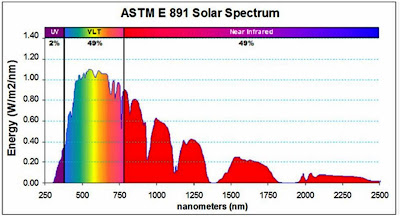
In technically, Infrared-red rejection (IRR) has a wavelength from 780nm-2500nm, which is meaning the entire IRR “band” is 1,720 nm wide. Different of window film manufacturers report performance for IRR in a variety of ways because there is not one, uniformly accepted test method for measuring IRR. Each manufacturer measures IRR differently, generally at a single point or narrow range at which the film may perform great and thus, best marketed in that range. For example, 3M products is measured under wavelength band 900-1000nm ONLY. It has 97% IRR in that band only but does not mean it has same results in overall wavelength.
user posted image

Some specific examples of these claims include:

Product A: A product manufacturer reports the Infrared-red rejection (IRR) at only one wavelength, 1000nm, where the energy from the sun has already significantly tapered off.
Product B: A manufacturer of a product chose to report the IRR at 1025 nm, which carries about 10% less solar energy than reporting it at 1000 nm.
Product C: The manufacturer chose a point to the far right of the spectrum, out in the near infrared at approximately 1450 nm, where there is almost no solar energy left.
Product D and E: Manufacturers not reporting a specific wave length or range of wavelengths over which they make their IRR claims.
Product F: The manufacturer of this product only reports their IRR number between 900nm and 1,000nm, for a total bandwidth of 100 nm. Noting that the entire IRR band is 1,720 nm wide, this figure represents about 6% of the entire width of the IRR. Therefore, the IRR reported by this company ignores 94% of the infrared wavelengths.

Lastly, Raytech emphasize consumers to test window film by BTU solar power meter instead of IRR meter because BTU meter can show how much of the total solar heat can be rejected by a window film smile.gif

You are welcome to visit our branch to see product demo personally. We can test products by BTU solar meter and do comparison for few brands with meter for u to understand smile.gif
*
Excellent explanation.
jamespaul
post Dec 13 2017, 03:01 PM

Getting Started
**
Junior Member
211 posts

Joined: Oct 2014
QUOTE(I'm V-Kool @ Dec 13 2017, 02:29 PM)
V-Kool Elite = V-Kool 70 = TSER 55%

http://www.v-kool.com/automotive-window-films/V-KOOL70
*
Not Smart TAG friendly i suppose
jamespaul
post Dec 14 2017, 03:32 PM

Getting Started
**
Junior Member
211 posts

Joined: Oct 2014
QUOTE(I'm V-Kool @ Dec 13 2017, 06:25 PM)
It's Smart Tag friendly expect those access card/auto gate with poor infra red reception
*
Question @VKOOL, how do you achieve 55% TSER with 70% VLT and yet be SMART TAG friendly?

@lordglisty, you mentioned that Raytech has higher IRR range than 3M, means it is not SMART TAG friendly right?
jamespaul
post Dec 15 2017, 10:46 AM

Getting Started
**
Junior Member
211 posts

Joined: Oct 2014
QUOTE(Lord Gitsy @ Dec 14 2017, 11:50 PM)
Hi, 3M Crystalline's material is not same with Raytech Ultra 70 and also other brands products and developed from different manufacturer's technology so detection of Smartag cannot be same. I believe it is a great benefit for customer if we can sell a high performance product with lesser Smartag problem right ?
*
I 100% agree on the material and technology being different.

However, as you mentioned heat rejection is based on three things, VLT+IRR+UV= TSER

If VLT is constant and UV is already at 99% (so another constant), the only differing one would be the IRR.

Your explanation that Raytech can have higher TSER than 3m or LLumar or Suntek, is that Raytech can block more IRR.

Eg: IRR for 3M is 97% but it is only a small bandwidth, 900-1000nm (i think), and you said that Raytech's TSER is higher as its IRR is higher across a wider range of Infrared (750nm to 2500nm).

Hence, i praised your explanation on Raytech's ability to block more heat (higher TSER) than other brands.

Now, after some thinking, if Raytech blocks more IR spectrum and SMART TAG uses IR spectrum, wouldn't that make Raytech tint unusable with SMART TAG?

While I understand that technology can be different but unless heat nature from the Sun is changed, a good TSER tint will indirectly stop SMART TAG from working.

Do correct me if i am wrong

Thanks
jamespaul
post Dec 16 2017, 11:52 AM

Getting Started
**
Junior Member
211 posts

Joined: Oct 2014
QUOTE(Wilson1122 @ Dec 15 2017, 12:09 PM)
Smartag use Infra red, but there is a specific bandwidth of IR. As long as the the tint film do not filtered out 100% of IR emited by Smartag, i think smartag will be detected at toll.
correct me if im wrong.
*
Agreed that it uses a specific bandwidth of IR. And agreed on the fact that as long as not 100% of IR being filtered out by Smartag it would still work.

Raytech claims that they filter out more IR than other brands, if other brands already struggle to work with Smartag, doesnt that make Raytech's claim an oxymoron?

According to Raytech, they can achieve better TSER than most brands in Malaysia for a specific VLT
jamespaul
post Dec 21 2017, 09:08 AM

Getting Started
**
Junior Member
211 posts

Joined: Oct 2014
QUOTE(Eyuna3 @ Dec 20 2017, 07:59 PM)
Bros, may i ask a question.
My car just tinted with brand 3M from Honda Authorized Dealer and i found the VLT are quite high... Am i able to add another tint to reduce VLT? or i need to re-do it all again
*
When you say VLT is high meaning? Honda, in theory, should tint, according to JPJ standards (that said, not all outlets follow this specification)

Assuming that Honda tint according to JPJ, you are left with sunshade as an alternative.

It is not recommended to tint over tints, as two tints expand and shrinks differently, and one may affect the other.

2 Pages  1 2 >Top
 

Change to:
| Lo-Fi Version
0.0621sec    0.77    7 queries    GZIP Disabled
Time is now: 19th December 2025 - 08:36 PM
