Welcome Guest ( Log In | Register )

29 Pages « < 11 12 13 14 15 > » Bottom

Outline · [ Standard ] · Linear+

 Ask a Mathematical Physicist

views
     
TSCritical_Fallacy
post Jan 20 2014, 02:14 PM

∫nnộvisεr
Group Icon
VIP
3,713 posts

Joined: Nov 2011
From: Torino
QUOTE(maximR @ Jan 14 2014, 09:56 PM)
For example in EE , Maxwell's equations are simplified to something else to solve circuit problems. Correct me if I'm wrong because these are what I've gathered from websites and videos.
Technically, not simplification.

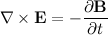
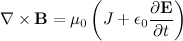
Maxwell's equations are a set of four fundamental laws that describe the electric and magnetic fields arising from varying distributions of electric charges and currents, and how those fields change in time. They are:

1. Gauss’s law (aka Gauss’s flux theorem)
user posted image

2. Gauss’s law for magnetism
user posted image

3. Faraday’s law of induction
user posted image

4. Ampère’s circuital law with Maxwell’s correction
user posted image

And together with the Lorentz force law,

user posted image

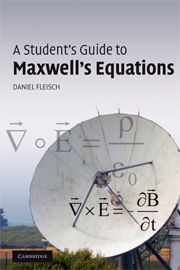
Maxwell's equations form the foundation of classical electrodynamics, classical optics, and electric circuits. So, they do solve not only circuit problems, but also relativistic quantum electrodynamics problems. You'll find some interesting applications of Maxwell's equations in RADAR Cross-Section (RCS) modeling of target. Somewhere in the near future, you will love this book. blush.gif

user posted image

This post has been edited by Critical_Fallacy: Jan 20 2014, 05:02 PM
TSCritical_Fallacy
post Jan 20 2014, 08:20 PM

∫nnộvisεr
Group Icon
VIP
3,713 posts

Joined: Nov 2011
From: Torino
QUOTE(delsoo @ Jan 20 2014, 07:55 PM)
thanks, everything clear now! rclxm9.gif
I don't think you get the full picture of differentiation. We DO NOT technically apply the Power Rule to an Exponent Function. This is not about math or calculus. This is about Pattern Recognition, which you must train yourself to recognize the type of a math function. The Differentiation formulas are actually shortcuts and come in handy if you can recognize the function. Otherwise, I'm afraid you have to do the hard way: sweat.gif

user posted image
TSCritical_Fallacy
post Jan 21 2014, 03:25 PM

∫nnộvisεr
Group Icon
VIP
3,713 posts

Joined: Nov 2011
From: Torino
QUOTE(delsoo @ Jan 20 2014, 11:09 PM)
Lol.... It's quite hard to understand everything of the certain chapter within a short period... I am not a fast learner. Between camera you look at this question?? I dunno to differentiate series or parallel this question
This circuit is easy but tricky. icon_idea.gif

user posted image
TSCritical_Fallacy
post Jan 21 2014, 03:26 PM

∫nnộvisεr
Group Icon
VIP
3,713 posts

Joined: Nov 2011
From: Torino
QUOTE(quovadis123 @ Jan 20 2014, 11:41 PM)
Do you come across A.I before? You have strong profile in Robotics and you live through World War 2 before.
I want to ask about some decision making process so I can utilise it in development.
Such as Markov, RL, Q-learning.
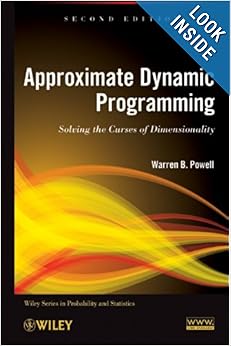
Indirectly. Robotics is a very vast field, and open to innovations. My knowledge is limited to robot motion planning using search algorithms such as Dijkstra's algorithm, A* (pronounced "A-star"), D*, Fortune's algorithm for generating a Voronoi diagram, and Rapidly-exploring Random Tree (RRT). If you are interested in Reinforcement Learning, perhaps you'd like to read up on Approximate Dynamic Programming. I'll recommend this book, which you can find a number of interesting algorithms such as Q-Learning, TD(λ), Back-Propagation through time (BPTT).

user posted image

If you are interested in Evolving Intelligent Search Engine Optimization (EISEO), Intelligent Control (IC) is a hybrid approach to Decision Support System (DSS) based on Soft Computing and Computational Intelligence methodologies. In recent years, the IC approach has been growing rapidly in visibility and importance. The guiding principle of intelligent control is that, in general, superior performance is achieved when Fuzzy Logic, Neural Networks (NN), Bayesian Networks (BN), and Genetic Algorithms (GA) are used in combination rather than in stand-alone mode. The four paradigms have their own advantages and disadvantages.

The advantage of Fuzzy Multi-Criteria Decision Making is that it works using approximate information and it represents knowledge in a linguistic form, which resembles human-like reasoning. The NN has the advantage of learning from experience. BN is a well-developed methodology for mapping real world problems into statistical formulations, and if the causal model is accurate and the evidence accurately represented, Bayesian systems give scientifically defensible results. GA optimizes or learns through adaptation of a system’s structure or parameters by evolving a random population while exploring the search space in several directions. The fusion of the four paradigms creates an intelligent system with a certain degree of autonomy and enhanced adaptive performance.
TSCritical_Fallacy
post Jan 21 2014, 05:34 PM

∫nnộvisεr
Group Icon
VIP
3,713 posts

Joined: Nov 2011
From: Torino
QUOTE(Akatsuki0895 @ Jan 20 2014, 09:56 PM)
question:
The Earth takes one year to orbit the Sun at a distance of 1.5 X 10^11 m. Calculate its speed. Explain why this is its average speed and not its velocity.
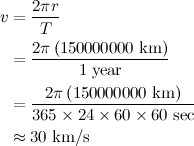
The speed in question is in fact the Mean Orbital Speed, which is equal to the distance traveled over the time taken. The question tells us the time (more accurately, Orbital Period, T) it takes for the Earth to go once around the Sun is 1 year. So in order to find the Mean Orbital Speed, we just have to figure out the distance traveled by the Earth when it goes once around the Sun. To do that, we will ASSUME that the orbit of the Earth is circular, so that we can determine the circumference.

user posted image

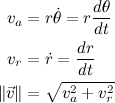
To explain why this is Mean Orbital Speed and not its "precise" velocity, we first need to understand this is a rotational motion, which means the motion has radial (user posted image) and azimuthal (user posted image) components of orbital velocity (user posted image).

user posted image

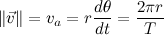
Because we assume the orbit of the Earth is perfectly circular, the radius (distance between Earth and Sun) is constant. This implies the radial velocity user posted image. Therefore, if this is a circular orbit, then the speed of the Earth around the Sun is
user posted image

However, Kepler’s first law tells us that the planets follow elliptical paths around the sun. This is the case for Earth's orbit and the radial velocity is non-zero, which in turn implies that the orbital velocity is NOT the Mean Orbital Speed (|v| ≠ 2πr / T). But not all ellipses come in the same shape. The shapes are described by their 'eccentricity' (which tells us how flatten they are). The eccentricity (e) is a number that varies between 0 and 1, with 0 being a circle, 0 < e < 1 being an ellipse, 1 being a parabola, and e > 1 being a hyperbola. It turns out that the orbit of the Earth right now as an eccentricity of 0.016. This means it is almost a circle, making our approximation on the orbital speed 30 km/s valid.

user posted image

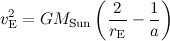
In the two-body problem, the more precise orbital velocity of Earth can be obtained using the Vis-viva equation (beyond A-level):

user posted image

This post has been edited by Critical_Fallacy: Jan 21 2014, 05:35 PM
TSCritical_Fallacy
post Jan 21 2014, 05:50 PM

∫nnộvisεr
Group Icon
VIP
3,713 posts

Joined: Nov 2011
From: Torino
QUOTE(quovadis123 @ Jan 21 2014, 04:42 PM)
Currently reading the book called "Artificial Intelligence - A modern Approach 3rd edition."
user posted image
This textbook is fairly big and thick in my library shelf. sweat.gif

If you want a non-rigorous mathematical treatment of Markovian Decision Process, try reading Operations Research books because the prerequisites are basic knowledge of Markov chains, Linear programming, and Probabilistic dynamic programming. icon_idea.gif

user posted image
TSCritical_Fallacy
post Jan 21 2014, 11:06 PM

∫nnộvisεr
Group Icon
VIP
3,713 posts

Joined: Nov 2011
From: Torino
QUOTE(Akatsuki0895 @ Jan 21 2014, 09:27 PM)
Thanks alot but i dun quite understand the 2nd part after the calculation. sweat.gif
QUOTE(acgerlok7 @ Jan 21 2014, 09:39 PM)
Dude, in short can i say its speed not velocity, because there is zero displacement? biggrin.gif
This is not a play on words, where Speed is Scalar and Velocity is Vector. In fact, the question asks to determine how fast The Earth orbits around the barycenter of a two-body system, usually around a more massive body, The Sun, in this case. In Astrodynamics terminology, this is Orbital Velocity, user posted image (see the blue-circled velocity), which the time derivative of the Earth's Position Vector, r.

This Orbital Velocity vector can be resolved into component user posted image (the green-circled velocity) along the outward radial from The Sun and azimuthal component user posted image (the red-circled velocity) perpendicular to it. At this moment, it is important to point out that user posted image. Otherwise, you're likely to confuse between the Orbital Velocity and the formula for Radial Velocity.
user posted image

In Part 1, you calculate the red-circled velocity, which happens to be the Mean Orbital Speed if you assume the Orbit is perfectly circular. Because the radius r is constant, the Radial Velocity (green-circled) is zero, as explained in Post #767.

In Part 2, you should explain that in fact it is necessary to calculate the blue-circled velocity, not the red one, by arguing that Kepler’s 1st Law states that all planetary bodies (in our Solar System) follow elliptical paths around the sun.

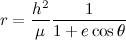
Since the Earth's orbit is elliptical, the Orbital Velocity (blue-circled) can be determined using Pythagorean theorem as shown in Post #767, because the Radial Velocity (green-circled) is non-zero. This is due to the fact that the Sun's radial coordinate of Earth can be obtained as an angle-varying function of θ (aka True Anomaly in Astrodynamics terminology):

user posted image

where h is the specific angular momentum and μ is the Sun's gravitational parameter in this case.
TSCritical_Fallacy
post Jan 23 2014, 03:23 PM

∫nnộvisεr
Group Icon
VIP
3,713 posts

Joined: Nov 2011
From: Torino
QUOTE(Akatsuki0895 @ Jan 22 2014, 09:03 PM)
I cant understand everything completely ...are u trying to say that the actual Orbital velocity is the blue-circled velocity instead of red-circled velocity because Kepler’s 1st Law states that all planetary bodies (in our Solar System) follow elliptical paths around the sun?
Not expecting you to understand everything about Astrodynamics, but the whole is greater than the sum of its parts. The failure of some Teachers to explain a knowledge correctly. The failure of some Student to learn a knowledge properly.

At your level, you should a developed analytical thinking skill. For example, what does velocity really mean for a rotating body? Are you very sure that the velocity of a rotating body is the red-circled one? If you look at the diagram carefully, you should notice that the blue-circled velocity is a tangential velocity.

Have you learned about Kepler's Laws of Planetary Motion in your Physics class? sweat.gif

QUOTE(Akatsuki0895 @ Jan 22 2014, 09:34 PM)
I got another question, can u explain y is there acceleration when there are change of distance but difference in velocity is still constant?
Please show the equation of the relationship between acceleration, change of distance, and constant velocity. icon_rolleyes.gif
TSCritical_Fallacy
post Jan 23 2014, 03:27 PM

∫nnộvisεr
Group Icon
VIP
3,713 posts

Joined: Nov 2011
From: Torino
QUOTE(acgerlok7 @ Jan 21 2014, 09:49 PM)
Solve the ODE of (2y+3x)dx + (y-x)dy = 0.
As mentioned by v1n0d, first you should perform the Exactness Test on the given First-order ODE.

user posted image

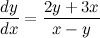
If it fails test, then the ODE is not exact and it cannot be solved using the normal procedure for exact 1st-order ODE. If you look at the ODE carefully, the M and N are simple enough to be expressed in an alternative ODE form:

user posted image

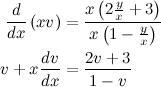
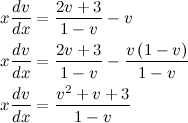
This new form of ODE is not separable, but it can be transformed into a separable one by changing the variable. You can easily recognize that this ODE is homogeneous because all terms in the numerator and the denominator are of first degree. Because of this, the function of a homogeneous equation can be expressed as f(v) where v = y/x or y = xv.

user posted image

Simplifying it:

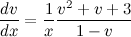
user posted image

Rearranging gives a separable ODE:

user posted image

Its solution can be obtained by integration:

user posted image

P.S. Pattern recognition is a very important skill in determining the method of attacking a particular type of ODE. icon_idea.gif
TSCritical_Fallacy
post Jan 24 2014, 02:42 PM

∫nnộvisεr
Group Icon
VIP
3,713 posts

Joined: Nov 2011
From: Torino
QUOTE(acgerlok7 @ Jan 21 2014, 09:49 PM)
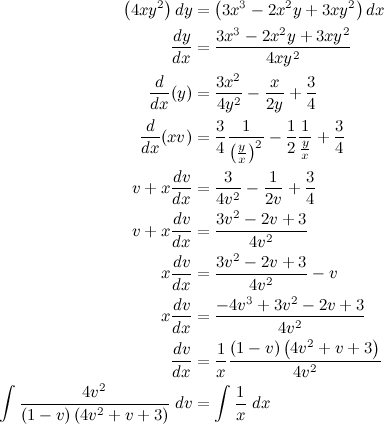
SOLVE (3x^3 - 2x^2y+3xy^2) dx= 4xy^2 dy
user posted image
TSCritical_Fallacy
post Jan 24 2014, 02:54 PM

∫nnộvisεr
Group Icon
VIP
3,713 posts

Joined: Nov 2011
From: Torino
QUOTE(Akatsuki0895 @ Jan 23 2014, 09:53 PM)
I'm just starting my A-levels  blush.gif
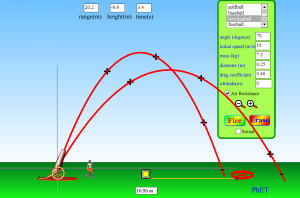
Has your Physics Teacher covered Projectile Motion? maximR, RED-HAIR-SHANKS, & ystiang are going to love this interactive simulation. happy.gif

Click to run the simulation!
user posted image

This post has been edited by Critical_Fallacy: Jan 24 2014, 03:02 PM
TSCritical_Fallacy
post Jan 24 2014, 07:41 PM

∫nnộvisεr
Group Icon
VIP
3,713 posts

Joined: Nov 2011
From: Torino
QUOTE(acgerlok7 @ Jan 22 2014, 01:29 PM)
but num 12 do you have nay clue how to integrate the V part, considering i use y=VX (homogenous equations method) the x part no prob at all... but im completely gone case for the V part.
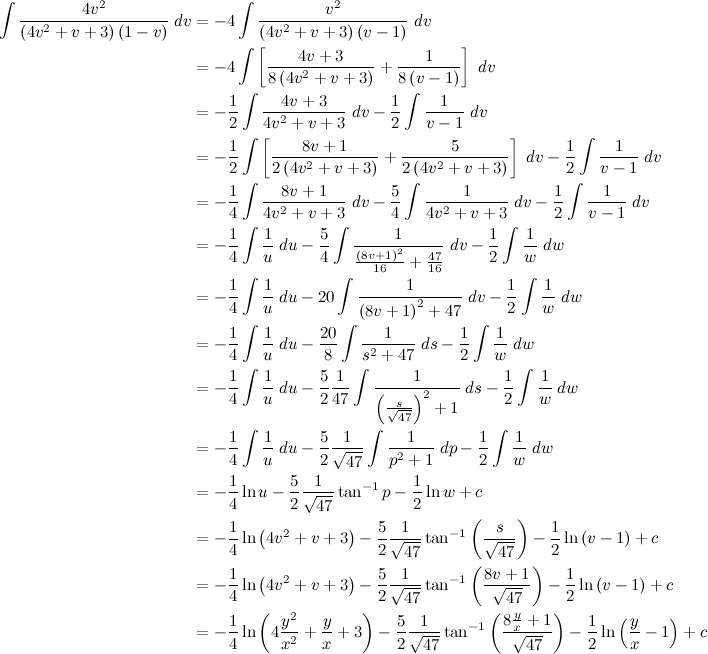
Phew! sweat.gif Master your Partial Fraction, Completing the Square, Algebraic Manipulation skills, and Integration by Substitution method...

user posted image

This post has been edited by Critical_Fallacy: Jan 24 2014, 07:43 PM
TSCritical_Fallacy
post Jan 24 2014, 07:55 PM

∫nnộvisεr
Group Icon
VIP
3,713 posts

Joined: Nov 2011
From: Torino
QUOTE(ystiang @ Jan 24 2014, 07:49 PM)
Will that human become disabled e or even die with that shooting force? XDD
Nope! Human Cannonball needs Physics simulation too (including Air Drag as well). sweat.gif

user posted image
TSCritical_Fallacy
post Jan 25 2014, 02:02 AM

∫nnộvisεr
Group Icon
VIP
3,713 posts

Joined: Nov 2011
From: Torino
QUOTE(Akatsuki0895 @ Jan 24 2014, 07:46 PM)
do u have more of this regarding other chapters? thumbup.gif
This Planetary Orbit Simulator shows you that the Earth's Orbital Velocity (an angle-varying vector) is NOT the same as the Mean Orbital Speed (a constant speed). Click the 4th Tab to access to the Newtonian features. Check the "Vector" box. The Blue line is a Periodic function with an extremely low Peak-to-Peak amplitude in astronomical sense. I hope this is the simple enough. sweat.gif

user posted image
TSCritical_Fallacy
post Jan 25 2014, 02:14 AM

∫nnộvisεr
Group Icon
VIP
3,713 posts

Joined: Nov 2011
From: Torino
Hi Akatsuki0895, maximR, RED-HAIR-SHANKS,

This is the most Graphically Interactive Orbit Simulator developed by Laboratory for Atmospheric and Space Physics (LASP), University of Colorado. I love the Comet! wub.gif

user posted image

For other Interactive Lessons, click here.

This post has been edited by Critical_Fallacy: Jan 25 2014, 02:17 AM
TSCritical_Fallacy
post Jan 25 2014, 02:20 AM

∫nnộvisεr
Group Icon
VIP
3,713 posts

Joined: Nov 2011
From: Torino
QUOTE(ninty @ Jan 24 2014, 07:46 PM)
It has been a VERY long time since I've done these things, so someone correct me if I'm wrong. And my LaTeX is very rusty.
Thanks for supporting LaTeX. You've been very helpful to delsoo and others. notworthy.gif
TSCritical_Fallacy
post Jan 25 2014, 02:25 AM

∫nnộvisεr
Group Icon
VIP
3,713 posts

Joined: Nov 2011
From: Torino
QUOTE(delsoo @ Jan 24 2014, 08:06 PM)
hey thanks for the working! can i use 0.5 (q*2/c) ?? if i do so my ans will be different right?
Yes, you may and you'll arrive at the same answer. But, can you tell us why? nod.gif
TSCritical_Fallacy
post Jan 25 2014, 02:37 AM

∫nnộvisεr
Group Icon
VIP
3,713 posts

Joined: Nov 2011
From: Torino
Hi Akatsuki0895, maximR, RED-HAIR-SHANKS, v1n0d, ystiang

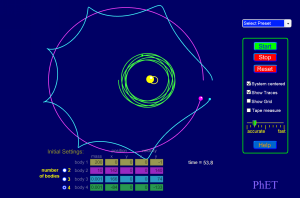
This is my favorite simulator because it is by far the most accurate Multi-Body Orbit Simulator according to the Orbital Mechanics. The simulator shows how a planet and its star orbit a common center (the barycenter), although the Sun's wobble is barely perceptible. The most interesting "preset" would be the Sun, Planet, Comet. You must run it to see the "unexpected" for yourself. icon_rolleyes.gif

user posted image
TSCritical_Fallacy
post Jan 26 2014, 09:23 AM

∫nnộvisεr
Group Icon
VIP
3,713 posts

Joined: Nov 2011
From: Torino
QUOTE(delsoo @ Jan 26 2014, 12:08 AM)
Can you eexplain why dQ/Q0-Q equals to negative ln(Q0-Q) why not POSITIVE??    ps I haven't learn integration but I did know that d/dx of ln x= 1/x...
Hi ∂soo,

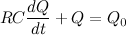
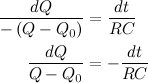
This first-order ordinary differential equation (ODE) arises in the (resistor-capacitor) RC circuit during capacitor is charging.

user posted image

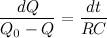
Rearranging the equation:

user posted image

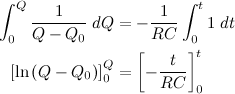
There are 2 general methods to solve this ODE: (1) Heuristic, and (2) Algorithmic. By Heuristic method, you'll intuitively integrate by u-substitution, as hinted bt ystiang and quovadis123. Since I don't want to disturb your syllabus, you can use the algorithmic method by following a finite list of well-defined instructions for calculating a function, just like a computer.

A computer will convert the coefficient of the variable Q to a positive value, is this case, by factoring the denominator so that:

user posted image

Now, integrating both side by using using the Integration Table (a computer will use its database):

user posted image

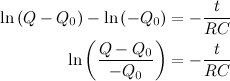
Next, substitute integration limits,

user posted image

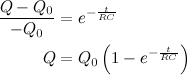
Finally, take the inverse log of both sides and rearrange it. Thus,

user posted image

The rate at which a capacitor charges depends on the product of R and C. This product is known as the time constant of the circuit and is given the symbol τ (the Greek letter tau).

user posted image

For charging, the time constant, τ (tau) is defined as the time required to charge the capacitor to 63.21% of Q0. For discharging, the time constant is defined as the time required to discharge the capacitor to 36.79% of Q0. For all practical purposes, transient duration can be considered to last for only five time constants (5τ). This valuable info can be used to design a RC circuit.

user posted image

For example, to design a RC circuit so that it charges in 1 sec, we set:

user posted image

Using this value of 0.2, we can comfortably select R = 20 kΩ and C = 10 μF. icon_rolleyes.gif
TSCritical_Fallacy
post Jan 26 2014, 06:43 PM

∫nnộvisεr
Group Icon
VIP
3,713 posts

Joined: Nov 2011
From: Torino
QUOTE(delsoo @ Jan 26 2014, 10:58 AM)
I still don't understand why is it necessary to convert Q to positive value as you stated in the computer algorithm method....
Tell me, how do evaluate this? icon_idea.gif

user posted image

29 Pages « < 11 12 13 14 15 > » Top
 

Change to:
| Lo-Fi Version
0.0599sec    0.42    7 queries    GZIP Disabled
Time is now: 24th December 2025 - 04:15 AM