Welcome Guest ( Log In | Register )

29 Pages « < 9 10 11 12 13 > » Bottom

Outline · [ Standard ] · Linear+

 Ask a Mathematical Physicist

views
     
TSCritical_Fallacy
post Jan 3 2014, 10:19 PM

∫nnộvisεr
Group Icon
VIP
3,713 posts

Joined: Nov 2011
From: Torino
QUOTE(maximR @ Jan 3 2014, 09:06 PM)
And thanks for your explanation on the change in displacement in kinematics equations . All textbooks , be it SPM  or STPM do not mention this important fact , because the initial displacement is always assumed to be zero . The important thing to realise is the freedom in choosing increasing values of x and the coordinate system , with this , students will never be confused and make mistakes about the sign of g in different situations .
Students starting out in the study of College Physics need to embrace the concept of mathematical modeling readily. Throughout most of your Physics course, mathematical modeling means no more than using algebra, geometry, trigonometry and calculus to represent physical phenomena. It is important to keep in mind that in physics, as distinct from pure mathematics, each graph and each mathematical expression tells a story about the real world we live in. The purpose I introduced early transcendentals in my tutorials is to lay the foundations to you for a smooth transition from Calculus to Ordinary First-Order Differential Equations. icon_idea.gif

QUOTE(maximR @ Jan 3 2014, 09:06 PM)
I have another question : In order to increase the angle of landing ( projectile motion ) when a bullet is fired horizontally , do we increase the height from which the bullet is fired ( or vice-versa ) and increase the initial velocity of the bullet ( or vice-versa ) ? I've tried proving this using the equations , and I came to the conclusion that height should be increased and velocity should also be increased . I need clarification . Thanks .
Ignoring air resistance, if you fire a bullet 500 m/s horizontally from the top of a cliff that is 50 m above a long lake, and simultaneously drop a bullet off the cliff from the same height, they will both reach the ground at the same time. Of course, the dropped bullet (initial velocity is zero) will land on the ground vertically at 90° perpendicular to a flat ground. sweat.gif
TSCritical_Fallacy
post Jan 4 2014, 12:54 AM

∫nnộvisεr
Group Icon
VIP
3,713 posts

Joined: Nov 2011
From: Torino
QUOTE(maximR @ Jan 3 2014, 11:10 PM)
Shouldn't the projection of i' on the horizontal axis be i' cos phi ? How to show that :
i' = i cos phi + j sin phi ?
Rotating just the i^ vector (x-axis) i' = i cos φ is incomplete. Technically, you have to rotate every vector in the vector space. Anyway, a picture is worth a thousand words! laugh.gif

user posted image

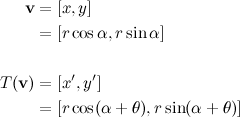
Given that T is a linear transformation. To show that it rotates every vector in 2-dimensional vector space R² counterclockwise through the angle θ, let v = (x, y) be a vector in R². Using polar coordinates (which you probably have learned in Critical Tutorial #3: Complex Numbers polar form), you can write v and T(v ) as

user posted image

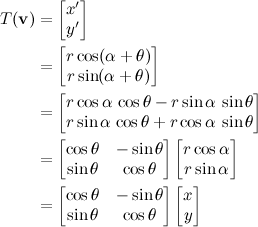
respectively, where r = √(x² + y²) is the length (a.k.a. norm) of vector v and α (alpha) is the angle from the positive x-axis counterclockwise to the vector v. Now, applying the linear transformation T to produces

user posted image

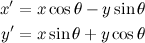
So the projected coordinates (x',y') of the point (x,y) after rotation are:

user posted image

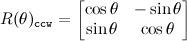
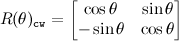
From the linear transformation above, R(θ) is known as the counterclockwise Rotation matrix:

user posted image

If the direction of vector rotation is clockwise, then the Rotation matrix becomes:

user posted image

This post has been edited by Critical_Fallacy: Jan 4 2014, 01:10 AM
TSCritical_Fallacy
post Jan 4 2014, 02:01 PM

∫nnộvisεr
Group Icon
VIP
3,713 posts

Joined: Nov 2011
From: Torino
Hi maximR,

You have seen how linear transformation works. Here is one real application of linear transformation. A robot can drive a certain distance or turn about a certain angle in its local coordinate system. For many applications such as Unmanned ground vehicle (UGV), Unmanned aerial vehicle (UAV), and Unmanned underwater vehicles (UUV), however, it is important to first establish a map (in an unknown environment) or to plan a path (in a known environment). These path points are usually specified in global or world coordinates.

Translating local robot coordinates to global world coordinates is a 2D transformation that requires a translation and a rotation, in order to match the two coordinate systems as shown in the Figure below.

user posted image

Assume the Robot has the global position [Rx, Ry] and has global orientation ψ. It senses an Obstacle at local coordinates [Ox', Oy']. Then the global coordinates [Ox, Oy] can be calculated as follows:

user posted image

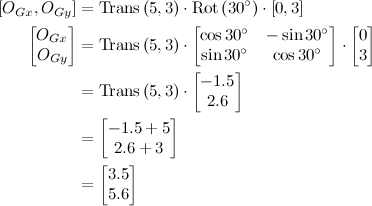
For example, the marked position at the above Figure has local coordinates [0, 3]. The robot’s position is [5, 3] and its counterclockwise orientation is 30°. The global object position is therefore:

user posted image

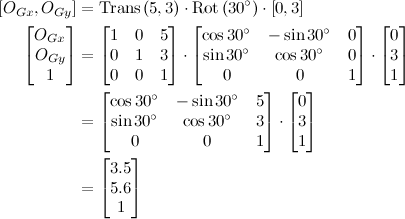
For computation purpose (perhaps kingkingyyk is interested sweat.gif), the coordinate transformations can be greatly simplified by using homogeneous coordinates, where an arbitrary 2-D transformation sequences can be summarized in a single 3×3 matrix.

user posted image
TSCritical_Fallacy
post Jan 4 2014, 03:24 PM

∫nnộvisεr
Group Icon
VIP
3,713 posts

Joined: Nov 2011
From: Torino
QUOTE(maximR @ Jan 4 2014, 02:19 PM)
Thank you for your detailed explanation , as always . I thought it would only involve simple trigonometry since the professor said " I will not derive it here , assuming that you're comfortable with this " . Now this clears things up in a way , I'd have to seriously start studying Matrices now since it's used extensively in Physics .
I would like to show you a quote from Galileo Galilei’s The Assayer (1623): “Philosophy is written in that great book which ever lies before our eyes — I mean the universe — but we cannot understand it if we do not first learn the language and grasp the symbols, in which it is written. This book is written in the mathematical language, and the symbols are triangles, circles and other geometrical figures, without whose help it is impossible to comprehend a single word of it; without which one wanders in vain through a dark labyrinth.

Suggested route for learning Mathematical Physics:

(1) Matrix Algebra
(2) Vectors & Tensors
(3) Ordinary Differential Equations
(4) Partial Differential Equations

Effort spent in mastering these mathematical methods will be well rewarded! thumbup.gif
TSCritical_Fallacy
post Jan 4 2014, 08:04 PM

∫nnộvisεr
Group Icon
VIP
3,713 posts

Joined: Nov 2011
From: Torino
QUOTE(delsoo @ Jan 4 2014, 07:50 PM)
Can someone explain why the v is zero?
To learn, you must understand the reason behind the answer to "why" in the first place.

Yesterday, have you learned the reason behind the answer (see Post #582) to your question in Post #563?

I ask because the way to answer your latest question is exact the same as in Post #582.

Can you sketch the Electric field around 'O'?

Remember the Superposition principle of potentials? sweat.gif

user posted image

This post has been edited by Critical_Fallacy: Jan 4 2014, 08:06 PM
TSCritical_Fallacy
post Jan 4 2014, 09:50 PM

∫nnộvisεr
Group Icon
VIP
3,713 posts

Joined: Nov 2011
From: Torino
QUOTE(kingkingyyk @ Jan 3 2014, 09:16 PM)
It was planned in the syllabus but end up lecturer didn't teach.  mega_shok.gif
Just want to clarify with v1n0d. Isn't the application of four-color theorem shown on the cover of the book? unsure.gif

user posted image
TSCritical_Fallacy
post Jan 4 2014, 10:38 PM

∫nnộvisεr
Group Icon
VIP
3,713 posts

Joined: Nov 2011
From: Torino
QUOTE(delsoo @ Jan 4 2014, 10:12 PM)
i have another question here...  it's paer b btw the ans for a is 5.4x10*-4 m
I'm pretty sure your textbook shows this formula for electric potential:

user posted image

Find the Q of the Big droplet and radius r of the Big droplet. icon_idea.gif
TSCritical_Fallacy
post Jan 4 2014, 10:40 PM

∫nnộvisεr
Group Icon
VIP
3,713 posts

Joined: Nov 2011
From: Torino
QUOTE(kingkingyyk @ Jan 4 2014, 08:07 PM)
Vector and differential equation are important for Physics.  wink.gif
To show maximR some useful applications of Differential Equations for Mathematical Modeling in Physical Sciences.

user posted image
TSCritical_Fallacy
post Jan 4 2014, 11:18 PM

∫nnộvisεr
Group Icon
VIP
3,713 posts

Joined: Nov 2011
From: Torino
QUOTE(delsoo @ Jan 4 2014, 10:59 PM)
the charge of the big droplet should be the same as before and the radius will become twice of its initial value?  this is based on my understanding but the ans is not correct based on my understanding cry.gif
That probably means one thing, and indicate another thing.

The obvious thing is your understandings on the charge and the radius of the big droplet need to be corrected.

The second thing is to use mathematics to backup your reasons.

We cannot simply assume that the COMBINED charges of the big droplet reduces half to the individual charge of the small droplet.

Similarly, we also cannot simply assume that the radius of a larger VOLUME of spherical droplet is twice of the radius of the smaller VOLUME of spherical droplet.
TSCritical_Fallacy
post Jan 5 2014, 08:29 AM

∫nnộvisεr
Group Icon
VIP
3,713 posts

Joined: Nov 2011
From: Torino
QUOTE(v1n0d @ Jan 5 2014, 08:22 AM)
Yes, it is. Personally, my favorite part about graph theory is it's origin story, i.e. the Seven Bridges of Königsberg problem.
I love Euler's solution of the Königsberg bridge problem!

user posted image

This post has been edited by Critical_Fallacy: Jan 5 2014, 09:24 AM
TSCritical_Fallacy
post Jan 5 2014, 09:23 AM

∫nnộvisεr
Group Icon
VIP
3,713 posts

Joined: Nov 2011
From: Torino
QUOTE(ailing tan @ Jan 5 2014, 12:39 AM)
i am here again! can you explain question 18 part a ?
danny88888 is right! Part (a) asks you to find the equations of all asymptotes.

Do you remember how to plot a Reciprocal Function: f(x) = 1/x in SPM Add Math?

Do you remember how to plot a Hyperbolic function in 1st Term Pure Math Chapter 5: Analytic Geometry?

Basically, to find the vertical and horizontal asymptotes, you have to find the LIMITS. icon_idea.gif

user posted image

QUOTE(ailing tan @ Jan 5 2014, 12:39 AM)
once i found dy/dx (gradient) then what should i do next ?
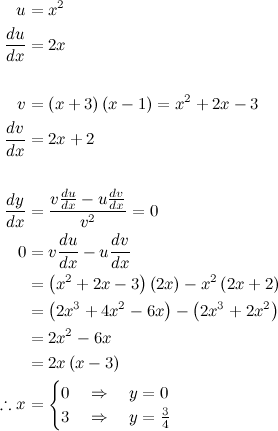
Next, you should find the turning points when the slope dy/dx = 0.

user posted image

QUOTE(ailing tan @ Jan 5 2014, 12:39 AM)
i cant understand the equations of all asymptotes.
Using Cover-up method, you can find the partial fractions of the function.

user posted image

Applying the superposition principle, you can sketch the graph! icon_idea.gif

+ user posted image

+ user posted image

+ user posted image

= user posted image

Now, can you verify the asymptotes in Part (a) from this graph? sweat.gif

This post has been edited by Critical_Fallacy: Jan 5 2014, 09:39 AM
TSCritical_Fallacy
post Jan 5 2014, 11:22 PM

∫nnộvisεr
Group Icon
VIP
3,713 posts

Joined: Nov 2011
From: Torino
QUOTE(ailing tan @ Jan 5 2014, 03:24 PM)
blush.gif
Have you found all the asymptotes? smile.gif
TSCritical_Fallacy
post Jan 5 2014, 11:23 PM

∫nnộvisεr
Group Icon
VIP
3,713 posts

Joined: Nov 2011
From: Torino
QUOTE(ailing tan @ Jan 5 2014, 06:44 PM)
how to factrorise x*4 +x-1 ? i calculate it using calc , the ans is -1.732 but how to do it  using long division? or remainder theorem?
If you want to factor user posted image, you can use CASIO fx-570 to aid you.

The built-in function "SOLVE" in the calculator uses Newton's method to find a real root, one at a time, if any.

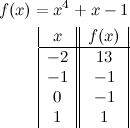
From the function, it is not difficult to test a few points.

user posted image

The results suggest that at least one real root lies between x: −2 & −1, and one real root lies between x: 0 & 1.

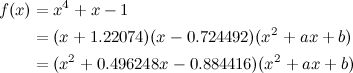
Picking the initial point x= −1, CASIO returns a real root x = −1.22074.

Similarly, picking the initial point x= 1, CASIO returns a real root x = 0.724492.

user posted image

Performing the long division gives an irreducible quadratic expression:

user posted image

Therefore, the factors are:

user posted image

user posted image
TSCritical_Fallacy
post Jan 6 2014, 12:30 AM

∫nnộvisεr
Group Icon
VIP
3,713 posts

Joined: Nov 2011
From: Torino
QUOTE(ailing tan @ Jan 6 2014, 12:15 AM)
according to newton's law, if the roots lie between 0 and 1 then the f(1) should be equal to -1 . am i right?
(1) Don't confuse Newton's Numerical Method (a.k.a. Newton-Raphson Method) with Newton's Law (F = ma).

(2) user posted image

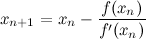
(3) By picking the starting point x = 1, Newton's Method computes the roots by iterations: user posted image.

(4) Newton's iteration terminates if user posted image, that is when x = 0.724492.
TSCritical_Fallacy
post Jan 6 2014, 12:38 AM

∫nnộvisεr
Group Icon
VIP
3,713 posts

Joined: Nov 2011
From: Torino
QUOTE(ailing tan @ Jan 6 2014, 12:15 AM)
Picking the initial point x= −1, CASIO returns a real root x = −1.22074.

Similarly, picking the initial point x= 1, CASIO returns a real root x = 0.724492
Follow the instructions below to compute the root(s) numerically: icon_idea.gif

user posted image
TSCritical_Fallacy
post Jan 6 2014, 10:05 PM

∫nnộvisεr
Group Icon
VIP
3,713 posts

Joined: Nov 2011
From: Torino
QUOTE(danny88888 @ Jan 5 2014, 11:00 AM)
Can someone explain to me what is envelope theorem?
Are you tackling economic optimization problems? sweat.gif

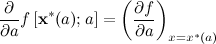
THEOREM ::
Let user posted image be a function in n variables user posted image that depends on a parameter a. For each value of a, let user posted image be a maximum or minimum point for user posted image. Then

user posted image
TSCritical_Fallacy
post Jan 7 2014, 01:04 AM

∫nnộvisεr
Group Icon
VIP
3,713 posts

Joined: Nov 2011
From: Torino
QUOTE(sabrina222 @ Jan 7 2014, 12:13 AM)
Hey .......this all question is freaking me out......majority of these Q and A is what program¿F6/A levels/ausmat
Thanks/?
They are mostly Pre-U Maths and Physics, though there are some underground scientists! icon_rolleyes.gif
TSCritical_Fallacy
post Jan 7 2014, 02:26 PM

∫nnộvisεr
Group Icon
VIP
3,713 posts

Joined: Nov 2011
From: Torino
QUOTE(sabrina222 @ Jan 7 2014, 10:34 AM)
Is there any ausmat syllabus discussed here?
You are welcomed to do discuss about AUSMAT Math and Physics here. wink.gif
TSCritical_Fallacy
post Jan 7 2014, 02:43 PM

∫nnộvisεr
Group Icon
VIP
3,713 posts

Joined: Nov 2011
From: Torino
QUOTE(danny88888 @ Jan 7 2014, 07:41 AM)
Yup, it's about Economics, I still don't really get it how to use the envelope theorem cry.gif

This term i will be taking statistics too, are you good with stats too?  cry.gif
I can handle Introductory Statistical Methods only. unsure.gif

- Basic Probability,
- Discrete Random Variables,
- Continuous Random Variables,
- Point Estimation of Parameters and Sampling Distributions,
- Simple Linear Regression and Correlation
- Statistical Quality Control

For Advanced Statistical Methods made easy, you can probably consult a good teacher like mumeichan! icon_idea.gif

- Statistical Intervals for a Single Sample
- Tests of Hypotheses
- Statistical Inference for Two Samples
- Multiple Linear Regression
- The Analysis of Variance (ANOVA)
- Design of Experiments with Several Factors
TSCritical_Fallacy
post Jan 7 2014, 04:05 PM

∫nnộvisεr
Group Icon
VIP
3,713 posts

Joined: Nov 2011
From: Torino
QUOTE(maximR @ Jan 7 2014, 03:05 PM)
I would dearly appreciate it if you could reveal your tertiary education background.
Isn't it more important that we invite mumeichan to start a brief class on Applied Statistical Methods with Excel: for SPM & Pre-U Students? sweat.gif

Like how to determine Sample Size, Mean, Standard Deviation, and Standard Error of the Mean using =COUNT, =AVERAGE, and =STDEV functions...

Advanced topic may include finding the Confidence Interval about the Mean using the TINV Function... icon_idea.gif

29 Pages « < 9 10 11 12 13 > » Top
 

Change to:
| Lo-Fi Version
0.0522sec    1.63    7 queries    GZIP Disabled
Time is now: 23rd December 2025 - 11:35 PM