Welcome Guest ( Log In | Register )

4 Pages < 1 2 3 4 >Bottom

Outline · [ Standard ] · Linear+

 IntelAtomSoCAndroid-IA(X86)phone/tab,INTEL inside, SamsungGTab3/FHD-AsusFonepadNote6,MeMO10

views
     
SyathibiyMegat
post Apr 5 2013, 02:34 AM

Linguistics
*******
Senior Member
2,634 posts

Joined: Dec 2011
QUOTE(andyjyneo @ Apr 5 2013, 01:45 AM)
Read here and here.
More links will be provided if you're not convinced.

Samsung has the backing from Intel on this Tizen.
Samsung may jumpship to Tizen if Google treats them unfairly.
It's just a matter of time only, with the Motorola X Phone is coming out soon.
*
But it was Motorola who made an agreement with Intel. Nothing abt Samsung
TSwkkm007
post Apr 6 2013, 01:19 PM

Look at all my stars!!
*******
Senior Member
3,123 posts

Joined: Sep 2008
From: OUG - Muhibbah LRT


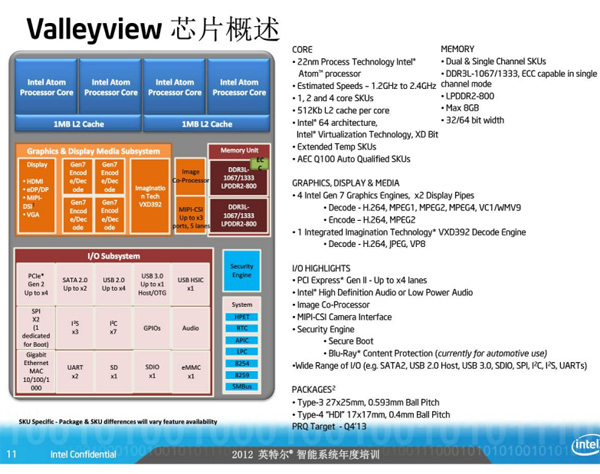
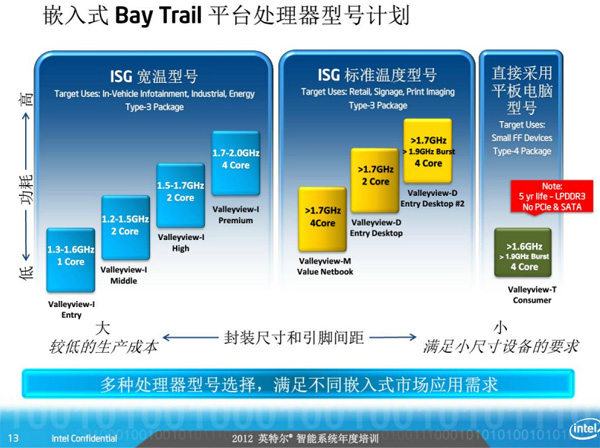
Anyone have better deeper info on the upcoming vallyview baytrail atom 22mm?
TSwkkm007
post Apr 6 2013, 01:25 PM

Look at all my stars!!
*******
Senior Member
3,123 posts

Joined: Sep 2008
From: OUG - Muhibbah LRT


QUOTE(soulseeker6187 @ Apr 4 2013, 09:27 PM)
Another thing this Atom clovertrail+ lacks off is LTE.
with Intel expensive chip price(just an assumption based on PC chips) compared to ARM.
and lacks of LTE, many manufacturer will not be using this for their flagship phones.
*
Got LTE bro check my 1st post. But LTE having so many frequency, we only can use the 2600mHZ spectrum.
If America 700mHZ then the story like Apple iPhone 5 ,iPad 4 & mini WiFi + cellular doh.gif can't use 4g @ Malaysia.
For cellular 234G Qualcomm are the taiko.

This post has been edited by wkkm007: Apr 6 2013, 01:27 PM
soulseeker6187
post Apr 6 2013, 01:56 PM

Look at all my stars!!
*******
Senior Member
2,774 posts

Joined: Jun 2009


QUOTE(wkkm007 @ Apr 6 2013, 01:25 PM)
Got LTE bro check my 1st post. But LTE having so many frequency, we only can use the 2600mHZ spectrum.
If America 700mHZ then the story like Apple iPhone 5 ,iPad 4 & mini WiFi + cellular doh.gif  can't use 4g @ Malaysia.
For cellular 234G Qualcomm are the taiko.
*
http://m.tomshardware.com/news/Lenovo-K900...hone,20718.html

The k900 dont have lte.

Maybe it can add on lte using seperate chip. Coz clovertrail+ dont have integrated lte.
eq8all
post Apr 6 2013, 03:17 PM

Casual
***
Junior Member
351 posts

Joined: Jan 2005
From: Ampang | Selangor | The Valley


QUOTE(wkkm007 @ Apr 6 2013, 01:19 PM)
Anyone have better deeper info on the upcoming vallyview baytrail atom 22mm?
*
Other than this fudzilla article, not much else so far. Down in the comments there however that cybergusa guy seems to know a bit more apparently.
TSwkkm007
post Apr 6 2013, 03:24 PM

Look at all my stars!!
*******
Senior Member
3,123 posts

Joined: Sep 2008
From: OUG - Muhibbah LRT


Intel Atom SoC/ Atom thread Valleyview ; Bay Trail, Netbook,Nettop,China Ipad,NowSmartphone!
http://forum.lowyat.net/topic/2575431/
QUOTE(wkkm007 @ Nov 4 2012, 03:44 PM)
http://hexus.net/tech/news/cpu/44385-intel...ail-valleyview/

user posted image

user posted image

http://forum.lowyat.net/index.php?showtopic=2515470&hl=
Intel Atom CPU on phone with hyper threading!, might beat dual core!
Motorola and ZTE using Atom on smartphone

OK this is old but no 1 care on Atom already sad.gif

this two poor thread
Intel Atom, Are you waiting for it?
http://forum.lowyat.net/topic/690284

Intel Atom/ION discussion thread, le's start talking about these baby
http://forum.lowyat.net/topic/1154355/
*
TSwkkm007
post Apr 6 2013, 03:26 PM

Look at all my stars!!
*******
Senior Member
3,123 posts

Joined: Sep 2008
From: OUG - Muhibbah LRT


QUOTE(eq8all @ Apr 6 2013, 01:17 PM)
Other than this fudzilla article, not much else so far. Down in the comments there however that cybergusa guy seems to know a bit more apparently.
*
8GB ram 64Bit rclxms.gif apple pun takut smile.gif
SyathibiyMegat
post May 8 2013, 12:32 AM

Linguistics
*******
Senior Member
2,634 posts

Joined: Dec 2011
Intel's Silvermont Architecture Revealed: Getting Serious About Mobile
QUOTE
user posted image
The most frustrating part about covering Intel’s journey into mobile over the past five years is just how long it’s taken to get here. The CPU cores used in Medfield, Clover Trail and Clover Trail+ are very similar to what Intel had with the first Atom in 2008. Obviously we’re dealing with higher levels of integration and tweaks for further power consumption, but the architecture and much of the core remains unchanged. Just consider what that means. A single Bonnell core, designed in 2004, released in 2008, is already faster than ARM’s Cortex A9. Intel had this architecture for five years now and from the market’s perspective, did absolutely nothing with it. You could argue that the part wasn’t really ready until Intel had its 32nm process, so perhaps we’ve only wasted 3 years (Intel debuted its 32nm process in 2010). It’s beyond frustrating to think about just how competitive Intel would have been had it aggressively pursued this market.

Today Intel is in a different position. After acquisitions, new hires and some significant internal organizational changes, Intel seems to finally have the foundation to iterate and innovate in mobile. Although Bonnell (the first Atom core) was the beginning of Intel’s journey into mobile, it’s Silvermont - Intel’s first new Atom microarchitecture since 2008 - that finally puts Intel on the right course.

Although Silvermont can find its way into everything from cars to servers, the architecture is primarily optimized for use in smartphones and then in tablets, in that order. This is a significant departure from the previous Bonnell core that was first designed to serve the now defunct Mobile Internet Devices category that Intel put so much faith in back in the early to mid 2000s. As Intel’s first Atom architecture designed for mobile, expectations are high for Silvermont. While we’ll have to wait until the end of the year to see Silvermont in tablets (and early next year for phones), the good news for Intel is that Silvermont seems competitive right out of the gate. The even better news is that Silvermont will only be with us for a year before it gets its first update: Airmont.
user posted image
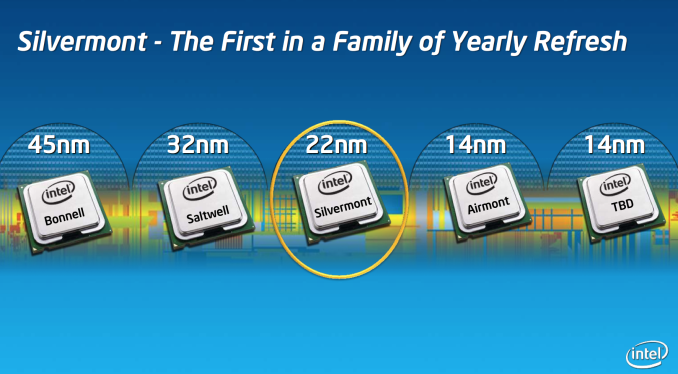
Intel made this announcement last year, but Silvermont is the beginning of Intel’s tick-tock cadence for Atom. Intel plans on revving Atom yearly for at least the next three years. Silvermont introduces a new architecture, while Airmont will take that architecture and bring it down to 14nm in 2014/2015. One year later, we’ll see another brand new architecture take the stage also on 14nm. This is a shift that Intel needed to implement years ago, but it’s still not too late.

Before we get into an architectural analysis of Silvermont, it’s important to get some codenames in order. Bonnell was the name of the original 45nm Atom core, it was later shrunk to 32nm and called Saltwell when it arrived in smartphones and tablets last year. Silvermont is the name of the CPU core alone, but when it shows up in tablets later this year it will do so as a part of the Baytrail SoC and a part of the Merrifield SoC next year in smartphones.
22nm

To really understand the Silvermont story, you need to first understand Intel’s 22nm SoC process. Two years ago Intel announced its 22nm tri-gate 3D transistors, which would eventually ship a year later in Intel’s Ivy Bridge processors. That process wasn’t suited for ultra mobile. It was optimized for the sort of high performance silicon that was deployed on it, but not the ultra compact, very affordable, low power silicon necessary in smartphones and tablets. A derivative of that process would be needed for mobile. Intel now makes two versions of all of its processes, one optimized for its high performance CPUs and one for low power SoCs. P1270 was the 22nm CPU process, and P1271 is the low power SoC version. Silvermont uses P1271. The high level characteristics are the same however. Intel’s 22nm process moves to tri-gate non-planar transistors that can significantly increase transistor performance and/or decrease power.
user posted image
This part is huge. The move to 22nm 3D transistors lets Intel drop threshold voltage by approximately 100mV at the same leakage level. Remember that power scales with the square of voltage, so a 100mV savings depending on what voltage you’re talking about can be very huge. Intel’s numbers put the power savings at anywhere from 25 - 35% at threshold voltage. The gains don’t stop there either. At 1V, Intel’s 22nm process gives it an 18% improvement in transistor performance or at the same performance Intel can run the transistors at 0.8V - a 20% power savings. The benefits are even more pronounced at lower voltages: 37% faster performance at 0.7V or less than half the active power at the same performance.
user posted image
The end result here is Intel can scale frequency and/or add more active logic without drawing any more power than it did at 32nm. This helps at the top end with performance, but the vast majority of the time mobile devices are operating at very lower performance and power levels. Where performance doesn’t matter as much, Intel’s 22nm process gives it an insane advantage.

If we look back at our first x86 vs. ARM performance data we get a good indication of where Intel’s 32nm process had issues and where we should see tangible improvements with the move to 22nm:
user posted image
Qualcomm’s 28nm Krait 200 was actually able to get down to lower power levels than Intel could at 32nm. Without having specific data I can’t say for certain, but it’s extremely likely that with Silvermont Intel will be able to drive down to far lower power levels than anything we’ve ever measured.

Understanding what Intel’s 22nm process gives it is really key to understanding Silvermont.

Intel announces next-generation Silvermont mobile CPU microarchitecture
QUOTE
Intel has announced the next generation of its CPU architecture designed primarily for mobile devices such as smartphones and tablets, called Silvermont. Silvermont will be replacing the Saltwell CPUs that have been used in the recent Medfield, Clovertrail and Clovertrail+ SoC.

With Silvermont, Intel will be starting the same tick-tock cadence they use for their desktop processors. Silvermont is based on a 22nm architecture and will be succeeded by Airmont next year, which will be based on 14nm. Devices running Silvermont CPUs are expected this year, with tablets running the new Atom processors by the end of 2013.

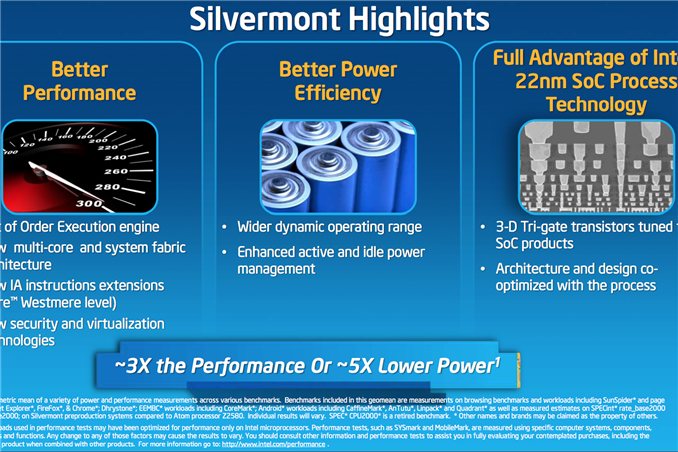
The Silvermont CPUs will be part of the new Bay Trail range of SoCs. According to Intel, the new architecture provides 3x the peak performance over the current generation Atom processors but with an amazing 5x lower power consumption. Intel didn’t specify the changes on the GPU side in Bay Trail but promised double the performance over the current range of Atom processors.

Finally, after all these years of delaying, it seems Intel might just have a shot at winning the race in the mobile segment with the new and upcoming Atom processors against ARM.

QUOTE
In 3 years you will be saying Qualcomm,Exynos,Tegra what are those?Intel will kill any mobile cpu manufacturer in the near future.Samsung Galaxy S6 will probably be powered by an Intel processor.

QUOTE
Intel Atom will use Qualcomm Snapdragon as a condom to tap Exynos, nobody can compete with intel when it comes to CPU's in my opinion.

I want Intel in all upcoming Motorola's smartphones! biggrin.gif
TSwkkm007
post May 8 2013, 12:55 AM

Look at all my stars!!
*******
Senior Member
3,123 posts

Joined: Sep 2008
From: OUG - Muhibbah LRT


QUOTE(SyathibiyMegat @ May 7 2013, 10:32 PM)
Nice job bro impressive rclxms.gif rclxms.gif
VictorKeong
post May 8 2013, 05:00 PM

On my way
****
Senior Member
599 posts

Joined: Jun 2011
From: Perlis


cant wait for K900! biggrin.gif
VictorKeong
post May 8 2013, 05:00 PM

On my way
****
Senior Member
599 posts

Joined: Jun 2011
From: Perlis


cant wait for K900! biggrin.gif
ghost321
post May 9 2013, 10:45 AM

Casual
***
Junior Member
334 posts

Joined: Jan 2003
From: Pen@ng


k900's antutu benchmark
score 27825

http://www.youtube.com/watch?v=IrWXG3szcEs

This post has been edited by ghost321: May 9 2013, 10:47 AM
rexa13
post Jun 3 2013, 01:33 PM

Getting Started
**
Junior Member
185 posts

Joined: Jan 2010
intel like a big ship, slow to turn , once it move forward the momentum make it hard to stop.. soon it will be good option for customer.
SyathibiyMegat
post Jun 4 2013, 05:42 AM

Linguistics
*******
Senior Member
2,634 posts

Joined: Dec 2011
And now, more and more Android-based devices that will be using Intel processor. Asus is the latest
SyathibiyMegat
post Jun 4 2013, 11:04 PM

Linguistics
*******
Senior Member
2,634 posts

Joined: Dec 2011
Innovation, Reinvention on Intel® Architecture Fuel Wave of 2-in-1 Devices, New Mobile Computing Experiences

QUOTE
NEWS HIGHLIGHTS

- Intel introduced 4th generation Intel® Core™ processors that serve as foundation to wave of new 2-in-1s that combine stunning PC performance with tablet-like mobility in one device and deliver on Ultrabook™ vision.
- New Intel Core processors deliver biggest power savings in company history, enabling over 9 hours of battery life1 with stunning performance and two times the graphics capability versus the previous generation2.
- Intel demonstrated for the first time its next-generation 22nm quad-core Intel® Atom™ SoC for tablets in conjunction with its forthcoming 4G LTE multimode data solution.
- Showed first smartphone reference design platform based on next-generation 22nm Intel Atom SoC for smartphones.

COMPUTEX, Taipei, Taiwan, June 4, 2013 – Ushering in a wave of new Ultrabook™ andemerging 2-in-1 devices that deliver a PC when you need it and a tablet when you want it, Intel Corporation today introduced its ground-breaking 4th generation Intel® Core™ Processor family.

Speaking at Computex Taipei 2013, Executive Vice President Tom Kilroy said Intel has more than 50 different 2-in-1 designs in the pipeline across a range of price points, including premium Ultrabook 2-in-1s powered by the new Intel Core processors, and other designs powered by forthcoming processors based on the company's 22nm Silvermont microarchitecture.

"Today we deliver on the vision set forth 2 years ago to reinvent the laptop with the introduction of our 4th generation Intel Core processors that were designed from the ground up for the Ultrabook and serve as the foundation for a new era of 2-in-1 computing," said Kilroy. "We made one of the most seismic changes to our roadmap ever to build these new Core processors that deliver the stunning performance of the PC and the mobility of a tablet in one device. The new processors power the most exciting 2-in-1 designs to-date."

Kilroy also highlighted momentum in ultra-mobility, pointing to Intel's next-generation 22nm quad-core and most powerful Intel® Atom™ system-on-chip (SoC; codenamed "Bay Trail-T") yet for tablets coming this holiday, the company's forthcoming 4G LTE multimode solution and its next-generation 22nm Atom SoC (codenamed "Merrifield") for smartphones.

"With the new Intel Core processors introduced today, our next-generation Atom SoC for tablets and other 22nm products coming soon, the advances in Intel® architecture are accelerating the pace of innovation, enabling new experiences and powering some of the best mobile devices coming to market this year," said Kilroy.

Accelerating Fast: Tablets, Smartphones and LTE

Intel's 22nm low-power, high-performance Silvermont microarchitecture is enabling the company to accelerate and significantly enhance its tablet and smartphone offerings.

For tablets on shelves for holiday 2013, Intel's next-generation, 22nm quad-core Atom SoC ("Bay Trail-T") will deliver superior graphics and more than two times the CPU performance of the current generation. It will also enable sleek designs with 8 or more hours of battery life and weeks of standby, as well as support Android* and Windows 8.1*.

For the first time, Kilroy demonstrated Intel's 4G LTE multimode solution in conjunction with the next-generation 22nm quad-core Atom SoC for tablets. The Intel® XMM 7160 is one of the world's smallest and lowest-power multimode-multiband LTE solutions and will support global LTE roaming in a single SKU.

With a number of phones with Intel silicon inside having shipped across more than 30 countries, Kilroy previewed what's coming. He showed for the first time a smartphone reference design platform based on "Merrifield," Intel's next-generation 22nm Intel Atom SoC for smartphones that will deliver increased performance and battery life. The platform includes an integrated sensor hub for personalized services, as well as capabilities for data, device and privacy protection.


This post has been edited by SyathibiyMegat: Jun 4 2013, 11:07 PM
TSwkkm007
post Jun 5 2013, 08:24 AM

Look at all my stars!!
*******
Senior Member
3,123 posts

Joined: Sep 2008
From: OUG - Muhibbah LRT


I read from GSM arena Samsung Galaxy Tab 3 using atom too
HotzKiss
post Jun 5 2013, 09:57 AM

Getting Started
**
Junior Member
92 posts

Joined: Dec 2007


quad core intel is coming

mudkipryan94
post Jun 5 2013, 10:01 AM

someone need a sarcasm meter?
********
All Stars
12,000 posts

Joined: Feb 2010
From: Banting, Puchong, KL


QUOTE(wkkm007 @ Mar 28 2013, 03:25 AM)
rclxms.gif rclxms.gif rclxms.gif well done sifus smile.gif
salimbest83
post Jun 5 2013, 10:02 AM

♥PMS on certain day♥
*******
Senior Member
8,645 posts

Joined: Feb 2006
From: Jelutong Penang


they shud release it asap.
later play catch up with Samsung n Motorola X
hard lo.
salimbest83
post Jun 5 2013, 10:03 AM

♥PMS on certain day♥
*******
Senior Member
8,645 posts

Joined: Feb 2006
From: Jelutong Penang


QUOTE(wkkm007 @ Jun 5 2013, 08:24 AM)
I read from GSM arena Samsung Galaxy Tab 3 using atom too
*
its using the slower old Atom.
thats the main drawback of gt3

4 Pages < 1 2 3 4 >Top
 

Change to:
| Lo-Fi Version
0.0238sec    0.43    5 queries    GZIP Disabled
Time is now: 18th December 2025 - 06:54 AM