Welcome Guest ( Log In | Register )

Bump Topic Topic Closed RSS Feed
14 Pages < 1 2 3 4 > » Bottom

Outline · [ Standard ] · Linear+

> LYN Christian Fellowship V6 (Group), God Loves you.

views
     
pehkay
post Dec 26 2012, 01:30 PM

Getting Started
**
Junior Member
145 posts

Joined: Jan 2008


QUOTE(unknown warrior @ Dec 26 2012, 01:15 PM)
I think he meant sensitive because of the continuous subconscious hatred propaganda by local media.

As such it naturally also attached subconscious fear whenever anyone opens their mouth and talk about Israel in Malaysia.

I don't know if anyone notice this thing, but I do feel the propaganda very clearly and thus learn to unblock this sensitive fear by thinking from a wider perspective.

I don't have to submit to this ridiculous fear but talk openly whenever opportunities present itself.
*
Ah that, I agreed. Very persuasive atmosphere of animosity here in MY.


pehkay
post Dec 27 2012, 09:47 AM

Getting Started
**
Junior Member
145 posts

Joined: Jan 2008


QUOTE(Jedi @ Dec 26 2012, 02:46 PM)
beautiful , pehkay. Early CHurch Father's writing, u really do your research and reading! I enjoy your sharing, keep it coming. For I have no time myself to ECF writings, let alone Thomas Aquinas' Summa Theologica, St Augustine and Augustine of Hippo's..
yes, that we are made firstborns !!!  thumbup.gif

I remembered you wrote and I saved it to memo:
Funny how I read on facebook one of our brother writing 'What if I can show u God became unholy ONCE'

and he quoted:

Misconception: Christ was born to take our sins upon Himself ... in fact.
(snip)
*

Re: Misconception

True. thumbup.gif The Bible is very careful about this matter. If the Bible contained only John 1:14, we might think that He became a sinful person. But the Bible also contains Romans 8:3, which says that God sent His Son “in the likeness of the flesh of sin.” Christ became flesh, but He was only in the likeness of the flesh of sin. There was no sin in His flesh. He had only the likeness, not the sinful nature, of the flesh. Paul composed this phrase of three words: likeness, flesh, and sin. To say only flesh of sin would indicate sinful flesh. Moreover, Paul does not say that God sent His Son in the likeness of the flesh and stop there. He adds “of sin.” Likeness denotes strongly that Christ’s humanity does not have sin, but still that His humanity was in some way related to sin.

In another verse, 2 Corinthians 5:21, Paul says that Christ “did not know sin.” This means that He had no sin.

Yet, like you mentioned, 2 Corinthians 5:21 also says that this One who had no sin was made sin by God. Our mentality cannot understand this. If the Scriptures were not written this way, it would seem heretical to say that Christ was made sin; but Christ was made sin for us as our full substitute. If this had not happened, we could not have been saved. “Him who did not know sin He made sin on our behalf.” The One whom God made sin knew no sin.

This matter is portrayed in the Old Testament in the type of the brass serpent, described in Numbers 21. When the children of Israel sinned against God, they were bitten by serpents and were dying. Moses looked to God for them, and God told him to make a brass serpent and lift it up on a pole. Whoever looked upon that brass serpent would live, and many did (vv. 6-9).

Then in John 3 the Lord Jesus talked to Nicodemus about regeneration. Nicodemus was a Bible teacher (v. 10) and taught the Old Testament, especially the Pentateuch. “Nicodemus said to Him, How can a man be born when he is old? He cannot enter the second time into his mother’s womb and be born, can he?” (v. 4). The Lord implied that if he could go back to his mother’s womb and be born again, he would still be flesh: “That which is born of the flesh is flesh” (v. 6). To be reborn is not to be born a second time of the flesh, but to be born ofthe Spirit. “That which is born of the Spirit is spirit” (v. 6).

Nicodemus wondered how these things could be. Then the Lord Jesus said to him in a rebuking tone, “You are the teacher of Israel, and you do not know these things?” (v. 10). He then referred Nicodemus to the record in Numbers 21: “And as Moses lifted up the serpent in the wilderness, even so must the Son of Man be lifted up; that everyone who believes in Him may have eternal life” (vv. 14-15).

This portrait clearly indicates that the brass serpent bears only the appearance, the likeness, of the serpent, but not its poisonous nature. This corresponds with Paul’s word “in the likeness of the flesh of sin.”

When Christ died on the cross, He was not only a Lamb in the eyes of God but also a serpent. Both these aspects of Christ are in John. John 1:29 refers to the Lamb of God, and John 3:14 refers to the Son of Man, Christ, lifted up like the brass serpent in the wilderness. When Christ, our Redeemer, was on the cross, on the one hand, He was the Lamb of God to take away our sin; on the other hand, He was also a serpent. The holy Word does tell us that when Christ died on the cross, in the eyes of God He was like a brass serpent.

In order to accomplish a full redemption, He as the Son of God became flesh. The Word became incarnate. John, though, did not say that the Word became a man; he said, “The Word became flesh.” By the time of the incarnation, flesh was a negative term. But we must be careful in saying this. A serpent surely is negative, but this serpent is a brass serpent. It bears only the appearance of a serpent; it does not have its nature. Do you think that when Christ was made sin He had a sinful nature? Absolutely not! This is why Paul qualifies his word by saying, “who did not know sin.” Even though He was made sin by God, He had no sin in Him and He knew no sin. Our Lord is a wonderful Redeemer. The Bible tells us God became a man in the likeness of fallen and sinful flesh.

Re: ECF
Well ... how to put it ... er ... I am not really familiar with ECF writings that much. Personally, that only thing I can affirm from the writing is on the truth of deification, which is, lost among the Western Christianity. The reformation's (Luther) radical departure from tradition as source of authority in the church cast a dark shadow over the majority of the previous writings on the church and brought them over intense suspicion. But, it is not his intent (or ours) to "throw the baby out with the bath water".

This post has been edited by pehkay: Dec 27 2012, 09:51 AM
pehkay
post Jan 1 2013, 10:52 AM

Getting Started
**
Junior Member
145 posts

Joined: Jan 2008


Much grace to you all brothers! May the Lord graced you more
pehkay
post Jan 4 2013, 04:38 PM

Getting Started
**
Junior Member
145 posts

Joined: Jan 2008


Shared a footnote ...

This book [Hebrews], having the concept that all positive things are heavenly, points us to the very Christ who is in the heavens. In the Gospels is the Christ who lived on the earth and died on the cross for the accomplishing of redemption. In the Acts is the resurrected and ascended Christ propagated and ministered to men. In Romans is the Christ who is our righteousness for justification and our life for sanctification, transformation, conformation, glorification, and building up. In Galatians is the Christ who enables us to live a life that is versus the law, religion, tradition, and forms. In Philippians is the Christ who is lived out of His members. In Ephesians and Colossians is the Christ who is the life, the content, and the Head of the Body, the church. In 1 and 2 Corinthians is the Christ who is everything in the practical church life. In 1 and 2 Thessalonians is the Christ who is our holiness for His coming back. In 1 and 2 Timothy and Titus is the Christ who is God's economy, enabling us to know how to conduct ourselves in the house of God. In the Epistles of Peter is the Christ who enables us to take God's governmental dealings administered through sufferings. In the Epistles of John is the Christ who is the life and fellowship of the children of God in God's family. In Revelation is the Christ who is walking among the churches in this age, ruling over the world in the kingdom in the coming age, and expressing God in full glory in the new heaven and new earth for eternity. In this book is the present Christ, who is now in the heavens as our Minister (8:2) and our High Priest (4:14-15; 7:26), ministering to us the heavenly life, grace, authority, and power and sustaining us to live a heavenly life on earth. He is the Christ now, the Christ today, and the Christ on the throne in the heavens, who is our daily salvation and moment-by-moment supply.
pehkay
post Jan 6 2013, 05:16 PM

Getting Started
**
Junior Member
145 posts

Joined: Jan 2008


QUOTE(lopo90 @ Jan 6 2013, 04:57 PM)
Ok, I haven't gone through all. Will do so later. I took 1 of it Deuteronomy 22: 23-24, this is from the english standard version, apparently there are so many other versions.

23 If there is a betrothed virgin, and a man meets her in the city and lies with her,

24 then you shall bring them both out to the gate of that city, and you shall stone them to death with stones, the young woman because she did not cry for help though she was in the city, and the man because he violated his neighbor's wife. So you shall purge the evil from your midst.
In a nutshell, rape is a crime against the husband. Women who do not shout loud enough to be heard while being raped should be killed. Which the article has put it in a very accurate way.

Correct me if I'm wrong
*
You sure you read it right? The verse says "she did not cry for help". Not because no one heard her. smile.gif


pehkay
post Jan 7 2013, 11:10 AM

Getting Started
**
Junior Member
145 posts

Joined: Jan 2008


QUOTE(lopo90 @ Jan 7 2013, 12:47 AM)
You bet I do have a lot more questions to ask. For now there's 1 question I would like to ask about. What happens to those who does not believe in a god but are sincerely kind and good.

Do they go to hell for not accepting Christ?
*
From a post I did before:

If you are open, then try not to think things from the viewpoint of right and wrong ... smile.gif

There are two different kinds of people: one kind does evil, and the other kind does good. According to good and evil, these two kinds of people are absolutely different. Yet in the matter of putting God aside and not giving God any place, they are absolutely the same. Just as those who do evil put God aside, so those who do good also put God aside. Just as those who do evil do not give God any room, so those who do good also do not give God any room. These two kinds of people behave differently-one does good and the other does evil; nevertheless, they have exactly the same kind of attitude toward God. Those who do evil give up the law, thereby rejecting God, and those who do good keep the law, thereby also rejecting God. The former forsake God by violating the law, while the latter forsake God by observing the law. Both groups of people have problems because of the law. The first group of people gives up God because they have broken the law, whereas the second group forsakes God because they consider that they have kept the law. Hence, we can see that both these conditions of rejecting God are related to the law.

GOD DESIRING US NEITHER TO DO EVIL NOR TO DO GOOD

Then what should we choose? Should we choose good or evil? Should we choose to break the law or to keep the law? On the surface, it seems that it is much better to keep the law than to break the law, because it appears that breaking the law alienates us from God while keeping the law might bring us closer to God. Thus, it seems that we should choose to do good. However, although doing good might appear to be a worthy goal, yet it is not the right goal, and in fact it is the wrong goal. Doing evil is an unworthy goal and the wrong goal as well. Therefore, both good and evil are wrong. Of course, God has absolutely no intention for us to do evil, but neither does He intend for us to do good. God's intention is neither for us to be responsible to do evil nor for us to be responsible to do good.

Those who sin and do evil, such as bandits, robbers, and fornicators, put God aside and do not care about God. If they were aware of God, they would be afraid to do evil things. The reason they dare to do evil things is that they do not acknowledge the existence of God; they have put God aside. Those who conduct themselves in an upright and proper manner are moral and good in others' eyes. They are often boastful, saying, "What are heaven and hell? Who is God and who is the devil? Such things do not exist! Everything depends on our conducting ourselves according to our conscience. We should do things according to proper reasoning. We should not do things that would hurt others, nor should we do things that would harm ourselves. We should take care of others as well as ourselves. It is good enough that we conduct ourselves in an upright way." People like this have good behavior, their words are trustworthy, and their character is good, but they do not acknowledge the existence of God. This is to be good. People who are good in this way are commendable but mistaken because their goal is incorrect.

MAN BEING CREATED TO CONTAIN GOD

In the beginning God created man neither to do good nor to do evil. Rather, God created man for His purpose. He wanted man to have fellowship with Him, to be filled with Him, to live in Him, and to be mingled with Him as one entity. Man was created for God as a vessel to contain God (Rom. 9:21, 23). This is similar to a glass being made as a vessel to contain water. It is wrong to put dirty things into the glass, but even if we put gold into it, it is still wrong. This is because the glass was made as a vessel to contain water, not other things.

Human beings were created neither to contain evil nor to contain good. We were created neither to be evil persons nor to be good persons. Then what kind of people should we be? How can a living person do neither evil nor good? Can anyone escape from good and evil? None of us can. A person who is without God cannot escape from good, evil, and death in his life. Only a person who has died does neither good nor evil.

BEING NEITHER GOOD MEN NOR EVIL MEN BUT GOD-MEN

In the garden of Eden there were two trees: the tree of life and the tree of the knowledge of good and evil (Gen. 2:9). Concerning the tree of the knowledge of good and evil, the Bible says that he who eats of it shall surely die (v. 17). When someone eats of this tree, it may seem to be evil, but it is actually death, or it may seem to be good, but in reality it is still death. The issue of evil is death, and the issue of good is also death. These three-good, evil, and death-are inseparable. Then what is the tree of life in the middle of the garden? This tree of life is life itself. What man sees is life, what he eats is life, and the issue of his eating is also life. Who is this life? This life is God Himself.

Please remember that in the garden of Eden the first tree- the tree of life-is God Himself, and the second tree-the tree of the knowledge of good and evil-is good, evil, and death. People on earth who do not have God choose the second tree instead of the first. The result of choosing the second tree is good, evil, and death. They are good men, evil men, and eventually dead men. These three kinds of persons are all in the tree of the knowledge of good and evil. Then, as saved ones, are we good men, evil men, or dead men? Praise the Lord, we who have been saved have the life of God in us, so we are God-men.

However, is our real situation like this? Are we God-men in our daily living? This is a big problem. It is very difficult for us to be freed from the law in our human living. We are always turning back to the law, and the law is always following us. Even today, having become Christians, we still cannot easily break away from the law, and instead of living to God, we still live before the law to be people of the law. Although we have been saved and we have God in us, we do not live to God.

As human beings we were created for God Himself. We are vessels to contain God. We should not take good or evil into us; rather, we should take God into us. How can God be put into us? It is by means of the Holy Spirit. The Scriptures tell us clearly that when the Holy Spirit is in us, God is in us (1 John 3:24; 4:13; Rom. 8:9a, 11). What does God want us to do? God wants us to be dead to the law so that we may live to God. Before we were saved, we lived to good and evil; that is, we lived to death. Now that we are saved, we should start learning to live to God. This means that as vessels to contain God according to His purpose in creating man, we should live to God instead of living to the law. We should be neither good men nor evil men but God-men.
pehkay
post Jan 9 2013, 02:05 PM

Getting Started
**
Junior Member
145 posts

Joined: Jan 2008


What is the building up of the church? .. er.. part 1

In Matthew 16 the Lord Jesus spoke about the building of the church. After Peter received the revelation concerning Christ, the Lord said, “On this rock I will build My church” (Matt. 16:18). In saying these words, the Lord certainly did not mean that the building of His church would begin at the time of His second coming. At the latest, the Lord began to build the church on the day of Pentecost. In 1 Peter 2:5 Peter says that we are living stones being built up a spiritual house. This indicates that the building of the church is taking place today, not only in the future.

We thank the Lord for showing us that the building is taking place now. Moreover, He has shown us the way to have the building. Ephesians 2:21 says that all the building is growing, and the next verse says that we are being built together into God’s dwelling place. Thus, growing equals being built, and being built equals growing. This indicates that the proper building of the church is the growth in life.

In Ephesians chapter four we also have the thought of growth. Verse 13 speaks of a full-grown man (Gk.), and verse 15 says that we should hold the truth in order to grow up in everything into the Head, Christ. Furthermore, verse 16 speaks of the growth of the Body unto the building up of itself in love. Even verse 14 has the thought of growth, for it says that we should no longer be children tossed to and fro. To be no longer children is to have the proper growth. Therefore, in Ephesians 4:13-16 the thought of growth is found in every verse. According to these verses, the building of the Body comes through the growth in life.

In the entire universe God has just one dwelling place. The building of this dwelling place began, at the latest, on the day of Pentecost, and it is still going on. The process of building will be completed, not at the time of the Lord’s coming back, but at the end of the millennium.

According to the New Testament, from the time of Adam until the time of the millennium there are four ages: the age of Adam, the age of the law, the age of grace, and the age of the kingdom. The building of the church takes place during the age of grace and the age of the kingdom. It began on the day of Pentecost, the beginning of the age of grace, and it will be completed by the end of the age of the kingdom. Then the fullness of time with the New Jerusalem will come. Thus, the completion of God’s building will be in the new heaven and new earth, which will appear after the millennium. Although the New Jerusalem comes at the beginning of the millennium, its full completion, the completion of God’s building, will not be until the end of the millennium.

Although the building is going on today, the majority of Christians are not concerned about it and have no heart for it. They neither understand it nor speak of it. Today many of us have been captured by the vision of the building. We have seen that what the Lord is seeking today is the building. Without the building, there is no way for Him to come back.

This post has been edited by pehkay: Jan 9 2013, 02:06 PM
pehkay
post Jan 10 2013, 09:22 AM

Getting Started
**
Junior Member
145 posts

Joined: Jan 2008


QUOTE(unknown warrior @ Jan 9 2013, 08:40 PM)
That's because by far I believe most Churches in Malaysia are still preaching a mixture of Law and grace.
Even my Church is no exception.
How can People get encouraged? Because it's will be very confusing for some.
The law only cause believers Faith to shrink and can be infectious.
*
The problem is that there are veils that covers us from seeing this. Also, there is no clear speaking or trumpeting of the full knowledge of the truth among the churches; When the leading ones are not clear, I am afraid many young believers will be led astray too.

This is clearly revealed in Galatians. Strictly speaking, sin is not a veil that covers people, because everyone knows that sin is evil. Likewise, the world does not veil us, because many who seek God know that the world also is evil. The primary veil revealed in Galatians is religion. In the eyes of many people, religion is a good thing. No dictionary or lexicon tells us that religion is something negative. Apparently, religion causes people to be for God, to fear Him, and to worship Him. In actuality, religion is the strongest, thickest veil.

The first layer of covering that veils our eyes is religion, and the second layer is tradition. In every religion there are many traditions. Before Saul was saved, he was not worldly or sinful; he was altogether religious and traditional. Nothing used by Satan is as subtle as religion. Satan uses sin and worldliness to keep people from God, but it is easy to understand that sin and the world are not good. However, it is difficult to realize that religion is a strong enemy of Christ. Satan utilizes the veil of religion to deceive people. This is true not only of Judaism but even of Christianity, which is a more developed religion. sweat.gif

Gal 1:4 says, “Who gave Himself for our sins that He might rescue us out of the present evil age.” Paul’s emphasis here is not that we are rescued from hell but that we are rescued out of the present age. According to the context of Galatians, the present age at Paul’s time was religion. To be rescued from religion at that time was to be delivered from the present evil age. Christ gave Himself for our sins that He might deliver us out of the religion of the modern age, which in Paul’s time was the religion of Judaism and in our own time is the religion of Christianity. :/ sweat.gif

Religion is something for God and for the benefit of people, yet it is apart from Christ and without the Spirit of Christ. As long as Christ is not in something, no matter how good it may be, it is only religion. Even if we pray or study the Bible but are not in the spirit and do not have the Spirit of Christ, we are in religion, which does not bring forth the church. Christ as the Spirit is the only element that produces the church. As long as we do things in the spirit and with the Spirit of Christ, we have the church life. Otherwise, whatever we do may be good, may be for God, and may be for people’s benefit, but we will simply produce another kind of religion. Whatever we do must be realized and practiced in our spirit with the Spirit of Christ as the presence and reality of Christ.

We all need this revelation, and all the veils upon us need to be removed. Then we will see that what matters is not to have certain practices but to have the living Christ revealed in us (v. 16). Mere teaching is not able to help us. God’s desire is not a matter of religion but of the living Christ, the life-giving Spirit, dwelling in our human spirit. On his way to Damascus, Paul received not mere teaching but a revelation from the heavens so that he could see Christ and God’s will to have the church, which comes out of Christ. At that time Paul became clear not by man’s teaching but by a revelation of Christ from God. This is what we need today.

God’s will is simply to reveal His Son, Christ, in us. We need to leave behind the religious ways of meeting, praying, and teaching in today’s Christianity. We should even leave behind our old traditional knowledge of the Bible. What we need is to have our entire being unveiled to see Christ and receive Him into us. As we experience the indwelling Christ’s operating within us, we all love one another, and the result is that we have the church life. The church life is not a matter of religious teachings, gifts, regulations, forms, or ordinances. It is a matter of enjoying Christ as the All-inclusive Spirit (or grace) for the Practical, Genuine, and Real Church Life[U]

(Ah .... too much text already ... and haven't come to chapter 2 on the law ...Galatians 1 exposes religion with its traditions, and chapter 2 speaks of the law with its ordinances.)
pehkay
post Jan 11 2013, 10:27 AM

Getting Started
**
Junior Member
145 posts

Joined: Jan 2008


» Click to show Spoiler - click again to hide... «


Haha .. yes I am familiar with what RC brothers on Peter and I must say, that quote from St. Basil is quite good. Again, I feel that it is the understanding that will elevate us out of these necessary "arguments"...

Whereas most fundamental Christians say that it refers to Christ (and it is correct to say that the rock denotes Christ), not even this understanding is adequate. The rock here refers not only to Christ but even the more to the revelation concerning Christ. In Matt. 16, the Father reveals something from the heavens to Peter. This heavenly revelation from the Father is the rock.

After Peter declared that Jesus is the Christ, the Son of the living God, the Lord said to Him, “You are blessed, Simon Bar-jona, because flesh and blood did not reveal this to you, but My Father who is in the heavens” (Matt. 16:17). “Flesh and blood” here refer to man, who is composed of flesh and blood. Only the Father knows the Son (Matt. 11:27); hence, only He can reveal the Son to us. The source of the revelation of Christ, which is the basis upon which the revelation of the church as the mystery of Christ is given, is the Father.

Matthew 16:18a says, “I also say to you that you are Peter, and on this rock I will build My church.” The Father’s revelation concerning Christ is just the first half of the great mystery, which is Christ and the church (Eph. 5:32). Hence, the Lord needed “also” to reveal to Peter the second half, which is concerning the church.

The words “this rock” refer not only to Christ but also to the revelation of Christ, which Peter received from the Father. The church is built on this revelation concerning Christ. First, the rock refers to the wonderful person of Christ, the Son of the living God. Second, it refers to the revelation of this person as seen by Peter. When we see this revelation, the revelation becomes the rock. Thus, the church is built not only on the person of Christ but also on the revelation of His person.

No doubt, the Lord’s word must have made a deep impression on Peter, even though it is not likely that he understood it at the time. However, after the life-giving Spirit had been breathed into him and after the economical Spirit had blown upon him, Peter became a man of Spirit, a man with the essential Spirit within him and the economical Spirit upon him. As such a man he surely began to understand the Lord’s word concerning him being a stone. Peter might have said to himself, “I recall that when I first met the Lord, He said that He would give me a new name, a name that means stone. Later He called me ‘Peter’ and said that He would build His church upon a rock. Now I understand what the Lord was saying.”

Having this understanding, Peter in Acts 4 could present the Lord Jesus as the stone despised by the builders but which has become the cornerstone. Later, when he had become old, he wrote his first Epistle, in which he spoke of the Lord as the living stone and of the believers as living stones for God’s building: “To whom coming, a living stone, having been rejected by men, but with God chosen, held in honor, you yourselves also, as living stones, are being built up a spiritual house” (1 Pet. 2:4-5a). According to Acts 3 and 4, Peter knew the Healer not only as God’s Servant, the Holy One, the Righteous One, the Author of life, the Prophet, and the seed in whom all the earth would be blessed; he also knew Him as the stone for God’s building.

Jesus Christ is a stone for God’s building!!! He is not only the Servant, the Holy One, the Righteous One, the Author of life, the Prophet, and the seed; He is a stone for God’s building. According to 4:12, this stone is the One in whom we can be saved. Hence, He is the Stone-Savior. As the Stone-Savior, He is solid, strong, and reliable. We can rely on Him and stand on Him. This stone is the rock, the foundation stone, and the cornerstone. In Zechariah 4:7 we see that He is even the topstone. Christ is the material for God’s building. God’s building is entirely of Christ.

The universal church has been formed out of the all-inclusive person of Christ. He is the factor, the element, the constituent, for the formation of the universal church. The church, therefore, was not formed out of nothing but was formed out of something wonderful. The church as the Body of Christ is constituted with the unsearchable riches of Christ (Eph. 3:8, 10). This is the real oneness.

Through this revelation, Peter was transformed from Simon to Peter, from a son of Jonah to a son of the Father in the heavens. When we see this revelation, the revelation becomes the rock. Thus, the church is built not only on the Person, but also on the revelation of this Person. Thirdly, this rock refers to Peter’s declaration that Jesus is the Christ, the Son of the living God. Hence, the rock refers to three things: the Person, the revelation, and the declaration.

In order to be built we need the Person, the revelation, and the declaration. We should not only know this as a doctrine, but also practice it. The Person is always available, for He is both universal and local. But it is possible to talk about Christ without having the revelation of Him. As soon as we see that Jesus is the Christ, the Son of the living God, and declare it, we are built. However, nominal Christians who attend a so-called service on Sunday morning only to spend the rest of the day at sporting events or the movies are not built upon this rock. But when some begin to see that Jesus is the Christ and the Son of the living God, they are built up; for they are attached to Christ, the anointed One, and the Son of God comes into them as life. Immediately, they and He become one. It was at the juncture of confessing that Jesus was the Christ and the Son of God, that Simon was changed to Peter. The more we experience Christ, the more, we became truly one.


pehkay
post Jan 12 2013, 10:48 AM

Getting Started
**
Junior Member
145 posts

Joined: Jan 2008


Building up of the church pt 2

GROWING IN LIFE THROUGH KEEPING THE ONENESS

The building is simply the growth in life. If we do not keep the oneness, we have no way to grow in life. Breaking the oneness spoils the growth in life. Genuine growth in life is safeguarded by keeping the oneness. In other words, once the oneness is damaged, there is no growth in life. This is not a mere doctrine but our experience. Through our experience we have learned that true growth in life is in the keeping of the oneness. We may advance in knowledge or improve our behavior, but we cannot have the genuine growth in life apart from keeping the oneness. The genuine growth in life is regulated by the maintaining of the oneness. Thus, it is crucial that we know how to be one.

KEEPING THE ONENESS AND ARRIVING AT THE ONENESS

Ephesians 4:3 tells us to keep the oneness of the Spirit (Gk.), and in verse 13 we see that we need to arrive at the oneness of the faith and of the full knowledge of the Son of God (Gk.). In these verses we see the two ends of oneness: keeping the oneness and arriving at the oneness. On the one hand, we have the oneness already. If not, how could we keep it? Keeping it implies having it. The oneness we have already is the oneness of the Spirit, and the oneness of the Spirit is the Spirit Himself. Because we have the Spirit within us, we have the oneness. Now we simply need to keep it. For example, the lamps in the meeting hall have the same electricity. The electricity within them is their oneness. They are one not in themselves, but in the electricity. Likewise, we have the one Spirit in us. This Spirit is our oneness. Hence, the oneness is called the oneness of the Spirit.

We need to keep this oneness until we arrive at the oneness of the faith and of the full knowledge of the Son of God. At one end of the oneness is the oneness of the spirit, and at the other end is the oneness of the faith and of the full knowledge of the Son of God. We need to keep the oneness of the Spirit as we go on to arrive at the oneness of the faith and of the full knowledge of the Son of God.

The oneness of the faith and of the full knowledge of the Son of God is a full-grown man. Arriving at this oneness means arriving at a full-grown man. This oneness is also the measure of the stature of the fullness of Christ. Christ has a fullness, the fullness of Christ has a stature, and the stature has a measure. Thus, Ephesians 4:13 speaks of the measure of the stature of the fullness of Christ. As a man, I have a stature, and my stature has a measure. The measure of this stature is my fullness. The oneness of the faith and of the full knowledge of the Son of God is both the full-grown man and the measure of the stature of the fullness of Christ.

ARRIVING BY GROWING IN LIFE

Although we have not yet arrived at a full-grown man, at the measure of the stature of the fullness of Christ, our destiny is such an arrival. Today we are on the way. Some of us may be very close to this destination, and others may be quite far from it. The way to arrive is by growing in life. The more we grow, the closer we come to the end. When we are fully grown, we shall arrive at our destination. This means that full growth is our destination.

LOWLINESS

It is in the growth in life that we have genuine lowliness (Eph. 4:2). Lowliness is not a human virtue. Lowliness comes from the growth in life. If we would keep the oneness of the Spirit, we must have lowliness. Never think highly of yourself. The first requirement, the first prerequisite, of maintaining the genuine oneness is lowliness. Instead of considering ourselves so highly, we need to say, “Lord, I would like to be lowly. I don’t want to be high.”

MEEKNESS

The second requirement is meekness. Meekness means not to resist. If we do not resist whatever happens to us, then we have meekness.

LONG-SUFFERING

Along with lowliness and meekness, we need long-suffering. No place exhausts our endurance more than the church. The church exhausts everyone’s endurance. If you think that you are able to endure, the Lord will bring to you those who can exhaust you. We all need to be exhausted. The Lord’s intention is to exhaust us. The elders may expect the brothers to be nice and lovable and the sisters to be quiet and agreeable. But the more you expect the brothers and sisters to be like this, the more naughty they will be. The elders must be prepared to face the difficulties caused by naughty brothers and sisters. They will exhaust you to the uttermost and then, after exhausting you, will complain that you have no patience or sympathy. Thus, we need long-suffering.

In addition to long-suffering, we must bear one another in love. Instead of vindicating ourselves or justifying ourselves, we need to bear everyone. We should not only bear a few according to our preference, but all the saints. We need to bear them in our spirit to the throne of grace and pray for them. This is easy to talk about, but difficult to practice. For this we need the Lord’s mercy. Apart from His mercy, we cannot bear anyone. Those who have been elders for five years will agree with this, for they have suffered a great deal in the eldership, having been cut into pieces by the brothers and sisters. But this is our destiny, our life, our way. If an elder tries to drop the eldership, he will be through with the church life.

As we go on to the oneness of the faith and of the full knowledge of the Son of God, there will be differences among us according to the various stages of life. These differences are unavoidable, and we should not try to eliminate or reduce them. Rather, we need to allow the brothers and sisters to be what they are. This is the way to keep the oneness through lowliness, meekness, long-suffering, and bearing one another in love. There is no other way.

THE TEST OF OUR GROWTH IN LIFE

The extent to which we keep the oneness of the Spirit in this way tests how much growth in life we have. The more we grow in life, the more we shall be able to bear various kinds of differences. However, if you cannot go along with differences, you are still very young. But if you can go along with all kinds of differences, this indicates that you are quite mature. The more we grow in life, the more differences we shall be able to take. We shall not want to reduce the differences, change things, or correct the saints. Rather, we shall minister life to the saints and let them grow. If they give us some difficulty, we shall bear them in love. This is a sign of our health, of our growth, and of our maturity. But if we like to unify, to change, to correct, and to adjust, this is a sign that we are still immature. For the keeping of the genuine oneness, we all need to grow.
pehkay
post Jan 14 2013, 11:19 AM

Getting Started
**
Junior Member
145 posts

Joined: Jan 2008


BUILDING OF THE CHURCH pt 3

GROWTH IN LIFE BEING THE INCREASE OF CHRIST

Colossians 2:19 "...grows with the growth of God."

In the language of the New Testament, to be built is to grow. Most Christians, however, consider growth as merely a matter of improvement. But it is possible to have a great deal of improvement without any growth. The growth in life is the addition of Christ as life into our being. Not only Christians but even unbelievers may improve as their natural life matures. For example, as a young person grows from a teenager to a man in his late twenties, he will improve. But this improvement is not the growth in life. Many Christians have been helped to improve themselves by listening to sermons. Although sermons may help people to improve, they do not help them to grow in life. According to the Bible, to grow is to have more of Christ wrought into our being. The growth in life is simply the increase of Christ in our being.

For the building of the church, the growth in life is urgently needed. If we do not have this growth, we cannot have any building. The growth in life is the real building. This building is not a matter of having someone above you, below you, or beside you. Take the example of Aquila and Priscilla, who were one with the other saints wherever they were. Aquila and Priscilla could be one with others because they had considerable growth in life.

THE DEGREE OF ONENESS AND BUILDING DEPENDING ON OUR GROWTH

The degree to which we can be one with the saints depends upon the growth in life we have. You may be one with certain saints that are close to you. But if you do not have the proper growth in life, you will not be able to be one with the saints in another locality if you move there. This inability to be one with saints in a new locality proves that you do not have the growth in life. If you have the genuine growth in life, you will be one with the saints wherever you may be.

The more we grow in life, the more we are built. If you have the real growth in life, you will be able to be built together with others whom you have not met before. When you come together with them, there will be no problems because you all have had the growth in life. The real growth in life is the building, and the genuine building is a spiritual matter in life since the building of God’s house is absolutely not material, but spiritual. The house of God, the church today, is not a physical entity, but a spiritual entity. How much we have been built into the church depends upon how much we have grown in life. Many have been Christians for years, but do not have any growth. Thus, there are problems whenever they come together.

In a family we have brothers and sisters, but no special friends. Likewise, in the church we have only brothers and sisters, not any friends. Nevertheless, some may still want to have friends among the brothers and sisters. In a sense, they are one with their friends because their friends suit their taste, choice, and preference. However, if they move to another place that does not match their taste, they will not be one with anyone. But if you have the growth in life, wherever you may go you will be one with the saints. This oneness is the building.

Some brothers always want their own preference. If they cannot get it in one place, they will move to another and to still another. There are saints who moved from one church to another trying to find their preference. With them there was no growth in life. Because there was no growth in life, wherever they went there was no oneness. They simply could not be one with others. But suppose you have the genuine growth in life. Even in a church where the situation is the most difficult, you will still be able to be one. If you cannot be one in the place where you are, do not think that by moving elsewhere you will be able to be one. If you should move to another place, you may find it worse than the place you left. This may cause you to go to even a third place. Nevertheless, the situation will be the same. Actually, it is not a matter of the place, but of the growth in life. The more you grow in life, the more you will be able to be one with the saints. This is the building. By this we see that the genuine building is the growth in life.

This post has been edited by pehkay: Jan 14 2013, 11:22 AM
pehkay
post Jan 15 2013, 10:11 AM

Getting Started
**
Junior Member
145 posts

Joined: Jan 2008


The building of the church pt4

First Corinthians 3 speaks of the planting, the watering, and the growing. Paul said that he planted; he sowed the seed. Then Apollos came to water, to irrigate. Then God gave the growth (v. 6).

We all need the planting of the life seed, not knowledge. The things of life are always in the Spirit. Knowledge is in the mind, but life is in the Spirit, and the Spirit is the reality of life. The Lord said, "It is the Spirit who gives life...the words which I have spoken to you are spirit and are life" (John 6:63). Romans 8:6 says that the mind set on the spirit is life. Life is in the Spirit, and knowledge is in the mind.

To plant is absolutely a matter of life in the Spirit, not a matter of mere teaching. This is why Paul told us that when he came to Corinth the first time, he did not use enticing words of man's wisdom, but he exercised his spirit to demonstrate the Spirit (1 Cor. 2:1-4). His speech was in demonstration of the Spirit, not of knowledge. By this he sowed the life seed, planting something of Christ into the spirits of the Corinthians. Then Apollos came to water the seed. God goes along with this organic work. When we plant and water, God follows to give the growth.

Paul told us that we are God's farm (3:9). Planting, watering, and growing are all for the farm, the cultivated land. On God's farm we have to grow something, and what we grow is Christ. Christ has been sown into us, and now Christ has to grow out of us. The Greek word for cultivated land in 1 Corinthians 3:9 means "farm" or "tilled ground." The church is God's farm to grow Christ.

Paul also said that we are God's building (v. 9). This indicates that the growth on God's farm is for the building. The church is built up by the growth in life. Whatever grows on God's farm is for the building. In other words, God's farm grows Christ, and Christ is for the building. The church is not built up by teaching or by organizing but by the growth in life. Paul planted, Apollos watered, and God gave the growth for the building up of the church.

CHRIST AS EVERYTHING TO US

First Corinthians is a precious book which follows the book of Romans in God's sovereign arrangement of the books of the Bible. Romans starts with the condemnation of sins and then goes on to justification, identification with Christ, the walk and life in the Spirit, and the Body life. But how can we have the Body life? For the answer, we need 1 Corinthians. If you want to have the Body life, you have to realize that Christ is everything to you. This is what 1 Corinthians reveals to us.

Chapter one tells us that we have been called into the fellowship, the participation, the enjoyment, of this wonderful One (v. 9). God has put us into Him (v. 30), and He is the power and wisdom of God (v. 24). Now we are in Christ, enjoying Him as everything. Chapter two tells us that if we are going to enjoy Christ, we have to give up our soul-life. Otherwise, we will be a soulish person, who always considers the things of Christ to be foolishness (v. 14). We have to be a person in the spirit so that we can enjoy this wonderful One. For our past Christ is our righteousness; for our present He is our sanctification; and for our future destiny He is our redemption (1:30). He is everything to us.

But if we are going to realize such a Christ, we have to be in the spirit. We may use electricity as an illustration of this. The electricity installed in a building can be applied only by turning on the switch. In the same way, Christ can be applied to us only by the exercise of our spirit. We have to be in the spirit. Then we will become spiritual persons (2:15; 3:1). A spiritual person is a person living, moving, acting, and having his being in the spirit.
pehkay
post Jan 16 2013, 10:24 AM

Getting Started
**
Junior Member
145 posts

Joined: Jan 2008


The building up of the church pt 5

TRANSFORMED INTO PRECIOUS MATERIAL FOR GOD'S BUILDING

First Corinthians goes on to tell us that something of Christ has been planted into us. The real ministry of life is like the ministry of Apollos, who watered the seed. God goes along with this watering and gives the growth. Christ has been sown into us, and Christ is going to grow out of us. When Christ grows out of us, this growth transforms us to produce the gold, silver, and precious stones (v. 12). According to our natural being, we are wood, grass, and stubble, but we are being transformed into precious material for God's building.

The Lord will not use anything of our natural being for His building. Some of the saints may be good in a natural way without any transformation in their nature or disposition. Our natural goodness has nothing to do with God's building. We were born as wood, grass, and stubble—worthless material for God's building. But we were reborn with gold, and we are being transformed into silver and precious stones by being watered and by our growth in life. We need the watering for the growth in life that we may be transformed. Thus, 1 Corinthians 3 shows us the planting, watering, growing, transforming, and the producing of precious material for God's building.

GOD'S BUILDING BY THE GROWTH IN LIFE

Paul said that both he who plants and he who waters are nothing (v. 7). Paul and Apollos are nothing. What counts is God Himself who gives the growth. We cannot do anything with our human hand. We cannot organize a church, but we can plant and water so that God can go along with our ministry to give the growth in life. Then something of Christ will grow up within others to transform them into precious material for God's building. This is absolutely not something organized by the human hand but something of the growth in life by God's life-giving power.

Ephesians 2:21 says that all the building is growing into a holy temple in the Lord. If there is no growth, there is no building. The building grows into a temple. We cannot organize something to be the house of God. The house of God is something that grows up. Ephesians 4 says that we need to hold Christ as the reality that we may grow up in all things into Christ as the Head (v. 15). First, we grow into Christ. Then all the Body receives something of Christ to minister to the members. By this kind of ministry, the Body is built up by growing (v. 16). Again we see the growth and the building.

GROWING WITH THE GROWTH OF GOD

Colossians 2:19 says that the real building of the Body depends on the growth, and this growth comes from the growth of God. God is eternally perfect and complete, but this verse says that God grows. God in Himself needs no growth, but in us He needs the growth. God is complete in Himself, but He is not complete in us. The growth of the Body of Christ has nothing to do with the doctrinal knowledge of the Bible, the way of worship, or any such matter. Rather, the growth of the Body depends on the growth of God, the increase of God's element, in the Body. We need the growth of God within us.

God has to be added into our being again and again. This is why we are told that we need to be filled unto all the fullness of God (Eph. 3:19). We have a little bit of God within us, but we need more of Him added to us. When we are filled with God, we will be "crazy" to speak about Christ. When Paul was defending himself before King Agrippa, the Roman politician Festus exclaimed, "You are insane, Paul. Much learning is driving you insane" (Acts 26:24). Then Paul said, "I am not insane, most excellent Festus, but I am uttering words of truth and soberness" (v. 25). Actually Paul was crazy for Christ because he was filled with God. If you are filled unto the fullness of God, you will speak about Christ all the time. We need to be filled with God for the growth of God. God has to increase within us day by day. We grow not by the increase of gifts, the increase of knowledge, or the increase of moral or ethical attainment. We grow only by the increase of God.

Let us consider two brothers. One brother is always adjusting himself to fit into certain situations. He is always nice and willing to be adjusted. We may mistakenly think that this is a very good brother who is full of life. Another brother is rough and tough. He is not very willing to be adjusted. But at times he is touched by the life-giving Spirit. You can realize that even though he is rough, there is the increase of God within him. This is the growth in life. If you would prefer the brother who is outwardly nice instead of the other brother who is inwardly experiencing the increase of God, this shows that you do not know what life is.

If we were asked to choose between Jacob and Esau, many of us would prefer Esau. Jacob was a supplanter, a heel holder, who was skilled at cheating others. He did not cheat others to their face but at their "heels." Jacob was someone who would cheat you behind your back. It seems that God was not fair to choose Jacob over Esau. God said that He loved Jacob and hated Esau (Rom. 9:13). Because Jacob cheated his brother Esau, he was forced to leave his home and go to his uncle Laban. While he was on his journey, he was forced to sleep in the open air, and he had a wonderful dream. When he awoke from that dream, he declared that the place where he slept was Bethel, the house of God. He set up the stone, upon which he had laid his head, as a pillar and poured oil upon it (Gen. 28:10-22). God's hand was upon him, not to do some outward correcting or adjusting work but to do an inner transforming work. God eventually told him that he would no longer be called Jacob but Israel (32:28). He would no longer be a supplanter but a prince of God.

What are we doing here in the church? Are we correcting, adjusting, and improving people? If we are doing this, we are in religion. It is the work of Confucius to improve people. Instead, we are here planting and watering that God may follow to give the growth so that people can be transformed into precious material for God's building. To grow and be transformed is to have God increasing in you all the time.

pehkay
post Jan 20 2013, 06:07 PM

Getting Started
**
Junior Member
145 posts

Joined: Jan 2008


You guys only come out in the early morning smile.gif
pehkay
post Jan 21 2013, 12:27 PM

Getting Started
**
Junior Member
145 posts

Joined: Jan 2008


QUOTE(ray123 @ Jan 21 2013, 12:08 PM)
The word "perfect" in my earlier sentence was merely a phrase. I do not claim to be an authority on the subject matter, just that there was no need for someone to tell me that "the Christian god is 3-in-one like shampoo is wrong" because I already know it's incorrect and it's not that simple. All I'm saying that I'm not as lacking in general knowledge as some non-Christians who belittle or simply misunderstood the concept.

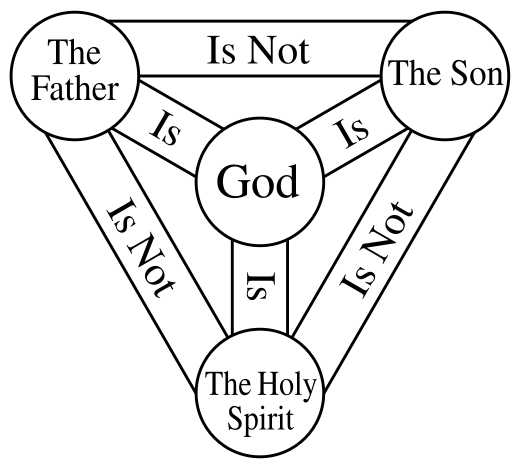
In the past I have used this picture:

user posted image

Someone once said:
and I replied:
*
Hey, not a bad start smile.gif At least All Three Are God is shown. Though I was shocked at some Christians that have a subconscious thingy that the Spirit is a little bit inferior even though verbally they won't say it.

You can get into other "aspects" of the Triune God like eternal coexistence, circuminsession (coinherence) and circumincession (perichoresis).


pehkay
post Jan 21 2013, 01:15 PM

Getting Started
**
Junior Member
145 posts

Joined: Jan 2008


QUOTE(unknown warrior @ Jan 21 2013, 01:12 PM)
In the book of Genesis (Torah), there are many reference when God speaks referring to himself, the translation read, We and Us. I believe they subscribe to the book of Moses as well.

Genesis 1:26 (KJV)
And God said, Let us make man in our image, after our likeness: and let them have dominion over the fish of the sea, and over the fowl of the air, and over the cattle, and over all the earth, and over every creeping thing that creepeth upon the earth.
If that isn't clear and plain enough, nothing else will.

Any attempt to explain that away is nothing short of swinging and twisting according to human reasoning.
*
biggrin.gif In the grammatical composition of Genesis 1:1, the Hebrew word for God, Elohim, is plural in number, while the predicate created is singular. Go figures ....
pehkay
post Jan 21 2013, 04:07 PM

Getting Started
**
Junior Member
145 posts

Joined: Jan 2008


QUOTE(unknown warrior @ Jan 21 2013, 01:28 PM)
The way I understand it, it's a unison relationship for reference sake.

I was praying one day and the Holy Spirit illuminated this to me.

He said,

Whenever you call God, you're invoking all 3 persons at once to attention.

Because at times in mid of my prayer, I would call on Jesus for something, I would call on God the Father for something and I would call the Holy Spirit for something.
*
God is triune for His move, purpose or economy and for our experience and enjoyment (2 Cor 13:14). To enter man, He has to be Triune smile.gif

In the divine Trinity, the Father is the source, and the Son is the expression. The Spirit is the entering in of the Triune God, the Applier. The Father plans, the Son accomplishes, and the Spirit applies. Hence, the Father is the Planner, the Son is the Accomplisher, and the Spirit is the Applier. The Son has accomplished all that the Father has planned. Now the Spirit comes to apply all the Father has planned and the Son has accomplished. Here we see the Three of the Triune God working together. The Planner is the source, the Accomplisher is the expression, and the Applier is the One who enters into us. When the Spirit as the Applier enters into us, He brings with Him whatever the Father has planned and the Son has accomplished. This is the working of the Triune God—the Father, the Son, and the Spirit—to dispense Himself and all that He has planned and accomplished, and is now applying, into our being.

Yes, the entire Triune God operates. The word used is "...distinct yet not separate".

Contrary to the modern, popular view that the three of the Godhead are and act separably. In many instances of the Gospels especially, John, there is a distinct operation (at that time, the Son gave life), actually, it is also the Father and the Spirit gives life (not separate).

E.g.

For just as the Father has life in Himself, so He gave to the Son to also have life in Himself. (5:26)
As the living Father has sent Me and I live because of the Father. (6:57)
Even as You have given Him authority over all flesh to give eternal life to all whom You have given Him. (17:2)
For just as the Father raises the dead and gives them life,so also the Son gives life to whom He wills. (5:21)

This post has been edited by pehkay: Jan 21 2013, 04:10 PM
pehkay
post Jan 22 2013, 03:51 PM

Getting Started
**
Junior Member
145 posts

Joined: Jan 2008


Hello!
pehkay
post Jan 23 2013, 05:45 PM

Getting Started
**
Junior Member
145 posts

Joined: Jan 2008


THE GRACE OF CHRIST

The Embodiment of the Processed Triune God Becoming the Believers’ Enjoyment

All the riches of this God become His grace. The meaning of grace is God becoming our enjoyment freely. Today, when we enjoy God, we are enjoying His all-inclusiveness and limitlessness being given to us freely as grace. John 1:14 says, “The Word became flesh.’’ For this reason, God brought grace to us for our enjoyment. Grace is simply what Christ is. It is also all the riches of Christ.

First, Christ is God. He brought God to us. This is one side of Him as grace. Next, He became a man, and He brought His humanity to us. This is another side of grace. All His human experiences, His accomplishment on the cross, and all that He has attained and obtained, including His ascension and enthronement, are all given freely to us as our free portion. Moreover, He is light, love, holiness, righteousness, authority, power, and strength. All these have become our enjoyment, and they are the different aspects of grace.

We know also that grace issues from the love of God, and it is communicated into us through the Holy Spirit. Hence, 2 Corinthians 13:14 says, “The grace of the Lord Jesus Christ and the love of God and the fellowship of the Holy Spirit be with you all.’’ The fellowship of the Holy Spirit communicates to us the love of God and the grace of Christ, and it becomes our daily experience and enjoyment. All these are aspects of the grace of Christ.

This grace is also the embodiment of the processed Triune God. The elements of the Triune God are the Father, the Son, and the Spirit, who have passed through the processes of incarnation, human living, crucifixion, resurrection, ascension, and glorification. Without these processes, He would not be a man. But after passing through incarnation, He became a man. Without passing through human living, He would not know what it is like to live the human life and would not be able to taste the sufferings of human life for Himself. Without passing through the cross, He would not be able to taste death. Without entering into resurrection, though He is life, He could not have experienced resurrection. If He were to remain in heaven without descending to earth and ascending again to heaven, He could never have human living and the experience of death and resurrection.

The Triune God, the Father, the Son, and the Spirit, has passed through all the processes. Every time He passed through a process, some elements were added into Him. When He passed through incarnation, the human element was added. When He passed through crucifixion, the element of death was added. When He passed through resurrection, the element of resurrection was added. When He passed through ascension and glorification, the elements of ascension and glorification were added. Today, the God in whom we believe contains within Himself many different elements. To Him, these elements are His riches. To us, they are our grace for us to receive, experience, and enjoy.
pehkay
post Jan 25 2013, 10:51 AM

Getting Started
**
Junior Member
145 posts

Joined: Jan 2008


THE GRACE OF CHRIST pt 2

Being Sufficient

This grace and enjoyment is sufficient for us today. It is not lacking in any way. It is sufficient for us in a rich way. We know that it is not easy to be a human being. We have parents above us and children under us. We also have husbands or wives beside us. We do not need to mention other relationships. These three levels of relationships alone are difficult enough for us. If we can live harmoniously with our parents, children, and husbands or wives, we can be considered a success in our human living already. However, there are many trials and sufferings in the human life in addition to these relationships. But the grace of God, which is also the riches of Christ, is sufficient for us in all these environments.

If we have this Christ as grace, He will be in us as our enjoyment, and He will prove Himself sufficient to deal with all the people, matters, and things. In this way, not only will we be able to pass through sufferings, but we will be able to be proper brothers or sisters in the church. We will experience sanctification and transformation. In the end, we will be conformed to the glorious image of Christ. This will make us mature and will enable us to enter into His glory and to match Him. All this is what grace accomplishes for us.

As Power Tabernacling over the Believers

This grace is what God is in Himself as all His riches. Now it is gradually wrought and constituted into us. In this way, this power becomes everything to us, and it has become the power that tabernacles over us.

Empowering the Believers in All Things, Making Them Uncommon

Moreover, this grace is empowering us in all things. Paul told us that he became an uncommon person not through himself, but through the grace of Christ that was present in him. We can use electricity as an illustration of how Christ is present in us. When electricity is present with the microphone, it will transmit our voice. Of course, when electricity is present with man, man will be killed by it. This is the result of the presence of electricity. When Christ is present with us, the first thing He brings is the killing element. After this, He enables us to live with Him.

Our destiny is to die with Christ and to live with Him. Without the presence of Christ, we can never experience death, and we can never experience resurrection. We will remain in ourselves. This is something to be condemned. We can only be a proper and right person when we die with Christ and live together with Him. This is like an electric toy: without electricity, it will not move but will remain in the same place all the time. But when electricity is applied, it will turn around unceasingly. It is the same way with us, the believers. When the grace of Christ is present with the believers, it will empower them in all things and will make them uncommon persons.

THE BOUNTIFUL SUPPLY OF THE SPIRIT OF JESUS CHRIST

The all-inclusiveness and limitlessness of Christ become the riches of Christ. Today, these riches become the grace that we enjoy. This grace comes upon us through the Spirit. The Triune God is Spirit. The ultimate consummation of the Triune God is also the Spirit. Moreover, after the Lord Jesus resurrected from the dead, He also became a life-giving Spirit. But this does not mean that there are three Spirits. It is only the three aspects of the one Spirit. As far as God is concerned, His nature is Spirit. As far as the ultimate consummation of the Triune God is concerned, and as far as the Lord’s incarnation, crucifixion, resurrection, and ascension are concerned, He is also the Spirit. Furthermore, all the riches of Christ that come to us as grace and enjoyment are also a matter of the Spirit.

Sometimes in the morning we feel happy and sweet while we are singing the hymns. This is because the Spirit of God is with us. This Spirit of God that is with us is grace. If your parents bother you, you can still sing and can still say “Hallelujah.’’ This is because grace is with you. If others praise you and commend your merits, you will not be proud. On the contrary, you can be humble and can have the full sense that you are glorifying God. This shows that the Spirit is present with you. This Spirit that is present with you is the grace. Whatever we could not do formerly but are able to do now is done through the presence of the Spirit, that is, through the presence of this instant grace.

The Riches of Christ Becoming the Bountiful Supply of This Spirit to the Believers

The riches of Christ realized in the Spirit are the bountiful supply to the believers. Whatever we need is supplied to us in this bountiful Spirit. If we need God, this bountiful Spirit is God in us. If you think that your humanity is too poor, the Spirit within you will supply you with the humanity of Jesus. If you need patience, this Spirit will supply you with patience. If you need utterance, this Spirit will supply you with utterance. If you need joy or peace, this Spirit will supply you with joy and peace. These bountiful supplies are also the grace that continually supplies us within.
This Spirit Abiding in the Believers to Become One Spirit with Them, That They May Experience Christ and Live Him

We have seen that this grace is a Person, and this Person is the Spirit of God. The Spirit of God is simply the reality of Christ, and Christ is the embodiment of the Triune God. In the end, what comes to us is the Spirit. When He is enjoyed by us, He becomes grace. Hence, the key today is the Spirit. He is not in our ears, or in our mind, but in our spirit. First Corinthians 6:17 says, “He who is joined to the Lord is one spirit.’’ This shows that the Spirit can become one spirit with our spirit. The end of this experience is that our whole being will become the grace of Christ, who is the all-inclusive and limitless One.

At the end of his Epistles, Paul often mentioned grace and peace being with us. We know that peace comes from grace, and grace is the Spirit that is present with us. Now this Spirit with His bountiful supply is in our spirit. Whenever we exercise our spirit and use our spirit, we can contact the Spirit, and we can experience the God of grace. We can also experience His all-inclusiveness and limitlessness. These are the riches of Christ that we enjoy.

14 Pages < 1 2 3 4 > » 
Bump Topic Topic ClosedOptions New Topic
 

Change to:
| Lo-Fi Version
0.0240sec    0.31    6 queries    GZIP Disabled
Time is now: 5th December 2025 - 04:42 PM