NUFC Members at Lowyat.net
There is an official Malaysian supporters club for NUFC, ,however its forum is rather lacking activity but there mite b some news once in awhile about whats going on in the club
 yeahh:
Fan since the keegan yearsTachikoma:
Fan since 2001
I like NU for their sexy attacking football thumbup.gif (that was the way NU played when I first started supporting NU anyway sleep.gif)
I dislike the way NU is always stuck with retarded defenders, and that NU has Jabba the Hut for a chairman. Of course, I also hate graeme souness, but he isn't staying past this season anyway =Pyuyuyu:
Fan since Alan Shearer comes to NU
I like NU for Alan Shearer alone. His younger day, better than owen or rooney now.
I dislike the way NU always compete with no avail for top place. Sure NU have been up high on the table (once 1st and leading quite some points at mid season but....) but everytime against stronger team like MU or arsenal, the feeling of being bashed is very strong. In short, their inconsistencieskueks:
fan since 1998...when started to watch football,1st team,1st player i noticed is newcastle and alan shearer
then i oso like their jersey , black and white !!!!ykc:
fan since 1997, not really addicted to football that time, but as time goes by I'm obsessed by Newcastle.
I like NU because of Alan Shearer.
Dislike ... the NU board of directors.Guai Guai Zai:
Fan since 1997
Like NU is becuz i like Alan Shearer. And of course, like their way of playing football also, ATTACKING!!
Dislike NU becuz of their sloopy defending and their stupid manager, Souness.aziejal:
A fan of Newcastle United when they sign Alan Shearer.
He is an idol for me and inspire me to play football. plus, the way they play back then was magic.. hislop between the post, dabizas solid as a rock, lee and batty controlling the middle, ginola on the wing, shearer and sir les scoring goals up front. kinkeetFan of NEWCASTLE UNITED F.C. since 2003... flex.gif
Like NUFC's strikers, midfielders, goalkeeper but not defenders!
Start like NUFC since 2003 coz they are 3rd on the EPL in 2003 under the charge of Sir Bobby Robson.
4ever NUFC fan...
Notoriez
Been supporting NUFC since 1996 when Alan Shearer were bought for 15M pounds (world record)Neozero
Been a fan of Newcastle Utd since 1994 season, the season they got promoted and almost won the league. love newcastle for the true geordie spirit and beautiful flow of football for great player like ginola, asprilla, batty, rob lee, peter beardsley, andy cole, sir ferdinand and etc... and also not the forget our true legend Wor Alan Shearer... just hoping that they will bring home a trophy asapCharkoteow
A fan of Newcastle United FC since the first EPL match i saw on TV which was Newcastle v Wimbledon(know as MK Dons now) on 1997. . .
It was love at first sight. With swift attacking from the flanks and teh sublime finish by top class strikers (shearer, ferdinand, asprilla) Newcastle at that time can pwned any team at any time . .
Still loves Newcastle now because of the fans, the stadium and the stripes!
The fans never turn their backs when Newcastle on the downfall and it would be a shame if I did the opposite.
I love Freddie Shepperd too because of his generousity to provide huge funds although it was miss used by numbers of floppy managers.
Once a Geordie, Always a Geordie!calcool77
Become Newcastle United fan since 1996
Loves NU attacking football style; Loves NU Passionate, Loyal supporters; Loves NU Black And White jersey; Loves NU legends like Sir Ferdinand, Cole, Asprilla, Rob Lee, Speed, and so on...Oh ya!!The most influential and powerful striker Alan Shearer!!Proud to be one the Geordie!!magpies14
been a newcastle fan since 1993-94 , when kevin keegan took helm of the club and steer the club to promotion from Division One to Premier League. The key purchase made by Keegan was buying Andy Cole from Bristol city for a mere £1.75 million. There onwards, keegan brought many many Geordie legends like Peter Breadsley, David Ginola (my fav player all time), Faustino Asprilla, Rob Lee, Les Ferdinand, Philippe Albert, David Batty and not forgetting our current manager- Alan Shearer....dxjb
- Newcastle United Fan since 1993
- Lived in Newcastle from September 92 (aged 6)- December 96
- 1st match heard on radio was Newcastle 7-1 Swindon Town Premier League match in 93
- Supported Newcastle United ever since that match
- Love at first hearing..hehehe
Feel free to pm me what u'd like to put here and incase newcastles fortune changes and u'd like to change ur statement ... hehe

p/s original quote by yeahh
 The St James' Park Story: Part 1
» Click to show Spoiler - click again to hide... «
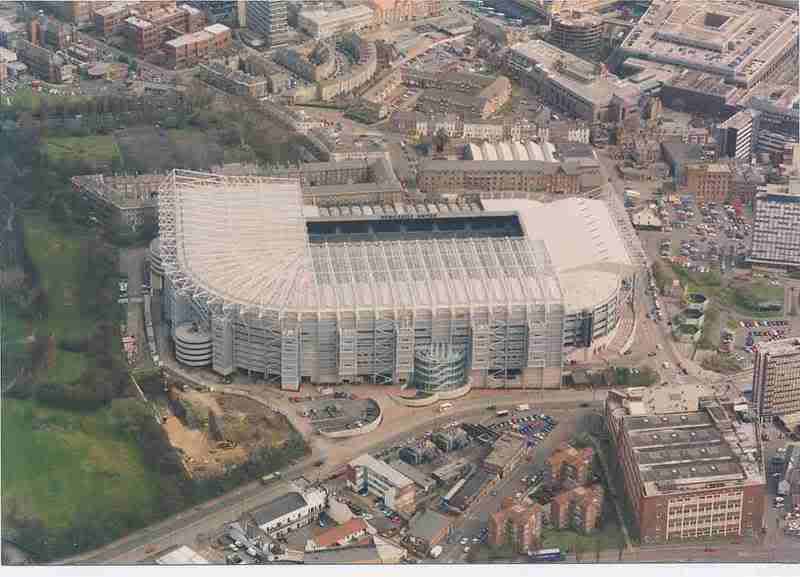
The St James' Park Story: Part 1
ST JAMES' PARK is the oldest football stadium in the North East, football having first played on the turf as early as 1880.
The story of the development of Newcastle United's traditional headquarters on the edge of the city centre has been one of much intrigue featuring intense local politics over the years. It has been a talking point in the region for generations, and even at one stage led to words being spoken in the House of Commons.
The ground has been the home of three clubs; Newcastle Rangers, Newcastle West End and Newcastle East End who moved to the arena in the summer of 1892 shortly before changing their name to Newcastle United.
Situated on a small hill overlooking the city and part of the historic Town Moor owned by the Freemen of the City - which further complicated any development proposals - St James Park is very close to the spot of the city's execution gallows, the last hanging taking place in 1844, less than 40 years before football was first played in the vacinity.
Back in Victorian Tyneside, St James Park was barely a rough patch of grazing land and had a notorious slope, a drop of fully 18 feet from the north to south goal. Local butchers could still graze their animals on the pitch before being led to slaughter!
The ground was bounded by Leazes Park and the exquisite Georgian Leazes Terrace, built to house some of the elegant ladies and gents of Tyneside. While the classical architectural features of Leazes Terrace provided a magnificent backdrop to the arena, it would in the future cause the Club untold difficulties in trying to develop stands around such a historic and listed building.
By the time Newcastle East End had been installed at St James Park development had only been completed in a minor way. And when Newcastle United started to take part in Football League action a small stand had been erected, but local residents were soon complaining to the Town Clerk and threatened to take legal proceedings to stop the "intolerable nuisance" of playing football!
With Newcastle United's promotion to the First Division in 1898, the club made a big effort to start to develop the ground. However, approvals from the local corporation came very slowly and in February 1899 it was recorded that the club were even prepared to move from the site because of the poor state of the pitch and accommodation.
Major building work eventually started though, with a new stand at the Gallowgate End being erected, the pitch being levelled and relayed and a terrace formed on the other sides of the ground. A corrugated iron fence enclosed the ground and the capacity was announced at 30,000.
A much bigger and grandiose development plan was put in to action only 5 years later when a complete reconstruction of the ground took place. United's growing stature - they were to win three Championships in the coming years - prompted the club to think and act big.
From a modest 30,000 stadium United soon opened what was classed as the best stadium in the country at the time, one to house upwards of 60,000. A huge new stand was erected on the Barrack Road side of the ground and substantial terraces formed on the remaining three sides of the ground.
Also built was a vast swimming pool beneath the stand with player's facilities, a luxury touch the envy of every club in the Football League. The new stadium was opened in September 1905 with pomp and ceremony. Tyneside at the time had a stadium to be proud of - however one that remained largely unaltered for the next 70 years as further development plans were constantly thwarted.
During the Twenties decade the club attempted to take development a stage further, putting plans together for covered accommodation on the open sides of the ground. Archibald Leitch, a distinguished football ground architect who built, among others, Stamford Bridge, was employed to produce a scheme which included double-decker stands and complete cover around the ground.
However, after much wrangling between landlord and planners which lasted to 1930, all that was built was a modest cover over the Leazes End enclosure.
The St James' Park Story: Part 2» Click to show Spoiler - click again to hide... «
The St James' Park Story: Part 2
NEWCASTLE United have - as tenants of the prestigious St James' Park site - never had an easy route from the outset in attempting to modernise their facilities (more details on the current structure can be found on the Stadium page under the Club section).
Immediately after World War Two, the board again attempted to erect a stand on the Leazes Terrace side of the ground but could not come to any agreement.
And during the Fifties United's officials were again in turbulent disagreement with the Council over the thorny question of developing the same side of the stadium. United applied to build a two-tier stand, which would have increased capacity to 80,000. Newcastle United's plan never got off the drawing board.
Relationships between club and council dipped to an all time low in the early sixties once United lost the 1966 World Cup attraction due to the inability to secure a development package for St James Park. The World Cup organising committee not unreasonably insisted that substantial improvements had to be made before handing the lucrative stage venue to St James Park.
With no decision having been made regarding the club's 1958 proposals, United lodged further plans in 1963 together with a request for a lengthy extension to their lease to protect Newcastle's proposed hefty investment. Meeting after meeting followed, claim and counter-claim bounced around, and headline after headline was created. All that came out of a sorry saga was that the two parties couldn't agree.
The council even drew up their own proposals for a multi-purpose stadium, a 40,000 capacity "Wembley of the North", but the club wanted no part of it. Intermingled into the dispute was a local political Labour v Tory feud as well. There was even talk of the club being evicted from Gallowgate! It was no surprise when the World Cup managers called it a day and handed the stage matches to Middlesbrough instead. Newcastle missed out on the biggest feast of football Britain was to see.
Newcastle United's board was furious. And it was certainly not the end of the affair. For another 20 years the battle over development raged on. After another multi-use sports centre concept was put forward by the Council, the Magpies made serious plans to move from the site.
In April 1966 details were revealed of a new arena in Gosforth and by 1968 Newcastle had applied for planning permission. Minister for Sport, Dennis Howell was asked to mediate between the club and landlord, but United pressed ahead with a �1m super-stadium near the racecourse.
However, at the last moment in 1971, some semblance of agreement with the Council materialised and the plan was scrapped. A new scheme had at last been agreed for the transformation of St James Park. Yet there was still a long way to go, and many more arguments before redevelopment took shape.
The agreed proposal consisted of four new cantilevered stands all around St James Park, giving an eventual capacity of 47,340. In January 1972 work started on a new Leazes Terrace stand - almost 50 years since the club had first applied for planning permission on that side of the stadium. A year later the stand was opened - even then it appeared to be jinxed and was some months late due to a builder's strike.
It was some time before the next phase started. In 1978, the Leazes End terrace - for so long the favoured haunt of United's fans - was demolished and work started on a cantilevered stand behind the goal. But relegation and recession hit United's finances and there were more problems with the City planners - the Leazes Stand never got out of the ground.
The St James' Park Story: Part 3» Click to show Spoiler - click again to hide... «
The St James' Park Story: Part 3
IN THE aftermath of the Bradford City fire disaster in 1985, local councils aimed safety checks on all existing facilities and considering the age of United's West Stand, the Magpies were bound to have problems - and they did. The structure came under vigorous inspection. Newcastle had to start to plan for a replacement.
Another redevelopment proposal was lodged - with the original scheme now scrapped - but the City Council refused permission for the project. Further discussions took place and eventually part of the scheme was accepted.
In the close season of 1986 United demolished the 80 year old West Stand and commenced work on an impressive looking �5m structure to become the centre-point of the club's activities. To be named the Milburn Stand as a lasting tribute to Jackie Milburn, it was opened during the 1987-88 season.
Still there was much needed further development of the arena required to take St James Park into the modern era. This however was shelved due to the club's perilous financial position. Newcastle United needed a miracle both on and off the field as the nineties decade opened. That miracle arrived in the shape of Sir John Hall who completed a take-over of the club in the opening weeks of 1992.
From that moment everything changed in the fortunes of Newcastle United. And the thorny question of redeveloping St James Park was high on Sir John's agenda. With his experience in property development and his substantial financial backing, a complete new proposal was submitted to the Council for approval. This time Sir John and his team were to reach a quick agreement.
The adversity of the past was over. The years of feuding buried. Work started immediately to transform the Gallowgate site at a cost of almost �25m into a stadium to rival any in Britain.
Firstly the Leazes End structure at last rose from the ground. Renamed the Sir John Hall Stand, it was opened for United's debut in the Premiership in 1993. Substantial modifications to the Milburn Stand took place, a new pitch and drainage system installed, new floodlighting as well as the construction of the Gallowgate Stand and infilling all corners of the stadium to produce a marvellous all seater bowl with capacity of around 37,000.
Added were impressive corporate and office facilities. Within the space of three short years the new showpiece stadium had been completed. It was a remarkable feat when compared to the previous 70 years of feuding.
Yet the Club still had one major hurdle to overcome. The success of the Magpies warranted a much, much bigger capacity. Newcastle soon needed to expand. Three options were on the table; further develop St James Park, move to another site close by and construction a brand new arena, or move out of the city, to somewhere like Gateshead. A whole new prolific debate was unleashed on the Tyneside public. Few supporters wanted to move from their traditional home, while the majority were totally against moving outwith the city boundary.
After much heated debate the club drew up plans for a new 55,000 capacity, �65m stadium to be constructed next door to St James Park in Leazes Park. The existing facilities would be transformed into an indoor arena with extensive parkland between the two centres. It appeared the perfect answer and would have been a great sporting monument for the region to rival Europe's best; the Amsterdam arena, San Siro and Stade de France.
But Newcastle United fell into a political quagmire and had to cope with every sort of fringe opposition group with the outcome that the scheme would have to go to Public Enquiry and result in a lengthy delay before commencement - if indeed at all.
Newcastle could not afford to wait. With almost 20,000 paying customers not being able to gain entry to Gallowgate, the club had to reconsider and switch to further developing St James Park. The club's revised proposals to increase the much needed capacity to over 52,000 has been achieved by constructing two huge double tiers to both the Milburn and Leazes Stands at a cost of over �40m.
After a lengthy - and another controversial planning process - permissions were granted in July 1998 after the Secretary-of-State refused to call-in the application, avoiding the same fate as the Leazes Park development.
The conclusion to a century of development wrangles was finally sealed. With completion achieved in August 2000, United's new Millennium stadium is an impressive sight and a landmark for the region.
For more details on the modern structure visit the Stadium page under the Club section.
Kit Story» Click to show Spoiler - click again to hide... «
BLACK'N'WHITE ORIGINS
Unlike many clubs, Newcastle United have traditionally kept their famous black and white colours since the day before the turn of the 20th Century when the Club's directors decided to bin their pioneering outfit as worn by Newcastle East End. It was way back on August 2nd 1894, when the Magpies decided to discard the red of United's founding club.
The East Enders pulled on all red shirts then, as well as a jersey of, amazingly, red and white stripes! Meanwhile, their great rivals for Tyneside prominence over the first decade of organised football, and the other half of Newcastle United's origins, Newcastle West End pulled on various colours. It has been established that they played in red and black-dark blue hooped shirts.
The Club's board meeting journal record the change in colours: "It was agreed that the Club's colours should be changed from red shirts and white knickers to black and white shirts (two inch stripe) and dark knickers." This would stop the frequent colour clashes which were occurring in the Second Division at the time. Nowhere though, in those official minutes does it state why they selected black and white. And there is still no definitive answer to that mystery.
A few theories have been put forward over time. The most popular surrounds a fervent supporter from the city's Blackfriars monastery, Father Dalmatius Houtmann. This Dutchman was often to be seen with United's players in the years before the turn of the century, the monastery being just a goal-kick away from St. James' Park. He was dressed in a traditional black and white habit, and it has been suggested that the Club decided to adopt his colours.
Another legend that has been handed down over the years is the story of a pair of magpies nesting in the old Victorian Stand at St. James' Park. It was said that United's players of the time became so attached to the two birds that they picked their distinctive colours of black and white and named themselves the Magpies.
Another suggestion goes back deep into history and the English Civil War, tracing the black and white colours to a famous 17th-Century Cavalier, William Cavendish (1593-1676). As Earl, and later, Duke of Newcastle, he had strong connections with Tyneside and Northumberland, which have remained in the region to this day. The City still has a Cavendish Place, and large areas of the region were at one time owned by the family. Streets like Welbeck Road, Devonshire Place, Portland Terrace and Bentinck Road have Cavendish connections, while the Earl also owned Ogle and Bothal castles in Northumberland. The Cavendish heraldic crest of three white stags on a black background - the first black'n'white connection - was to be seen all over the North East.
And when Civil war raged, Cavendish was of course very much a Royalist man. He raised an volunteer army on Tyneside, known as the Newcastle Whitecoats and their black and white attire became very distinctive. Their white shirts, dark pants and hats, along with their black leather boots, belts and pouches looked the part. They must indeed have looked like the very first Toon Army! The Cavendish, and Whitecoats, colours of black and white continued in the region for many years and it is entirely probable that this is where Newcastle United's famous colours originated.
After changing from East End's red colours, for the first two decades of Newcastle United's history the Club saw their side wear dark blue shorts, not black, in many games up to the First World War. And in the years leading to the hostilities, United pulled on a shirt with broad stripes featured on the front and back of the jersey. It was the start of a remarkable series of differing designs of black and white stripes.
In the Twenties the stripes became narrower, while centre stripes varied from white to black. Generally though, the Club shirt remained the same right up to season 1958/59 with the exception of a change in collar from the "grand-dad" look to a conventional one. However with Charlie Mitten installed as boss, his modern and continental influence gave the black'n'white a dramatic change. In came a streamlined version, but few liked it in an era of traditional values. The kit was perhaps a decade ahead of its time and was rapidly shelved, to be replaced by a more convential style for the Sixties.
During the following decade, kit manufacturers started to play a major part in football. A succession of companies like Bukta, Umbro and Asics started to find imaginative ways of designing United's classical black'n'white striped shirt using logos, side flashes, different styles of collars, and the introduction of blue tints as United's third colour. And with the introduction of a Club sponsor, the Magpies had Newcastle Breweries' famous Blue Star emblazoned on the shirt from season 1982/83, now replaced by present sponsors NTL's colourful logo.
Season 1989/90 saw probably the most unusual design when a mix of narrow and broad black and white stripes produced a "bar-code" look that took a while to get used to. World giants adidas have been United's kit manufacturer as well as a major sponsor for several years and they have produced a succession of quality designed kits. It is quite amazing what can be done with black and white stripes!
Club Information
» Click to show Spoiler - click again to hide... «
Nickname
The Magpies
Club Colours
Home: Black & white stripe shirts, black shorts, black socks
Away: Green shirts, white shorts, white and green socks
Third: All blue
Ground Capacity
52,387
Pitch Measurements
105 x 68 Metres
Record Home Attendance
68,386 v Chelsea, 3rd September 1930 (Division One)
Record Average Attendance
56,299 Season 1947-48 (Division Two)
Football League Champions
1904-05; 1906-07; 1908-09; 1926-27
FA Cup Winners
1910; 1924; 1932; 1951; 1952; 1955
UEFA (Fairs) Cup Winners
1969
Record Victory
13-0 v Newport County (h), Division 2, 5th October 1946
Record Defeat
0-9 v Burton Wanderers (a), Div Two, 15th April 1895
Most League Points
45, Division Two, 1964-65, (Two Points Win)
96, Division One, 1992-93 (Three Points Win)
Most League Goals
98, Division One, 1951-52
Record Transfer Fee Received
�13.667 million for Jonathan Woodgate in August 2004
Record Transfer Fee Paid
�16 million for Michael Owen in August 2005
This post has been edited by kueks: Jun 18 2011, 03:17 PM 

 Nov 30 2010, 11:42 PM, updated 15y ago


 Quote
Quote










 0.0198sec
 1.10
1.10
 6 queries
 GZIP Disabled