

 Sep 30 2008, 02:58 AM, updated 17y ago


photo by google
CLASSIFICATION
» Click to show Spoiler - click again to hide... «
All centipedes are in phylum Arthropoda, class Chilopoda.
The class Chilopoda contains 5 living orders. (order Devonobiomorpha is extinct):
Scutigeromorpha, Lithobiomorpha, Craterostigmomorpha,
Scolopendromorpha and Geophilomorpha.
The class Chilopoda contains 5 living orders. (order Devonobiomorpha is extinct):
Scutigeromorpha, Lithobiomorpha, Craterostigmomorpha,
Scolopendromorpha and Geophilomorpha.
BIOLOGY
» Click to show Spoiler - click again to hide... «
Centipedes are quite common invertebrate animals which are found in soil, litter, underneath stones, bark and sometimes even found on walls in caves or homes or on top of roofs.
Scolopendrid centipedes are found across all climates, but the giants are only found in the tropics and warmer temperate regions. They inhabit deserts, forests, mountains, woodland, limestone caves, etc.... Species from temperate regions are usually of moderate size (1cm to 10cm)=(1/2" to 4") in length but many tropical species of the order Scolopendromorpha are large and can grow up to (23cm to 28cm)=(9" to 11"). They live alone and are nocturnal. During the day they can be found in damp, dark places (ex. underneath stones) When the weather is too wet or too dry they seek other locations, including the insides of homes.
The body of a Scolopendrid centipede can easily be divided into two sections, head and trunk.
The head contains a headplate (cephalic plate) with or without ocelli, 2 antennae and the poison claws (maxillipeds) which wrap forward under the head, but are in fact part of the 1st tergite of the trunk. The legs of the 1st trunk segment are modified to form the poison claws which are used to seize prey. The remaining segments of the trunk each hold a pair of legs, the last pair (ultimate legs) are larger and pointing backwards, these ultimate legs function as pincers or have been adapted for stridulation (Alipes sp.).
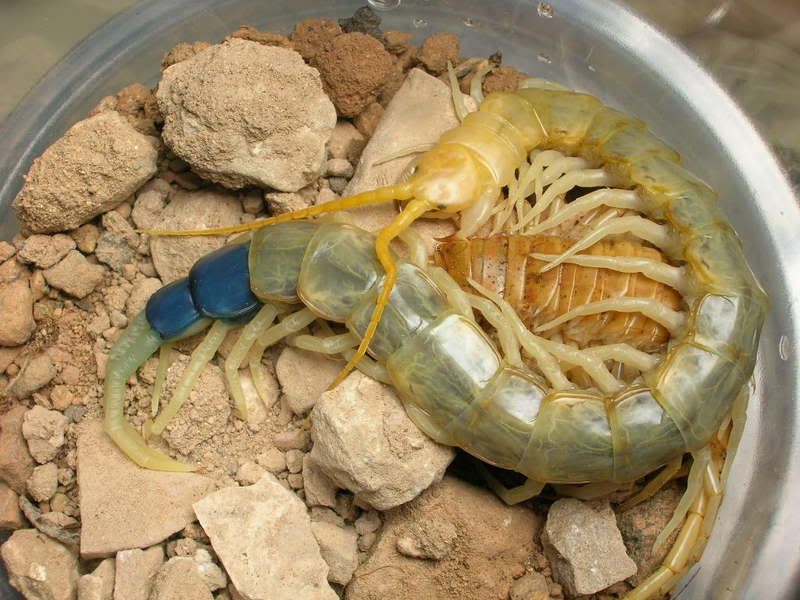
Their color can vary from drab brownish, yellowish to dark with brightly coloured parts in red, orange, green, blue or violet. Coloration is not a good start to identify a centipede, the coloration changes during their lifespan and young immatures usually have very different colors then the adult specimen in a same specie. The climate in which young instars are been raised can also have influence in the pigmentation on adult specimen.
Scolopendrids are soft-bodied and dorso-ventrally flattened centipedes. The body is composed of hardened plates connected by flexible membranes. The exoskeleton is mostly composed of chitin, a non-living layer, which does not grow. Centipedes (like all other invertebrates) need to shed (replace the exoskeleton) if they are to grow, known as moulting or ecdysis.
Scolopendrid centipedes are found across all climates, but the giants are only found in the tropics and warmer temperate regions. They inhabit deserts, forests, mountains, woodland, limestone caves, etc.... Species from temperate regions are usually of moderate size (1cm to 10cm)=(1/2" to 4") in length but many tropical species of the order Scolopendromorpha are large and can grow up to (23cm to 28cm)=(9" to 11"). They live alone and are nocturnal. During the day they can be found in damp, dark places (ex. underneath stones) When the weather is too wet or too dry they seek other locations, including the insides of homes.
The body of a Scolopendrid centipede can easily be divided into two sections, head and trunk.
The head contains a headplate (cephalic plate) with or without ocelli, 2 antennae and the poison claws (maxillipeds) which wrap forward under the head, but are in fact part of the 1st tergite of the trunk. The legs of the 1st trunk segment are modified to form the poison claws which are used to seize prey. The remaining segments of the trunk each hold a pair of legs, the last pair (ultimate legs) are larger and pointing backwards, these ultimate legs function as pincers or have been adapted for stridulation (Alipes sp.).
Their color can vary from drab brownish, yellowish to dark with brightly coloured parts in red, orange, green, blue or violet. Coloration is not a good start to identify a centipede, the coloration changes during their lifespan and young immatures usually have very different colors then the adult specimen in a same specie. The climate in which young instars are been raised can also have influence in the pigmentation on adult specimen.
Scolopendrids are soft-bodied and dorso-ventrally flattened centipedes. The body is composed of hardened plates connected by flexible membranes. The exoskeleton is mostly composed of chitin, a non-living layer, which does not grow. Centipedes (like all other invertebrates) need to shed (replace the exoskeleton) if they are to grow, known as moulting or ecdysis.
KEEPING AS PETS
HOUSING
» Click to show Spoiler - click again to hide... «
Centipedes have flexible pleural zones, between the hard sternites and tergites.
This way they can sqeeze underneath rocks or logs to hide or crawl into crevices in nature.
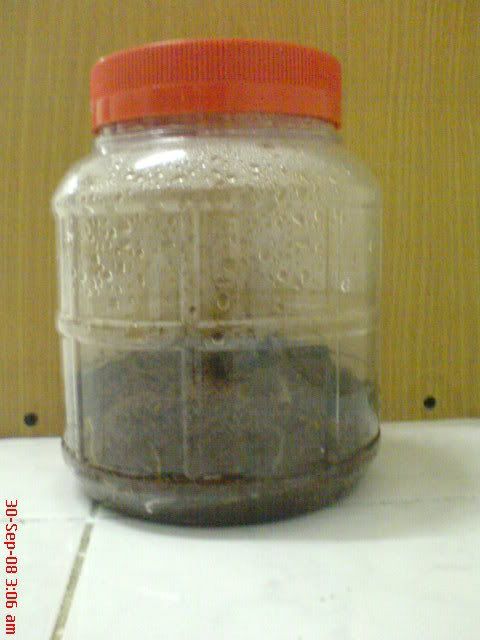
Keep this in mind when choosing the right enclosure to house your pet-scolopendrid.
They can easily crawl trough a small airhole, or a lid that's not closed fairly. They are true escape artist and while you're sleeping they have plenty of time to examine their new houses on any oportunities to escape.
A general rule for the minimum cage size for an adult pet-scolopendrid are:
Lenght => 2 x the bodylenght of the scolopendrid.
Width => 1 x the bodylenght of the scolopendrid.
Height => 1 x the bodylenght of the scolopendrid + substrate height.
(to prevent them to reach the top of the enclosure)
Smaller specie or young adolescent ones can be kept in smaller round enclosures.
A diameter of 2 x the bodylength of the scolopendrid is enough. It's easier this way for the young or smaller ones to catch prey.
You can use all types of substrate and hidingplaces, just keep in mind the substrate should be suitable for the centipede to dig in and it should have some rather moist area's,... not dripping wet and it should be thick enough to make a burrow. (example for larger spec. 10cm - 4" thick)
Hidingspots should be big enough for the Scolopendrid to make a burrow underneath.
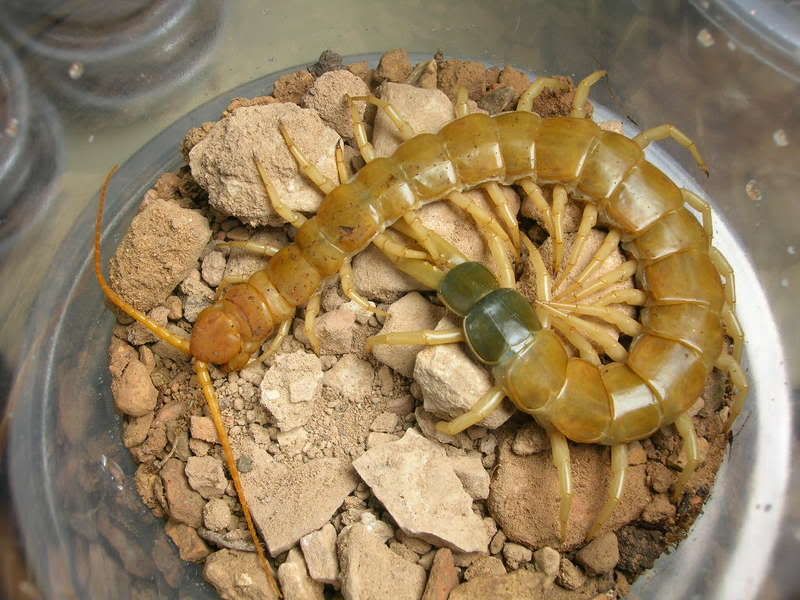
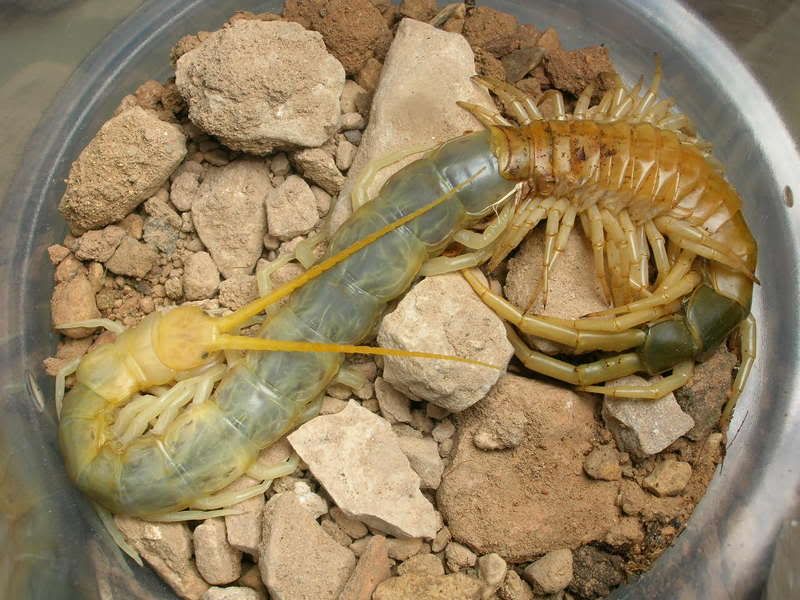
I use limestone mixed with soil as substrate for desert specie .
Rainforest specie i keep on a mix of soil and sand.
Some flat rocks, stones, logs, corkbark are great hidingspots for your pet.
It's also recommendable to provide a small waterdish so they'll have acces to drinkingwater anytime. You can decorate your tank with some leaves, moss or plants,... but the Scolopendrid won't mind if you don't.
Try to keep the enclosure clean and get rid of feeding-leftovers a.s.a.p..
I keep small groups of woodlice (Crustacean) in the enclosures to clean up the the substrate, larger spec. of Scolopendrid won't be interested in them as food.
This way they can sqeeze underneath rocks or logs to hide or crawl into crevices in nature.
Keep this in mind when choosing the right enclosure to house your pet-scolopendrid.
They can easily crawl trough a small airhole, or a lid that's not closed fairly. They are true escape artist and while you're sleeping they have plenty of time to examine their new houses on any oportunities to escape.
A general rule for the minimum cage size for an adult pet-scolopendrid are:
Lenght => 2 x the bodylenght of the scolopendrid.
Width => 1 x the bodylenght of the scolopendrid.
Height => 1 x the bodylenght of the scolopendrid + substrate height.
(to prevent them to reach the top of the enclosure)
Smaller specie or young adolescent ones can be kept in smaller round enclosures.
A diameter of 2 x the bodylength of the scolopendrid is enough. It's easier this way for the young or smaller ones to catch prey.
You can use all types of substrate and hidingplaces, just keep in mind the substrate should be suitable for the centipede to dig in and it should have some rather moist area's,... not dripping wet and it should be thick enough to make a burrow. (example for larger spec. 10cm - 4" thick)
Hidingspots should be big enough for the Scolopendrid to make a burrow underneath.
I use limestone mixed with soil as substrate for desert specie .
Rainforest specie i keep on a mix of soil and sand.
Some flat rocks, stones, logs, corkbark are great hidingspots for your pet.
It's also recommendable to provide a small waterdish so they'll have acces to drinkingwater anytime. You can decorate your tank with some leaves, moss or plants,... but the Scolopendrid won't mind if you don't.
Try to keep the enclosure clean and get rid of feeding-leftovers a.s.a.p..
I keep small groups of woodlice (Crustacean) in the enclosures to clean up the the substrate, larger spec. of Scolopendrid won't be interested in them as food.
FEEDING
» Click to show Spoiler - click again to hide... «
Centipedes in captivity can be fed live or dead food. Scolopendrids are active nocturnal predators but sometimes also scavage on corpses. Their food can consist of small or large insects, small rodents or reptiles. In captivity the most common food used are roaches, crickets, grasshoppers and for the larger specie sometimes baby mice (pinkies). Alternatives can be earthworms, mealworms, bacon, beef, banana, mango, etc.... but these shouldn't be the main dish of the centipedes meal.
Scolopendrids aren't sensitive to an irregular feeding schedule or of the quantities they'll get. Plenty of times overfeeding causes more trouble than underfeeding. Left-over crickets or decomposing food can seriously harm your pet-scolopendrid !
If there are still feeder-insects running around the centipedes enclosure after 2 days the centipede can be overfed or is preparing for an upcoming molt. Advicable to remove the left-overs and don't feed the centipede for 1 or 2 weeks.
Personally i don't feed any live rodents to my pet-scolopendrids, although their famed ability to eat mice, it's still riskfull and not necessary as they also take on dead meat.
Scolopendrids aren't sensitive to an irregular feeding schedule or of the quantities they'll get. Plenty of times overfeeding causes more trouble than underfeeding. Left-over crickets or decomposing food can seriously harm your pet-scolopendrid !
If there are still feeder-insects running around the centipedes enclosure after 2 days the centipede can be overfed or is preparing for an upcoming molt. Advicable to remove the left-overs and don't feed the centipede for 1 or 2 weeks.
Personally i don't feed any live rodents to my pet-scolopendrids, although their famed ability to eat mice, it's still riskfull and not necessary as they also take on dead meat.
MOULTING
» Click to show Spoiler - click again to hide... «
The skin of centipedes (exoskeleton) is mostly composed of chitin, a non-living layer, wich does not grow. So if centipedes want to grow, they need to shed (replace the exoskeleton) known as moulting or ecdysis. The actual shedding process can take a half hour or up to 2 hours.
Young instars do molt aprox. every 2 or 3 months, fullgrown adults only once or twice a year.
Adults can shed for regenerating lost bodyparts (such as antennae, legs, ultimate legs)
When a centipede is about to molt you can notice the old exoskeleton getting loose, the centipede is getting a dull color (starts at the ultimate legs) and won't eat at this time. (best to avoid having live-food with the centipede at this moment,... as they could damage the centipede when he's molting !) During the molting process the new exoskeleton is still very soft and flexibel, it can take up to 2 days before the new skin is fully hardened. Centipedes usually eat their shedded skin right after they molted, to regain strength.
Young instars do molt aprox. every 2 or 3 months, fullgrown adults only once or twice a year.
Adults can shed for regenerating lost bodyparts (such as antennae, legs, ultimate legs)
When a centipede is about to molt you can notice the old exoskeleton getting loose, the centipede is getting a dull color (starts at the ultimate legs) and won't eat at this time. (best to avoid having live-food with the centipede at this moment,... as they could damage the centipede when he's molting !) During the molting process the new exoskeleton is still very soft and flexibel, it can take up to 2 days before the new skin is fully hardened. Centipedes usually eat their shedded skin right after they molted, to regain strength.
this is just the basic care sheet, it is taken from http://www.scolopendra.be/news.php
go to the website to learn more and they have plenty of pictures too!!
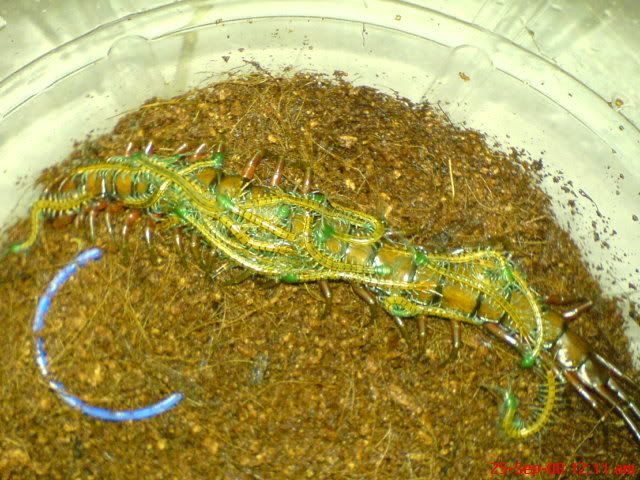
mama and her babies
So lets all join in the fun and learn more about this amazing creatures!!
This post has been edited by littlesaint: Nov 2 2008, 02:26 AM
 Quote
Quote



 0.0262sec
 0.59
0.59
 6 queries
 GZIP Disabled