QUOTE(singchaii @ Jun 21 2008, 09:08 AM)
Yeah. Soft turbo.. Actually it mean single blade not only have 1 blade la. hehe.. I also not sure. need someone which do turbo car to clarify about this

. Picture I dun have it now as my friend still helping me finding it.
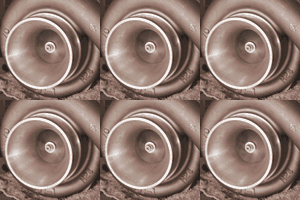
I found the picture on net. TD05 Single blade.
» Click to show Spoiler - click again to hide... «
ooo
hmm...would like to see the inside if can
once u fren find post for us to see k

QUOTE(singchaii @ Jun 21 2008, 09:08 AM)
Turbo Charge la. You know what, carburetor also can run turbo charge.

wont that system have quite bad fc?
...no electronics to control fuel input wor...
QUOTE(singchaii @ Jun 21 2008, 09:08 AM)
Yes. I see some station is RM2.74 and some is RM2.72. But it not of the petronas. Is because of the petrol station itself. You sent this to petronas, then that petrol station will be dead meat.
i tot fuel prices at the pump is controled from a central office
didnt know the fuel station can change it themselves
tot all was controled through that satalite dish that all stations have

QUOTE(singchaii @ Jun 21 2008, 09:08 AM)
Nope. If you have bigger turbo, then make sure the piping and intercooler is suitable to compress the pressure. Mean bigger turbo, bigger piping and bigger intercooler. Because turbo is running about pressure. If those air not compress in the piping and intercooler, then will happen turbo lag. That why usually you see those bigger turbo have bigger intercooler piping and intercooler. But not all turbo user care about this. What the care, janji ada turbo.

actually, the intercooler is to drop the temperature of the air so that it becomes more dense
when the air is compressed by the turbo turbine, it adheres to the universal gas law:
PV=T
where P is pressure, V is volume and T is temperature
so according to this formula, if P goes up, as it does in a turbo system, the T will go up also
so if the temperature of the gas can be reduced, oxygen density can be increased
turbo lag is not caused by intercooler size
i understand why you are saying that bigger pipes will reduce it
to a certain extent that is true
but the biggest contributor to turbo lag is the the turbine size
the larger the turbine, the higher the boost it can achieve
but also the heavier it is and thus the higher the inertia
inertia is the resistance of a mass to change of motion
newton's law states that a mass in motion will stay in motion and a mass at rest will stay at rest unless acted upon by an external force
as the turbine gets larger, the inertia increases so the time it takes to spin up to its operating speed where it can boost the intake air is longer
a smaller turbine which will be lighter will be able to spin up much faster thus reducing the "lag" from the time the pedal is pressed to the time the turbo kicks in
this is why supercharged cars do not have the lag coz they are tapping their power directly from the engine rather than having a turbine in the exhaust which has to spin up
the trade off is ofcourse parasitic load on the engine
higher end turbo cars now are moving towards multi staged turbos to reduce turbo lag to a minimum
they use more than one turbine starting with a small turbine to kick in and then slowly switch over to the bigger turbine once it is up to speed
this method is very effective
the only draw back is the additional cost


 Jun 21 2008, 08:30 AM


 Quote
Quote







 0.0276sec
 0.80
0.80
 6 queries
 GZIP Disabled