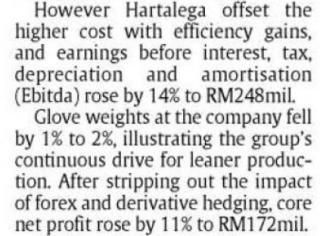
Derivative hedging means making a bet on the future movement of currency, either up or down.
Ie. USD is currently 3.05. The company expect the currency to go lower to USD 3.00. The company have 6-month sales target of 10 mil usd.
They hedge RM/USD exchange rate in the future at 3.05 by setting up contract to sell let says 10 mil USD to be delivered in 6 months time + about 1% contract fees.
If at end of 6 months average USD is now 3.01, they lose money from their sales (10 mil x (3.05-3.01) = -400K USD.
However they also earn from their derivative contract (10mil x (3.05-3.01)) - (100K contract fees)= +300k USD
If at end of 6 months average USD is now 3.08, they make money from their sales (10 mil x (3.08-3.05) = +300k usd
However they will lose from their derivative contract (10mil x (3.05-3.08) - 100k contract fees = -400k usd
In both scenario they minimize their gain/loss
However if sales drop and currency goes out of control, they will suffer huge losses...from derivative play

Example sales drop to 5 mil and USD shoot up to 3.20
Sales gain is 5mil x (3.20-3.050 = + 750K usd
Derivative = 10 mil x (3.05-3.20) = - 1500K usd
A company should just focus on their main business in jmy view. This hedging is like gambling to me. But if their main income is from exports, I guess they want to maximise the gains (but with risk of loosing). Heard that MAS was hedging on the jet fuel price during Idris time and they profited from it. Lucky speculation? Ha.
I guess one way to find out whether a company has the required skill in hedging is to look at their past hedging performance. Right ? Any other ways?
Cheerio.


 Nov 8 2012, 03:04 PM


 Quote
Quote





 0.0239sec
 0.71
0.71
 7 queries
 GZIP Disabled