

QUOTE(HikayatSalju @ Dec 22 2025, 10:35 AM)
Why international news report different?

https://www.scmp.com/week-asia/people/artic...477e7f34aea4061

Corrected edi. Tak faham bm kot 🤣😁🤣https://www.scmp.com/week-asia/people/artic...477e7f34aea4061
BERAK: Najib has lost to stay in HOUSE ARREST
|
|
 Dec 22 2025, 11:14 AM Dec 22 2025, 11:14 AM
Show posts by this member only | IPv6 | Post
#61
|
 
Senior Member
5,757 posts Joined: Jan 2003 From: Sri Kembangan  
|
QUOTE(HikayatSalju @ Dec 22 2025, 10:35 AM) Why international news report different? Corrected edi. Tak faham bm kot 🤣😁🤣https://www.scmp.com/week-asia/people/artic...477e7f34aea4061 |
|
|
|
|
|
Dec 22 2025, 11:14 AM
|

Junior Member
43 posts Joined: Nov 2013
|
So cannot go back to..
» Click to show Spoiler - click again to hide... « |
|
|
Dec 22 2025, 11:15 AM
Show posts by this member only | IPv6 | Post
#63
|

Junior Member
162 posts Joined: Mar 2020
|
QUOTE(submergedx @ Dec 22 2025, 11:06 AM) babi fake newssssssssssssssssssss Kalau x tipu bukan doggygamingpro🫢😁🤣 |
|
|
Dec 22 2025, 11:16 AM
|

Senior Member
1,712 posts Joined: Aug 2009
|
QUOTE(ZeroSOFInfinity @ Dec 22 2025, 10:27 AM) Enjoy the Kajang satay specially prepared for you during Chirstmas!  |
|
|
Dec 22 2025, 11:16 AM
|

Senior Member
566 posts Joined: Oct 2006
|
QUOTE(milolauda @ Dec 22 2025, 11:11 AM) crazy la if thief can have home stay , stole so much in Malaysia if you want to be a thief make sure you steal billions or hundred millions, don't steal susu tepung or sardin.dllm march4th liked this post
|
|
|
Dec 22 2025, 11:16 AM
Show posts by this member only | IPv6 | Post
#66
|
|
Senior Member
5,757 posts Joined: Jan 2003 From: Sri Kembangan
|
QUOTE(Schumacher @ Dec 22 2025, 10:44 AM) The law is clear that no one can challenge the Agong’s power to grant respite. I hope raja raja melayu will call n emergency meeting to to address. N grant full n immediate pardon to show who is the boss. Every other conviction will be immediately pardoned as well. xtrabite liked this post
|
|
|
|
|
|
Dec 22 2025, 11:19 AM
|

Senior Member
7,272 posts Joined: Nov 2008 From: SINGAPORE💃
|
» Click to show Spoiler - click again to hide... « no need AI la bro, its already clearly stated .. YDPA has the power to "mengampunkan", in this term means "kurangkan" hukuman, this article never mention that YDPA has the power to put him under "house arrest", however YDPA has the power to overrule this article and release with pardon (must be done with the approval of all the Raja-Raja Melayu) which happened on PMX case ..  Artikel 42 (Perbicaraan Najib Razak) (42-1) Memberi kuasa prerogatif kepada YDPA untuk mengampunkan, menangguhkan, atau meringankan hukuman bagi kesalahan yang dilakukan di Wilayah Persekutuan. YDPA juga boleh meremit (menggantung) atau meringankan apa-apa hukuman yang dijatuhkan mahkamah bagi kesalahan tersebut. (41-2) Berdasarkan Perkara 42, Lembaga Pengampunan Wilayah Persekutuan mengurangkan hukuman penjara dan denda bekas Perdana Menteri, Najib Razak, membenarkan beliau dibebaskan lebih awal pada Ogos 2028. Ia adalah satu kuasa istimewa Raja-raja Melayu (YDPA) untuk memberi keadilan tambahan di luar sistem mahkamah biasa, berfungsi melalui nasihat Lembaga Pengampunan. |
|
|
Dec 22 2025, 11:21 AM
Show posts by this member only | IPv6 | Post
#68
|
|
Senior Member
5,757 posts Joined: Jan 2003 From: Sri Kembangan
|
QUOTE(milolauda @ Dec 22 2025, 11:11 AM) crazy la if thief can have home stay , stole so much Apa yg dia curi? If dia yg curi kenapa KERAjaan kiri kanan succesirecovered this recovered n not from najib pun so siapa yg curi sekarang?dllm |
|
|
Dec 22 2025, 11:21 AM
Show posts by this member only | IPv6 | Post
#69
|

Newbie
10 posts Joined: May 2013
|
as usual, start bashing race already  march4th liked this post
|
|
|
Dec 22 2025, 11:24 AM
|
|
Senior Member
1,926 posts Joined: Feb 2016
|
QUOTE(tifosi @ Dec 22 2025, 10:48 AM) Already cut from 12 years to 6 years, just sit diam diam till end of 6 years la. So the 6 years after deducting this that holiday, behaviour merit agak agak which year keluar in style?Don't pattern banyak march4th liked this post
|
|
|
Dec 22 2025, 11:24 AM
|

Junior Member
565 posts Joined: Oct 2007 From: MARS
|
well well, this week gonna have lots of commentator in media
|
|
|
Dec 22 2025, 11:24 AM
|

Senior Member
1,176 posts Joined: May 2006 From: Memesia
|
hahahaha Kajang also not bad wat
|
|
|
Dec 22 2025, 11:29 AM
|

Junior Member
121 posts Joined: Apr 2011
|
QUOTE(desmond2020 @ Dec 22 2025, 11:09 AM) ayam ask AI if i read correctly, both of the cases cited means the decision is not open to debate or challenge because He-Who-I-Cannot-Name has the absolute power.In Malaysia, whether the King's (Yang di-Pertuan Agong) power to grant a pardon is discretionary is a subject of significant legal debate, with a notable conflict between constitutional text and judicial interpretation. The Legal Context (Article 42 of the Federal Constitution) The Power: Under Article 42(1), the King has the power to grant pardons, reprieves, and respites for offenses tried by court-martial and those committed in the Federal Territories. The Pardons Board: The King presides over a Pardons Board, which includes the Attorney General and a Minister. The Debate: Discretionary vs. Bound by Advice Constitutional Argument (Non-Discretionary): Article 40(1A): Introduced in 1994, this clause stipulates that in exercising his functions under the Constitution, the King "shall accept and act in accordance with" advice provided. Legal experts and the Malaysian Bar argue that because Article 40(2) specifically lists only four discretionary powers (and pardons are not among them), the King must follow the Pardons Board’s advice. Judicial and Governmental View (Discretionary/Absolute): Non-Justiciability: Malaysian courts, including the Federal Court, have consistently ruled that the power of pardon is a "royal prerogative" and is non-justiciable, meaning it cannot be challenged or reviewed in court. Judicial Precedent: In cases like Sim Kie Chon and more recently in 2023 (Anwar Ibrahim v Mohd Khairul Azam), the courts held that the power is personal to the King and is an "absolute" discretion. Government Stance: In 2025, government representatives have reiterated that the King retains "absolute authority" to decide on pardons, even despite the recommendations of the board. Summary of Current Status (2025) While the written Constitution (Article 40(1A)) suggests the King is bound by advice, the courts' interpretation remains that the power is a personal, absolute, and non-justiciable prerogative. Consequently, in practice, the power is treated as discretionary and final what i cited is just saying before the power is exercised at the Pardon Board, He-Who-I-Cannot-Name will follow the advice. |
|
|
|
|
|
Dec 22 2025, 11:29 AM
Show posts by this member only | IPv6 | Post
#74
|

Junior Member
70 posts Joined: Jun 2007
|
As usual, all the racist comments comes out march4th liked this post
|
|
|
Dec 22 2025, 11:29 AM
Show posts by this member only | IPv6 | Post
#75
|

Junior Member
130 posts Joined: Feb 2015 
|
Then boleh dapat full pardon lah?
HAHAHAHAHA 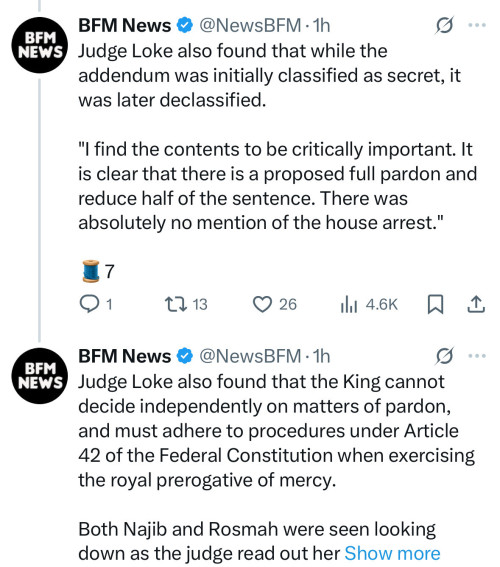 |
|
|
Dec 22 2025, 11:30 AM
|

Senior Member
774 posts Joined: Nov 2010
|
QUOTE(jojolicia @ Dec 22 2025, 11:24 AM) So the 6 years after deducting this that holiday, behaviour merit agak agak which year keluar in style? Someone calculated should be 2026/2027 i think |
|
|
Dec 22 2025, 11:30 AM
|
|
Senior Member
1,204 posts Joined: Sep 2010
|
QUOTE(Blackscreamerz @ Dec 22 2025, 11:01 AM) I read 40(3), 42(1) and 44(4) together. Thats why the Pardon Board exists. The Pardon Board’s role is only to advise on pardon applications. Nowhere does it state that the Agong can grant a respite only if the matter has been deliberated by the Pardon Board.But i miss the addendum cause i didnt follow the details of his case. so it is procedural issue. This post has been edited by Schumacher: Dec 22 2025, 02:07 PM |
|
|
Dec 22 2025, 11:31 AM
|

Senior Member
1,035 posts Joined: Feb 2007
|
QUOTE(AyamBannedTwice @ Dec 22 2025, 11:29 AM) Then boleh dapat full pardon lah? Either or ke?HAHAHAHAHA Kalau gitu dah discount means fulfil la? |
|
|
Dec 22 2025, 11:32 AM
|
|
Junior Member
121 posts Joined: Apr 2011
|
QUOTE(Schumacher @ Dec 22 2025, 11:30 AM) The Pardon Board’s role is only to advise on pardon applications. Nowhere does it state that the Agong can grant a respite only if the matter has been deliberated by the Pardon Board. The judge is essentially making new rules, which I believe is unconstitutional. I was tempted to search for Pardon Board role and objective of formation.but i need to rush weekly report lol....i guess i leave it to the experts here to answer... |
|
|
Dec 22 2025, 11:33 AM
|
|
Newbie
1 posts Joined: Apr 2015
|
bad news for rosmah , waited for so long , cannot love love with Ajib Gor
|
| Change to: |  0.0174sec 0.0174sec
 1.47 1.47
 6 queries 6 queries
 GZIP Disabled GZIP Disabled
Time is now: 24th December 2025 - 09:49 PM |
 Quote
Quote
