Welcome Guest ( Log In | Register )

Outline · [ Standard ] · Linear+

 Malaysia lands, Embarrassment.

views
     
nihility
post Jun 6 2025, 02:55 PM

Regular
******
Senior Member
1,596 posts

Joined: Sep 2021


QUOTE(Porkycorgi5588 @ Jun 6 2025, 02:40 PM)
you got watch video or not?
it's distribution.

investor come in, expect data center only.
local authorities are expected to give TNB substation for free.

Which for big development, is unspoken requirement for you like resurfacing the roads around your site.
However, this usually means 33kV or 11kV substations only. Those are typically close to end user location.
Your problem is with 110kV substations which usually servers entire industrial parks.

Building those take time. C&S is 1 year + if you quick, but you also gotta wait 2 years for the transformers to be built and commissioned.

Land is cheap where these facilities don't exist.
Where these facilities exist, land is not cheap.

This is partially why there has been such a huge push for Solar for industrial players lately to shed TNB load in order for TNB to supply to data center instead.

Water infra also an issue for the same reason. Problem is clean water for cooling tower HVAC systems used by datacenters.
*
Rare to see someone from the industry willing to spill the beans.
nihility
post Jun 6 2025, 04:45 PM

Regular
******
Senior Member
1,596 posts

Joined: Sep 2021


QUOTE(Syie9^_^ @ Jun 6 2025, 03:14 PM)
execution slow then how? bring katana? laugh.gif
more beans please corgi. biggrin.gif
more beans please.
*
You post something like this and expect quality replies? No wonder Malaysia feels hopeless sometimes...

About the utility readiness —if you were the utility provider, ask yourself: Would you invest in expensive infrastructure first, and then hope the customers come later?

We’re talking about large-scale infrastructure that involves massive CAPEX — not a few thousand ringgit, but millions or even billions.
No utility provider will commit that kind of spending unless they can recover it.
If there are no confirmed users, no ability to bill, and a real risk of underutilization — who wants to answer to the board for spending without guaranteed demand?

It’s just logical business decision-making.

When a data center comes in, their power requirements are huge. We're not talking about small-scale installations with a single or double chamber that take a few months to commission. A typical data center may need anywhere from 5 MW to 20 MW — which means they need a PMU.

That PMU needs its own building, proper design, and must be constructed and handed over to TNB.
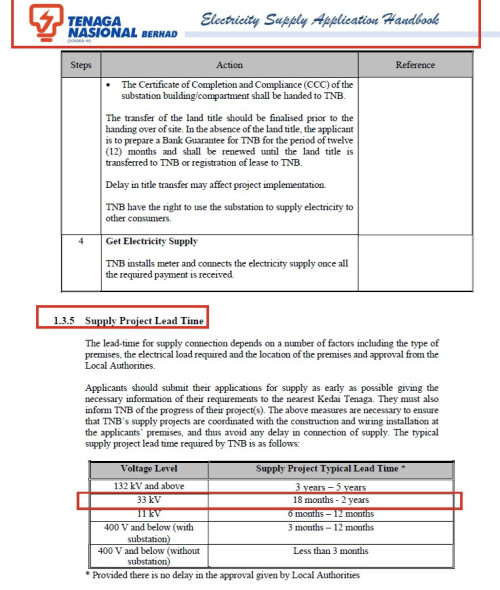
Only after TNB officially takes over can they begin their part — which could take another 18 to 24 months for external 33kV cabling and energization.

user posted image
Reference taken from the TNB's Handbook

Even if the DC building construction is fast-tracked, the overall project still hits a bottleneck when it comes to power readiness from the utility provider like TNB.

The same issue applies to SAJ when it comes to water supply — if the current water tower can’t meet the demand, a new one needs to be built, and that takes time.

So the ang moh companies face this problem here and act surprised — as if they won’t face similar issues elsewhere (Thailand, Philippine or Australia )?
Unless there’s a comprehensive master plan that has been in place for years specifically to cater for data center needs, I doubt any town planner or state government would be crazy or foolish enough to build such large infrastructure without a guaranteed anchor client.

nihility
post Jun 9 2025, 12:05 PM

Regular
******
Senior Member
1,596 posts

Joined: Sep 2021


QUOTE(hjh87 @ Jun 6 2025, 05:31 PM)
Guys, it's not just 33kV. As far as I know, these large DC projects currently require 275kV. Inside the TNB portal for consultation, it already shows that TNB has established a dedicated team to handle this type of project.

Normally, for 275kV—or even 132kV, which I've seen before—the fastest completion time is around 2 to 3 years. Keep in mind, this involves pylon erection and land acquisition, which can be a huge mess, especially when private land is involved.

The building and internal infrastructure are quite straightforward; it's the external infrastructure that's going to be the real challenge.
*
No one dare to reply your post but I appreciate your reply. One 275 kV PMU can theoretically power about 2.5 to 3 cities the size of Petaling Jaya at peak demand. The, 275kV demand is very huge !

For a 275 kV to be completed within 2 to 3 years is already a miracle. The land acquisition is not an easy matter when it involves private land — in case the private owner contests the compensation of the land acquisition. The public thinks it is a wet market transaction.

What’s saddening is the ang moh highlighting the problem (without exploring the cause of the problem), but the readers just believe it without any intention to understand the depth of the issues faced in the distribution.

~

Practical Example (Malaysia)
PMU Serdang East (275 kV AIS):
Took approximately 30 months from ground-breaking to energization.

PMU Olak Lempit Upgrade (275/500 kV):
Estimated project duration was 36 months due to complexity and transformer upgrades

~

The public who criticize these delays are like people asking why a baby can’t be born faster by getting nine women pregnant at the same time.

If the ang moh wants to compare Malaysia with other countries — Thailand, the Philippines, or Australia — and if those countries truly can build a 275 kV substation faster, then yes, TNB should reflect on why others can deliver the "baby" sooner.

But until we see that happening consistently elsewhere, the public needs to educate themselves. You can’t rush something that naturally takes time. Just like making a baby — it takes nine months, no matter how impatient you are. In this case - 275kV PMU need minimum time around 30-36 months ( if the existing site do not have any 275KV PMU)


nihility
post Jun 10 2025, 04:58 PM

Regular
******
Senior Member
1,596 posts

Joined: Sep 2021


QUOTE(hjh87 @ Jun 9 2025, 05:22 PM)
Thanks for providing the example of the time taken for those PMUs.

This is just my personal opinion, and I understand it may offend certain firms, especially those who design oversized infrastructure because their fees are tied to a percentage of the total construction cost. In my view, not all data centers necessarily require a 275 kV connection — in many cases, 132 kV might be sufficient.

That said, the final decision ultimately lies with the operators and depends heavily on the project’s budget.

On another note, for projects involving the government, the approval and development process can be significantly faster. I won’t name specific projects, but there are cases where 132 kV sites were delivered on a fast-track basis. It often comes down to whether the government is willing to support the project. Once the Land Acquisition Act is invoked for TNB (Tenaga Nasional Berhad), the project typically proceeds smoothly, with compensation matters handled afterward.

Under Malaysian Acts, TNB can also leverage certain legal provisions ("Akta") to their advantage.

Again, I’m just sharing some rough insights — no offense intended.
*
No worries about causing offense — no one is getting offended, at least not me. This is a public forum, after all. We're here to share information, not to offend anyone or make enemies.

I appreciate your responses.


Change to:
| Lo-Fi Version
0.0166sec    0.46    6 queries    GZIP Disabled
Time is now: 17th December 2025 - 07:50 AM