

 Jun 1 2025, 09:18 PM


QUOTE(lurkingaround @ Jun 1 2025, 07:48 PM)
Because you have to keep the car on while you slow charge to keep the DC/DC converter working.
If it was above 20% he can off and lock the car and charge.
So are you asking him to leave the car on for 2 hours while he slow charge the main traction battery?
You believe wrongly.

No, you believe wrongly, .......
.
https://www.reddit.com/r/electricvehicles/c...vs_12v_battery/ - r/electricvehicles 1 yr. ago
Positive_Guarantee20
ELI5: Traction battery vs. 12V battery
....
deleted
As a safety measure, all EV cars disconnect the Traction Battery after no usage between 5-10 minutes of isle no powered on state. The 12v passively maintains the car's ECUs at that point.
Therefore, a 12v will only charge from the Traction Battery when the car is operational, as in driving.
lbfb
This isn’t neccacarly true of the Ioniq 5 ( and maybe all E-GMP, but not sure there). The I5 will engage the traction battery to top up the 12V as long as the former is above, I believe, 20% SoC. That’s what the orange light on the dashboard is indicating, that the high voltage system is active.
Likely issue for the OP is that the 12V batteries in some I5s just die eventually. Assuming the vehicle has had all TSBs applied I believe it should be fine once the 12V is replaced. Don’t know if it’s been stated or determined if they’re dying because of something the vehicle is doing or they’re just crap batteries.
retiredminion
Not all EVs. Teslas will keep the low voltage battery refreshed from the traction battery.
I left my 2021 model Y with the older 12v lead acid battery parked and unplugged for 3 weeks and everything was fine when I returned. So too my wife's 2023 model 3 with the 16v lithium low voltage battery. Even most newer ICE cars would have 12v battery problems after being parked for 3 weeks.
retiredminion
Apparently you missed the part that said "... most newer ICE cars ...".
The reason is due to all of the electronics that continuously draw power in newer vehicles. I'm not personally familiar with farm vehicles but I'm guessing they don't generally provide things like keyless entry, remote functions, alarm systems, etc. ....
.
NZgeek
In general, it works like this:
The low voltage (usually 12v, but newer Teslas use 48v) battery powers the car's systems when it's not in a ready-to-drive state.
When the car is put into a ready-to-drive state, the high voltage traction battery takes over and an inverter produces the lower voltage needed for the car's systems.
The traction battery is disconnected when it's not needed. This is likely for safety reasons: why expose the car's systems to 400v/800v if it's not being used? The connection/disconnection mechanism typically lives inside the traction battery pack, whereas the inverter to low voltage usually lives outside the battery pack (to help with cooling).
It's fairly common for EVs to monitor the level of the low voltage battery, and to use the traction battery to charge the low voltage battery as needed. The 12v battery is also often charged when the car is charging from the wall.
There usually aren't many parasitic drains on the low voltage battery. The worst drains are usually caused by apps that contact the car, e.g. to get its charge status for a smart charger. This can prevent the car's systems from going into sleep mode, causing it to drain the low voltage battery a lot more than it should.
.
yawn If it was above 20% he can off and lock the car and charge.
So are you asking him to leave the car on for 2 hours while he slow charge the main traction battery?
You believe wrongly.
No, you believe wrongly, .......
.
https://www.reddit.com/r/electricvehicles/c...vs_12v_battery/ - r/electricvehicles 1 yr. ago
Positive_Guarantee20
ELI5: Traction battery vs. 12V battery
....
deleted
As a safety measure, all EV cars disconnect the Traction Battery after no usage between 5-10 minutes of isle no powered on state. The 12v passively maintains the car's ECUs at that point.
Therefore, a 12v will only charge from the Traction Battery when the car is operational, as in driving.
lbfb
This isn’t neccacarly true of the Ioniq 5 ( and maybe all E-GMP, but not sure there). The I5 will engage the traction battery to top up the 12V as long as the former is above, I believe, 20% SoC. That’s what the orange light on the dashboard is indicating, that the high voltage system is active.
Likely issue for the OP is that the 12V batteries in some I5s just die eventually. Assuming the vehicle has had all TSBs applied I believe it should be fine once the 12V is replaced. Don’t know if it’s been stated or determined if they’re dying because of something the vehicle is doing or they’re just crap batteries.
retiredminion
Not all EVs. Teslas will keep the low voltage battery refreshed from the traction battery.
I left my 2021 model Y with the older 12v lead acid battery parked and unplugged for 3 weeks and everything was fine when I returned. So too my wife's 2023 model 3 with the 16v lithium low voltage battery. Even most newer ICE cars would have 12v battery problems after being parked for 3 weeks.
retiredminion
Apparently you missed the part that said "... most newer ICE cars ...".
The reason is due to all of the electronics that continuously draw power in newer vehicles. I'm not personally familiar with farm vehicles but I'm guessing they don't generally provide things like keyless entry, remote functions, alarm systems, etc. ....
.
NZgeek
In general, it works like this:
The low voltage (usually 12v, but newer Teslas use 48v) battery powers the car's systems when it's not in a ready-to-drive state.
When the car is put into a ready-to-drive state, the high voltage traction battery takes over and an inverter produces the lower voltage needed for the car's systems.
The traction battery is disconnected when it's not needed. This is likely for safety reasons: why expose the car's systems to 400v/800v if it's not being used? The connection/disconnection mechanism typically lives inside the traction battery pack, whereas the inverter to low voltage usually lives outside the battery pack (to help with cooling).
It's fairly common for EVs to monitor the level of the low voltage battery, and to use the traction battery to charge the low voltage battery as needed. The 12v battery is also often charged when the car is charging from the wall.
There usually aren't many parasitic drains on the low voltage battery. The worst drains are usually caused by apps that contact the car, e.g. to get its charge status for a smart charger. This can prevent the car's systems from going into sleep mode, causing it to drain the low voltage battery a lot more than it should.
.
 , Now bringing Ioniq into the picture when the topic is on Atto3?
 You can try to divert all you want but , you like to jump here and there with no coherence in your argument.
Now you want to bring up a point in Ioniq 5 and Tesla as though it's going to help you in anyway.
You love to put unrelated piece of information. Tesla has its own algorithm and ioniq 5 has its own algorithm.
Bringing up how other car works , doesn't change the fact that BYD has its own algorithm and you were wrong.
QUOTE
lurkingaround claims:- The traction battery recharges the 12V battery "periodically" when the BMS detects low voltage for both parked and driving.
QUOTE
Therefore, a 12v will only charge from the Traction Battery when the car is operational, as in driving.
LOL your own long winded statement already proved your statement wrong.
This post has been edited by Drian: Jun 1 2025, 09:25 PM
 Quote
Quote

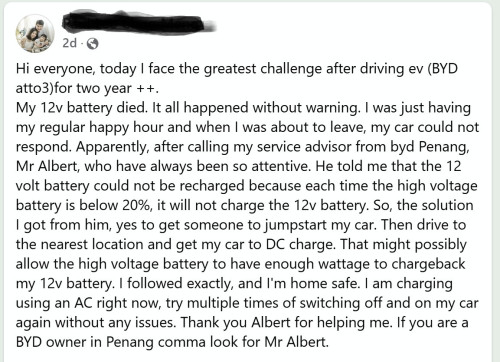 [/url]
 0.0116sec
 0.21
0.21
 5 queries
 GZIP Disabled