In WW1 and WW2, you'd end up with 120men companies. And that's company level, not down to platoon or squad-level yet.
Yes i realise using the term regiment is not quite accurate to describe a single unit. My point is there is less emphasis on cohesion in formations of units...more on movement, surpression and cover.
Moving to modern times will change what we know of Total War. I mean imagine WW2 in RTW.
Massive new info and goodies! Empire: Total War FAQ 6
» Click to show Spoiler - click again to hide... «
QUOTE
Hi guys,
Welcome to our sixth Empire: Total War FAQ, where this month we tackle even more of your Land Battle questions…
Will guns be distinguishable by their appearance and smoke etc?
You will be able to tell the difference between very large, large, medium and small cannon, carronades, 8 and 10 inch mortars, rifles, carbines and muskets, I’m not sure you will get more granularity than that. We felt that anything more is unlikely to be noticed in the thick of battle.
If artillery gun crew lines are broken, will they flee to safer ground until its safe to return, or will they route from the field?
This question is not easily answered as it depends on the situation. If the artillery is sufficiently spooked, they will flee. If not, they will route to a safer place until they can return to their guns or the situation turns so bad they have to run from the field of battle.
Can we have the option to preview a battlefield before choosing battle?
Generals don’t always get to pick the ground that they fight on and great generals will even take the ground chosen by the enemy and make it their own. Or to put it another way: The current mechanism assumes that the battlefield chosen is the best that could be attained as a result of manoeuvre and counter manoeuvre of opposing forces and the limits of terrain in the area. We give the player time to review the battlefield in the deployment phase and there are a number of cues as to the likely composition of the battlefield obtainable by looking at the campaign map.
Will Empire: Total War generals (not captains) play a lesser role in field combat compared to previous Total War games?
It depends? If the question is: will they be less likely to be able to act like a powerful killing machine the answer is a categorical yes. In the period of this game generals were far less renowned for their individual prowess (although some exceptions are present that prove the rule - e.g. Charles of Sweden) in battle and much more for their ability to swing a battle by being at the right place at the right time and inspiring their troops with both good planning and sensible commands. In the same way, failure to place your general where he is most effective will result in problems keeping your troops from being quickly demoralised.
Will there be a “fire by rank” system for troops in line formation, e.g. British redcoats? And will you be taking into account that some armies may have better skills than others in some areas e.g. British troops could fire and reload their muskets faster then the French could?
The short answer to all that is yes but with some reservations. It will depend on a nation’s research into tactics, the units deployed, their experience, what system is used and how good they are compared to their opponents. The British were not always the best at everything. If they had been they would have beaten the Americans in the War of Independence, Wellington would not have needed the support of Blucher at Waterloo and he would not have said it was “a close run thing”.
Are different countries’ uniforms, colours and changes in uniforms included?
Yes but as much as we would like to include every uniform, every turn back, every button, every badge and every uniform colour represented by every nation, in the game, and reflect all those uniform changes in detail over the 18th century (100 years), the logistics really aren’t viable for a game made in the time we have.
As a result we chose to select a representative sample of uniforms from throughout the period to reflect that change and variety. Every nation has a “national colour” that we use to represent that nation and is featured strongly in their uniforms. On top of that we add variations, where we think its effective, in their uniforms that are appropriate either according to faction or unit type or in some cases both. That isn’t the end of things though.
Will Calvary with swords point their swords at the enemy who they are charging at instead of holding it upright like in “Rome: Total War”?
We completely overhauled the animations system for Empire. Cavalry will now lower their swords or lances in the final approach of a charge.
Can riflemen be ordered to hide in long grass and shoot when enemies are on top of them and then charge with bayonets?
Simple answer: Yes as long as they are trained in field-craft and you have researched the bayonet.
Early guns were very sensitive to damp and damage. Will this be represented in game?
Yes, of course. Rain and snow are both significant contributors to misfires and hang-fires, along with unit fatigue, training and morale states. If it is raining or snowing too much then gunpowder combat becomes next to impossible A particularly inept soldier can end up blinding themselves with a flash in the pan or rupturing a cannon and killing the crew.
Will the battle maps be bigger?
Yes they are. The battlefield playable areas are currently up to 1.4km2.
Will the environment determine movement rate and morale?
Yes both have a noticeable effect on the movement and morale of units, according to their origin and the environmental conditions
At the time of the American Revolution, the standard British six-pounder cannon had a crew of fifteen men working the gun (not just standing around it). Will we see this sort of realism reflected on the battlefield? If not, why?
Sadly, no we won’t have 15 men crews. This is because the choreography required was something we found to actually detrimental to gameplay as well as being incredibly complex to code. In the end we went for a smaller number that carry out a representative set of actions, most importantly those involving loading and firing.
Will it be possible to shot at the horses so they are dead, but the riders stand up and keep on fighting without their horses?
We are looking in to a suitable method of implementing this but we have yet to come up with a solution that works in all cases.
Will our men finally be intelligent enough to load their weapons while the enemy is still out of range, and then FIRE when the enemy gets into range?
That would depend on the player. Have you set your unit to fire at will or to fire when ordered? How well trained are your troops? If they have time, your units will change to their melee option.
Q: Will famous characters such as Wellington make an appearance in the game, and will they have special abilities to reflect their historical importance?
If the conditions are right they will.
What new character traits are there?
This is far too big a question to answer in an FAQ. Traits and ancillaries certainly haven’t been ignored. They have been updated and crafted to fit the period. Per character you can expect to see more meaningful, character building and far less contrary traits and ancillaries. Although this will mean fewer traits per character there will be no less variety than previous games.
That wraps it up for this month. Keep your questions coming on our official forums and stay tuned to www.totalwar.com for the latest updates!
Take care,
Mark O’Connell
Faction Preview: France
» Click to show Spoiler - click again to hide... «
France has had fifty years of military and administrative excellence under Louis XIV, the Sun King and his servants. They achieved this in spite of a backdrop of strife and rebellion sparked by France’s involvement in the Thirty Years War. Louis and his able ministers, Cardinals Richelieu and Mazarin, were able to steer France away from the feudal struggles that hampered growth, and they created a centralised government where the King’s power is absolute.
In 1700, France is the pre-eminent power in Western Europe, with an unrivalled army, vast colonies and a King who is respected and feared by all, both at home and abroad. Few nations pose any real threat to his well-equipped armies and heavily fortified borders.
The French Bourbon dynasty is strong, even though Louis XIV is aging. There are sons and relations aplenty, with legitimate claims to many titles. To the south, the lack of a Hapsburg heir in Spain – and the feeble-mindedness of Charles II – means that a Bourbon could one day rule in Madrid. A course of action that brings this about has much to recommend it. Of course, not all offshoots of the Hapsburg line are weak as their Spanish cousins. The Austrian Habsburgs, and other European nations, may not be entirely willing to see a Frenchman or French nominee as King of Spain. No matter.
France is surrounded by possibilities, and beyond Europe there are other continents to conquer and colonise: New France in North America, and the riches of India. The untrustworthy British may have to be swept aside or crushed, but what is wrong with that?
Land Unit : Grenadier
» Click to show Spoiler - click again to hide... «
Grenadiers are large, strong men, armed with muskets and carrying bags of bombs to hurl at the enemy’s ranks.
Explosive grenades are one of the oldest types of gunpowder weapon, and one of the most dangerous to use. Grenades are a simple cast iron ball, with a fuse sticking out of the top. Fuses are notoriously unreliable, and grenadiers can die as their own bombs explode prematurely. Yet no matter how terrifying grenades are for the throwers, they are infinitely worse for the targets! Grenadiers see themselves as elite, and occupy the place of honour at the right of the line on parade. They have good reason: only large, brave men become grenadiers, because it takes a big chap to throw one properly. Even their uniform makes them look bigger thanks to the pointed grenadier’s cap; a tricorne gets in the way of a good throw.
Historically, grenadier regiments and battalions began as ad hoc assault forces. All line infantry regiments had grenadier companies; collecting these sub-units gave commanders a useful group of heavily armed, aggressive and skilful soldiers. Grenadier companies remained in line infantry regiments after the creation of grenadier regiments, but they abandoned grenades. Instead, each grenadier company became a “heavy mob” of the biggest and strongest soldiers in a regiment.
Naval Unit : Sloop
» Click to show Spoiler - click again to hide... «
A sloop of war is usually ketch-rigged with two masts. These small vessels handle well in restricted waters.
The ability to navigate in exceptionally shallow or dangerous waters makes sloops very useful in such seas as the reef-strewn waters of the Caribbean. They can also operate without the need for extensive onshore naval facilities nearby. They are also extremely useful as fleet auxiliaries, carrying out communications tasks and vital inshore scouting work, and can hunt down smaller prey such as privateers and small enemy cargo vessels. A sloop-of-war (sometimes a corvette in French service) is a different vessel from a civilian, merchant sloop, having a flush deck, two square-rigged masts, guns, and a larger crew.
Historically, a post captain would rarely command a ship this small. The commanding officer was the “master and commander” (this is the origin of the modern naval rank of commander), and held the formal rank of lieutenant. Captain Cook RN commanded HMS Resolution, a sloop converted from a collier (coal ship), on his epic Pacific voyages and was highly satisfied with its performance. Sloop captains could be aggressive: before his promotion to post captain, Thomas Cochrane commanded the 14-gun HMS Speedy and managed to capture “El Gamo”, a Spanish xebec of 32 guns with a crew six times larger than his own!
Dev Diaries : Land Battles in the Old Regime and the early Enlightenment
» Click to show Spoiler - click again to hide... «
Hi there,
My name is Jamie Ferguson. I’m a senior game designer on the Total War series. Some of you may know me from the official forums where I show up, from time to time. In this two-part diary I’m going to be talking about both the historical background of war in the 18th century and its game implementation and impact on the Land battles of Empire: Total War.
Well, where do you start? Drinking a soldier’s 2-pint ration of grog (an 18th Century concoction of water, rum, sugar and limejuice) might get you in the mood but won’t help with keeping a clear understanding of things. We could just talk about the various features of battle in Empire Total War, but that wouldn’t really give anyone an insight as to why they are there. So bear with me as I’m going to include some background to the why and wherefores of Empire: Total War.
The first myth we have to destroy, as a developer of Empire, is the common and preconceived idea that 18th century warfare was “slow”, “plodding”, and just involved “blokes standing in a line and then blasting away at each other. Warfare in any period can be stripped to it’s most basic form. In previous Total War games – Shogun, Rome and Medieval, we’ve explored a wide variety of historical warfare and unlocked an enormous amount of fun through the strategic possibilities presented by each period. This is certainly the case with Empire – the land battles in this game will be the most spectacular and strategically varied we’ve ever created.
The reality of 18th century warfare was far from simplistic. It was based around a rapidly changing world, full of new and developing technologies, both in warfare and society. This was the era of the Enlightenment, the Agricultural Revolution and the beginning of the Industrial Revolution. The “old way” of doing things was being shaken to its foundations by new thinking, new writing, new weapons and anything else that seemed new. Battles in the Empire period were just as likely to become free flowing, and sometimes, chaotic affairs, as they were in any period before or since. Just as in history, a player in Empire will have to consider the formations and positioning of units at the beginning and during a battle. These will be important because manoeuvre, counter manoeuvre and tactical planning of well-timed attacks are a vital element of successful combat. Denying the enemy space for manoeuvre is, as a result, also essential. The principles then, are easy to grasp.
"All that is advantageous to the enemy is disadvantageous to you, and all that is useful to you damages the enemy" Vegetius
What is often forgotten is that the fast, dispersed and mobile warfare of the modern age is only possible because of electronic communications and modern weaponry. In the Empire period troops had to be within telescope range of the commanding general and musket armed troops needed to be used en-masse and at close range. After all smooth bore muskets were very unreliable and inaccurate, especially at the beginning of this period. Many a battle was lost for the want of a competent officer in the right place at the right time or the infantry lines becoming too raged and dispersed. To reflect this in Empire, your armies’ performance will be affected by your general’s proximity to his troops. Spread your forces too far and you might have problems on your flanks. Leave your forces to thinly spread and their fire becomes ineffective. All of this will require a successful player to think on their feet and be aware of the ebb and flow of the battle. The player is going to have to be aware of the use of combined arms (Infantry, Artillery and Cavalry and their formations) in order to get good results on the battlefield. Just lining up your troops and firing away at the enemy isn’t going to win unless the enemy are seriously outnumbered or you are protected by the walls of a fort against an enemy devoid of artillery.
"No man is to be employed in the field who is not trained and tested in discipline" - Vegetius
“Is that’s all that’s different?” You ask. Well, as many of our fans know, Total War games follow a Revolution/Evolution cycle. Empire is our revolution and appropriately enough revolutions were taking place on the battlefield, as well as in the streets and fashion houses of cities in the 18th Century.
So although, in 1700, there were still some, old style, 17th Century levy troops of pike-armed men and armoured heavy cavalry, their time was coming to an end. Even if the threat of being stabbed by a foot or two of sharp metal was still a good way of making the enemy blink, a massed volley of lead musket balls was an even more effective method of removing your opponents. Increasingly so, as musket weaponry was now beginning to be mass-produced and allowed standing armies of relatively cheap but combat effective troops. As a result new and, sometimes experimental, unit types were becoming common. For example Dragoons, Musket-armed Grenadiers, light infantry and line infantry and mobile artillery were becoming a permanent feature of standing armies. A far cry from the previous melee based armies of Total War. The armies the player starts with at the beginning of Empire will reflect this transitional phase. And it will up to the player to modernise, improve and build up their army. Failing to invest in research or improving your military infrastructure might result in your army being outclassed by its opponents.
"Let him who desires peace prepare for war." Vegetius
Unlike previous Total War games troops won’t only be a result of the buildings you construct. We wanted to create that feeling of revolution, change and innovation that was such a strong feature of the period throughout the game. For example; the soldiers that fought in this period were often a reflection of the government that they fought for. As a result unit availability won’t just be based on a faction or culture. They will also reflect your nation’s government type as well as its scientific and technological research. Revolutionary or Republican units aren’t going to be available to an Absolute monarchy and Imperial Household Guards aren’t going to be available to a Republic. The same also goes for technological advancement. A rifled musket unit isn’t going to be available unless you research all the right elements that make mass produced rifled barrels (as opposed to smooth bore muskets) possible.
In previous Total War games when you got something new you had to hire completely new units to take advantage of that new item. Although there are still cases where this is true, we now also have improvements that automatically get rolled out across your nation’s armies and navies. For example bayonet improvements starting with the “Plug” bayonet and moving through to the final “Socket” version that improve your musket troop’s melee ability and also gradually become less of a hindrance to your units’ ability to fire. There will be researchable innovations in military drills, such as the Prussian firing drills, that increase your units’ rate of fire. Or improvements in construction like the copper bottoming of ships, that make them less prone to fouling and thus faster moving. All of these will be rolled out to existing units, automatically.
Blimey! So much to talk about and so little time and space to tell you all about it. I guess I’m going to have to leave us there, waiting for the next part of this diary where I shall talk more about the actual units and the ways that the player can effect changes to the battlefield itself. Speak to you soon. http://www.totalwar.com
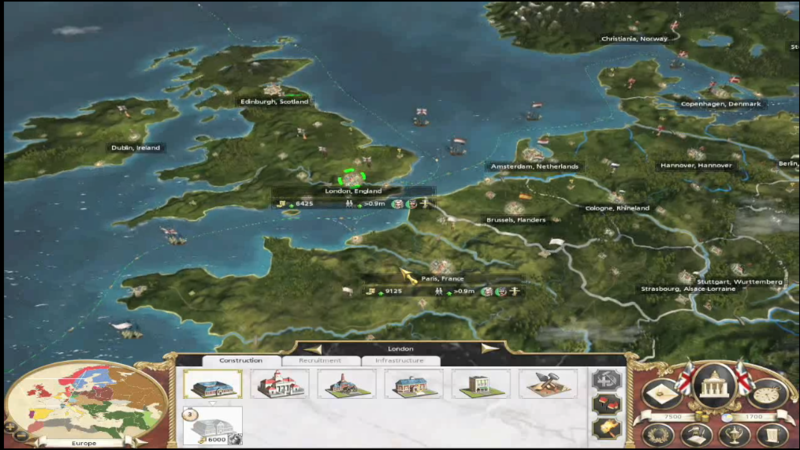
The system of provinces and regions are a bit different in Empire. As you can see whole of England is a single region. But the way it works is that there are outlying towns in that region and London is the capital of that region.
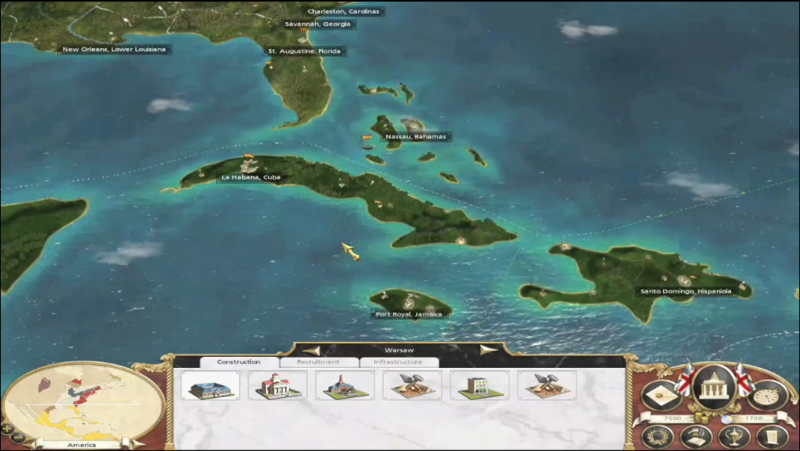
And yes you can settle in the carribeans. You dont build new colonies like civ still but maybe you take over existing settlements. You can see the water surrounding the Carribean is of a green colour. This will reflect in the naval battles in the area with greenish sea.
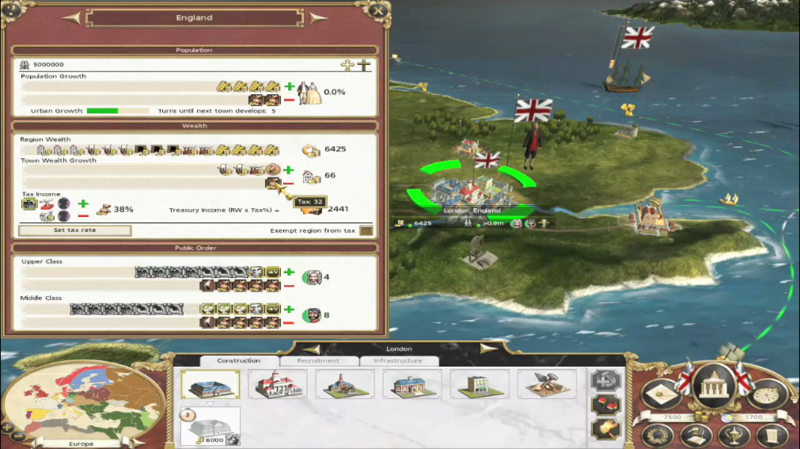
A lot of info in this screen. You can see here you have a single region management UI and this one is for England(when you click London). You can see that there is different happiness levels for the aristrocats and the plebes, you can set different tax levels for them or exempt taxes from the region(very handy if there is a rebelion going on).
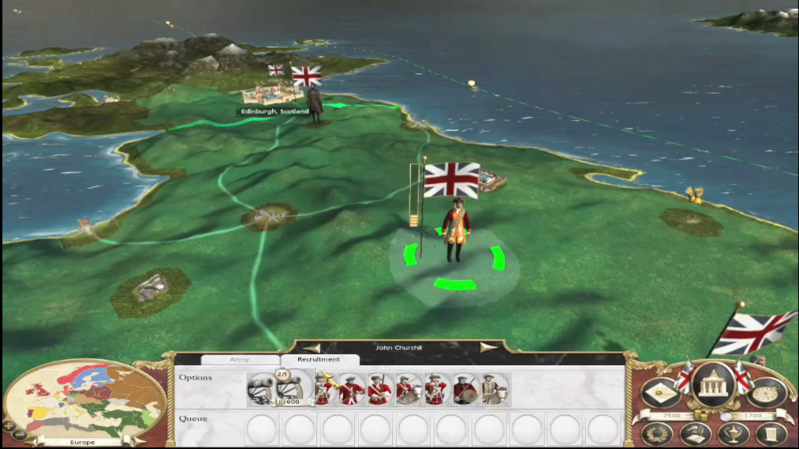
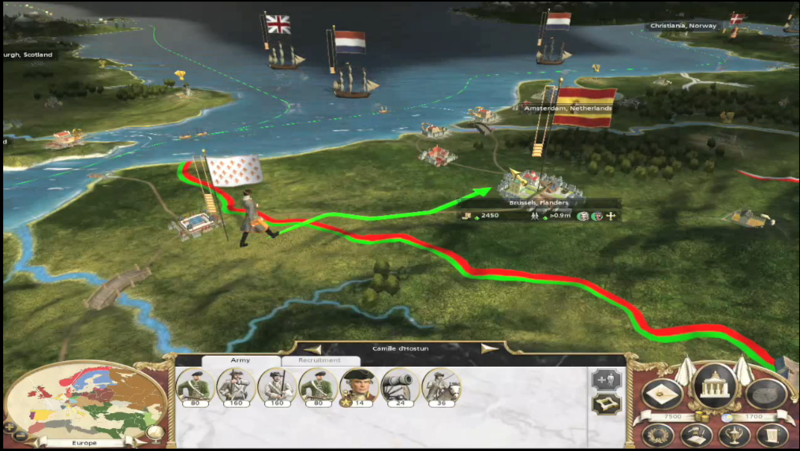
As it had been said before, you can recruit troops from your generals. Just click on your general and you are given the options of troops you can recruit from nearby towns(it depends on your upgrade level of course to determine what troops you get). Less micromanagement about remembering about recruiting troops from specific cities.
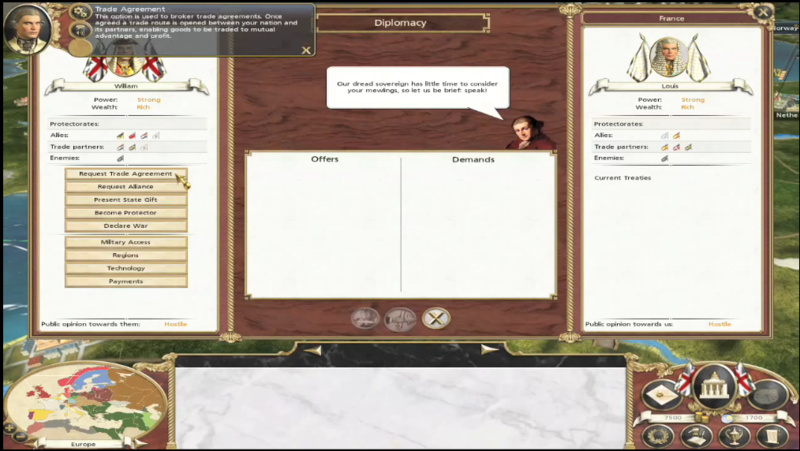
The functionality of the diplomacy screen looks similar to previous games except you can also trade technologies/ or sell them and use them for negotiation.
Major change(for the better)...you cant simply go waltzing in any territory. You need to declare war on a nation or sign a military access pact to be able to enter to a region not belonged to you.
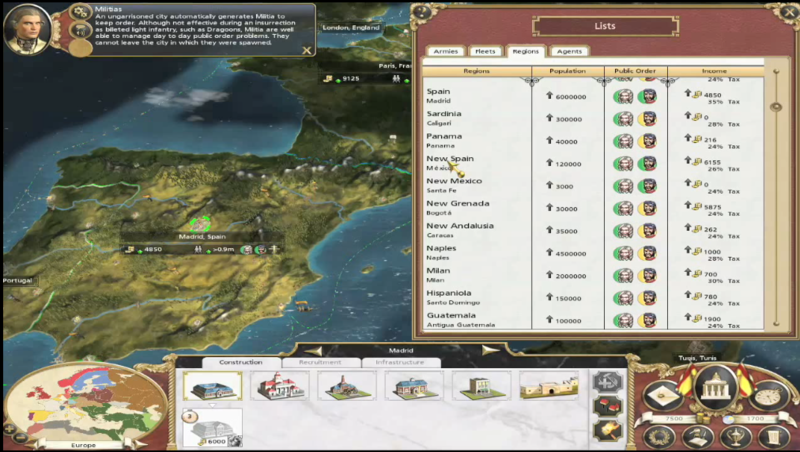
As usual you get an interface that allows you to look at your entire empire and be able to change tax rates etc. The tutorial message says any ungarrisoned city will generate militia which can defend the city. You cant move these militia out of the city. Militia are useful for day to day policing of public order.
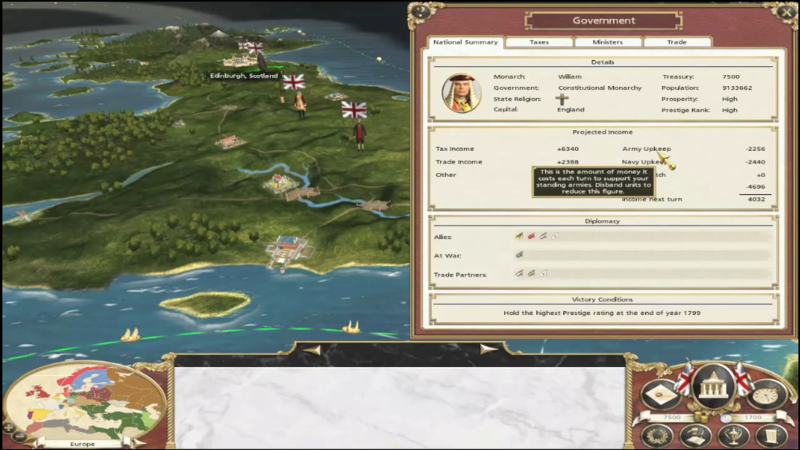
Here is a summary screen of your government and gives details such as properity, wealth, prestige, state religion, capital. There are different tabs and one named Ministers allow you to look at your cabinet and hire ministers which might give your specific boosts. Also the text below the summary says "Hold the highest prestige rating until the year 1799" kinda hints that the game ends at 1799 and doesn't go past 1800. You would most probably be able to continue past this like all previous games though.
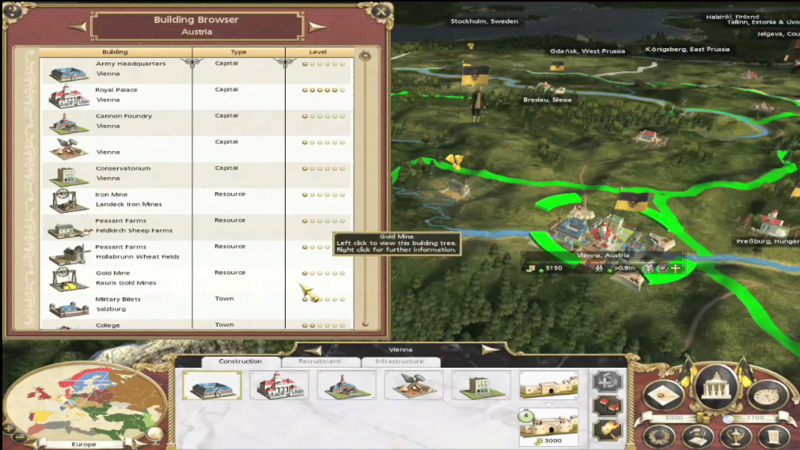
You can upgrade your capitals by focusing on trade or military by picking different upgrade types. You can see that some upgrades will appear in your capital and some will appear in outlying towns in your region.
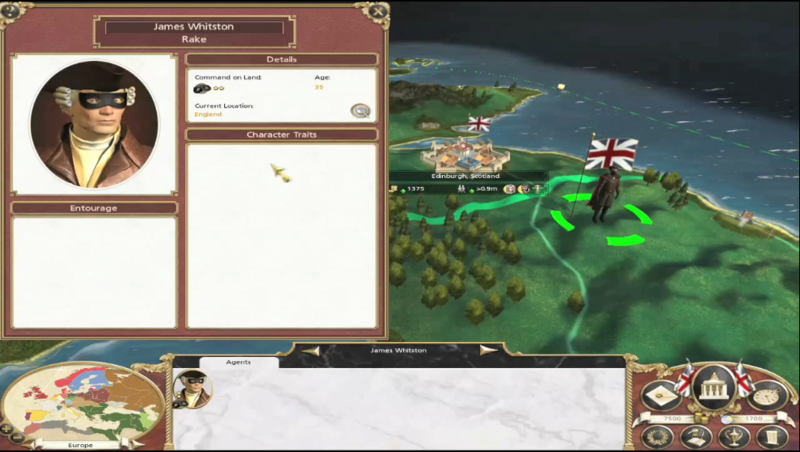
And of course you still have agents(reduced) like in Empire spying/assasination/sabotaging duties is done by the rake. Similar system with ancilarry charaters like previous total wars.
This post has been edited by frags: Oct 29 2008, 12:59 PM
Good News! Empire: Total War will be using Steam for its multiplayer infrastructure. No more gamespy!
QUOTE
Full Steam Ahead for Empire: Total War LONDON (28th October, 2008) – SEGA Europe Ltd. today announce that Empire: Total War™ will incorporate Steamworks™, a complete suite of publishing and development tools that offers PC game developers and publishers access to the game features and services available through Steam.
Steamworks will support both the retail and electronic versions of the Empire: Total War game giving players game updates, downloadable content, friend-list support and achievements. To play single-player Empire: Total War,players need only to connect to the internet once via the Steam client after installing the game.
Steamworks will serve as Empire: Total War’s multiplayer backend, providing server browsing and match-making functionality, bolstering Total War’s new level of commitment to multiplayer game modes and features. Further details on multiplayer will be announced soon.
SEGA is also pleased to announce the Special Forces Edition of Empire: Total War. This premium-packaged edition of the title offers true aficionados of the series the chance to build their empire with the help of a range of exclusive elite units and plot their next move on a detailed print of the globe-spanning Campaign Map.
Additional elite units are available as pre-order bonuses with major game retailers throughout Europe, alongside a pre-purchase incentive when purchasing the title as a PC digital download from Steam. For details on content, availability and pricing, please visit www.totalwar.com/empire/preorder.
"We are delighted to be working with an infrastructure as effective as Steam" said Mike Simpson, Studio Director at the Creative Assembly. "Having their matchmaking and support systems on board for Empire; Total War makes a huge difference both for players and for the development team. It not only helps make multiplayer slick and sizzling, it also frees up a huge chunk of the team's time which helps make the whole game better."
"Total War has become one of the most successful franchises in PC strategy gaming, one of the industry’s mainstay genres," said Gabe Newell, president of Valve. "We’re honored Sega selected Steamworks as they expand the franchise with leading-edge online services."
Empire: Total War is set in the 18th century, a turbulent era that is the most requested by Total War’s loyal fan base and a period alive with global conflict, revolutionary fervour and technological advances. With themes such as the Industrial Revolution, America’s struggle for independence, the race to control Eastern trade routes and the globalisation of war on land and sea, Empire: Total War promises to be the richest and most dynamic PC RTS game of all time. Empire: Total War will be released on the 6th of February.
For further information on Empire: Total War please visit www.totalwar.com. For assets on Empire: Total War or other SEGA games please visit www.sega-press.com.
You can pre purchase ETW now in Steam and get a free download of RTW!
ANd they also announced a special edition:
QUOTE
In a time when a soldier’s life could be given easily and quickly, it took extreme courage and determination for a true hero to forge a reputation for themselves. Whether through harsh and highly disciplined training, generations of successful military tradition or world-leading technology, the units available as part of the Empire: Total War Special Forces Edition are among the very best of the best.
The Special Forces Edition introduces six of the most influential military forces of the 18th Century. True to the period, these exclusive elite units become available on the campaign map via a certain faction or once a specific geographical region is under control.
The Empire: Total War Special Forces Edition also includes a beautifully illustrated version of the Campaign map, showing all three theatres of war (America, Europe and India) and their connecting, highly prized trade routes.
Special Forces Units The following elite units are included as part of the Empire: Total War Special Forces Edition. This premium packaged edition for aficionados of the Total War series comes complete with a unique Steam unlock code. Once the game is installed and verified by Steam, players can enter their code and unlock these elite units which will then appear in the single player game.
HMS Victory - The Royal Navy’s most distinguished and formidable first rate ship of the line; Lord Nelson’s 104 gun flagship is one of the most heavily armed ships of the 18th Century.
Rogers’ Rangers - Major Robert Rogers’ company of rangers are highly trained elite light infantry, specialising in reconnaissance and special operations. They are extremely mobile in even the most challenging environments.
Ottoman Organ Gun - A viciously powerful field gun, able to inflict incredible damage on the opposing army. Emphatic proof of the Ottoman Empire’s advanced knowledge of gunpowder and firearms technology.
Ghoorkas - "Better to die than be a coward" has been the motto of these elite Nepalese soldiers for centuries. Disciplined, tough and courageous, they carry a deadly 18-inch long, curved knife known as the kukri.
Corso Terrestre Guerillas - An independent light infantry guerrilla regiment, experienced in skirmish and stealth tactics. Surprise raids and ambushes are the guerillas’ favoured tactics, a way to compensate for their limited number and light armour.
Bulkeley's Regiment - A French unit of Irish mercenaries with a fearsome reputation for hardiness. Exceptionally tough and resilient, they make for a highly flexible and dependable regiment.
Not very thrilled about special editions having exclusive units.
Sweden dominates Scandinavia and the Baltic, a Northern European empire that is the legacy of the incomparable warrior-king, Gustavus II Adolphus. Even though he died in battle at Luetzen in 1632, the army that he created helped Sweden profit from the seemingly endless religious struggles of the Thirty Years War. The nation emerged from that conflict immeasurably stronger in military terms, and able to invade its Baltic neighbours at will. This military power did, however, cost money and Swedish lives. Neither of these commodities is available in abundance, and the prudent stewardship has been necessary too. Charles XI, however, has left an impressive arsenal in place for his son, should he wish to take up the sword; and Charles XII has an obsessive interest in soldiering.
As the new century dawns, Sweden is a strong, aggressive state, surrounded by jealous rivals from whom she has taken territory in the last hundred years. To the east, the Russians would like unhindered access to the Baltic, and therefore Western Europe beyond. To the south, Poland-Lithuania wants its lost lands back. To the west, the other Scandinavian nations want independence or an end to Swedish domination of the Baltic.
In all these potential threats, however, lurk opportunities for those bold enough to seize the chance. Individually, Sweden’s rivals are not quite as threatening as they might appear: Russia is huge, that much is true, but incredibly backwards. There is no reason why the Baltic, as a Swedish “Mare Nostrum”, cannot become the basis of a new Northern, Protestant empire. Sweden’s armies are the equal of any in Europe, and her navy is not without resources and skill. With a home empire secured, who is to say that an overseas empire cannot be taken and held too?
Naval Unit
Fifth Rate
Frigates are single-deck warships, used for a variety of tasks thanks to a combination of good handling, firepower and endurance at sea.
“Fifth rate” is a Royal Navy term for the largest of the single-deck frigates, square-rigged ships that carry some 44 guns, usually no heavier than 12-pounders. Originally a French design – but quickly adopted by the other European powers – the frigate is used for pursuit, convoy protection, commerce raiding and reconnaissance work. The design’s excellent sailing characteristics and good handling, especially in inshore waters, make it a useful addition to any blockading fleet. The frigate’s ability to operate far away from a home port also makes them it a useful cruiser, carrying the fight to the enemy in unexpected waters.
Frigates can have the advantage over larger, two-deck ships in rough waters. A frigate captain rarely has to worry about his gun deck taking on water, and can therefore fight in conditions that leave bigger ships at a disadvantage. However, fifth rates are not powerful enough to face battleships. They have the speed and handling to stay out of trouble; they do not have the strength of construction to survive a pounding! Against sloops, brigs and merchantmen, however, they are deadly. This makes them excellent postings for officers hungry for prize money and glory.
Frigates captains made splendid role models for fictional heroes: Thomas, Lord Cochrane earned a fortune in prize money, gained the nickname “le loup des mers” (sea-wolf) and was the inspiration for fictional heroes Horatio Hornblower and Jack Aubrey.
ok imma get special edition no matter what my parents say cause this game is worth it,every TW game is worth it(only i know that M2TW and M2TW:K was worth it) btw special edition can preorder from tsb right?
ok imma get special edition no matter what my parents say cause this game is worth it,every TW game is worth it(only i know that M2TW and M2TW:K was worth it) btw special edition can preorder from tsb right?
btw to u people who are doubting whether or not to buy this game,IMHO Total War series never let u down,they always shine and give great gameplay and graphics...i gotta admit this is the only PC game that i want to buy if there are a series of them
This post has been edited by Boomeraangkid: Nov 5 2008, 12:10 AM
btw to u people who are doubting whether or not to buy this game,IMHO Total War series never let u down,they always shine and give great gameplay and graphics...i gotta admit this is the only PC game that i want to buy if there are a series of them
Since it was announced August last year. Heck been waiting for the next total war even before it was announced.
My rig could support the previous TW games. Is the requirement much higher in this one?
QUOTE(Aoshi_88 @ Nov 5 2008, 07:57 AM)
Don't think so though they claim it's a new game engine.
Possibly higher. It is a new engine. The old engine(RTW/M2TW) was an engine that ran only on a single core. The new one will have loads of physics and stuff. But they say it will run on a 2 year old machine. Requirements arent out yet.
I wait this game for so long already i think is near to release already......Can't wait to play British Empire for the Queen Elizabert
It should be King George the fourth in 1730 something and his father George the third before that. Queen Victoria took the throne during 1800's and this period was known as the Victorian period and the famous term "The sun never sets on the British Empire" was coined during this period as Britain became the most powerful nation.
So during Empire's period it should be "God save the King" not queen.


 Sep 30 2008, 10:11 PM


 Quote
Quote




 i even forgotten how i knew about it


 0.0286sec
 0.49
0.49
 6 queries
 GZIP Disabled