Welcome Guest ( Log In | Register )

Outline · [ Standard ] · Linear+

 ETF: Irish domiciled ETF vs US, WHT benefit vs expense ratio bid spread

views
     
TSYggdrasil
post Oct 26 2019, 09:04 PM, updated 7y ago

Look at all my stars!!
*******
Senior Member
2,210 posts

Joined: Jan 2018
Lazy to explain. But roarus asked something interesting here:

user posted image

Stashaway said the costs of expense ratio/bid spread may outweigh the benefit of lower Withholding Tax.

True or false?

Data:

https://finance.yahoo.com/quote/VOO/history?p=VOO
https://finance.yahoo.com/quote/CSPX.L/history?p=CSPX.L

https://finance.yahoo.com/quote/QQQ/history?p=QQQ
https://finance.yahoo.com/quote/CNDX.L/history?p=CNDX.L

Methodology:

Same as previous thread using harmonic mean and geometric return.

But, I noticed something interesting. There were additional and missing data from both the US domiciled ETF and the ones listed at London Stock Exchange.
I suspect it's due to public holidays but let's find out using Google.

user posted image

user posted image

NOTE: 25 April 2011 is public holiday in London not in US.


user posted image

user posted image

NOTE: 25 Nov 2010 is public holiday in US not in London.

Total list of data removed:

user posted image

IMPORTANT: Yahoo Finance does not give daily bid/ask spread data. I can only calculate which ETF gives better return. Since both track the same thing, their returns should be the same. Furthermore, bid/ask spread does not matter as everything will be 'equalled' out eventually as your transactions get higher and higher (i.e. n is very huge).

This is why I use harmonic mean. It's the same reason why there is little to low exchange rate risk when buying foreign ETFs because let's say MYR is weak and you buy less of USD ETF (1USD:MYR4.5). Some years, MYR grew stronger than USD (1USD:MYR3.5). Eventually your transactions will converge towards the harmonic mean. Possibly near 1 USD:MYR 4 depending on scenarios.

You may argue that you lose 'return' when you sell the ETF because you sell at a lower price compared to US domiciled ETF due to the wider bid/ask spread gap. This is bullshit because another person may argue that he/she has to buy at a higher price compared to US domiciled ETF due to bid/ask spread. Furthermore, some days you may queue at buy instead of buy from the seller. Some days you may buy immediately. Eventually everything will be evened out. Also, assuming efficient markets, there is unlikely to be mispricings in ETFs because the NAV can be calculated almost instantly every second and a lower priced ETF than its NAV (undervalued) will be bought up immediately until it equals the fair value.

Thus, the argument that bid/ask spread causes lower returns is untrue and any difference between the returns from US domiciled vs non-US domiciled ETFs is solely due to other factors including expense ratio/tracking error. High possibility it is the effect of higher expense ratios that is compounded for years especially since the non-US domiciled ETF is measured based on NAV. Higher expenses -> Lower NAV -> Less money that gets reinvested.


Results:

user posted image

user posted image

Note: I suppose the dividends have already been accounted for in the price of the ETFs on the LSE. Hence, the NAV increases as dividends are taxed, reinvested immediately and should reflect the price.

Conclusion:

What Stashaway said is true. You have an advantage buying US domiciled ETFs which have lower expense ratios. However, the gap is very small at 0.13%~0.15% in the long run.

This post has been edited by Yggdrasil: Oct 26 2019, 09:11 PM
TSYggdrasil
post Oct 26 2019, 09:25 PM

Look at all my stars!!
*******
Senior Member
2,210 posts

Joined: Jan 2018
Reserved. I will test out FAANG/FAAMG returns if I have time. Let me know if I made a mistake/you disagree or you have anything interesting to investigate.

This post has been edited by Yggdrasil: Oct 26 2019, 09:35 PM
roarus
post Oct 27 2019, 09:56 AM

Regular
******
Senior Member
1,042 posts

Joined: Jan 2003
CSPX and CNDX doesn't pay out dividends because they're accumulative ETFs - the fund manager reinvests all distribution from its holdings immediately. But unlike dividend reinvestment (drip) schemes, holders don't see it reflected as additional units, they see it as NAV/price increase. We* can load any historical price chart of the fund and use it as reference for total return minus withholding tax without doing additional calculation.

For VOO and QQQ, we* need to look at periodic distribution, minus out 30% and combine it into historical price chart to get the complete picture of total return minus withholding tax - probably a total nightmare unless you have access to a bloomie or eikon terminal.

*We = Malaysian resident and tax payer to Malaysia only
TSYggdrasil
post Oct 27 2019, 01:41 PM

Look at all my stars!!
*******
Senior Member
2,210 posts

Joined: Jan 2018
QUOTE(roarus @ Oct 27 2019, 09:56 AM)
CSPX and CNDX doesn't pay out dividends because they're accumulative ETFs - the fund manager reinvests all distribution from its holdings immediately. But unlike dividend reinvestment (drip) schemes, holders don't see it reflected as additional units, they see it as NAV/price increase. We* can load any historical price chart of the fund and use it as reference for total return minus withholding tax without doing additional calculation.

For VOO and QQQ, we* need to look at periodic distribution, minus out 30% and combine it into historical price chart to get the complete picture of total return minus withholding tax - probably a total nightmare unless you have access to a bloomie or eikon terminal.

*We = Malaysian resident and tax payer to Malaysia only
*
When VOO and QQQ pay dividend, the dividend yield given on Yahoo Finance's website is net of WHT or not yet net but we pay our own dividends later?
TSYggdrasil
post Oct 27 2019, 02:14 PM

Look at all my stars!!
*******
Senior Member
2,210 posts

Joined: Jan 2018
user posted image

user posted image

CSPX.L and CNDX.L still lose.
I think Stashaway is right. I mean they are probably smarter than both of us. biggrin.gif
roarus
post Oct 27 2019, 03:01 PM

Regular
******
Senior Member
1,042 posts

Joined: Jan 2003
QUOTE(Yggdrasil @ Oct 27 2019, 01:41 PM)
When VOO and QQQ pay dividend, the dividend yield given on Yahoo Finance's website is net of WHT or not yet net but we pay our own dividends later?
*
Yahoo's figures are pre tax figures. Broker usually withholds it based on your tax residency declaration when you open up an account
TSYggdrasil
post Nov 17 2019, 08:47 PM

Look at all my stars!!
*******
Senior Member
2,210 posts

Joined: Jan 2018
roarus I recently found out about Invesco EQQQ NASDAQ-100 UCITS ETF (EQQQ.MI)

I realised my mistake when I compared QQQ with the Ireland equivalent was that my sample was using NASDAQ 100 from Invesco while comparing it to iShares. bangwall.gif
That probably explains the difference.

I did a quick test using EQQQ.MI (Invesco - Milan) as there was a problem with the data from Invesco EQQQ NASDAQ-100 UCITS ETF (EQQU.L) and sure enough it was better.

user posted image

Note: I assumed that the withholding tax was 15% but it doesn't matter because it's an accumulating ETF.

Edit: I removed the problematic data resulting in a 3 year sample and QQQ wins again. ranting.gif

user posted image

Edit: Wrong image earlier. This is the correct one. Small difference only.

This post has been edited by Yggdrasil: Nov 17 2019, 09:34 PM
moosset
post Nov 17 2019, 09:23 PM

Regular
******
Senior Member
1,917 posts

Joined: Sep 2012
QUOTE(Yggdrasil @ Nov 17 2019, 08:47 PM)
Note: I assumed that the withholding tax was 15% but it doesn't matter because it's an accumulating ETF.
*
accumulating ETF means no need to pay WHT?? hmm.gif
TSYggdrasil
post Nov 17 2019, 09:29 PM

Look at all my stars!!
*******
Senior Member
2,210 posts

Joined: Jan 2018
QUOTE(moosset @ Nov 17 2019, 09:23 PM)
accumulating ETF means no need to pay WHT??  hmm.gif
*
Need but in my calculation for the ETF in Milan, it doesn't matter what WHT rates.
I'm not sure whether the Withholding Tax in Milan is 15% or something else but it doesn't matter because withholding tax are already paid by them.
roarus
post Nov 17 2019, 10:36 PM

Regular
******
Senior Member
1,042 posts

Joined: Jan 2003
QUOTE(Yggdrasil @ Nov 17 2019, 08:47 PM)
roarus I recently found out about Invesco EQQQ NASDAQ-100 UCITS ETF (EQQQ.MI)

I realised my mistake when I compared QQQ with the Ireland equivalent was that my sample was using NASDAQ 100 from Invesco while comparing it to iShares.  bangwall.gif
That probably explains the difference.

I did a quick test using EQQQ.MI (Invesco - Milan) as there was a problem with the data from Invesco EQQQ NASDAQ-100 UCITS ETF (EQQU.L) and sure enough it was better.

» Click to show Spoiler - click again to hide... «


Note: I assumed that the withholding tax was 15% but it doesn't matter because it's an accumulating ETF.

Edit: I removed the problematic data resulting in a 3 year sample and QQQ wins again.  ranting.gif

» Click to show Spoiler - click again to hide... «


Edit: Wrong image earlier. This is the correct one. Small difference only.
*
EQQQ is in GBP (15,783.00 = 157 pounds 83 pence). Prices outside US trading market could be influenced by futures

For QQQ - How are you calculating data for it? Do you let the price 'drop' on ex-date and 'reinvest' it again on div payment date?

It's probably easier to calculate CSPX or VUSD against VOO to a certain extend. Assuming lump sum $10k at start of year and compare how much you'd have at the end of the year, I'm pretty sure you'd end up with more if you go CSPX or VUSD.

This post has been edited by roarus: Nov 17 2019, 10:37 PM
TSYggdrasil
post Nov 18 2019, 06:40 AM

Look at all my stars!!
*******
Senior Member
2,210 posts

Joined: Jan 2018
QUOTE(roarus @ Nov 17 2019, 10:36 PM)
EQQQ is in GBP (15,783.00 = 157 pounds 83 pence). Prices outside US trading market could be influenced by futures
*
That makes sense. However, there were some dates whereby the data were around 170 suddenly it jumped to 15783.00. I trimmed these off.

QUOTE(roarus @ Nov 17 2019, 10:36 PM)
For QQQ - How are you calculating data for it? Do you let the price 'drop' on ex-date and 'reinvest' it again on div payment date?
*
No accurate dividend data was given so I used the difference between the closing price and the adjusted closing price to calculate dividend yield. The closing price should be the reinvested portion.

I.e. I presume adjusted price is sort of like ex-dividend. A RM1 share paying RM0.20 dividend should be RM0.80 ex-dividend date. If it still remains RM1 on ex-dividend, technically the dividend has been 'reinvested' into the shares pushing the price up.

Quite hard to explain without the Excel file. What I'm trying to say is actually Modigliani and Miller's Dividend Irrelevance Theory.

QUOTE(roarus @ Nov 17 2019, 10:36 PM)
It's probably easier to calculate CSPX or VUSD against VOO to a certain extend. Assuming lump sum $10k at start of year and compare how much you'd have at the end of the year, I'm pretty sure you'd end up with more if you go CSPX or VUSD.
*
Hmm. I didn't use this method because it does not track multiple periods. Using this means the sample size is only 2 observation.

I will try to upload the Excel file for QQQ and EQQU.L when I have time.
dwRK
post Nov 18 2019, 01:48 PM

the consummate chartist
*******
Senior Member
6,230 posts

Joined: Jun 2006


why so complicated...my 1st pass simplistic approach...

fees paid on investment, say $10k, assume price/value no change throughout
(a) $10000 * 0.2% = $20
(b) $10000 * 0.3% = $30

underlying dividend yield is the same, say 2%, so dividend taxed
(a) $10000 * 2% * 30% = $60
(b) $10000 * 2% * 15% = $30

so clearly (b) is better than (a), since overall less money taken. what can make this false is dividend yield so low that wht has minimal effect, this is around 0.6-0.7%

next question is distributing or accumulating? if wanna stay invested, distributed funds may be insufficient to buy whole units, therefore have to keep and wait. so imho, if prices are going up then accumulating, if going down then distributing.

roarus
post Nov 19 2019, 11:26 PM

Regular
******
Senior Member
1,042 posts

Joined: Jan 2003
QUOTE(Yggdrasil @ Nov 18 2019, 06:40 AM)
That makes sense. However, there were some dates whereby the data were around 170 suddenly it jumped to 15783.00. I trimmed these off.
*
If you're taking from Yahoo! Finance, the data is wonky - for funds that are available in USD/GBP, data for USD and GBP fund gets tangled up. It's been like this for years and it doesn't seem like Yahoo! will be addressing it

QUOTE(dwRK @ Nov 18 2019, 01:48 PM)
next question is distributing or accumulating? if wanna stay invested, distributed funds may be insufficient to buy whole units, therefore have to keep and wait. so imho, if prices are going up then accumulating, if going down then distributing.
*
If you're buying in an index fund at fixed interval regardless market up or down, then accumulating. Distributing has some wee cost (probably a negligible speck for big honking funds that track S&P500) spent for the effort to transfer dividends out to everyone.

This post has been edited by roarus: Nov 19 2019, 11:33 PM
TSYggdrasil
post Nov 20 2019, 07:15 PM

Look at all my stars!!
*******
Senior Member
2,210 posts

Joined: Jan 2018
QUOTE(dwRK @ Nov 18 2019, 01:48 PM)
why so complicated...my 1st pass simplistic approach...

fees paid on investment, say $10k, assume price/value no change throughout
(a) $10000 * 0.2% = $20
(b) $10000 * 0.3% = $30

underlying dividend yield is the same, say 2%, so dividend taxed
(a) $10000 * 2% * 30% = $60
(b) $10000 * 2% * 15% = $30
*
You cannot simply do this because this is theoretical whereby what I am doing is testing it against actual data.
It's like saying Inveso's Nasdaq 100 and iShares' Nasdaq 100 should give same return if both expense ratios and Withholding Tax are the same. But is it true? We don't know until we test it.

QUOTE(dwRK @ Nov 18 2019, 01:48 PM)
next question is distributing or accumulating? if wanna stay invested, distributed funds may be insufficient to buy whole units, therefore have to keep and wait. so imho, if prices are going up then accumulating, if going down then distributing.
*
From what I noticed, US domiciled are distributing while non-US are accumulating.
TSYggdrasil
post Nov 20 2019, 07:24 PM

Look at all my stars!!
*******
Senior Member
2,210 posts

Joined: Jan 2018
QUOTE(roarus @ Nov 19 2019, 11:26 PM)
If you're taking from Yahoo! Finance, the data is wonky - for funds that are available in USD/GBP, data for USD and GBP fund gets tangled up. It's been like this for years and it doesn't seem like Yahoo! will be addressing it
*
Attached Excel file for QQQ v EQQU.L for samples from 26/3/2015 to 15/5/2018 (excluding public holidays) if you are interested to read.
QQQ still wins but by a slim margin <1%. Note my sample is only 3.136 years.

Link: here
dwRK
post Nov 20 2019, 08:07 PM

the consummate chartist
*******
Senior Member
6,230 posts

Joined: Jun 2006


QUOTE(Yggdrasil @ Nov 20 2019, 07:15 PM)
You cannot simply do this because this is theoretical whereby what I am doing is testing it against actual data.
It's like saying Inveso's Nasdaq 100 and iShares' Nasdaq 100 should give same return if both expense ratios and Withholding Tax are the same. But is it true? We don't know until we test it.
*
There will be slippages, different spreads, different trading hours hence different closing prices... but the're tracking the same index hence if everything being the same, it must be the same... ± some errors here and there. Unless invesco or ishare quietly songlap somewhere... but you're right I don't know for sure.

Reminds me of a story...my friend was doing a project in Singapore, and the manager asked for an estimate. So friend gave sgd xx.x mil. Manager was not happy...he wants it in 4 decimals...because in Singapore schools all trained to do 4 decimals... lol

Here, I just wanna know which one is better, I don't need to know by how much. So a big picture approach is to start with a simple model, then test & challenge it to failure... if the conclusion don't change we have our winner.

This post has been edited by dwRK: Nov 21 2019, 06:13 AM
dwRK
post Nov 20 2019, 10:29 PM

the consummate chartist
*******
Senior Member
6,230 posts

Joined: Jun 2006


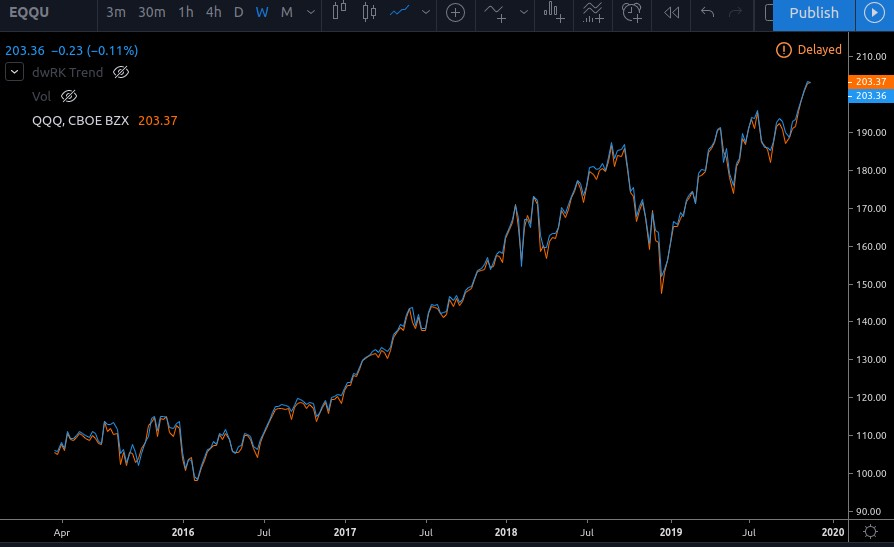
blue is eqqu, red is qqq...generally eqqu has higher price than qqq but not always...right now eqqu is only 1 cent cheaper
user posted image

so if expense is priced into the etf...i don't see any divergence...therefore wht on dividend looks to be the deciding factor since these are distributing

This post has been edited by dwRK: Nov 21 2019, 12:54 AM
dwRK
post Nov 20 2019, 11:00 PM

the consummate chartist
*******
Senior Member
6,230 posts

Joined: Jun 2006


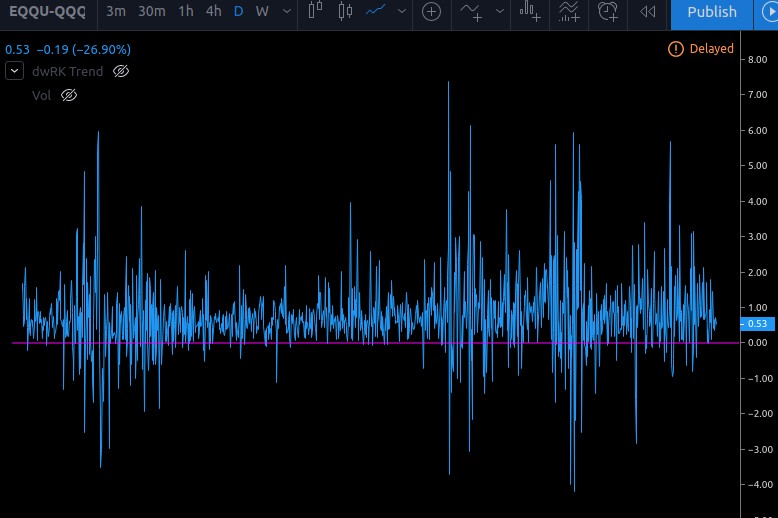
this is eqqu-qqq

user posted image

eqqu generally about 0.6 cents more but it makes no difference since when you sell you get the same back...there is also no gradual drifting downwards since 2015 to indicate value erosion due to higher fees

Edit: the big spikes probably due to big movements after London close.

This post has been edited by dwRK: Nov 23 2019, 07:26 AM
dwRK
post Nov 21 2019, 07:04 AM

the consummate chartist
*******
Senior Member
6,230 posts

Joined: Jun 2006


QUOTE(Yggdrasil @ Nov 20 2019, 07:15 PM)
From what I noticed, US domiciled are distributing while non-US are accumulating.
*
My guess is in USA, wht can range from 0/15/20/30%...so it's impossible to come up with a fair reinvestment / pricing.

Non-US domiciled on the other hand most likely have a tax treaty with the US and tax system that results in flat rate for everyone, hence able to adjust the price fairly. They have both distributing and accumulating.

This post has been edited by dwRK: Nov 21 2019, 11:43 AM
roarus
post Nov 21 2019, 03:39 PM

Regular
******
Senior Member
1,042 posts

Joined: Jan 2003
QUOTE(dwRK @ Nov 21 2019, 07:04 AM)
My guess is in USA, wht can range from 0/15/20/30%...so it's impossible to come up with a fair reinvestment / pricing.

Non-US domiciled on the other hand most likely have a tax treaty with the US and tax system that results in flat rate for everyone, hence able to adjust the price fairly. They have both distributing and accumulating.
*
It's because US tax system makes it impossible to create an accumulating fund. Similar to AUS where each individual has to track each unit/lot purchased in multiple calendar years because the capital and dividends are taxable and at the individual's tax bracket.

2 Pages  1 2 >Top
 

Change to:
| Lo-Fi Version
0.0181sec    1.04    5 queries    GZIP Disabled
Time is now: 4th December 2025 - 10:24 AM