Welcome Guest ( Log In | Register )

Outline · [ Standard ] · Linear+

 ETF: Irish domiciled ETF vs US, WHT benefit vs expense ratio bid spread

views
     
dwRK
post Nov 18 2019, 01:48 PM

the consummate chartist
*******
Senior Member
6,230 posts

Joined: Jun 2006


why so complicated...my 1st pass simplistic approach...

fees paid on investment, say $10k, assume price/value no change throughout
(a) $10000 * 0.2% = $20
(b) $10000 * 0.3% = $30

underlying dividend yield is the same, say 2%, so dividend taxed
(a) $10000 * 2% * 30% = $60
(b) $10000 * 2% * 15% = $30

so clearly (b) is better than (a), since overall less money taken. what can make this false is dividend yield so low that wht has minimal effect, this is around 0.6-0.7%

next question is distributing or accumulating? if wanna stay invested, distributed funds may be insufficient to buy whole units, therefore have to keep and wait. so imho, if prices are going up then accumulating, if going down then distributing.

dwRK
post Nov 20 2019, 08:07 PM

the consummate chartist
*******
Senior Member
6,230 posts

Joined: Jun 2006


QUOTE(Yggdrasil @ Nov 20 2019, 07:15 PM)
You cannot simply do this because this is theoretical whereby what I am doing is testing it against actual data.
It's like saying Inveso's Nasdaq 100 and iShares' Nasdaq 100 should give same return if both expense ratios and Withholding Tax are the same. But is it true? We don't know until we test it.
*
There will be slippages, different spreads, different trading hours hence different closing prices... but the're tracking the same index hence if everything being the same, it must be the same... ± some errors here and there. Unless invesco or ishare quietly songlap somewhere... but you're right I don't know for sure.

Reminds me of a story...my friend was doing a project in Singapore, and the manager asked for an estimate. So friend gave sgd xx.x mil. Manager was not happy...he wants it in 4 decimals...because in Singapore schools all trained to do 4 decimals... lol

Here, I just wanna know which one is better, I don't need to know by how much. So a big picture approach is to start with a simple model, then test & challenge it to failure... if the conclusion don't change we have our winner.

This post has been edited by dwRK: Nov 21 2019, 06:13 AM
dwRK
post Nov 20 2019, 10:29 PM

the consummate chartist
*******
Senior Member
6,230 posts

Joined: Jun 2006


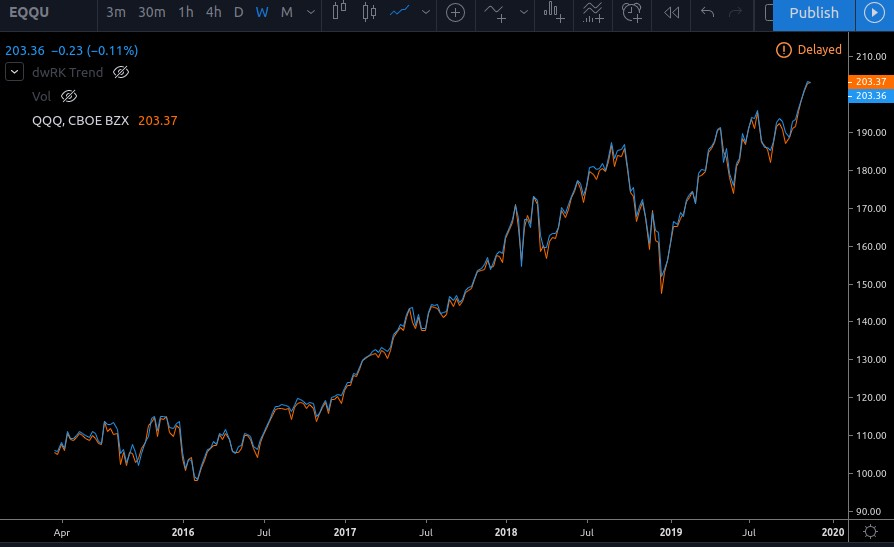
blue is eqqu, red is qqq...generally eqqu has higher price than qqq but not always...right now eqqu is only 1 cent cheaper
user posted image

so if expense is priced into the etf...i don't see any divergence...therefore wht on dividend looks to be the deciding factor since these are distributing

This post has been edited by dwRK: Nov 21 2019, 12:54 AM
dwRK
post Nov 20 2019, 11:00 PM

the consummate chartist
*******
Senior Member
6,230 posts

Joined: Jun 2006


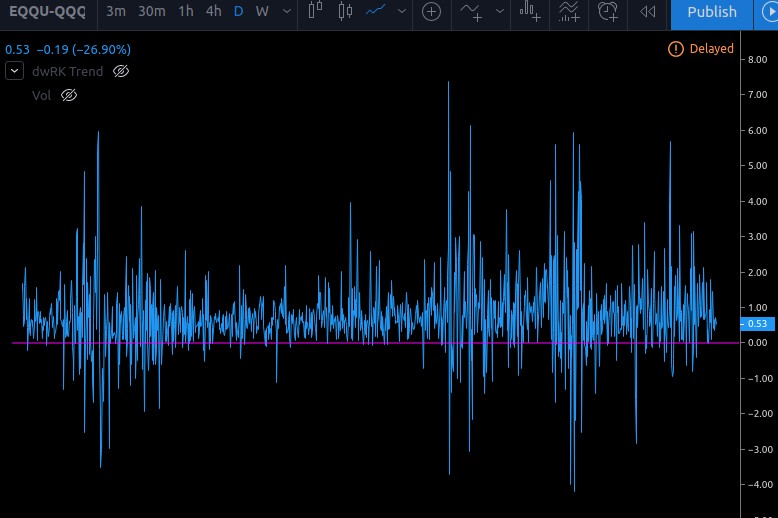
this is eqqu-qqq

user posted image

eqqu generally about 0.6 cents more but it makes no difference since when you sell you get the same back...there is also no gradual drifting downwards since 2015 to indicate value erosion due to higher fees

Edit: the big spikes probably due to big movements after London close.

This post has been edited by dwRK: Nov 23 2019, 07:26 AM
dwRK
post Nov 21 2019, 07:04 AM

the consummate chartist
*******
Senior Member
6,230 posts

Joined: Jun 2006


QUOTE(Yggdrasil @ Nov 20 2019, 07:15 PM)
From what I noticed, US domiciled are distributing while non-US are accumulating.
*
My guess is in USA, wht can range from 0/15/20/30%...so it's impossible to come up with a fair reinvestment / pricing.

Non-US domiciled on the other hand most likely have a tax treaty with the US and tax system that results in flat rate for everyone, hence able to adjust the price fairly. They have both distributing and accumulating.

This post has been edited by dwRK: Nov 21 2019, 11:43 AM


Change to:
| Lo-Fi Version
0.0135sec    0.46    6 queries    GZIP Disabled
Time is now: 4th December 2025 - 07:59 PM