Outline ·
[ Standard ] ·
Linear+
ETF: Irish domiciled ETF vs US, WHT benefit vs expense ratio bid spread
|
roarus
|
 Oct 27 2019, 09:56 AM Oct 27 2019, 09:56 AM
|

|
CSPX and CNDX doesn't pay out dividends because they're accumulative ETFs - the fund manager reinvests all distribution from its holdings immediately. But unlike dividend reinvestment (drip) schemes, holders don't see it reflected as additional units, they see it as NAV/price increase. We* can load any historical price chart of the fund and use it as reference for total return minus withholding tax without doing additional calculation.
For VOO and QQQ, we* need to look at periodic distribution, minus out 30% and combine it into historical price chart to get the complete picture of total return minus withholding tax - probably a total nightmare unless you have access to a bloomie or eikon terminal.
*We = Malaysian resident and tax payer to Malaysia only
|
|
|
|
|
|
roarus
|
Oct 27 2019, 03:01 PM
|
|
|
QUOTE(Yggdrasil @ Oct 27 2019, 01:41 PM) When VOO and QQQ pay dividend, the dividend yield given on Yahoo Finance's website is net of WHT or not yet net but we pay our own dividends later? Yahoo's figures are pre tax figures. Broker usually withholds it based on your tax residency declaration when you open up an account |
|
|
|
|
|
roarus
|
Nov 17 2019, 10:36 PM
|
|
|
QUOTE(Yggdrasil @ Nov 17 2019, 08:47 PM) roarus I recently found out about Invesco EQQQ NASDAQ-100 UCITS ETF (EQQQ.MI)I realised my mistake when I compared QQQ with the Ireland equivalent was that my sample was using NASDAQ 100 from Invesco while comparing it to iShares.  That probably explains the difference. I did a quick test using EQQQ.MI (Invesco - Milan) as there was a problem with the data from Invesco EQQQ NASDAQ-100 UCITS ETF (EQQU.L) and sure enough it was better. » Click to show Spoiler - click again to hide... « Note: I assumed that the withholding tax was 15% but it doesn't matter because it's an accumulating ETF. Edit: I removed the problematic data resulting in a 3 year sample and QQQ wins again.  » Click to show Spoiler - click again to hide... « Edit: Wrong image earlier. This is the correct one. Small difference only. EQQQ is in GBP (15,783.00 = 157 pounds 83 pence). Prices outside US trading market could be influenced by futures For QQQ - How are you calculating data for it? Do you let the price 'drop' on ex-date and 'reinvest' it again on div payment date? It's probably easier to calculate CSPX or VUSD against VOO to a certain extend. Assuming lump sum $10k at start of year and compare how much you'd have at the end of the year, I'm pretty sure you'd end up with more if you go CSPX or VUSD. This post has been edited by roarus: Nov 17 2019, 10:37 PM |
|
|
|
|
|
roarus
|
Nov 19 2019, 11:26 PM
|
|
|
QUOTE(Yggdrasil @ Nov 18 2019, 06:40 AM) That makes sense. However, there were some dates whereby the data were around 170 suddenly it jumped to 15783.00. I trimmed these off. If you're taking from Yahoo! Finance, the data is wonky - for funds that are available in USD/GBP, data for USD and GBP fund gets tangled up. It's been like this for years and it doesn't seem like Yahoo! will be addressing it QUOTE(dwRK @ Nov 18 2019, 01:48 PM) next question is distributing or accumulating? if wanna stay invested, distributed funds may be insufficient to buy whole units, therefore have to keep and wait. so imho, if prices are going up then accumulating, if going down then distributing. If you're buying in an index fund at fixed interval regardless market up or down, then accumulating. Distributing has some wee cost (probably a negligible speck for big honking funds that track S&P500) spent for the effort to transfer dividends out to everyone. This post has been edited by roarus: Nov 19 2019, 11:33 PM |
|
|
|
|
|
roarus
|
Nov 21 2019, 03:39 PM
|
|
|
QUOTE(dwRK @ Nov 21 2019, 07:04 AM) My guess is in USA, wht can range from 0/15/20/30%...so it's impossible to come up with a fair reinvestment / pricing. Non-US domiciled on the other hand most likely have a tax treaty with the US and tax system that results in flat rate for everyone, hence able to adjust the price fairly. They have both distributing and accumulating. It's because US tax system makes it impossible to create an accumulating fund. Similar to AUS where each individual has to track each unit/lot purchased in multiple calendar years because the capital and dividends are taxable and at the individual's tax bracket. |
|
|
|
|
|
roarus
|
Nov 22 2019, 11:08 PM
|
|
|
QUOTE(Yggdrasil @ Nov 20 2019, 07:24 PM) Attached Excel file for QQQ v EQQU.L for samples from 26/3/2015 to 15/5/2018 (excluding public holidays) if you are interested to read. QQQ still wins but by a slim margin <1%. Note my sample is only 3.136 years. Link: hereJust noticed, you used EQQU.L - which points to a distributing class. In that case the dividend yield in your spreadsheet shouldn't be 0 right? |
|
|
|
|
|
roarus
|
Nov 23 2019, 06:13 PM
|
|
|
I got more with CSPX 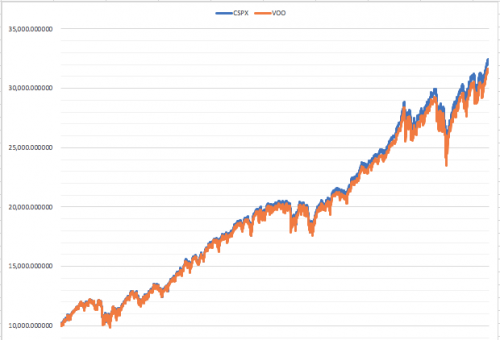 CSPX vs VOO - 16 Sep 2010 till 22 Nov 2019 - Starting with $10,000 capital - Fractional units allowed (for the good preservation of my sanity and hair) - VOO dividends applied with 30% WHT - VOO dividends reinvested on payment date (because that's what happens in real life, you can only reinvest after dividend is paid out rather than ex date) - Initial buy and dividend reinvest using closing price Excel file download here: https://ufile.io/jv3vdxcyEnd result: CSPX: 32,232.81 +698.33 (322.33%) VOO: 31,534.48 (315.34%) This post has been edited by roarus: Nov 23 2019, 06:16 PM |
|
|
|
|



 Quote
Quote


 0.0178sec
 0.37
0.37
 6 queries
 GZIP Disabled