QUOTE(MasBoleh! @ Sep 14 2022, 11:59 AM)
Sorry for the late reply, been occupied in other areas.
Let's just say my reporting boss is a Swiss

Colleague B in the end approached PostFinance and successfully opened an account.
In any case, i would like to specifically mentioned that all the swiss bank account required to pay maintenance fees monthly, and for us that live abroad, we needed to pay additional fees.
https://www.moneyland.ch/en/swiss-bank-fees-abroad--------------------------------------------
So you are saying the negative interest rates only kicks in when the cash balance above 50k CHF, in this context, means if my cash balance below 50k CHF, there is no "additional charges" aka negative interest rates impose by IBKR? And how come IBKR has negative interest charges (pardon my stupid question)
Yea make sense, very likely will be in Capital with dividends been reinvested.
The submission of Form 60 to the FTA is been done yearly or every 6 months or?
Oh my goodness, this is very detailed explanation, i truly appreciates your generosity

I am getting excited when reading your post, because I really prefer to have a long term stable investment instead of trading which is trying to buy low sell high, or shorting of stocks.
You are certainly right, i almost wanted to point out on the currency appreciation in long run for Swiss Franc which may outweigh the US counterparts.
---------------------------------------------------
I would say different markets have different pros and cons, US as world number 1 economy, their markets certainly have huge movements and I personally also see it as a safe option, although when comes to recession, their impact also greater if compared to i.e. SIX. But for now, investing into stable companies like Apple, Microsoft, Amazon etc.. looks pretty good. But we will never know, as even Nokia who was once a big giant in the mobile phone market already collapsed, so anything is plausible.
So when talks to US market, i try to be neutral too but of course must be agree to disagree
I agree with you on the SIX, long term wise, Swiss is good, especially Nestle which itself also considered an extremely good stock in Malaysia.
Just a curiosity question, it is rather personal, you may choose to answer or don't wanna answer or PM me. Are you actively investing in SIX at the moment? And if yes, how you do so without a Swiss bank account? Since you mentioned about the risk of unfavourable exchange rate. You are residing in HK which is one of the financial centre, i believe there may have some avenue for you to do so without a Swiss bank account?
Thank you
Again sorry it took me so long to reply this post.
Thanks for info, no problem. PostFinance has a "neobank" called Yuh, a JV with Swissquote, can consider that too.
https://www.yuh.com/en/pricingYour colleagues must all be very rich.

Should follow Ram's advice and try the neobanks, they really disrupt the banking market there.
------------------------------------
Yes, if cash balance is below 50k CHF, no "negative" interest rate charges. So, you can keep CHF cash up to 50k CHF in your IB account without losing/gaining anything. The negative interest rate imposed by IB is because the SNB interest rate is currently negative. Swiss banks which maintain reserves or balance at SNB will have to end up paying SNB instead. So, in turn, money kept at banks by corporations/public will actually result in bank charging you interest instead of them paying you interest.
https://www.snb.ch/en/iabout/stat/statrep/i...change_rates#t2 IB's CHF cash balance are maintained at a local Swiss bank account (Credit Suisse, I believe), and they are thus affected by the same monetary policy.
Submission of Form 60 to FTA can be done at least frequently, once every 3 years, i.e. the maximum period to claim back the tax is the past 3 years. You can get your tax residency proof once a year from LHDN (via the LHDN stamp) or once every 3 years, although the former is preferred.
-------------------------------------
One possible factor for Nestle Malaysia's performance is because Nestle SA, the parent company and EPF collectively control 80% of all shares. Free float is only around 20% of all equities.
https://www.marketscreener.com/quote/stock/...491622/company/ So, the liquidity is low yet demand is high, resulting in a high share price/additional liquidity premium as a result.
Erm. Not sure what you mean by "actively investing". I am a very passive investor, hardly changing anything in my portfolio. I remain invested in Nestle, Novartis (through US ADR) and Roche at the moment. They help me weather the current storm well. Will add more in the future when I have more cash coming in.
You don't need a Swiss bank account to transfer CHF funds if you use IBKR. Just use Wise to first convert the money you have (USD, SGD, MYR, HKD etc.) to CHF and store it in your Wise CHF currency balance, then send the money to IBKR's Swiss bank account (a Credit Suisse account) via the usual steps (initiate a deposit notification at IB first, then transfer the money from your CHF currency balance to the designated Credit Suisse account). You should receive your money and see it reflected in your IB currency balance under an hour. From there, you can buy stocks etc. with the CHF funds deposited. Note Wise will charge you 0.5 CHF for the outbound transfer to IB's Credit Suisse account. That's the only fee involved, aside from any forex spread/charges earlier from your USD/SGD/MYR/HKD conversion to CHF.
Add-on, just saw Ramjade's post: you can use IB's own FX conversion if you already deposited SGD/USD/HKD in IB. Note that there is no SGD/CHF or CHF/SGD currency pair, so you will have to go through at least 2 conversions from SGD to CHF, e.g. SGD -> USD -> CHF. I am not sure if the charges are the same as Wise, but the total cost should be comparable.
The unfavourable exchange rates kicks in when you want to reclaim your Swiss WHT. As SNB pays out your reclaimed money in CHF, you need to have a bank account which can receive CHF. I tried out Dukascopy the other day but the charges are ridiculous... So, I just plan to use CIMB SG to receive the inward remittance. The extra cost is the currency conversion from CHF to SGD which has a spread of about 1.1% (for CIMB SG). But the good thing is there are no minimum charges for the inward telegraphic transfer, so you get to receive nearly all the funds refunded.
At least that's how I think it should work, I haven't tried out yet until 2 more years later when I will start claiming back my WHT. By then, I will give an update there about the "steps" involved.
This post has been edited by TOS: Sep 14 2022, 02:33 PM 

 Sep 10 2022, 02:41 PM


 Quote
Quote
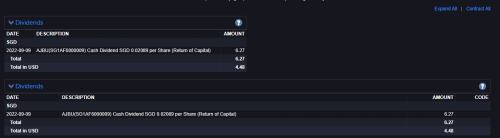


 ), I believe I have no issue with rights subscription using DBS Vickers, be it S-banks/stocks or S-REITs.


 0.2444sec
 0.53
0.53
 7 queries
 GZIP Disabled