Welcome Guest ( Log In | Register )

65 Pages « < 32 33 34 35 36 > » Bottom

Outline · [ Standard ] · Linear+

 LYN Catholic Fellowship V02 (Group), For Catholics (Roman or Eastern)

views
     
khool
post Feb 7 2018, 11:27 AM

Getting Started
**
Junior Member
225 posts

Joined: Mar 2008


Wednesday of the Fifth Week in Ordinary Time
Lectionary: 331


user posted image

Reading 1 (1 Kgs 10:1-10)

The queen of Sheba, having heard of Solomon's fame,
came to test him with subtle questions.
She arrived in Jerusalem with a very numerous retinue,
and with camels bearing spices,
a large amount of gold, and precious stones.
She came to Solomon and questioned him on every subject
in which she was interested.
King Solomon explained everything she asked about,
and there remained nothing hidden from him
that he could not explain to her.

When the queen of Sheba witnessed Solomon's great wisdom,
the palace he had built, the food at his table,
the seating of his ministers, the attendance and garb of his waiters,
his banquet service,
and the burnt offerings he offered in the temple of the LORD,
she was breathless.
"The report I heard in my country
about your deeds and your wisdom is true," she told the king.
"Though I did not believe the report until I came and saw with my own eyes,
I have discovered that they were not telling me the half.
Your wisdom and prosperity surpass the report I heard.
Blessed are your men, blessed these servants of yours,
who stand before you always and listen to your wisdom.
Blessed be the LORD, your God,
whom it has pleased to place you on the throne of Israel.
In his enduring love for Israel,
the LORD has made you king to carry out judgment and justice."
Then she gave the king one hundred and twenty gold talents,
a very large quantity of spices, and precious stones.
Never again did anyone bring such an abundance of spices
as the queen of Sheba gave to King Solomon.

Responsorial Psalm (PS 37:5-6, 30-31, 39-40)

R. The mouth of the just murmurs wisdom.

Commit to the LORD your way;
trust in him, and he will act.
He will make justice dawn for you like the light;
bright as the noonday shall be your vindication.
R. The mouth of the just murmurs wisdom.

The mouth of the just man tells of wisdom
and his tongue utters what is right.
The law of his God is in his heart,
and his steps do not falter.
R. The mouth of the just murmurs wisdom.

The salvation of the just is from the LORD;
he is their refuge in time of distress.
And the LORD helps them and delivers them;
he delivers them from the wicked and saves them,
because they take refuge in him.
R. The mouth of the just murmurs wisdom.

Alleluia (See Jn 17:17b, 17a)

R. Alleluia, alleluia.
Your word, O Lord, is truth:
consecrate us in the truth.
R. Alleluia, alleluia.

Gospel (Mk 7:14-23)

Jesus summoned the crowd again and said to them,
“Hear me, all of you, and understand.
Nothing that enters one from outside can defile that person;
but the things that come out from within are what defile.”

When he got home away from the crowd
his disciples questioned him about the parable.
He said to them,
“Are even you likewise without understanding?
Do you not realize that everything
that goes into a person from outside cannot defile,
since it enters not the heart but the stomach
and passes out into the latrine?”
(Thus he declared all foods clean.)
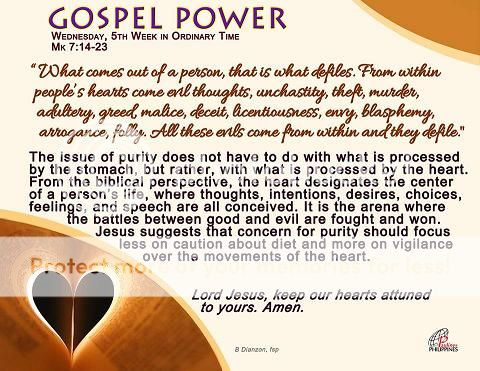
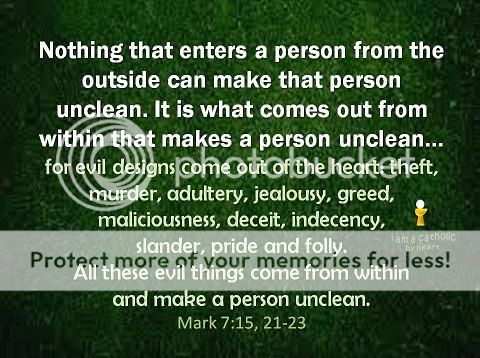
“But what comes out of the man, that is what defiles him.
From within the man, from his heart,
come evil thoughts, unchastity, theft, murder,
adultery, greed, malice, deceit,
licentiousness, envy, blasphemy, arrogance, folly.
All these evils come from within and they defile.”
user posted image

REFLECTIONS: WORD Today

user posted image

The Queen of Sheba (First Reading) traveled thousands of kilometers for many weeks from Ethiopia to Jerusalem, in order to listen to the amazing wisdom of Solomon, king of Israel. She gave him many tons of gold and jewels as gifts for this once in a lifetime opportunity.

How fortunate, how BLESSED we are! We are just a few steps from the Bible on the bookshelf where we can listen to the much greater Wisdom of Jesus, King of the Universe - everyday!

When we read the Word of God, it is Jesus who travels deep into our heart where the battle between good and evil rages. Only He has the power to defeat the army of "evil thoughts, immorality, theft, murder, adultery, greed, wickedness, deceit, self-indulgence, envy, slander, pride and foolishness." (Gospel)

We don't have to pay Jesus a single cent. It is He who gifts us with fabulous faith, wisdom and peace!

Listen to Jesus in the Bible daily, and allow His goodness and mercy to flow out from you to bless your family and the world.

WISDOM SONG


Source: https://www.facebook.com/CatholicMassReflec...834561616841595
user posted image

TSyeeck
post Feb 7 2018, 12:02 PM

Look at all my stars!!
*******
Senior Member
3,576 posts

Joined: Apr 2006


This is the End of the Law
BROTHER ANDRÉ MARIE

user posted image
Christ, the Lawgiver of the New and Eternal Covenant

Our beloved mentor, Brother Francis, used to remind us often of the importance of purpose. One way he did this was to tell the story, related in various ascetical treatises on the religious life, of the monk who used to look up at the sky from time to time. When asked by those unfamiliar with his custom what he was doing, the monk would reply, “I’m fixing my aim.”

The monk’s purpose was to become a saint, to go to Heaven, and in this bodily, sensible way, he recalled to mind this supernatural end. In doing such things, devout souls stir up holy desires and draw closer to their goal.

If I were to say that the purpose of law is identical to that monk’s purpose in looking up to the heavens, I would be taken for a fool by a good number of people. Yet, that is exactly the purpose of law according to Saint Thomas Aquinas.

Now the first principle in practical matters, which are the object of the practical reason, is the last end: and the last end of human life is bliss or happiness, as stated above (I-II:2:7; I-II:3:1). Consequently the law must needs regard principally the relationship to happiness. (ST, Ia, IIae, Q. 90, A. 2.)

Those familiar with Saint Thomas’ notions of happiness know well that the Angelic Doctor identifies it with heavenly beatitude. Mere human law is powerless to effect this end, so we need Divine Law in order to achieve it. But more on that further down. The point here is that law has as its purpose to direct man to his final end, which is Heaven. While human law cannot achieve that end — but, rather it aims at a merely temporal happiness that is not our true finality — it must not hinder it. (This is one of the reasons secular societies just do not work. The state inevitably makes itself the end of man.)

Modernity has given us various errors concerning law. By way of defect, we may consider the errors of the antinomians, who absolve Christians from following the moral law. By way of excess and misdirection, we have the legal positivists, who elevate all law to the same level, while equating law with the arbitrary dictates of whatever ruling class is in power — no matter how contrary such “laws” are to one another or to the moral law. The proponents of such errors, who plague the Church as well as civil society, do not much value Saint Thomas’ definition of law, with all four of its constituent notes:

[T]he definition of law … is nothing else than an ordinance of reason for the common good, made by him who has care of the community, and promulgated. (ST, Ia, IIae, Q. 90, A. 4.)

If it is not for the common good, it is not a law. If it is not an ordinance of reason, it is not a law. Roe v. Wade? Not a law. Some ordinance forbidding “discrimination” against sodomites who demand a wedding cake from a Christian baker for their post-abomination bacchanalia? Not a law. A statute decriminalizing usury? Not a law. Examples could be multiplied ad nauseam. Should Saint Thomas be given plenipotentiary veto power over our state and federal system of statutes and court cases, the weighty tomes found in law libraries would become suddenly lighter. And many a lawyer would not understand what happened, because the poor fellow is a legal positivist.

Even in the Church, it seems, there are those who would cut Saint Thomas’ definition in half and make law into the diktat of the lawmaker. But while such may come from “him who has care of the community,” and may be “promulgated,” if it is not an ordinance of reason for the common good, it is not a law. At least that is the opinion of Saint Thomas, and I, for what it is worth, have the temerity to agree with him.

Supposed laws, whether civil or ecclesiastical, that form obstacles to man’s salvation contradict the very purpose of law and therefore have no authority whatsoever.

Saint Thomas distinguishes the eternal law, the natural law, human law, and Divine law. There is some overlapping here, so to present them in sharper categories we distinguish between the Divine (positive) law, the natural law (which also comes from God) and human law. The Divine positive law and the natural law are included in the “eternal law,” because the eternal law is God’s own governance of the universe. Human law comes from a human authority, and it is distinguished into ecclesiastical and civil law. Canon law, while it pertains, in part, to divine things, is not Divine law, although it does, in places, cite the Divine positive law. Canon Law, and all ecclesiastical law, is therefore human law.

It remains to explain what the Divine positive law is. Saint Thomas distinguishes two such bodies of law: the Old Law and the New Law, corresponding to the Old and New Testaments of Sacred Scripture. The Old Law is divided by a threefold division: ceremonial precepts, judicial precepts, and the moral law. Of these three, the only part of that law that survives as binding on Christians is the moral law, which is none other than the natural law. The New Law of Christ, on the other hand, consists primarily in the grace of the Holy Ghost and only secondarily in the written law of the Gospel, which is summarized in the Sermon on the Mount.

Saint Thomas notes that if man had a mere natural end, then the natural law would be sufficient to guide him to that end, which would consist in natural happiness. However, man has an end that is above nature, and for that end he needs a higher law to guide him. This higher law consists in the twofold, supernaturally revealed word of God. The Old Law is a preparation for the New, while the New Law surpasses its predecessor by far, having the intrinsic power to justify man — that is, to make man holy. It has this power because, as Saint Thomas argues, the New Law is itself primarily the interior grace of the Holy Ghost.

Is it any mystery, then, that the treatise on grace follows immediately after the treatise on law in the Summa?

Such a lofty conception of law is no doubt foreign to some readers, but this is the language and accompanying worldview of the Ages of Faith, something that must be brought back if we are to have a restored Christendom.

Let us get back to purpose. The purpose of all this law is to guide man to his end, which is happiness. (And no, this is not selfish.) For this reason, then, we see the Beatitudes at the heart of the written (i.e., secondary) part of the New Law. The Beatitudes each have two parts, the merit and the reward. The merit pertains to this life, and the reward pertains imperfectly to this life, but perfectly to the next. By living according to the grace of the Holy Spirit in this life, and availing ourselves of the supernatural panoply of divine helps dispensed by Christ through His Church, we can, even in this vale of tears, enjoy an anticipation of heavenly beatitude.

Only in this way, by living according to the New Law of Christ, can man achieve his ultimate end, his happiness.

Far from being a burden to human nature and an indignity to a free man, the law of God is profoundly liberating and life giving. It helps us “fix our gaze” on a happiness that is infinitely higher than what we could have in this life, because it is a Divine life.

“The Lord is sweet and righteous: therefore he will give a law to sinners in the way” (Ps. 24:8).

http://catholicism.org/ad-rem-no-300.html

This post has been edited by yeeck: Feb 7 2018, 12:07 PM
TSyeeck
post Feb 7 2018, 12:06 PM

Look at all my stars!!
*******
Senior Member
3,576 posts

Joined: Apr 2006


Simian Antinomianism
BROTHER ANDRÉ MARIE

The heresy of antinomianism received its name from Martin Luther, who, wrote against the more “extreme” doctrines of Johannes Agricola, the enfant terrible of Luther’s own novel doctrine of Justification by faith only. In brief, antinomianism — coming from anti + nomos (Gk: “law”) — is the contention that Christians are absolved from adherence to the moral law.

That Luther would object to Agricola was hypocritical on at least two fronts. First, once the cat of sola scriptura was let out of the bag, with its corollary of private interpretation, one would think Luther’s objecting to another’s use of the principle would be self-defeating. (Who did he think he was, the Pope?) Secondly, Agricola’s doctrine, relatively “extreme” as it might have been, agreed in kind with many of Luther’s own remarks denying the necessity of good works or the need of the Christian believer to resist temptation. (It was not for nothing that Luther called the canonical Epistle of Saint James “an epistle of straw.”) In short, Luther himself held to a form of antinomianism.

Agricola’s heresy was not unique. Some early gnostic sects and various weird medieval movements held similar errors. For the antinomian gnostics, one who was adept at the gnosis (the esoteric knowledge) somehow transcended good and evil.

Today, our society is caught in a tug-of-war between two opposite errors on the question of law. Besides the popular antinomianism that denies the natural law and its demands (voiced in such pat-phrases as, “you can’t legislate morality” and “we are free to do whatever we like as long as it doesn’t hurt someone else”), there is the legal positivism of the statist. This latter is the doctrine that law derives from the written body of legislation (statutes, court cases), and does not depend upon a higher standard that is antecedent to the written corpus. Statist liberals are not the only legal positivists by a long shot. Some putative “conservatives” are rightly numbered as such, as they consider the Constitution itself is sufficient as the nation’s law, without reference to the natural law.

The two errors are opposite, but, they are also complementary in a larger dialectic. Where antinomianism reigns, people will act like beasts, naturally. This moral anarchy makes the many and minute laws of the gigantic modern state seem necessary, hence the perceived reasonableness of positivism to bring order out of chaos. The Italian communist revolutionary, Antonio Gramsci, understood this, and therefore considered cultural and moral subversion a better alternative to the violent global revolution of his Soviet fellows.

(In “Conscience and the Nanny State” I considered at greater length this phenomenon of moral anarchy breeding tyranny.)

The idea that young people ought to be taught the moral law so that they might be masters of themselves and work for an ordered and just society is brought out in Rudyard Kipling’s classic, The Jungle Book. Those who have only seen the Disney film — which does not remotely do the book justice — should read Kipling’s work before they object to my recommending it. (Which I do, especially in the complete Penguin Classics edition, which contains almost all the Mowgli stories plus much more.)

A passage I find compelling is the description, in the chapter entitled “Kaa’s Hunting,” of the monkeys. These comical creatures are among Mowgli’s enemies because of their lawlessness, but the young “man-cub” does not realize this yet, and is flattered when they seek his company after Baloo, his bear-mentor, had been particularly hard on him during his lessons. When Baloo discovers the illicit friendship, he sternly rebukes the boy. Even Bagheera, the panther, who is much milder than Baloo, is irate that Mowgli would play with the Bandar-log, as the monkeys are called.

Note well the description of the monkeys as without remembrance, without a leader, without a law. For this reason, they are rudderless, fickle, silly, mercurial — and very dangerous. They are, it may be said, without a tradition — and therefore they go chaotically from one novelty to another to another, never learning from their mistakes, yet remaining stubbornly convinced that they are better than all the people of the jungle.

“Mowgli,” said Baloo, “thou hast been talking with the Bandar-log—the Monkey People.”

Mowgli looked at Bagheera to see if the Panther was angry too, and Bagheera’s eyes were as hard as jade stones.

“Thou hast been with the Monkey People—the gray apes—the people without a law—the eaters of everything. That is great shame.”

“When Baloo hurt my head,” said Mowgli (he was still on his back), “I went away, and the gray apes came down from the trees and had pity on me. No one else cared.” He snuffled a little.

“The pity of the Monkey People!” Baloo snorted. “The stillness of the mountain stream! The cool of the summer sun! And then, man-cub?”

“And then, and then, they gave me nuts and pleasant things to eat, and they—they carried me in their arms up to the top of the trees and said I was their blood brother except that I had no tail, and should be their leader some day.”

“They have no leader,” said Bagheera. “They lie. They have always lied.”

“They were very kind and bade me come again. Why have I never been taken among the Monkey People? They stand on their feet as I do. They do not hit me with their hard paws. They play all day. Let me get up! Bad Baloo, let me up! I will play with them again.”

“Listen, man-cub,” said the Bear, and his voice rumbled like thunder on a hot night. “I have taught thee all the Law of the Jungle for all the peoples of the jungle—except the Monkey-Folk who live in the trees. They have no law. They are outcasts. They have no speech of their own, but use the stolen words which they overhear when they listen, and peep, and wait up above in the branches. Their way is not our way. They are without leaders. They have no remembrance. They boast and chatter and pretend that they are a great people about to do great affairs in the jungle, but the falling of a nut turns their minds to laughter and all is forgotten. We of the jungle have no dealings with them. We do not drink where the monkeys drink; we do not go where the monkeys go; we do not hunt where they hunt; we do not die where they die. Hast thou ever heard me speak of the Bandar-log till today?”

“No,” said Mowgli in a whisper, for the forest was very still now Baloo had finished.

“The Jungle-People put them out of their mouths and out of their minds. They are very many, evil, dirty, shameless, and they desire, if they have any fixed desire, to be noticed by the Jungle People. But we do not notice them even when they throw nuts and filth on our heads.”

He had hardly spoken when a shower of nuts and twigs spattered down through the branches; and they could hear coughings and howlings and angry jumpings high up in the air among the thin branches.

“The Monkey-People are forbidden,” said Baloo, “forbidden to the Jungle-People. Remember.”

A little later, we see that the Monkey-folk, besides desiring to be noticed by the Jungle People, and despite their evident demerits, are intensely conceited and consider themselves cutting-edge:

“They were always just going to have a leader, and laws and customs of their own, but they never did, because their memories would not hold over from day to day, and so they compromised things by making up a saying, ‘What the Bandar-log think now the jungle will think later,’ and that comforted them a great deal.”

This is a wonderful description of the modernist, the man who hates tradition, law, and Christian social order — and moreover despises those who love such things.

When later, the Bandar-log turn on Mowgli and kidnap him, Baloo and Bagheera resort to the only means they know: to summon the aid of Kaa, the hungry thirty-foot python with the mesmerizing glance, the one creature in the Jungle that the monkeys fear. Mowgli is saved, but only after a gruesome scene of simian carnage that would not be appropriate for a children’s cartoon.

Lord Baden Powell, the founder of scouting, was a personal friend of Rudyard Kipling. Imagery from The Jungle Book was explicitly incorporated into Baden Powell’s program of forming young men. Mowgli, who had to learn the Law of the Jungle, represents the youth being directed and formed according to the “law” of scouting, and names like “cub,” “wolf,” “Akela,” etc., all finding a place in the scouting nomenclature.

http://catholicism.org/ad-rem-no-216.html
khool
post Feb 7 2018, 02:00 PM

Getting Started
**
Junior Member
225 posts

Joined: Mar 2008


user posted image

user posted image

TSyeeck
post Feb 7 2018, 02:49 PM

Look at all my stars!!
*******
Senior Member
3,576 posts

Joined: Apr 2006


Q&A: Why do Catholics believe that Christ is sacrificed in each and every Mass, when Scripture plainly states that He was sacrificed on Calvary once and for all?

user posted image

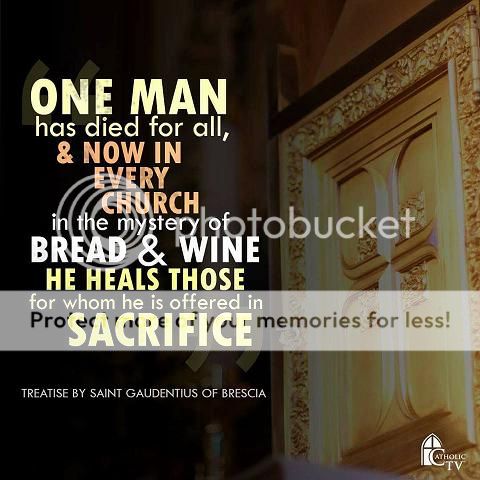
Most non-Catholics do not realize it, but Christ Himself offered the first Mass at the Last Supper. At the Last Supper He offered (sacrificed) Himself to His Father in an unbloody manner, that is, under the form of bread and wine, in anticipation of His bloody sacrifice on the cross to be offered on the following day, Good Friday. In the Mass, not now by anticipation, but rather in retrospect, Christ continues to make that offering of Himself to His Father – by the hands of the priest. "And whilst they were at supper, Jesus took bread, and blessed, and broke: and gave to his disciples, and said: Take ye, and eat. This is my body. And taking the chalice, he gave thanks, and gave to them, saying: Drink ye all of this. For this is my blood of the new testament, which shall be shed for many unto remission of sins." (Matt. 26:26-28). Christ ordered His Church to perpetuate that sacrificial rite for the continued sanctification of His followers, saying, "Do this for a commemoration of me" (Luke 22:19) – so the Catholic Church complies with His order in the Mass. In other words, every Mass is a re-enactment of Our Lord's one sacrifice of Calvary. The Mass derives all its value from the Sacrifice of the Cross; the Mass is that same sacrifice, not another. It is not essentially a sacrifice offered by men (although men also join in), but rather it is the sacrifice of Jesus Christ.

Christ's bloody sacrifice on Calvary was accomplished "once" (Heb. 10:10), just as Scripture says. The Catholic Church likewise teaches that the sacrifice of the Cross was a complete and perfect sacrifice – offered "once." But the Apostle Paul – the same Apostle who wrote this text in the book of Hebrews – also bears witness that the sacrificial rite which Christ instituted at the Last Supper is to be perpetuated – and that it is not only important for man's sanctification, but is the principal factor in man's final redemption. In 1 Corinthians 11:23-26, St. Paul tells how, at the Last Supper, Our Lord said: "This do ye, as often as you shall drink, for the commemoration of me. For as often as you shall eat this bread, and drink the chalice, you shall show the death of the Lord, until he come." Thus at every Mass the Christian has a new opportunity to worship God with this one perfect sacrifice and to "absorb" more of Christ's saving and sanctifying grace of Calvary. This grace is infinite, and the Christian should continuously grow in this grace until his death. The reason the Mass is offered again and again is not from any imperfection in Christ, but from our imperfect capacity to receive.

Finally, the holy sacrifice of the Mass fulfills the Old Testament prophecy: "For from the rising of the sun even to the going down, my name is great among the Gentiles, and in every place there is sacrifice, and there is offered to my name a clean oblation: for my name is great among the Gentiles, saith the Lord of hosts." (Mal. 1:11). The Sacrifice of the Mass is offered every day throughout the world, and in every Mass the only truly "clean oblation" is offered, that is, Christ Himself; thus the Mass is the perfect fulfillment of this prophecy.


khool
post Feb 8 2018, 11:20 AM

Getting Started
**
Junior Member
225 posts

Joined: Mar 2008


Thursday of the Fifth Week in Ordinary Time
Lectionary: 332


user posted image

Reading 1 (1 Kgs 11:4-13)

When Solomon was old his wives had turned his heart to strange gods,
and his heart was not entirely with the LORD, his God,
as the heart of his father David had been.
By adoring Astarte, the goddess of the Sidonians,
and Milcom, the idol of the Ammonites,
Solomon did evil in the sight of the LORD;
he did not follow him unreservedly as his father David had done.
Solomon then built a high place to Chemosh, the idol of Moab,
and to Molech, the idol of the Ammonites,
on the hill opposite Jerusalem.
He did the same for all his foreign wives
who burned incense and sacrificed to their gods.
The LORD, therefore, became angry with Solomon,
because his heart was turned away from the LORD, the God of Israel,
who had appeared to him twice
(for though the LORD had forbidden him
this very act of following strange gods,
Solomon had not obeyed him).

So the LORD said to Solomon: "Since this is what you want,
and you have not kept my covenant and my statutes
which I enjoined on you,
I will deprive you of the kingdom and give it to your servant.
I will not do this during your lifetime, however,
for the sake of your father David;
it is your son whom I will deprive.
Nor will I take away the whole kingdom.
I will leave your son one tribe for the sake of my servant David
and of Jerusalem, which I have chosen."

Responsorial Psalm (PS 106:3-4, 35-36, 37 and 40)

R. Remember us, O Lord, as you favor your people.

Blessed are they who observe what is right,
who do always what is just.
Remember us, O LORD, as you favor your people;
visit us with your saving help.
R. Remember us, O Lord, as you favor your people.

But they mingled with the nations
and learned their works.
They served their idols,
which became a snare for them.
R. Remember us, O Lord, as you favor your people.

They sacrificed their sons
and their daughters to demons.
And the LORD grew angry with his people,
and abhorred his inheritance.
R. Remember us, O Lord, as you favor your people.

Alleluia (Jas 1:21bc)

R. Alleluia, alleluia.
Humbly welcome the word that has been planted in you
and is able to save your souls.
R. Alleluia, alleluia.

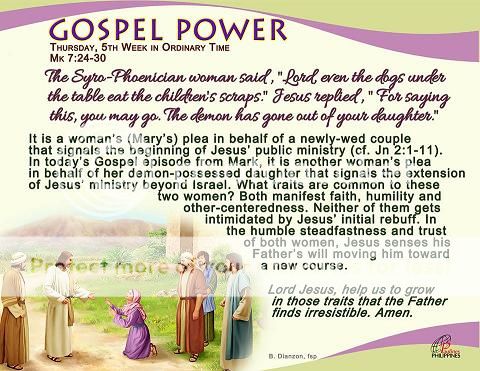
Gospel (Mk 7:24-30)

Jesus went to the district of Tyre.
He entered a house and wanted no one to know about it,
but he could not escape notice.
Soon a woman whose daughter had an unclean spirit heard about him.
She came and fell at his feet.
The woman was a Greek, a Syrophoenician by birth,
and she begged him to drive the demon out of her daughter.
He said to her, “Let the children be fed first.
For it is not right to take the food of the children
and throw it to the dogs.”
She replied and said to him,
“Lord, even the dogs under the table eat the children’s scraps.”
Then he said to her, “For saying this, you may go.
The demon has gone out of your daughter.”
When the woman went home, she found the child lying in bed
and the demon gone.

user posted image

REFLECTIONS: WORD Today

user posted image

In his old age, King Solomon turned to worshipping the idols of his many foreign wives in order to secure his kingdom and the foreign alliances he made through them. The wisest man in the world became tricky.

Solomon had many wives from foreign countries, arranged marriages to strengthen political alliances, increase his influence abroad and strengthen his kingdom. But God had clearly instructed the people of Israel not to inter-marry with foreigners "because they will surely turn your hearts to their gods." (Deuteronomy 7:3)

Solomon had 700 wives of royal birth (plus 300 concubines). And they did turn his heart away from the Lord. These wives cajoled and convinced Solomon to build shrines for their different gods where they could worship. To make matters worse, Solomon himself joined in worshiping those idols.

Idolatry is the gravest sin against God whose very 1st commandment is "I am the LORD your God; you shall have no other before me."

And so Solomon fell out of God's favor and the fall of his kingdom begins.

In contrast to Solomon's corrupted wisdom is the simple faith of the non-Jewish woman in the Gospel. She asks Jesus to heal her daughter. Jesus tests her by seemingly insulting her for being a pagan. But she swallows her pride and persists to ask in faith. Jesus is impressed and she falls into favor with Jesus and He heals her child.

We too fall into idolatry when we put pride, profit, career, politics and other idols more important than God, adopting ways that contradict what Jesus teaches.

O Lord Jesus, grant me the Wisdom to wait in Faith for Your mercy. Amen.

IDOLATRY - A COMMENTARY BY FR. ROBERT BARRON


Source: https://www.facebook.com/CatholicMassReflec...834953936802363

user posted image

khool
post Feb 8 2018, 02:31 PM

Getting Started
**
Junior Member
225 posts

Joined: Mar 2008


user posted image

user posted image

TSyeeck
post Feb 8 2018, 02:47 PM

Look at all my stars!!
*******
Senior Member
3,576 posts

Joined: Apr 2006


A Vatican-Based Bishop Extols China
Reality checks in Rome are badly needed these days.
By George Weigel — February 7, 2018

Despite the media and blogosphere attention he attracts, Bishop Marcelo Sánchez Sorondo, a 75-year-old Argentine who is chancellor of various pontifical academies, is a small-bore bit player in the current drama of what friends and critics alike regard as an increasingly dysfunctional Vatican. Yet when someone of even his relative insignificance announces that “right now, those who are best implementing the social doctrine of the Church are the Chinese,” that dysfunction comes into sharp relief — and a correction of the record is imperative.

Catholic social doctrine is built on four foundational principles: the inviolable dignity and value of every human person, the responsibility of all to exercise their rights in ways that contribute to the common good, the importance of social pluralism and civil society (and thus the rejection of totalitarianism), and the imperative of solidarity (the virtue of civic friendship that binds free societies together). Those principles helped shape the revolution of conscience that preceded and helped make possible the political revolution of 1989 in Central and Eastern Europe. Those principles were also in play in the democratic transformations of Latin America and East Asia in the latter decades of the 20th century. Those principles remain the core of the social doctrine of the Church today.

And in 2018, those principles are systematically denied, in both theory and practice, by the People’s Republic of China.

Bishop Sánchez Sorondo seems to have been much impressed by a recent tour of the PRC, noting in an interview that the Chinese “do not have shantytowns” and Chinese young people “do not take drugs,” which he attributed to a “positive national conscience.” In that same interview, the Argentine prelate also managed to get in a dig at El Norte, claiming that, in China, “the economy does not dominate politics, as happens in the United States.”

What the bishop evidently did not see, or conjure with, during his tour were the following:

There are over 1,000 laogai camps spread across China, where slave labor is the rule and political prisoners are frequently murdered, so their transplantable organs can be harvested to benefit the more politically reliable members of the population.

In China, the state, not a husband and wife, determine the number of children a couple can have, and while the notorious one-child policy has been replaced by a two-child policy, the regime continues to insist that official cadres, not parents, decide on the number of children a family may welcome.

To enforce its internal population policies, the Chinese state claims the right to conduct compulsory abortions when women become pregnant in violation of state-determined birth quotas — a grotesque cruelty regularly practiced in the PRC today.

China’s draconian population-control policies have resulted in what amounts to a genocide of unborn baby girls, which has resulted in the most imbalanced boy-to-girl ratio of any country on the planet.

China’s people have no right of free movement within their own country, as the ministry of public security assigns every subject of the regime an official residence, a hukou, which is usually the home of one’s parents; yet many Chinese do move away from their hukou, making them illegal aliens in their own country. As one of America’s keenest students of China, Nicholas Eberstadt, put it in a memo to me, “Peasants who move for work to a big city . . . have no right to services like health care or education; are routinely compensated less for work than ‘natives’ with comparable education and skills; and are virtually certain to lose in any dispute with a local. It’s Soweto with Chinese characteristics.”

China is an officially atheistic state, according to the Chinese Communist Party, and religious persecution is a staple of the regime’s repressive apparatus.

Those are the facts. To try to square them with the social doctrine of the Catholic Church requires something approaching a psychotic detachment from reality — or, worse, a willful ignorance, turning a blind eye to repression and persecution in order to indulge fantasies of a socialist paradise freed from the unpleasantness of bourgeois liberal society. The same detachment from reality also informed Bishop Sánchez’s praise of China’s adherence to the Paris climate accord and its “moral leadership” in the field of climate change. What air, one wonders, did the bishop breathe in China, one of the most heavily polluted countries in the world? And does His Excellency imagine that a totalitarian regime, bent on asserting itself as a global power and unaccountable to its populace, is going to seriously address its problems of massive air, water, and soil pollution because it signed a piece of paper in the City of Light?

The “useful idiot” has been a player on the world stage since the days of Lenin (although one wonders whether, in this case, the idiocy is so extreme that the perpetrator’s utility to the regime begins to decline). Bishop Sánchez Sorondo’s absurd misrepresentations of the realities of 21st-century China put him in a rogues’ gallery that includes such notables as Walter Duranty, who deliberately failed to report the Ukrainian terror famine in 1932–33 to the readers of the New York Times, and Herbert Matthews, whose encomia to Fidel Castro similarly misled the readers of what was once a national paper of record.

The further problem in Sánchez’s case is that his statements, however bizarre, inevitably implicate the pope he serves and cast doubt not only on the prudence of the Vatican’s current attempts at a démarche with the PRC (which I addressed here) but on the integrity of the Holy See. If a Vatican official, no matter how far down the totem pole, can, with impunity, spout inanities that provide cover for a wicked regime, something is gravely wrong in one of the few centers of power in the world whose primary stock-in-trade is truth-telling.

According to the Vatican yearbook, the Annuario Pontificio, Bishop Marcelo Sánchez Sorondo turned 75, the normal retirement age for bishops, last September 8. Perhaps his China escapade will suggest to his superiors that it is past time to accept the resignation he submitted then, and thereby deprive him of the megaphone he has used to embarrass the Church, to grossly distort Catholic social doctrine, and to betray the persecuted Catholics of China.

— George Weigel is Distinguished Senior Fellow of Washington’s Ethics and Public Policy Center, where he holds the William E. Simon Chair in Catholic Studies.

"If we renounce our faith,
we will disappear and
there will not be a resurrection.
If we are faithful, we will still disappear,
but there will be a resurrection."

Bishop Ignatius Kung Pinmei - 1954

This post has been edited by yeeck: Feb 8 2018, 02:47 PM
TSyeeck
post Feb 8 2018, 05:10 PM

Look at all my stars!!
*******
Senior Member
3,576 posts

Joined: Apr 2006


Under Grace not Under Law
"I'm under grace now, I'm no longer under the law, so I don't need to keep God's law, the ten commandments."

This is the most popular phrase I keep hearing with regards to the law of God, and keeping the Bible ten commandments. But what is the truth about being under grace and not under the law? Those professing Christians who claim that we no longer need to keep the law of God, ie, the ten commandments, often quote certain verses from the apostle Paul. One of the most popular verses being in Romans 6:14 ..... 'For sin shall not have dominion over you: for ye are not under the law, but under grace.'
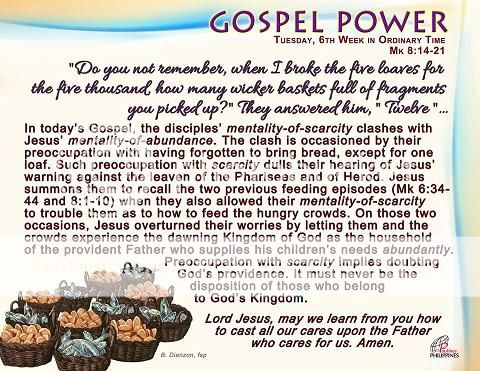
The problem is that the majority of Christians stop right there and ignore the very next verse which says ..... 'What then? shall we sin, because we are not under the law, but under grace? God forbid.' ..... Paul could not be any clearer. Does being under grace give us a licence to carry on in sin? GOD FORBID!! Does being under grace mean we can now commit idolatry, adultery, covet, steal, lie, murder? Of course not! Therefore the Bible ten commandments must still be binding upon every living being. Just think for a moment about the cost of sin.

Think about what Christ Jesus went through for you because of your sin. Paul confirmed in the strongest language he could say, that being under grace DOES NOT give us licence to carry on living a sinful life and ignore the law of God. So what does this mean? Well, if being under grace does not give us licence to sin, then it means that we must NOT sin, and therefore KEEP the ten commandments, the divine law of God. Do you see that? We are either allowed to carry on sinning under grace, or we are not. And Paul confirms that we are NOT allowed to carry on in sin under grace.

It's interesting that the Christians who proclaim the ten commandments to be abolished always quote the apostle Paul's writings. But the apostle Peter says in 2 Peter 3:15-16 that things Paul wrote about are hard to understand. And this is true if you take what Paul said about the law at face value, because Paul "seems" to suggest that we are no longer under the law of God (the ten commandments) whereas other scripture verses clearly say that we SHOULD still keep the ten commandments. Confusing? But if you are learned in Bible scripture then you will understand that Paul when referring to not being under the law, is not talking about the ten commandments.
If we take in the WHOLE council of the New Testament, it clearly teaches us that being under grace actually demands MORE of us.

Think about it this way; Say you were found guilty of murdering someone, and the law of the land sentenced you to death. Can you "work" your way to freedom? No, because you are under the law and it demands your life. The only way you can be free, is if a judge has compassion on you and pardons you. Let's say that happens; A judge comes along and pardons you. You are now under grace and no longer under the law, which demanded your life. You are free!! Now, do you leave thinking, "I'm free!! I found grace with the judge, I'm free to go and commit more crimes, because I'm now under grace, not under the law!" Of course not. Any person with an ounce of gratitude would now go and KEEP the law the best they could. And anyway, does the law of the land now become void because you found grace from the judge? No, the law still stands. Do you see this truth with regards to being under grace, not under law?

Jesus Christ Himself even confirmed His hatred for this false teaching of being free from His law, and being able to carry on living in sin. In the book of Revelation, He reveals to John His hatred for the teachings (doctrine) of the Nicolaitanes ..... Revelation 2:15 .....'So hast thou also them that hold the doctrine of the Nicolaitanes, which thing I hate.' ..... And what doctrine did the Nicolaitanes teach? They taught that being under grace meant that you could carry on living in sin! Jesus Hates this teaching!

Isaiah 42:21 .....'The LORD is well pleased for his righteousness' sake; he will magnify the law, and make it honourable.'

So what does it mean to not be under law? Well, firstly, as we learned in the previous studies, there were two laws. The divine moral law of God, the ten commandments, and the ceremonial laws that were ADDED to the ten commandments because of sin. Those ceremonial laws were taken away by Christ on the cross and we no longer need to keep those laws, as they contained sacrifices, burnt offerings, feast days etc, which pointed to Jesus, as He became our sacrifice. Another way of not being under the law is the fact that those who are in Christ Jesus are now free from the law of sin and death (Romans 8:2).

What is the law of sin and death? Is it the ten commandments? Absolutely not. What is our human nature we inherit from Adam and Eve? Sin! And what is the result of sin? Death! (Romans 6:23). That is the basic law of sin and death. But those who are in Christ are now free from that law, because they are under grace, not under the law of sin and death and in Romans 6:23 Paul confirmed that Jesus came to free us from the penalty of sin, which is death. He didn't come to free us from the ten commandments, God's divine, eternal, moral law. He came to free us from sin and death.

Is the Ten Commandments a Righteous Law?
What does it mean to be UN-righteous? Take a look at what Paul said in Romans 1:29-31 .....'Being filled with all unrighteousness, fornication, wickedness, covetousness, maliciousness; full of envy, murder, debate, deceit, malignity; whisperers, backbiters, haters of God, despiteful, proud, boasters, inventors of evil things, disobedient to parents, without understanding, covenantbreakers, without natural affection, implacable, unmerciful.'

Look at the things that Paul is linking with unrighteousness. Are these not things which go against the ten commandments, the moral law of God? How could the saying "under grace, not under the law" mean that we no longer need to keep the ten commandments, and yet breaking the ten commandments would be classed as unrighteousness? It just doesn't make sense. And if we take a look at some other verses from Paul, we will see that being under grace DOESN'T mean we no longer need to keep the ten commandments:

Romans 6:1-2 .....'What shall we say then? Shall we continue in sin, that grace may abound? God forbid. How shall we, that are dead to sin, live any longer therein?' ..... Again, Paul says in the strongest language he can that being under grace does NOT give us licence to continue living in sin. How can anyone who has truly accepted Christ continue living in open willfull sin? It's not possible. Now take a look at Romans 7:22-25. You will see Paul pointing out two laws. One righteous, spiritual law, the divine moral law of God found in the ten commandments, and a law of the flesh, which is sin. Now he says that he DELIGHTS in the law of God, which he keeps in His heart, but he also sees another law warring against this spiritual law of God, and that "other" law is the law of sin and death! The law of the flesh, which is our natural fallen state inherited from Adam and Eve. And Paul thanks God for FREEING us from this law of sin and death though our Lord, Christ Jesus.

Romans 8:1-2 .....'There is therefore now no condemnation to them which are in Christ Jesus, who walk not after the flesh, but after the Spirit. For the law of the Spirit of life in Christ Jesus hath made me free from the law of sin and death' ..... To whom is there no condemnation? To those who are IN Christ Jesus, who DO NOT walk after the flesh. What does it mean to walk after the flesh? To willfully sin, and to think there is no problem with sin! So why would it be a problem to continue living in sin? ..... Romans 8:7 .....'Because the carnal mind is enmity against God: for it is not subject to the law of God, neither indeed can be.' ..... So if we continue to be "carnally minded", then we will be at war with the Spirit of God, because we are not subjecting ourselves to the law of God, the ten commandments. And what does it mean to continue to be carnally minded? ..... Romans 8:6 .....'For to be carnally minded is death.'

Romans 6:13 .....'Neither yield ye your members as instruments of unrighteousness unto sin: but yield yourselves unto God, as those that are alive from the dead, and your members as instruments of righteousness unto God.' ..... Without the sacrifice of Christ Jesus, we would have been dead in our sins. There would be no hope of the resurrection and no future for us. But now those of us who are in Christ, are "alive from the dead", which means we should yield our bodies as "instrument of righteousness". How do we yield to righteousness? By walking each day with Christ Jesus and being obedient to God's divine moral law, the ten commandments. Take a look at what Paul said about the divine moral law of God:

Romans 7:12 .....'Wherefore the law is holy, and the commandment holy, and just, and good.' ..... The divine law of God is holy, just and good. And what did Paul say in another place? ..... Romans 12:9 .....'Abhor that which is evil; cleave to that which is good.' ..... Being under grace, we are to hate that which is evil, all sin, and CLING to what is good. What did Paul say is good and just and holy in the previous passage? The law of God!

Revelation 14:12 .....'Here is the patience of the saints: here are they that keep the commandments of God, and the faith of Jesus.'

Yes we are under grace, but that doesn't and shouldn't stop us from keeping the law of God found in the Bible ten commandments. We are no longer under the law of sin and death, as Christ Jesus has freed us from this law, the law of the flesh. He paid the full price for our sin, but we should NEVER use His grace as an excuse to carry on living in sin. So the next time you think "Oh I'm under grace not under law", take a look at the WHOLE council of God and think on what Jesus did for you. He gave you a pardon from your death sentence. Are you now going to continue breaking the very law that put you in that death sentence in the first place? Are you going to count the love of Christ so cheaply? May God guide you into His truth about being under His grace.

2 Corinthians 3:7 - Was the Law Engraved in Stone Abolished?

This is one of those gray passages that is grossly misunderstood and abused by the proponents who teach that the Ten Commandments are no longer binding against the clear instructions of Jesus who said we are not only to obey the law but teach it also. (Matthew 5:17-19) Here is the entire passage for 2 Corinthians 3:7.

2 Corinthians 3:3-9 "Being manifested, that you are the epistle of Christ, ministered by us, and written not with ink, but with the Spirit of the living God; not in tables of stone, but in the fleshly tables of the heart. And such confidence we have, through Christ, towards God. Not that we are sufficient to think any thing of ourselves, as of ourselves: but our sufficiency is from God. Who also hath made us fit ministers of the new testament, not in the letter, but in the spirit. For the letter killeth, but the spirit quickeneth. Now if the ministration of death, engraven with letters upon stones, was glorious; so that the children of Israel could not steadfastly behold the face of Moses, for the glory of his countenance, which is made void: How shall not the ministration of the spirit be rather in glory? For if the ministration of condemnation be glory, much more the ministration of justice aboundeth in glory."

The ministration of death [the Ten Commandments points out sin; Romans 7:7, and sin points to death; Romans 6:23] on stone was Glorious and was NOT to be done away. It was the glory on the face of Moses that was done away.

Moses was the minister of the Old Covenant. He gave the people God's instructions on how to keep the Ten Commandments law [detailed requirements on what to do] and what to do when it was broken [Priests and Sacrifices]. This glorious system of ministration was done away with, not the Ten Commandments. Christ ministers the New Covenant. He gives people the Spirit who gives people instructions on how to keep the law [think it, not just do it] and what to do if it is broken [genuinely repent and confess his sins]. Under the New Covenant the law is written in our hearts.

Hebrews 8:10 “For this is the covenant that I will make with the house of Israel after those days, saith the Lord; I will put my laws into their mind, and write them in their hearts: and I will be to them a God, and they shall be to me a people:”

To enable people to internalize His law, to love it and obey it eagerly and willingly, God made this promise. See also 2 Corinthians 3:3 in the above passage in contention.

Ezekiel 36:26-27 “A new heart also will I give you, and a new spirit will I put within you: and I will take away the stony heart out of your flesh, and I will give you an heart of flesh. 27 And I will put my spirit within you, and cause you to walk in my statutes, and you shall keep my judgments, and do them.”

The subject is not the doing away with the law or its establishment, but rather, the change of the location of the law from “tables of stone” to the “tables of the heart.” Under Moses' ministration the law was on stones. Under the Holy Spirit's ministration, through Christ, the law is written upon the heart. Christ's ministration of the law is effective because He transfers the law to the heart of the Christian. Then keeping the law becomes a delight and a joyful way of living because the Christian has true love for both God and man. "Thou shalt love the Lord Thy God with all thy heart and all thy soul. Thou shalt love thy neighbour as thyself".
TSyeeck
post Feb 8 2018, 05:35 PM

Look at all my stars!!
*******
Senior Member
3,576 posts

Joined: Apr 2006


The surprising Marian hymn the Church gives us for Lent

user posted image

If you’ve ever prayed the Rosary, odds are good you know the Salve Regina — the Hail, Holy Queen, a prayer passed down to us from the Middle Ages and prayed by the faithful the world over. But you may not know that it’s only one of four Marian Antiphons — prayers to the Blessed Virgin Mother that are recited at the end of night prayer by Catholics everywhere.

Each of the four belongs to a particular season. From Advent through Candlemas, we pray the Alma Redemptoris Mater, during Easter the Regina Caeli, from Pentecost through the end of Ordinary time, it’s the Hail, Holy Queen. And as of yesterday, we’re singing the Ave Regina Caelorum, which is translated in the Liturgy of the Hours as follows:

Hail, Queen of heaven;
hail, Mistress of the Angels;
hail, root of Jesse; hail, the gate
through which the Light rose over the earth.

Rejoice, Virgin most renowned
and of unsurpassed beauty.
Farewell, Lady most comely.
Prevail upon Christ to pity us.

What’s remarkable about the Church’s choice of this hymn for the weeks leading up to Lent and then the seemingly interminable weeks of prayer, fasting and almsgiving, is that there’s nothing particularly dolorous about it. One would expect Lent to be marked by the Stabat Mater, a hymn to Mary at the foot of the Cross. Instead, we have a hymn of joy.

“Ave, Regina,” we sing, echoing the greeting Gabriel offered Our Lady at the Annunciation. Interestingly, this “Ave,” so dully translated “Hail” throughout English prayers, might better be translated, “Rejoice.” “Rejoice!” Gabriel cried to an unsuspecting Mary in Nazareth. And “Rejoice!” we cry here.

Starting on the very day she offered her son as a sacrifice in the Temple, we begin singing to her, asking her to rejoice. As the ashes are traced on our foreheads, a reminder of the death we deserve and the death offered in our stead, we remind Mary—and ourselves—to rejoice.

On days of abstinence, again we sing, “Rejoice!” As we follow our Lord into the city where he will be slain, we grit our teeth and continue our Lenten cry: rejoice! Only on Holy Thursday and Good Friday does the Church allow us to silence what may seem an unnatural refrain. As Jesus is dragged before the Sanhedrin, as he lies dead in the tomb, the joy of the coming resurrection is almost—almost—overshadowed by sorrow. And so we stand in silence beside the Blessed Mother, waiting in hope for the promise to be fulfilled.

Because that has been the reason for our joy all along. As we take a deep breath and get ready for Lent, we focus not on the suffering but on the joy. All through the dreary weeks of February, we call to Mary, to each other, and to ourselves, to rejoice. As we take up our Lenten penance, we fix our eyes on the joy the other side of the cross. When the lack of caffeine or protein or pop music threatens to defeat us, we choose to rejoice. Even as we veil our statues and cry out for Pilate to crucify our king, each night we’re called back to Mary’s side, where we ask her (and ourselves) to choose joy. Because Lent isn’t ultimately about the Cross, it’s ultimately about the resurrection.

Our lives aren’t ultimately about the Cross. Our lives are about the resurrection.

It seems nearly impossible to believe that on some days, when the weight of illness and loneliness and poverty and sin come close to pushing us under. Mary may have felt the same way, knowing what her son was about to endure, watching him suffer as none had ever suffered. And she didn’t paste a Pollyanna grin on her face. No, Mary’s joy wasn’t pretended happiness. Mary’s joy was hope, a deep trust that whatever she might suffer, at the end of it all was an empty tomb and the embrace of her savior.

I imagine myself, while reciting this prayer, standing beside a white-lipped Mary, murmuring to her. “This is awful. But you’re going to be the queen of heaven. This is awful, but think how the angels are about to rejoice. This is awful! But your life has given us the dawn from on high, the Messiah, the Lord of all.“

When we pray this antiphon, I think Mary returns the favor. I think she acknowledges the pain of our lives, but points through Good Friday to Easter Sunday. “Rejoice!” she whispers. “God will work even this for good.”

It’s still a week and a half till Lent, but sometimes I think I need a running start. Would you join me, and millions of Catholics around the world, in committing to pray this antiphon every night from now until the Wednesday of Holy Week? Let it be a reminder: However ugly life might get, there is always something—Someone—to rejoice over.
TSyeeck
post Feb 9 2018, 12:31 PM

Look at all my stars!!
*******
Senior Member
3,576 posts

Joined: Apr 2006


The Catholic Faith, A Religion of Both Word and Symbol: Guest Article by Veronica Arntz
GREGORY DIPIPPO

Once again, we are very happy to share a guest article by Veronica Arntz with our readers. Veronica earned her Bachelor of Arts in Liberal Arts from Wyoming Catholic College, and is currently pursuing her Master of Arts in Theology at the Augustine Institute.
And the Word became flesh, and dwelt among us, full of grace and truth; we have beheld his glory, glory as of the only-begotten Son from the Father.” In the fullness of time, the Son of God took on human flesh and became one of us in all things but sin. Christ, the Word of God, walked on this earth, talked with men, performed miracles, and gave us the teachings of the New Covenant. As the Second Vatican Council’s document Dei Verbum comments,
This plan of revelation [of God] is realized by deeds and words having an inner unity: the deeds wrought by God in the history of salvation manifest and confirm the teaching and realities signified by the words, while the words proclaim the deeds and clarify the mystery contained in them. By this revelation, then, the deepest truth about God and the salvation of man shines out for our sake in Christ, who is both the mediator and the fullness of all revelation (art. 2).
As such, it would be impossible to accuse the Catholic Church of being a religion either entirely of words or entirely of symbols (as revealed in deeds or actions). Rather, because of the Incarnation, the Catholic faith is a religion of both word and symbol, which is particularly expressed in her sacred liturgy—both in the Holy Sacrifice of the Mass and the Divine Office.

user posted image
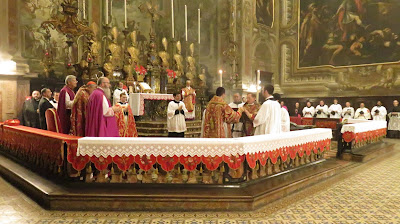
Candlemas celebrated this past Friday by His Excellency Robert Morlino, Bishop of Madison, Wisconsin. (Courtesy of the Tridentine Mass Society of Madison.)

How is the Catholic Faith a religion of the word? This is realized in the fact that the Word of God, Christ, became flesh. Christ himself is the wisdom that fashioned the universe (Wisdom 7:22); he spoke, and the whole world came to be in an instance. It is for this reason that John’s prologue begins with the following, “In the beginning was the Word, and the Word was with God, and the Word was God. He was in the beginning with God; all things were made through him, and without him was not anything made that was made” (John 1:1-3). The Gospel writer recalls the opening words of Genesis 1:1, and he unites God the Creator and the Word of God—they are indeed one. Thus, as Joseph Ratzinger/Pope Benedict XVI frequently wrote, the world came to be through creative Reason. As he states in Verbum Domini,

Creation is born of the Logos and indelibly bears the mark of the creative Reason which orders and directs it; with joy-filled certainty the psalms sing, “By the word of the Lord the heavens were made, and all their host by the breath of his mouth” (Ps 33:6); and again, “he spoke, and it came to be; he commanded, and it stood forth” (Ps 33:9) (art. 8).

The Word spoke, and all things in creation are like his words, revealing the mystery of the Creator through their diversity.

Furthermore, we can understand “word” in a more literal sense; indeed, the above passage will support what we mean when we say that the Catholic faith is also a religion of symbol. Christ spoke words to his disciples, mostly through parables and recounting the words of the Old Covenant, so that they might come to deeper knowledge of himself and his teachings. As He himself says, “I have come as light into the world, that whoever believes in me may not remain in darkness.…He who rejects me and does not receive my sayings has a judge; the word that I have spoken will be his judge on the last day. For I have spoken on my own authority; the Father who sent me has himself given me commandment what to say and what to speak. And I know that his commandment is eternal life.” (John 12:46, 48-50)

In other words, those who do not listen to the words that Christ has spoken will be their own judge, because through his words, Christ is proclaiming eternal life and the way to attain that life. Christ, as the Word, is the source of all other words—he is the source of all Truth, which is why the Scriptures are composed of divinely inspired words. The disciples transmitted Christ’s teachings through words, first through oral tradition, and then through words written down in the Scriptures. Therefore, the words of the Catholic faith are essential for understanding what the Apostles taught, which was given to them by Christ himself.

The Catholic Church continues to use words as she defines dogmas, which are already contained within the words of Scripture. While it is true that words, being mere convention, do not fully convey the reality of a thing, and in some sense fall short of the reality, they are still necessary in order to give thought and shape to the truth. Indeed, some words are closer to the truth of reality than others are, which is why the Church is careful and precise when she defines dogma. For example, one thinks of the early Christological debate involving the words, homoousios (same substance) and homoiousios (similar substance). At first glance, these words might not seem to be so different, but when describing the one substance of the Father and the Son of God, the extra letter makes all the difference. Moreover, she uses words in her liturgies, to pray to God and give him thanksgiving and praise for all he has done for us.

user posted image
The singing of the Gospel during a solemn Mass in the Ambrosian Rite, part of last year’s Sacra Liturgia conference in Milan. (© Sacra Liturgia)

As we have already hinted, the Catholic faith is not simply about words—it is not simply a rationalist religion. Rather, it is rich in symbols and in typology, revealed through Christ’s action and fulfillment of the Old Covenant. Yet the words and the symbols are directly related; in the Church today, Dr. Peter Kwasniewski writes that we are experiencing “spiritual illiteracy.” “Once the language of symbols is abolished [as occurred with the iconoclasm following the Second Vatican Council], the people cannot read the symbols any more, and are therefore cut off in principle from access to the riches of the Church.” Here he speaks of understanding symbols in literary language: the symbols of the Church are to be read, and thereby understood. In other words, symbols are rich in meaning, which means that we can “read” multiple layers of significance in them. As he continues, “Up until quite recently, Catholics grew up with the language of the Church—her pageantry of symbols, her liturgical rites and special music and cycle of feasts and fasts, her catechism.” Dr. Kwasniewski laments that these symbols are foreign to many Catholics, because they have not been fully initiated into the use and understanding of them.

What, then, is a symbol? A symbol is a sign that points beyond itself to a greater meaning. Within the Sacred Scriptures, we find many symbols that point forward to the coming of Christ. For example, Moses is a symbol, or a type, of Jesus Christ, because he is the giver of the law to the people of Israel. Moreover, he speaks with God face-to-face, as with a friend (Exod 30:11). Moses, therefore, is a type of Christ, because Christ is the giver of the New Law of the New Covenant, and in Christ, we behold the face of God. Since Christ became incarnate, God now has a human face, and we can speak to him as Moses did with God on the mountain. “For the law was given through Moses; grace and truth came through Jesus Christ” (John 1:17). The Crucifix is also a symbol for the Catholic faith, a sign of Christ’s sacrifice for the redemption of mankind; every time we see one, we are reminded of Christ’s sacrifice, and our sinful human nature.

In the Holy Sacrifice of the Mass, symbol and word are united. In the Asperges me, the choir chants the words of the hymn that describe our cleansing from sin: “Thou shalt sprinkle me, O Lord, with hyssop, and I shall be cleansed; Thou shalt wash me, and I shall become whiter than snow. Have mercy on me, O God, according to Thy great mercy.” Meanwhile, the priest sprinkles the people with baptismal water, a rewashing in the waters of baptism to be cleansed from sin. The incensing of the altar symbolizes the Offertory itself; the incense rises like a prayer to the heavens, the prayerful act of the faithful and the priest that God might bestow his mercy on them and on the whole world. The Mass ends with the Last Gospel, the Prologue of the Gospel of John, which reminds the faithful to give praise and thanksgiving to the Incarnate Word, who by his Passion, Death, and Resurrection brought salvation to all who would choose to follow him.

Moreover, the vestments, the polyphony, the architecture—all of these symbols are meant to point to Christ, the Word Incarnate. In so many of our modern churches, we see what Kwasniewski writes of in the article cited above: a removal of so many of the Church’s beautiful symbols, to the point that very few people can recognize them anymore or their significance. Altar rails, ornate statues, baldacchinos, among many other things, were removed from the churches shortly after the Second Vatican Council. This meant that they were absent from the consciousness of the people, and have been so for a whole generation or more. These traditions of the Church, all of which were oriented toward giving glory to God, were replaced with postmodern pseudo-decorations, which did not point the worshipper to Christ, but rather, back to himself. The idea was to make everything within the Church more comprehensible by modern man, but by making everything so understandable, the worshipper has since lost interest, because he is surrounded by those things he encounters on a daily basis. Rather than being elevated to the sublime, the modern worshipper encounters only those things he sees in his daily life at the office and in the world. Thus, when the Church fully unites her tradition of symbols and her tradition of words in the Mass, she is able to speak to man’s deepest longing to be united with God, who transcends him and his mundane activities.

user posted image

What does this mean for the Church in the postmodern world? The Church ought to embrace the fullness of her traditions, both in her words and in her symbols. Because of Christ’s Incarnation, she is able to speak through both words and symbols—Christ gives meaning to both of them. The Church can do a great service to the people if she returns to the fullness of words and symbols, for the people are starved for meaning in their churches and their liturgies. Rather than catering to the needs of “modern man”, the Church can give him the richness and deepness of her traditions, most especially realized in the Holy Sacrifice of the Mass.
khool
post Feb 9 2018, 02:56 PM

Getting Started
**
Junior Member
225 posts

Joined: Mar 2008


Friday of the Fifth Week in Ordinary Time
Lectionary: 333


user posted image

Reading 1 (1 kgs 11:29-32; 12:19)

Jeroboam left Jerusalem,
and the prophet Ahijah the Shilonite met him on the road.
The two were alone in the area,
and the prophet was wearing a new cloak.
Ahijah took off his new cloak,
tore it into twelve pieces, and said to Jeroboam:

“Take ten pieces for yourself;
the LORD, the God of Israel, says:
‘I will tear away the kingdom from Solomon’s grasp
and will give you ten of the tribes.
One tribe shall remain to him for the sake of David my servant,
and of Jerusalem,
the city I have chosen out of all the tribes of Israel.’”

Israel went into rebellion against David’s house to this day.

Responsorial Psalm (PS 81:10-11ab, 12-13, 14-15)

R. I am the Lord, your God: hear my voice.

"There shall be no strange god among you
nor shall you worship any alien god.
I, the LORD, am your God
who led you forth from the land of Egypt."
R. I am the Lord, your God: hear my voice.

"My people heard not my voice,
and Israel obeyed me not;
So I gave them up to the hardness of their hearts;
they walked according to their own counsels."
R. I am the Lord, your God: hear my voice.

"If only my people would hear me,
and Israel walk in my ways,
Quickly would I humble their enemies;
against their foes I would turn my hand."
R. I am the Lord, your God: hear my voice.

Alleluia (See Acts 16:14b)

R. Alleluia, alleluia.
Open our hearts, O Lord,
to listen to the words of your Son.
R. Alleluia, alleluia.

Gospel (Mk 7:31-37)

Jesus left the district of Tyre
and went by way of Sidon to the Sea of Galilee,
into the district of the Decapolis.
And people brought to him a deaf man who had a speech impediment
and begged him to lay his hand on him.
He took him off by himself away from the crowd.
He put his finger into the man's ears
and, spitting, touched his tongue;
then he looked up to heaven and groaned, and said to him,
"Ephphatha!" (that is, "Be opened!")
And immediately the man's ears were opened,
his speech impediment was removed,
and he spoke plainly.
He ordered them not to tell anyone.
But the more he ordered them not to,
the more they proclaimed it.
They were exceedingly astonished and they said,
"He has done all things well.
He makes the deaf hear and the mute speak."

user posted image

REFLECTIONS: WORD Today

user posted image

David, Israel's greatest king, loved God faithfully, even if not perfectly. He united all the 12 tribes of Israel into 1 strong and glorious kingdom. But his son Solomon was unfaithful even with his great God-given wisdom. He led the people to worship many gods.

When Solomon died, civil war split the kingdom once again, leaving only 1 portion (the fused tribes of Judah/Simeon) for the son of Solomon to reign. The nation was divided into the northern kingdom of Israel and the southern kingdom of Judah. They would keep fighting each other until some 400 years later, the whole Promised Land fell into the hands of various foreign powers. David's kingdom was completely gone.

Sin is a sickness that splits a nation, a family, and a personality. The consequence of sin expands far and wide through space and time.

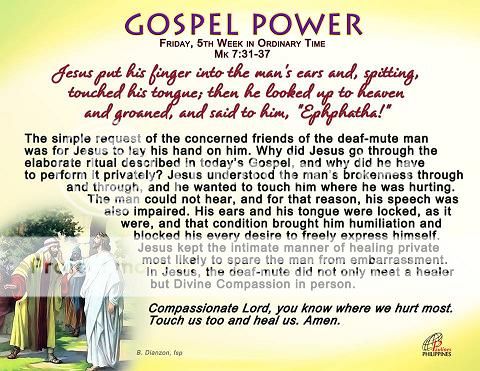
In the Gospel, Jesus, "Son of David" is traveling through the lost tribes of Israel and even territories outside. He is healing the sick, gathering the chosen family, reuniting the nation, and building the worldwide Kingdom of God. He heals a deaf and dumb man so that he could now hear and speak.

If you have been worshiping other gods and now sense trouble in your life and family, come to Jesus quickly before it's too late. Ask for the grace of a listening heart, so that you may once more love and speak with love of the One who is Love.

Lord Jesus, heal our land and our families!

Prayer of St. Francis a.k.a Make Me A Channel of Your Peace (Sung By Angelina, EWTN)


Source: https://www.facebook.com/CatholicMassReflec...835341203430303

user posted image

khool
post Feb 9 2018, 02:57 PM

Getting Started
**
Junior Member
225 posts

Joined: Mar 2008


user posted image

user posted image

khool
post Feb 12 2018, 05:12 PM

Getting Started
**
Junior Member
225 posts

Joined: Mar 2008


Monday of the Sixth Week in Ordinary Time
Lectionary: 335


user posted image

Reading 1 (Jas 1:1-11)

James, a servant of God and of the Lord Jesus Christ,
to the twelve tribes in the dispersion, greetings.

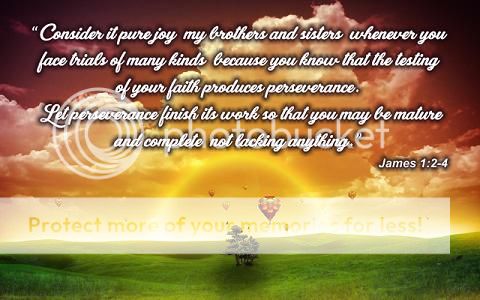
Consider it all joy, my brothers and sisters,
when you encounter various trials,
for you know that the testing of your faith produces perseverance.
And let perseverance be perfect,
so that you may be perfect and complete, lacking in nothing.
But if any of you lacks wisdom,
he should ask God who gives to all generously and ungrudgingly,
and he will be given it.
But he should ask in faith, not doubting,
for the one who doubts is like a wave of the sea
that is driven and tossed about by the wind.
For that person must not suppose that he will receive anything from the Lord,
since he is a man of two minds, unstable in all his ways.

The brother in lowly circumstances
should take pride in high standing,
and the rich one in his lowliness,
for he will pass away "like the flower of the field."
For the sun comes up with its scorching heat and dries up the grass,
its flower droops, and the beauty of its appearance vanishes.
So will the rich person fade away in the midst of his pursuits.

Responsorial Psalm (Ps 119:67, 68, 71, 72, 75, 76)

R. Be kind to me, Lord, and I shall live.

Before I was afflicted I went astray,
but now I hold to your promise.
R. Be kind to me, Lord, and I shall live.

You are good and bountiful;
teach me your statutes.
R. Be kind to me, Lord, and I shall live.

It is good for me that I have been afflicted,
that I may learn your statutes.
R. Be kind to me, Lord, and I shall live.

The law of your mouth is to me more precious
than thousands of gold and silver pieces.
R. Be kind to me, Lord, and I shall live.

I know, O LORD, that your ordinances are just,
and in your faithfulness you have afflicted me.
R. Be kind to me, Lord, and I shall live.

Let your kindness comfort me
according to your promise to your servants.
R. Be kind to me, Lord, and I shall live.

Alleluia (Jn 14:6)

R. Alleluia, alleluia.
I am the way and the truth and the life, says the Lord;
no one comes to the Father except through me.
R. Alleluia, alleluia.

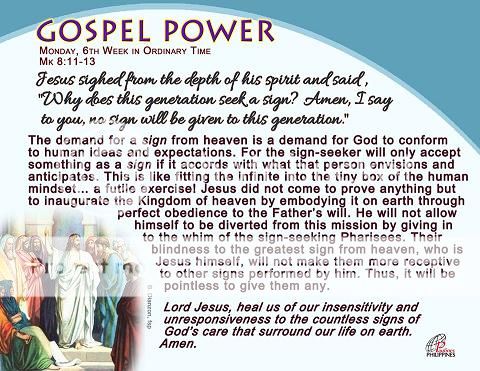
Gospel (Mk 8:11-13)

The Pharisees came forward and began to argue with Jesus,
seeking from him a sign from heaven to test him.
He sighed from the depth of his spirit and said,
"Why does this generation seek a sign?
Amen, I say to you, no sign will be given to this generation."
Then he left them, got into the boat again,
and went off to the other shore.

user posted image

REFLECTIONS: WORD Today

user posted image

When the Pharisees demanded a miracle from Jesus to prove His divinity, Jesus sighed deeply. Refusing to perform cheap magic tricks, He left them.

We may not doubt the divinity and of Jesus, but we can have the same demanding, impatient attitude in our petitions. When we give Jesus strict instructions what to do about our problems, we are tying His hands, preventing Him from putting into action the events that His all-seeing Wisdom designed to produce the very best for us.

St. James advises us: "Dear brothers and sisters, when trials of any kind come your way, consider it an opportunity for great joy. For you know that when your faith is tested, your endurance has a chance to grow. So let it grow, for when your endurance is fully developed, you will be perfect and complete, lacking nothing." (1st Reading)

Lord Jesus, grant me the wisdom to see that my cross is not an instrument of my destruction but of my salvation.

I WILL RISE - THE WISDOM OF GOD


Source: https://www.facebook.com/CatholicMassReflec...836784186619338

user posted image

khool
post Feb 12 2018, 05:14 PM

Getting Started
**
Junior Member
225 posts

Joined: Mar 2008


user posted image

user posted image

khool
post Feb 13 2018, 02:40 PM

Getting Started
**
Junior Member
225 posts

Joined: Mar 2008


Mark 9:37 (NRSVCE)

“Whoever welcomes one such child in my name welcomes me, and whoever welcomes me welcomes not me but the one who sent me.”

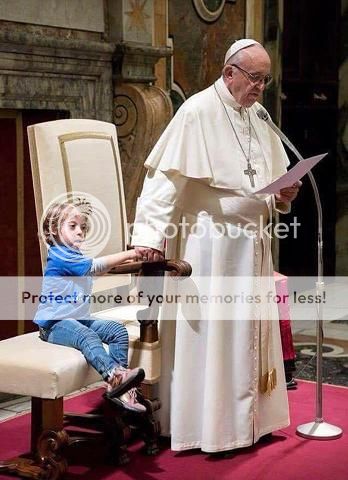
A beautiful little girl with Down syndrome, got up from her seat during a papal audience and went toward the Pope. The security guards quickly moved in to take her back to her mother. The Pope stopped everyone and said to the girl, "come sit next to me.” The girl then sat down near him and the Holy Father continued to preach while holding hands with the little girl.

user posted image

Amen!!! rclxm9.gif rclxms.gif nod.gif thumbup.gif

https://www.facebook.com/uCatholic/posts/2035681776449200

khool
post Feb 13 2018, 02:43 PM

Getting Started
**
Junior Member
225 posts

Joined: Mar 2008


Tuesday of the Sixth Week in Ordinary Time
Lectionary: 336


user posted image

Reading 1 (Jas 1:12-18)

Blessed is he who perseveres in temptation,
for when he has been proven he will receive the crown of life
that he promised to those who love him.
No one experiencing temptation should say,
"I am being tempted by God";
for God is not subject to temptation to evil,
and he himself tempts no one.
Rather, each person is tempted when lured and enticed by his desire.
Then desire conceives and brings forth sin,
and when sin reaches maturity it gives birth to death.

Do not be deceived, my beloved brothers and sisters:
all good giving and every perfect gift is from above,
coming down from the Father of lights,
with whom there is no alteration or shadow caused by change.
He willed to give us birth by the word of truth
that we may be a kind of first fruits of his creatures.

Responsorial Psalm (Ps 94:12-13a, 14-15, 18-19)

R. Blessed the man you instruct, O Lord.

Blessed the man whom you instruct, O LORD,
whom by your law you teach,
Giving him rest from evil days.
R. Blessed the man you instruct, O Lord.

For the LORD will not cast off his people,
nor abandon his inheritance;
But judgment shall again be with justice,
and all the upright of heart shall follow it.
R. Blessed the man you instruct, O Lord.

When I say, "My foot is slipping,"
your mercy, O LORD, sustains me;
When cares abound within me,
your comfort gladdens my soul.
R. Blessed the man you instruct, O Lord.

Alleluia (Jn 14:23)

R. Alleluia, alleluia.
Whoever loves me will keep my word, says the Lord;
and my Father will love him
and we will come to him.
R. Alleluia, alleluia.

Gospel (Mk 8:14-21)

The disciples had forgotten to bring bread,
and they had only one loaf with them in the boat.
Jesus enjoined them, "Watch out,
guard against the leaven of the Pharisees
and the leaven of Herod."
They concluded among themselves that
it was because they had no bread.
When he became aware of this he said to them,
"Why do you conclude that it is because you have no bread?
Do you not yet understand or comprehend?
Are your hearts hardened?
Do you have eyes and not see, ears and not hear?
And do you not remember,
when I broke the five loaves for the five thousand,
how many wicker baskets full of fragments you picked up?"
They answered him, "Twelve."
"When I broke the seven loaves for the four thousand,
how many full baskets of fragments did you pick up?"
They answered him, "Seven."
He said to them, "Do you still not understand?"

user posted image

REFLECTIONS: WORD Today

user posted image

The disciples were on a boat with Jesus. They were worried that they only had 1 loaf of bread. They still feared hunger in spite witnessing Jesus twice feed many thousands with only a few loaves.

Jesus warned them, "Beware of the yeast of the Pharisees and Herod."

The Pharisees and Herod were completely opposite. The Pharisees desired God while Herod desired the world. But inside, the same
yeast of self-reliance drove them. They relied on their own power to achieve what they desired.

The Pharisees relied on their own efforts to save themselves by obeying the law of Moses perfectly, disregarding God's grace. Herod of course relied in his political and military power, not God.

Self-reliance leads us to distrust that our Father can give us our daily bread. Distrust then leads us to do sinful things to preserve ourselves. Jesus warns, "whoever wants to save their life will lose it, but whoever loses their life for me will save it." (Luke 9:24)

And St. James (First Reading) reminds us, "My beloved brothers and sisters, all good giving and every perfect gift is from above, coming down from the Father of lights..."

When we forget that it is God in His goodness who does the ultimate work of saving our soul and feeding our body, we become insecure, fearful and sinful. Come to the Holy Mass where God feeds us Bread from Heaven - His very own Son - and be at peace.

SAVE ME


Source: https://www.facebook.com/CatholicMassReflec...837151476582609

user posted image

khool
post Feb 13 2018, 02:46 PM

Getting Started
**
Junior Member
225 posts

Joined: Mar 2008


user posted image

user posted image

TSyeeck
post Feb 14 2018, 11:19 AM

Look at all my stars!!
*******
Senior Member
3,576 posts

Joined: Apr 2006


user posted image
TSyeeck
post Feb 14 2018, 12:13 PM

Look at all my stars!!
*******
Senior Member
3,576 posts

Joined: Apr 2006


65 Pages « < 32 33 34 35 36 > » Top
 

Change to:
| Lo-Fi Version
0.0362sec    0.32    6 queries    GZIP Disabled
Time is now: 4th December 2025 - 07:10 PM