Welcome Guest ( Log In | Register )

65 Pages « < 33 34 35 36 37 > » Bottom

Outline · [ Standard ] · Linear+

 LYN Catholic Fellowship V02 (Group), For Catholics (Roman or Eastern)

views
     
TSyeeck
post Feb 17 2018, 12:52 PM

Look at all my stars!!
*******
Senior Member
3,573 posts

Joined: Apr 2006


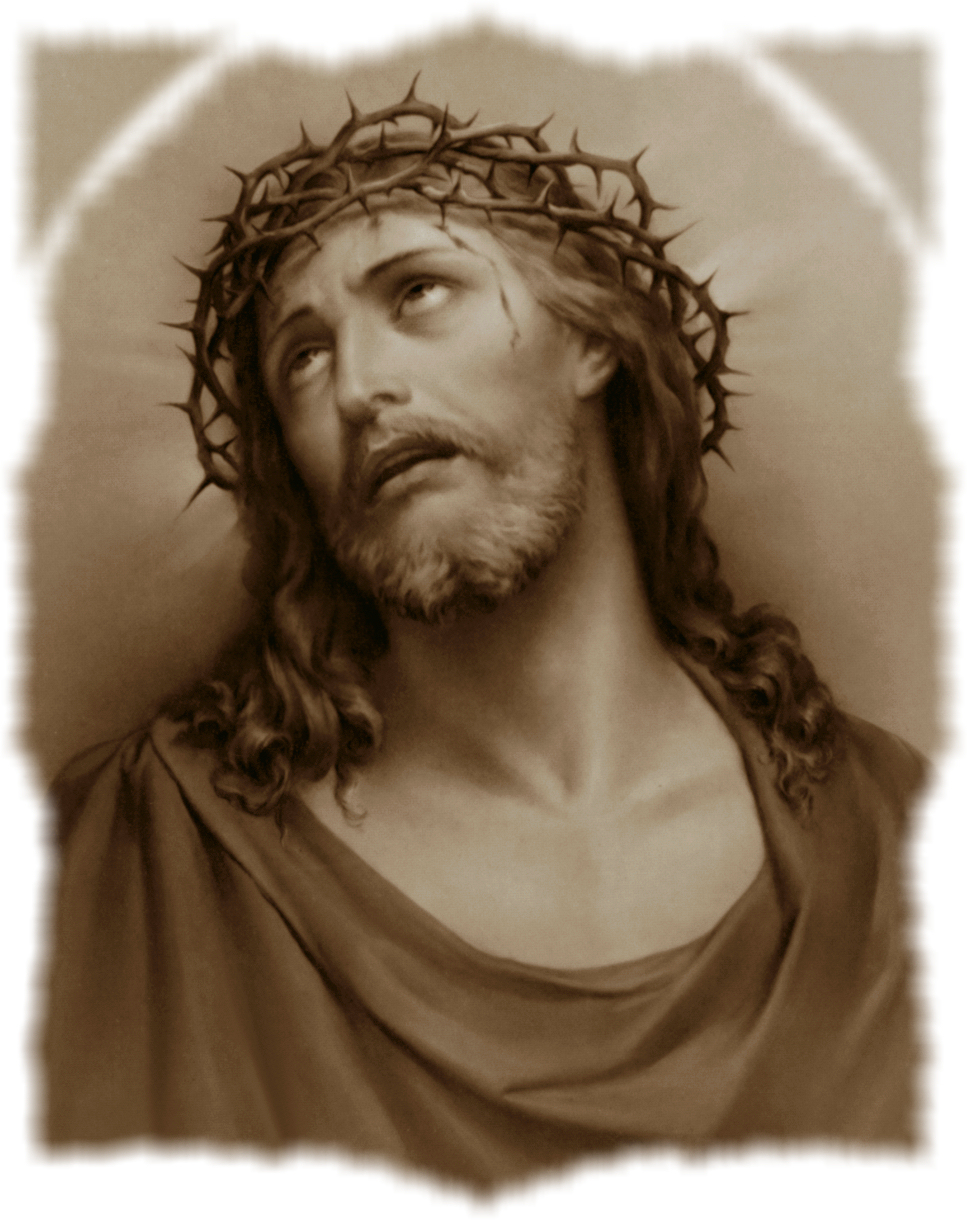
Traditionally, each Friday in Lent is dedicated in a special way to some aspect of the Passion. This first friday in Lent is dedicated to the Crown of Thorns.

Dear Lord, I am grieved when I consider Your sad condition when You wore the Crown of Thorns upon Your Holy Head.
I desire to withdraw the thorns by offering to the Eternal Father the merits of Your Wounds for the salvation of sinners. I wish to unite my actions to the merits of Your Most Holy Crown, so that they may gain many merits, as You have promised. Amen.

user posted image
khool
post Feb 20 2018, 12:19 PM

Getting Started
**
Junior Member
225 posts

Joined: Mar 2008


Tuesday of the First Week of Lent
Lectionary: 225


user posted image

Reading 1 (Is 55:10-11)

Thus says the LORD:
Just as from the heavens
the rain and snow come down
And do not return there
till they have watered the earth,
making it fertile and fruitful,
Giving seed to the one who sows
and bread to the one who eats,
So shall my word be
that goes forth from my mouth;
It shall not return to me void,
but shall do my will,
achieving the end for which I sent it.

Responsorial Psalm (Ps 34:4-5, 6-7, 16-17, 18-19)

R. From all their distress God rescues the just.

Glorify the LORD with me,
let us together extol his name.
I sought the LORD, and he answered me
and delivered me from all my fears.
R. From all their distress God rescues the just.

Look to him that you may be radiant with joy,
and your faces may not blush with shame.
When the poor one called out, the LORD heard,
and from all his distress he saved him.
R. From all their distress God rescues the just.

The LORD has eyes for the just,
and ears for their cry.
The LORD confronts the evildoers,
to destroy remembrance of them from the earth.
R. From all their distress God rescues the just.

When the just cry out, the LORD hears them,
and from all their distress he rescues them.
The LORD is close to the brokenhearted;
and those who are crushed in spirit he saves.
R. From all their distress God rescues the just.

Verse Before the Gospel (Mt 4:4b)

One does not live on bread alone,
but on every word that comes forth from the mouth of God.

Gospel (Mt 6:7-15)

Jesus said to his disciples:
"In praying, do not babble like the pagans,
who think that they will be heard because of their many words.
Do not be like them.
Your Father knows what you need before you ask him.

"This is how you are to pray:

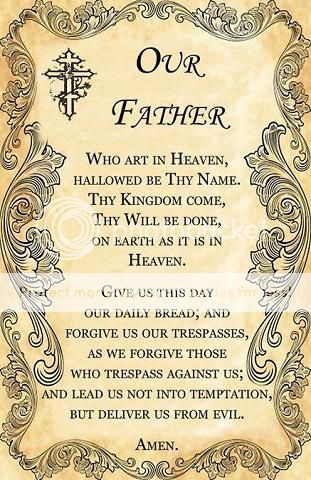
Our Father who art in heaven,
hallowed be thy name,
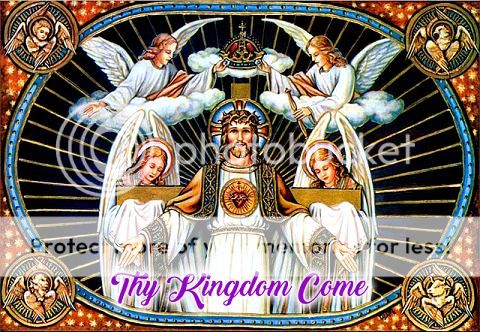
thy Kingdom come,
thy will be done,
on earth as it is in heaven.
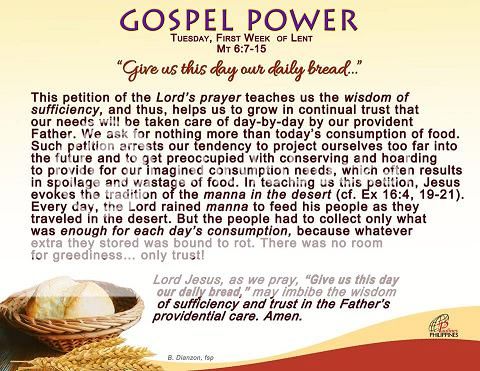
Give us this day our daily bread;
and forgive us our trespasses,
as we forgive those who trespass against us;
and lead us not into temptation,
but deliver us from evil.

"If you forgive men their transgressions,
your heavenly Father will forgive you.
But if you do not forgive men,
neither will your Father forgive your transgressions."

user posted image

REFLECTIONS: WORD Today

user posted image

In the ancient First Reading, God said that just as rain from heaven waters the earth, causing seed to grow and produce fruit that feed the hungry, "So also will be the word that I speak. It will not fail to do what I plan for it. It will do everything I send it to do."

In the fullness of time, God sent His Word to become Flesh - Jesus Christ, His perfectly obedient Son. The teachings of Jesus is the Water of Life, transforming our lives from a dry, shrunken dessert shrub into a lush, fruit-bearing tree in the Kingdom of God.

In the Gospel, Jesus teaches us the Lord's Prayer, wherein we say, "Your Kingdom come, your will be done, on earth as it is in heaven." By these Words we adopt the attitude of a productive cooperator and co-builder of the Kingdom:

We do not pray to convince God to do our will. We pray to understand the beauty of His, that we may bear fruits that feed a world hungry for God's love.

THE LORD'S PRAYER


Source: https://www.facebook.com/CatholicMassReflec...840207279610362

user posted image

khool
post Feb 20 2018, 03:29 PM

Getting Started
**
Junior Member
225 posts

Joined: Mar 2008


user posted image

user posted image

TSyeeck
post Feb 22 2018, 04:11 PM

Look at all my stars!!
*******
Senior Member
3,573 posts

Joined: Apr 2006


Reward and Merit


Paul tells us: "For [God] will reward every man according to his works: to those who by perseverance in working good seek for glory and honor and immortality, he will give eternal life. There will be . . . glory and honor and peace for every one who does good, the Jew first and also the Greek. For God shows no partiality" (Rom. 2:6–11; cf. Gal. 6:6–10).

In the second century, the technical Latin term for "merit" was introduced as a synonym for the Greek word for "reward." Thus merit and reward are two sides of the same coin.

Protestants often misunderstand the Catholic teaching on merit, thinking that Catholics believe that one must do good works to come to God and be saved. This is exactly the opposite of what the Church teaches. The Council of Trent stressed: "[N]one of those things which precede justification, whether faith or works, merit the grace of justification; for if it is by grace, it is not now by works; otherwise, as the Apostle [Paul] says, grace is no more grace" (Decree on Justification 8, citing Rom. 11:6).

The Catholic Church teaches only Christ is capable of meriting in the strict sense—mere man cannot (Catechism of the Catholic Church 2007). The most merit humans can have is condign—when, under the impetus of God’s grace, they perform acts which please him and which he has promised to reward (Rom. 2:6–11, Gal. 6:6–10). Thus God’s grace and his promise form the foundation for all human merit (CCC 2008).

Virtually all of this is agreed to by Protestants, who recognize that, under the impetus of God’s grace, Christians do perform acts which are pleasing to God and which God has promised to reward, meaning that they fit the definition of merit. When faced with this, Protestants are forced to admit the truth of the Catholic position—although, contrary to Paul’s command (2 Tim. 2:14), they may still dispute the terminology.

Thus the Lutheran Book of Concord admits: "We are not putting forward an empty quibble about the term ‘reward.’ . . . We grant that eternal life is a reward because it is something that is owed—not because of our merits [in the strict sense] but because of the promise [of God]. We have shown above that justification is strictly a gift of God; it is a thing promised. To this gift the promise of eternal life has been added" (p. 162).

The following passages illustrate what the Church Fathers had to say on the relationship between merit and grace.


Ignatius of Antioch


"Be pleasing to him whose soldiers you are, and whose pay you receive. May none of you be found to be a deserter. Let your baptism be your armament, your faith your helmet, your love your spear, your endurance your full suit of armor. Let your works be as your deposited withholdings, so that you may receive the back-pay which has accrued to you" (Letter to Polycarp 6:2 [A.D. 110]).


Justin Martyr


"We have learned from the prophets and we hold it as true that punishments and chastisements and good rewards are distributed according to the merit of each man’s actions. Were this not the case, and were all things to happen according to the decree of fate, there would be nothing at all in our power. If fate decrees that this man is to be good and that one wicked, then neither is the former to be praised nor the latter to be blamed" (First Apology 43 [A.D. 151]).


Tatian the Syrian


"[T]he wicked man is justly punished, having become depraved of himself; and the just man is worthy of praise for his honest deeds, since it was in his free choice that he did not transgress the will of God" (Address to the Greeks 7 [A.D. 170]).


Athenagoras


"And we shall make no mistake in saying, that the [goal] of an intelligent life and rational judgment, is to be occupied uninterruptedly with those objects to which the natural reason is chiefly and primarily adapted, and to delight unceasingly in the contemplation of Him Who Is, and of his decrees, notwithstanding that the majority of men, because they are affected too passionately and too violently by things below, pass through life without attaining this object. For . . . the examination relates to individuals, and the reward or punishment of lives ill or well spent is proportioned to the merit of each" (The Resurrection of the Dead 25 [A.D. 178]).


Theophilus of Antioch


"He who gave the mouth for speech and formed the ears for hearing and made eyes for seeing will examine everything and will judge justly, granting recompense to each according to merit. To those who seek immortality by the patient exercise of good works [Rom. 2:7], he will give everlasting life, joy, peace, rest, and all good things, which neither eye has seen nor ear has heard, nor has it entered into the heart of man [1 Cor. 2:9]. For the unbelievers and the contemptuous and for those who do not submit to the truth but assent to iniquity . . . there will be wrath and indignation [Rom. 2:8]" (To Autolycus 1:14 [A.D. 181]).


Irenaeus


"[Paul], an able wrestler, urges us on in the struggle for immortality, so that we may receive a crown and so that we may regard as a precious crown that which we acquire by our own struggle and which does not grow upon us spontaneously. . . . Those things which come to us spontaneously are not loved as much as those which are obtained by anxious care" (Against Heresies4:37:7 [A.D. 189]).


Tertullian


"Again, we [Christians] affirm that a judgment has been ordained by God according to the merits of every man" (To the Nations 19 [A.D. 195]).

"In former times the Jews enjoyed much of God’s favor, when the fathers of their race were noted for their righteousness and faith. So it was that as a people they flourished greatly, and their kingdom attained to a lofty eminence; and so highly blessed were they, that for their instruction God spoke to them in special revelations, pointing out to them beforehand how they should merit his favor and avoid his displeasure" (Apology 21 [A.D. 197]).

"A good deed has God for its debtor [cf. Prov. 19:17], just as also an evil one; for a judge is the rewarder in every case [cf. Rom. 13:3–4]" (Repentance 2:11 [A.D. 203]).


Hippolytus


"Standing before [Christ’s] judgment, all of them, men, angels, and demons, crying out in one voice, shall say: ‘Just is your judgment,’ and the justice of that cry will be apparent in the recompense made to each. To those who have done well, everlasting enjoyment shall be given; while to lovers of evil shall be given eternal punishment" (Against the Greeks 3 [A.D. 212]).


Cyprian of Carthage


"The Lord denounces [Christian evildoers], and says, ‘Many shall say to me in that day, Lord, Lord, have we not prophesied in your name, and in your name have cast out devils, and in your name done many wonderful works? And then will I profess unto them, I never knew you: depart from me, you who work iniquity’ [Matt. 7:21–23]. There is need of righteousness, that one may deserve well of God the Judge; we must obey his precepts and warnings, that our merits may receive their reward" (The Unity of the Catholic Church 15, 1st ed. [A.D. 251]).

"[Y]ou who are a matron rich and wealthy, anoint not your eyes with the antimony of the devil, but with the collyrium of Christ, so that you may at last come to see God, when you have merited before God both by your works and by your manner of living" (Works and Almsgivings 14 [A.D. 253]).


Lactantius


"Let every one train himself to righteousness, mold himself to self-restraint, prepare himself for the contest, equip himself for virtue . . . [and] in his uprightness acknowledge the true and only God, may cast away pleasures, by the attractions of which the lofty soul is depressed to the earth, may hold fast innocence, may be of service to as many as possible, may gain for himself incorruptible treasures by good works, that he may be able, with God for his judge, to gain for the merits of his virtue either the crown of faith, or the reward of immortality" (Epitome of the Divine Institutes 73 [A.D. 317]).


Cyril of Jerusalem


"The root of every good work is the hope of the resurrection, for the expectation of a reward nerves the soul to good work. Every laborer is prepared to endure the toils if he looks forward to the reward of these toils" (Catechetical Lectures 18:1 [A.D. 350]).


Jerome


"It is our task, according to our different virtues, to prepare for ourselves different rewards. . . . If we were all going to be equal in heaven it would be useless for us to humble ourselves here in order to have a greater place there. . . . Why should virgins persevere? Why should widows toil? Why should married women be content? Let us all sin, and after we repent we shall be the same as the apostles are!" (Against Jovinian 2:32 [A.D. 393]).


Augustine


"We are commanded to live righteously, and the reward is set before us of our meriting to live happily in eternity. But who is able to live righteously and do good works unless he has been justified by faith?" (Various Questions to Simplician 1:2:21 [A.D. 396]).

"He bestowed forgiveness; the crown he will pay out. Of forgiveness he is the donor; of the crown, he is the debtor. Why debtor? Did he receive something? . . . The Lord made himself a debtor not by receiving something but by promising something. One does not say to him, ‘Pay for what you received,’ but ‘Pay what you promised’" (Explanations of the Psalms 83:16 [A.D. 405]).

"What merits of his own has the saved to boast of when, if he were dealt with according to his merits, he would be nothing if not damned? Have the just then no merits at all? Of course they do, for they are the just. But they had no merits by which they were made just" (Letters 194:3:6 [A.D. 412]).

"What merit, then, does a man have before grace, by which he might receive grace, when our every good merit is produced in us only by grace and when God, crowning our merits, crowns nothing else but his own gifts to us?" (ibid., 194:5:19).


Prosper of Aquitaine


"Indeed, a man who has been justified, that is, who from impious has been made pious, since he had no antecedent good merit, receives a gift, by which gift he may also acquire merit. Thus, what was begun in him by Christ’s grace can also be augmented by the industry of his free choice, but never in the absence of God’s help, without which no one is able either to progress or to continue in doing good" (Responses on Behalf of Augustine 6 [A.D. 431]).


Sechnall of Ireland


"Hear, all you who love God, the holy merits of Patrick the bishop, a man blessed in Christ; how, for his good deeds, he is likened unto the angels, and, for his perfect life, he is comparable to the apostles" (Hymn in Praise of St. Patrick 1 [A.D. 444]).


Council of Orange II


"[G]race is preceded by no merits. A reward is due to good works, if they are performed, but grace, which is not due, precedes [good works], that they may be done" (Canons on grace 19 [A.D. 529]).


NIHIL OBSTAT: I have concluded that the materials
presented in this work are free of doctrinal or moral errors.
Bernadeane Carr, STL, Censor Librorum, August 10, 2004

IMPRIMATUR: In accord with 1983 CIC 827
permission to publish this work is hereby granted.
+Robert H. Brom, Bishop of San Diego, August 10, 2004
TSyeeck
post Feb 23 2018, 02:42 PM

Look at all my stars!!
*******
Senior Member
3,573 posts

Joined: Apr 2006


The Second Friday in Lent is dedicated to the Holy Lance and Nails.

user posted image

The Sacred Lance and Nails of Our Lord Jesus Christ
Friday after the First Sunday of Lent
Mass Said in Some Places


Introit: Ps. xxi: 17-18 et 15
They have pierced my hands and my feet: they have numbered all my bones: and I am poured out as water [Ps. Ibid., 15] My heart has become like wax melting away within my bosom. Glory be.... They have pierced.

Collect
O God, who in assuming flesh was afflicted by the Nails, and didst will to be wounded by the Lance for the salvation of the world: grant, we beseech Thee; that we who solemnly venerate the Nails and Lance on earth, may enjoy the glorious triumph of victory in heaven. Thou who livest and reignest.....

A Reading From The Prophet Zacharia
xii: 10-11; xiii: 6-7

Thus saith the Lord: And I will pour out upon the house of David, and upon the inhabitants of Jerusalem, the spirit of grace, and of prayers: and they shall look upon me, whom they have pierced: and they shall mourn for him as one mourneth for an only son, and they shall grieve over him, as the manner is to grieve for the death of the firstborn. In that day there shall be a great lamentation in Jerusalem. And they shall say to him: What are these wounds in the midst of thy hands? And he shall say: With these I was wounded in the house of them that loved me. Awake, O sword, against my shepherd, and against the man that cleaveth to me, saith the Lord of hosts: strike the shepherd, and the sheep shall be scattered: and I will turn my hand to the little ones: saith the Lord almighty.

Gradual: Ps. lxviii: 21-22
Insult has broken my heart, and I am weak, I looked for sympathy, but there was none; for comforters, and I found none. Rather they put gall in my food, and in my thirst they gave me vinegar to drink.

Tract: Isaias: liii: 4-5
Surely He hath borne our infirmities and carried our sorrows: and we have thought Him, as it were, a leper, and as one struck by God and afflicted. But He was wounded for our iniquities, He was bruised for our sins: the chastisement of our peace was upon Him, and by His bruises we were healed.

In Masses outside of Lent the tract is omitted and replaced by:
Alleluia, Alleluia. Hail, our King: Thou alone art merciful in spite of our errors: Obedient to the Father Thou wert led to be crucified, as a humble lamb to the slaughter. Alleluia

During Paschaltide:
Alleluia, Alleluia. Hail, our King: Thou alone art merciful in spite of our errors: Obedient to the Father Thou wert led to be crucified, as a humble lamb to the slaughter. Alleluia To Thee be glory, hosanna: to Thee be triumph and victory: to Thee be the highest praise and the crown of honor. Alleluia.

Gospel: John xix: 28-35

The continuation of the holy Gospel according to John:

Jesus knowing that all things were now accomplished, that the scripture might be fulfilled, said: «I thirst.» Now there was a vessel set there, full of vinegar. And they, putting a sponge full of vinegar and hyssop, put it to his mouth. Jesus therefore, when He had taken the vinegar, said: «It is consummated.» And bowing His head, He gave up the ghost. Then the Jews (because it was the parasceve), that the bodies might not remain upon the cross on the sabbath day (for that was a great sabbath day), besought Pilate that their legs might be broken: and that they might be taken away. The soldiers therefore came: and they broke the legs of the first, and of the other that was crucified with him. But after they were come to Jesus, when they saw that He was already dead, they did not break his legs. But one of the soldiers with a spear opened His side: and immediately there came out blood and water. And he that saw it hath given testimony: and his testimony is true.

Offertory
Evil men rose up against Me: without mercy they sought to kill Me: they did not hesitate to spit in My face: with their lances they wounded Me, and they have struck all My bones.

Secret
Sanctify us O Lord, we beseech Thee, with this holy and immaculate evening sacrifice: which Thine only-begotten Son offered on the Cross for the salvation of the world. Thou who livest and reignest....

Preface of the Holy Cross
It is truly meet and just, right and availing unto salvation, that we should in all times and in all places give thanks unto Thee, O holy Lord, Father almighty and everlasting God. Who didst set the salvation of mankind upon the tree of the Cross, so that whence came death, thence also life might rise again, and that he who overcame by the tree might also be overcome on the tree; through Christ our Lord. Through whom the angels praise Thy majesty, the dominations adore, the powers are in awe, the virtues of highest heaven and the blessed seraphim unite in blissful exultation. With them we praise Thee; grant that our voices too may blend, saying in adoring praise

Communion
The looked upon Him whom they have pierced, when they shook the foundations of the earth.

Postcommunion:
Lord Jesus Christ, who didst spontaneously offer Thyself on the Cross as an immaculate holocaust to God the Father; we beseech Thee; that from this same sacrifice we may obtain Thine indulgence, and eternal glory. Thou who livest and reignest with the same God the Father....
TSyeeck
post Feb 26 2018, 03:37 PM

Look at all my stars!!
*******
Senior Member
3,573 posts

Joined: Apr 2006


Exorcists Explain Ireland’s Rise in Demonic Activity
When confession lines grow short, demonic activity increases
By Patti Armstrong

user posted image

For every action, there is an equal and opposite reaction. It’s Isaac Newton’s Third Law of Motion. If you push a large rock up a hill, it will exert an equal force back on you.

Is there a similar law for the supernatural world? Absolutely. Walk away from God and the devil will meet with no resistance when he comes at you. It is the reason that Fr. Vincent Lampert, the designated exorcist for the archdiocese of Indianapolis, said in an interview for a previous article that if a person wants nothing to do with God, he cannot help, but if you go to Mass and receive the sacraments, the devil is already on the run. It is not an equal reaction, however. “The power of God is greater than the power of evil,” Father Lampert said.

That brings us to Ireland. During the last two decades, the Catholic influence has melted away in the land that St. Patrick converted from paganism. At the same time, demonic activity has increased. Coincidence? Of course not.

Secularism and consumerism have overtaken religiousness but also, scandals in the Church have shown once again that when the devil influences a cleric to abuse, there is always more than one victim. There is the physical victim and there is the Church, whose teachings get rejected based on the behavior of sinful men. Even in death, God-less funerals have risen dramatically in the post-Catholic culture.

Being Irish Catholic went from being a badge of honor to disdained. The truth and the power of the Church is no less, just less people are willing to listen. It is a logical spiritual reaction that demonic activity is now on the rise.


Signs of the Times

One sign is the growing pro-abortion mood in Ireland. This May, the traditionally pro-life country, will have a referendum for the repeal of the Irish Constitution’s Eight Amendment which recognizes unborn babies as human beings. Ireland’s prime minister has declared he will campaign to have it repealed. The devil makes war on God’s creation through the wombs of mothers by influencing people to push for abortion.

The devil is both hidden and influencing people and harassing some of them. In The Irish Catholic, Fr. Pat Collins, a renowned exorcist, said that in recent years, demonic activity has risen exponentially. He has called on Church leaders to appoint a team of exorcists to cope with what he sees as a rising tide of evil in the country.

Father Collins reported that he is “inundated almost daily with desperate people seeking his help to deal with what they believe to be demonic possession and other evil goings on.” People are claiming to have ghostly encounters, being pulled from their beds, and even full-blown possession.

The good news is that people are turning to the Church for help. The bad news is that the bishops have been slow to respond by training more priests to be exorcists. “The Church doesn’t know what to do with them and they refer them on either to a psychologist or to somebody that they’ve heard of that is interested in this form of ministry, and they do fall between the cracks and often are not helped,” Father Collins said. He has written an open letter to the Church hierarchy. I hope that bishops will respond. I also hope that his plea will get people to rethink the Church.


It All Goes Back to Confession Lines

Msgr. John Esseff, a priest in the diocese of Scranton, Pennsylvania, for 65 years and an exorcist for over 40 years, said that Ireland has now gone the way of other European countries that have walked away from the Catholic Church. As a result, fewer people are frequenting the sacrament of confession, which he said is worth more than 100 exorcisms; one imparts sacramental grace and the other is a blessing to move a person back to the sacraments. When confession lines grow short, demonic activity increases, according to him.

“Since Vatican II with the decline in the Sacrament of Reconciliation, we’ve seen not just an increase in abortion but also in personal sin which is the primary work of the devil,” Msgr. Esseff said. “This has been true all over the world where the Church has declined.”

We need a personal awareness of sin because sin is the greatest evil, he explained. “Sin is a far greater evil than the devil,” Msgr. Esseff said. “The devil is outside of us. Even in a possession, he cannot possess the soul.” According to him, the work of Satan as we are told in the Our Father, is temptation. “Even though we’ve been redeemed with the union we have with Christ, sin robs us of the greatest gift that we have which is grace. We have a capacity to live like Jesus, who told us, ‘What I have done, you will do and even greater.’”

Through an awareness of who we are, Msgr. Esseff said we can participate in the life of Jesus and become united to him. He explained that we separate ourselves from Jesus through our sin which is why we confess at the beginning of every Mass through praying the Confiteor: “I confess to almighty God and to you, my brothers and sisters, that I have greatly sinned…”

“The more we make the sacrament of reconciliation, the less we will have demonic activity,” he said. “It takes away the scum and the dirt of sin that opens us up to the devil.”

The mercy and love of God is there for the sinner but acknowledging that we are sinners is being covered up, Msgr. Esseff explained. “We are almost proud of it and we display it in society, and it’s not just in Ireland. We need to recognize that the culprit is sin and realize it is the greatest evil.”

Copyright © 2018 EWTN News, Inc. All rights reserved.
TSyeeck
post Feb 27 2018, 11:46 AM

Look at all my stars!!
*******
Senior Member
3,573 posts

Joined: Apr 2006


TSyeeck
post Mar 2 2018, 01:51 PM

Look at all my stars!!
*******
Senior Member
3,573 posts

Joined: Apr 2006


The Friday after the 2nd Sunday of Lent is dedicated to the Holy Winding Sheet of Christ (now commonly called the Holy Shroud)

user posted image

user posted image

O God, who in the holy winding-sheet in which thy most sacred body was wrapped by Joseph when it was taken down from the cross, hast left us a memorial of thy passion, mercifully grant that, by thy death and burial, we may be brought to the glory of thy resurrection.
and85rew
post Mar 3 2018, 12:17 PM

Red Devil
*****
Senior Member
877 posts

Joined: May 2006
From: Kuching


this year good friday in march
khool
post Mar 6 2018, 10:32 AM

Getting Started
**
Junior Member
225 posts

Joined: Mar 2008


THE PROFESSION OF FAITH
QUOTE
"Our profession of faith begins with God, for God is the First and the Last, the beginning and the end of everything. The
Credo begins with God the Father, for the Father is the first divine person of the Most Holy Trinity; our Creed begins with the
creation of heaven and earth, for creation is the beginning and the foundation of all God's works."
---the Catechism of the Catholic Church, no. 198

Catholic belief is succinctly expressed in the profession of faith or credo called the Nicene Creed:

The Nicene Creed

I believe in one God,
the Father almighty,
maker of heaven and earth,
of all things visible and invisible.

I believe in one Lord Jesus Christ,
the Only Begotten Son of God,
born of the Father before all ages.
God from God, Light from Light,
true God from true God,
begotten, not made, consubstantial with the Father;
through him all things were made.
For us men and for our salvation
he came down from heaven,
QUOTE

and by the Holy Spirit was incarnate of the Virgin Mary,
and became man.

For our sake he was crucified under Pontius Pilate,
he suffered death and was buried,
and rose again on the third day
in accordance with the Scriptures.
He ascended into heaven
and is seated at the right hand of the Father.
He will come again in glory
to judge the living and the dead
and his kingdom will have no end.

I believe in the Holy Spirit,
the Lord, the giver of life,
who proceeds from the Father and the Son,
who with the Father and the Son is adored and glorified,
who has spoken through the prophets.

I believe in one, holy, catholic and apostolic Church.
I confess one Baptism for the forgiveness of sins
and I look forward to the resurrection of the dead
and the life of the world to come. Amen.

user posted image

Source: http://www.usccb.org/beliefs-and-teachings/what-we-believe/

TSyeeck
post Mar 9 2018, 01:20 PM

Look at all my stars!!
*******
Senior Member
3,573 posts

Joined: Apr 2006


The Friday after the 3rd Sunday of Lent is dedicated to the Five Holy Wounds of Christ.

The five wounds comprised one through each hand or wrist, one through each foot, and one to the chest.

Two of the wounds were through either his hands or his wrists, where nails were inserted to fix Jesus to the cross-beam of the cross on which he was crucified.
Two were through the feet where the nail(s) passed through both to the vertical beam.
The final wound was in the side of Jesus' chest, where, according to the New Testament, his body was pierced by the Holy Lance in order to be sure that he was dead. The Gospel of John states that blood and water poured out of this wound (John 19:34). Although the Gospels do not specify on which side he was wounded, it was conventionally shown in art as being on Jesus's proper right side, though some depictions, notably a number by Rubens, show it on the proper left.

user posted image

user posted image

Isaias 53:3-5: "Despised, and the most abject of men, a man of sorrows, and acquainted with infirmity: and His look was as it were hidden and despised, whereupon we esteemed Him not. Surely He hath borne our infirmities and carried our sorrows: and we have thought Him as it were a leper, and as one struck by God and afflicted. But He was wounded for our iniquities, He was bruised for our sins: the chastisement of our peace was upon him, and by His bruises we are healed."

John 20:27-28: "Then He saith to Thomas: Put in thy finger hither, and see My Hands; and bring hither thy hand, and put it into My side; and be not faithless, but believing. Thomas answered, and said to Him: My Lord, and my God."

Because of His Wounds, because His Sacred, Precious Blood was spilt, you have the opportunity to see the Face of God. That's Christianity in a nutshell, something that every Christian knows, but too few truly ponder enough. Of course, we Catholics have always meditated on Christ's Passion -- each Mass is a re-presentation of His Sacrifice, and, in addition, the Stations of the Cross is a standard Lenten devotion, and the Sorrowful Mysteries of the Rosary remind us of what He went through for us. But we also have another devotion available to us, one that helps us meditate more concretely on His sufferings: devotion to His Five Sacred Wounds.

The five main wounds He suffered, though -- the wound in each Foot, the wound in each Hand, and the wound in His side caused by St. Longinus's lance -- are symbolic of all the wounds, and special devotion to them arose very early on. St. John the Divine is said to have appeared to Pope Boniface II (d. A.D. 532) and revealed a special Mass -- the "Golden Mass" -- in honor of Christ's Five Wounds, and it is the effect of these Five Wounds that are most often produced in the bodies of the men and women who imitate Him best -- the stigmatics. St. Francis being the first of these, his spiritual daughter, St. Clare, developed a strong devotion to the Five Wounds, as did the Benedictine St. Gertrude the Great, and others.

Honor is shown to these Sacred Wounds in many small ways, too -- from the 5 grains of incense inserted into the Paschal Candle, to the custom of dedicating each Pater said in the body of the Dominican Rosary to one of the Five Wounds. They are symbolized in art by the Jerusalem Cross, 5 circles on a Cross, 5 roses, and the 5-pointed star, and they are seen as symbolized by many things in nature -- from the stamens of the Passion Flower, the 5 seeds found in the almost perfect 5-pointed star in a cross-sectioned apple, to the Sand Dollar. And there are special prayers to honor them, too.


Prayer in Honor of the Five Wounds
Act of Contrition


As I kneel before Thee on the cross, most loving Saviour of my soul, my conscience reproaches me with having nailed Thee to that cross with these hands of mine, as often as I have fallen into mortal sin, wearying Thee with my base ingratitude. My God, my chief and perfect good, worthy of all my love, because Thou hast loaded me with blessings; I cannot now undo my misdeeds, as I would most willingly; but I loathe them, grieving sincerely for having offended Thee, Who art infinite goodness. And now, kneeling at Thy feet, I try, at least, to compassionate Thee, to give Thee thanks, to ask Thee pardon and contrition; wherefore with my heart and lips, I say:

To the Wound of the Left Foot

Holy wound of the left foot of my Jesus, I adore Thee; I compassionate Thee, O Jesus, for the most bitter pain which Thou didst suffer. I thank Thee for the love whereby Thou laboured to overtake me on the way to ruin, and didst bleed amid the thorns and brambles of my sins. I offer to the Eternal Father the pain and love of Thy most holy humanity, in atonement for my sins, all of which I detest with sincere and bitter contrition.

Recite one Our Father, one Hail Mary, and one Glory Be

Holy Mother, pierce me through,
In my heart each wound renew
Of my Saviour crucified.

To the Wound of the Right Foot

Holy wound of the right foot of my Jesus, I adore Thee; I compassionate Thee, O Jesus, for the most bitter pain which Thou didst suffer. I thank Thee for that love which pierced Thee with such torture and shedding of blood, in order to punish my wanderings and the guilty pleasures I have granted to my unbridled passions. I offer the Eternal Father all the pain and love of Thy most holy humanity, and I pray Thee for grace to weep over my sins with hot tears, and to enable me to persevere in the good which I have begun, without ever swerving again from my obedience to the divine commands.

Recite one Our Father, one Hail Mary, and one Glory Be

Holy Mother, pierce me through,
In my heart each wound renew
Of my Saviour crucified.

To the Wound of the Left Hand

Holy wound of the left hand of my Jesus, I adore Thee; I compassionate Thee, O Jesus, for the most bitter pain which Thou didst suffer. I thank Thee for having in Thy love spared me the scourges and eternal damnation which my sins have merited. I offer to the Eternal Father the pain and love of They most holy humanity: and I pray Thee to teach me how to turn to good account my span of life, and bring forth in it worthy fruits of penance, and to disarm the justice of God, which I have provoked.

Recite one Our Father, one Hail Mary, and one Glory Be

Holy Mother, pierce me through,
In my heart each wound renew
Of my Saviour crucified.

To the Wound of the Right Hand

Holy wound of the right hand of my Jesus, I adore Thee; I compassionate Thee, O Jesus, for the most bitter pain which Thou didst suffer. I thank Thee for Thy graces lavished on me with such love, in spite of all my most perverse obstinacy. I offer to the Eternal Father all the pain and love of Thy most holy humanity; and I pray Thee to change my heart and its affections, and make me do all my actions in accordance with the will of God.

Recite one Our Father, one Hail Mary, and one Glory Be

Holy Mother, pierce me through,
In my heart each wound renew
Of my Saviour crucified.

To the Wound of the Sacred Side


Holy wound in the side of my Jesus, I adore Thee; I compassionate Thee, O Jesus, for the cruel insult Thou didst suffer. I thank Thee, my Jesus, for the love which suffered Thy side and Heart to be pierced, so that the last drops of blood and water might issue forth, making my redemption to overflow. I offer to the Eternal Father this outrage, and the love of Thy most holy humanity, that my soul may enter once for all into that most loving Heart, eager and ready to receive the greatest sinners, and never more depart.

Recite one Our Father, one Hail Mary, and one Glory Be

Holy Mother, pierce me through,
In my heart each wound renew
Of my Saviour crucified.


g0ldeneye
post Mar 9 2018, 04:20 PM

New Member
*
Newbie
45 posts

Joined: Oct 2004


Yee & Khoo, just a suggestion, your topics are too deep, this is a forum suggest you cater it for "interesting" discussion ... rather than just 2 of you posting prayers ...
TSyeeck
post Mar 10 2018, 10:40 AM

Look at all my stars!!
*******
Senior Member
3,573 posts

Joined: Apr 2006


QUOTE(g0ldeneye @ Mar 9 2018, 04:20 PM)
Yee & Khoo, just a suggestion, your topics are too deep, this is a forum suggest you cater it for "interesting" discussion ... rather than just 2 of you posting prayers ...
*
Please go ahead and start some topics for discussion if you wish.
TSyeeck
post Mar 11 2018, 03:36 PM

Look at all my stars!!
*******
Senior Member
3,573 posts

Joined: Apr 2006


Show Us Thy Face and We Shall Be Saved
The experience is probably a common one. You find yourself out in public and see a person from the back or side and say to yourself, “Hey, that’s Mike! (or Sarah, Ted, Mary, etc.),” only to discover when the person turns that you behold the face of a stranger. The shape of the head, the hair, or some other accidental resemblance threw you off, but the face gave it away. This was a stranger. Because if there is anything you can recognize in your friend, it’s his face.

The face reveals us, and that at different levels. Those who know us best can often read our emotions and deepest thoughts in our face.

In paragraph eight of the recent document published by the CDF, Placuit Deo, we read, “The good news of salvation has a name and a face: Jesus Christ, Son of God, Savior.”

user posted image

Indeed, it has. There is a long Christian tradition of devotion to the Holy Face of Our Lord, rooted, as so much of the Religion is, in the Messianic hopes of Israel. There are four Psalms wherein king David begs God to “turn not away thy face” either “from me” or “from thy servant” (26:9, 68:18, 101:3, 142:7). Elsewhere, the Psalmist says, “Convert us, O God: and shew us thy face, and we shall be saved” (79:4, cf. vs. 8, 20); and “Make thy face to shine upon thy servant; save me in thy mercy” (30:17). This is but a small catalogue of such “facial” references to God in the Psalter.

The Aaronic priests of the Old Testament offered a trinitarian form of blessing in these words: “The Lord bless thee, and keep thee. The Lord shew his face to thee, and have mercy on thee. The Lord turn his countenance to thee, and give thee peace.” (Num. 6:24-26). Note the second invocation, italicized here; it is obviously a foreshadowing of the Incarnation, when the mercy of God would deign to grace the world with a human face that really shows us the Lord.

“He that seeth me seeth the Father also” (John 14:9) said Jesus, whom Saint Paul called, “the image [εἰκὼν, icon] of the invisible God” (Col. 1:15), and concerning whom that same Apostle says that God deigned to shine in our hearts “the light of the knowledge of the glory of God, in the face of Christ Jesus” (2 Cor. 4:6).

In the sixth century, that Holy Face became the object of a particular devotion when the Mandylion of Edessa was discovered stored in the walls of that Syrian city while they were being repaired. The image was associated by the populace with accounts of King Agbar of Edessa, who was brought an image of Christ by Saint Jude Thaddeus to cure him of his ailments. (It is owning to this story that Saint Jude is so often portrayed with an image of Our Lord). Eusebius of Caesaria, the fourth-century Church historian, wrote of Saint Jude’s delivery of the image to Agbar as a fact, and so did other ecclesiastical writers. Both Saint John Damascene (d. 749), and Pope Gregory II (d. 731) took the account to be a true one.

This image, counted an acheiropoieton (αχειροποιητον, that is, “not made with hands”) was eventually moved to Constantinople, and thence (after the terrible sack of that city by the Crusaders) to France. There are those who believe that this Mandylion is none other than the Shroud of Turin, a case which is made on the website of the Melkite Greek Catholic Eparchy of Newton.

The possible identity of the Mandylion with the Shroud aside, the former served as a model for icons of the Holy Face of Christ for a very long time, and seems to have impacted the art of iconography wherever it traveled (the same is said of the Shroud). A whole genre of icon derives from the Mandylion, of which a beautiful example is the Image of the Savior Made Without Hands by Simon Ushakov.

Images of the Holy Face have long been associated with the Basilica of the Holy Savior in Rome (known also as Saint John Lateran), and likenesses of that Face as it appears in the apse mosaic are visible on the exteriors of various buildings in the neighborhood of that important Church, which is the Pope’s Cathedral as Bishop of Rome.

Veneration of images of the Holy Face was practiced universally in both the Christian East and West.

In the 1840’s, Sister Marie de Saint-Pierre, a Discalced Carmelite nun in Tours, France, received a series of revelations from Our Lord, who said that He wanted prayers to be offered in reparation for the profanation of Sundays and blasphemies against His Holy Name. The particular reparation He called for involved the adoration of His Holy Face.

Here I wish to draw attention to two things: the very edifying and pious Catholic lawyer, Leo Dupont, who helped spread the devotion and around whom many miracles were worked, and, second, a miracle that happened in Saint Peter’s Basilica the year following Sister Marie de Saint-Pierre’s death in 1848:

In January, 1849, His Holiness Pope Pius IX, ordered that public prayers be offered in all the Churches of Rome to ask for God’s mercy upon the pontifical states. This order was given in Gaeta where the Holy Father had been forced to flee, because of revolutions. The Relic of Veronica’s Veil was exposed for public veneration. On the third day, “through another veil of silk which covers the true relic of Veronica’s Veil, and absolutely prevents the features from being distinguished, the Divine Face appeared distinctly, as if living, and was illumined by a soft light; the features assumed a death-like hue, and the eyes, deep-sunken, wore an expression of great pain.” Copies of the True Image were made and distributed. Some were given to the Prioress of the Benedictines at Arras. She, knowing of the revelations to Sr. Mary of St. Peter, sent a few copies of the Image to the Carmel of Tours. Upon receiving them, the Prioress immediately sent two of them to Leo Dupont.
The exact date of that “third day” was January 6, the feast of the Epiphany, which word means “apparition,” or “manifestation,” something of significance given what we said of the face of a man being that by which chiefly we know him.

The gradual circulation of copies of the Veronica (as the veil itself is known) after the “Miracle of the Vatican” helped to popularize the devotion — especially in France. The images would, in fact, continue to be made and distributed well into the twentieth century. One of the families that joined an Archconfraternity established to honor the Holy Face was the Martin family, who gave us Saint Thérèse of Lisieux. Her full religious name, be it recalled, was Sister Thérèse of the Child Jesus and the Holy Face, and if we attend to this photo of her (one of several such), we can see that the small “diptych” she holds portrays both the Child Jesus and the Holy Face, the latter image being a replica of the Veronica.

The profundity of Saint Thérèse’s devotion to the Holy Face can be seen in the two prayers and lovely “Canticle” that she composed in Its honor. Her emphasis in the devotion seems to have been on imitation and union, rather than on reparation.

In 1936, the first year of the horrible Spanish Civil War, Our Lord spoke to Blessed Maria Pierina De Micheli, a religious sister who, though an Italian from around Milan, belonged to a religious congregation known as the Daughters of the Immaculate Conception of Buenos Aires. The message she received was once again one of reparation. This time, Our Lord commanded a medal to be struck. The image of the Holy Face on this sacramental is not that of the Veronica. Owing to the amazing 1898 discovery of Secondo Pia in his darkroom, namely, that the Holy Shroud of Turin is dramatically more visible when a photonegative is developed, the image of Christ on the Holy Shroud became more popular than the Veronica. The Shroud was, therefore, the model for the Holy Face medal.

Jesus told Sister Maria Pierina, “I will that My Face, which reflects the intimate pains of My Spirit, the suffering and the love of My Heart, be more honoured. He who meditates upon Me, consoles Me. Every time that My Face is contemplated, I will pour My love into the hearts of men and through My Holy Face will be obtained the salvation of many souls.”

But this grace was hard won. Jesus’ Face was “disfigured” in the Passion. As astonishing as it sounds, that beautiful, luminous, majestic visage was actually made ugly. Saint Alphonsus di Ligouri, in his meditation on the Sixth Station of the Cross (Veronica wipes the Face of Jesus), has us address these words to the Savior:

Thy face was beautiful before, but in this journey it has lost all its beauty, and wounds and blood have disfigured it. Alas, my soul also was once beautiful, when it received Thy grace in Baptism; but I have disfigured it since by my sins; Thou alone, my Redeemer, canst restore it to its former beauty. Do this by Thy Passion, O Jesus.
At Christmastime we speak of the “admirabile commercium” (wondrous exchange) whereby Christ, taking our nature, divinizes us. But here, because of sin, we see that that exchange is also an horribile commercium because of what it cost Him, a price visible in His wounded Face. Isaias 53, which was, for Saint Thérèse, a major part of her own devotion to the Holy Face, says that “there is no beauty in him, nor comeliness: and we have seen him, and there was no sightliness, that we should be desirous of him” (Isaias 53:2). Psalm 21, another vivid prophesy of the Passion, speaks in the Person of Christ (v.3): “But I am a worm, and no man: the reproach of men, and the outcast of the people.”

In becoming disfigured, despised, and terrible to behold in His Passion, our Redeemer merits the grace to beautify our soul, and He Himself, as our Divine Physician and Savior, applies that grace to us by a variety of means. By devoutly contemplating His Holy Face, we open up a channel whereby Jesus Himself communicates this grace to beautify the soul. That is to say, the prayerful consideration of the icon, statue, or effigy of the Holy Face is itself a means of obtaining grace. That claim, which is consonant with what the Church teaches concerning sacramentals in general, is backed up by Our Lord’s words to these holy women to whom He revealed His Face. Here, we see the traditional wisdom of the practice, so popular among Eastern Christians, of venerating icons, as well as the diabolical malice of Iconoclasm, which I hold to be the last of the Christological heresies. (For a short account of one of the miracles the Fathers of Nicea II cited in defense of holy images, see: Lebanese Jews Converted by Miracle.)

The sacred countenance of Our Lord, worthy of adoration, is the object not only of painting and the plastic arts, but also of music and poetry.

Returning to the theme of painted or sculpted images being a channel of grace, we conclude with some ideas inspired by Saint Thomas. The more he meditated on the subject, the more the holy Dominican realized that, as Christ is the mediator of grace, supernatural grace is not just the “grace of God,” but also the “Grace of Christ.” Borrowing a figure from Saint John Damascene, Saint Thomas said that the sacred humanity of Our Lord is itself an instrument of the divinity, but a “joined instrument,” like a hand, not an unjoined instrument like a chisel or brush. Here is the radical conclusion of his reasoning: When God uses this instrument in our sanctification, it leaves its “marks” on us; therefore, grace makes us Christi-like.

If we cooperate with the Divine Artist when we contemplate His image, then the Uncreated Image will imprint Itself on the canvas of our souls. The Father will then say to us, “I know your face. This is my beloved child, in whom I am well pleased.”

In the Immaculate Heart of Mary,
Brother André Marie, M.I.C.M.

khool
post Mar 13 2018, 11:37 AM

Getting Started
**
Junior Member
225 posts

Joined: Mar 2008


QUOTE(g0ldeneye @ Mar 9 2018, 04:20 PM)
Yee & Khoo, just a suggestion, your topics are too deep, this is a forum suggest you cater it for "interesting" discussion ... rather than just 2 of you posting prayers ...
*
dear goldeneye ... thank you sincerely for the suggestion.

apologies if what i have posted is too deep, i am just merely trying to help those who may not have time to look up daily readings and reflections for the day. we seldom find time to devote to God in this hectic society of ours, too many distractions ... as such whatever i post just requires we to spend a few minutes of our time in communion with Him. I hope you understand that.

as Bro Yeeck has also suggested, perhaps you could also assist us by posting a topic that will encourages interesting and respectful discussion. i am pretty sure whoever follows this topic would be grateful. we all wish to grow in our Catholic faith, and the only way to do that is to share our experiences and stories yes?

Matt 18:20

"... For where two or three are gathered in my name, I am there among them. ..."

God bless! biggrin.gif

TSyeeck
post Mar 15 2018, 12:07 PM

Look at all my stars!!
*******
Senior Member
3,573 posts

Joined: Apr 2006


God's Resistible Grace
Tim Staples

Calvinists teach that man is powerless to resist God’s grace; hence, there is no truly free will.

The Catholic and biblical position, though, holds that we must “work out our salvation with fear and trembling”—meaning we must do something—“for it is God who works in you both to will and to do according to his good pleasure” (Phil. 2:12-13)—meaning God’s grace must precede and accompany every meritorious action that brings about our salvation.

The Catholic teaching emphasizes both God’s grace and man’s cooperation. But there is no room in Calvinist teaching for St. Paul’s inspired notion of man as “co-laborer” with God (1 Cor. 3:9). In Calvin’s words:

QUOTE
If [by free will] is meant that after we are once subdued by the power of the Lord to the obedience of righteousness, we proceed voluntarily, and are inclined to follow the movement of grace, I have nothing to object… If, again, it is meant that man is able of himself to be a fellow-laborer with the grace of God, I hold it to be a most pestilent delusion (Institutes, Bk. 2, Ch. 3, Para. 11).


Of course, Catholics agree that man cannot “of himself” merit anything from God—meaning, apart from God’s empowering grace. But Calvin’s meaning is very different. For him, “Subdued by the power of the Lord” means that man cannot resist the movement of God’s grace.

If God wills for you to go to heaven, he will give you grace to that end and you will be irresistibly moved to act in accord with it.


If God wills for you to go to hell, then you will not be given grace and you will be moved to sin by God’s eternal decree.

Now, before we proceed any further, two notes. First, many Calvinists will claim they believe in “free will,” as does the Westminster Confession. But “free will” for the Calvinist means acting in accord with irresistible grace that he cannot do anything but accept. The term voluntary, which Calvin used in the passage above, becomes meaningless. According to Calvin, when God extends his “special grace” of salvation and mercy he “does not suffer a refusal” (Institutes, Bk. 3, Ch. 22, Para. 6). Yet, man is “free”? This would be like Vito Corleone, in The Godfather, making “an offer you can’t refuse” and then claiming the offer was “freely” accepted.

Second, honest Calvinists acknowledge the contradiction here. Clifton Kirkpatrick, who at the time held the highest elected staff position in the Presbyterian Church (USA), wrote:

QUOTE
If, then, a sovereign God decides to elect persons to eternal life, that is a decision for all time and eternity… Presbyterians have endorsed this conviction, but with Calvin, we have always had trouble with it for two reasons. First, if God predestines every person, and not all are called, elected, or predestined for salvation, then God has predestined (the Westminster Confession says “fore-ordained”) some persons to hell or eternal damnation. Second, if God has determined the ultimate fate of all persons, then the individual has no power to make any important decisions. Presbyterians have learned to believe, also, in free will, realizing that these two doctrines are logically impossible to hold at the same time, but that each is true, as taught in the Westminster Confession… Those persons who can with a clear conscience accept what they are taught, regardless of apparent inconsistencies, are in some ways better off than those who think.[1]


Notice the almost cult-like acceptance of this logical contradiction. The Catholic and biblical faith never asks anyone to check his intellect at the door. Although we recognize that certain truths of our faith are supra-rational, there is nothing in our faith that is irrational. I have to agree with Kirkpatrick that a thinking man will have trouble with this Calvinist notion of double predestination. In fact, I would say that a thinking man is not going to remain Calvinist unless he can learn to believe what he knows to be irrational. And that is not faith; that is closer to superstition.

The grace of God is resistible, according to St. Paul:

QUOTE
You are severed from Christ, you who would be justified by the law; you have fallen away from grace. For through the Spirit, by faith, we wait for the hope of righteousness. For in Christ Jesus neither circumcision nor uncircumcision is of any avail, but faith working through love. You were running well; who hindered you from obeying the truth? (Gal. 5:4-7).


Paul warns these Galatian Christians not to be seduced by “Judaizers” who were telling them belief in Christ is great, but that they must also return to the Old Covenant temple, sacrifices, law, circumcision, etc. in order to be saved. He warns that if they do this, they forfeit Christ; they “fall from grace.” To “fall from grace” means they resist God’s grace.

The inspired author of Hebrews also teaches we can “fall from grace”:

QUOTE
Strive for peace with all men, and for that holiness without which no man will see God. Take heed lest anyone be wanting in the grace of God [Gr.—usteron apo tes karitos tou theou—“falling from the grace of God”]; lest any root of bitterness springing up cause trouble and by it the many be defiled; let there not be any immoral or profane person, such as Esau, who for one meal sold his birthright (Heb. 12:14-16, Confraternity Bible).


The Greek verb ustereo, translated above as “wanting,” means “to fall short of, lack, or want.” Because the preposition apo, or “from,” is used immediately after the verb, a literal translation would be: “falling short of
from the grace of God.” I translate it as “falling from the grace of God.”

Similar to Paul’s letter to the Galatians, the writer to the Hebrews warns Christians not to “sell their birthright” as sons of God and forfeit the glory of heaven which is their inheritance as Christians. Indeed, we truly are sons of God, and if sons, “then heirs, heirs of God and fellow heirs with Christ, provided we suffer with him in order that we may also be glorified with him” (Rom. 8:17). The context of Hebrews emphasizes the truth that Christians can, in fact, “fall from grace” and lose their heavenly inheritance.

St. Stephen chimes in very specifically when it comes to resisting the grace of God. He almost seems to have Calvin in mind 1,500 years before Calvin when he speaks to his “brethren and fathers” (Acts 7:2) among the sons and daughters of Abraham:

QUOTE
You stiff-necked people, uncircumcised in heart and ears, you always resist the Holy Spirit. As your fathers did, so do you (Acts 7:51).


The Holy Spirit calls us by grace; thus, to “resist the Holy Spirit” is to resist God’s grace.

And finally, the words of our Lord himself are most clear:

QUOTE
O Jerusalem, Jerusalem, killing the prophets and stoning those who are sent to you! How often would I have gathered your children together as a hen gathers her brood under her wings, and you would not! Behold, you house is forsaken and desolate! (Matt. 23:37-38).


Jesus here speaks as God and informs us that he is ever calling to his people by his grace to come to him as a hen calls to her chicks. But he is equally clear that he respects the freedom with which he has gifted them. It is their choice whether they will to resist his call—resist his grace—or cooperate with it unto salvation (Gal. 6:7-9; Rom, 5:1-2; 2 Cor. 6:1-2).


[1] What Unites Presbyterians, Geneva Press, Louisville, Kentucky, 1997, p. 17. Emphasis added.

https://www.catholic.com/magazine/online-ed...esistible-grace
TSyeeck
post Mar 17 2018, 10:34 PM

Look at all my stars!!
*******
Senior Member
3,573 posts

Joined: Apr 2006


user posted image
khool
post Mar 25 2018, 01:29 PM

Getting Started
**
Junior Member
225 posts

Joined: Mar 2008


user posted image

khool
post Mar 29 2018, 02:00 PM

Getting Started
**
Junior Member
225 posts

Joined: Mar 2008


user posted image

khool
post Mar 30 2018, 09:49 AM

Getting Started
**
Junior Member
225 posts

Joined: Mar 2008


user posted image


65 Pages « < 33 34 35 36 37 > » Top
 

Change to:
| Lo-Fi Version
0.0302sec    0.52    6 queries    GZIP Disabled
Time is now: 3rd December 2025 - 01:20 AM