Welcome Guest ( Log In | Register )

65 Pages « < 29 30 31 32 33 > » Bottom

Outline · [ Standard ] · Linear+

 LYN Catholic Fellowship V02 (Group), For Catholics (Roman or Eastern)

views
     
khool
post Jan 16 2018, 11:11 AM

Getting Started
**
Junior Member
225 posts

Joined: Mar 2008


Tuesday of the Second Week in Ordinary Time
Lectionary: 312


user posted image

Reading 1 (1 Sm 16:1-13)

The LORD said to Samuel:
"How long will you grieve for Saul,
whom I have rejected as king of Israel?
Fill your horn with oil, and be on your way.
I am sending you to Jesse of Bethlehem,
for I have chosen my king from among his sons."
But Samuel replied:
"How can I go?
Saul will hear of it and kill me."
To this the LORD answered:
"Take a heifer along and say,
'I have come to sacrifice to the LORD.'
Invite Jesse to the sacrifice, and I myself will tell you what to do;
you are to anoint for me the one I point out to you."

Samuel did as the LORD had commanded him.
When he entered Bethlehem,
the elders of the city came trembling to meet him and inquired,
"Is your visit peaceful, O seer?"
He replied:
"Yes! I have come to sacrifice to the LORD.
So cleanse yourselves and join me today for the banquet."
He also had Jesse and his sons cleanse themselves
and invited them to the sacrifice.
As they came, he looked at Eliab and thought,
"Surely the LORD's anointed is here before him."
But the LORD said to Samuel:
"Do not judge from his appearance or from his lofty stature,
because I have rejected him.
Not as man sees does God see,
because he sees the appearance
but the LORD looks into the heart."
Then Jesse called Abinadab and presented him before Samuel,
who said, "The LORD has not chosen him."
Next Jesse presented Shammah, but Samuel said,
"The LORD has not chosen this one either."
In the same way Jesse presented seven sons before Samuel,
but Samuel said to Jesse,
"The LORD has not chosen any one of these."
Then Samuel asked Jesse,
"Are these all the sons you have?"
Jesse replied,
"There is still the youngest, who is tending the sheep."
Samuel said to Jesse,
"Send for him;
we will not begin the sacrificial banquet until he arrives here."
Jesse sent and had the young man brought to them.
He was ruddy, a youth handsome to behold
and making a splendid appearance.
The LORD said,
"There–anoint him, for this is he!"
Then Samuel, with the horn of oil in hand,
anointed him in the midst of his brothers;
and from that day on, the Spirit of the LORD rushed upon David.
When Samuel took his leave, he went to Ramah.

Responsorial Psalm (Ps 89:20, 21-22, 27-28)

R. I have found David, my servant.

Once you spoke in a vision,
and to your faithful ones you said:
"On a champion I have placed a crown;
over the people I have set a youth."
R. I have found David, my servant.

"I have found David, my servant;
with my holy oil I have anointed him,
That my hand may be always with him,
and that my arm may make him strong."
R. I have found David, my servant.

"He shall say of me, 'You are my father,
my God, the Rock, my savior.'
And I will make him the first-born,
highest of the kings of the earth."
R. I have found David, my servant.

Alleluia (See Eph 1:17-18)

R. Alleluia, alleluia.
May the Father of our Lord Jesus Christ
enlighten the eyes of our hearts,
that we may know what is the hope
that belongs to our call.
R. Alleluia, alleluia.

Gospel (Mk 2:23-28)

As Jesus was passing through a field of grain on the sabbath,
his disciples began to make a path while picking the heads of grain.
At this the Pharisees said to him,
"Look, why are they doing what is unlawful on the sabbath?"
He said to them,
"Have you never read what David did
when he was in need and he and his companions were hungry?
How he went into the house of God when Abiathar was high priest
and ate the bread of offering that only the priests could lawfully eat,
and shared it with his companions?"
Then he said to them,
"The sabbath was made for man, not man for the sabbath.
That is why the Son of Man is lord even of the sabbath."

user posted image

REFLECTIONS: WORD Today

user posted image

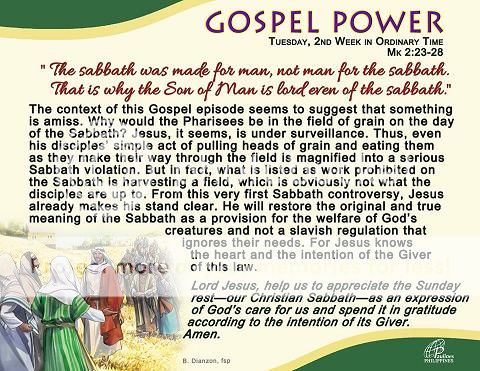
"The sabbath was made for man, not man for the sabbath." (Gospel)

Often, we think of God as just a set of laws (like Sunday Mass obligation) that need to be done swiftly so we can attend to the more "important matters" of life.

But God made laws for man's good, NOT for his compliance as slave. The Son of God became lowly son of man to be with us always; not just at Mass but also at work, at play and at rest.

"Not as man sees does God see, because he sees the appearance but the LORD looks into the heart." (First Reading)

Mere outward compliance of requirements denies Jesus entry into our innermost being and have a deep relationship with Him. Jesus invites us to change our attitude, to see God's laws as the ways that He makes known His loving and guiding presence, steering us along the path toward green pastures of blessings.

LORD, KEEP MY HEART ALWAYS TRUE TO YOU


Source: https://www.facebook.com/CatholicMassReflec...825257147772042

user posted image

khool
post Jan 16 2018, 11:20 AM

Getting Started
**
Junior Member
225 posts

Joined: Mar 2008


user posted image

HORRIBLE is the death [an evil tongue] inflicts; the netherworld is preferable to it. It has no power over the just; they will not burned in its flames. ~ Sir 28:21-22

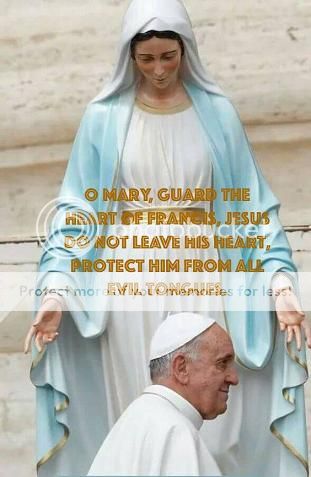
Mary's words were discreet, and her voice was measured.

She did not shout and she was careful not to say anything bad about another person - nor even to listen willingly to wrong that was spoken. ~ St. Athanasius

"We get to know people after their words. St. Paul, encouraging Christians to behave like children of light, not like sons of darkness [ . . . ] and to understand whether we are children of darkness, it is enough to analyse what words we use". ~ Pope Francis.

TSyeeck
post Jan 16 2018, 12:21 PM

Look at all my stars!!
*******
Senior Member
3,576 posts

Joined: Apr 2006


The Sin of Being Silent

Vincent of Beauvais

user posted image

Dealing with the peccatum taciturnitatis (sin of being silent) in general, Vincent de Beauvais explains this grave moral fault: “Next we should consider taciturnity. For it is known that just as an excess of loquacity is a vice, so also is, at times, excessive taciturnity. Indeed, ‘There is a time to keep silence and a time to speak’ (Eccles 3:7); St. Isidore: ‘The tongue must be watched, but not inflexibly arrested.’ For it is a vice, by keeping quiet, to allow someone unworthy or unfit to be chosen for promotions and honors, or permit someone worthy to lose his dignity, goods or honor.

“The same can be said if, in meetings of the council, you keep quiet out of ignorance or malice and thus withhold the truth from the other advisers. Likewise, during a court hearing, if you see someone make a fraudulent accusation or be unjustly condemned, you will sin. And if you fail to reprehend the detractors in conversations defaming others by neither excusing nor praising the person defamed, you will sin by remaining silent. Likewise, when you perceive that a word to edify, instruct, exhort or correct someone is necessary, you commit a sin if you withhold that wholesome advice. Hence Isaiah exclaimed: ‘Woe is me, because I have held my peace’ (6:5). The same is said in Ecclesiasticus: ‘And refrain not to speak in the time of salvation’ (4:28).”

This command is directed primarily to the Hierarchs and clerks who keep quiet. Nevertheless, their defection obliges all laymen to speak up, since Vincent de Beauvais, cited below, uses the adverb especially when referring to the Prelates, which means that those who are not vested with priestly dignity have an analogous duty.

“This is obligatory especially for Prelates and all those who direct or take care of souls. This is clearly stated in Exodus: 28, whose precept called for placing little bells alternating with pomegranates hanging from the priestly chasubles so that the priest would be heard as he entered or left the sanctuary and thus would not die. St. Gregory explains this by saying: ‘The priest who enters will die if the sound is not heard, for he will attract for himself the wrath of the Eternal Judge if the sound of preaching does not come from him.’ Likewise, Ezekiel, 33:6: ‘And if the watchman sees the sword coming, and sounds not the trumpet: and the people look not to themselves, and the sword comes, and cuts off a soul from among them: he indeed is taken away in his iniquity, but I will require his blood at the hand of the watchman.’”

(Vincent of Beauvais, Speculum quadruplex sive speculum maius, Graz, Akademische Druck-Verlagsanstalt, 1964, col. 1228)
khool
post Jan 16 2018, 12:59 PM

Getting Started
**
Junior Member
225 posts

Joined: Mar 2008


Work Out Your Salvation in Fear and Trembling

user posted image

(Today’s) reading: Phil 2

First, I would like to point out that Chapter 2 of the letter to the Philippians is one of the most moving pieces of Scripture. It’s worth reading again, meditating on and praying over.

There are several passages to make note of.
QUOTE
Have this mind among yourselves, which is yours in Christ Jesus, who, existing in the form of God, did not consider equality with God as something to be used for His own advantage.  Instead He emptied Himself by assuming the form of a slave, taking on the likeness of men.
I recently heard a priest who got deeper into the translation of this passage. A more literal translation of this verse is:
QUOTE
Because he was equal to God did not consider equality with God as something to be exploited for his personal gain rather he rendered it void taking the form of a slave.
Wow.

This passage is saying something that we tend to know but not really understand. Jesus is God and because he is God he does not need aggrandizement. Jesus doesn’t need to use his divinity to gain honor or respect, so he (in a sense) surrenders it, to become a man. It should impress upon us the dramatic step God took for our salvation. Also, as we are adopted sons and daughters of the Father, we should realize that this is possible for us too. This is what it means to be holy. To emulate Christ in all things including the surrender of ourselves, our pride, our need for recognition and become humble a servant of our fellow man.

Second, we address the famous verse, Paul writes:
QUOTE
Therefore, my beloved, as you have always obeyed, so now, not only as in my presence but much more in my absence, work out your own salvation with fear and trembling, for it is God who works in you, both to will and to work for his good pleasure. (Phi 2:12-13)
First, what is clear is that salvation is something that must be worked out and is not something that is finished. Thus, the idea of “once saved, always saved” is refuted. Again, we can accept that stylistically we may refer to two aspects of salvation: justification (an initial moment of salvation in the past) and sanctification (the working out unto perfection of the human person). Justification may happen once but sanctification must be done over time.

Also, notice that this working out salvation is tied to obedience. Paul basically says you have always been obedient so continue to be so, even when he is not there. In fact, one translation for the word faith in Hebrew is obedience. This implies that there is a supplication aspect to faith, the humbling of oneself. In the old covenant, this obedience was to the law. In the New Covenant, this is a different type of obedience, it is obedience to the demands of love.

Finally, notice what the passage says about works, “for it is God who works in you, both to will and to work for his good pleasure.” This short sentence says a lot. It shows that the will, the desire to do good works, is itself a grace given to you by God and the doing of good works is God working through us. This helps address the question of why works can be meritorious. Even the desire to do them is a gift of grace from God. At all points we are being held up by Him, we are being moved forward by him. As to good works not that the verse does not go so far as to say that God causes (or forces) us to do good works. Therefore the verse implies free will.

Finally, notice the amazing consistency we have seen in Paul's theology on works in the last few days. He teaches that we are one body of Christ. He says that he makes up what is lacking in Christ's suffering with his own body. He says that God "began a good work in us" and that "we suffer for his sake" and finally that we must "work out our own salvation". All this fits together to show that our suffering / good works are meritorious because as we are part of the body of Christ our suffering were gathered together by Jesus when he was on the cross. In gathering them to himself Jesus transforms our suffering and works from finite meritless actions into infinitely holy works. I want to stress that this is literally anything and everything we do. My writing this article out of love for others is obedience to faith is a good work that is united to Jesus on the cross. Tonight when I cook dinner for my kids, that is a suffering (albeit a small one) that again is made meritorious because of my connection to the body of Christ. We as brothers and sisters in the body are truly God's co-workers when we live out the Christian life which is another reason why Paul repeatedly implores all Christians to do so.

Source : http://www.catholic365.com/article/7890/da...-trembling.html

khool
post Jan 16 2018, 01:06 PM

Getting Started
**
Junior Member
225 posts

Joined: Mar 2008


user posted image

user posted image

khool
post Jan 17 2018, 03:03 PM

Getting Started
**
Junior Member
225 posts

Joined: Mar 2008


user posted image

khool
post Jan 17 2018, 03:10 PM

Getting Started
**
Junior Member
225 posts

Joined: Mar 2008


Jan 19 2018, 03:26 PM
This post has been deleted by yeeck because: -

khool
post Jan 17 2018, 03:12 PM

Getting Started
**
Junior Member
225 posts

Joined: Mar 2008


user posted image

user posted image

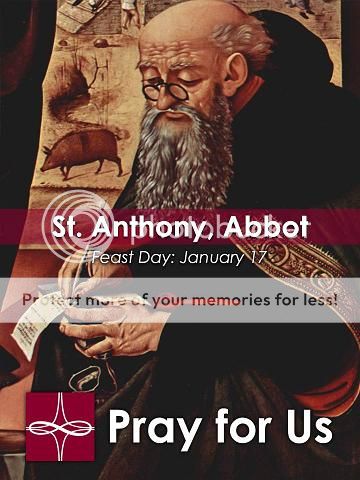
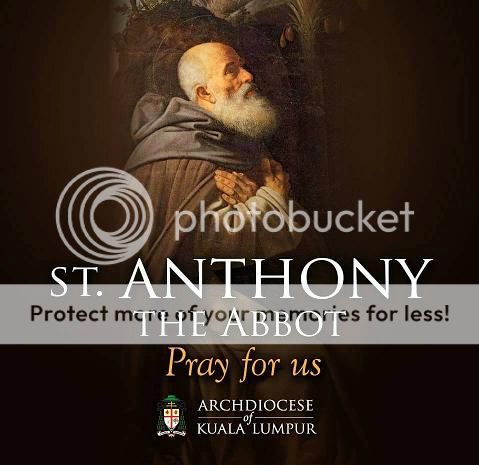
St. Anthony of Egypt is the founder of modern day monasticism. He sold almost everything he had, leaving enough for his younger sister to live a good life. He went into the desert and became a hermit. After almost 30 years of living in solitude, he came back to provide guidance to a growing community of hermits, thus marking the beginning of modern day monasticism. Many people sought to hear St. Anthony's spiritual advice, including Emperor Constantine. �

"Do not be astonished if an emperor writes to us, for he is a man, but rather: wonder that God wrote the Law for men, and has spoken to us through his own Son." (St. Anthony)

user posted image

khool
post Jan 18 2018, 11:11 AM

Getting Started
**
Junior Member
225 posts

Joined: Mar 2008


Thursday of the Second Week in Ordinary Time
Lectionary: 314


user posted image

Reading 1 (1 Sm 18:6-9; 19:1-7)

When David and Saul approached
(on David's return after slaying the Philistine),
women came out from each of the cities of Israel to meet King Saul,
singing and dancing, with tambourines, joyful songs, and sistrums.
The women played and sang:

"Saul has slain his thousands,
and David his ten thousands."

Saul was very angry and resentful of the song, for he thought:
"They give David ten thousands, but only thousands to me.
All that remains for him is the kingship."
And from that day on, Saul was jealous of David.

Saul discussed his intention of killing David
with his son Jonathan and with all his servants.
But Saul's son Jonathan, who was very fond of David, told him:
"My father Saul is trying to kill you.
Therefore, please be on your guard tomorrow morning;
get out of sight and remain in hiding.
I, however, will go out and stand beside my father
in the countryside where you are, and will speak to him about you.
If I learn anything, I will let you know."

Jonathan then spoke well of David to his father Saul, saying to him:
"Let not your majesty sin against his servant David,
for he has committed no offense against you,
but has helped you very much by his deeds.
When he took his life in his hands and slew the Philistine,
and the LORD brought about a great victory
for all Israel through him,
you were glad to see it.
Why, then, should you become guilty of shedding innocent blood
by killing David without cause?"
Saul heeded Jonathan's plea and swore,
"As the LORD lives, he shall not be killed."
So Jonathan summoned David and repeated the whole conversation to him.
Jonathan then brought David to Saul, and David served him as before.

Responsorial Psalm (ps 56:2-3, 9-10a, 10b-11, 12-13)

R. In God I trust; I shall not fear.

Have mercy on me, O God, for men trample upon me;
all the day they press their attack against me.
My adversaries trample upon me all the day;
yes, many fight against me.
R. In God I trust; I shall not fear.

My wanderings you have counted;
my tears are stored in your flask;
are they not recorded in your book?
Then do my enemies turn back,
when I call upon you.
R. In God I trust; I shall not fear.

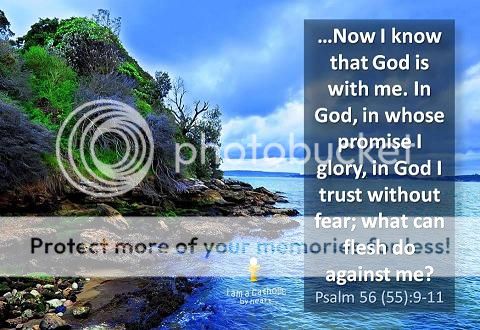
Now I know that God is with me.
In God, in whose promise I glory,
in God I trust without fear;
what can flesh do against me?
R. In God I trust; I shall not fear.

I am bound, O God, by vows to you;
your thank offerings I will fulfill.
For you have rescued me from death,
my feet, too, from stumbling;
that I may walk before God in the light of the living.
R. In God I trust; I shall not fear.

Alleluia (See 2 Tm 1:10)

R. Alleluia, alleluia.
Our Savior Jesus Christ has destroyed death
and brought life to light through the Gospel.
R. Alleluia, alleluia.

Gospel (Mk 3:7-12)

Jesus withdrew toward the sea with his disciples.
A large number of people followed from Galilee and from Judea.
Hearing what he was doing,
a large number of people came to him also from Jerusalem,
from Idumea, from beyond the Jordan,
and from the neighborhood of Tyre and Sidon.
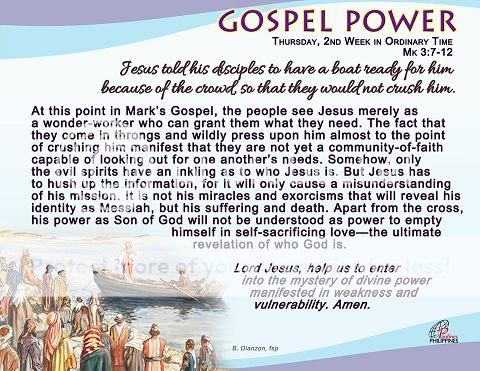
He told his disciples to have a boat ready for him because of the crowd,
so that they would not crush him.
He had cured many and, as a result, those who had diseases
were pressing upon him to touch him.
And whenever unclean spirits saw him they would fall down before him
and shout, "You are the Son of God."
He warned them sternly not to make him known.

user posted image

REFLECTIONS: WORD Today

user posted image

In the First Reading, King Saul is threatened by David's fast-growing popularity. He suspects David is after his crown. He tells Jonathan his son to kill David. But instead Jonathan acted as mediator, talking about the goodness he saw in David. His father's eyes were opened and the anger in his heart cooled down.

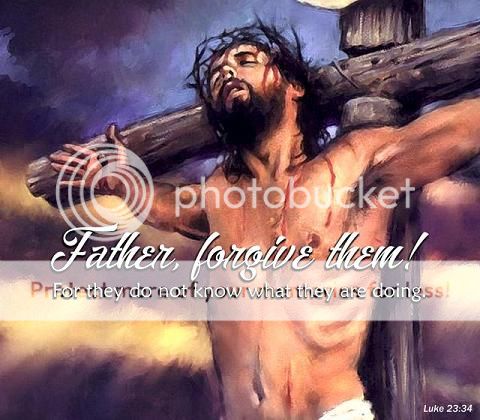
This is what the Son of God does for all of us. He became human so He could experience our weakness. He then can say, "Father forgive them for they do not know what they are doing."

Jesus said this hanging on the cross (Luke 23:34), accepting the punishment for my errors and yours, cooling down our Father's anger.

Let us remember this next time we hear a brother or sister being criticized or judged harshly. Instead of adding fuel to the fire, Jesus expects us whom He has saved to be mediators and agents of His mercy and peace.

LET THERE BE PEACE ON EARTH


Source: https://www.facebook.com/CatholicMassReflec...826044797693277

user posted image

khool
post Jan 18 2018, 01:48 PM

Getting Started
**
Junior Member
225 posts

Joined: Mar 2008


user posted image

user posted image

TSyeeck
post Jan 19 2018, 11:01 AM

Look at all my stars!!
*******
Senior Member
3,576 posts

Joined: Apr 2006


WALSH: Christians In The East Lose Their Lives, But Christians In The West Are Losing Their Souls
By MATT WALSH

January 18, 2018

user posted image

I was recently invited to attend and give a reflection at a prayer vigil for persecuted Christians, hosted by a church in Maryland. The church was hoping that 150 congregants would come. They got about three.

To be fair, there was some bad weather that afternoon. And it was on a Friday night, when most people would rather be relaxing on the couch or going out to a nice dinner with their spouse. There are a million reasons — a few of them even legitimate — why you might not show up to something like this. But it was sad, all the same, to see the bare pews, and to hear a couple of speakers deliver beautiful and impassioned pleas to an empty church. At the end they collected donations for a Christian school in Iraq, but nobody was there to give anything.


Before the vigil, I remember saying to my wife that every church in the country ought to do something like this at least once a month. Now I know why they don’t.

I reflected on this when I read a report that Christian persecution and genocide is worse now than it has ever been in history. Christians in Afghanistan, Somalia, Sudan, Pakistan, North Korea, Libya, Iraq, Yemen, Iran, Egypt, and many other countries, are regularly imprisoned, tortured, beaten, raped, and martyred. Their churches are destroyed. Their houses burned. They meet and worship in secret, risking their lives in the process. They live every moment in constant danger.

About 215 million Christians face what is called “extreme persecution” for their faith. It’s estimated that around a million have been slaughtered since 2005. There is no way to know exactly how many. What we do know is that Christianity has been dramatically reduced in parts of the world where it had existed for nearly 2,000 years.


Tradition tells us that St. Mark brought Christianity to Egypt in the early part of the first century. Today, the seed he planted has been ripped up. Two churches in the country were attacked and 44 Christians massacred on Palm Sunday last year. In the same year, 28 Christian pilgrims were martyred while en route to a monastery. The Muslim assailants gave them a chance to save themselves if they would recite an Islamic profession of faith. They refused and so they were shot in the head. This sort of thing is a regular occurrence in Egypt and in several other nations across the globe.

But what do we care?

There are other things to worry about here. Hollywood sex scandals. Twitter disputes. Whatever controversial thing Trump said this week. So on and so on. We — myself included — spend far more time, and spill far more ink, on these issues than we ever have on the coordinated genocide of our fellow believers in the Middle East, Africa, and Asia. Why?

I have come to believe that our disinterest stems not only from the general apathy that defines western society and the western church, but from moral cowardice. To face the plight of our brothers and sisters is to face ourselves. To see these Christians who would rather be shot dead in the desert than renounce their faith is to see our own faith as a shabby, pitiful, hollow imitation. To see Christians who would risk their very lives to go to church and preach the Gospel is to question why we will do neither of those things, even though we are perfectly free and able. We cannot confront these truths of ourselves, so we will not confront the truth of Christian persecution.

Christians in the East forfeit their lives rather than forfeit their souls, and we forfeit our souls even though we could quite easily retain both. The Church overseas has been under violent assault, yet the enemies of Christ have not won. They have diminished the Church in numbers by killing its members, but it is strong and resilient where it still stands. Our situation is exactly the reverse.

We have submitted to the forces of darkness. We have bent our knees in homage to Satan, and the enemies of the faith haven’t even fired a shot to induce our surrender. Satan does not beat us with a stick; he dangles a carrot. He lulls us to sleep. He distracts us. He tempts us. Kill us? Why would he do that? We are no threat to him. A Christian in Afghanistan is a threat. He must be destroyed. It's the only way. But a lazy, soft, equivocating Christian in the West? There is no need to persecute him. He is not worthy of it. Just give him a television and the internet and let him damn himself.

Satan’s legions in America — to include his agents within the church, of which there are many — have figured out the secret. Don’t put a gun to their heads and tell them to stop being Christian. Instead, just give them something else to do. Whatever you do, never make them afraid, because if you do that you may accidentally awaken their courage. And then your plan is in trouble.

Indeed, if your persecution produces a bunch of passionate, courageous Christians, you better go and execute every last one of them. Leave even one alive, let even one slip through the cracks, and you’re doomed. A Christian like that — one who cannot be shamed into silence, cannot be intimidated, cannot be made to conform, cannot be controlled by Earthly forces — is powerful beyond all imagining. All you can do with him is kill him. He’s too dangerous. Your tricks won’t work on him. He has the grace of God and you have nothing better to offer him.

From the Devil's perspective, this is not ideal. Murdering such a Christian means sending him straight to Heaven, which is why the mass slaughter of Christians is a bittersweet sight in Hell. On one hand, the demons enjoy such immense suffering. On the other, they are losing souls forever into the arms of the Almighty. Satan surely prefers the situation here in the West. We believe we are blessed to be free from the trials inflicted upon our brothers and sisters, but he knows better. We kick back and relax in our false sense of security while he licks his lips and prepares to feast upon us.

He knows that we have become numb in our comforts. Our faith is stagnant and stale. We don't cling desperately to God. We cling to other things: our jobs, our relationships, our ambitions, our friends, our hobbies, our phones, our pets. We don't even think of Him most of the time. We make no attempt to conform our lives to His commandments or to walk the narrow path that Christ forged for us. We are too busy for all that, we say, and it's inconvenient. Christ says, "Pick up your cross and follow," but we take this as an optional suggestion. We leave our crosses on the side of the road and head back inside where it's warm and there's a new Netflix show to binge. We tell ourselves that we'll be fine in the end because we are decent people, and we are leading normal lives, and, sure, we believe in Jesus or whatever.

And Satan laughs.

He does not want us to be jolted out of this stupor, and he has no doubt instructed his legions accordingly. The persecutors of the church in America have quite an easy job. For them, the strategy is clear: Put down the gun. Drop the machete. Don't scare these people. Don't make martyrs of them. Don't give them any hint that there is a war going on and the fate of their souls lies in the balance. Let them be arrogant and self-assured. Let them push out any thought of their own mortality. Let them dismiss everything I'm saying right now as "pessimistic" and "negative." Let them enjoy themselves. Let them have their spiritual indifference and let them dress it up as "positivity" and "hopefulness." Let them have it all. Fluff their pillow for them, even. Turn on the TV and hand them the remote. Feed them. Pamper them. Pleasure them. Give them everything their hearts desire. Don’t appeal to their fear; appeal to their lust, their laziness, their gluttony, their vanity, their pride, their boredom.

And watch them drop like flies.
TSyeeck
post Jan 19 2018, 11:17 AM

Look at all my stars!!
*******
Senior Member
3,576 posts

Joined: Apr 2006


Is Faith a Gift?
FATHER LEONARD FEENEY, M.I.C.M.

When Our Lord was asked: “Master, which is the great commandment in the law? He replied: “Thou shalt love the Lord thy God with thy whole heart, and with thy whole soul, and with thy whole mind.”

The triumphant answer which Our Lord gave to the question concerning the great commandment, clearly indicates that He is prepared to supply through revelation truths equal to supporting such a wholesale love. Our Lord’s statement is an open promise that He is in the act of teaching a gospel intense enough in content to arouse such an all-embracing outlook on salvation.

And when Our Lord went on to add: “This is the greatest and first commandment. And the second is like to this: Thou shalt love thy neighbor as thyself,” obviously He meant to say: “And if thy neighbor should come to thee and ask: ‘What is the great commandment for me? ’ You must tell him what I have told you; and you must realize that the overwhelming overture I offer you in the first commandment is meant as much for your neighbor as it is for you. In this way, you will clearly show that you love your neighbor as you do yourself, by sharing with him your best gift – your Faith.”

How this codicil to the great commandment, “Thou shalt love thy neighbor as thyself,” has been taken from the context in which Our Lord put it, anyone knows who has had to go through the torture of listening to liberal Catholics explaining to self-interested Protestants how they can get to heaven without joining the Catholic Church. Nothing of the sustained challenge of Our Lord is left after the liberal Catholics have finished with it. “We must,“ they say, “love God with our whole heart our whole soul, and our whole mind. You, dear heretics, may not be equal to such a thorough performance. Even so, do not worry. We shall love you almost more than if you were. For the second commandment of Christ interests us much more than the first does, and we are determined to love our neighbor as ourselves, even when we do not see the slightest reason for doing so.”

When I was a child, the Protestant doctrine I resented most was Calvinism. Calvinism predestined one group (the group to which I did not belong) to heaven. The rest of us were earmarked for hell. There was no way of getting either in or out of this rigid system of predestination, not even by believing in Jesus and loving Him with all your heart. And it seemed to me altogether a brutal arrangement on God’s part to make a good life on earth completely unnecessary so as to deserve reward in the life to come.

I have come, in adult years to detest another doctrine even more than that of Calvinism. It is the doctrine taught by Catholic liberals. They teach the predestination of one group to the right way of saving one’s soul and of another group to the wrong way of doing so. Indeed, we are expected to love those who are “saving” their souls in the wrong way, even more than those who are doing it as Christ prescribes. In this hell-instructed arrangement, Our Lord becomes no longer an Evangel, but an Evangelist; He ceases to be the Way, the Truth, and the Life, and degenerates into being some sort of general good news for everybody. The needful and essential Graces leading to salvation, particularly those of Baptism and the Eucharist, are compensated for by uncovenanted equivalents — with such labels as “the soul of the Church” and “baptism of desire.” Movements entitled “inter-faith,” abetted by Catholic liberals, quickly become movements of inter-hope and inter charity, telling us that the road to the Beatific Vision is any route one chooses to follow.

And now we may come to the pointed question. Is Faith a gift? Yes, it is a gift, a sheer gift, bestowed on us out of God’s lavishness, and not out of any implicit contract in the covenant of creation. Faith is a dynamic gift, too, which means that it is both freely given and freely received. It is also a fruitful gift to such an extent that once we have it, we must never look on it as something which is our due, and ours to keep. We must freely give what we have freely received. Whenever we meet a heretic or a pagan, we must remember that our best gift, our Faith, is one which is also intended for him-even providentially so, once he has met us.

That Faith is a gift, we know only by Faith. To allow a garrulous sophist like Mortimer Adler to stand on a Catholic lecture platform and borrow from our Faith an excuse for his not being a Catholic — namely, that Faith is a gift — is truly to let the native instruct the missionary and all nations teach the Church.1

The question, “Is Faith a gift?” Is not always an innocent inquiry, seeking for a doctrinal explanation. It is often a mixture of interrogation and subterfuge, hoping for a psychological excuse. As such, we should treat it, not with our courtesy, but with our clear contempt.

Is Faith a gift? Yes it is a gift which God need not have given, but has. Ask and you shall receive; seek and you shall find; knock and it shall be opened to you. But do not say when Faith is held out to you, “I cannot take it. It is a gift.”

This article by Father Feeney was published in the 1940’s. The Jewish philosopher, Mortimer J. Adler, probably knew much more of Saint Thomas Aquinas’ philosophy and theology than most Catholic priests of his day. Yet he remained an unbeliever. When he would speak at Catholic institutions, Professor Adler would sometimes be asked why he was not a Catholic. His answer was “Faith is a gift.” Thankfully, after about 15 years as an Episcopalian, Adler entered the Catholic Church in December of 1999. The gift was both offered and accepted. The sophist found wisdom at last. ↩
khool
post Jan 19 2018, 11:19 AM

Getting Started
**
Junior Member
225 posts

Joined: Mar 2008


Friday of the Second Week in Ordinary Time
Lectionary: 315


user posted image

Reading 1 (1 Sm 24:3-21)

Saul took three thousand picked men from all Israel
and went in search of David and his men
in the direction of the wild goat crags.
When he came to the sheepfolds along the way, he found a cave,
which he entered to relieve himself.
David and his men were occupying the inmost recesses of the cave.

David's servants said to him,
"This is the day of which the LORD said to you,
'I will deliver your enemy into your grasp;
do with him as you see fit.'"
So David moved up and stealthily cut off an end of Saul's mantle.
Afterward, however, David regretted that he had cut off
an end of Saul's mantle.
He said to his men,
"The LORD forbid that I should do such a thing to my master,
the LORD's anointed, as to lay a hand on him,
for he is the LORD's anointed."
With these words David restrained his men
and would not permit them to attack Saul.
Saul then left the cave and went on his way.
David also stepped out of the cave, calling to Saul,
"My lord the king!"
When Saul looked back, David bowed to the ground in homage and asked Saul:
"Why do you listen to those who say,
'David is trying to harm you'?
You see for yourself today that the LORD just now delivered you
into my grasp in the cave.
I had some thought of killing you, but I took pity on you instead.
I decided, 'I will not raise a hand against my lord,
for he is the LORD's anointed and a father to me.'
Look here at this end of your mantle which I hold.
Since I cut off an end of your mantle and did not kill you,
see and be convinced that I plan no harm and no rebellion.
I have done you no wrong,
though you are hunting me down to take my life.
The LORD will judge between me and you,
and the LORD will exact justice from you in my case.
I shall not touch you.
The old proverb says, 'From the wicked comes forth wickedness.'
So I will take no action against you.
Against whom are you on campaign, O king of Israel?
Whom are you pursuing? A dead dog, or a single flea!
The LORD will be the judge; he will decide between me and you.
May he see this, and take my part,
and grant me justice beyond your reach!"
When David finished saying these things to Saul, Saul answered,
"Is that your voice, my son David?"
And Saul wept aloud.
Saul then said to David: "You are in the right rather than I;
you have treated me generously, while I have done you harm.
Great is the generosity you showed me today,
when the LORD delivered me into your grasp
and you did not kill me.
For if a man meets his enemy, does he send him away unharmed?
May the LORD reward you generously for what you have done this day.
And now, I know that you shall surely be king
and that sovereignty over Israel shall come into your possession."

Responsorial Psalm (PS 57:2, 3-4, 6 and 11)

R. Have mercy on me, God, have mercy.

Have mercy on me, O God; have mercy on me,
for in you I take refuge.
In the shadow of your wings I take refuge,
till harm pass by.
R. Have mercy on me, God, have mercy.

I call to God the Most High,
to God, my benefactor.
May he send from heaven and save me;
may he make those a reproach who trample upon me;
may God send his mercy and his faithfulness.
R. Have mercy on me, God, have mercy.

Be exalted above the heavens, O God;
above all the earth be your glory!
For your mercy towers to the heavens,
and your faithfulness to the skies.
R. Have mercy on me, God, have mercy.

Alleluia (2 Cor 5:19)

R. Alleluia, alleluia.
God was reconciling the world to himself in Christ,
and entrusting to us the message of reconciliation.
R. Alleluia, alleluia.

Gospel (Mk 3:13-19)

Jesus went up the mountain and summoned those whom he wanted
and they came to him.
He appointed Twelve, whom he also named Apostles,
that they might be with him
and he might send them forth to preach
and to have authority to drive out demons:
He appointed the Twelve:
Simon, whom he named Peter;
James, son of Zebedee,
and John the brother of James, whom he named Boanerges,
that is, sons of thunder;
Andrew, Philip, Bartholomew,
Matthew, Thomas, James the son of Alphaeus;
Thaddeus, Simon the Cananean,
and Judas Iscariot who betrayed him.

user posted image

REFLECTIONS: WORD Today

user posted image

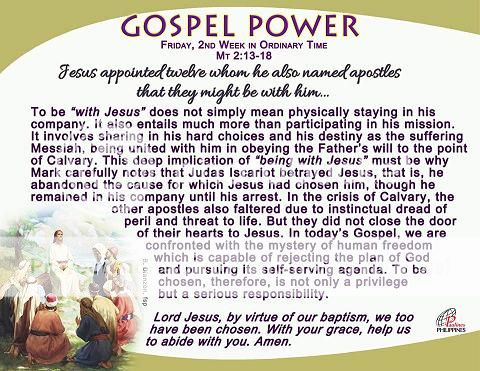
In the Gospel, Jesus calls 12 disciples (students) and appoints them as apostles "to be sent out to preach and have authority to cast out demons."

Jesus shares His work and His authority with them. There is no selfishness in Jesus. He picks only 12 people to change the whole world because they too were to invite others to help in Christ's work. And so today there are 2 billion Christians in God's worldwide Kingdom.

In sharp contrast is King Saul in the First Reading. He is obsessed with keeping power all to himself. In grave misuse of resources God entrusted to him, he sends 3,000 soldiers to kill just 1 man, David his "rival". Saul failed, and his reign eventually ended in suicide.

Pride, jealousy, rivalry is very destructive in the Kingdom of God. It is the devil's work to split and divide. We who profess to serve the Lord, let us always make an honest check that the work we are promoting is the Lord's, not ours.

May these words of St. Paul be our constant reminder:

"Do nothing out of selfish ambition or vain conceit. Rather, in humility value others above yourselves, not looking to your own interests but each of you to the interests of the others. In your relationships with one another, have the same mindset as Christ Jesus." (Phil 2:3-5)

THE KINGDOM OF GOD IS JUSTICE AND PEACE


Source: https://www.facebook.com/CatholicMassReflec...826489030982187

user posted image

khool
post Jan 19 2018, 01:39 PM

Getting Started
**
Junior Member
225 posts

Joined: Mar 2008


user posted image

user posted image

TSyeeck
post Jan 19 2018, 03:25 PM

Look at all my stars!!
*******
Senior Member
3,576 posts

Joined: Apr 2006


The Feast of St Anthony the Abbot
GREGORY DIPIPPO

St Athanasius of Alexandria is best known as the great champion of the Nicene Faith, for which he was exiled five times over the course of an episcopate of 45 years (328-373); for his witness to the truth of the Incarnation, and his important writings on the subject, he is honored as a Doctor of the Church. But it was also he who brought to the attention of the West the ascetic and anchoretic life, a phenomenon well-established in his native Egypt by the early fourth-century, but at that point just emerging in the West. This was done by writing the Life of St Anthony of Egypt, who is often called “the Abbot” to distinguish him from his later namesake, St Anthony of Padua; in the East he is simply “Anthony the Great.” Of this Life, which was to have an enormous influence in the Church, both East and West, it might well be said what St Thomas Aquinas said about St Bonaventure writing the life of St Francis: “Let us leave the saint to work for the saint.”

St Anthony was not the first monk or hermit, as Athanasius’ Life makes quite clear; and indeed, the Church honors a saint named Paul with the title “the First Hermit.” Anthony was ninety years old, and had been living as an ascetic for over 70 years, before he first met Paul, shortly before the latter’s death at the age of 113. Paul’s feast day was long kept on January 10th, exactly a week before that of Anthony, to symbolize that he preceded him in the ascetic life. (It was later moved to his date in the Byzantine Rite, January 15.) Anthony also had as a contemporary St Pachomius, who is held in particular honor in the East as the founder of the cenobitic life, and the author of an important monastic rule. Nevertheless, Anthony may rightly be called the Father of Monasticism in the East, as St Benedict is in the West; for it was by his example, more than any other, that so many men and women of his own time and subsequent eras were inspired to embrace the monastic life.

user posted image

In the Confessions, St Augustine writes that two officials of the imperial court, (then at Trier, where Athanasius passed his first exile), on reading the life of Anthony, renounced their position to become monks, the one saying to the other, “ ‘Now I have broken loose from those hopes of ours (for preferment in the court), and am resolved to serve God; and this I begin upon, from this hour, in this place. If thou like not to imitate me, oppose me not.’ The other answered, he would cleave to him, and be his fellow in so great a reward, so great a service.” (Book 8.15)

Shortly thereafter, in the famous episode where Augustine, torn about how to free himself of his past sins and follow God, hears children singing “Take up, read; take up, read”, he takes up the epistles of St Paul and reads, “ ‘Not in rioting and drunkenness, not in chambering and impurities, not in contention and envy: But put ye on the Lord Jesus Christ, and make not provision for the flesh in its concupiscences.’ (Rom. 13, 13-14) No further would I read; nor was there need to: for instantly at the end of this sentence, by a light as it were of serenity infused into my heart, all the darkness of doubt vanished away.” But it was the life of St Anthony that convinced him that “Take up, read,” meant to take up the Bible and read it, since Anthony, “coming in (to a church) during the reading of the Gospel, received the admonition, as if what was being read was spoken to him, ‘Go, sell all that thou hast, and give to the poor, and thou shalt have treasure in heaven, and come and follow me.’ (Matthew 19, 21) And by such oracle he was forthwith converted unto Thee.” (Book 8, 29)

St Athanasius tells of many times when St Anthony struggled against devils, both by resisting temptations, and suffering bodily harm that the devil was permitted to inflict upon him. On one such occasion, early in his life as an ascetic, “a multitude of demons … so cut him with stripes that he lay on the ground speechless from the excessive pain.” He was discovered unconscious by the local villagers, who thought him dead, and brought him to their church. On recovering, he fearlessly returned to the place where he had been tormented, and
after he had prayed, he said with a shout, ‘Here am I, Antony; I flee not from your stripes, for even if you inflict more, nothing shall separate me from the love of Christ.’ … But the enemy, who hates good, marveling that … he dared to return, called together his hounds and burst forth, … so in the night they made such a din that the whole of that place seemed to be shaken by an earthquake, and the demons, as if breaking the four walls of the dwelling, seemed to enter through them, coming in the likeness of beasts and creeping things. And the place was on a sudden filled with the forms of lions, bears, leopards, bulls, serpents, asps, scorpions, and wolves, …. But Antony … said, ‘If there had been any power in you, it would have sufficed had one of you come, but since the Lord has made you weak, you attempt to terrify me by numbers: and a proof of your weakness is that you take the shapes of brute beasts.’ … So after many attempts they gnashed their teeth upon him, because they were mocking themselves rather than him.” (Life of Anthony 8 and 9)

When St Anthony went to visit St Paul the First Hermit, as recorded in the latter’s biography written by St Jerome, they greeted each other by name as they met, though they had never seen each other before. A crow then brought them a full loaf of bread, at which Paul said to Anthony, “for sixty years I have daily received (from the crow) half a loaf of bread; now at thy coming, Christ has doubled the provision for his soldiers.” Perhaps inspired by the similarity between this episode and that of the crows that brought food to the Prophet Elijah (3 Kings 17), the Byzantine Liturgy explicitly compares Anthony to Elijah in the dismissal hymn (apolytikion) of Vespers on his feast day.
You imitated the zealous Elias by your life, you followed the Baptist by straight paths, our Father Anthony; you became the founder of the desert and strengthened the whole world by your prayers. And so intercede with Christ God that our souls may be saved.
Throughout the Middle Ages, St Anthony was also venerated as the patron Saint against various skin diseases, such as erysipelas and ergotism, some of which are still called “St Anthony’s fire” or “holy fire” in places. A commonly used medieval prayer of his Mass was as follows.
Deus, qui concedis obtentu beati Antonii Confessoris tui, morbidum ignem extingui, et membris aegris refrigeria praestari: fac nos, quaesumus, ipsius meritis et precibus, a gehennae incendiis liberatos, integros mente et corpore tibi feliciter presentari.
God, who grantest by the protection of Thy blessed Confessor Anthony that the fire of illness be extinguished, and refreshment given to sickly members; we ask that by his merits and prayers, we may be delivered from the fires of hell, and happily presented to the Thee, sound in mind and body.
khool
post Jan 19 2018, 03:27 PM

Getting Started
**
Junior Member
225 posts

Joined: Mar 2008


Campaign to restore a 131-year-old deserted church in Kedah.

user posted image

FEW people today have heard of Sungai Lembu in Kedah and fewer still know it is the site of a 131-year-old Catholic church in ruins.

It was once a grand church named the Sacred Heart of Jesus, styled after the Notre Dame Cathedral in Paris. It was built in 1882 by a French missionary together with the Hakka Catholic populace who were the early settlers of the area known as Pagar Teras, about three kilometres away from Sungai Lembu.

Sungai Lembu, a Chinese New Village, opened in 1952 with about 100 households. It is 10km from Bukit Mertajam. Christine Wong, 76, recalled walking to attend Sunday mass at the church with her parents and other villagers.The walk from the neighbouring villages of Machang Bubok and Junjong took about an hour or two.

The church, which has 62 steps leading up to it from the roadside, sits on a hillock, providing visitors a breathtaking view of the nearby Bukit Mertajam hills. One can almost visualise a bride being led up the stairs to her waiting bridegroom in the church, during its heyday.

Wong, who lives in Sungai Lembu, remembered the dedicated French priest at that time, Father Marcel Selier, who spoke Mandarin and Hakka.She recalled there were many church activities as well as Cate-chism classes for the children.

The communist insurgency in the 1940s and 50s disrupted church services and the people were resettled in new villages like Sungai Lembu. Wong said they stayed behind barbed wire fencing to protect them from communists and went out only to work on their farms or in the rubber plantations.

When Pagar Teras was designated a ‘black area’ in 1948, Father Marcel moved church activities to Kulim, operating from temporary premises. Chapels were also opened in the new villages during that time including the Chapel of the Imma-culate Conception in Sungai Lembu. In 1957, the new Sacred Heart of Jesus Church (SHJC) built with stained glass windows from the church in Pagar Teras was opened. The church at Pagar Teras was eventually abandoned to the elements and the jungle.

Today, the church altar and belfry still stand, and an eerie silence surrounds the ruins and the graveyard in its vicinity.Sungai Lembu village committee secretary Yeo Keng Chuan, who is promoting eco-tourism and heritage sites in the area which is not far from the Mengkuang Dam, said the ruins were deteriorating rapidly.

According to Yeo, some of the locals as well as visitors claimed to have seen an apparition of a lady they believed to be either the Blessed Virgin Mary or St Anne in the niche where the statue of the Sacred Heart of Jesus once was.

“Many visitors have come to see the church including a French photographer who was fascinated by the ruins,” he said. “Some say they can see an image of a lady at the altar and that the image is more prominent in their photographs.

“Something needs to be done fast to restore the church in view of its rich history.” The church and cemetery grounds belong to the Roman Catholic Diocese of Penang, and are cared for by SHJC Kulim.

Last year, parish priest Father Thomas Koo initiated the setting up of the Beautification Committee of the Pagar Teras Old Church to res-tore it to its former glory. Committee chairman Francis Chen said this move came about after Penang Chief Minister Lim Guan Eng’s visit to Sungai Lembu in October last year when he happened to see the church ruins.

Lim then gave a donation of RM20,000 from the state government to start the ball rolling towards restoration of the site. Chen said the funds were used for fencing and a gate and laying a drain fronting the church.

“We will put up a signboard on the church’s history before All Souls Day which falls on Nov 2,” he said. We are still waiting for a reply from the authorities. The Class A classification will enable us to get the funds to realise our dream of restoring the church. “The restoration is expected to cost about RM200,000,” he said.

Father Marcel, the first resident priest at Pagar Teras, is buried in the cemetery near the old church, at his request. He served as parish priest of Sacred Heart of Jesus Church from 1940 to 1959 and again from 1963 to 1973.

At least eight priests, the earlier ones being Frenchmen too, served at the church in Pagar Teras from the 1880s until the church moved to Kulim. Another parish priest Father Barnabas Gao is also buried at the cemetery in Pagar Teras.

To get to Sungai Lembu, get on the Kulim highway heading towards Kulim, and then take the Penanti/Berapit exit which also leads to the Mengkuang Dam. Once you have taken the exit, turn right towards Berapit and you will see signboards showing the way to Sungai Lembu. The village is a 10-minute drive from Kulim town and 45 minutes from Sungai Petani.

He added that an application was now before the Seberang Prai Municipal Council for the site to be classified as a heritage area.

Source: https://www.facebook.com/media/set/?set=a.8...32165583&type=3

Side article: Dilapidated Church (Church of the Sacred Heart of Jesus)

TSyeeck
post Jan 19 2018, 05:17 PM

Look at all my stars!!
*******
Senior Member
3,576 posts

Joined: Apr 2006


The Devil’s Doctrine
APR 25, 2005 BROTHER ANDRÉ MARIE

There is a doctrine so diabolical, so sinister and wicked that it deserves, in this author’s opinion, a unique claim to the name “The Devil’s Doctrine.” This teaching is sheer poison to the soul which embraces it. Like a spiritual AIDS, it kills the soul’s built-in immune system, the conscience, and it convicts the sinner in his sins and errors almost without hope of conversion. It either throws the sinner into a bottomless despair for his sins, or (more often today) it forces him into another sin against the virtue of hope: the deadly sin of presumption. The doctrine is none other than the familiar Calvinist one of “perseverance of the saints,” commonly expressed by that snidely presented query: “Are you saved, brother”?

The teaching is totally unbiblical and untraditional. In other words, it isn’t Christian. Yet, many who call themselves Christian, especially in America, hold this doctrine and make it a major part of their religion. Various Baptist and Presbyterian sects hold it as revealed truth, as do countless nondenominational, independent “Bible Churches” influenced by these larger sects.

T.U.L.I.P.

John Calvin (1509-1564), the Swiss Protestant “Reformer,” authored a system of grace known by the acronym, TULIP. “Five Point” Calvinism, as it is called, holds the following doctrines: (1) “Total Depravity” from original sin; so total, in fact, that man lost his free will in the fall. (2) “Unconditional Election,” which means that those who are predestined to heaven are saved without any merit or good will on their part (consequently, those predestined to hell can literally do nothing about it). (3) “Limited Atonement,” which means that Jesus’ sacrifice on the Cross was only for the elect, and not for all men. (4) “Irresistible Grace,” the idea that God’s grace is impossible to resist (by bad will), therefore, we do not and cannot cooperate with God. If He gives us the grace to do something, like puppets, we do it no matter what. (5) “Perseverance of the Saints,” which would have us believe that once we are put in the state of grace, we cannot lose that state, but will infallibly be saved. “Once saved, always saved,” is the Calvinist battle cry associated with this last part of TULIP.

So that the reader does not think mine is a rude caricature of this teaching, I cite C. H. Spurgeon (1834-92), a famous English Calvinist preacher of the last century. Spurgeon, a Baptist, gives us this Calvinistic doctrine in its simplicity: “[N]or can I comprehend a gospel which lets saints fall away after they are called, and suffers the children of God to be burned in the fires of damnation after having once believed in Jesus. Such a gospel I abhor.” (Charles H. Spurgion, “A Defence of Calvinism.”) Ironically enough, this same fiery preacher claimed, “The old truth that Calvin preached, that Augustine preached, that Paul preached, is the truth that I must preach to-day, or else be false to my conscience and my God. I cannot shape the truth; I know of no such thing as paring off the rough edges of a doctrine. John Knox’s [Scottish Calvinist founder of the Presbyterian Church] gospel is my gospel. That which thundered through Scotland must thunder through England again.”

Such is the error we mean to refute in this article. As we will see, neither St. Paul nor St. Augustine preached the “truth” that was preached by Calvin, Knox, or Spurgeon.

Given the internal logic of TULIP — and it is ruthlessly logical with itself, each piece fitting perfectly with the others — if any one of its five planks is destroyed, the whole Calvinist platform tumbles down. Therefore, this article, which is intended only to refute “perseverance of the saints,” will effectively refute the whole Calvinist system.

There are several passages in Holy Scripture that repudiate the “once saved, always saved” position. We present some of them here, but by no means pretend to include all of them. Since most “eternally secure” Protestants use the King James Version of the Bible, for the sake of polemics, all of the Biblical texts we will use in this article will be from that Bible (not that we in any way endorse this Protestant Bible over our Catholic Douay-Rheims). We should note that the grammar conventions and orthography (spelling conventions) of the original are preserved in these Bible quotes.

The Old Testament

Justification, or Righteousness, existed in the Old Testament and the holy people of that time were called to persevere in their holiness. The Old Testament shows us example after example of saints and sinners. One interesting Old Testament pair is King David and his son, Solomon. David, who was holy and just, became a terrible sinner, but then repented and died a saint. He is regarded as a saint by the Catholic Church. His son, Solomon, while he was more wise than his father and had achieved great personal holiness, fell away and became an horrendous sinner: an adulterer, idolator, murderer, etc., all sins which, by name, exclude people from heaven. (Of course, we don’t know how he died, but most authors are not optimistic about his salvation. The Church does not regard him as a saint.)

The Old Testament book of Ezechiel teaches the following doctrine: “But when the righteous turneth away from his righteousness, and committeth iniquity, and doeth according to all the abominations that the wicked man doeth, shall he live? All his righteousness that he hath done shall not be mentioned: in his trespass that he hath trespassed, and in his sin that he hath sinned, in them shall he die. Yet ye say, The way of the Lord is not equal. Hear now, O house of Israel; Is not my way equal? are not your ways unequal? When a righteous man turneth away from his righteousness, and committeth iniquity, and dieth in them; for his iniquity that he hath done shall he die.” (Ezekiel 18:24-26.)

This passage clearly shows that the “righteous” man (the just man, the man in the state of grace) can “fall away” from that righteousness and “die” in his “sin.” In Scriptural language, to “die in one’s sins” is to be a reprobate, damned. As our Lord said, “for if ye believe not that I am he, ye shall die in your sins.” (John 8:24)

The Gospels

The Gospels should always be our starting point in the New Testament, since therein are recorded the sacred utterances of the Son of God Himself. Jesus personally assures us, “he that endureth to the end shall be saved” (Matt. 10:22). Commenting on this verse, Saint Cyprian (AD 200-258) says, “So whatever precedes the end is only a step by which we ascend to the summit of salvation. It is not the final point wherein we have already gained the full result of the ascent” (On the Unity of the Church, 21). Cyprian here shows the classical distinction Catholics make between being “saved,” i.e., in heaven; and being “justified,” i.e., put in the state of grace while on earth. The first in the order of time is justification, from which, if we persevere, we “ascend to the summit of salvation.”

In the Parable of the Sower, recorded in the eighth chapter of St. Luke’s Gospel, the Divine Master illustrated for us the different ways the Gospel is received by different people. As the sower (God) spread his seeds (the faith), four different things happened: “(1) some fell by the way side… (2) some fell upon a rock; and as soon as it was sprung up, it withered away, because it lacked moisture… (3) some fell among thorns… (4) other fell on good ground, and sprang up, and bare fruit an hundredfold.”

The group that concerns us is the second, of whom our Lord says, “They on the rock are they, which, when they hear, receive the word with joy; and these have no root, which for a while believe, and in time of temptation fall away” (Luke 8:13).

They “receive the word,” and they “believe,” but then they “fall away.” Remember what Spurgeon said: “[N]or can I comprehend a gospel which lets saints fall away after they are called.” He confesses that he cannot comprehend — will not accept — the Gospel as it was preached by Jesus Christ.

Saint Paul

Next we proceed to that author most used (and abused) by all of the so-called “Reformers,” St. Paul. In his Epistle to the Romans (11:19-22), he says, “Thou wilt say then, The branches [the Jews] were broken off, that I might be graffed in. Well; because of unbelief they were broken off, and thou standest by faith. Be not highminded, but fear, For if God spared not the natural branches, take heed lest he also spare not thee. Behold therefore the goodness and severity of God: on them which fell, severity; but toward thee, goodness, if thou continue in his goodness: otherwise thou also shalt be cut off.” [The capitalizations within the sentence are in the original. This same convention appears in some of the biblical passages to follow.]

Here we have St. Paul addressing believing, genuinely born-again Christians who lived in Rome. As he puts it in the beginning of the Epistle (1:7): “To all that be in Rome, beloved of God, called to be saints…” He further says of these people to whom he writes that their faith “is spoken of throughout the whole world” (1:8). He also calls their faith, “the mutual faith, both of you and me” (1:11). These Romans, then, had the same faith as Paul; therefore they were true believers. And they were “beloved of God,” that is, in the state of grace, justification, or “friendship of God.”

According to the Calvinist doctrine, these Romans were safe. They had the “blessed assurance” of their salvation because they were true Christians (after all, since they had a mutual faith with an inspired writer of the Bible, they had to be true Christians). Why then does St. Paul tell them to “fear” that they could be “cut off”? The answer is simple: Though they presently believe and are “beloved of God,” they can fail to “continue in his goodness” and lose their salvation.

Again St. Paul affirms that the justified Christian can lose grace, when he tells the Galatians, who were being deceived by Judaizing heretics: “I marvel that ye are so soon removed from him that called you into the grace of Christ unto another gospel” (Gal. 1:6). The guilty Galatians were “removed from him,” that is, removed from Christ. He affirms in the third chapter of the same epistle that they, “having begun in the Spirit,” now fail to “obey the truth” (Gal. 3:1-3). Recall once again what Spurgeon said above, that he opposes, “a gospel which lets saints fall away after they are called.” The Gospel of St. Paul is such a one, since he accuses the Galatians of being removed from Christ and brought to a different doctrine.

Saint Paul himself — who was called directly by Christ, who bore the wounds of Christ in his body and had been raptured to the third heaven — feared for his own salvation. Writing to the Corinthians, he says, “But I keep under my body, and bring it into subjection: lest that by any means, when I have preached to others, I myself should be a castaway” (I Cor. 9:27). Are we any better than the Apostle?

Other Epistles

The Catholic Epistles (“General Epistles” in the King James Version) furnish us with more examples. St. Peter warns, “For if after they have escaped the pollutions of the world through the knowledge of the Lord and Saviour Jesus Christ, they are again entangled therein, and overcome, the latter end is worse with them than the beginning. For it had been better for them not to have known the way of righteousness, than, after they have known [it], to turn from the holy commandment delivered unto them. But it is happened unto them according to the true proverb, The dog [is] turned to his own vomit again; and the sow that was washed to her wallowing in the mire” (2 Pet. 2:20-22).

With vivid allegory, St. Peter shows the misery of the believer who has “escaped the allurements of the world” and then is “again entangled therein.” Since, in accordance with our Lord’s formula “unto whomsoever much is given, of him shall be much required” (Luke 12:48), the believer is entrusted to keep Christian Faith and morals, the “latter end” of the fallen from grace “is worse with them than the beginning.”

The Prince of the Apostles emphasizes his point in the next chapter: “Ye therefore, beloved, seeing ye know these things before, beware lest ye also, being led away with the error of the wicked, fall from your own stedfastness” (2 Peter 3:17).

After enumerating the great evils of those “having not the Spirit,” Saint Jude exhorts the faithful: “Keep yourselves in the love of God” (Jude 21). To “keep” is to “not lose.” St. Jude would not waste the inspired words of his epistle, if it were impossible for them to fail to keep the love of God.

St. John, again speaking to people who have already been made just, says, “Look to yourselves, that we lose not those things which we have wrought, but that we receive a full reward. Whosoever transgresseth, and abideth not in the doctrine of Christ, hath not God. He that abideth in the doctrine of Christ, he hath both the Father and the Son.”

St. James, in his epistle, gives the example of an erring believer and how he can be brought back: “Brethren, if any of you do err from the truth, and one convert him; Let him know, that he which converteth the sinner from the error of his way shall save a soul from death, and shall hide a multitude of sins” (James 5:19-20). “Any of you”! Note again that he is talking to people who are of the flock. If a Christian errs from the truth and is converted, the good man who helps him reaps these spiritual benefits.

All Scripture

The whole spirit of Scripture, with its countless warnings to be vigilant, to practice virtue, to avoid sin, to fear God, to keep hope, etc., tells us the just can lose what he has been given, and does so by his own free will. If the true Christian cannot lose his righteousness, then God’s issuing a whole series of moral commands in Scripture is something of a waste of words. The command not to sin is superfluous — either because the true believer cannot sin, or because, even if he did sin, it really wouldn’t matter since he is still saved. (As we will see, this second view — sin really doesn’t matter — is the common Protestant opinion.)

Paul, who says that fornicators will not inherit the kingdom of heaven, is a fool for telling Timothy to “keep thyself pure” (1 Timothy 5:22) since Timothy, the true believer, either cannot commit fornication, or if he did, would not thereby lose his righteousness. He is a fool for telling Christians to “grieve not the holy Spirit of God” (Eph. 4:30) if by doing so they would still have “blessed assurance” of their salvation. Too, he is a fool for commanding that we “be angry and sin not” (Eph. 4:26) unless sins against charity presented a spiritual danger: the danger of becoming a reprobate. St. Peter’s exhortation to “Be sober, be vigilant; because your adversary the devil, as a roaring lion, walketh about, seeking whom he may devour” (1 Peter 5:8), makes him equally a fool, since the “blood bought” Christians to whom he wrote were assured of their salvation.

Our Lord, too, would be guilty of great folly for His many exhortations in the Gospels, like this one: “And take heed to yourselves, lest at any time your hearts be overcharged with surfeiting, and drunkenness, and cares of this life, and so that day come upon you unawares. For as a snare shall it come on all them that dwell on the face of the whole earth. Watch ye therefore, and pray always, that ye may be accounted worthy to escape all these things that shall come to pass, and to stand before the Son of man.” Why “watch” and why “pray” if the justified Christian is guaranteed to “stand before the Son of man” in heaven at the end of time? Countless other exhortations and warnings could be cited. Anyone who picks up a Bible and reads for a few minutes will find one himself.

The Fathers

From Scripture we move to the early witnesses of the Apostolic Faith, the Fathers of the Church. Were they Calvinist? No. They flatly oppose the doctrines of Calvin regarding free will and perseverance. We will begin with two early authors. The first-century author, Hermas (+c. 80), says “But if any one relapse into strife, he will be cast out of the tower, and will lose his life. Life is the possession of all who keep the commandments of the Lord” (The Shepherd 3:8:7). Ignatius of Antioch (+c. 110) lets us know that repentance is possible for those who lapse: “And pray without ceasing in behalf of other men; for there is hope of the repentance, that they may attain to God. For cannot he that falls arise again, and he may attain to God?” (Letter to the Ephesians 10) Note the use of the words “arise again,” which suggests that they had, previous to their fall, “arisen” to Christian justice.

Calvin admitted that St. John Chrysostom’s (+407) teaching on grace and free will was “for many ages taught and believed.” Chrysostom clearly didn’t hold the Protestant view when he said, “Whom he draws, he draws willingly,” a clear proof of the necessity of our cooperation with divine grace. In fact, Calvin goes to the trouble of attempting a refutation of that Father (John Calvin, Institutes of the Christian Religion, Book II, chap. 3, sec. 10). But in order to legitimize his heresy, Calvin had to present his new teaching as something ancient. Therefore, he appealed to the authority of St. Augustine. But Augustine, “the Doctor of Grace,” was in no way a Calvinist, for in one sentence, he rejects TULIP: “If, however, being already regenerate and justified, he relapses of his own will into an evil life, assuredly he cannot say, `I have not received,’ because of his own free choice to evil he has lost the grace of God, that he had received.” (Rebuke and Grace, chap. 9 in Nicene and Post-Nicene Fathers, a Protestant edition) In the same work, a work which the African Bishop wrote to show the benefit of a rebuke for the sake of repentance, he writes “…we still rebuke those, and reasonably rebuke them, who, although they were living well, have not persevered therein; because they have of their own will been changed from a good to an evil life, and on that account are worthy of rebuke; and if rebuke should be of no avail to them, and they should persevere in their ruined life until death, they are also worthy of divine condemnation for ever.” (Rebuke and Grace, chap 12 in NPNF edition) By way of beating a dead horse, permit me to insert yet another reminder of the lie of the Calvinist Spurgeon: “The old truth that Calvin preached, that Augustine preached, that Paul preached, is the truth that I must preach to-day…”

Another early Christian (and a foremost authority on the Bible), St. Jerome (+420), also holds the Catholic view (he was a Roman Catholic, after all). Jerome had a celebrated controversy with a heretic named Jovinian. One of Jovinian’s principal errors was that the just man could never sin. He used this text from St. John as his major apologetic: “Whosoever is born of God doth not commit sin; for his seed remaineth in him: and he cannot sin, because he is born of God” (I John 3: 9).

In St. Jerome’s refutation of Jovinian, he gives the following paraphrase as the true understanding of that text: “Therefore I tell you, my little children, whosoever is born of God, committeth no sin, in order that you may not sin and that you may know that you will remain sons of God so long as you refrain from sin.” (Against Jovinian, Book II, chap. 2. emphasis added.) In the two italicized portions, Jerome teaches (1) that the just man has the free will to choose to sin, and (2) that he will forfeit his justice if he does sin.

He continues in the same vein, commenting on the Our Father, “Why do we pray that we may not enter into temptation, and that we may be delivered from the evil one, if the devil cannot tempt those who are baptized? The case is different if this prayer belongs to the Catechumens, and is not adapted to faithful Christians. Paul, the chosen vessel, chastised his body, and brought it into subjection, lest after preaching to others he himself should be found a reprobate…” (Against Jovinian, Book II, chap. 3).

At the beginning of this article, we stated, “The teaching is totally unbiblical and untraditional. In other words, it isn’t Christian.” The above proofs from Holy Scripture and the Fathers authenticate this.

What the Church Teaches

For the record, we should cite the authority of the Church condemning Calvin’s view of perseverance. The Council of Trent (1545 – 1563) was convened primarily to condemn the Protestant heresies that had started earlier in the same century. In two canons, the council censures the teachings of Calvin on perseverance. Canon 15 states, “If any one saith, that a man, who is born again and justified, is bound of faith to believe that he is assuredly in the number of the predestinate; let him be anathema.” Canon 16 adds, “If any one saith, that he will for certain, of an absolute and infallible certainty, have that great gift of perseverance unto the end, unless he have learned this by special revelation; let him be anathema.”

Thus the Church backed up with her solemn authority the teaching which had, since the beginning of the Church, been believed by all Catholics. It was only necessary that she do so because the likes of Calvin questioned the orthodox doctrine.

The Devil’s Doctrine?

The Church was harsh on Calvin’s teaching for good reason: It is error. But is it really justified to say that it is the “devil’s doctrine”? Yes. Let me illustrate with a true account of something that just happened to me. When I was preparing this article, I wanted to find an example of a modern church that teaches “eternal security.” Spurgeon has gone to his reward, but I wanted a living example to show the præternatural evil of this heresy. I had a few Chick Tracts that I got at a truck stop, so I flipped through them to see if they had this teaching. (For those who are unfamiliar with Jack Chick, he runs an international fundamentalist “ministry” which produces and distributes small cartoon tracts.) None of the four tracts I had explicitly expressed the “blessed assurance” doctrine, but they all had this on the inside back cover:

QUOTE
Nobody else can save you. Trust Jesus today!

Admit you are a sinner.
Be willing to turn from sin (repent).
Believe that Jesus Christ died for you, was buried and rose from the dead.
Through prayer, invite Jesus into your life to become your personal Saviour.
What to Pray:

Dear God, I am a sinner and need forgiveness. I believe that Jesus Christ shed His precious blood and died for my sin. I am willing to turn from sin. I now invite Christ to come into my heart and life as my personal Saviour.

Did you accept Jesus Christ as your own personal Saviour?


Next to the question, there were two check boxes, one marked “yes” and the other “no,” with a line to write down the date.

Having no direct proof that Chick promotes the Calvinist doctrine on perseverance, I took advantage of the phone number on the back of the tract. I told the lady who answered the phone that I had a question about the Bible. She put me on the line with “Brother Jim,” who was only too happy to preach to me. I posed the question, “If I say this prayer and mean it in my heart — really mean it — (he interrupted me to assure me that he knew I meant it)… does this mean that I’m saved”?

“YES!” came the reply.

“Can I lose that…?”

“NO!” (He also assured me that my name was written in the book of life!)

I asked him about what St. Paul had told the Romans and the Galatians (see above) regarding being “cut off,” “removed …unto another gospel,” etc. His answer was that we can be cut off from fellowship, but not friendship. Neither are we removed from sonship. He gave the typical Calvinist example that when you are born “biologically” (i.e., naturally) your parents will always remain your parents, so when you become a son of God, you can’t lose that either. (This is a poor example, since a child can be cut off from his inheritance by being disowned, and salvation is our supernatural inheritance. The question, then, becomes, “So God doesn’t have the same right that even a natural parent has to disown his bad child?”)

It didn’t take long before he hung up on me, but my mission was accomplished. Without any tricks or manipulations from me, he said that I would literally never forfeit my salvation once I said Jack Chick’s little prayer. Nothing could ever make me go to hell. Literally nothing. I was amazed. (For the record, I neither told any lies nor even suggested a single untruth during the conversation. I mostly asked questions and let him answer. The few declarative sentences I used — e.g. “I read this tract,” “I am reading from the King James Bible,” etc. — were all true.)

This is why “blessed assurance” is diabolical: Somebody finds a Chick tract at a truck stop. He’s lived a bad life and knows it. He reads the tract that shows pictures of people like him being thrown into hell by the angels, while nice Calvinist folks are flying up to heaven. He gets a little scared, but then he sees that all he has to do is say the “Chick prayer” and he’s saved. He recites the prayer — probably becoming very emotional — in some private place in the truck stop. Then he hops in his rig and goes on his merry way, thinking that nothing he does can keep him from heaven. If he gets drunk, commits adultery, or repeatedly cheats the Teamsters out of his dues, he is still saved. If he feels guilty, he calls “Brother Jim” at Chick Publications, who tells him that the devil wants him to doubt his salvation, but since he was born again, he cannot go to hell. Since his salvation is already accomplished (it’s a “finished work”), the man never sincerely and humbly prays to be saved, which prayer God would hear and reward with grace. That grace, if cooperated with, would lead him to the truth (Catholicism).

This satanic psychology doesn’t go just with Chick tracts, but with most common forms of Fundamentalist, Evangelical, or Reformed Protestantism, no matter where they can be found. These people have infected themselves with the dirty needle of presumption. When a Catholic talks with one of them about the Faith, the very first thing that comes to mind, no matter what doctrine is being discussed, is “I’m already saved.” The fundamentalist repeats it like a mantra, and treats any contrary evidence (Holy Scripture, etc.), as the devil trying to get him to doubt his salvation so that he can’t lead others to God.

Of course, God’s grace can convert the fundamentalist, but one task of the Catholic is to show him that he cannot have such assurance of his salvation. Once this diabolical “first line of defense” is knocked down, if he has good will, his conversion will begin.

A Catholic Alternative

But what is the alternative to the Protestant “perseverance of the Saints”? Hope. The Christian should never fall into the sin of despair, thinking that he cannot be saved. But neither is he permitted to presume that he will have the grace of final perseverance. What all sound authorities say, including Fathers and Doctors of the Church, is that we may, with the indispensable aid of divine grace, obtain the grace of perseverance by constant and unremitting prayer. Indeed, what better thing is there to pray for than one’s salvation? The prayer of St. Peter, simple as it is, is a good starting point: “Lord, save me.” (Matthew 14:30)

khool
post Jan 19 2018, 05:27 PM

Getting Started
**
Junior Member
225 posts

Joined: Mar 2008


Didn't Chickie boy already crap-ture up? Last year was it? Right?

QUOTE(yeeck @ Jan 19 2018, 05:17 PM)
The Devil’s Doctrine
APR 25, 2005  BROTHER ANDRÉ MARIE

There is a doctrine so diabolical, so sinister and wicked that it deserves, in this author’s opinion, a unique claim to the name “The Devil’s Doctrine.” This teaching is sheer poison to the soul which embraces it. Like a spiritual AIDS, it kills the soul’s built-in immune system, the conscience, and it convicts the sinner in his sins and errors almost without hope of conversion. It either throws the sinner into a bottomless despair for his sins, or (more often today) it forces him into another sin against the virtue of hope: the deadly sin of presumption. The doctrine is none other than the familiar Calvinist one of “perseverance of the saints,” commonly expressed by that snidely presented query: “Are you saved, brother”?

The teaching is totally unbiblical and untraditional. In other words, it isn’t Christian. Yet, many who call themselves Christian, especially in America, hold this doctrine and make it a major part of their religion. Various Baptist and Presbyterian sects hold it as revealed truth, as do countless nondenominational, independent “Bible Churches” influenced by these larger sects.

T.U.L.I.P.

John Calvin (1509-1564), the Swiss Protestant “Reformer,” authored a system of grace known by the acronym, TULIP. “Five Point” Calvinism, as it is called, holds the following doctrines: (1) “Total Depravity” from original sin; so total, in fact, that man lost his free will in the fall. (2) “Unconditional Election,” which means that those who are predestined to heaven are saved without any merit or good will on their part (consequently, those predestined to hell can literally do nothing about it). (3) “Limited Atonement,” which means that Jesus’ sacrifice on the Cross was only for the elect, and not for all men. (4) “Irresistible Grace,” the idea that God’s grace is impossible to resist (by bad will), therefore, we do not and cannot cooperate with God. If He gives us the grace to do something, like puppets, we do it no matter what. (5) “Perseverance of the Saints,” which would have us believe that once we are put in the state of grace, we cannot lose that state, but will infallibly be saved. “Once saved, always saved,” is the Calvinist battle cry associated with this last part of TULIP.

So that the reader does not think mine is a rude caricature of this teaching, I cite C. H. Spurgeon (1834-92), a famous English Calvinist preacher of the last century. Spurgeon, a Baptist, gives us this Calvinistic doctrine in its simplicity: “[N]or can I comprehend a gospel which lets saints fall away after they are called, and suffers the children of God to be burned in the fires of damnation after having once believed in Jesus. Such a gospel I abhor.” (Charles H. Spurgion, “A Defence of Calvinism.”) Ironically enough, this same fiery preacher claimed, “The old truth that Calvin preached, that Augustine preached, that Paul preached, is the truth that I must preach to-day, or else be false to my conscience and my God. I cannot shape the truth; I know of no such thing as paring off the rough edges of a doctrine. John Knox’s [Scottish Calvinist founder of the Presbyterian Church] gospel is my gospel. That which thundered through Scotland must thunder through England again.”

Such is the error we mean to refute in this article. As we will see, neither St. Paul nor St. Augustine preached the “truth” that was preached by Calvin, Knox, or Spurgeon.

Given the internal logic of TULIP — and it is ruthlessly logical with itself, each piece fitting perfectly with the others — if any one of its five planks is destroyed, the whole Calvinist platform tumbles down. Therefore, this article, which is intended only to refute “perseverance of the saints,” will effectively refute the whole Calvinist system.

There are several passages in Holy Scripture that repudiate the “once saved, always saved” position. We present some of them here, but by no means pretend to include all of them. Since most “eternally secure” Protestants use the King James Version of the Bible, for the sake of polemics, all of the Biblical texts we will use in this article will be from that Bible (not that we in any way endorse this Protestant Bible over our Catholic Douay-Rheims). We should note that the grammar conventions and orthography (spelling conventions) of the original are preserved in these Bible quotes.

The Old Testament

Justification, or Righteousness, existed in the Old Testament and the holy people of that time were called to persevere in their holiness. The Old Testament shows us example after example of saints and sinners. One interesting Old Testament pair is King David and his son, Solomon. David, who was holy and just, became a terrible sinner, but then repented and died a saint. He is regarded as a saint by the Catholic Church. His son, Solomon, while he was more wise than his father and had achieved great personal holiness, fell away and became an horrendous sinner: an adulterer, idolator, murderer, etc., all sins which, by name, exclude people from heaven. (Of course, we don’t know how he died, but most authors are not optimistic about his salvation. The Church does not regard him as a saint.)

The Old Testament book of Ezechiel teaches the following doctrine: “But when the righteous turneth away from his righteousness, and committeth iniquity, and doeth according to all the abominations that the wicked man doeth, shall he live? All his righteousness that he hath done shall not be mentioned: in his trespass that he hath trespassed, and in his sin that he hath sinned, in them shall he die. Yet ye say, The way of the Lord is not equal. Hear now, O house of Israel; Is not my way equal? are not your ways unequal? When a righteous man turneth away from his righteousness, and committeth iniquity, and dieth in them; for his iniquity that he hath done shall he die.” (Ezekiel 18:24-26.)

This passage clearly shows that the “righteous” man (the just man, the man in the state of grace) can “fall away” from that righteousness and “die” in his “sin.” In Scriptural language, to “die in one’s sins” is to be a reprobate, damned. As our Lord said, “for if ye believe not that I am he, ye shall die in your sins.” (John 8:24)

The Gospels

The Gospels should always be our starting point in the New Testament, since therein are recorded the sacred utterances of the Son of God Himself. Jesus personally assures us, “he that endureth to the end shall be saved” (Matt. 10:22). Commenting on this verse, Saint Cyprian (AD 200-258) says, “So whatever precedes the end is only a step by which we ascend to the summit of salvation. It is not the final point wherein we have already gained the full result of the ascent” (On the Unity of the Church, 21). Cyprian here shows the classical distinction Catholics make between being “saved,” i.e., in heaven; and being “justified,” i.e., put in the state of grace while on earth. The first in the order of time is justification, from which, if we persevere, we “ascend to the summit of salvation.”

In the Parable of the Sower, recorded in the eighth chapter of St. Luke’s Gospel, the Divine Master illustrated for us the different ways the Gospel is received by different people. As the sower (God) spread his seeds (the faith), four different things happened: “(1) some fell by the way side… (2) some fell upon a rock; and as soon as it was sprung up, it withered away, because it lacked moisture… (3) some fell among thorns… (4) other fell on good ground, and sprang up, and bare fruit an hundredfold.”

The group that concerns us is the second, of whom our Lord says, “They on the rock are they, which, when they hear, receive the word with joy; and these have no root, which for a while believe, and in time of temptation fall away” (Luke 8:13).

They “receive the word,” and they “believe,” but then they “fall away.” Remember what Spurgeon said: “[N]or can I comprehend a gospel which lets saints fall away after they are called.” He confesses that he cannot comprehend — will not accept — the Gospel as it was preached by Jesus Christ.

Saint Paul

Next we proceed to that author most used (and abused) by all of the so-called “Reformers,” St. Paul. In his Epistle to the Romans (11:19-22), he says, “Thou wilt say then, The branches [the Jews] were broken off, that I might be graffed in. Well; because of unbelief they were broken off, and thou standest by faith. Be not highminded, but fear, For if God spared not the natural branches, take heed lest he also spare not thee. Behold therefore the goodness and severity of God: on them which fell, severity; but toward thee, goodness, if thou continue in his goodness: otherwise thou also shalt be cut off.” [The capitalizations within the sentence are in the original. This same convention appears in some of the biblical passages to follow.]

Here we have St. Paul addressing believing, genuinely born-again Christians who lived in Rome. As he puts it in the beginning of the Epistle (1:7): “To all that be in Rome, beloved of God, called to be saints…” He further says of these people to whom he writes that their faith “is spoken of throughout the whole world” (1:8). He also calls their faith, “the mutual faith, both of you and me” (1:11). These Romans, then, had the same faith as Paul; therefore they were true believers. And they were “beloved of God,” that is, in the state of grace, justification, or “friendship of God.”

According to the Calvinist doctrine, these Romans were safe. They had the “blessed assurance” of their salvation because they were true Christians (after all, since they had a mutual faith with an inspired writer of the Bible, they had to be true Christians). Why then does St. Paul tell them to “fear” that they could be “cut off”? The answer is simple: Though they presently believe and are “beloved of God,” they can fail to “continue in his goodness” and lose their salvation.

Again St. Paul affirms that the justified Christian can lose grace, when he tells the Galatians, who were being deceived by Judaizing heretics: “I marvel that ye are so soon removed from him that called you into the grace of Christ unto another gospel” (Gal. 1:6). The guilty Galatians were “removed from him,” that is, removed from Christ. He affirms in the third chapter of the same epistle that they, “having begun in the Spirit,” now fail to “obey the truth” (Gal. 3:1-3). Recall once again what Spurgeon said above, that he opposes, “a gospel which lets saints fall away after they are called.” The Gospel of St. Paul is such a one, since he accuses the Galatians of being removed from Christ and brought to a different doctrine.

Saint Paul himself — who was called directly by Christ, who bore the wounds of Christ in his body and had been raptured to the third heaven — feared for his own salvation. Writing to the Corinthians, he says, “But I keep under my body, and bring it into subjection: lest that by any means, when I have preached to others, I myself should be a castaway” (I Cor. 9:27). Are we any better than the Apostle?

Other Epistles

The Catholic Epistles (“General Epistles” in the King James Version) furnish us with more examples. St. Peter warns, “For if after they have escaped the pollutions of the world through the knowledge of the Lord and Saviour Jesus Christ, they are again entangled therein, and overcome, the latter end is worse with them than the beginning. For it had been better for them not to have known the way of righteousness, than, after they have known [it], to turn from the holy commandment delivered unto them. But it is happened unto them according to the true proverb, The dog [is] turned to his own vomit again; and the sow that was washed to her wallowing in the mire” (2 Pet. 2:20-22).

With vivid allegory, St. Peter shows the misery of the believer who has “escaped the allurements of the world” and then is “again entangled therein.” Since, in accordance with our Lord’s formula “unto whomsoever much is given, of him shall be much required” (Luke 12:48), the believer is entrusted to keep Christian Faith and morals, the “latter end” of the fallen from grace “is worse with them than the beginning.”

The Prince of the Apostles emphasizes his point in the next chapter: “Ye therefore, beloved, seeing ye know these things before, beware lest ye also, being led away with the error of the wicked, fall from your own stedfastness” (2 Peter 3:17).

After enumerating the great evils of those “having not the Spirit,” Saint Jude exhorts the faithful: “Keep yourselves in the love of God” (Jude 21). To “keep” is to “not lose.” St. Jude would not waste the inspired words of his epistle, if it were impossible for them to fail to keep the love of God.

St. John, again speaking to people who have already been made just, says, “Look to yourselves, that we lose not those things which we have wrought, but that we receive a full reward. Whosoever transgresseth, and abideth not in the doctrine of Christ, hath not God. He that abideth in the doctrine of Christ, he hath both the Father and the Son.”

St. James, in his epistle, gives the example of an erring believer and how he can be brought back: “Brethren, if any of you do err from the truth, and one convert him; Let him know, that he which converteth the sinner from the error of his way shall save a soul from death, and shall hide a multitude of sins” (James 5:19-20). “Any of you”! Note again that he is talking to people who are of the flock. If a Christian errs from the truth and is converted, the good man who helps him reaps these spiritual benefits.

All Scripture

The whole spirit of Scripture, with its countless warnings to be vigilant, to practice virtue, to avoid sin, to fear God, to keep hope, etc., tells us the just can lose what he has been given, and does so by his own free will. If the true Christian cannot lose his righteousness, then God’s issuing a whole series of moral commands in Scripture is something of a waste of words. The command not to sin is superfluous — either because the true believer cannot sin, or because, even if he did sin, it really wouldn’t matter since he is still saved. (As we will see, this second view — sin really doesn’t matter — is the common Protestant opinion.)

Paul, who says that fornicators will not inherit the kingdom of heaven, is a fool for telling Timothy to “keep thyself pure” (1 Timothy 5:22) since Timothy, the true believer, either cannot commit fornication, or if he did, would not thereby lose his righteousness. He is a fool for telling Christians to “grieve not the holy Spirit of God” (Eph. 4:30) if by doing so they would still have “blessed assurance” of their salvation. Too, he is a fool for commanding that we “be angry and sin not” (Eph. 4:26) unless sins against charity presented a spiritual danger: the danger of becoming a reprobate. St. Peter’s exhortation to “Be sober, be vigilant; because your adversary the devil, as a roaring lion, walketh about, seeking whom he may devour” (1 Peter 5:8), makes him equally a fool, since the “blood bought” Christians to whom he wrote were assured of their salvation.

Our Lord, too, would be guilty of great folly for His many exhortations in the Gospels, like this one: “And take heed to yourselves, lest at any time your hearts be overcharged with surfeiting, and drunkenness, and cares of this life, and so that day come upon you unawares. For as a snare shall it come on all them that dwell on the face of the whole earth. Watch ye therefore, and pray always, that ye may be accounted worthy to escape all these things that shall come to pass, and to stand before the Son of man.” Why “watch” and why “pray” if the justified Christian is guaranteed to “stand before the Son of man” in heaven at the end of time? Countless other exhortations and warnings could be cited. Anyone who picks up a Bible and reads for a few minutes will find one himself.

The Fathers

From Scripture we move to the early witnesses of the Apostolic Faith, the Fathers of the Church. Were they Calvinist? No. They flatly oppose the doctrines of Calvin regarding free will and perseverance. We will begin with two early authors. The first-century author, Hermas (+c. 80), says “But if any one relapse into strife, he will be cast out of the tower, and will lose his life. Life is the possession of all who keep the commandments of the Lord” (The Shepherd 3:8:7). Ignatius of Antioch (+c. 110) lets us know that repentance is possible for those who lapse: “And pray without ceasing in behalf of other men; for there is hope of the repentance, that they may attain to God. For cannot he that falls arise again, and he may attain to God?” (Letter to the Ephesians 10) Note the use of the words “arise again,” which suggests that they had, previous to their fall, “arisen” to Christian justice.

Calvin admitted that St. John Chrysostom’s (+407) teaching on grace and free will was “for many ages taught and believed.” Chrysostom clearly didn’t hold the Protestant view when he said, “Whom he draws, he draws willingly,” a clear proof of the necessity of our cooperation with divine grace. In fact, Calvin goes to the trouble of attempting a refutation of that Father (John Calvin, Institutes of the Christian Religion, Book II, chap. 3, sec. 10). But in order to legitimize his heresy, Calvin had to present his new teaching as something ancient. Therefore, he appealed to the authority of St. Augustine. But Augustine, “the Doctor of Grace,” was in no way a Calvinist, for in one sentence, he rejects TULIP: “If, however, being already regenerate and justified, he relapses of his own will into an evil life, assuredly he cannot say, `I have not received,’ because of his own free choice to evil he has lost the grace of God, that he had received.” (Rebuke and Grace, chap. 9 in Nicene and Post-Nicene Fathers, a Protestant edition) In the same work, a work which the African Bishop wrote to show the benefit of a rebuke for the sake of repentance, he writes “…we still rebuke those, and reasonably rebuke them, who, although they were living well, have not persevered therein; because they have of their own will been changed from a good to an evil life, and on that account are worthy of rebuke; and if rebuke should be of no avail to them, and they should persevere in their ruined life until death, they are also worthy of divine condemnation for ever.” (Rebuke and Grace, chap 12 in NPNF edition) By way of beating a dead horse, permit me to insert yet another reminder of the lie of the Calvinist Spurgeon: “The old truth that Calvin preached, that Augustine preached, that Paul preached, is the truth that I must preach to-day…”

Another early Christian (and a foremost authority on the Bible), St. Jerome (+420), also holds the Catholic view (he was a Roman Catholic, after all). Jerome had a celebrated controversy with a heretic named Jovinian. One of Jovinian’s principal errors was that the just man could never sin. He used this text from St. John as his major apologetic: “Whosoever is born of God doth not commit sin; for his seed remaineth in him: and he cannot sin, because he is born of God” (I John 3: 9).

In St. Jerome’s refutation of Jovinian, he gives the following paraphrase as the true understanding of that text: “Therefore I tell you, my little children, whosoever is born of God, committeth no sin, in order that you may not sin and that you may know that you will remain sons of God so long as you refrain from sin.” (Against Jovinian, Book II, chap. 2. emphasis added.) In the two italicized portions, Jerome teaches (1) that the just man has the free will to choose to sin, and (2) that he will forfeit his justice if he does sin.

He continues in the same vein, commenting on the Our Father, “Why do we pray that we may not enter into temptation, and that we may be delivered from the evil one, if the devil cannot tempt those who are baptized? The case is different if this prayer belongs to the Catechumens, and is not adapted to faithful Christians. Paul, the chosen vessel, chastised his body, and brought it into subjection, lest after preaching to others he himself should be found a reprobate…” (Against Jovinian, Book II, chap. 3).

At the beginning of this article, we stated, “The teaching is totally unbiblical and untraditional. In other words, it isn’t Christian.” The above proofs from Holy Scripture and the Fathers authenticate this.

What the Church Teaches

For the record, we should cite the authority of the Church condemning Calvin’s view of perseverance. The Council of Trent (1545 – 1563) was convened primarily to condemn the Protestant heresies that had started earlier in the same century. In two canons, the council censures the teachings of Calvin on perseverance. Canon 15 states, “If any one saith, that a man, who is born again and justified, is bound of faith to believe that he is assuredly in the number of the predestinate; let him be anathema.” Canon 16 adds, “If any one saith, that he will for certain, of an absolute and infallible certainty, have that great gift of perseverance unto the end, unless he have learned this by special revelation; let him be anathema.”

Thus the Church backed up with her solemn authority the teaching which had, since the beginning of the Church, been believed by all Catholics. It was only necessary that she do so because the likes of Calvin questioned the orthodox doctrine.

The Devil’s Doctrine?

The Church was harsh on Calvin’s teaching for good reason: It is error. But is it really justified to say that it is the “devil’s doctrine”? Yes. Let me illustrate with a true account of something that just happened to me. When I was preparing this article, I wanted to find an example of a modern church that teaches “eternal security.” Spurgeon has gone to his reward, but I wanted a living example to show the præternatural evil of this heresy. I had a few Chick Tracts that I got at a truck stop, so I flipped through them to see if they had this teaching. (For those who are unfamiliar with Jack Chick, he runs an international fundamentalist “ministry” which produces and distributes small cartoon tracts.) None of the four tracts I had explicitly expressed the “blessed assurance” doctrine, but they all had this on the inside back cover:
Next to the question, there were two check boxes, one marked “yes” and the other “no,” with a line to write down the date.

Having no direct proof that Chick promotes the Calvinist doctrine on perseverance, I took advantage of the phone number on the back of the tract. I told the lady who answered the phone that I had a question about the Bible. She put me on the line with “Brother Jim,” who was only too happy to preach to me. I posed the question, “If I say this prayer and mean it in my heart — really mean it — (he interrupted me to assure me that he knew I meant it)… does this mean that I’m saved”?

“YES!” came the reply.

“Can I lose that…?”

“NO!” (He also assured me that my name was written in the book of life!)

I asked him about what St. Paul had told the Romans and the Galatians (see above) regarding being “cut off,” “removed …unto another gospel,” etc. His answer was that we can be cut off from fellowship, but not friendship. Neither are we removed from sonship. He gave the typical Calvinist example that when you are born “biologically” (i.e., naturally) your parents will always remain your parents, so when you become a son of God, you can’t lose that either. (This is a poor example, since a child can be cut off from his inheritance by being disowned, and salvation is our supernatural inheritance. The question, then, becomes, “So God doesn’t have the same right that even a natural parent has to disown his bad child?”)

It didn’t take long before he hung up on me, but my mission was accomplished. Without any tricks or manipulations from me, he said that I would literally never forfeit my salvation once I said Jack Chick’s little prayer. Nothing could ever make me go to hell. Literally nothing. I was amazed. (For the record, I neither told any lies nor even suggested a single untruth during the conversation. I mostly asked questions and let him answer. The few declarative sentences I used — e.g. “I read this tract,” “I am reading from the King James Bible,” etc. — were all true.)

This is why “blessed assurance” is diabolical: Somebody finds a Chick tract at a truck stop. He’s lived a bad life and knows it. He reads the tract that shows pictures of people like him being thrown into hell by the angels, while nice Calvinist folks are flying up to heaven. He gets a little scared, but then he sees that all he has to do is say the “Chick prayer” and he’s saved. He recites the prayer — probably becoming very emotional — in some private place in the truck stop. Then he hops in his rig and goes on his merry way, thinking that nothing he does can keep him from heaven. If he gets drunk, commits adultery, or repeatedly cheats the Teamsters out of his dues, he is still saved. If he feels guilty, he calls “Brother Jim” at Chick Publications, who tells him that the devil wants him to doubt his salvation, but since he was born again, he cannot go to hell. Since his salvation is already accomplished (it’s a “finished work”), the man never sincerely and humbly prays to be saved, which prayer God would hear and reward with grace. That grace, if cooperated with, would lead him to the truth (Catholicism).

This satanic psychology doesn’t go just with Chick tracts, but with most common forms of Fundamentalist, Evangelical, or Reformed Protestantism, no matter where they can be found. These people have infected themselves with the dirty needle of presumption. When a Catholic talks with one of them about the Faith, the very first thing that comes to mind, no matter what doctrine is being discussed, is “I’m already saved.” The fundamentalist repeats it like a mantra, and treats any contrary evidence (Holy Scripture, etc.), as the devil trying to get him to doubt his salvation so that he can’t lead others to God.

Of course, God’s grace can convert the fundamentalist, but one task of the Catholic is to show him that he cannot have such assurance of his salvation. Once this diabolical “first line of defense” is knocked down, if he has good will, his conversion will begin.

A Catholic Alternative

But what is the alternative to the Protestant “perseverance of the Saints”? Hope. The Christian should never fall into the sin of despair, thinking that he cannot be saved. But neither is he permitted to presume that he will have the grace of final perseverance. What all sound authorities say, including Fathers and Doctors of the Church, is that we may, with the indispensable aid of divine grace, obtain the grace of perseverance by constant and unremitting prayer. Indeed, what better thing is there to pray for than one’s salvation? The prayer of St. Peter, simple as it is, is a good starting point: “Lord, save me.” (Matthew 14:30)
*
SUSMr. WongSF
post Jan 22 2018, 08:24 PM

Casual
***
Junior Member
427 posts

Joined: Jan 2016
From: Addis Ababa


Congrats guys rclxm9.gif ,

You're actually mentioned in the Bible, in the book of Revelation chapter 17 !

“The woman was arrayed in purple and scarlet, and adorned with gold and precious stones and pearls, having in her hand a golden cup full of abominations and the filthiness of her fornication.” - Revelation 17:4

user posted image

user posted image


“THE MOTHER OF HARLOTS AND OF THE ABOMINATIONS OF THE EARTH.” - Revelation 17:5


In 1564 A.D Pope Pius IV proclaimed in the Council of Trent, 12 decrees which he charged all men that would be saved, to own and to swear unto. The 11th one states:

I do acknowledge that holy Catholic and apostolic Roman Church to be the mother and mistress of all churches: And I do promise to swear true allegiance to the Bishop of Rome, the successor of St. Peter, the prince of the apostles, and Vicar of Jesus Christ.


khool
post Jan 23 2018, 11:37 AM

Getting Started
**
Junior Member
225 posts

Joined: Mar 2008


Tuesday of the Third Week in Ordinary Time
Lectionary: 318


user posted image

Reading 1 (2 Sm 6:12b-15, 17-19)

David went to bring up the ark of God from the house of Obed-edom
into the City of David amid festivities.
As soon as the bearers of the ark of the LORD had advanced six steps,
he sacrificed an ox and a fatling.
Then David, girt with a linen apron,
came dancing before the LORD with abandon,
as he and all the house of Israel were bringing up the ark of the LORD
with shouts of joy and to the sound of the horn.
The ark of the LORD was brought in and set in its place
within the tent David had pitched for it.
Then David offered burnt offerings and peace offerings before the LORD.
When he finished making these offerings,
he blessed the people in the name of the LORD of hosts.
He then distributed among all the people,
to each man and each woman in the entire multitude of Israel,
a loaf of bread, a cut of roast meat, and a raisin cake.
With this, all the people left for their homes.

Responsorial Psalm (PS 24:7, 8, 9, 10)

R. Who is this king of glory? It is the Lord!

Lift up, O gates, your lintels;
reach up, you ancient portals,
that the king of glory may come in!
R. Who is this king of glory? It is the Lord!

Who is this king of glory?
The LORD, strong and mighty,
the LORD, mighty in battle.
R. Who is this king of glory? It is the Lord!

Lift up, O gates, your lintels;
reach up, you ancient portals,
that the king of glory may come in!
R. Who is this king of glory? It is the Lord!

Who is this king of glory?
The LORD of hosts; he is the king of glory.
R. Who is this king of glory? It is the Lord!

Alleluia (SEE MT 11:25)

R. Alleluia, alleluia.
Blessed are you, Father, Lord of heaven and earth;
you have revealed to little ones the mysteries of the Kingdom.
R. Alleluia, alleluia.

Gospel (Mk 3:31-35)

The mother of Jesus and his brothers arrived at the house.
Standing outside, they sent word to Jesus and called him.
A crowd seated around him told him,
"Your mother and your brothers and your sisters
are outside asking for you."
But he said to them in reply,
"Who are my mother and my brothers?"
And looking around at those seated in the circle he said,
"Here are my mother and my brothers.
For whoever does the will of God
is my brother and sister and mother."

user posted image

REFLECTIONS: WORD Today

user posted image

In 1000 BC, King David defeated the Philistines and took over their city of Jerusalem. David brought into it the Ark of the Covenant, the sacred chest that contained the 10 Commandments (the Word of God). Thus Jerusalem became the center of political power and religious worship for the united kingdom of the 12 Tribes of Israel.

In the glorious reign of King David who trIed his best to stay faithful to God, the nation, the whole family of God was very strong, secure and prosperous.

In the Gospel is the living Word of God, Jesus. The Word says, "Whoever does the will of God is my brother and sister and mother."Is your family Jesus' family? It is if the 10 Commandments, the fundamental will of God is obeyed. Jesus says it will never disappear (Mt 5:17-18) and no one enters heaven without it (Mt 19:16-19).

The 10 Commandments are:
1. I am the Lord your God: You shall not have strange Gods before me.
2. You shall not take the name of the Lord your God in vain.
3. Remember to keep holy the Lord’s Day.
4. Honor your father and mother.
5. You shall not kill.
6. You shall not commit adultery.
7. You shall not steal.
8. You shall not bear false witness against your neighbor.
9. You shall not covet your neighbor’s wife.
10. You shall not covet your neighbor’s goods.

Study, memorize and obey all the 10 Commandments. God will unite, protect and bless your family.

BISHOP BARRON ON THE TEN COMMANDMENTS


Source: https://www.facebook.com/CatholicMassReflec...828279540803136

user posted image


65 Pages « < 29 30 31 32 33 > » Top
 

Change to:
| Lo-Fi Version
0.0367sec    0.47    6 queries    GZIP Disabled
Time is now: 5th December 2025 - 07:52 AM