O ya.. I think is single adult. I'm 33 years old. Danny and Chloe recommend me to join. May I know what activities they r doing? Sicym is for younger age of people?
Yes, you would fall under single adults ministry.
As for activities, I cannot tell you as I am not involved in that ministry. The best is to contact the people who help out in SAM. do visit the SIC web page to get their contact numbers, or you can call the Church office to get further information:
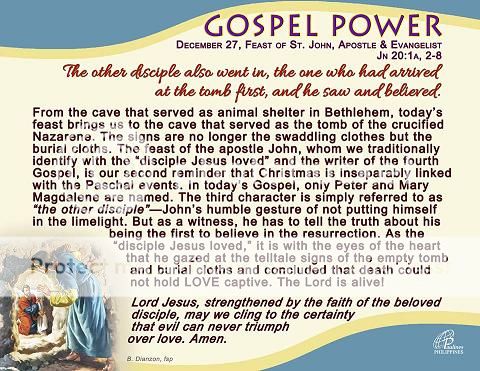
Feast of Saint John, Apostle and evangelist Lectionary: 697
Reading 1 (1 Jn 1:1-4)
Beloved: What was from the beginning, what we have heard, what we have seen with our eyes, what we looked upon and touched with our hands concerns the Word of life — for the life was made visible; we have seen it and testify to it and proclaim to you the eternal life that was with the Father and was made visible to us— what we have seen and heard we proclaim now to you, so that you too may have fellowship with us; for our fellowship is with the Father and with his Son, Jesus Christ. We are writing this so that our joy may be complete.
Responsorial Psalm (Ps 97:1-2, 5-6, 11-12)
R. Rejoice in the Lord, you just!
The LORD is king; let the earth rejoice; let the many isles be glad. Clouds and darkness are around him, justice and judgment are the foundation of his throne. R. Rejoice in the Lord, you just!
The mountains melt like wax before the LORD, before the LORD of all the earth. The heavens proclaim his justice, and all peoples see his glory. R. Rejoice in the Lord, you just!
Light dawns for the just; and gladness, for the upright of heart. Be glad in the LORD, you just, and give thanks to his holy name. R. Rejoice in the Lord, you just!
Alleluia (See Te Deum)
R. Alleluia, alleluia. We praise you, O God, we acclaim you as Lord; the glorious company of Apostles praise you. R. Alleluia, alleluia.
Gospel (Jn 20:1a and 2-8)
On the first day of the week, Mary Magdalene ran and went to Simon Peter and to the other disciple whom Jesus loved, and told them, "They have taken the Lord from the tomb, and we do not know where they put him." So Peter and the other disciple went out and came to the tomb. They both ran, but the other disciple ran faster than Peter and arrived at the tomb first; he bent down and saw the burial cloths there, but did not go in. When Simon Peter arrived after him, he went into the tomb and saw the burial cloths there, and the cloth that had covered his head, not with the burial cloths but rolled up in a separate place. Then the other disciple also went in, the one who had arrived at the tomb first, and he saw and believed.
REFLECTIONS: WORD Today
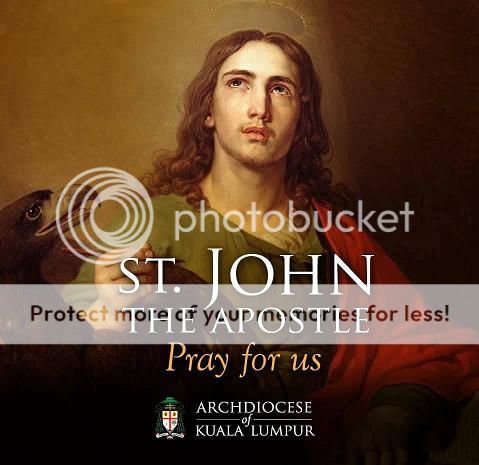
On this 3rd day of the Christmas Octave, the Church celebrates the Feast of St. John the Apostle and Evangelizer, "the one whom Jesus loved." He was the only apostle who was not martyred, and so he was able to write the majestic and profound 4th Gospel in the wise old age of 80+.
He also wrote three of the Epistles (1 John, 2 John, 3 John) and the Book of Revelation. He was the last apostle to die. He died in his nineties in Ephesus (west coast of modern Turkey.)
The Gospel of John is not a straight-line narration of the events of Jesus' life; it focuses on the theology of Christ's inseparable humanity and divinity. He testifies to us that Jesus is true God who became true man (John 1:1 & 14) and this God/man "is what we have heard and what we have seen - and touched with our own hands." (1 John 1:1) And in today's Gospel, St. John testifies that in the Resurrection, Jesus is alive forevermore, not just in spirit but in actual flesh and blood.
St. John is saying that Jesus is THE Ultimate Sacrament of God, the visible, audible and touchable Sign of the invisible and infinite God. This is the Christmas Mystery that the Catechism of the Catholic Church explains in paragraphs 525 and 526. At that first Christmas, the infinite God made Himself into a small, humble and poor baby in order to share in our frail humanity and to share with us His divinity.
And Jesus continues to do this today in the Sacrament of the Holy Eucharist. The Word made Flesh humbles Himself further into a thin slice of bread for each of us to eat in a much more intimate, one-on-one personal relationship. In St. John's Gospel, Jesus tells us, "I am the living bread which came down from heaven. If anyone eats of this bread, he will live forever; and the bread which I shall give for the life of the world is my flesh." (John 6:51)
Pope Francis puts it this way: "The love of God is not something vague or generic; the love of God has a name and a face: Jesus Christ."
With the powerful life-giving graces Jesus the Eucharist brings into our humanity, we gain super-strength to endure in our journey to divinity. So come, we whom Jesus loves, let us continue celebrating Christmas with St. John and with the Eucharist - the Body and Blood of God with us - so that our Christmas joy may be complete.
“Here is the true Faith: This Baby is God, and this Woman is the Mother of God.”
With the manifestation of Jesus Christ as the eternal Son of the eternal Father, the doctrine of the Holy Trinity, which was implicit in the Old Testament, becomes explicit in the New. Now we know that the true God is a community of consubstantial, coequal, and coeval Persons, all worthy of the highest cult of adoration, thanksgiving, reparation, and petition. Before the revelation of God in the Flesh, we did not have such knowledge.
That mystery by which we know the mystery of the Trinity — the Incarnation of the eternal Word — was itself an altogether new revelation, a fulfillment of the mysterious prophesy of Jeremy, “for the Lord hath created a new thing upon the earth: A WOMAN SHALL COMPASS A MAN” (31:22).
That new thing was beloved of the holy angels and hated by the demons.
Satan’s fall was caused by his rejection of the economy of the Incarnation, with its consequent crowning of that Woman as Queen of the Angels — his Queen. In his demonic hatred of that Woman, he seduced her precursor, Eve. And in his preternatural hatred of that Woman’s “seed” (cf. Gen. 3:15), he hates all children. Under his influence, therefore, the pagan world gave us the diminution of woman to the status of man’s sexual plaything. (A role she was largely spared in Christendom owing to the cultus of the Blessed Virgin Mary, cf., Orestes Brownson’s “The Moral and Social Influence of Devotion to Mary.”) And in the darker sort of paganism — the more clearly diabolical kind — we see the wicked cult of child sacrifice.
Thus the Canaanite god, Moloch, and the Punic god, Baal were each the recipient of a cult that included child sacrifice. The former cult was practiced by apostate Israelites, who murdered their own children, which they were specifically commanded not to do in the book of Leviticus. The cult of the latter, Baal, was one of the reasons the Romans sought to destroy Carthage. Pagan though they were, the Romans were not so corrupt as to fathom child sacrifice, and their orators cited infant sacrifice in their anti-Punic rhetoric as a reason why Carthage must be destroyed. In spite of a fashionable modern attempt to rehabilitate the ancient Phoenicians’ reputation, recent archeological evidence shows that the Romans were right; these people really did sacrifice their children to demons.
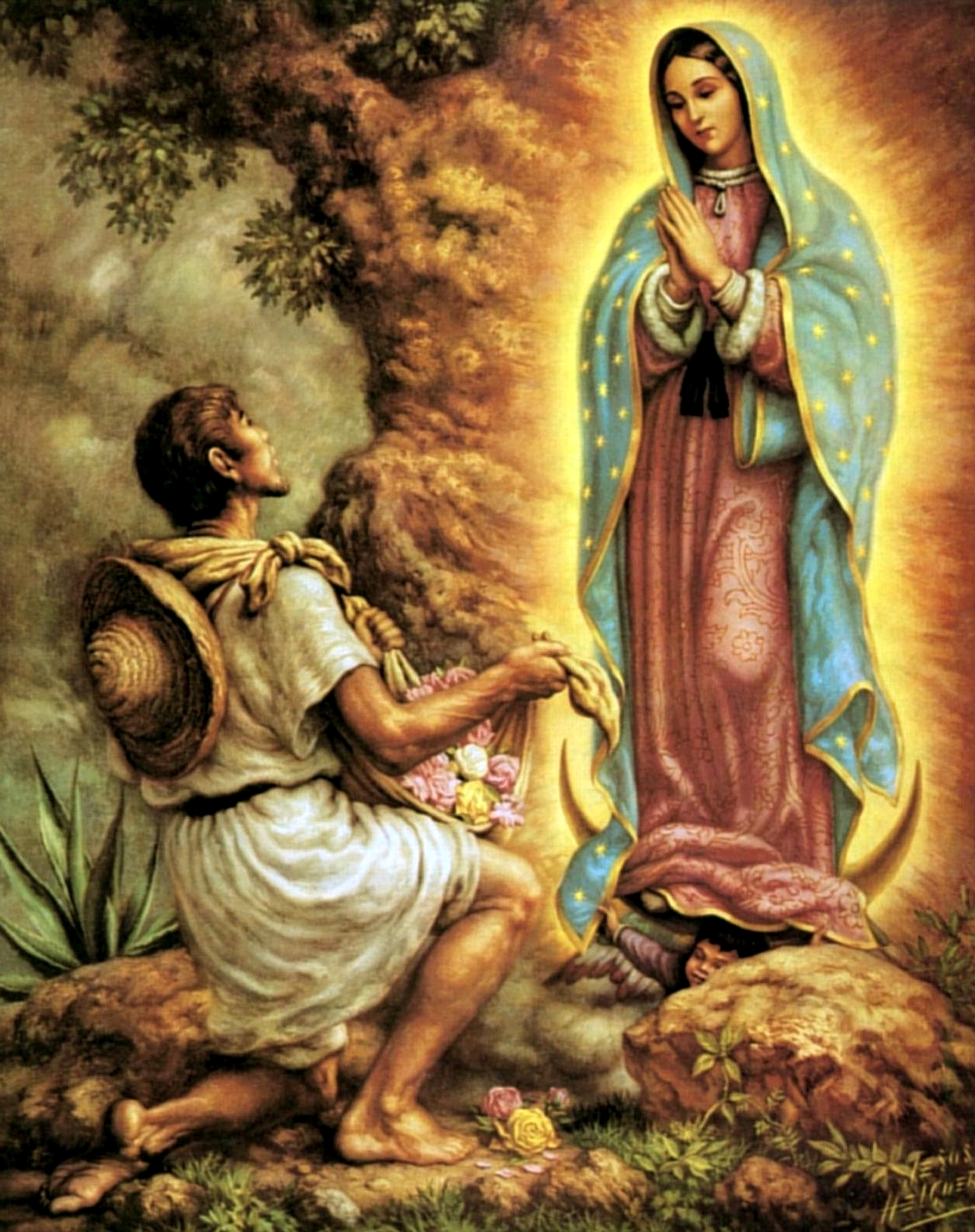
Closer to home, while the Aztecs practiced various kinds of human sacrifice, the worship of Tlaloc, their god of rain, water, and earthly fertility, specifically demanded child sacrifice, as did certain other of their cults (mentioned at various points here). We know that the holy Virgin of Guadalupe came personally to evangelize the Aztecs through the instrumentality of Saint Juan Diego and his tilma. Fighting diabolical fire with fire of a heavenly sort, the miraculous image of Guadalupe is an ingenious pictogram of a pregnant young Queen defeating the Aztec pantheon.
And her beautiful words to Saint Juan Diego show just how tender and loving a Mother that Queen is!
* * * * * * * * * * * *
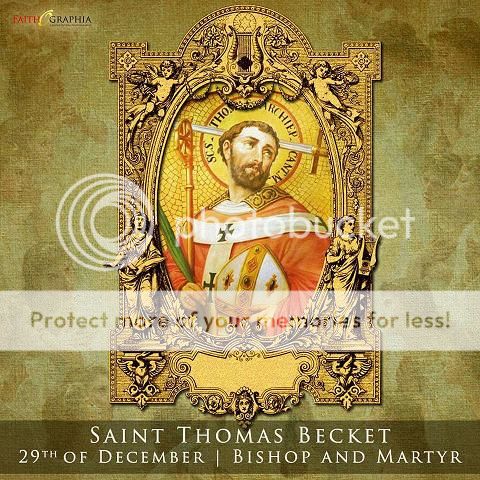
The liturgical calendar becomes strangely sanguinary just after Christmas Day. The second day of the Octave is the “Feast of Stephen,” that saintly deacon and protomartyr who heads up a bloody band to salute the newborn King. Then comes His Apostle and Evangelist, Saint John, on December 27, a martyr in all but his actual death; followed by the Holy Innocents; followed by Saint Thomas a Becket, the martyred Bishop of Canterbury.
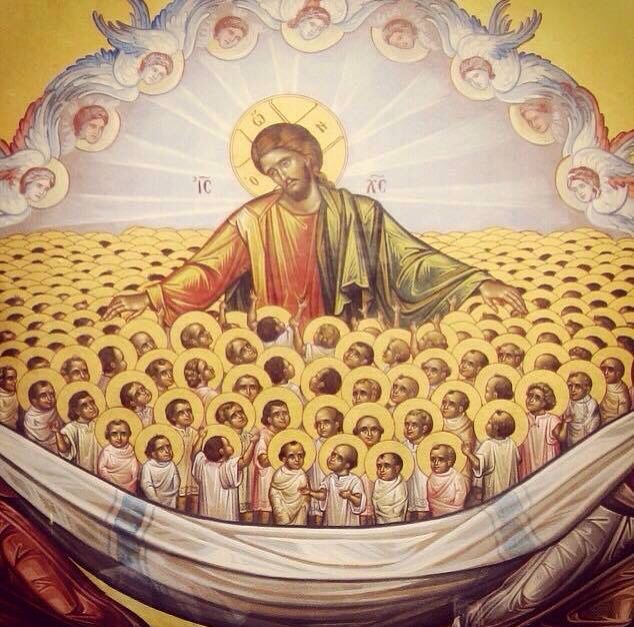
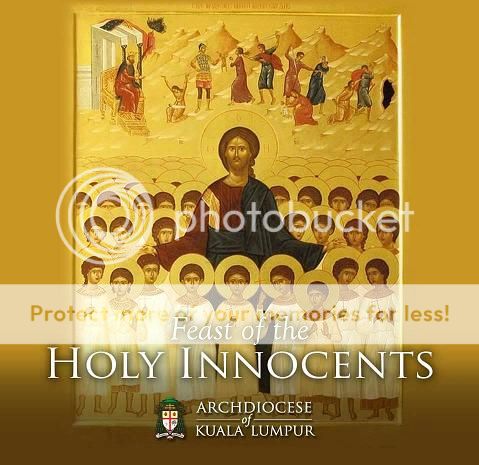
The feast of the Holy Innocents, known also as Childermas (the Mass of the Children, as Christmas is the Mass of Christ), celebrates those little Jewish boys of Bethlehem who had the honor of being mistaken for Christ. The Church, in her liturgy, gives them the graceful name flores martyrum, “flowers of the martyrs.” The hymn whence come these words has been set to music by Michael Haydn, younger brother of the more famous Franz Joseph Haydn. Speaking of musical tributes, let us not forget that the melancholy 14th-Century Coventry Carol is in honor of the Holy Innocents. The carol is melancholy, but can also be called bittersweet, the sweet coming in at the end via the tonal device known as the “Picardy third.” As tragic as the slaughter of these innocents was, it remains part of salvation history — a divine comedy in the true sense of the word, as there is a happy ending.
In our own day, the cults of Baal, Moloch, Tlaloc, and Herod’s selfish ambitions all continue in the abortion industry, which has — at least in some places — overt connections to the Satanic. But even when not explicitly Satanic, the abortion industry is playing the role of useful idiot for Satan. Ditto for the pharmaceutical industry’s production of chemical abortifacients and other methods of birth control. The demonic hatred of the Divine Child continues in the wicked practice of onanism, a mortal sin which is nearly pandemic in our day, at least in the developed world, which seeks Herod-like to impose it on poorer nations.
A delicate point suggests itself here. In spite of the uninformed optimism of many in the pro-life movement, and contrary to the sanguine novelties of the authors of the International Theological Commission’s study on Limbo, unbaptized babies, being yet stained by original sin, are not admitted to the Beatific Vision when they die. European witches, in the Ages of Faith, gave bizarre and sacrilegious tribute to this truth of the Catholic Faith when they sacrificed unbaptized infants to Satan in their black rites. Shakespeare, well aware of this practice, makes use of it in the grotesque list of ingredients bubbling in the witches caldron in Macbeth:
Liver of blaspheming Jew, Gall of goat, and slips of yew Silver'd in the moon's eclipse, Nose of Turk and Tartar's lips, Finger of birth-strangled babe Ditch-deliver'd by a drab, Make the gruel thick and slab...
Satan continues to attack and corrupt women as he did Eve. Strangely, his promises have become less attractive. Eve was promised to become like God. Via feminism, Satan promises the modern woman she can become just like men. What a bum deal! If only she is willing to sacrifice her femininity in the dark rites of abortion and contraception, she can forge her own destiny and become … enslaved in a Dilbert cubicle just like the male of the species! Maybe one day, she can even become president. And in fulfilling her ambitions and sacrificing children and family on the altar of feminism, this “liberated” woman unwittingly assists Satan in his attack on the Mother and Child.
To restore the woman and the child — and marriage and the family — to their proper place, we need to restore the place of that Woman and that Child in our own hearts and souls.
I said above that Satan continues to attack and corrupt women. Let nobody read into these words the idea that demons do not tempt men. That he does, and often, as he did in Eden, by using women. Men, if they be Christian men, and not completely corrupted by his wiles, will realize that their duty is to care for, respect, and protect women and children — for each is an image of that grand Image of Catholicity, given by God to Saint Joseph's loving care.
“Here is the true Faith: This Baby is God, and this Woman is the Mother of God.”
In the Immaculate Heart of Mary, Brother André Marie, M.I.C.M.
Feast of the Holy Innocents, martyrs Lectionary: 698
Reading 1 (1 Jn 1:5—2:2)
Beloved: This is the message that we have heard from Jesus Christ and proclaim to you: God is light, and in him there is no darkness at all. If we say, "We have fellowship with him," while we continue to walk in darkness, we lie and do not act in truth. But if we walk in the light as he is in the light, then we have fellowship with one another, and the Blood of his Son Jesus cleanses us from all sin. If we say, "We are without sin," we deceive ourselves, and the truth is not in us. If we acknowledge our sins, he is faithful and just and will forgive our sins and cleanse us from every wrongdoing. If we say, "We have not sinned," we make him a liar, and his word is not in us.
My children, I am writing this to you so that you may not commit sin. But if anyone does sin, we have an Advocate with the Father, Jesus Christ the righteous one. He is expiation for our sins, and not for our sins only but for those of the whole world.
Responsorial Psalm (Ps 124:2-3, 4-5, 7cd-8)
R. Our soul has been rescued like a bird from the fowler's snare.
Had not the LORD been with us— When men rose up against us, then would they have swallowed us alive, When their fury was inflamed against us. R. Our soul has been rescued like a bird from the fowler's snare.
Then would the waters have overwhelmed us; The torrent would have swept over us; over us then would have swept the raging waters. R. Our soul has been rescued like a bird from the fowler's snare.
Broken was the snare, and we were freed. Our help is in the name of the LORD, who made heaven and earth. R. Our soul has been rescued like a bird from the fowler's snare.
Alleluia (See Te Deum)
R. Alleluia, alleluia. We praise you, O God, we acclaim you as Lord; the white robed army of martyrs praise you. R. Alleluia, alleluia.
Gospel (Mt 2:13-18)
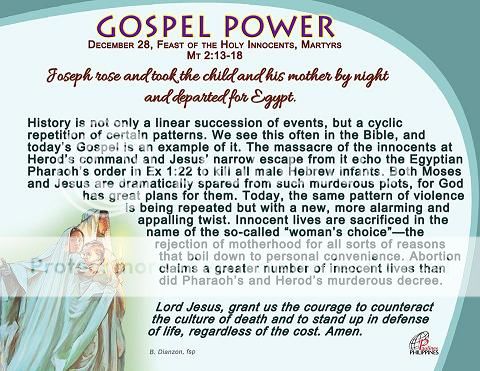
When the magi had departed, behold, the angel of the Lord appeared to Joseph in a dream and said, "Rise, take the child and his mother, flee to Egypt, and stay there until I tell you. Herod is going to search for the child to destroy him." Joseph rose and took the child and his mother by night and departed for Egypt. He stayed there until the death of Herod, that what the Lord had said through the prophet might be fulfilled, Out of Egypt I called my son.
When Herod realized that he had been deceived by the magi, he became furious. He ordered the massacre of all the boys in Bethlehem and its vicinity two years old and under, in accordance with the time he had ascertained from the magi. Then was fulfilled what had been said through Jeremiah the prophet:
A voice was heard in Ramah, sobbing and loud lamentation; Rachel weeping for her children, and she would not be consoled, since they were no more.
REFLECTIONS: WORD Today
On this 4th day of the Christmas Octave (Dec. 25 - Jan. 1), we honor the martyrdom of the Holy Innocents. It is a somber reminder of how Christmas was almost aborted.
In the Gospel, we read that soon after the 'Three' Wise Men had worshipped the child King and departed, the Jewish King Herod sent troops to massacre the innocent children of Bethlehem. Herod did it in the aim of eliminating the Savior long promised to the Jews but whom he rejected.
In stark contrast, the Wise Men came from distant lands; they were not Jews, not believers of the One True God. But their hearts had been strangely moved to follow the light of a bright star that God sent to lead them to His Son and worship Him.
"God is light; in Him there is no darkness" (1 John 1:5)
Like Herod, we live in darkness when we reject Christ. And when Christ is rejected, death is sure to follow to fill the vacuum. Today we know for sure Christ has been rejected because we see Christ's little brothers and sisters aborted in their mother's wombs, contracepted in bedrooms, and massacred in classrooms where Religion was replaced by sex education.
Let us follow the Light of Jesus to Mass today and worship Him in behalf of all innocent victims who will never get to know the joy of seeing a shining star on top a Christmas tree.
The Fifth Day in the Octave of Christmas Lectionary: 202
Reading 1 (1 Jn 2:3-11)
Beloved: The way we may be sure that we know Jesus is to keep his commandments. Whoever says, "I know him," but does not keep his commandments is a liar, and the truth is not in him. But whoever keeps his word, the love of God is truly perfected in him. This is the way we may know that we are in union with him: whoever claims to abide in him ought to walk just as he walked.
Beloved, I am writing no new commandment to you but an old commandment that you had from the beginning. The old commandment is the word that you have heard. And yet I do write a new commandment to you, which holds true in him and among you, for the darkness is passing away, and the true light is already shining. Whoever says he is in the light, yet hates his brother, is still in the darkness. Whoever loves his brother remains in the light, and there is nothing in him to cause a fall. Whoever hates his brother is in darkness; he walks in darkness and does not know where he is going because the darkness has blinded his eyes.
Responsorial Psalm (Ps 96:1-2a, 2b-3, 5b-6)
R. Let the heavens be glad and the earth rejoice!
Sing to the LORD a new song; sing to the LORD, all you lands. Sing to the LORD; bless his name. R. Let the heavens be glad and the earth rejoice!
Announce his salvation, day after day. Tell his glory among the nations; among all peoples, his wondrous deeds. R. Let the heavens be glad and the earth rejoice!
The LORD made the heavens. Splendor and majesty go before him; praise and grandeur are in his sanctuary. R. Let the heavens be glad and the earth rejoice!
Alleluia (Lk 2:32)
R. Alleluia, alleluia. A light of revelation to the Gentiles and glory for your people Israel. R. Alleluia, alleluia.
Gospel (Lk 2:22-35)
When the days were completed for their purification according to the law of Moses, the parents of Jesus took him up to Jerusalem to present him to the Lord, just as it is written in the law of the Lord, Every male that opens the womb shall be consecrated to the Lord, and to offer the sacrifice of a pair of turtledoves or two young pigeons, in accordance with the dictate in the law of the Lord.
Now there was a man in Jerusalem whose name was Simeon. This man was righteous and devout, awaiting the consolation of Israel, and the Holy Spirit was upon him. It had been revealed to him by the Holy Spirit that he should not see death before he had seen the Christ of the Lord. He came in the Spirit into the temple; and when the parents brought in the child Jesus to perform the custom of the law in regard to him, he took him into his arms and blessed God, saying:
"Lord, now let your servant go in peace; your word has been fulfilled: my own eyes have seen the salvation which you prepared in the sight of every people, a light to reveal you to the nations and the glory of your people Israel."
The child's father and mother were amazed at what was said about him; and Simeon blessed them and said to Mary his mother, "Behold, this child is destined for the fall and rise of many in Israel, and to be a sign that will be contradicted (and you yourself a sword will pierce) so that the thoughts of many hearts may be revealed."
REFLECTIONS: WORD Today
We are now on the 5th day of the Christmas Octave. Do you still remember the loving text messages we sent on Christmas day that talked of peace and goodwill? Or does hot anger for neighbor and business rival once more rule our days?
The Christmas message from Jesus has not changed (1Jn 2:7), it remains the same: Love one another, forgive, be kind and considerate to each other.
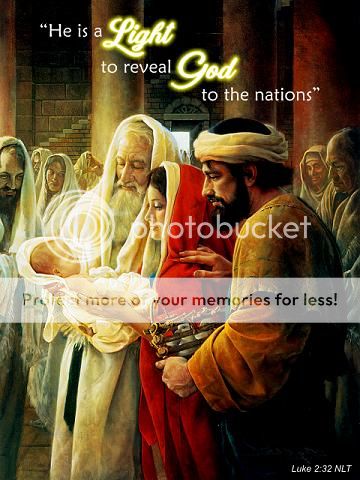
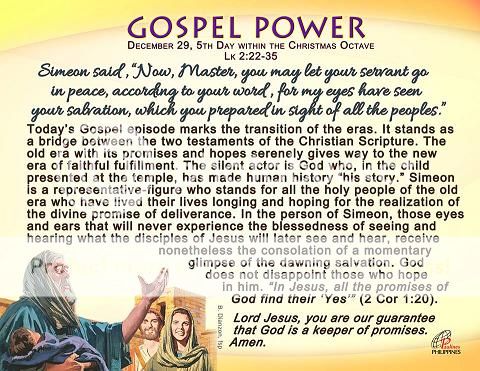
In the Gospel, old Simeon at the Temple greet Mary and Joseph as they present the Baby Jesus to God His Father. In joy, Simeon says of Jesus, "He is a light to reveal God to the nations." (Lk 2:32 NLT) Simeon is saying that Jesus is the Light promised by God through Isaiah 500 years earlier (Isaiah 49:6).
The Word of God, Jesus and His Gospel, is the beam that reveals the path to peace and goodwill on earth - and the kind of relationship we have with others shows how faithfully we have followed His Light.
Sweet Baby Jesus, gentle Star of Bethlehem, lead me and I will follow. Light the way You would have me walk. And should I ever stray, expose my falsehood and lead me back to Christmas day.
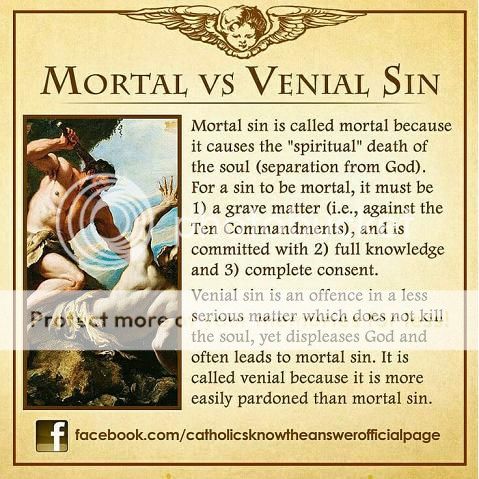
A serious, grave or mortal sin is the knowing and willful violation of God’s law in a serious matter, for example, idolatry, adultery, murder, slander. These are all things gravely contrary to the love we owe God and, because of Him, our neighbor. As Jesus taught, when condemning even looking at a woman lustfully, sin can be both interior (choices of the will alone) or exterior (choices of the will carried into action). A man who willfully desires to fornicate, steal, murder or some other grave sin, has already seriously offended God by choosing interiorly what God has prohibited.
Mortal sin is called mortal because it is the “spiritual” death of the soul (separation from God). If we are in the state of grace it loses this supernatural life for us. If we die without repenting we will lose Him for eternity. However, by turning our hearts back to Him and receiving the Sacrament of Penance we are restored to His friendship. Catholics are not allowed to receive Communion if they have unconfessed mortal sins.
Venial sins are slight sins. They do not break our friendship with God, although they injure it. They involve disobedience of the law of God in slight (venial) matters. If we gossip and destroy a person’s reputation it would be a mortal sin. However, normally gossip is about trivial matters and only venially sinful. Additionally, something that is otherwise a mortal sin (e.g. slander) may be in a particular case only a venial sin. The person may have acted without reflection or under force of habit. Thus, not fully intending the action their guilt before God is reduced. It is always good to remember, especially those who are trying to be faithful but sometimes fall, that for mortal sin it must not only be 1) serious matter, but 2) the person must know it is serious and then 3) freely commit it.
These two categories of sin are explicitly to be found in Sacred Scripture. In the Old Covenant there were sins that merited the death penalty and sins that could be expiated by an offering. This Law was a teacher that prepared the way for the faith (Gal. 3:24). In the New Covenant these material categories are replaced by spiritual ones, natural death by eternal death. There are thus daily faults for which we must daily ask forgiveness (Mt. 6:12), for even the “just man falls seven times a day” (Prov. 24:16), and mortal faults that separate the sinner from God (1 Cor. 6:9-10) for all eternity.
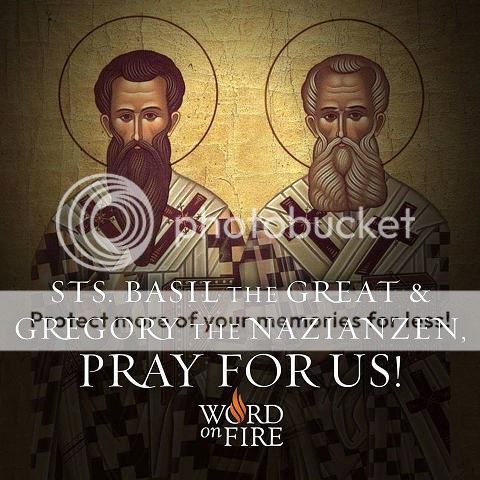
Memorial of Saints Basil the Great and Gregory Nazianzen, Bishops and Doctors of the Church Lectionary: 205
Reading 1 (1 Jn 2:22-28)
Beloved: Who is the liar? Whoever denies that Jesus is the Christ. Whoever denies the Father and the Son, this is the antichrist. Anyone who denies the Son does not have the Father, but whoever confesses the Son has the Father as well.
Let what you heard from the beginning remain in you. If what you heard from the beginning remains in you, then you will remain in the Son and in the Father. And this is the promise that he made us: eternal life. I write you these things about those who would deceive you. As for you, the anointing that you received from him remains in you, so that you do not need anyone to teach you. But his anointing teaches you about everything and is true and not false; just as it taught you, remain in him.
And now, children, remain in him, so that when he appears we may have confidence and not be put to shame by him at his coming.
Responsorial Psalm (ps 98:1, 2-3ab, 3cd-4)
R. All the ends of the earth have seen the saving power of God.
Sing to the LORD a new song, for he has done wondrous deeds; His right hand has won victory for him, his holy arm. R. All the ends of the earth have seen the saving power of God.
The LORD has made his salvation known: in the sight of the nations he has revealed his justice. He has remembered his kindness and his faithfulness toward the house of Israel. R. All the ends of the earth have seen the saving power of God.
All the ends of the earth have seen the salvation by our God. Sing joyfully to the LORD, all you lands; break into song; sing praise. R. All the ends of the earth have seen the saving power of God.
Alleluia (Heb 1:1-2)
R. Alleluia, alleluia. In the past God spoke to our ancestors through the prophets; in these last days, he has spoken to us through the Son. R. Alleluia, alleluia.
Gospel (Jn 1:19-28)
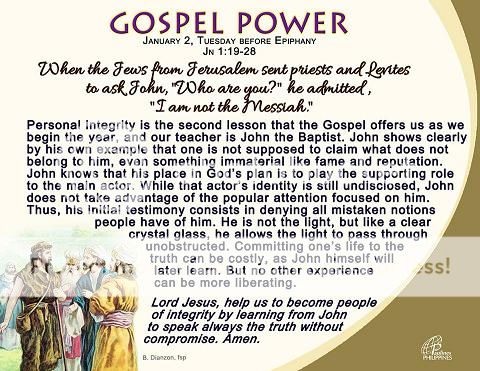
This is the testimony of John. When the Jews from Jerusalem sent priests and Levites to him to ask him, "Who are you?" He admitted and did not deny it, but admitted, "I am not the Christ." So they asked him, "What are you then? Are you Elijah?" And he said, "I am not." "Are you the Prophet?" He answered, "No." So they said to him, "Who are you, so we can give an answer to those who sent us? What do you have to say for yourself?" He said: "I am the voice of one crying out in the desert, 'Make straight the way of the Lord,' as Isaiah the prophet said." Some Pharisees were also sent. They asked him, "Why then do you baptize if you are not the Christ or Elijah or the Prophet?" John answered them, "I baptize with water; but there is one among you whom you do not recognize, the one who is coming after me, whose sandal strap I am not worthy to untie." This happened in Bethany across the Jordan, where John was baptizing.
REFLECTIONS: WORD Today
Christmas Season started on December 25 and ends with the Baptism of the Lord (January 8 this year). The Season started with the Christmas Octave (Dec. 25 - Jan. 1), the single, continuous 8-day celebration of the Lord's birth. And now the Season of Christmas continues on till January 8.
Now that things are more quite, it's time for a little review of what we had celebrated. Just what exactly is the meaning of the word CHRIST in Christmas? It comes from the Greek word KRISTOS which means the "anointed one" or the one God appointed and authorized to be the savior of mankind.
The Gospel setting is 30 A.D., just a little before Jesus started His public ministry. Jesus was still unknown at that time, but His cousin John the Baptist was already very popular among the Jews with his powerful preaching. People were starting to think that he was the Christ. He could easily have claimed the honor (and honorarium), but he flatly stated that he was not, that he was just an unworthy servant preparing people for the arrival of the true Christ.
The First Reading is a letter written in 90+ A.D. by John the Apostle, the last living apostle. He is writing to faithful Christians, warning them of "antichrists," people who, even at that early stage of Christianity, were already spreading lies that Jesus is not the Christ.
Today, after the holiday festivities, we start to go back to the daily routine of life. But let us never forget the message of Christmas:
Jesus IS the Christ - and WE are not.
Let us not go back to being our own christ, saving ourselves, solving life's problems with immoral anti-Christ ways. Let us also be wary of people and ideologies that promote non-Christian ideas of how to save society and the world.
And when we are helping others or serving at church, let us not forget we are just servants given by Christ the privilege of doing HIS work. He is the one gifting us with a happy and purpose-filled life through service, unworthy as we are. We need to remember this for there is a very real anger of falling into the hallucination that we are the savior of the people we are helping, or the star of the show at church, then demand appreciation, applause or even payment for services we are supposed to be doing for love of Jesus.
May our words and works always point to Christ as the true source of Christmas joy.
Kazakh Bishops affirm indissolubility of marriage – and its implications
Three Kazakhstani Bishops signed a statement on Sunday confirming that it is not licit to admit to sacramental communion Catholics who are divorced and illictly remarried, if they are not living according to the long-standing teachings of the Church. Jan 03, 2018
By Carl Bunderson
Three Kazakhstani Bishops signed a statement on Sunday confirming that it is not licit to admit to sacramental communion Catholics who are divorced and illictly remarried, if they are not living according to the long-standing teachings of the Church.The statement was released in response to norms issued by several groups of bishops since the promulgation of Amoris laetitia.“It is not licit (non licet) to justify, approve, or legitimize either directly or indirectly divorce and a non-conjugal stable sexual relationship through the sacramental discipline of the admission of so-called 'divorced and remarried' to Holy Communion, in this case a discipline alien to the entire Tradition of the Catholic and Apostolic faith,” read the Dec. 31, 2017 letter of the Bishops.“By making this public profession before our conscience and before God who will judge us, we are sincerely convinced that we have provided a service of charity in truth to the Church of our day and to the Supreme Pontiff, Successor of Saint Peter and Vicar of Christ on earth.”The statement was signed by Archbishop Tomash Peta of Maria Santissima in Astana; his auxiliary, Bishop Athanasius Schneider; and Archbishop Jan Pawel Lenga, Archbishop Emeritus of Karaganda.It comes nearly a year after the same Bishops issued an appeal to prayer that Pope Francis would confirm the Church's constant practice regarding the indissolubility of marriage.The three Bishops noted that some Bishops around the world – such as those of Malta and Sicily – have issued norms allowing for the divorced-and-remarried who have a living spouse yet who are in “stable cohabitation more uxorio” with a third person to “receive the sacrament of Penance and Holy Communion, while continuing to live habitually and intentionally more uxorio with a person who is not their legitimate spouse.” Those norms have qualified that such permissions are limited to individual cases, at the discretion of a confessor, pastor, or Bishop.
More uxorio, which means “in the mode of marriage,” refers in this context to cohabitation and a sexual relationship between those who are not validly married. “These pastoral norms have received approval from various hierarchical authorities. Some of these norms have received approval even from the supreme authority of the Church,” they noted. Pope Francis had, in 2016, sent a letter approving of norms from the Bishops of the Buenos Aires region of Argentina, which seemed to permit reception of holy communion in particular cases.The Pope's letter, and the Buenos Aires norms, were then promulgated in the Acta Apostolicae Sedis, a fact made known last month.“The spread of these ecclesiastically approved pastoral norms has caused a considerable and ever increasing confusion among the faithful and the clergy, a confusion that touches the central manifestations of the life of the Church, such as sacramental marriage with the family, the domestic church, and the sacrament of the Most Holy Eucharist,” the Kazakh bishops stated.They said that to admit the divorced-and-remarried to Communion “means in practice a way of approving or legitimizing divorce, and in this meaning a kind of introduction of divorce in the life of the Church.”Such pastoral norms “are revealed in practice and in time” as a way of spreading the “plague of divorce”, they said, quoting from the Second Vatican Council's pastoral constitution on the Church in the modern world, Gaudium et spes.The bishops maintained that the Church should be, rather, “a bulwark and an unmistakable sign of contradiction against the plague of divorce … because of her unconditional fidelity to the doctrine of Christ.”“An approval or legitimation of the violation of the sacredness of the marriage bond, even indirectly through the mentioned new sacramental discipline, seriously contradicts God's express will and His commandment,” the Kazakh bishops wrote.They stated that sexual acts between those who are not married are “always contrary to God's will and constitute a grave offense”' and that no circumstance, including diminished guilt, can make such a sexual relationship “a positive moral reality.”The bishops also emphasized that although the Church cannot judge the internal state of grace of any person, sacramental discipline is not based on this but on their “visible and objective situation”; and that is it morally illicit “to engage in sexual relations with a person who is not one’s legitimate spouse supposedly to avoid another sin.”
They also affirmed that the divorced-and-remarried may be admitted to Communion “only when they with the help of God's grace and a patient and individual pastoral accompaniment make a sincere intention to cease from now on the habit of such sexual relations and to avoid scandal. It is in this way that true discernment and authentic pastoral accompaniment were always expressed in the Church.”
Furthermore, they said that those who violate their marriage bond with their legitimate spouse may not participate in Communion, and that “the fulfillment of God's will … constitutes the true spiritual good of the people here on earth and will lead them to the true joy of love in the salvation of eternal life.”The bishops called the recently proposed pastoral norms “a substantial alteration” of the Church's 2,000 year discipline, and added: “a substantially altered discipline will eventually lead to an alteration in the corresponding doctrine.”“The constant Magisterium of the Church … has preserved and faithfully transmitted both in the doctrine (in theory) and in the sacramental discipline (in practice) in an unequivocal way, without any shadow of doubt and always in the same sense and in the same meaning (eodem sensu eademque sententia), the crystalline teaching of Christ concerning the indissolubility of marriage.”The bishops said that the indissolubility of a ratified and consummated marriage is “the revealed word of God and the faith of the Church,” and that sacramental discipline cannot contradict this, “because of its Divinely established nature.”The faith naturally “excludes a formal contradiction between the faith professed on the one hand and the life and practice of the sacraments on the other,” they said, citing Vatican II and the writings of St. John Paul II.“In view of the vital importance that the doctrine and discipline of marriage and the Eucharist constitute, the Church is obliged to speak with the same voice. The pastoral norms regarding the indissolubility of marriage must not, therefore, be contradicted between one diocese and another, between one country and another,” they added, citing St. Irenaeus of Lyons and St. Thomas Aquinas.The bishops provided ample citations for the existing teaching and practice regarding the indissolubility of marriage, including Bl. Pius IX, Ven. Pius XII, Bl. Paul VI, St. John Paul II, and the Pontifical Council for Legislative Texts.“As Catholic bishops, who … must defend the unity of faith and the common discipline of the Church, and take care that the light of the full truth should arise for all men we are forced in conscience to profess in the face of the current rampant confusion the unchanging truth and the equally immutable sacramental discipline regarding the indissolubility of marriage according to the bimillennial and unaltered teaching of the Magisterium of the Church,” they wrote.“Being bishops in the pastoral office those, who promote the Catholic and Apostolic faith, we are aware of this grave responsibility and our duty before the faithful who await from us a public and unequivocal profession of the truth and the immutable discipline of the Church regarding the indissolubility of marriage. For this reason we are not allowed to be silent,” stated the Kazakh bishops.They made their affirmation in the spirit of Ss. John the Baptist, John Fisher, and Thomas More, who were martyred for upholding the indissolubility of marriage, and of Bl. Laura Vicuna, who offered her life for the conversion of her mother, who was living in concubinage.--CNA
Memorial of Saint Elizabeth Ann Seton, Religious Lectionary: 207
Reading 1 (1 Jn 3:7-10)
Children, let no one deceive you. The person who acts in righteousness is righteous, just as he is righteous. Whoever sins belongs to the Devil, because the Devil has sinned from the beginning. Indeed, the Son of God was revealed to destroy the works of the Devil. No one who is begotten by God commits sin, because God's seed remains in him; he cannot sin because he is begotten by God. In this way, the children of God and the children of the Devil are made plain; no one who fails to act in righteousness belongs to God, nor anyone who does not love his brother.
Responsorial Psalm (Ps 98:1, 7-8, 9)
R. All the ends of the earth have seen the saving power of God.
Sing to the LORD a new song, for he has done wondrous deeds; His right hand has won victory for him, his holy arm. R. All the ends of the earth have seen the saving power of God.
Let the sea and what fills it resound, the world and those who dwell in it; Let the rivers clap their hands, the mountains shout with them for joy before the LORD. R. All the ends of the earth have seen the saving power of God.
The LORD comes; he comes to rule the earth; He will rule the world with justice and the peoples with equity. R. All the ends of the earth have seen the saving power of God.
Alleluia (Heb 1:1-2)
R. Alleluia, alleluia. In the past God spoke to our ancestors through the prophets; in these last days, he has spoken to us through the Son. R. Alleluia, alleluia.
Gospel (Jn 1:35-42)
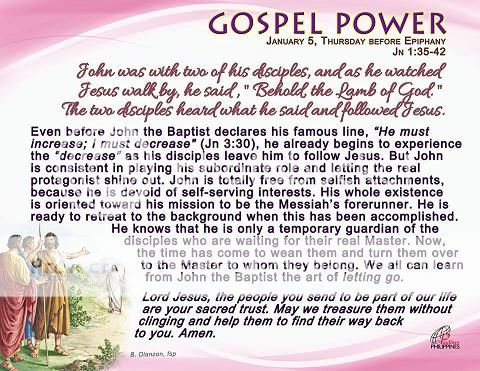
John was standing with two of his disciples, and as he watched Jesus walk by, he said, "Behold, the Lamb of God." The two disciples heard what he said and followed Jesus. Jesus turned and saw them following him and said to them, "What are you looking for?" They said to him, "Rabbi" (which translated means Teacher), "where are you staying?" He said to them, "Come, and you will see." So they went and saw where he was staying, and they stayed with him that day. It was about four in the afternoon. Andrew, the brother of Simon Peter, was one of the two who heard John and followed Jesus. He first found his own brother Simon and told him, "We have found the Messiah," which is translated Christ. Then he brought him to Jesus. Jesus looked at him and said, "You are Simon the son of John; you will be called Cephas," which is translated Peter.
REFLECTIONS: WORD Today
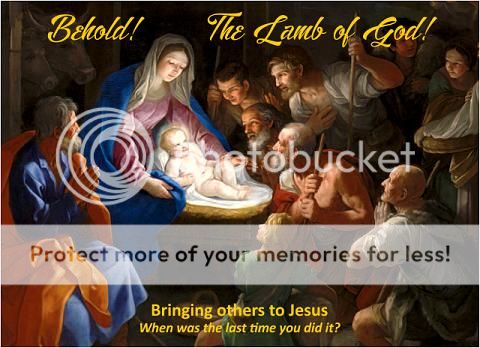
"Look! There is the Lamb of God!"
In today's Gospel, friends tell their friends who tell other friends about Jesus. The first evangelizers did this in great excitement, like children telling their friends about their new Christmas gift.
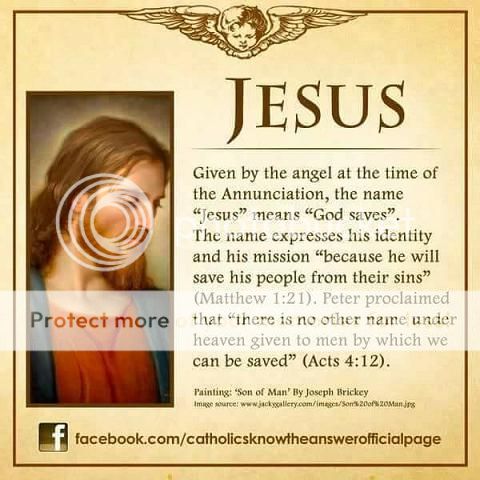
Evangelizers continued this process down the centuries till Christianity spread worldwide.But sadly, many of us today are ashamed to talk about Jesus, or even speak His Name. There is a need for New Evangelization, or the re-launching of the Good News in regions where the passion for Christ is getting cold. Started by Pope John Paul II and continued by Pope Benedict XVI and our current Pope Francis, the New Evangelization calls on all Christians, not just priests and missionaries, to renew our love for Jesus and then tell our friends about Him.
Clearly God has a plan for us for He never allows difficulties without meaning to make good come out of it. After being evangelized by Peter, God allowed the persecution of the earliest Christians in Jerusalem so they would scatter all over the Middle East and evangelize. Due to economic reasons, we too are scattered to all the habitable continents of the earth.
Evangelization does not require us to be eloquent preachers. It can be as simple as inviting friends to come to Mass or to join our faith community, and telling them of our wonderful experience with Jesus there...
When we approach God for our needs, Jesus is there sitting beside Him. May Jesus be excited and say, "Look Father! There is my friend!"
Memorial of Saint John Neumann, Bishop Lectionary: 208
Reading 1 (1 Jn 3:11-21)
Beloved: This is the message you have heard from the beginning: we should love one another, unlike Cain who belonged to the Evil One and slaughtered his brother. Why did he slaughter him? Because his own works were evil, and those of his brother righteous. Do not be amazed, then, brothers and sisters, if the world hates you. We know that we have passed from death to life because we love our brothers. Whoever does not love remains in death. Everyone who hates his brother is a murderer, and you know that no murderer has eternal life remaining in him. The way we came to know love was that he laid down his life for us; so we ought to lay down our lives for our brothers. If someone who has worldly means sees a brother in need and refuses him compassion, how can the love of God remain in him? Children, let us love not in word or speech but in deed and truth.
Now this is how we shall know that we belong to the truth and reassure our hearts before him in whatever our hearts condemn, for God is greater than our hearts and knows everything. Beloved, if our hearts do not condemn us, we have confidence in God.
Responsorial Psalm (Ps 100:1b-2, 3, 4, 5)
R. Let all the earth cry out to God with joy.
Sing joyfully to the LORD, all you lands; serve the LORD with gladness; come before him with joyful song. R. Let all the earth cry out to God with joy.
Know that the LORD is God; he made us, his we are; his people, the flock he tends. R. Let all the earth cry out to God with joy.
Enter his gates with thanksgiving, his courts with praise; Give thanks to him; bless his name. R. Let all the earth cry out to God with joy.
The LORD is good: the LORD, whose kindness endures forever, and his faithfulness, to all generations. R. Let all the earth cry out to God with joy.
Alleluia
R. Alleluia, alleluia. A holy day has dawned upon us. Come, you nations, and adore the Lord. Today a great light has come upon the earth. R. Alleluia, alleluia.
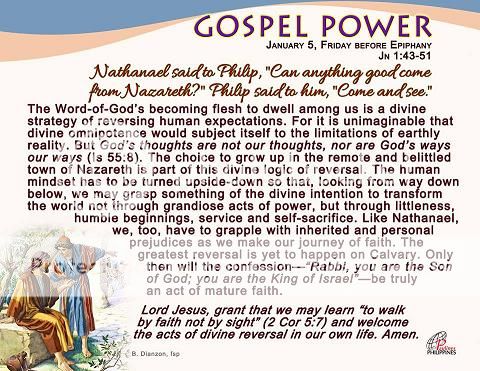
Gospel (Jn 1:43-51)
Jesus decided to go to Galilee, and he found Philip. And Jesus said to him, "Follow me." Now Philip was from Bethsaida, the town of Andrew and Peter. Philip found Nathanael and told him, "We have found the one about whom Moses wrote in the law, and also the prophets, Jesus, son of Joseph, from Nazareth." But Nathanael said to him, "Can anything good come from Nazareth?" Philip said to him, "Come and see." Jesus saw Nathanael coming toward him and said of him, "Here is a true child of Israel. There is no duplicity in him." Nathanael said to him, "How do you know me?" Jesus answered and said to him, "Before Philip called you, I saw you under the fig tree." Nathanael answered him, "Rabbi, you are the Son of God; you are the King of Israel." Jesus answered and said to him, "Do you believe because I told you that I saw you under the fig tree? You will see greater things than this." And he said to him, "Amen, amen, I say to you, you will see the sky opened and the angels of God ascending and descending on the Son of Man."
REFLECTIONS: WORD Today
Jesus found Phillip and He said to him, "Follow me." (Gospel)
This is the whole reason for Christmas. The Son of God came down from heaven to look for each one us lost in the darkness of sin and invite us to follow Him back home.
And the path back home "is the message you have heard from the beginning, that we should love one another." (First Reading)
This is the message of Jesus that He preached and performed all His life, from Christmas to Crucifixion. It has not changed and it will never change.
We whom He has found now follow Him and join in His work. Phillip found his friend Nathanael and invited him to "Come and see" the wonders of fellowship with Jesus. We follow Jesus in laying down our lives for our brothers and sisters - or at least our time, talent and treasure.
The way to know if someone truly loves you is when he or she brings you home to Jesus.
Speaking to some 8,000 people at a Catholic leadership conference, Bishop Robert Barron said on Tuesday that trust in the risen Christ should give us the courage to preach the truth boldly.“Through the Holy Spirit, the ascended, risen Christ commands his mystical Body the Church to do what he did, and to say what he said. That’s it…that’s the task of the Church to the present day.”Barron, the auxiliary bishop of Los Angeles, is also the founder of Word on Fire Catholic Ministries and host of the award-winning “Catholicism” documentary. He delivered one of the opening keynotes at this year’s Student Leadership Summit in Chicago. Known as SLS, the summit is hosted by the Fellowship of Catholic University Students (FOCUS) every other year. It aims to train student leaders and other ministers with tools for evangelization and missionary work, largely on college campuses.This year’s SLS drew more than 8,000 participants, more than double the attendance of the last summit, hosted in 2016 in Dallas with approximately 3,400 participants.In his talk, Bishop Barron focused on the Acts of the Apostles, a Biblical book that he said “sets the agenda for us” in the work of evangelization.He noted that this book begins with an account of Jesus’ ascension, comparing Christ’s glorified position in heaven to that of a general who commands his army at a vantage point from above.
“It tells us very clearly who’s in charge, and what I mean by that is, the ascended Christ who now commands his Church.”Moving on from the Ascension to the account of Pentecost, Barron said that the descent of the Holy Spirit compels us to spread the Word of God. The Holy Spirit comes to earth to guide the Church, he said, led by the ascended Christ from heaven.“In myriad ways, according to your particular missions, bring something of heaven to earth, doing as Jesus did,” the bishop exhorted attendants.In bringing the message of heaven to earth, Catholics should be careful not to water down the Gospel or fall for bland and uninspiring half-truths, he said.He recalled an encounter that he had with Biblical scholar Scott Hahn, who remarked that “there is no historical basis for the for the claim that St. Francis said, ‘Preach always, and when necessary, use words.’”While indeed “our whole life should be a kind of preaching,” Barron said, the statement attributed to St. Francis can become a problem when it is “used as a justification for a kind of pastoral reductionism,” for example, the idea that “what it all really comes down to is taking care of the poor.”While caring for the poor is important, Barron said, this work “in and of itself can never be evangelically sufficient.”“This is not the time for anti-intellectualism in our Church! We have lots of young people, you know them, they're your friends and colleagues, who are leaving the Church for intellectual reasons,” Barron said.He called for a kind of “bold speech” needed to proclaim the Gospel, pointing to the preaching in the early Church, which challenged the widely held belief at the time that “Caesar is Lord.”“The bold speech of the Church is that not ‘Caesar,’ or any of his colleagues or predecessors or successors, but rather Jesus is Lord, Jesus is the king. And he is also Christos, anointed.”The Roman empire at the time, Barron said, was rather liberal with regards to new religions, yet still rejected the early Christians because they identified Jesus – and not Caesar – as the only Lord.“If he is Lord, everything in your life belongs to him. Your personal life, yes. Your body, yes. Your friendships, yes. Your political life, yes. Your entertainment, yes. All of it.”When Christianity becomes reduced to a mere message that can be gained from the dominant culture, Bishop Barron said, it moves from the faith of early persecuted Christians to one which is rewarded lavishly by others.
“That’s what happens to a weakened, attenuated Christianity,” he said.“In the Acts of the Apostles we hear that when those first disciples spoke, people were cut to the heart. Still true, still true to this day. Bland spiritual teachings, saying what everybody else says, that won’t cut anyone to the heart, but trust me, declaring the lordship of Jesus, that’ll cut them to the heart.”Bishop Barron highlighted Jesus’ role in light of the Old Testament, saying that only as a fulfillment of laws and the prophets does Jesus make sense. He pointed to St. Stephen’s speech to the Sanhedrin before his martyrdom, in which the saint summarized the entire Old Testament and then described Jesus’ ministry.When Jesus is cut off from his roots in Israel, he becomes just a philosopher or wise figure, a “flattened out, uninspiring Jesus,” the bishop warned.In contrast, he said, “when you present Jesus as the fulfillment of the great story of Israel, Jesus as the fulfillment of the temple that was meant to bring humanity and divinity together, when you preach him as the fulfillment of the law and the covenant and the Torah, when you preach him as the culmination of all the proclamation of the prophets, people will be cut to the heart.”Bishop Barron related a story he commonly tells of a little girl he met while working in Chicago who presented to him a detailed account of George Lucas’ “Star Wars” movies. He said that kids’ aptitude to memorize such complex plotlines and character names dispels the notion that they cannot understand the Bible.“This great, rollicking, complex, rich story that we have, full of weird names, yeah, but no weirder than Obi-Wan Kenobi, right? The kids have no trouble with that. Don’t tell me they can’t understand the Bible. And therefore don’t tell me that they can’t appreciate Jesus as the culmination of that great story.”The Bishop ended his talk by encouraging conference attendees in prayer and asking them to help “remind the world whom they are to worship.”“Everybody worships somebody or something,” he said. “Everyone’s got a king, right? Our job is to stand up boldly and say, ‘No, Christ is your king. Everything in your life belongs to him’.”--CNA
Thus says the LORD: Here is my servant whom I uphold, my chosen one with whom I am pleased, upon whom I have put my spirit; he shall bring forth justice to the nations, not crying out, not shouting, not making his voice heard in the street. a bruised reed he shall not break, and a smoldering wick he shall not quench, until he establishes justice on the earth; the coastlands will wait for his teaching.
I, the LORD, have called you for the victory of justice, I have grasped you by the hand; I formed you, and set you as a covenant of the people, a light for the nations, to open the eyes of the blind, to bring out prisoners from confinement, and from the dungeon, those who live in darkness.
Or:
(Is 55:1-11)
Thus says the LORD: All you who are thirsty, come to the water! You who have no money, come, receive grain and eat; come, without paying and without cost, drink wine and milk! Why spend your money for what is not bread, your wages for what fails to satisfy? Heed me, and you shall eat well, you shall delight in rich fare. Come to me heedfully, listen, that you may have life. I will renew with you the everlasting covenant, the benefits assured to David. As I made him a witness to the peoples, a leader and commander of nations, so shall you summon a nation you knew not, and nations that knew you not shall run to you, because of the LORD, your God, the Holy One of Israel, who has glorified you.
Seek the LORD while he may be found, call him while he is near. Let the scoundrel forsake his way, and the wicked man his thoughts; let him turn to the LORD for mercy; to our God, who is generous in forgiving. For my thoughts are not your thoughts, nor are your ways my ways, says the LORD. As high as the heavens are above the earth so high are my ways above your ways and my thoughts above your thoughts.
For just as from the heavens the rain and snow come down and do not return there till they have watered the earth, making it fertile and fruitful, giving seed to the one who sows and bread to the one who eats, so shall my word be that goes forth from my mouth; my word shall not return to me void, but shall do my will, achieving the end for which I sent it.
Or:
(Acts 10:34-38)
Peter proceeded to speak to those gathered in the house of Cornelius, saying: "In truth, I see that God shows no partiality. Rather, in every nation whoever fears him and acts uprightly is acceptable to him. You know the word that he sent to the Israelites as he proclaimed peace through Jesus Christ, who is Lord of all, what has happened all over Judea, beginning in Galilee after the baptism that John preached, how God anointed Jesus of Nazareth with the Holy Spirit and power. He went about doing good and healing all those oppressed by the devil, for God was with him."
Or:
(1 Jn 5:1-9)
Beloved: Everyone who believes that Jesus is the Christ is begotten by God, and everyone who loves the Father loves also the one begotten by him. In this way we know that we love the children of God when we love God and obey his commandments. For the love of God is this, that we keep his commandments. And his commandments are not burdensome, for whoever is begotten by God conquers the world. And the victory that conquers the world is our faith. Who indeed is the victor over the world but the one who believes that Jesus is the Son of God?
This is the one who came through water and blood, Jesus Christ, not by water alone, but by water and blood. The Spirit is the one who testifies, and the Spirit is truth. So there are three that testify, the Spirit, the water, and the blood, and the three are of one accord. If we accept human testimony, the testimony of God is surely greater. Now the testimony of God is this, that he has testified on behalf of his Son.
Responsorial Psalm (Ps 29:1-2, 3-4, 3, 9-10)
R. The Lord will bless his people with peace.
Give to the LORD, you sons of God, give to the LORD glory and praise, Give to the LORD the glory due his name; adore the LORD in holy attire. R. The Lord will bless his people with peace.
The voice of the LORD is over the waters, the LORD, over vast waters. The voice of the LORD is mighty; the voice of the LORD is majestic. R. The Lord will bless his people with peace.
The God of glory thunders, and in his temple all say, "Glory!" The LORD is enthroned above the flood; the LORD is enthroned as king forever. R. The Lord will bless his people with peace.
Or:
(Is 12:2-3, 4bcd, 5-6)
R. You will draw water joyfully from the springs of salvation.
God indeed is my savior; I am confident and unafraid. My strength and my courage is the LORD, and he has been my savior. With joy you will draw water at the fountain of salvation. R. You will draw water joyfully from the springs of salvation.
Give thanks to the LORD, acclaim his name; among the nations make known his deeds, proclaim how exalted is his name.R/ You will draw water joyfully from the springs of salvation. Sing praise to the LORD for his glorious achievement; let this be known throughout all the earth. Shout with exultation, O city of Zion, for great in your midst is the Holy One of Israel! R. You will draw water joyfully from the springs of salvation.
Alleluia (Cf. Jn 1:29)
R. Alleluia, alleluia. John saw Jesus approaching him, and said: Behold the Lamb of God who takes away the sin of the world. R. Alleluia, alleluia.
Gospel (Mk 1:7-11)
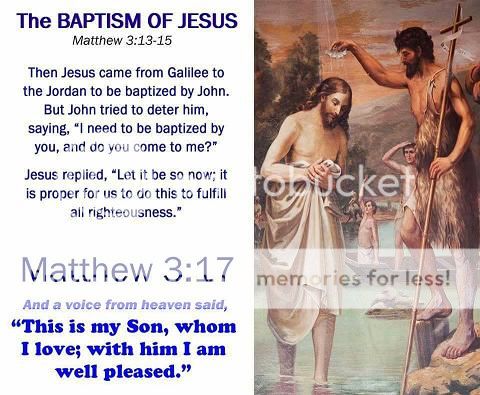
This is what John the Baptist proclaimed: "One mightier than I is coming after me. I am not worthy to stoop and loosen the thongs of his sandals. I have baptized you with water; he will baptize you with the Holy Spirit."
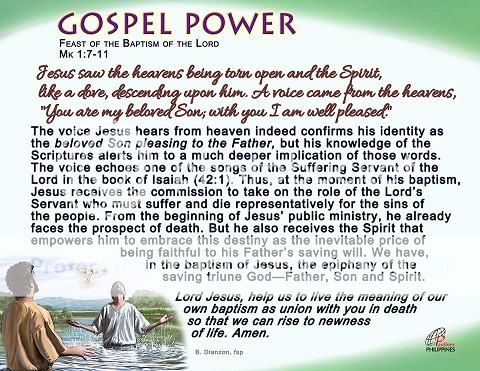
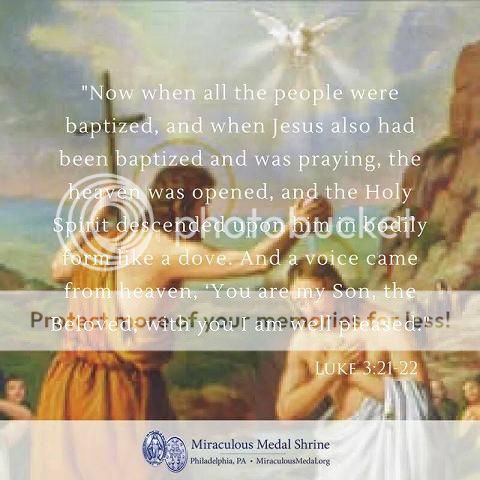
It happened in those days that Jesus came from Nazareth of Galilee and was baptized in the Jordan by John. On coming up out of the water he saw the heavens being torn open and the Spirit, like a dove, descending upon him. And a voice came from the heavens, "You are my beloved Son; with you I am well pleased."
REFLECTIONS: WORD Today
Coming out of Christmas Season, we now go into Ordinary Time in the Church calendar, the period reserved for our quiet growth and maturing. The Church invites us to meditate on the lessons and insights we gained last Christmas, and weave them into the fabric of our daily life.
Ordinary Time starts with the Baptism of the Lord. Now aged 30, Jesus is baptized - not to be washed of sin (He had none) but to put on ours, and show us how to cast them off.
This reminds us of our own baptism. John the Baptist says, "I have baptized you with water; but He will baptize you with the Holy Spirit." (Gospel)
At our one-time baptism with water, we were cleansed of the stain of Adam & Eve's original sin. We were washed clean and giftedwith the Holy Spirit, ready to live the fullness of life with Jesus. "I have come in order that you might have life - life in all its fullness." (John 10:10 GNT)
But we are forever weak and prone to slide back to sin. And so the Spirit of Jesus in us needs to constantly re-baptize and re-kindle our love for God. We learn from the First Reading that Jesus can do this if we consume His Body & Blood at the Holy Mass (Isaiah 55:1-2) ==AND== read His Words in the Holy Bible (vv. 10-11).
Let us do this daily. Then shall we be fully equipped and energized all day to commune with His life, His work, His peace and His happiness.


 Dec 27 2017, 11:18 AM


 Quote
Quote







 0.0330sec
 0.41
0.41
 6 queries
 GZIP Disabled