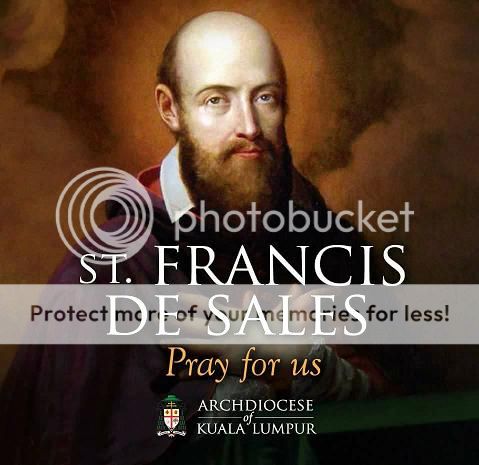
Memorial of Saint Francis de Sales, Bishop and Doctor of the Church Lectionary: 319
Reading 1 (2 Sm 7:4-17)
That night the LORD spoke to Nathan and said: "Go, tell my servant David, 'Thus says the LORD: Should you build me a house to dwell in? I have not dwelt in a house from the day on which I led the children of Israel 319 out of Egypt to the present, but I have been going about in a tent under cloth. In all my wanderings everywhere among the children of Israel, did I ever utter a word to any one of the judges whom I charged to tend my people Israel, to ask: Why have you not built me a house of cedar?'
"Now then, speak thus to my servant David, 'The LORD of hosts has this to say: It was I who took you from the pasture and from the care of the flock to be commander of my people Israel. I have been with you wherever you went, and I have destroyed all your enemies before you. And I will make you famous like the great ones of the earth. I will fix a place for my people Israel; I will plant them so that they may dwell in their place without further disturbance. Neither shall the wicked continue to afflict them as they did of old, since the time I first appointed judges over my people Israel. I will give you rest from all your enemies. The LORD also reveals to you that he will establish a house for you. And when your time comes and you rest with your ancestors, I will raise up your heir after you, sprung from your loins, and I will make his Kingdom firm. It is he who shall build a house for my name. And I will make his royal throne firm forever. I will be a father to him, and he shall be a son to me. And if he does wrong, I will correct him with the rod of men and with human chastisements; but I will not withdraw my favor from him as I withdrew it from your predecessor Saul, whom I removed from my presence. Your house and your kingdom shall endure forever before me; your throne shall stand firm forever.'"
Nathan reported all these words and this entire vision to David.
Responsorial Psalm (PS 89:4-5, 27-28, 29-30)
R. For ever I will maintain my love for my servant.
“I have made a covenant with my chosen one; I have sworn to David my servant: I will make your dynasty stand forever and establish your throne through all ages.” R. For ever I will maintain my love for my servant.
“He shall cry to me, ‘You are my father, my God, the Rock that brings me victory!’ I myself make him firstborn, Most High over the kings of the earth.” R. For ever I will maintain my love for my servant.
“Forever I will maintain my love for him; my covenant with him stands firm. I will establish his dynasty forever, his throne as the days of the heavens.” R. For ever I will maintain my love for my servant.
Alleluia
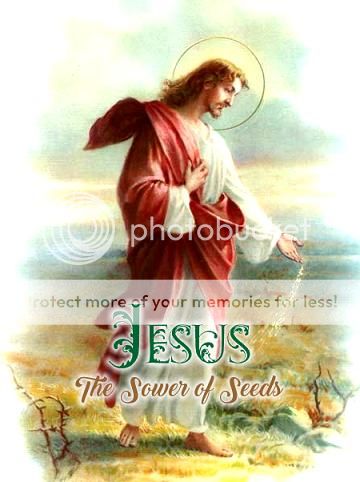
R. Alleluia, alleluia. The seed is the word of God, Christ is the sower; all who come to him will live forever. R. Alleluia, alleluia.
Gospel (Mk 4:1-20)
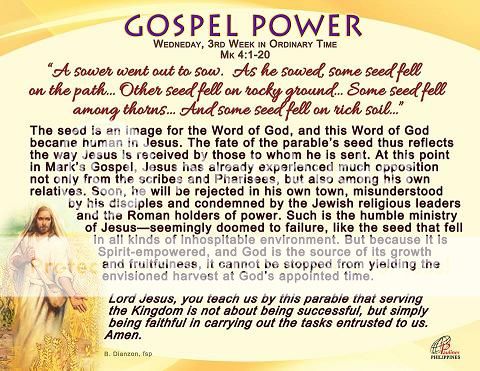
On another occasion, Jesus began to teach by the sea. A very large crowd gathered around him so that he got into a boat on the sea and sat down. And the whole crowd was beside the sea on land. And he taught them at length in parables, and in the course of his instruction he said to them, "Hear this! A sower went out to sow. And as he sowed, some seed fell on the path, and the birds came and ate it up. Other seed fell on rocky ground where it had little soil. It sprang up at once because the soil was not deep. And when the sun rose, it was scorched and it withered for lack of roots. Some seed fell among thorns, and the thorns grew up and choked it and it produced no grain. And some seed fell on rich soil and produced fruit. It came up and grew and yielded thirty, sixty, and a hundredfold." He added, "Whoever has ears to hear ought to hear."
And when he was alone, those present along with the Twelve questioned him about the parables. He answered them, "The mystery of the Kingdom of God has been granted to you. But to those outside everything comes in parables, so that they may look and see but not perceive, and hear and listen but not understand, in order that they may not be converted and be forgiven."
Jesus said to them, "Do you not understand this parable? Then how will you understand any of the parables? The sower sows the word. These are the ones on the path where the word is sown. As soon as they hear, Satan comes at once and takes away the word sown in them. And these are the ones sown on rocky ground who, when they hear the word, receive it at once with joy. But they have no roots; they last only for a time. Then when tribulation or persecution comes because of the word, they quickly fall away. Those sown among thorns are another sort. They are the people who hear the word, but worldly anxiety, the lure of riches, and the craving for other things intrude and choke the word, and it bears no fruit. But those sown on rich soil are the ones who hear the word and accept it and bear fruit thirty and sixty and a hundredfold."
REFLECTIONS: WORD Today
The grateful King David wanted to make a House (Temple) of God. But God said no. He instead would build the House (family line) of David. From it will emerge Christ the King who will build God's Temple in the hearts of His people - a Kingdom that will last forever.
Sometimes we are tempted to build God's Temple in such a way that that we get to share the limelight. With such impure intentions, our work is doomed to fail. Each of us is a building block in the Living Temple, the Body of Christ. We must follow the building plan of Jesus the Master Carpenter, allowing His Wisdom to put and use us where He sees fit.
We need to understand His guidelines in the Bible, and to discern what He wants us to do in the seeds of inspiration He sows in our thoughts and in our hearts as we go through the day. We then act and offer our work for His glory. Only then shall we bear truly lasting fruits that build up and strengthen our family, neighborhood and His Temple.
Ireneus disciple of Polycarp who was a disciple of John the apostle.
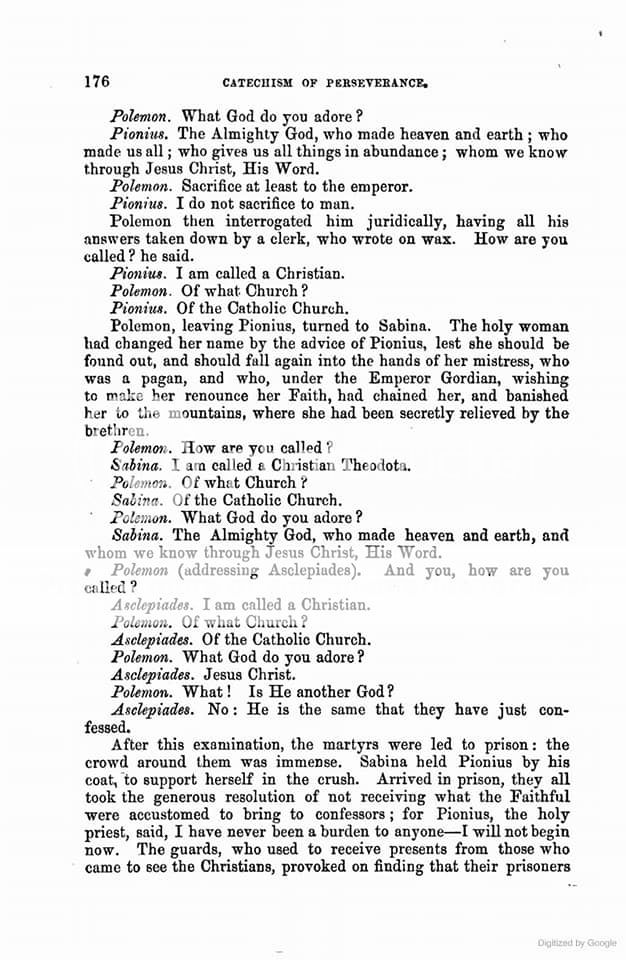
For when the Greeks, having arrested the slaves of Christian catechumens, then used force against them, in order to learn from them some secret thing [practised] among Christians, these slaves, having nothing to say that would meet the wishes of their tormentors, except that they had heard from their masters that the divine communion was the body and blood of Christ, and imagining that it was actually flesh and blood, gave their inquisitors answer to that effect.
Then these latter, assuming such to be the case with regard to the practices of Christians, gave information regarding it to other Greeks, and sought to compel the martyrs Sanctus and Blandina to confess, under the influence of torture, [that the allegation was correct]. To these men Blandina replied very admirably in these words: How should those persons endure such [accusations], who, for the sake of the practice [of piety], did not avail themselves even of the flesh that was permitted [them to eat]?
PERSECUTION OF SAINT CRISPINA
In 304 A.D., the persecution of Emperor Diocletian was well under way. The Romans were burning the books of scripture and trying to prevent Christians from celebrating the Holy Mass. As in the persecution under Emperor Decius the Romans were trying to force Christians to sacrifice to the Roman gods. Many under torture or the threat of torture succumbed but many others did not.
Crispina who was a wealthy woman and mother, was an example of the deep faith of the early church. In the trial of Crispina the Proconsul Anullinus sat as magistrate in the city of Theveste in Africa on December 5, 304 A.D. The trial went as follows.
The clerk announced to Anullinus: "Crispina, a lady of Tagorra, is to be tried at your good pleasure. She has spurned the laws of our lords the emperors."
Proconsul. "Bring her in," When she stood before him, he first made sure that she understood the decree demanding sacrifice.
Crispina. "I have never sacrificed, and I shall not do so, save to the one true God and to our Lord, Jesus Christ, His son, who was born and died.”
Anullinus. “You are a stubborn and insolent woman, and you will soon begin to feel the force of our laws against your will.”
Crispina. “Whatever happens. I shall be glad to suffer on behalf of the faith which I hold firm."
Anullinus. "I will have you beheaded All Africa has offered sacrifice, as you are well aware.
Crispina. May they never find it easy, to make me offer sacrifice to demons; but I sacrifice to the Lord who has made heaven, the earth, the sea, and all things that are in them".
Anullinus. "You utter blasphemy in not honoring what is conducive to your safety.” To bring pressure, therefore, he ordered his aides:
Anullinus. "Let her be completely disfigured by having her hair cut and her head shaved with a razor till she is bald, that her beauty might thus be brought to shame."
Apparently this was done, but Crispina's attitude remained unchanged. So the pro-consul repeated his threat: Anullinus. "If you despise the worship of our venerable gods, I shall order your head cut off."
Crispina. "I should thank God, if I obtained this. I should be very happy to lose my head for the sake of my God. For I refuse sacrifice to these ridiculous deaf and dumb statues."
Anullinus. "So you absolutely persist in this foolish frame of mind'?" Crispina. "My God who is and who abides forever ordered me to be born; it was He who gave me salvation through the saving waters of baptism. He is at my side, helping me, strengthening His hand-maid in all things so that I will not commit sacrilege."
Anullinus. "Why should we suffer this impious Christian woman any further?" He commanded that the court record be read back to him. Then he wrote his sentence on a tablet and read it aloud:
Anullinus. "Seeing that Crispina has persisted in infamous superstition and refuses to offer sacrifice to our gods in accordance with the heavenly decrees of Augustan law, I have ordered her to be executed with the sword."
Crispina. "I bless God who has designed to free me from your hands. Thanks be to God! " In the documents of this discourse a Christian hand added to the minutes of the trial:
"And making the sign of the cross on her forehead and putting out her neck, she was beheaded for the name of the Lord Jesus Christ, to whom is honor for ever. Amen."
Monday of the Fourth Week in Ordinary Time Lectionary: 323
Reading 1 (2 Sm 15:13-14, 30; 16:5-13)
An informant came to David with the report, "The children of Israel have transferred their loyalty to Absalom." At this, David said to all his servants who were with him in Jerusalem: "Up! Let us take flight, or none of us will escape from Absalom. Leave quickly, lest he hurry and overtake us, then visit disaster upon us and put the city to the sword."
As David went up the Mount of Olives, he wept without ceasing. His head was covered, and he was walking barefoot. All those who were with him also had their heads covered and were weeping as they went.
As David was approaching Bahurim, a man named Shimei, the son of Gera of the same clan as Saul's family, was coming out of the place, cursing as he came. He threw stones at David and at all the king's officers, even though all the soldiers, including the royal guard, were on David's right and on his left. Shimei was saying as he cursed: "Away, away, you murderous and wicked man! The LORD has requited you for all the bloodshed in the family of Saul, in whose stead you became king, and the LORD has given over the kingdom to your son Absalom. And now you suffer ruin because you are a murderer." Abishai, son of Zeruiah, said to the king: "Why should this dead dog curse my lord the king? Let me go over, please, and lop off his head." But the king replied: "What business is it of mine or of yours, sons of Zeruiah, that he curses? Suppose the LORD has told him to curse David; who then will dare to say, 'Why are you doing this?'" Then the king said to Abishai and to all his servants: "If my own son, who came forth from my loins, is seeking my life, how much more might this Benjaminite do so? Let him alone and let him curse, for the LORD has told him to. Perhaps the LORD will look upon my affliction and make it up to me with benefits for the curses he is uttering this day." David and his men continued on the road, while Shimei kept abreast of them on the hillside, all the while cursing and throwing stones and dirt as he went.
Responsorial Psalm (PS 3:2-3, 4-5, 6-7)
R. Lord, rise up and save me.
O LORD, how many are my adversaries! Many rise up against me! Many are saying of me, "There is no salvation for him in God." R. Lord, rise up and save me.
But you, O LORD, are my shield; my glory, you lift up my head! When I call out to the LORD, he answers me from his holy mountain. R. Lord, rise up and save me.
When I lie down in sleep, I wake again, for the LORD sustains me. I fear not the myriads of people arrayed against me on every side. R. Lord, rise up and save me.
Alleluia (Lk 7:16)
R. Alleluia, alleluia. A great prophet has arisen in our midst and God has visited his people. R. Alleluia, alleluia.
Gospel (Mk 5:1-20)
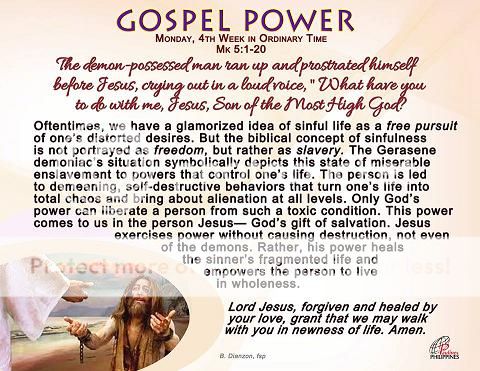
Jesus and his disciples came to the other side of the sea, to the territory of the Gerasenes. When he got out of the boat, at once a man from the tombs who had an unclean spirit met him. The man had been dwelling among the tombs, and no one could restrain him any longer, even with a chain. In fact, he had frequently been bound with shackles and chains, but the chains had been pulled apart by him and the shackles smashed, and no one was strong enough to subdue him. Night and day among the tombs and on the hillsides he was always crying out and bruising himself with stones. Catching sight of Jesus from a distance, he ran up and prostrated himself before him, crying out in a loud voice, "What have you to do with me, Jesus, Son of the Most High God? I adjure you by God, do not torment me!" (He had been saying to him, "Unclean spirit, come out of the man!") He asked him, "What is your name?" He replied, "Legion is my name. There are many of us." And he pleaded earnestly with him not to drive them away from that territory.
Now a large herd of swine was feeding there on the hillside. And they pleaded with him, "Send us into the swine. Let us enter them." And he let them, and the unclean spirits came out and entered the swine. The herd of about two thousand rushed down a steep bank into the sea, where they were drowned. The swineherds ran away and reported the incident in the town and throughout the countryside. And people came out to see what had happened. As they approached Jesus, they caught sight of the man who had been possessed by Legion, sitting there clothed and in his right mind. And they were seized with fear. Those who witnessed the incident explained to them what had happened to the possessed man and to the swine. Then they began to beg him to leave their district. As he was getting into the boat, the man who had been possessed pleaded to remain with him. But Jesus would not permit him but told him instead, "Go home to your family and announce to them all that the Lord in his pity has done for you." Then the man went off and began to proclaim in the Decapolis what Jesus had done for him; and all were amazed.
REFLECTIONS: WORD Today
In the First Reading, King David is suffering the consequence of his adultery, deceit and murder. His own son leads his people in rebellion against him. He flees Jerusalem, cursed, insulted and stoned.
David is like the man in the Gospel who is possessed by an army of demons. The man has to stay outside of the city, living in a cemetery, rejected by family and friends, stoning himself and always crying out. Sin does this to us.
King David however does not strike back at his tormentors even though he still had power to do so. He realizes that God is using them to bring him to repentance. He cries out, "Lord, rise up and save me!" (Resp. Psalm)
He humbly accepts his penance, hoping that God will have pity on him and bless him again. God did later restore him to the throne.
Likewise, the man in the Gospel runs to Jesus and falls flat before Him in total surrender. Jesus has mercy on him and drives out the demons from him. Jesus restores the man to sanity and peace, then sends him back home to his family and friends.
Are you suffering? Examine your conscience carefully and honestly. Run to Jesus in Confession, and He will restore your dignity as a child of God, fit to return to your place in the family table of Communion.
Tuesday of the Fourth Week in Ordinary Time Lectionary: 324
Reading 1 (2 Sm18:9-10, 14b, 24-25a, 30–19:3)
Absalom unexpectedly came up against David's servants. He was mounted on a mule, and, as the mule passed under the branches of a large terebinth, his hair caught fast in the tree. He hung between heaven and earth while the mule he had been riding ran off. Someone saw this and reported to Joab that he had seen Absalom hanging from a terebinth. And taking three pikes in hand, he thrust for the heart of Absalom, still hanging from the tree alive.
Now David was sitting between the two gates, and a lookout went up to the roof of the gate above the city wall, where he looked about and saw a man running all alone. The lookout shouted to inform the king, who said, "If he is alone, he has good news to report." The king said, "Step aside and remain in attendance here." So he stepped aside and remained there. When the Cushite messenger came in, he said, "Let my lord the king receive the good news that this day the LORD has taken your part, freeing you from the grasp of all who rebelled against you." But the king asked the Cushite, "Is young Absalom safe?" The Cushite replied, "May the enemies of my lord the king and all who rebel against you with evil intent be as that young man!"
The king was shaken, and went up to the room over the city gate to weep. He said as he wept, "My son Absalom! My son, my son Absalom! If only I had died instead of you, Absalom, my son, my son!"
Joab was told that the king was weeping and mourning for Absalom; and that day's victory was turned into mourning for the whole army when they heard that the king was grieving for his son.
Responsorial Psalm (PS 86:1-2, 3-4, 5-6)
R. Listen, Lord, and answer me.
Incline your ear, O LORD; answer me, for I am afflicted and poor. Keep my life, for I am devoted to you; save your servant who trusts in you. You are my God. R. Listen, Lord, and answer me.
Have mercy on me, O Lord, for to you I call all the day. Gladden the soul of your servant, for to you, O Lord, I lift up my soul. R. Listen, Lord, and answer me.
For you, O Lord, are good and forgiving, abounding in kindness to all who call upon you. Hearken, O LORD, to my prayer and attend to the sound of my pleading. R. Listen, Lord, and answer me.
Alleluia (MT 8:17)
R. Alleluia, alleluia. Christ took away our infirmities and bore our diseases. R. Alleluia, alleluia.
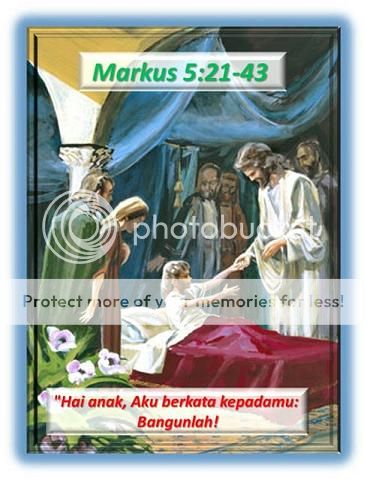
Gospel (Mk 5:21-43)
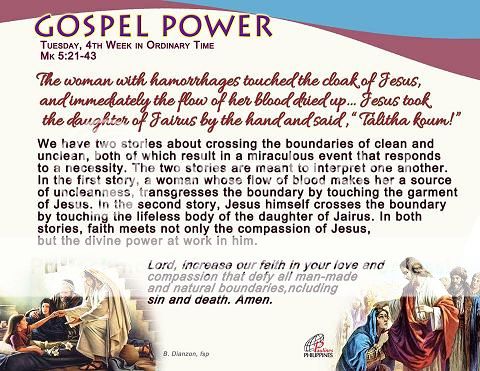
When Jesus had crossed again in the boat to the other side, a large crowd gathered around him, and he stayed close to the sea. One of the synagogue officials, named Jairus, came forward. Seeing him he fell at his feet and pleaded earnestly with him, saying, "My daughter is at the point of death. Please, come lay your hands on her that she may get well and live." He went off with him and a large crowd followed him.
There was a woman afflicted with hemorrhages for twelve years. She had suffered greatly at the hands of many doctors and had spent all that she had. Yet she was not helped but only grew worse. She had heard about Jesus and came up behind him in the crowd and touched his cloak. She said, "If I but touch his clothes, I shall be cured." Immediately her flow of blood dried up. She felt in her body that she was healed of her affliction. Jesus, aware at once that power had gone out from him, turned around in the crowd and asked, "Who has touched my clothes?" But his disciples said to him, "You see how the crowd is pressing upon you, and yet you ask, Who touched me?" And he looked around to see who had done it. The woman, realizing what had happened to her, approached in fear and trembling. She fell down before Jesus and told him the whole truth. He said to her, "Daughter, your faith has saved you. Go in peace and be cured of your affliction."
While he was still speaking, people from the synagogue official's house arrived and said, "Your daughter has died; why trouble the teacher any longer?" Disregarding the message that was reported, Jesus said to the synagogue official, "Do not be afraid; just have faith." He did not allow anyone to accompany him inside except Peter, James, and John, the brother of James. When they arrived at the house of the synagogue official, he caught sight of a commotion, people weeping and wailing loudly. So he went in and said to them, "Why this commotion and weeping? The child is not dead but asleep." And they ridiculed him. Then he put them all out. He took along the child's father and mother and those who were with him and entered the room where the child was. He took the child by the hand and said to her, "Talitha koum," which means, "Little girl, I say to you, arise!" The girl, a child of twelve, arose immediately and walked around. At that they were utterly astounded. He gave strict orders that no one should know this and said that she should be given something to eat.
REFLECTIONS: WORD Today
In the First Reading, Absalom, son of King David is killed. He was leading a rebellion to seize power from his father. When told of the good news, David cries bitterly at the loss of his wicked son instead of rejoicing in victory.
Here we see why God calls David "a man after my own heart." (Acts 13:22) David mirrored the love of our Heavenly Father for us His sons and daughters, mourning and yearning for us even when we rebel against Him, behaving like wicked gods seizing His power.
So great is our Father's love for us that He sent Jesus to GIVE us His power without cost. In the Gospel, power goes out from Jesus to heal a sick woman and to give life to a dead girl.
And on the cross, His life-power goes out from Him to all humanity, of all generations in all nations, to you and to me. It is the power to love. Are you using the power Jesus gave to love, heal and give life?
Thursday of the Fourth Week in Ordinary Time Lectionary: 326
Reading 1 (1 Kgs 2:1-4, 10-12)
When the time of David's death drew near, he gave these instructions to his son Solomon: "I am going the way of all flesh. Take courage and be a man. Keep the mandate of the LORD, your God, following his ways and observing his statutes, commands, ordinances, and decrees as they are written in the law of Moses, that you may succeed in whatever you do, wherever you turn, and the LORD may fulfill the promise he made on my behalf when he said, 'If your sons so conduct themselves that they remain faithful to me with their whole heart and with their whole soul, you shall always have someone of your line on the throne of Israel.'"
David rested with his ancestors and was buried in the City of David. The length of David's reign over Israel was forty years: he reigned seven years in Hebron and thirty-three years in Jerusalem.
Solomon was seated on the throne of his father David, with his sovereignty firmly established.
"Blessed may you be, O LORD, God of Israel our father, from eternity to eternity." R. Lord, you are exalted over all.
"Yours, O LORD, are grandeur and power, majesty, splendor, and glory." R. Lord, you are exalted over all.
"LORD, you are exalted over all. Yours, O LORD, is the sovereignty; you are exalted as head over all. Riches and honor are from you." R. Lord, you are exalted over all.
"In your hand are power and might; it is yours to give grandeur and strength to all." R. Lord, you are exalted over all.
Alleluia (Mk 1:15)
R. Alleluia, alleluia. The Kingdom of God is at hand; repent and believe in the Gospel. R. Alleluia, alleluia.
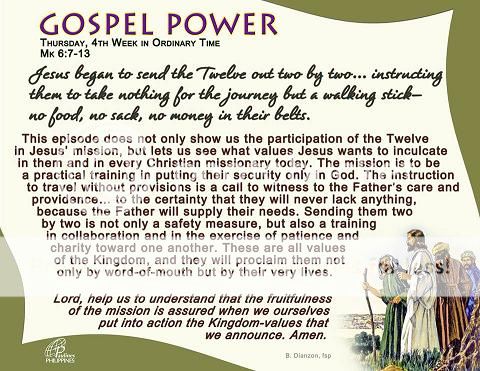
Gospel (Mk 6:7-13)
Jesus summoned the Twelve and began to send them out two by two and gave them authority over unclean spirits. He instructed them to take nothing for the journey but a walking stick –no food, no sack, no money in their belts. They were, however, to wear sandals but not a second tunic. He said to them, "Wherever you enter a house, stay there until you leave from there. Whatever place does not welcome you or listen to you, leave there and shake the dust off your feet in testimony against them." So they went off and preached repentance. The Twelve drove out many demons, and they anointed with oil many who were sick and cured them.
REFLECTIONS: WORD Today
On his deathbed (First Reading), King David passed on his authority to his son Solomon. What authority was this? Be a man; be faithful to God and lead His people.
David himself was not perfect in this, but reviewing his life in the Bible, we see that he really tried his best.
A thousand years later (today's Gospel), Jesus, "Son of David" and King of kings also passed on His authority to His followers. What authority? Be a man; trust God and do His work.
Reviewing our life, we can see we are far from perfect. But it's never too late to start anew and try our best. First to be faithful to our Lord, then to lead our children in trusting Jesus and carrying on His work.
May God bless us and help us bring up responsible, fruitful and happy citizens of our nation and of the Kingdom of God.
Feast of the Presentation of the Lord Lectionary: 524
Reading 1 (Mal 3:1-4)
Thus says the Lord God: Lo, I am sending my messenger to prepare the way before me; And suddenly there will come to the temple the LORD whom you seek, And the messenger of the covenant whom you desire. Yes, he is coming, says the LORD of hosts. But who will endure the day of his coming? And who can stand when he appears? For he is like the refiner's fire, or like the fuller's lye. He will sit refining and purifying silver, and he will purify the sons of Levi, Refining them like gold or like silver that they may offer due sacrifice to the LORD. Then the sacrifice of Judah and Jerusalem will please the LORD, as in the days of old, as in years gone by.
OR
Reading 1 (Heb 2:14-18)
Since the children share in blood and flesh, Jesus likewise shared in them, that through death he might destroy the one who has the power of death, that is, the Devil, and free those who through fear of death had been subject to slavery all their life. Surely he did not help angels but rather the descendants of Abraham; therefore, he had to become like his brothers and sisters in every way, that he might be a merciful and faithful high priest before God to expiate the sins of the people. Because he himself was tested through what he suffered, he is able to help those who are being tested.
Responsorial Psalm (PS 24:7, 8, 9, 10)
R. Who is this king of glory? It is the Lord!
Lift up, O gates, your lintels; reach up, you ancient portals, that the king of glory may come in! R. Who is this king of glory? It is the Lord!
Who is this king of glory? The LORD, strong and mighty, the LORD, mighty in battle. R. Who is this king of glory? It is the Lord!
Lift up, O gates, your lintels; reach up, you ancient portals, that the king of glory may come in! R. Who is this king of glory? It is the Lord!
Who is this king of glory? The LORD of hosts; he is the king of glory. R. Who is this king of glory? It is the Lord!
Alleluia (LK 2:32)
R. Alleluia, alleluia. A light of revelation to the Gentiles, and glory for your people Israel. R. Alleluia, alleluia.
Gospel (LK 2:22-40)
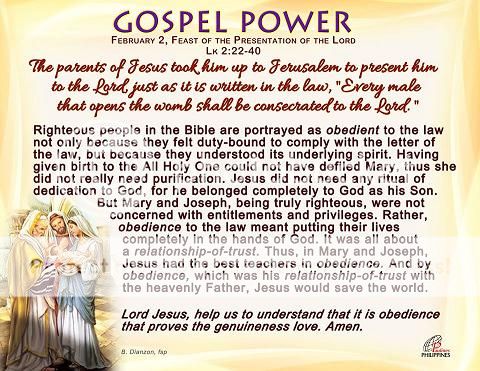
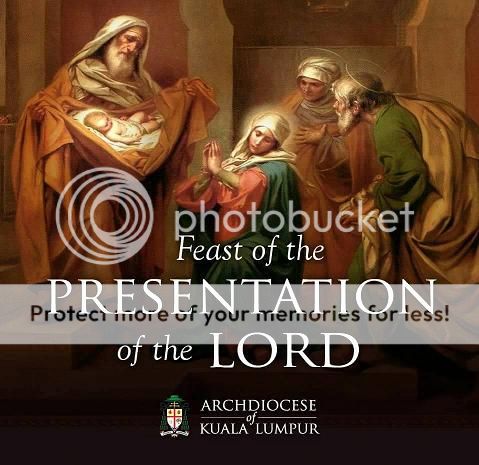
When the days were completed for their purification according to the law of Moses, Mary and Joseph took Jesus up to Jerusalem to present him to the Lord, just as it is written in the law of the Lord, Every male that opens the womb shall be consecrated to the Lord, and to offer the sacrifice of a pair of turtledoves or two young pigeons, in accordance with the dictate in the law of the Lord.
Now there was a man in Jerusalem whose name was Simeon. This man was righteous and devout, awaiting the consolation of Israel, and the Holy Spirit was upon him. It had been revealed to him by the Holy Spirit that he should not see death before he had seen the Christ of the Lord. He came in the Spirit into the temple; and when the parents brought in the child Jesus to perform the custom of the law in regard to him, he took him into his arms and blessed God, saying:
“Now, Master, you may let your servant go in peace, according to your word, for my eyes have seen your salvation, which you prepared in the sight of all the peoples: a light for revelation to the Gentiles, and glory for your people Israel.”
The child’s father and mother were amazed at what was said about him; and Simeon blessed them and said to Mary his mother, “Behold, this child is destined for the fall and rise of many in Israel, and to be a sign that will be contradicted Band you yourself a sword will pierceB so that the thoughts of many hearts may be revealed.” There was also a prophetess, Anna, the daughter of Phanuel, of the tribe of Asher. She was advanced in years, having lived seven years with her husband after her marriage, and then as a widow until she was eighty-four. She never left the temple, but worshiped night and day with fasting and prayer. And coming forward at that very time, she gave thanks to God and spoke about the child to all who were awaiting the redemption of Jerusalem.
When they had fulfilled all the prescriptions of the law of the Lord, they returned to Galilee, to their own town of Nazareth. The child grew and became strong, filled with wisdom; and the favor of God was upon him.
REFLECTIONS: WORD Today
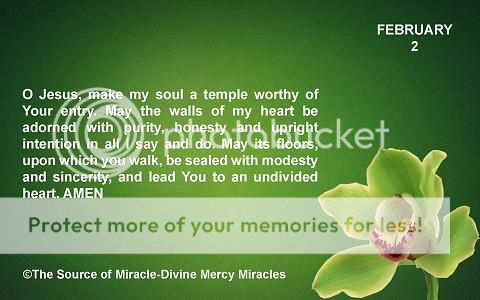
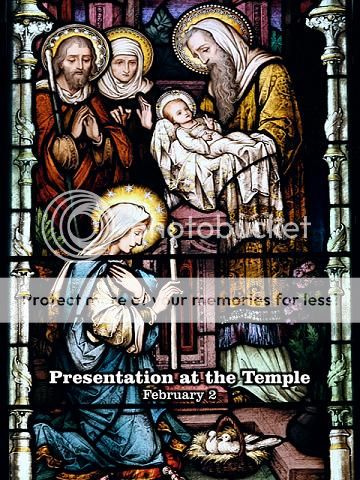
Today we celebrate the Feast of Presentation of the Lord at the Temple. This Feast is also popularly known as "Candelaria." It celebrates Christ as the Light who came to reveal the fullness of God to all nations (Luke 2:32).
The Light of Jesus is the divine fire that purifies the hearts and minds of men (Malachi 3:2). Those who approach the radiance of Christ are able to see their errors and thus can ask to be cleansed and purified. But those who stay in the dark fool themselves that they have no sin.
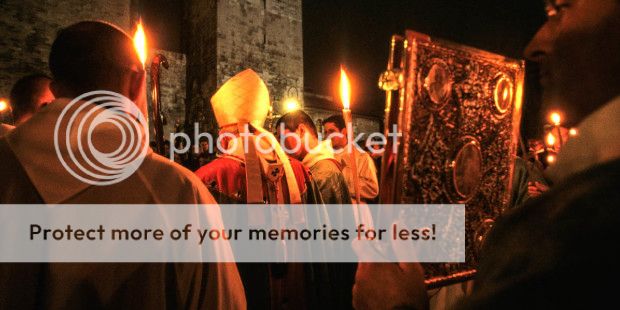
Today candles are blessed and lit up at the Mass as a sign of our welcoming the Light into our lives, declaring that we will trust & follow Jesus through any and all dark difficulties, fearing not even death (Hebrews 2:15).
Let us present ourselves at the temple-church with our candles. "Our bright shining candles are a sign of divine splendor of theone who comes to expel the dark shadows of evil and to make the whole universe radiant with the brilliance of his eternal light. Our candles also show how bright our souls should be when we go to meet Christ." (Sermon of St. Sophronius, Patriarch of Jerusalem, 638 AD)
Let us ask Jesus to ignite our hearts with passion for prayer and service that enrich and bring joy to ourselves, our family and our community.
What you need to know about the beautiful feast of Candlemas
Though not widely celebrated, it preserves a rich tradition of the Church.
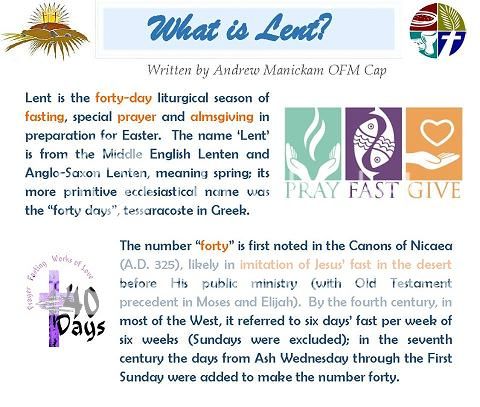
If you count 40 days after the celebration of Christmas you reach February 2. Early on, the Church marked that day with a special feast and it is the final “baby Jesus” day in the liturgical calendar before the celebration of Lent.
The feast has many different names in the Roman Catholic Church. It has been called the Feast of the Presentation of the Lord, theFeast of the Purification of the Blessed Virgin Mary and, more familiarly, Candlemas. Each name highlights a different aspect of the feast that the Church celebrates.
First of all, it is called the Feast of the Purification of the Blessed Virgin Mary on account of an ancient Mosaic law explained in Leviticus.
[If a woman conceives, and bears a child she shall be unclean] And when the days of her purifying are completed, whether for a son or for a daughter, she shall bring to the priest at the door of the tent of meeting a lamb a year old for a burnt offering, and a young pigeon or a turtledove for a sin offering, and he shall offer it before the Lord, and make atonement for her; then she shall be clean. (Leviticus 12:6-7)
Mary, being a faithful Jew, abided by the law and did what was required of her. After 40 days passed she approached the priest with the proper offering to be declared “clean.”
The liturgical celebration is also called the Feast of the Presentation of the Lord, and again corresponds to an ancient Jewish practice of presenting the first-born to God.
Everything that opens the womb of all flesh, whether man or beast, which they offer to the Lord, shall be yours; nevertheless the first-born of man you shall redeem. (Numbers 18:15)
As a result, Mary and Joseph brought with them Jesus, as St. Luke narrates, “And when the time came for their purification according to the law of Moses, they brought [Jesus] up to Jerusalem to present him to the Lord (as it is written in the law of the Lord, ‘Every male that opens the womb shall be called holy to the Lord’)” (Luke 2:22-23).
St. Luke narrates how, while at the Temple, the Holy Family encountered an old man named Simeon and what he said next constitutes the basis for why the feast is called Candlemas.
Now, Master, you may let your servant go in peace, according to your word, for my eyes have seen your salvation, which you prepared in sight of all the peoples, a light for revelation to the Gentiles, and glory for your people Israel. (Luke 2:29-32)
Simeon declared that Jesus would be a “light,” and the Church developed a custom of lighting and blessing candles on this day. Historically the priest would bless all the candles used during Mass for the entire year. The congregation also received candles and the words of Simeon were repeated in song. The current Roman Missal has the following prayer that summarizes the symbolism.
O God, source and origin of all light, who on this day showed to the just man Simeon the light for revelation to the Gentiles, we humbly ask that, in answer to your people’s prayers, you may be pleased to sanctify with your blessing these candles, which we are eager to carry in praise of your name, so that, treading the path of virtue, we may reach that light which never fails.
Though not a holy day of obligation, it is a beautiful day in the Church’s calendar, one that signals the end of the “Christmas-Cycle” and looks forward to the light that will shatter all darkness at the Easter Vigil — when another candlelight service is performed in recognition that, “the people who sit in darkness have seen a great light, on those dwelling in a land overshadowed by death light has arisen” (Matthew 4:16).
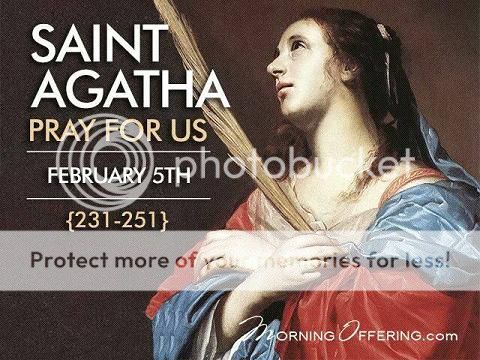
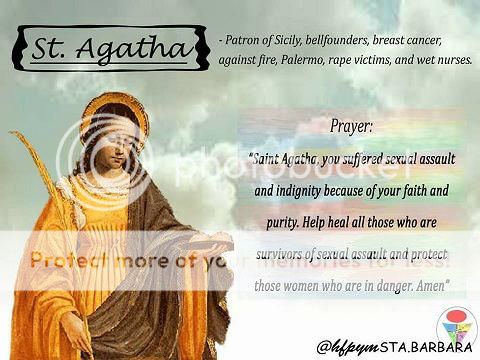
Memorial of Saint Agatha, Virgin and Martyr Lectionary: 329
Reading 1 (1 Kgs 8:1-7, 9-13)
The elders of Israel and all the leaders of the tribes, the princes in the ancestral houses of the children of Israel, came to King Solomon in Jerusalem, to bring up the ark of the LORD's covenant from the City of David, which is Zion. All the people of Israel assembled before King Solomon during the festival in the month of Ethanim (the seventh month). When all the elders of Israel had arrived, the priests took up the ark; they carried the ark of the LORD and the meeting tent with all the sacred vessels that were in the tent. (The priests and Levites carried them.)
King Solomon and the entire community of Israel present for the occasion sacrificed before the ark sheep and oxen too many to number or count. The priests brought the ark of the covenant of the LORD to its place beneath the wings of the cherubim in the sanctuary, the holy of holies of the temple. The cherubim had their wings spread out over the place of the ark, sheltering the ark and its poles from above. There was nothing in the ark but the two stone tablets which Moses had put there at Horeb, when the LORD made a covenant with the children of Israel at their departure from the land of Egypt.
When the priests left the holy place, the cloud filled the temple of the LORD so that the priests could no longer minister because of the cloud, since the LORD's glory had filled the temple of the LORD. Then Solomon said, "The LORD intends to dwell in the dark cloud; I have truly built you a princely house, a dwelling where you may abide forever."
Responsorial Psalm (PS 132:6-7, 8-10)
R. Lord, go up to the place of your rest!
Behold, we heard of it in Ephrathah; we found it in the fields of Jaar. Let us enter into his dwelling, let us worship at his footstool. R. Lord, go up to the place of your rest!
Advance, O LORD, to your resting place, you and the ark of your majesty. May your priests be clothed with justice; let your faithful ones shout merrily for joy. For the sake of David your servant, reject not the plea of your anointed. R. Lord, go up to the place of your rest!
Alleluia (See Mt 4:23)
R. Alleluia, alleluia. Jesus preached the Gospel of the Kingdom and cured every disease among the people. R. Alleluia, alleluia.
Gospel (MK 6:53-56)
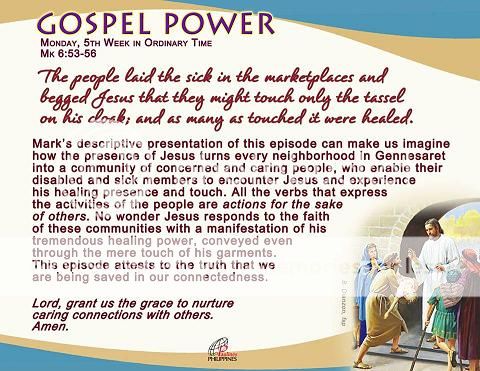
After making the crossing to the other side of the sea, Jesus and his disciples came to land at Gennesaret and tied up there. As they were leaving the boat, people immediately recognized him. They scurried about the surrounding country and began to bring in the sick on mats to wherever they heard he was. Whatever villages or towns or countryside he entered, they laid the sick in the marketplaces and begged him that they might touch only the tassel on his cloak; and as many as touched it were healed.
REFLECTIONS: WORD Today
In Old Testament times, the infinite and invisible God chose to limit Himself and enable man to experience Him with human senses. God chose two stone tablets (the 10 Commandments) to be His small, visible, real presence. God was contained in the Ark of the Covenant (a golden chest) and housed in the Temple built by King Solomon (First Reading).
Then in the New Testament, the infinite and invisible God chose to limit Himself into a small baby, contained in the Ark of the New Covenant (the sinless Mary). He grew up to be Jesus the Emmanuel (meaning "God with us"), the visible, touchable, real presence of God. Touching just His clothes healed the sick (Gospel).
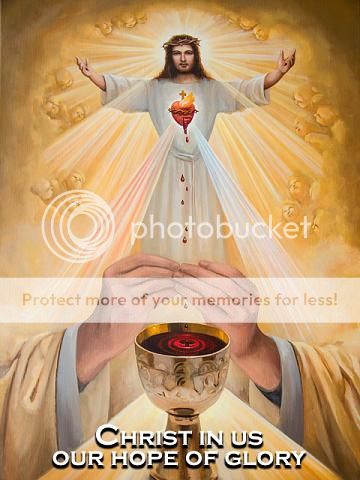
Today, the infinite and invisible God chooses to humble Himself further into the tiny Eucharist, contained in the Tabernacle, housed in the church. The Eucharist continues the visible, touchable, Real Presence of Jesus, God with us.
O Lord Jesus in the Eucharist, THANK YOU for your great love for me! Touch me, heal me, and transform me into Your real presence in the world. Amen.
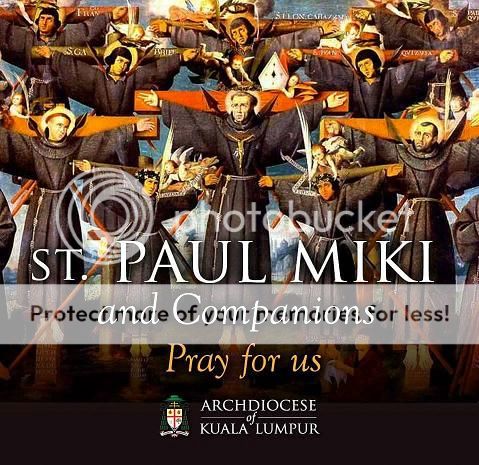
Memorial of Saint Paul Miki and Companions, Martyrs Lectionary: 330
Reading 1 (1 Kgs 8:22-23, 27-30)
Solomon stood before the altar of the LORD in the presence of the whole community of Israel, and stretching forth his hands toward heaven, he said, “LORD, God of Israel, there is no God like you in heaven above or on earth below; you keep your covenant of mercy with your servants who are faithful to you with their whole heart.
“Can it indeed be that God dwells on earth? If the heavens and the highest heavens cannot contain you, how much less this temple which I have built! Look kindly on the prayer and petition of your servant, O LORD, my God, and listen to the cry of supplication which I, your servant, utter before you this day. May your eyes watch night and day over this temple, the place where you have decreed you shall be honored; may you heed the prayer which I, your servant, offer in this place. Listen to the petitions of your servant and of your people Israel which they offer in this place. Listen from your heavenly dwelling and grant pardon.”
Responsorial psalm (PS 84:3, 4, 5 and 10, 11)
R. How lovely is your dwelling place, Lord, mighty God!
My soul yearns and pines for the courts of the LORD. My heart and my flesh cry out for the living God. R. How lovely is your dwelling place, Lord, mighty God!
Even the sparrow finds a home, and the swallow a nest in which she puts her young— Your altars, O LORD of hosts, my king and my God! R. How lovely is your dwelling place, Lord, mighty God!
Blessed they who dwell in your house! continually they praise you. O God, behold our shield, and look upon the face of your anointed. R. How lovely is your dwelling place, Lord, mighty God!
I had rather one day in your courts than a thousand elsewhere; I had rather lie at the threshold of the house of my God than dwell in the tents of the wicked. R. How lovely is your dwelling place, Lord, mighty God!
Alleluia (Ps 119:36, 29b)
R. Alleluia, alleluia. Incline my heart, O God, to your decrees; and favor me with your law. R. Alleluia, alleluia.
Gospel (Mk 7:1-13)
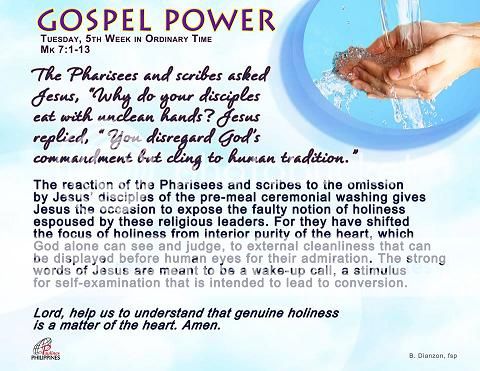
When the Pharisees with some scribes who had come from Jerusalem gathered around Jesus, they observed that some of his disciples ate their meals with unclean, that is, unwashed, hands. (For the Pharisees and, in fact, all Jews, do not eat without carefully washing their hands, keeping the tradition of the elders. And on coming from the marketplace they do not eat without purifying themselves. And there are many other things that they have traditionally observed, the purification of cups and jugs and kettles and beds.) So the Pharisees and scribes questioned him, "Why do your disciples not follow the tradition of the elders but instead eat a meal with unclean hands?" He responded, "Well did Isaiah prophesy about you hypocrites, as it is written:
This people honors me with their lips, but their hearts are far from me; In vain do they worship me, teaching as doctrines human precepts.
You disregard God's commandment but cling to human tradition." He went on to say, "How well you have set aside the commandment of God in order to uphold your tradition! For Moses said, Honor your father and your mother, and Whoever curses father or mother shall die. Yet you say, 'If someone says to father or mother, "Any support you might have had from me is qorban"' (meaning, dedicated to God), you allow him to do nothing more for his father or mother. You nullify the word of God in favor of your tradition that you have handed on. And you do many such things."
REFLECTIONS: WORD Today
In the First Reading, King Solomon reminds us of the correct concept and importance of a temple. It is not an enclosure of God who not even the whole universe can contain, but it is a special place for God's people to gather in communal prayer and strengthen the faith that binds them together.
In the Gospel, Jesus reminds us that our love for God is not expressed by mere observance of church rituals without understanding and fulfilling their original intent.
For instance, the Eucharist is not just another ritual of the Mass. It is intended to be the family meal of children who are of one heart and one mind, in agreement with their Father on how to live out their shared belief after the Mass.
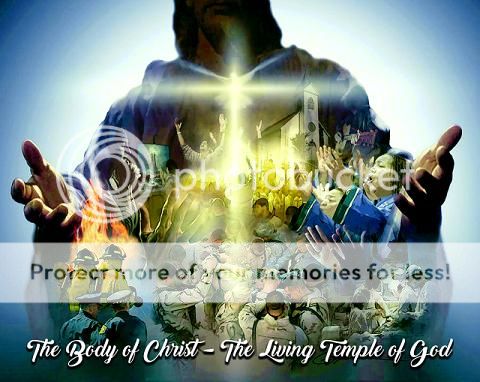
The Eucharist is Jesus working to build us into the real Temple of God - a harmonious and beautiful Body of Christ fit for God to live in.
May the weak in faith see us and say, "How beautiful is your dwelling place, Lord, mighty God." (Resp. Psalm)
51ST IEC 2016 - THE HOLY EUCHARIST BY BISHOP ROBERT BARRON


 Jan 23 2018, 01:53 PM


 Quote
Quote













 0.1026sec
 0.56
0.56
 7 queries
 GZIP Disabled