Welcome Guest ( Log In | Register )

65 Pages « < 8 9 10 11 12 > » Bottom

Outline · [ Standard ] · Linear+

 LYN Catholic Fellowship V02 (Group), For Catholics (Roman or Eastern)

views
     
khool
post Jul 28 2017, 09:17 AM

Getting Started
**
Junior Member
225 posts

Joined: Mar 2008


Friday of the Sixteenth Week in Ordinary Time
Lectionary: 399


user posted image

Reading 1 (Ex 20:1-17)

In those days:
God delivered all these commandments:

"I, the LORD, am your God,
who brought you out of the land of Egypt, that place of slavery.
You shall not have other gods besides me.
You shall not carve idols for yourselves
in the shape of anything in the sky above
or on the earth below or in the waters beneath the earth;
you shall not bow down before them or worship them.
For I, the LORD, your God, am a jealous God,
inflicting punishment for their fathers' wickedness
on the children of those who hate me,
down to the third and fourth generation;
but bestowing mercy down to the thousandth generation
on the children of those who love me and keep my commandments.

"You shall not take the name of the LORD, your God, in vain.
For the LORD will not leave unpunished
him who takes his name in vain.

"Remember to keep holy the sabbath day.
Six days you may labor and do all your work,
but the seventh day is the sabbath of the LORD, your God.
No work may be done then either by you, or your son or daughter,
or your male or female slave, or your beast,
or by the alien who lives with you.
In six days the LORD made the heavens and the earth,
the sea and all that is in them;
but on the seventh day he rested.
That is why the LORD has blessed the sabbath day and made it holy.

"Honor your father and your mother,
that you may have a long life in the land
which the LORD, your God, is giving you.

"You shall not kill.

"You shall not commit adultery.

"You shall not steal.

"You shall not bear false witness against your neighbor.

"You shall not covet your neighbor's house.
You shall not covet your neighbor's wife,
nor his male or female slave, nor his ox or ass,
nor anything else that belongs to him."

Responsorial Psalm (Ps 19:8, 9, 10, 11)

R. Lord, you have the words of everlasting life.

The law of the LORD is perfect,
refreshing the soul;
The decree of the LORD is trustworthy,
giving wisdom to the simple.
R. Lord, you have the words of everlasting life.

The precepts of the LORD are right,
rejoicing the heart;
The command of the LORD is clear,
enlightening the eye.
R. Lord, you have the words of everlasting life.

The fear of the LORD is pure,
enduring forever;
The ordinances of the LORD are true,
all of them just.
R. Lord, you have the words of everlasting life.

They are more precious than gold,
than a heap of purest gold;
Sweeter also than syrup
or honey from the comb.
R. Lord, you have the words of everlasting life.

Alleluia (Lk 8:15)

R. Alleluia, alleluia.
Blessed are they who have kept the word with a generous heart
and yield a harvest through perseverance.
R. Alleluia, alleluia.

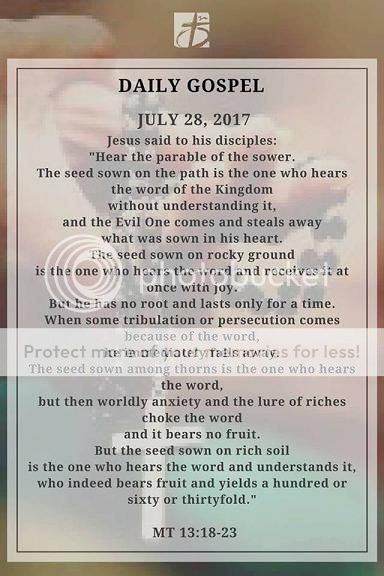
Gospel (Mt 13:18-23)

user posted image

user posted image

REFLECTION

One who hears the word and understands it. For Jesus, a true disciple is one who hears His word and understands it. This kind of follower is certainly productive. We get this idea in this passage where Jesus explains the meaning of the parable in Mt. 13:1-9.

Jesus teaches us the importance of hearing and understanding the word. This does not come automatically by just desiring, striving, and praying for it. Hidden behind the story is the idea of preparation.

We must prepare ourselves to become a rich soil. In nature there is fertile soil. Since we are human beings with all our faults, under formation, and on the road to perfection, we cannot consider ourselves yet as rich soil. We need conversion. To become His desired followers, we must remove the stones, the gravel, the thorns, and thistles that are in our hearts. Sin, wickedness, and evil prevent us from totally listening to God. They distract us from having full communion with God. We can never understand what the Kingdom of God is all about when we are swallowed by the values of the world manifested in superficial relationships and toxic lifestyle. Sin has to be exercised from our souls.

Are you productive in the eyes of God? Prepare. Learn to listen and understand.

SOURCE: “365 Days with the Lord 2017,” ST. PAULS Philippines, 7708 St. Paul Rd., SAV, Makati City (Phils.) http://www.ssp.ph

khool
post Jul 28 2017, 09:19 AM

Getting Started
**
Junior Member
225 posts

Joined: Mar 2008


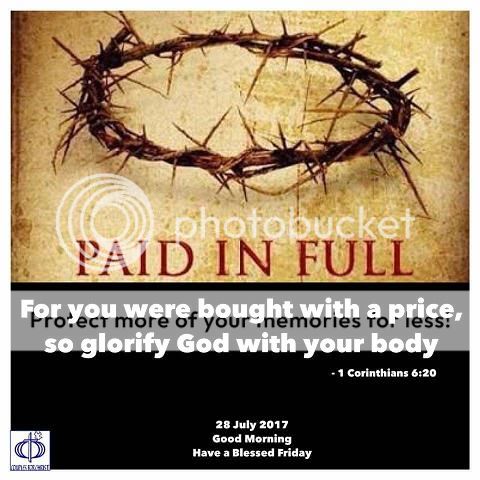
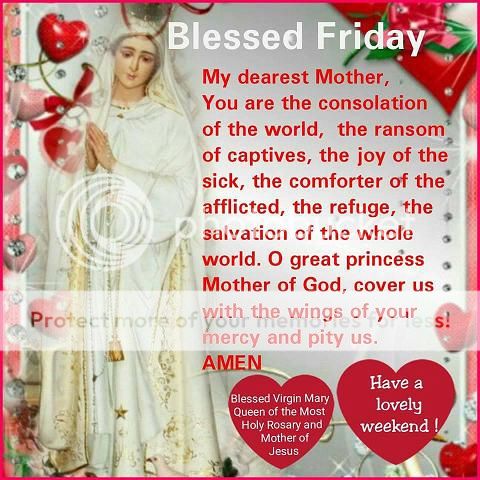
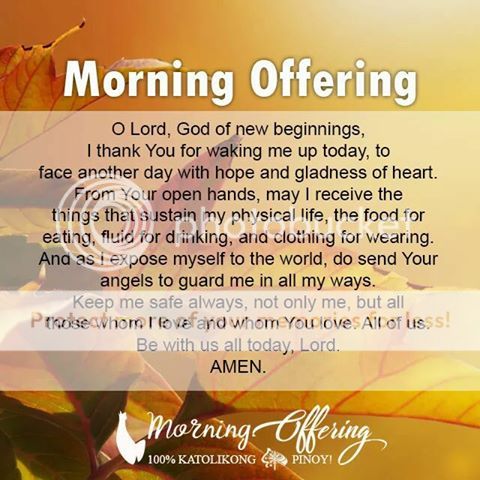
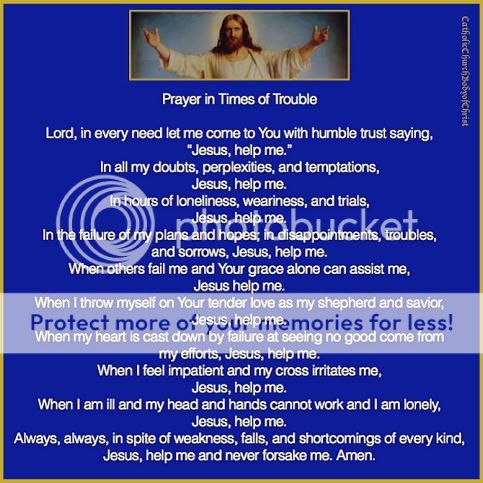
Good morning!!! God Bless!!!

user posted image

For those who are troubled! Pray!!!

user posted image

Amen! Amen!

khool
post Jul 28 2017, 09:29 AM

Getting Started
**
Junior Member
225 posts

Joined: Mar 2008


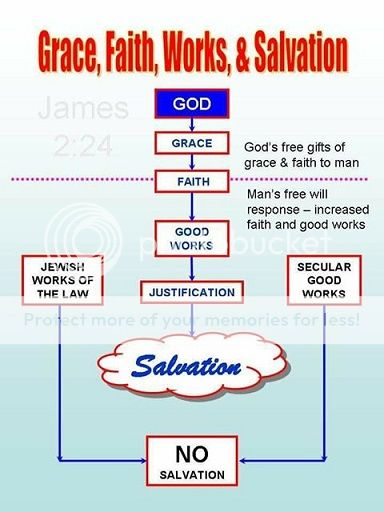
From the beginning of Christianity, baptism was regeneration, being born again. Initiation into the one church of one doctrine and one breaking of the bread, of the Chosen Nation, the Royal Priesthood. Our election.

Mal 1:11

"From the rising of the sun until it's going down my name is great among the Gentiles and everywhere a clean oblation is offered in my name."

At what point in history did baptism stop being born again? Less than 200 years?

22Purifying your souls in the obedience of charity, with a brotherly love, from a sincere heart love one another earnestly: 23Being born again not of corruptible seed, but incorruptible, by the word of God who liveth and remaineth for ever.

1 Peter 22

"Ver. 18. From your vain conversation of the tradition of your fathers. S. Peter teacheth what S. Paul repeats in many places, that it was in vain for them to hope to be saved by the ceremonies and precepts of the former law, to which their forefathers had added many unnecessary and groundless traditions. They could only hope for salvation by believing in Christ, by the price of whose precious blood they were redeemed from their sins, as they had heard by the word of the gospel preached to them. His doctrine is the same with that of S. Paul, of S. James, of S. John, and of the other apostles, that to be saved it is not enough to have faith or hope in Christ, but it must be a faith joined and working by charity, obeying the law of Christ in the spirit of charity with a sincere and brotherly love of every one, without setting our hearts upon the vanities and corruptible things of this world, remembering that all flesh is as grass, or the flowers of the field, which wither and pass away in a very short time. Thus presently vanish all riches, honours, pleasures, and all the glory of this life, but the word of God and his promises will bring us to happiness which will last for ever. Wi.

Ver. 23. Thus this new birth, common to you all, should form between you an union much more stable and solid than that formed in you by the ties of blood. V."

For we are buried together with him by baptism into death; that as Christ is risen from the dead by the glory of the Father, so we also may walk in newness of life.

Rm 6:4

26For you are all the children of God by faith, in Christ Jesus. 27For as many of you as have been baptized in Christ, have put on Christ. 28There is neither Jew nor Greek: there is neither bond nor free: there is neither male nor female. For you are all one in Christ Jesus.29And if you be Christ's, then are you the seed of Abraham, heirs according to the promise.

Gal 3:26

7And in godliness, love of brotherhood; and in love of brotherhood, charity. 8For if these things be with you and abound, they will make you to be neither empty nor unfruitful in the knowledge of our Lord Jesus Christ. 9For he that hath not these things with him, is blind, and groping, having forgotten that he was purged from his old sins.( Baptism now saves you". "Unless you are born of water and spirit..." )10Wherefore, brethren, labour the more, that (((by good works you may make sure your calling and election. )))

2 Peter 1:7

5Not by the works of justice, which we have done, ( Baptism is Grace given freely) but according to his mercy, he saved us, by the laver of regeneration, and renovation of the Holy Ghost; ( From the beginning of Christianity the laver of regeneration before the veil, " the veil, the flesh the bride, the church," was known as baptism) 6Whom he hath poured forth upon us abundantly, through Jesus Christ our Savior: 7That, being justified by his grace, we may be heirs, according to hope of life everlasting. 8It is a faithful saying: and these things I will have thee affirm constantly: that they, who believe in God, may be. ((( careful to excel in good works. )))

Titus 3:5

You are saved by grace ( Baptism the laver of regeneration now saves you) not of works ( We do not come to baptism through a precedent law. The mosaic law of rule fear and punishment on hardened hearts does not save) for we are HIS workmanship created in good works provided that you walk in them. ( Faith without works/ charity is dead. "Be careful to excell in good works." " Secure your election " Into the Royal Priesthood" in good works.

Peter says Paul's letters are hard to understand and can lead to the destruction of the unlearned and unwise.

The PRODIGALS SON is a fallen away Catholic.

Receive the Holy Spirit whose sins you forgive are forgiven whose sins you bind are bound.

user posted image

khool
post Jul 28 2017, 02:00 PM

Getting Started
**
Junior Member
225 posts

Joined: Mar 2008


Old and New
Seventeenth Sunday in Ordinary Time Year A


user posted image

For the past two Sundays we have been reading from the 13th chapter of Matthew’s Gospel, which contains several of Jesus’ parables. Today, we come to the final set of parables and the lectionary surprises us with a bonus. We get three additional parables with a fourth one thrown in at the end. This Sunday, I would like to skip the first three and turn your attention to the bonus parable, or the often forgotten eighth parable. It is often said that there are seven parables in the 13th chapter. Only a few scholars would treat this one-liner as a parable. This is the parable of the householder-scribe-like disciple. What a strange metaphor? It serves as an apt summary of all the other parables. It begins with a question posed by the Lord to His disciples, in reference to all the parables that He had just shared with them, “Have you understood all this?” When I stand here, I am tempted to end each and every one of my homilies with this same question, but on second thought, I better not, in case I only see blank faces staring back at me.

However, in response to the Lord’s question, the disciples gave a resounding ‘Yes,’ which is an overestimation of their insight since the disciples have no clue about the nature of the kingdom and the suffering it entails. For example, Peter will object to the Lord’s crucifixion and all the disciples flee upon Christ’s arrest in Gethsemane. These and many other such examples merely indicate that their comprehension was partial. It is at this point, that we are introduced to this cryptic saying cum parable, “every scribe who becomes a disciple of the kingdom of heaven is like a householder who brings out from his storeroom things both new and old.” What is unique about this parabolic saying is the combination of three different persons into a single metaphor – a scribe, a disciple, and a householder. They make strange bed-fellows.

First, let us consider the scribe. Among the Jews in the first century, a scribe was a technical position of one who had been educated formerly in the Law and Jewish tradition. We might think of him as a scholar, a serious student. He spent his life studying the Law, and stood before the people as a teacher. His primary duty was to expound and explain the Law to the common folks. A disciple of the Kingdom is entrusted with the same responsibility: to teach, to instruct, to catechise. It’s never to do so with one’s own ideas or opinions but only that which they had learnt from the Lord. At the end of Matthew’s gospel, Our Lord commissions His disciples in this manner, “Therefore go and make disciples of all nations, baptising them in the name of the Father and of the Son and of the Holy Spirit, and teaching them to obey everything I have commanded you.” This commission is directed not just at the bishops, priests, deacons and religious but given to every baptised person. Parents are often reminded that they are the primary catechists of their children and that they have been entrusted with the responsibility of handing on the faith that they have received from the Apostles.

Perhaps, the reason why many within the Church suffer from a crisis of faith is because there is a lack of adequate catechesis. And the reason why there is poor catechesis is because so many of us are poor scribes, poor teachers. And if we were to connect the dots in the chain of causation, we could easily conclude that poor students make poor teachers. The Lord used a word in His saying to describe the scribe’s training – it was the verb form of “disciple.” The scribe had to be “disciple.” He had to be mentored, he had to become an apprentice of a teacher. Before he could become a teacher, he had to be a student. It was not enough to have an armchair book knowledge of the faith. A disciple-scribe is one who must study the truth, live it and he does so by imitating the Master. The disciple’s life is to be a mixture of both learning and living. He should never cease learning if he wishes to continue teaching.

The final image that is used in this parabolic statement is that of a householder, who is charged with the care of the treasures of the household. It is here, we finally see the role of the scribe-disciple-householder. He is entrusted not just with the task of safe-guarding the treasures but also dispensing them. What would these treasures look like? We are told that he must bring “out from his storeroom things both new and old.”

In an age of modernity and post-modernity, where the past and ‘old’ things are often scorned and discarded, the saying makes an essential point about the role of disciples. We cannot be selective about the teachings of the Church, about what we wish to adopt or discard at will. But rather we all have a duty, together with the Magisterium (the Teaching authority of the Church, i.e. the Pope and the bishops) to safeguard, preserve, defend and expound both “the old and the new.” In the context of Jesus’ days, He had already assured His listeners that He had not come to abolish the Old Law but rather to fulfil it, to bring it to perfection with the New Law. His teachings are revolutionary but they are also traditional. The old covenant is not abolished, it is judiciously integrated into the new. Likewise, disciples are not to spurn the old for the sake of the new. Rather, they are to understand the new insights gleaned from Jesus’ parables in light of the old truths, and vice versa.

As for the Christian, the ultimate question is not personal preferences of style, or whether something is old or avant garde. Rather, it is whether or not it fits into the Kingdom of God, whether or not it is true. The remarkable thing about truth is that it has the quality of being both old and new at the same time. On the one hand, truth is not something that was invented yesterday. It is old because it has always existed. But if it were only old, then it cannot be truth. On the other hand, it is always new because the truth never ceases to be truth, no matter what time in history you live. It requires no updating. But if it were only new, it wouldn't be truth because truth cannot be something that has just been discovered as if centuries of human beings before us were oblivious to it. It has always been the truth. Truth is eternal. The truth of God does not change. It can never go out of fashion. This is because God is Truth Himself. In the words of St Augustine, God is “Beauty ever Ancient ever New.” As a corollary, something false cannot become true just because it has now become fashionable. As the wise G.K. Chesterton once said, “Fallacies do not cease to be fallacies because they become fashions.”

The Christian, who is a prudent scribe is neither a conservative prude, teaching what is old just because it is traditional or because he has sentimental attachments to it; nor is he a progressive revolutionary, throwing away all traditions and only teaching what is new. But the prudent scribe, the authentic Christian must teach, he must defend, and be even prepared to lay down his life for whatever the Church proposes in the deposit faith and which is found in both Sacred Scripture and Sacred Tradition, not because it is traditional or novel but because it is the revealed Truth. He does so even though this may earn him ridicule and hatred in the eyes of the world. He cannot substitute the infallible divinely revealed Truths with his own fallible opinions. As the Catechism appropriately reminds us, “What moves us to believe is not the fact that revealed truths appear as true and intelligible in the light of our natural reason: we believe ‘because of the authority of God Himself who reveals them, who can neither deceive nor be deceived,” (CCC 156) because these truths are “guaranteed by God, who is Truth itself” (CCC 144). When these truths are accepted with love and fidelity, what seems old, will always appear new, because Christ can never be out of fashion! He makes all things NEW!

Source: http://michaelckw.blogspot.my/

khool
post Jul 30 2017, 11:32 AM

Getting Started
**
Junior Member
225 posts

Joined: Mar 2008


Seventeenth Sunday in Ordinary Time
Lectionary: 109


user posted image

Reading 1 (1 KGS 3:5, 7-12)

The LORD appeared to Solomon in a dream at night.
God said, "Ask something of me and I will give it to you."
Solomon answered:
"O LORD, my God, you have made me, your servant, king
to succeed my father David;
but I am a mere youth, not knowing at all how to act.
I serve you in the midst of the people whom you have chosen,
a people so vast that it cannot be numbered or counted.
Give your servant, therefore, an understanding heart
to judge your people and to distinguish right from wrong.
For who is able to govern this vast people of yours?"

The LORD was pleased that Solomon made this request.
So God said to him:
"Because you have asked for this—
not for a long life for yourself,
nor for riches,
nor for the life of your enemies,
but for understanding so that you may know what is right—
I do as you requested.
I give you a heart so wise and understanding
that there has never been anyone like you up to now,
and after you there will come no one to equal you."

Responsorial (Psalm PS 119:57, 72, 76-77, 127-128, 129-130)

R. Lord, I love your commands.

I have said, O LORD, that my part
is to keep your words.
The law of your mouth is to me more precious
than thousands of gold and silver pieces.
R. Lord, I love your commands.

Let your kindness comfort me
according to your promise to your servants.
Let your compassion come to me that I may live,
for your law is my delight.
R. Lord, I love your commands.

For I love your command
more than gold, however fine.
For in all your precepts I go forward;
every false way I hate.
R. Lord, I love your commands.

Wonderful are your decrees;
therefore I observe them.
The revelation of your words sheds light,
giving understanding to the simple.
R. Lord, I love your commands.

Reading [B]2 ROM 8:28-30)

Brothers and sisters:
We know that all things work for good for those who love God,
who are called according to his purpose.
For those he foreknew he also predestined
to be conformed to the image of his Son,
so that he might be the firstborn
among many brothers and sisters.
And those he predestined he also called;
and those he called he also justified;
and those he justified he also glorified.

Alleluia (MT 11:25)

R. Alleluia, alleluia.
Blessed are you, Father, Lord of heaven and earth;
for you have revealed to little ones the mysteries of the kingdom.
R. Alleluia, alleluia.

Gospel (MT 13:44-52)

user posted image

user posted image

REFLECTION

Treasure Trove. Generosity is second nature to many of us. We are born with a kindness that is both part of our character and inspired by the goodness we witness around. Occasionally, practical circumstances move us to do something extra, and the desire to step in and make a difference in the life of someone in dire need propels us to greater heights. In many instances, our acts of kindness involve sharing our limited resources with others and giving out our hard-earned treasures to friends and strangers. In a genuine experience of giving, however, we must have realized that we receive something more precious than what we have given, something intangible, lasting, and strengthening.
Ordinary treasures are seen; they are the things we give to others even if we do not have enough. Real treasure, however, is invisible. It is what moves us to share our limited resources with others and open our hearts to them.

Jesus reminds us of such treasure in the Gospel. “The Kingdom of heaven,” He tells us, “is like a treasure buried in a field, which a person finds and hides again, and out of joy goes and sells all that he has and buys that field” (v. 44).

We reap what we sow (cf Gal 6:7). Our investment is really a kind of insurance policy that depends greatly on our ability to let go something. We learn to live meaningfully and acquire a deeper sense of happiness in relation to how we deal with others and how we make use of what we have. The Kingdom of heaven may be already in us, but its treasure is yet to be found or bought (cf vv. 45-46).

Despite the hardships of life, many things are available to us. We could be poor and still young, but acts of kindness are always at our disposal and within our reach. When we commit ourselves to a noble deed, we are making a choice and selecting a side – the side of principled goodness that shuns passivity and throws evil away (cf vv. 47-48).

We can be as good and happy as we allow ourselves to be. We set the bar of expectation at a particular level and measure our success against it. The Lord reminds us on this: “The measure with which you measure will in return be measured out to you” (Lk. 6:38).

But we can achieve more and do more. Each one of us is a treasure trove of God’s blessings. We have in our hands an endless supply of goodness that we can share with others. For as long as we dare to go and sell what we have – offer our life to God – we shall find a treasure more precious than gold and a life more fulfilling than our personal ambitions. It will be a treasure that gives us the strength and courage to carry out difficult tasks and the joy of finding God in others.

SOURCE: “365 Days with the Lord 2017,” ST. PAULS Philippines, 7708 St. Paul Rd., SAV, Makati City (Phils.) http://www.ssp.ph/

khool
post Jul 31 2017, 09:34 AM

Getting Started
**
Junior Member
225 posts

Joined: Mar 2008


Memorial of Saint Ignatius of Loyola, Priest
Lectionary: 401


user posted image

Reading 1 (Ex 32:15-24, 30-34)

Moses turned and came down the mountain
with the two tablets of the commandments in his hands,
tablets that were written on both sides, front and back;
tablets that were made by God,
having inscriptions on them that were engraved by God himself.
Now, when Joshua heard the noise of the people shouting,
he said to Moses, "That sounds like a battle in the camp."
But Moses answered, "It does not sound like cries of victory,
nor does it sound like cries of defeat;
the sounds that I hear are cries of revelry."
As he drew near the camp, he saw the calf and the dancing.
With that, Moses' wrath flared up, so that he threw the tablets down
and broke them on the base of the mountain.
Taking the calf they had made, he fused it in the fire
and then ground it down to powder,
which he scattered on the water and made the children of Israel drink.

Moses asked Aaron, "What did this people ever do to you
that you should lead them into so grave a sin?"
Aaron replied, "Let not my lord be angry.
You know well enough how prone the people are to evil.
They said to me, 'Make us a god to be our leader;
as for the man Moses who brought us out of the land of Egypt,
we do not know what has happened to him.'
So I told them, 'Let anyone who has gold jewelry take it off.'
They gave it to me, and I threw it into the fire, and this calf came out."

On the next day Moses said to the people,
"You have committed a grave sin.
I will go up to the LORD, then;
perhaps I may be able to make atonement for your sin."
So Moses went back to the LORD and said,
"Ah, this people has indeed committed a grave sin
in making a god of gold for themselves!
If you would only forgive their sin!
If you will not, then strike me out of the book that you have written."
The LORD answered, "Him only who has sinned against me
will I strike out of my book.
Now, go and lead the people to the place I have told you.
My angel will go before you.
When it is time for me to punish, I will punish them for their sin."

Responsorial Psalm (Ps 106:19-20, 21-22, 23)

R. Give thanks to the Lord, for he is good.

Our fathers made a calf in Horeb
and adored a molten image;
They exchanged their glory
for the image of a grass-eating bullock.
R. Give thanks to the Lord, for he is good.

They forgot the God who had saved them,
who had done great deeds in Egypt,
Wondrous deeds in the land of Ham,
terrible things at the Red Sea.
R. Give thanks to the Lord, for he is good.

Then he spoke of exterminating them,
but Moses, his chosen one,
Withstood him in the breach
to turn back his destructive wrath.
R. Give thanks to the Lord, for he is good.

Alleluia (Jas 1:18)

R. Alleluia, alleluia.
The Father willed to give us birth by the word of truth
that we may be a kind of firstfruits of his creatures.
R. Alleluia, alleluia.

Gospel (Mt 13:31-35)

Jesus proposed a parable to the crowds.
"The Kingdom of heaven is like a mustard seed
that a person took and sowed in a field.
It is the smallest of all the seeds,
yet when full-grown it is the largest of plants.
It becomes a large bush,
and the birds of the sky come and dwell in its branches."

He spoke to them another parable.
"The Kingdom of heaven is like yeast
that a woman took and mixed with three measures of wheat flour
until the whole batch was leavened."

All these things Jesus spoke to the crowds in parables.
He spoke to them only in parables,
to fulfill what had been said through the prophet:

I will open my mouth in parables,
I will announce what has lain hidden from the foundation of the world.

user posted image

REFLECTION

user posted image

"He spoke to them only in parables" ... The parable of the mustard seed and the parable of the yeast describe briefly the humble and small beginnings of God’s Kingdom and its grand endings. Intended to strengthen the disciples and make them more optimistic, the parables declare that, while the Kingdom of God seems to be insignificant at the start, it will be a big thing when full-blown.

As a rabbi, Jesus explains the mystery of the Kingdom in parables, for it cannot be described in plain language. Jesus uses the images of his culture and language, like similitudes and metaphors, to stir the imagination of his attentive listeners. Imagination enriches their little knowledge about the Kingdom. And most of all, Jesus uses parables to fulfill the words of the prophet, “I will open my mouth in parables.” It is through the parables that Jesus reveals what has long been hidden.

We, modern readers, are not accustomed to parables and why Jesus used them. We are at a loss as to what they really mean. But they are part of the good news of Jesus and we are challenged to figure them out.

If the Kingdom of God or heaven makes little sense to you, study and make an extra effort to understand God’s language.

user posted image

SOURCE: “365 Days with the Lord 2017,” ST. PAULS Philippines, 7708 St. Paul Rd., SAV, Makati City (Phils.) http://www.ssp.ph/

khool
post Jul 31 2017, 09:38 AM

Getting Started
**
Junior Member
225 posts

Joined: Mar 2008


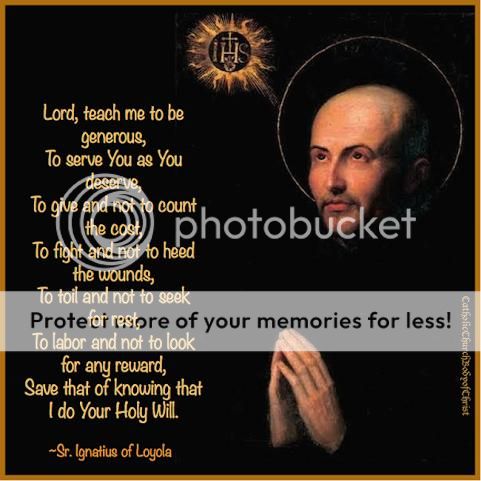
St Ignatius, pray for us ...

user posted image

user posted image

user posted image


This post has been edited by khool: Jul 31 2017, 09:40 AM
khool
post Jul 31 2017, 04:36 PM

Getting Started
**
Junior Member
225 posts

Joined: Mar 2008


4 Ways St. Ignatius can help you grow in emotional intelligence

His enormous influence in spiritual direction and his own personal holiness is proof that we can all make progress.

user posted image

I had a psychological exam once and the doctor remarked that I have an amazing lack of ability to recognize my own feelings. I might know I’m upset or happy, but I have trouble reflecting on why, and the dots between “I’m upset” and “this specific person said this specific thing and that’s why I’m upset” often go unconnected. Sometimes this is a strength because I can function and work right through my difficult feelings, but it’s definitely more often a weakness since I have often ignored my issues until I’ve fallen into a clinical depression or cycles of stress-related illness and couldn’t figure out why.

Generally, it’s actually pretty easy to go through life oblivious to what we’re feeling. Because of this, our motivations remain hidden and we can behave in self-destructive or irrational ways. This, I suppose, is why counseling and spiritual direction exist — we all need help coming to grips with our emotions. We need to understand them, confront them, accept them, and express them appropriately. This doesn’t simply relate to individual contentment, either, because the higher our emotional intelligence, the better we are at treating those around us with charity and empathy. It’s hard to deal with other people when you barely understand yourself.

St. Ignatius can help. His Spiritual Exercises were written as he was struggling to come to grips with his own emotional state, and they can help us understand our own “disordered affections.” Only in doing so can we can tame our inner chaos and live from a place of inner peace.

Here are some helpful insights into how to use Ignatius’ wisdom to develop your own emotional intelligence…

Think twice

The Exercises are about placing yourself in a moment and really, really feeling it. It’s important to note that the best approach to emotions isn’t to deny them or ignore them. Rational people have feelings, too, and it’s a beautiful part of the human experience. Instead of floating through life oblivious to emotions, it’s much more helpful to embrace what we’re feeling.

If an interaction from the past is bothering you but you can’t figure out why, or if someone said something that doesn’t sit right with you, go back through the moment in detail and imagine it with all five senses — what you saw, touched, heard, smelled, tasted. Allow the moment to wash over you, inhabit it again and place yourself there. As you re-live the moment and your feelings come into sharper focus, you’ll have more insight into how it has remained with you and continues to affect you. Maybe an apology needs to be made, maybe a resentment let go of, or a heart-to-heart talk is in order.

Be attentive

Don’t allow situations to overtake you and prompt unreflected actions. Sometimes, we’re confident we understand what’s happening around us because we have a lot of information, but if we haven’t taken the time for interior reflection, we may not know as much as we think. This is why Ignatius says, “it is not an abundance of knowledge that fills and satisfies the soul but rather an interior understanding and savoring of things.” What he means is that we ought to be attentive and ponder what it is we’re experiencing before jumping to conclusions. Often the reality lies below our surface impression, and our motivations may not always be as clear as we think they are. For instance, this woman named Martha Castenada tells of how the Exercises helped her attend to the fact that she resented her mother and never knew it. Once she clarified and reflected upon her emotions, she was able to recover her relationship with her mother.

Listen to your inner monologue

Don’t stop listening to yourself. Feelings may not be the best way to direct our actions — it isn’t good to act out of anger, for instance — but that doesn’t mean they don’t exist or that it’s wrong to feel angry. Patterns of avoidance are exactly how we fall into self-destructive habits and vices we end up powerless to control. Father Joe Laramie, who has years of experience leading Ignatian retreats, says that the Exercises, “involve becoming more aware of my own emotions.” This can be extremely difficult, because sometimes our inner monologue is about shame, confusion, or sadness – but we still need to listen.

Ignatius says, “I will ask for pain, tears, and suffering.” What he means is that he wants truly sad thoughts to prompt an appropriately sad response, he doesn’t want to become calloused to evil or accept flaws in himself. Father Joe says, “I bet none of you have ever prayed for shame and confusion!” It’s worth it, though, to work through any and all emotions we’re feeling and to confront even the difficult parts of our experiences. This is how we stay alive and vital instead of becoming numb to life.

Consider your attachments

We all have our attachments, things and people we really like. I know I would fall into a catatonic state without my coffee, that I would feel lonely and sad without my friends, and I always get an itchy, antsy feeling when I can’t get out for my daily run. Our attachments may or may not be healthy. Even attachments to things that are good can become unhealthy if our emotions are over-heated towards them.

For instance, I have in the past kept running even when I knew I was injured because I have a physical and psychological addiction to exercise. In this case, an attachment to a noble goal — staying healthy — became an emotional liability akin to addiction. Unhealthy attachments like this influence our emotional state in an undesirable manner and cloud our judgment.

When Ignatius encourages us to be attentive to our emotions, he intends that we would identify those that are disordered and begin to re-order them. Father Joe says, “Emotional intelligence involves noticing our emotions and then doing things to re-orient them in a healthier direction.”

Ignatius began life as a playboy soldier who desired to become famous by covering himself in the glories of warfare. When he got a cannonball to the leg, he had a lot of time to re-think his priorities and was able to totally change his life. He accomplished this amazing transformation by developing his emotional intelligence and re-directing his emotional attachments towards a different, much better goal. The result, his enormous influence in spiritual direction and his own personal holiness, is proof positive that we can indeed make progress.

user posted image

Source: https://aleteia.org/2017/07/30/4-ways-st-ig...time=1501397126

TSyeeck
post Aug 1 2017, 01:24 AM

Look at all my stars!!
*******
Senior Member
3,573 posts

Joined: Apr 2006


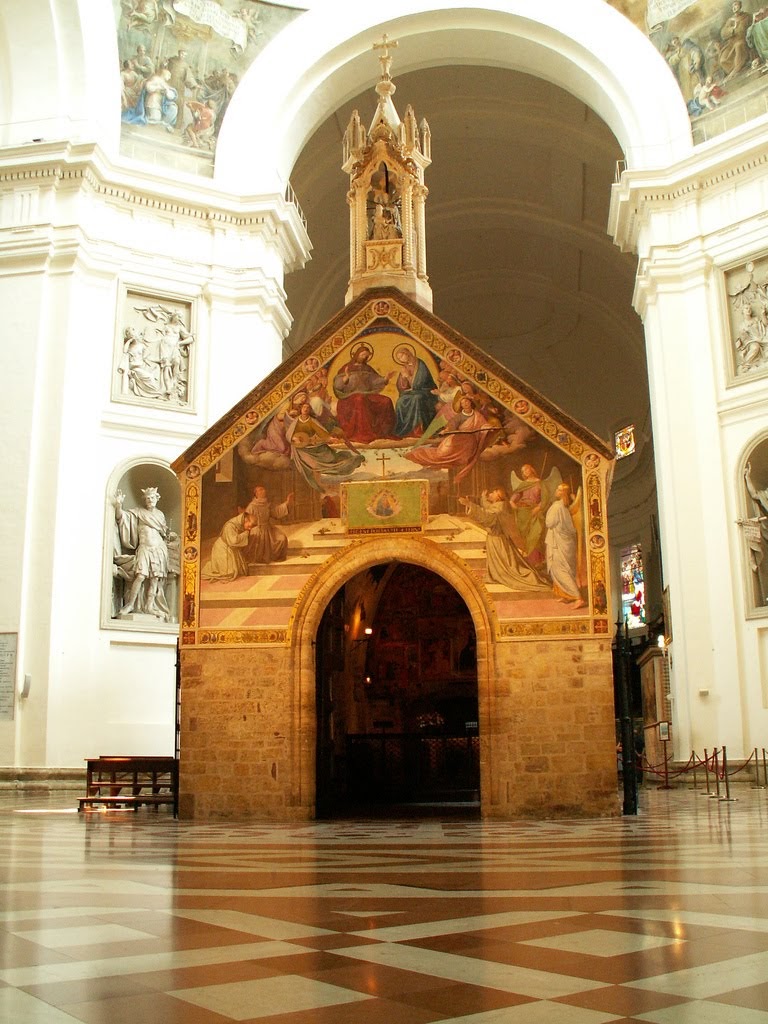
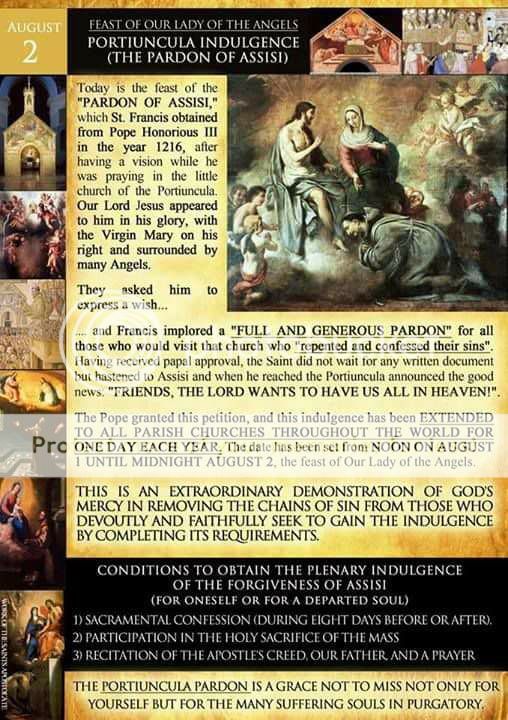
Indulgence of the Portiuncula: From 1 August Noon until 2 August Midnight, one can
gain the Indulgence of the Portiuncula obtained from the Pope by Saint Francis of Assisi
for his chapel and extended later to the whole world. To receive the plenary indulgence,
one must recite the Credo and Pater Noster - under the usual conditions for obtaining a
plenary indulgence - in any parish church, cathedral or minor basilica.


This indulgence began, according to the Franciscans, in the 13th century, likely making it the oldest plenary indulgence in the Church. The Portiuncula chapel had been neglected by the Benedictines, but eventually given to Saint Francis of Assisi with the intention of him creating a new religious order (and restoring the chapel). In 1209, the Order of Friars Minor was founded. The order would sadly split numerous times, with turbulence and rupture still occurring between Franciscans today. But the chapel has been under the care of Franciscans ever since their founding, and has hosted general chapters and a visit from Saint Clare of Assisi. Saint Francis died just feet from the chapel.

The Catholic Encyclopedia gives this history on the indulgence:

The Portiuncula Indulgence could at first be gained only in the Portiuncula chapel between the afternoon of 1 Aug. and sunset on 2 Aug. On 5 Aug., 1480 (or 1481), Sixtus IV extended it to all churches of the first and second orders of St. Francis for Franciscans; on 4 July, 1622, this privilege was further extended by Gregory XV to all the faithful, who, after confession and the reception of Holy Communion, visited such churches on the appointed day. On 12 Oct., 1622, Gregory granted the same privilege to all the churches of the Capuchins; Urban VIII granted it for all churches of the regular Third Order on 13 Jan., 1643, and Clement X for all churches of the Conventuals on 3 Oct., 1670. Later popes extended the privilege to all churches pertaining in any way to the Franciscan Order, even to churches in which the Third Order held its meetings (even parish churches, etc.), provided that there was no Franciscan church in the district, and that such a church was distant over an Italian mile (1000 paces, about 1640 yards). Some districts and countries have been granted special privileges. On 9 July, 1910, Pius X (only, however, for that year) granted the privilege that bishops could appoint any public churches whatsoever for the gaining of the Portiuncula Indulgence, whether on 2 Aug. or the Sunday following (Acta Apostolicae Sedis, II, 1910, 443 sq.; Acta Ord. Frat. Min., XXIX, 1910, 226). This privilege has been renewed for an indefinite time by a decree of the S. Cong. of Indul., 26 March, 1911 (Acta Apostolicae Sedis, III, 1911, 233-4). The Indulgence is toties-quoties, that is, it may be gained as often as one wishes (i.e. visits the church); it is also applicable to the souls in purgatory.

Following Vatican II, it survived the reforms of Paul VI:

In addition, a plenary indulgence can be acquired twice a year in parish churches: on the feast of the church's titular saint and on August 2, when the "Portiuncula" occurs, or on some other more opportune day determined by the Ordinary.

user posted image

This post has been edited by yeeck: Aug 1 2017, 01:25 AM
khool
post Aug 1 2017, 09:49 AM

Getting Started
**
Junior Member
225 posts

Joined: Mar 2008


Memorial of Saint Alphonsus Liguori, Bishop and Doctor of the Church
Lectionary: 402


user posted image

Reading 1 (Ex 33:7-11; 34:5b-9, 28)

The tent, which was called the meeting tent,
Moses used to pitch at some distance away, outside the camp.
Anyone who wished to consult the LORD
would go to this meeting tent outside the camp.
Whenever Moses went out to the tent, the people would all rise
and stand at the entrance of their own tents,
watching Moses until he entered the tent.
As Moses entered the tent, the column of cloud would come down
and stand at its entrance while the LORD spoke with Moses.
On seeing the column of cloud stand at the entrance of the tent,
all the people would rise and worship
at the entrance of their own tents.
The LORD used to speak to Moses face to face,
as one man speaks to another.
Moses would then return to the camp,
but his young assistant, Joshua, son of Nun,
would not move out of the tent.

Moses stood there with the LORD and proclaimed his name, "LORD."
Thus the LORD passed before him and cried out,
"The LORD, the LORD, a merciful and gracious God,
slow to anger and rich in kindness and fidelity,
continuing his kindness for a thousand generations,
and forgiving wickedness and crime and sin;
yet not declaring the guilty guiltless,
but punishing children and grandchildren
to the third and fourth generation for their fathers' wickedness!"
Moses at once bowed down to the ground in worship.
Then he said, "If I find favor with you, O LORD,
do come along in our company.
This is indeed a stiff-necked people;
yet pardon our wickedness and sins,
and receive us as your own."

So Moses stayed there with the LORD for forty days and forty nights,
without eating any food or drinking any water,
and he wrote on the tablets the words of the covenant,
the ten commandments.

Responsorial Psalm (Ps 103:6-7, 8-9, 10-11, 12-13)

R. The Lord is kind and merciful.

The LORD secures justice
and the rights of all the oppressed.
He has made known his ways to Moses,
and his deeds to the children of Israel.
R. The Lord is kind and merciful.

Merciful and gracious is the LORD,
slow to anger and abounding in kindness.
He will not always chide,
nor does he keep his wrath forever.
R. The Lord is kind and merciful.

Not according to our sins does he deal with us,
nor does he requite us according to our crimes.
For as the heavens are high above the earth,
so surpassing is his kindness toward those who fear him.
R. The Lord is kind and merciful.

As far as the east is from the west,
so far has he put our transgressions from us.
As a father has compassion on his children,
so the LORD has compassion on those who fear him.
R. The Lord is kind and merciful.

Alleluia

R. Alleluia, alleluia.
The seed is the word of God, Christ is the sower;
All who come to him will live for ever.
R. Alleluia, alleluia.

Gospel (Mt 13:36-43)

Jesus dismissed the crowds and went into the house.
His disciples approached him and said,
"Explain to us the parable of the weeds in the field."
He said in reply, "He who sows good seed is the Son of Man,
the field is the world, the good seed the children of the Kingdom.
The weeds are the children of the Evil One,
and the enemy who sows them is the Devil.
The harvest is the end of the age, and the harvesters are angels.
Just as weeds are collected and burned up with fire,
so will it be at the end of the age.
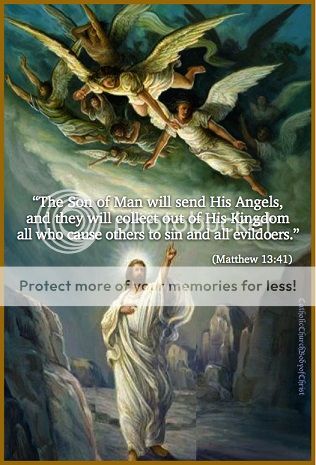
The Son of Man will send his angels,
and they will collect out of his Kingdom
all who cause others to sin and all evildoers.
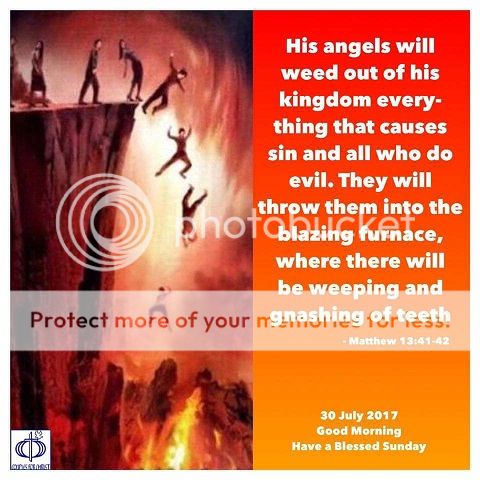
They will throw them into the fiery furnace,
where there will be wailing and grinding of teeth.
Then the righteous will shine like the sun
in the Kingdom of their Father.
Whoever has ears ought to hear."

user posted image

REFLECTION

Explain to us the Parables. The disciples ask Jesus for explanation. They know what the weeds are, but it is not clear how these and the other images are related to the Kingdom of God.

In the parable, Jesus explains, God sows good seed. God causes good people, represented by the good seed, to spread throughout the land. They are identified as God’s children. But the evil one comes to sow bad guys to spoil them, to frustrate God’s plan. The bad cause the good to trip, to sin, and even to lead them out of God’s fold.

There are also guys who want to eliminate the bad guys in God’s name. But God has a different plan. God will do it at harvest time or judgment. There is time for everything. Part of God’s plan is to eliminate evil in this world. It has already begun with Jesus.

We may be asking the same question and seeking clarification. For us Christians, the parable should mean: We are the good guys by virtue of our baptism. In the world, we should not allow ourselves to be corrupted by the bad guys.

The good guys will go to heaven, while the bad ones go somewhere else. Do you consider yourself a good guy? Explain.

user posted image

SOURCE: “365 Days with the Lord 2017,” ST. PAULS Philippines, 7708 St. Paul Rd., SAV, Makati City (Phils.) http://www.ssp.ph/


This post has been edited by khool: Aug 1 2017, 09:50 AM
khool
post Aug 1 2017, 09:59 AM

Getting Started
**
Junior Member
225 posts

Joined: Mar 2008


✝️ PRAYER AFTER COMMUNION

user posted image

My JESUS, what has passed our lips as food, O Lord, may we possess in purity of heart, that what is given to us in time, be our healing for eternity. May Your Body, O Lord, which I have eaten, and Your Blood which I have drunk, cleave to my very soul, and grant that no trace of sin be found in me, whom these pure and holy mysteries have renewed.

We humbly beseech You, Almighty God, to grant that those whom You refresh with Your sacraments, may serve you worthily by a life well pleasing to You. Through our Lord Jesus Christ, Your Son, Who lives and reigns, world without end. Amen.

Source: https://www.facebook.com/DailyRosary/photos...BsecIRrlrFyHzyA

user posted image

user posted image

This post has been edited by khool: Aug 1 2017, 02:22 PM
khool
post Aug 1 2017, 02:17 PM

Getting Started
**
Junior Member
225 posts

Joined: Mar 2008


The Necessity of Regular Confession and Dependence on God's Mercy

user posted image

Confession is something that boggles the minds of many. Often the question comes up, “If we can confess our sins directly to God, then what need have we for Confession, for the Sacrament of Reconciliation?” – the question is not only asked by Protestants, but Catholics also.

Let’s take a look at a few things. Firstly, what are the five names for Confession?

1. Confession (or the Sacrament of Confession)

2. The Sacrament of Reconciliation (probably the most often used name)

3. The Sacrament of Penance

4. The Sacrament of Forgiveness

5. The Sacrament of Conversion

Why do we have these five different names for the same thing? Here are some reasons, though they are not extensive.

1. We confess our sins to God. We name them and say how many times we committed each sin. In doing so, we acknowledge our human weaknesses and that we are in need of growing, learning, and correcting our faults, as well as our need for God’s mercy. In a sense, we confess that Jesus is Lord, and thus we must go through Him to receive forgiveness from the Father [God]. We confess that we are totally dependent on God and that we need His mercy.

2. We reconcile ourselves to God. Every Ash Wednesday, we here this line in the second reading – “Be reconciled to God” (2 Cor 5:20). By reconciling ourselves to God, we become one with Him again, ready to respond to His call for us – the Call of holiness, but also of LOVE.

3. We do penance. Many people see this as a punishment, when in fact, it is designed to help us reflect and learn from our sins, so as not to commit them again, by the help of God’s grace. Penance is part of the conversion process to obtain pardon and make satisfaction for the act against charity to which we have committed [the sin itself]. Thus, it reconciles us with the Church and God.

4. We are forgiven by God. When the priest, who comes in persona Christi [in the person of Christ] gives us absolution, we, the penitents, are granted forgiveness, pardon and peace of Christ.

5. The Sacrament should bring about a firm resolve, by the help of God’s grace, not to sin again and to avoid the near occasion of sin, and hence, there should be an element of conversion. If the penitent is not truly sorry for their sins and won’t at least try to stop their bad habits or sins, then they have not made a true resolve and can be refused absolution, since there was not an element of the conversion of heart. By conversion, one must have a contrite heart, and trusting in God’s mercy, allow His mercy to overflow from head to heart – believing that they are really forgiven – as the Greeks used the term, metanoia.

So, what is the actual purpose of Confession? Why do we need to go to a priest instead of “directly to God”?

If God is everywhere, then why would we need the sacraments? Why do we need the real presence of the Eucharist, consecrated in the Mass? Why do we need physical signs in the sacraments when God is always with us? These are questions asked a lot by many who seem to think the Catholic Church man-made the sacraments. Since we are both body and soul, we need to experience God in both the physical dimension [body] and spiritual dimension [soul].

There’s a very Catholic saying that goes like this, “what the body does, the soul will follow”. Being human, we need to be able to experience things through our senses to truly allow them to seep through into our hearts. The reason we have confession is partly linked to this.

For the Eucharist, though we know God is everywhere, the sacrament allows us to see, touch, taste Jesus. It serves as an objective reminder that God is here and present in our lives. In the case of confession, our human nature means we struggle to believe we are truly loved and forgiven. My parish priest of my home parish once said to us that the greatest act we will ever do is to accept we are accepted and forgiven. As Adam and Eve in the Garden of Eden hid from God, ashamed of having eaten the forbidden fruit, they showed that humans struggle with a very real battle in believing that God is loving and merciful, and so their reaction was one of fear and distrust in God’s mercy.

So, what does the Sacrament of Confession even do for us?

It allows us to experience, first hand, God’s mercy. When we approach the Sacrament of Confession, we are liberated by the ability to see the priest, hear him, allow the words of his giving of absolution under the authority of the Church to heal us, by letting them help us draw the line of the past in the sand and let the waves of the ocean of God’s mercy wash away our sin. We can hear the priest telling us, “you’re forgiven”. Just as Jesus said in the curing of the paralytic, “which of these is easier to say, “Your sins are forgiven” or “Get up and walk”?” (Mt 9:5). By allowing ourselves to hear these very healing words, we can overcome our otherwise too weak human selves, that would otherwise just keep questioning whether God really loves us or has forgiven us.

Moreover, the practice of ritual is part of lives. For example, imagine a young man proposing to the girl of his dreams. What would make more of an impact? Walking up to her and saying, “I love you, marry me”, or getting down on one knee, with a bouquet of flowers, smiling and saying, “My dearly beloved girlfriend, I love you so much, will you be mine forever and marry me?”. Of course, the second one would make a much greater impact – it goes without saying. So, in the same way, confession is just God’s gesture to us, to hold us and embrace us as His beloved, and show us His love for us in a very physical and spiritual way, to appeal to the body and soul that we are. If we do not let ourselves be embraced in this way, we stuff away the negativity of our imaginations, that eventually manifests and transmits itself across to others, especially those closest to us, to whom we love the most. What is not transformed is transmitted. If our darkness can be transformed by God’s mercy in the Sacrament of Confession, we are in a much better position to radiate God’s light, joy and love to others. Therefore, confession is a gift from God, to touch us, heal us and liberate us. By going to confession, we admit that we need God’s grace and mercy, and we learn humility, since we recognize that we are totally dependent on God, and in need of His love, mercy and compassion.

A Personal Anecdote

I’m a convert to the Catholic faith and made my first Confession at the age of 18. By that time, sin was weighing heavy upon me, and the sins of my childhood, some great and many in number, were burdening me, and there was a part of me that doubted God’s love for me. I struggled even through the RCIA to accept that God could use me for His greater glory and bless me with all that I had. Everything I asked of him, I was given more than an abundance, more than my teenage imagination could possibly comprehend. But I found it difficult to accept God’s mercy, His forgiveness, because I couldn’t forgive myself. I couldn’t forgive myself for hurting people in the past, and for all the possible things I might do in the future (as the priest who later became my regular confessor later on said to me, “don’t be caught up with the Theology of the Possibles, which by the way, isn’t a Theology!!”). I struggled to believe that God could forgive me if I couldn’t even forgive myself, but how wrong I was. After 40 minutes, yes, it was 40 minutes, I came out of the confessional for the first time, having had my sins washed clean. Finally, I was free. Everything seemed brighter. I felt as it if someone took a screen away from my eyes. I could see things so clearly, and it was beautiful. After I did my penance, I just sat on a bench at the back of the church and I looked up at the stained glass window and sunbathed in the presence of God.

Ever since then, I have gone regularly to Confession. Although I’m naturally quite shy and reserved, and often find it incredibly difficult to reveal my deepest heart’s secrets, especially my sins, the sacrament has taught me a great amount of humility. Even though I can be very embarrassed to confess certain sins in particular, I have learned to trust in God’s mercy and compassion, knowing that, as long as I do my best to keep myself from sin, by the help of God’s grace, He will keep me ever close to Him and always forgive me and help me along this very difficult journey we call, “life”.

Thus, I must encourage you to go to Confession with a contrite heart, sorry for your sins, and a sincere and firm purpose of amendment, with the help of God’s grace, to do better and sin no more. Most priests have recommended that once a month is healthy (even though Canon Law requires us to only go annually), and in some cases, especially if you know you’re in deep need of sacramental grace to overcome an “addicted sin” as some have called it (sins you commit over and over again, so deeply rooted that they’ve become bad habits, or worse, actual addictions), then go more often, or any time you commit mortal sin (grave, full knowledge and deliberate consent). For me, I go weekly, though this is not advised unless you have been specifically guided by a priest/your confessor to do so, since there is a risk of scruples (becoming overly obsessed with every little sin, including venial sins, until you fail to trust in God’s mercy, which is not healthy).

God bless you, my dear brothers and sisters in Christ. Know you have my prayers. May you always trust in God’s mercy and compassion, and be not afraid to approach the Sacrament of Confession. Remember, there’s probably nothing the priest hasn’t already heard before, and you probably won’t be the worst sinner he’s had to hear a confession for, so don’t worry. Trust God and depend on His mercy.

Source: http://www.catholic365.com/article/7128/th...gods-mercy.html


khool
post Aug 2 2017, 10:14 AM

Getting Started
**
Junior Member
225 posts

Joined: Mar 2008


Wednesday of the Seventeenth Week in Ordinary Time
Lectionary: 403


user posted image

Reading 1 (Ex 34:29-35)

As Moses came down from Mount Sinai
with the two tablets of the commandments in his hands,
he did not know that the skin of his face had become radiant
while he conversed with the LORD.
When Aaron, then, and the other children of Israel saw Moses
and noticed how radiant the skin of his face had become,
they were afraid to come near him.
Only after Moses called to them did Aaron
and all the rulers of the community come back to him.
Moses then spoke to them.
Later on, all the children of Israel came up to him,
and he enjoined on them all that the LORD
had told him on Mount Sinai.
When he finished speaking with them,
he put a veil over his face.
Whenever Moses entered the presence of the LORD to converse with him,
he removed the veil until he came out again.
On coming out, he would tell the children of Israel
all that had been commanded.
Then the children of Israel would see
that the skin of Moses' face was radiant;
so he would again put the veil over his face
until he went in to converse with the LORD.

Responsorial Psalm (Ps 99:5, 6, 7, 9)

R. Holy is the Lord our God.

Extol the LORD, our God,
and worship at his footstool;
holy is he!
R. Holy is the Lord our God.

Moses and Aaron were among his priests,
and Samuel, among those who called upon his name;
they called upon the LORD, and he answered them.
R. Holy is the Lord our God.

From the pillar of cloud he spoke to them;
they heard his decrees and the law he gave them.
R. Holy is the Lord our God.

Extol the LORD, our God,
and worship at his holy mountain;
for holy is the LORD, our God.
R. Holy is the Lord our God.

Alleluia (Jn 15:15b)

R. Alleluia, alleluia.
I call you my friends, says the Lord,
for I have made known to you all that the Father has told me.
R. Alleluia, alleluia.

Gospel (Mt 13:44-46)

Jesus said to his disciples:
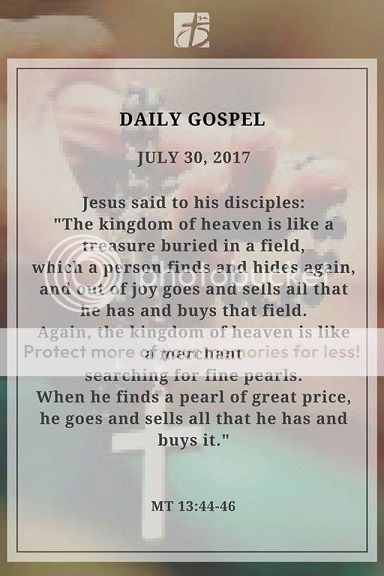
"The Kingdom of heaven is like a treasure buried in a field,
which a person finds and hides again,
and out of joy goes and sells all that he has and buys that field.
Again, the Kingdom of heaven is like a merchant
searching for fine pearls.
When he finds a pearl of great price,
he goes and sells all that he has and buys it."

user posted image

REFLECTION

Like a Treasure buried in a Field. What a strange parable of the Kingdom! In Biblical times, when there is trouble or invasion, people put their treasures and precious belongings in a jar and bury the container. It may happen that in time the treasure is forgotten or the one who buried it has died. Here comes a farmer who accidentally plows the jar and discovers the treasure. He knows he has no rights to it; the owner of the field was its true owner. To get the treasure, therefore, he must buy the field.

At first, the parable seems strange, but it makes sense when we speak about the nature of God’s Kingdom. God’s Kingdom is like a buried treasure that we encounter or stumble upon. It is a gift, but to make it our own, we must pay a big price.

We do not possess God’s Kingdom by just accidentally discovering it. We have to work hard and make necessary sacrifices to make our possession of it right. God’s Kingdom is a pure gift; our efforts to possess it make it even more precious to us.

Have you found the treasure called God’s Kingdom?

SOURCE: “365 Days with the Lord 2017,” ST. PAULS Philippines, 7708 St. Paul Rd., SAV, Makati City (Phils.) http://www.ssp.ph/

khool
post Aug 2 2017, 10:20 AM

Getting Started
**
Junior Member
225 posts

Joined: Mar 2008


user posted image

khool
post Aug 3 2017, 09:36 AM

Getting Started
**
Junior Member
225 posts

Joined: Mar 2008


Thursday of the Seventeenth Week in Ordinary Time
Lectionary: 404


user posted image

Reading 1 (Ex 40:16-21, 34-38)

Moses did exactly as the LORD had commanded him.
On the first day of the first month of the second year
the Dwelling was erected.
It was Moses who erected the Dwelling.
He placed its pedestals, set up its boards, put in its bars,
and set up its columns.
He spread the tent over the Dwelling
and put the covering on top of the tent,
as the LORD had commanded him.
He took the commandments and put them in the ark;
he placed poles alongside the ark and set the propitiatory upon it.
He brought the ark into the Dwelling and hung the curtain veil,
thus screening off the ark of the commandments,
as the LORD had commanded him.

Then the cloud covered the meeting tent,
and the glory of the LORD filled the Dwelling.
Moses could not enter the meeting tent,
because the cloud settled down upon it
and the glory of the LORD filled the Dwelling.
Whenever the cloud rose from the Dwelling,
the children of Israel would set out on their journey.
But if the cloud did not lift, they would not go forward;
only when it lifted did they go forward.
In the daytime the cloud of the LORD was seen over the Dwelling;
whereas at night, fire was seen in the cloud
by the whole house of Israel
in all the stages of their journey.

Responsorial Psalm (Ps 84:3, 4, 5-6a and 8a, 11)

R. How lovely is your dwelling place, O Lord, mighty God!

My soul yearns and pines
for the courts of the LORD.
My heart and my flesh
cry out for the living God.
R. How lovely is your dwelling place, O Lord, mighty God!

Even the sparrow finds a home,
and the swallow a nest
in which she puts her young–
Your altars, O LORD of hosts,
my king and my God!
R. How lovely is your dwelling place, O Lord, mighty God!

Blessed they who dwell in your house!
continually they praise you.
Blessed the men whose strength you are!
They go from strength to strength.
R. How lovely is your dwelling place, O Lord, mighty God!

I had rather one day in your courts
than a thousand elsewhere;
I had rather lie at the threshold of the house of my God
than dwell in the tents of the wicked.
R. How lovely is your dwelling place, O Lord, mighty God!

Alleluia (Acts 16:14b)

R. Alleluia, alleluia.
Open our hearts, O Lord,
to listen to the words of your Son.
R. Alleluia, alleluia.

Gospel (Mt 13:47-53)

Jesus said to the disciples:
"The Kingdom of Heaven is like a net thrown into the sea,
which collects fish of every kind.
When it is full they haul it ashore
and sit down to put what is good into buckets.
What is bad they throw away.
Thus it will be at the end of the age.
The angels will go out and separate the wicked from the righteous
and throw them into the fiery furnace,
where there will be wailing and grinding of teeth."

"Do you understand all these things?"
They answered, "Yes."
And he replied,
"Then every scribe who has been instructed in the Kingdom of heaven
is like the head of a household who brings from his storeroom
both the new and the old."
When Jesus finished these parables, he went away from there.

user posted image

REFLECTION

Do you understand all these things? Jesus asks this when He has finished proclaiming the parables of the Kingdom. The disciples answer, “Yes.” It is as good sign.

Before concluding His teachings, Jesus likens the Kingdom of heaven to a net thrown into the sea. The sea refers to Lake Galilee, not the Mediterranean Sea. The Greek word for sea and lake is the same – thalassa. The dragnet catches good and bad fish. The parable is similar to the earlier weeds among the wheat. In both stories, the good and the bad are allowed to grow together. Only at the end will they be separated and treated accordingly, as when the dragnet is hauled ashore and when harvest comes.

Jesus ends His teaching with another saying, “Every scribe who has been instructed in the Kingdom…” (v 52). It is believed that this scribe refers to the author of the gospel who is familiar with the old and the new teachings. It can also be applied to His disciples who, like the scribes, have been instructed in the Kingdom and must be skillful enough to make sense out of what they have been taught.

You understand your faith when you integrate it in your life. Do you see the connections between your catechism and such new teachings as the care of creation and of the family?

user posted image

SOURCE: “365 Days with the Lord 2017,” ST. PAULS Philippines, 7708 St. Paul Rd., SAV, Makati City (Phils.) http://www.ssp.ph/

This post has been edited by khool: Aug 3 2017, 09:38 AM
khool
post Aug 3 2017, 09:40 AM

Getting Started
**
Junior Member
225 posts

Joined: Mar 2008


user posted image

user posted image

This post has been edited by khool: Aug 3 2017, 09:41 AM
TSyeeck
post Aug 3 2017, 11:05 AM

Look at all my stars!!
*******
Senior Member
3,573 posts

Joined: Apr 2006


Evil Silence and Holy Silence
At the recommendation of my friend Gary Potter, I am reading — very slowly — Robert Cardinal Sarah’s The Power of Silence. The book is as Gary describes it in his short piece on our website, and I will say a bit on it a few paragraphs down.

As I was reading Cardinal Sarah’s book, the thought struck me that his encomium to holy silence might be juxtaposed with another recent work with the word “silence” in the title. I refer to the film by Martin Scorsese, Silence. The film was praised by the celebrated LGBTQ-advocate, James Martin, who served as Scorsese’s advisor on things Jesuit.

I have never seen the film, and do not plan on doing so. However, I have read the book upon which it was based, by the Japanese Catholic novelist, Shūsaku Endō. The book is a masterpiece of prose, even in translation. The writing is compelling, credible, and gripping. It is also the single most disturbing book I have ever read in my life. That, for the simple reason that the reader is artfully secreted into the mind of a man — a priest and a missionary — who is brought to the very precipice of apostasy by means of a cruel yet refined psychological torture.

The action of the book, which is based upon real events, takes place after the times of most of the Japanese martyrs (e.g, Saints Paul Miki, James Kisai and John de Goto; Saint Philip of Jesus). As Wikipedia notes, “The story is set in the time of Kakure Kirishitan (“Hidden Christians”), following the suppression of the Shimabara Rebellion (1637–1638) of Japanese Roman Catholics against the Tokugawa shogunate.” By this time, the feudal lords of Japan have realized that mass martyrdoms were only helping the cause of the Church in their country. As a result, they settled upon a policy that was diabolically clever.

Instead of martyring the missionaries and their converts, the stratagem is altered to torturing — to death — only the converts, even if they have apostatized, all in the sight of the missionaries, who are informed that they can save their Japanese children by personally committing apostasy. The way that they would show their apostasy is by stepping on a crudely carved image of Christ (with or without the Blessed Virgin), called a fumi-e.

The torture to which the converts are put is truly horrific. With small slits cut behind their ears, they are suspended upside-down over a pit reeking of its fetid contents of rotting flesh and excrement. They slowly bleed to death in a terribly painful way, due to the gruesome circulatory effects caused by the smallness of the slit.

The eponymous “silence” that Endō writes of so disturbingly is the silence of God amid the trials and spiritual agony of the book’s protagonist, Father Sebastião Rodrigues, S.J. It is not a holy silence; it is the missionary’s feeling of utter abandonment by God.

Did I mention that this is the single most disturbing book I have ever read in my life?

In a remarkably sympathetic and incisive commentary on the book (and the film) Lieutenant Geoff Jablonski, writing for the Lepanto Institute, tries his best to hold up whatever elements in both are salvageable. However, he agrees with other Catholic commentators — e.g., John Paul Meehan in Martyrs Know Apostasy Can Not Be Justified — that apostasy can never be justified under any circumstances. Alarmingly, some so-called conservative Catholics were perfectly willing to justify apostasy (or apparent apostasy) in the comments section of Prof. Meehan’s article, where your humble servant found himself in a bit of a dustup last year. In these days of sentimental theology, what should one expect?

The subsequent history of those priests whom we learn have stepped on the fumi-e are no more heroic than their act of external apostasy. For they go on to live respectable lives in Japan (they are forbidden to leave), take Japanese wives, and work against the interests of Christianity in the land they had formerly worked to evangelize. In other words, this is real apostasy, not merely a dissimulation. Scorsese apparently parted from the book in this regard by giving the film a clever surprise ending; but, as Geoff Jablonski points out, this is still not morally satisfactory.

There is Catholic heroism in the book, and one of the missionaries dies in an attempt to save his spiritual children who are being drowned to death. In his admirable attempt at reading lessons of genuine Catholic spirituality into Endō’s work, Lieutenant Jablonski contrasts the heroism and spiritual solidity of this missionary with the prideful self-reliance of Father Rodrigues, whose behavior is considerably less than heroic. How accurate this reading is to Endō’s intention nobody can say, since Endō (who is a great artist) is himself quite silent on the matter.

In the end, whether the evil silence is the fault of Father Sebastião Rodrigues, the character, or Shūsaku Endō, the writer, the silence — and then the shockingly blasphemous breaking of the silence — is not holy; it is evil. It is a silence that drives a man to apostasy. It is a silence that leads him to imagine (or hear, if Endō is to blame) Christ granting permission for apostasy. A triumph of existentialist morality!

A holy silence is one that draws close to God. More to the point, it is one that envelopes us in God. It renders His presence, as it were, tangible. Such a silence is informed by, and, in turn, strengthens, the theological and moral virtues. It is a silence that is not solipsistic, narcissistic, indulgent, or even selfish in the least. It is a silence that is ascetical and attentive to God, without the prideful presumption that God is obliged to “speak” to the soul — not, at least, in an audible or extraordinary way. Such silence is described ably by Robert Cardinal Sarah, on page sixty-one of The Power of Silence:

Silence, man’s effort, runs alongside hope, the theological virtue. In reality, the divine power of the theological virtue lifts and directs the human and ascetical impact of silence. Then a second [virtue, this one a] moral virtue appears: fortitude. Its function is to remove the obstacle that prevents the will from obeying reason. Fortitude is active and takes the offensive. The thing is to apply oneself to cultivating this virtue, which drives back all that could prevent man from living in dependence on God. Silence and hope are two conditions allowing fortitude to find its nourishment.

Through this asceticism of silence, how can we not understand and appreciate better the lights offered by these different Bible verses? “When words are many, transgression is not lacking” (Prov 10:19). “He who guards his mouth preserves his life; he who opens wide his lips comes to ruin” (Prov 13:3). “Whoever uses too many words will be loathed” (Sir [Ecclus] 20:8). “I tell you, on the day of judgment men will render account for every careless word they utter” (Mt 12:36). “Make balances and scales for your words, and make a door and a bolt for your mouth. Beware lest you err with your tongue, lest you fall before him who lies in wait” (Sir 28:25-26 [Ecclus 28:29-30]).

May we all progress in the cultivation of holy silence.

In the Immaculate Heart of Mary,
Brother André Marie, M.I.C.M.
khool
post Aug 3 2017, 11:12 AM

Getting Started
**
Junior Member
225 posts

Joined: Mar 2008


Bro Yeeck, you managed to watch the movie yet? if yes, what do you think of it?

QUOTE(yeeck @ Aug 3 2017, 11:05 AM)
Evil Silence and Holy Silence
At the recommendation of my friend Gary Potter, I am reading — very slowly — Robert Cardinal Sarah’s The Power of Silence. The book is as Gary describes it in his short piece on our website, and I will say a bit on it a few paragraphs down.

As I was reading Cardinal Sarah’s book, the thought struck me that his encomium to holy silence might be juxtaposed with another recent work with the word “silence” in the title. I refer to the film by Martin Scorsese, Silence. The film was praised by the celebrated LGBTQ-advocate, James Martin, who served as Scorsese’s advisor on things Jesuit.

I have never seen the film, and do not plan on doing so. However, I have read the book upon which it was based, by the Japanese Catholic novelist, Shūsaku Endō. The book is a masterpiece of prose, even in translation. The writing is compelling, credible, and gripping. It is also the single most disturbing book I have ever read in my life. That, for the simple reason that the reader is artfully secreted into the mind of a man — a priest and a missionary — who is brought to the very precipice of apostasy by means of a cruel yet refined psychological torture.

The action of the book, which is based upon real events, takes place after the times of most of the Japanese martyrs (e.g, Saints Paul Miki, James Kisai and John de Goto; Saint Philip of Jesus). As Wikipedia notes, “The story is set in the time of Kakure Kirishitan (“Hidden Christians”), following the suppression of the Shimabara Rebellion (1637–1638) of Japanese Roman Catholics against the Tokugawa shogunate.” By this time, the feudal lords of Japan have realized that mass martyrdoms were only helping the cause of the Church in their country. As a result, they settled upon a policy that was diabolically clever.

Instead of martyring the missionaries and their converts, the stratagem is altered to torturing — to death — only the converts, even if they have apostatized, all in the sight of the missionaries, who are informed that they can save their Japanese children by personally committing apostasy. The way that they would show their apostasy is by stepping on a crudely carved image of Christ (with or without the Blessed Virgin), called a fumi-e.

The torture to which the converts are put is truly horrific. With small slits cut behind their ears, they are suspended upside-down over a pit reeking of its fetid contents of rotting flesh and excrement. They slowly bleed to death in a terribly painful way, due to the gruesome circulatory effects caused by the smallness of the slit.

The eponymous “silence” that Endō writes of so disturbingly is the silence of God amid the trials and spiritual agony of the book’s protagonist, Father Sebastião Rodrigues, S.J. It is not a holy silence; it is the missionary’s feeling of utter abandonment by God.

Did I mention that this is the single most disturbing book I have ever read in my life?

In a remarkably sympathetic and incisive commentary on the book (and the film) Lieutenant Geoff Jablonski, writing for the Lepanto Institute, tries his best to hold up whatever elements in both are salvageable. However, he agrees with other Catholic commentators — e.g., John Paul Meehan in Martyrs Know Apostasy Can Not Be Justified — that apostasy can never be justified under any circumstances. Alarmingly, some so-called conservative Catholics were perfectly willing to justify apostasy (or apparent apostasy) in the comments section of Prof. Meehan’s article, where your humble servant found himself in a bit of a dustup last year. In these days of sentimental theology, what should one expect?

The subsequent history of those priests whom we learn have stepped on the fumi-e are no more heroic than their act of external apostasy. For they go on to live respectable lives in Japan (they are forbidden to leave), take Japanese wives, and work against the interests of Christianity in the land they had formerly worked to evangelize. In other words, this is real apostasy, not merely a dissimulation. Scorsese apparently parted from the book in this regard by giving the film a clever surprise ending; but, as Geoff Jablonski points out, this is still not morally satisfactory.

There is Catholic heroism in the book, and one of the missionaries dies in an attempt to save his spiritual children who are being drowned to death. In his admirable attempt at reading lessons of genuine Catholic spirituality into Endō’s work, Lieutenant Jablonski contrasts the heroism and spiritual solidity of this missionary with the prideful self-reliance of Father Rodrigues, whose behavior is considerably less than heroic. How accurate this reading is to Endō’s intention nobody can say, since Endō (who is a great artist) is himself quite silent on the matter.

In the end, whether the evil silence is the fault of Father Sebastião Rodrigues, the character, or Shūsaku Endō, the writer, the silence — and then the shockingly blasphemous breaking of the silence — is not holy; it is evil. It is a silence that drives a man to apostasy. It is a silence that leads him to imagine (or hear, if Endō is to blame) Christ granting permission for apostasy. A triumph of existentialist morality!

A holy silence is one that draws close to God. More to the point, it is one that envelopes us in God. It renders His presence, as it were, tangible. Such a silence is informed by, and, in turn, strengthens, the theological and moral virtues. It is a silence that is not solipsistic, narcissistic, indulgent, or even selfish in the least. It is a silence that is ascetical and attentive to God, without the prideful presumption that God is obliged to “speak” to the soul — not, at least, in an audible or extraordinary way. Such silence is described ably by Robert Cardinal Sarah, on page sixty-one of The Power of Silence:

Silence, man’s effort, runs alongside hope, the theological virtue. In reality, the divine power of the theological virtue lifts and directs the human and ascetical impact of silence. Then a second [virtue, this one a] moral virtue appears: fortitude. Its function is to remove the obstacle that prevents the will from obeying reason. Fortitude is active and takes the offensive. The thing is to apply oneself to cultivating this virtue, which drives back all that could prevent man from living in dependence on God. Silence and hope are two conditions allowing fortitude to find its nourishment.

Through this asceticism of silence, how can we not understand and appreciate better the lights offered by these different Bible verses? “When words are many, transgression is not lacking” (Prov 10:19). “He who guards his mouth preserves his life; he who opens wide his lips comes to ruin” (Prov 13:3). “Whoever uses too many words will be loathed” (Sir [Ecclus] 20:8). “I tell you, on the day of judgment men will render account for every careless word they utter” (Mt 12:36). “Make balances and scales for your words, and make a door and a bolt for your mouth. Beware lest you err with your tongue, lest you fall before him who lies in wait” (Sir 28:25-26 [Ecclus 28:29-30]).

May we all progress in the cultivation of holy silence.

In the Immaculate Heart of Mary,
Brother André Marie, M.I.C.M.
*
This post has been edited by khool: Aug 3 2017, 11:13 AM
khool
post Aug 3 2017, 02:10 PM

Getting Started
**
Junior Member
225 posts

Joined: Mar 2008


How Old Was the Theotokos When She Reposed?

By Professor Dr. Spyridon Kontoyiannes,
Professor of Theology at the University of Athens


user posted image

As the tradition of our Church teaches, the Falling Asleep of the Theotokos took place at the house of John the Evangelist, where the All Holy Virgin stayed, together with his brother James and their mother Salome who was related to the Theotokos, according to the known consignment of Christ from the Cross (John 19:26-27). The Theotokos was informed about her imminent falling asleep by an angel three days before the event, and so she was able to prepare herself and to give her two garments to two widowed neighbors.

When the All-holy Virgin fell asleep and her eyes were closed, the Apostles, who had been miraculously gathered together in Jerusalem from the “ends of the earth,” raised her bier and carried it to the garden of her family in Gethsemane, where her parents, Joachim and Anna, had been buried, and buried it there. During the transportation of the bier, fanatical Jews tried to overturn it, but they were miraculously blinded. Only one of them was able to touch the bier, but an invisible sword cut his two hands.

Many of the faithful, however, on many occasions have raised the question: how old was our All-holy Lady when she fell asleep? To find the age of the Theotokos at the time of her falling asleep we need to take the events of her life one by one, as they are delivered by the New Testament and the Tradition of our Church.

1. As regards the date of the birth of the Theotokos, the Menaia of the Church record according to the tradition the 8th of September of the year 16 BC.

2. Her betrothal by Zachariah her relative (Luke 1:36) to Joseph who was also her relative (Luke 1:27 3:23ff), occurred when the All-holy Virgin was 14 years old.

3. Her Annunciation that she would give birth to the Son and Word of God by the Archangel Gabriel occurred in the year 1 BC, i.e. when the All-holy Virgin had completed her 15th year.

4. Therefore, when she gave birth to our Lord Jesus Christ she was 16 years old.

5. At the outpouring of the Holy Spirit on the day of Pentecost, in May of the year AD 33, the All-holy Virgin had completed her 48th year and was present together with the Apostles at the Upper Room in Jerusalem (Acts 1:14, 2:1ff).

All the above-mentioned pieces of information concerning the life of the All-holy Theotokos are supplied by Luke the Evangelist in his Gospel and in his book the Acts of the Apostles, in combination with the great and sacred events of the Church, because the All-holy Virgin was the most venerable person in the early Church as the Mother of our Savior and God.

So, when in the year AD 48/49, another great and sacred event took place in the Church, the Apostolic Synod, Luke does not say whether our All-holy Lady was present. He does so, not out of contempt or irreverence towards her holy person but simply because by his silence he indicates that she had fallen asleep a little earlier than the summoning of the Apostolic Synod in AD 47 or 48/49. It would have been unthinkable and irrational if the first historian of the Church willfully ignored the person who gave birth to the Redeemer of the world; the person to whom human beings for over two thousand years “have been turning, after God” and regard her as their “indissoluble fortress and protection.” The silence of Luke the Evangelist in this case means nothing else than that our All-holy Lady had fallen asleep. She fell asleep and was transported to heaven as the Mother of our God and our Mother to Life at the age of 62/63.

The only Apostle who was absent from the funeral of the Theotokos was Thomas. However, when he arrived three days later and went to grave of the Theotokos, he did not find her body there but only her sepulcher clothes. At the grave of the Theotokos a magnificent temple was erected which is attributed to St. Helen. After the destruction of this temple the Byzantine emperors Marcian (450-457) and Pulcheria erected the temple which still exists today.

It was at this temple in Gethsemane that Saint John Damascene delivered his celebrated Orations on the Falling Asleep of the Theotokos. It is with him that we too sing today: “Let us praise her today with sacred songs… Let us honor her with an all-night vigil… Let us thank her with purity of soul and body… Let us cry with Gabriel, the first leader of the angels… Rejoice, you through whom death is being pushed aside and life has been brought in” (Oration II on the Dormition of the Theotokos, 16).

Source: https://www.facebook.com/Greek-Orthodox-Dai...wiSYhwI&fref=nf

khool
post Aug 4 2017, 09:30 AM

Getting Started
**
Junior Member
225 posts

Joined: Mar 2008


Memorial of Saint John Vianney, Priest
Lectionary: 405


user posted image

Reading 1 (Lv 23:1, 4-11, 15-16, 27, 34b-37)

The LORD said to Moses,
"These are the festivals of the LORD which you shall celebrate
at their proper time with a sacred assembly.
The Passover of the LORD falls on the fourteenth day of the first month,
at the evening twilight.
The fifteenth day of this month is the LORD's feast of Unleavened Bread.
For seven days you shall eat unleavened bread.
On the first of these days you shall hold a sacred assembly
and do no sort of work.
On each of the seven days you shall offer an oblation to the LORD.
Then on the seventh day you shall again hold a sacred assembly
and do no sort of work."

The LORD said to Moses, "Speak to the children of Israel and tell them:
When you come into the land which I am giving you,
and reap your harvest,
you shall bring a sheaf of the first fruits of your harvest
to the priest, who shall wave the sheaf before the LORD
that it may be acceptable for you.
On the day after the sabbath the priest shall do this.

"Beginning with the day after the sabbath,
the day on which you bring the wave-offering sheaf,
you shall count seven full weeks,
and then on the day after the seventh week, the fiftieth day,
you shall present the new cereal offering to the LORD.

"The tenth of this seventh month is the Day of Atonement,
when you shall hold a sacred assembly and mortify yourselves
and offer an oblation to the LORD.

"The fifteenth day of this seventh month is the LORD's feast of Booths,
which shall continue for seven days.
On the first day there shall be a sacred assembly,
and you shall do no sort of work.
For seven days you shall offer an oblation to the LORD,
and on the eighth day you shall again hold a sacred assembly
and offer an oblation to the LORD.
On that solemn closing you shall do no sort of work.

"These, therefore, are the festivals of the LORD
on which you shall proclaim a sacred assembly,
and offer as an oblation to the LORD burnt offerings and cereal offerings,
sacrifices and libations, as prescribed for each day."

Responsorial Psalm (Ps 81:3-4, 5-6, 10-11ab)

R. Sing with joy to God our help.

Take up a melody, and sound the timbrel,
the pleasant harp and the lyre.
Blow the trumpet at the new moon,
at the full moon, on our solemn feast.
R. Sing with joy to God our help.

For it is a statute in Israel,
an ordinance of the God of Jacob,
Who made it a decree for Joseph
when he came forth from the land of Egypt.
R. Sing with joy to God our help.

There shall be no strange god among you
nor shall you worship any alien god.
I, the LORD, am your God
who led you forth from the land of Egypt.
R. Sing with joy to God our help.

Alleluia (1 Pt 1:25)

R. Alleluia, alleluia.
The word of the Lord remains forever;
this is the word that has been proclaimed to you.
R. Alleluia, alleluia.

Gospel (Mt 13:54-58)

Jesus came to his native place and taught the people in their synagogue.
They were astonished and said,
"Where did this man get such wisdom and mighty deeds?
Is he not the carpenter's son?
Is not his mother named Mary
and his brothers James, Joseph, Simon, and Judas?
Are not his sisters all with us?
Where did this man get all this?"
And they took offense at him.
But Jesus said to them,
"A prophet is not without honor except in his native place
and in his own house."
And he did not work many mighty deeds there
because of their lack of faith.

user posted image

REFLECTION

He not the Carpenter’s Son? Jesus’ town mates are amazed at His teachings and His mighty deeds. They all have the same lowly background. They know everything about Him, including His family and relatives.

On the natural plane, they overlook that, at His age, Jesus may have learned a lot. He has accumulated wisdom and skills through His regular attendance of Sabbath services and His participation at Jewish religious festivals, as the annual pilgrimage to Jerusalem. In the Temple, He will be seen discussing and debating with the experts on the usual questions of the day, like paying tax and how to keep the Sabbath.

What the people cannot accept is that Jesus comes from God. Jesus has revealed His identity, but they do not believe Him. As a result of their disbelief, Jesus does not perform many miracles in Nazareth. Faith in Him is necessary to benefit from His power and experience His mighty deeds.

Do you believe in Jesus – not just believe in His miracles but also in His teachings? Put aside your own beliefs and learn His paradigms. Grow in faith through the teachings of His Church.

SOURCE: “365 Days with the Lord 2017,” ST. PAULS Philippines, 7708 St. Paul Rd., SAV, Makati City (Phils.) http://www.ssp.ph/

user posted image


65 Pages « < 8 9 10 11 12 > » Top
 

Change to:
| Lo-Fi Version
0.0350sec    0.37    6 queries    GZIP Disabled
Time is now: 3rd December 2025 - 08:54 AM