Welcome Guest ( Log In | Register )

65 Pages « < 7 8 9 10 11 > » Bottom

Outline · [ Standard ] · Linear+

 LYN Catholic Fellowship V02 (Group), For Catholics (Roman or Eastern)

views
     
khool
post Jul 20 2017, 10:57 AM

Getting Started
**
Junior Member
225 posts

Joined: Mar 2008


Thursday of the Fifteenth Week in Ordinary Time
Lectionary: 392


user posted image

Reading 1 (Ex 3:13-20)

Moses, hearing the voice of the LORD from the burning bush, said to him,
"When I go to the children of Israel and say to them,
'The God of your fathers has sent me to you,'
if they ask me, 'What is his name?' what am I to tell them?"
God replied, "I am who am."
Then he added, "This is what you shall tell the children of Israel:
I AM sent me to you."

God spoke further to Moses, "Thus shall you say to the children of Israel:
The LORD, the God of your fathers,
the God of Abraham, the God of Isaac, the God of Jacob,
has sent me to you.

"This is my name forever; this my title for all generations.

"Go and assemble the elders of Israel, and tell them:
The LORD, the God of your fathers,
the God of Abraham, Isaac, and Jacob,
has appeared to me and said:
I am concerned about you
and about the way you are being treated in Egypt;
so I have decided to lead you up out of the misery of Egypt
into the land of the Canaanites, Hittites, Amorites,
Perizzites, Hivites, and Jebusites,
a land flowing with milk and honey.

"Thus they will heed your message.
Then you and the elders of Israel
shall go to the king of Egypt and say to him:
"The LORD, the God of the Hebrews, has sent us word.
Permit us, then, to go a three-days' journey in the desert,
that we may offer sacrifice to the LORD, our God.

"Yet I know that the king of Egypt will not allow you to go
unless he is forced.
I will stretch out my hand, therefore,
and smite Egypt by doing all kinds of wondrous deeds there.
After that he will send you away."

Responsorial Psalm (Ps 105:1 and 5, 8-9, 24-25, 26-27)

R. The Lord remembers his covenant for ever.
or:
R. Alleluia.


Give thanks to the LORD, invoke his name;
make known among the nations his deeds.
Recall the wondrous deeds that he has wrought,
his portents, and the judgments he has uttered.
R. The Lord remembers his covenant for ever.
or:
R. Alleluia.


He remembers forever his covenant
which he made binding for a thousand generations—
Which he entered into with Abraham
and by his oath to Isaac.
R. The Lord remembers his covenant for ever.
or:
R. Alleluia.


He greatly increased his people
and made them stronger than their foes,
Whose hearts he changed, so that they hated his people,
and dealt deceitfully with his servants.
R. The Lord remembers his covenant for ever.
or:
R. Alleluia.


He sent Moses his servant;
Aaron, whom he had chosen.
They wrought his signs among them,
and wonders in the land of Ham.
R. The Lord remembers his covenant for ever.
or:
R. Alleluia.


Alleluia (Mt 11:28)

R. Alleluia, alleluia.
Come to me, all you who labor and are burdened,
and I will give you rest, says the Lord.
R. Alleluia, alleluia.

Gospel (Mt 11:28-30)

Jesus said:
"Come to me, all you who labor and are burdened,
and I will give you rest.
Take my yoke upon you and learn from me,
for I am meek and humble of heart;
and you will find rest for yourselves.
For my yoke is easy, and my burden light."

user posted image

REFLECTION

user posted image

I will give you rest. Jesus assures rest for his hardworking disciples. He invites them to come to him to recoup their energy.

To be true disciples, they must sweat it out, do unfamiliar things, and face strange people. It can be exhausting physically and psychologically. To follow Christ is deadly serious. Preaching exposes them to danger, like being sent to a battlefield. So Jesus invites them, “Come to me…” (v 28).

The other meaning of the word “rest” in Greek is refreshment. To be refreshed, they do not have to go back to the families they have left behind. Jesus takes over the role of their father, mother, spouse, children, sisters, brothers, and relatives who used to give them comfort.

When Jesus says, “My yoke is easy, and my burden light” (v 30), he is telling them that his approach to God is much simpler, in contrast to the other teachers of their religion who believe that to complicate worship is to please God.

In his approach, the responsibility required of them is much lighter. All they do is simply to follow him. Unlike the religious elite, Jesus does not exact oppressive obedience, beyond their means, for his own advantage.

If you feel burdened by your religion, you may not be following Christ at all.

SOURCE: “365 Days with the Lord 2017,” ST. PAULS Philippines, 7708 St. Paul Rd., SAV, Makati City (Phils.) http://www.ssp.ph/

khool
post Jul 20 2017, 11:02 AM

Getting Started
**
Junior Member
225 posts

Joined: Mar 2008


Recognizing Christ in Suffering Communities

user posted image

Communities as well as individuals suffer. All over the world there are large groups of people who are persecuted, mistreated, abused, and made victims of horrendous crimes. There are suffering families, suffering circles of friends, suffering religious communities, suffering ethnic groups, and suffering nations. In these suffering bodies of people we must be able to recognise the suffering Christ. They too are chosen, blessed, broken and given to the world.

As we call one another to respond to the cries of these people and work together for justice and peace, we are caring for Christ, who suffered and died for the salvation of our world.

Source: http://henrinouwen.org/meditation/recogniz...ng-communities/

TSyeeck
post Jul 21 2017, 01:06 AM

Look at all my stars!!
*******
Senior Member
3,573 posts

Joined: Apr 2006


user posted image
khool
post Jul 21 2017, 09:08 AM

Getting Started
**
Junior Member
225 posts

Joined: Mar 2008


Friday of the Fifteenth Week in Ordinary Time
Lectionary: 393


user posted image

Reading 1 (Ex 11:10—12:14)

Although Moses and Aaron performed various wonders
in Pharaoh's presence,
the LORD made Pharaoh obstinate,
and he would not let the children of Israel leave his land.

The LORD said to Moses and Aaron in the land of Egypt,
"This month shall stand at the head of your calendar;
you shall reckon it the first month of the year.
Tell the whole community of Israel: On the tenth of this month
every one of your families must procure for itself a lamb,
one apiece for each household.
If a family is too small for a whole lamb,
it shall join the nearest household in procuring one
and shall share in the lamb
in proportion to the number of persons who partake of it.
The lamb must be a year-old male and without blemish.
You may take it from either the sheep or the goats.
You shall keep it until the fourteenth day of this month, and then,
with the whole assembly of Israel present,
it shall be slaughtered during the evening twilight.
They shall take some of its blood
and apply it to the two doorposts and the lintel
of every house in which they partake of the lamb.
That same night they shall eat its roasted flesh
with unleavened bread and bitter herbs.
It shall not be eaten raw or boiled, but roasted whole,
with its head and shanks and inner organs.
None of it must be kept beyond the next morning;
whatever is left over in the morning shall be burned up.

"This is how you are to eat it:
with your loins girt, sandals on your feet and your staff in hand,
you shall eat like those who are in flight.
It is the Passover of the LORD.
For on this same night I will go through Egypt,
striking down every first born of the land, both man and beast,
and executing judgment on all the gods of Egypt—I, the LORD!
But the blood will mark the houses where you are.
Seeing the blood, I will pass over you;
thus, when I strike the land of Egypt,
no destructive blow will come upon you.

"This day shall be a memorial feast for you,
which all your generations shall celebrate
with pilgrimage to the LORD, as a perpetual institution."

Responsorial Psalm (Ps 116:12-13, 15 and 16bc, 17-18)

R. I will take the cup of salvation, and call on the name of the Lord.

How shall I make a return to the LORD
for all the good he has done for me?
The cup of salvation I will take up,
and I will call upon the name of the LORD.
R. I will take the cup of salvation, and call on the name of the Lord.

Precious in the eyes of the LORD
is the death of his faithful ones.
I am your servant, the son of your handmaid;
you have loosed my bonds.
R. I will take the cup of salvation, and call on the name of the Lord.

To you will I offer sacrifice of thanksgiving,
and I will call upon the name of the LORD.
My vows to the LORD I will pay
in the presence of all his people.
R. I will take the cup of salvation, and call on the name of the Lord.

Alleluia (Jn 10:27)

R. Alleluia, alleluia.
My sheep hear my voice, says the Lord,
I know them, and they follow me.
R. Alleluia, alleluia.

Gospel (Mt 12:1-8)

Jesus was going through a field of grain on the sabbath.
His disciples were hungry
and began to pick the heads of grain and eat them.
When the Pharisees saw this, they said to him,
"See, your disciples are doing what is unlawful to do on the sabbath."
He said to the them, "Have you not read what David did
when he and his companions were hungry,
how he went into the house of God and ate the bread of offering,
which neither he nor his companions
but only the priests could lawfully eat?
Or have you not read in the law that on the sabbath
the priests serving in the temple violate the sabbath
and are innocent?
I say to you, something greater than the temple is here.
If you knew what this meant, I desire mercy, not sacrifice,
you would not have condemned these innocent men.
For the Son of Man is Lord of the sabbath."

user posted image

REFLECTION

The son of man is Lord of the Sabbath. This statement serves as a conclusion of Jesus in his argument with the Pharisees on the Sabbath.

The Pharisees protest when they see Jesus’ disciples appearing to violate the Sabbath. The evangelist himself explains that they are hungry, and as a Latin saying puts it, “Necessitas non habet legem” (Necessity has no law).

Jesus defends his disciples. His explanation for “violating” must shock the Pharisees even more. No one is supposed to be called Son of Man except the one referred to in Daniel. Jesus claims to be the Son of Man and thus the Lord of the Sabbath. He is the rightful person to mediate the Sabbath. When Jesus allows the disciples to do what seems forbidden, no one can question him because he is the Lord of the Sabbath.

The Pharisees have long claimed that they are the guardians of their religion and protectors of the Law. However, Jesus sees himself as beyond the Law and its rightful interpreter, because he comes from God and knows the mind of God who gave the Law on Mount Sinai.

Sunday is the Christian Sabbath. How do you spend the day of rest? Is Jesus the Lord of your Sunday?

user posted image

SOURCE: “365 Days with the Lord 2017,” ST. PAULS Philippines, 7708 St. Paul Rd., SAV, Makati City (Phils.) http://www.ssp.ph/

khool
post Jul 21 2017, 09:13 AM

Getting Started
**
Junior Member
225 posts

Joined: Mar 2008


Shining as Lights in the World

Philippians 2:12

Therefore, my beloved, just as you have always obeyed me, not only in my presence, but much more now in my absence, work out your own salvation with fear and trembling;

user posted image

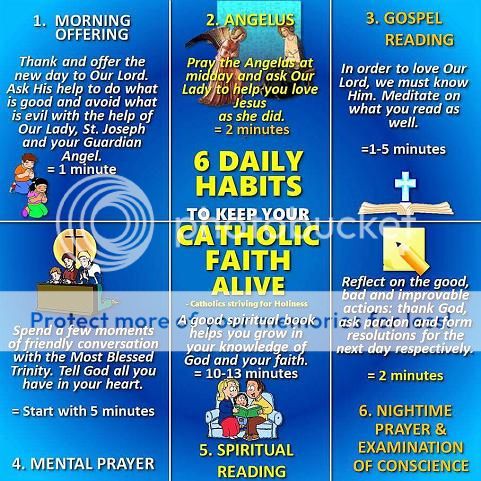
I am currently able to do #1 and #3 regularly, working on the rest with diligence! Let's pray for each other brothers and sisters! God bless and have a wonderful weekend! biggrin.gif

This post has been edited by khool: Jul 21 2017, 09:14 AM
khool
post Jul 21 2017, 02:12 PM

Getting Started
**
Junior Member
225 posts

Joined: Mar 2008


Amen! Amen!

Charlie Gard granted permanent residence in US by Congress 'to fly to America for treatment'

user posted image

Charlie Gard has reportedly been granted permanent residence in the US so he can travel to America to receive experimental treatment. The decision by US Congress may oblige Great Ormond Street Hospital to release the sick baby so he can receive nucleoside therapy.

Nebraska representative Jeff Fortenberry said an amendment has been passed "that grants permanent resident status to Charlie Gard and family so Charlie can get the medical treatment he needs".

Charlie, who has a rare genetic disease, is being kept on life support at the children's hospital amid an ongoing court battle between his parents, who want him to receive the treatment, and doctors, who say it is unlikely to work and it is kinder for life support to be switched off.

An American doctor flew to London this week to examine the critically ill baby as part of a last-ditch attempt to persuade a High Court judge the treatment stands a chance of working.

Charlie, who was born on 4 August 2016, has a faulty RRM2B gene, which affects the cells responsible for energy production and respiration, leaving him unable to move or breath without a ventilator.

Dr Michio Hirano, a neuroscientist from Columbia University in New York, is said to have spent over five hours trying to convince doctors, along with an expert from a Vatican hospital in Rome. The specialist told the High Court nucleoside therapy has a 10 per cent chance of improving Charlie's condition, adding his research “clearly indicates” it reduces muscle weakness in patients with a similar genetic disorder.

“This is the best scientific data we have,” he told the judge last week, adding he was prepared to extrapolate the findings on patients with TK2 depletion to Charlie’s genetic deficiency. “These are small numbers, but with very rare diseases we must use every patient and gather as much detail from each patient as possible.”

He said he hoped a high dose of nucleosides, which are found naturally in the body, would enter Charlie’s cells, affect the mitochondria and prove “therapeutic”.

But Katie Gollop QC, representing the hospital, called the doctor’s findings “all very theoretical”, saying: “You're trying to translate one experiment to another.”

Charlie being granted permanent residence in the US could mean his parents Connie Yates and Chris Gard, in their thirties, no longer need permission from doctors at Great Ormond Street to take him across the Atlantic for treatment, according to MailOnline.

Currently police can be called into arrest the parents if doctors believe they will cause suffering to their child.

It was previously reported Charlie had been granted US citizenship.

Source: http://www.independent.co.uk/News/health/c...f-a7848391.html


This post has been edited by khool: Jul 22 2017, 08:37 AM
khool
post Jul 21 2017, 03:31 PM

Getting Started
**
Junior Member
225 posts

Joined: Mar 2008


Sixteenth Ordinary Sunday Year A
Go to Sleep, Let God fix it


user posted image

After listening to complaints from parishioners for over thirteen years, I’ve come to realise that the common request or suggestion is that I should summarily reprimand, remove or dismiss all the ‘troublemakers’ in the parish. However, my usual reply is that if I were to act on every complaint, including the complains I get about the complainers; then I would end up sacking over 90% of the people in the parish! That answer is very unpopular, because many parishioners would expect me to be more pro-active and play tough (ironically, I must be tough only with the others, never with the complainers). But I guess this tendency goes beyond the parish. We seem to have a natural human desire to root out and destroy all that troubles us. We want to look for the final solution to all our problems. But in doing so, we end up devising greater suffering. Perhaps, the best example of this point is found in the Nazi’s Final Solution – millions of Jews and other nationalities and differently able persons had to die in this mad search for perfection. The very defenders of peace eventually turned into the greatest perpetrators of violence.

Strangely, it is not the Hitlers, the Pol Pots or the Lenins of this world that are solely guilty of such horrendous crimes. The trait is also present with many well-intentioned activists, visionaries who believe that it is incumbent upon them to fix the problem where they see fit, whether it be in society, the Church or the world. Some people just can’t stop themselves from meddling. We have to fix it; get rid of the undesirables. Do it our way. The problem with 'people with a cause', is that they often do more harm for their cause than if they did nothing at all. Trying to bend the world or reform the Church or shape others according to the way they see it. So they spend a great deal of effort and time trying to control what can’t be controlled. Even though their original motive may have been noble, they actually make things worse, whilst trying to make them better. Instead of building God’s kingdom, they end up building their own. They get in God’s way.

Today’s set of three parables are bent on frustrating these would-be Saviours of the world. They go against the grain because it seems to be soft on evil. In light of recent terrorist attacks, it seems not only naive, but it leaves us with few good options. Kill all the terrorists! We don’t have to look too far. There are the progressive-liberals within the Church who certainly believe that the Church would be much better off without all the conservative fuddy-duddies who seem to hold back the Church in her progress, and the defenders of Tradition who feel frustrated that God doesn’t seem to be doing anything about the liberal heretics who are ruining the Church and dragging her to hell. It even looks like God is either asleep on the job or His incompetent cousin is running things from the parlour. And we’re left to wonder who’s in charge out there?

In the first parable, in response to the servants’ desire to root out the darnel, to fix the problem, the Master orders, “Let them both grow till the harvest.” This is a stunning proposal: Just leave the weeds alone? You mean, “Let them have their way?” On the surface, the parable seems to be calling for passivity in the face of evil or worse, the tolerance of evil. Why would the master say what he said to his servants?

The counsel of Jesus is prudent. It is a reminder that life can be messy and we need not and should not play God or vigilantes. Since this is God’s Kingdom, He should be in charge. He sets the agenda, He lays out the path, and He determines the deadline. The problem is that the difference between the wheat and darnel is not always going to be obvious, and that there is potential danger of mistaking the good for the bad, the will of man for that of the will of God. Furthermore, one may find both wheat and darnel mixed up within every person. Goodness and evil, love and hate, prosperity and adversity, joy and sorrow all are so intimately intertwined. We may risk getting rid of the good in our zealous desire to root out the bad. Destroy the possibility of evil and you also destroy the possibility of goodness.

The patience of the farmer in letting the darnel grow on until harvest time, exemplifies the infinite mercy of God toward sinners. The parable reminds us that sinners are to be dealt with patiently, it offers us assurance that in the end God’s way will be victorious. That one day “the virtuous will shine like the sun in the kingdom of their Father”. The darnel could not change its nature, but the sinner can change his ways and God gives him every chance and every help to do this, up to his last moment of life. But in the end, there will be Judgment.

We must learn a double lesson of patience from this parable. First, to be patient with those who make our spiritual progress more difficult for us—they are actually helping us to be better Christians if we bear with patience the injuries they inflict on us. Second, we must try to imitate the patience God shows in His dealings with sinners. Such patience, however, can never be interpreted as mere passivity. I don’t think God wants us to wait ‘patiently,’ twiddle our thumbs and do nothing. We should never tire of striving against evil. While we must not approve of evil deeds or sins of others, we must still look on them as our brothers and sisters and do all in our power to put them back on the right road to heaven. We can do this by good example, and by fervent prayer for their conversion. We should also be rooting evil and sin within ourselves by making frequent confessions. Where it is opportune, to engage the other in fraternal correction, for it is an act of mercy to admonish the sinner and instruct the ignorant.

The additional two parables of the mustard seed and the leaven reinforce the message of the first. Rather than expecting smooth unhindered growth, we must accept that the growth of the Kingdom is always a messy affair and something beyond our perception. Don’t panic when you only perceive chaos. God remains in charge. Everything may seem to be getting completely out of control. But God remains in control. God does not only tolerate the messiness but in fact subverts the messiness and uses it as the raw material of His Kingdom. He often chooses and uses the defective, the rejects, the marginalised, the sinners, “the mustard seed(s)” and “leaven of this world” to be His instruments of grace.

We long for the time when the Kingdom will be complete, but that perfection would not be found in any earthly or human Utopia. For now we have to recognise that this is the way that God creates and works, and brings good life. God allows the mess. He demonstrates the value of the mess through the death of His Son on the cross. At the moment of the cross, it becomes clear that evil is utterly subverted for good. The Kingdom is built on the blood of martyrs, rather than on success stories. Persecution cannot destroy the Church, it can only make it stronger.

These parables provide enormous encouragement to all of us – God is in-charge! There is a story told about Pope St John XXIII, the architect of the Second Vatican Council, whose personal name was Angelo Giuseppe Roncalli. When he prayed, he had a habit of ending his lengthy prayers each night, by talking to himself. After a day of laborious church-work, he’d ask himself this question after struggling with insolvable church problems: “So who governs the church? You or God? Very well, then Angelo, go to sleep.” He got it right. Let God be God and let Him take charge. It’s comforting to know that although we are not able to fix everything, solve every problem, find closure to every issue, there is someone who can. Good to remember, “who governs the world, who governs the Church? You or God? Very well, go to sleep!”

Source: http://michaelckw.blogspot.my/

khool
post Jul 22 2017, 08:47 AM

Getting Started
**
Junior Member
225 posts

Joined: Mar 2008


Feast of Saint Mary Magdalene
Lectionary: 603


user posted image

Reading 1 (Sgs 3:1-4b)

The Bride says:
On my bed at night I sought him
whom my heart loves–
I sought him but I did not find him.
I will rise then and go about the city;
in the streets and crossings I will seek
Him whom my heart loves.
I sought him but I did not find him.
The watchmen came upon me,
as they made their rounds of the city:
Have you seen him whom my heart loves?
I had hardly left them
when I found him whom my heart loves.

OR

(2 Cor 5:14-17)

Brothers and sisters:
The love of Christ impels us,
once we have come to the conviction that one died for all;
therefore, all have died.
He indeed died for all,
so that those who live might no longer live for themselves
but for him who for their sake died and was raised.

Consequently, from now on we regard no one according to the flesh;
even if we once knew Christ according to the flesh,
yet now we know him so no longer.
So whoever is in Christ is a new creation:
the old things have passed away;
behold, new things have come.

Responsorial Psalm (Ps 63:2, 3-4, 5-6, 8-9)

R. My soul is thirsting for you, O Lord my God.

O God, you are my God whom I seek;
for you my flesh pines and my soul thirsts
like the earth, parched, lifeless and without water.
R. My soul is thirsting for you, O Lord my God.

Thus have I gazed toward you in the sanctuary
to see your power and your glory,
For your kindness is a greater good than life;
my lips shall glorify you.
R. My soul is thirsting for you, O Lord my God.

Thus will I bless you while I live;
lifting up my hands, I will call upon your name.
As with the riches of a banquet shall my soul be satisfied,
and with exultant lips my mouth shall praise you.
R. My soul is thirsting for you, O Lord my God.

You are my help,
and in the shadow of your wings I shout for joy.
My soul clings fast to you;
your right hand upholds me.
R. My soul is thirsting for you, O Lord my God.

Alleluia

R. Alleluia, alleluia.
Tell us, Mary, what did you see on the way?
I saw the glory of the risen Christ, I saw his empty tomb.
R. Alleluia, alleluia.

Gospel (Jn 20:1-2, 11-18)

On the first day of the week,
Mary Magdalene came to the tomb early in the morning,
while it was still dark,
and saw the stone removed from the tomb.
So she ran and went to Simon Peter
and to the other disciple whom Jesus loved, and told them,
"They have taken the Lord from the tomb,
and we don't know where they put him."

Mary stayed outside the tomb weeping.
And as she wept, she bent over into the tomb
and saw two angels in white sitting there,
one at the head and one at the feet
where the Body of Jesus had been.
And they said to her, "Woman, why are you weeping?"
She said to them, "They have taken my Lord,
and I don't know where they laid him."
When she had said this, she turned around and saw Jesus there,
but did not know it was Jesus.
Jesus said to her, "Woman, why are you weeping?
Whom are you looking for?"
She thought it was the gardener and said to him,
"Sir, if you carried him away,
tell me where you laid him,
and I will take him."
Jesus said to her, "Mary!"
She turned and said to him in Hebrew,
"Rabbouni," which means Teacher.
Jesus said to her,
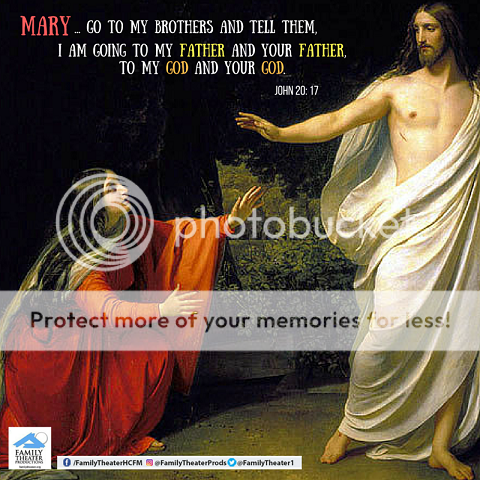
"Stop holding on to me, for I have not yet ascended to the Father.
But go to my brothers and tell them,
'I am going to my Father and your Father,
to my God and your God.'"
Mary Magdalene went and announced to the disciples,
"I have seen the Lord,"
and then reported what he told her.

user posted image

REFLECTION

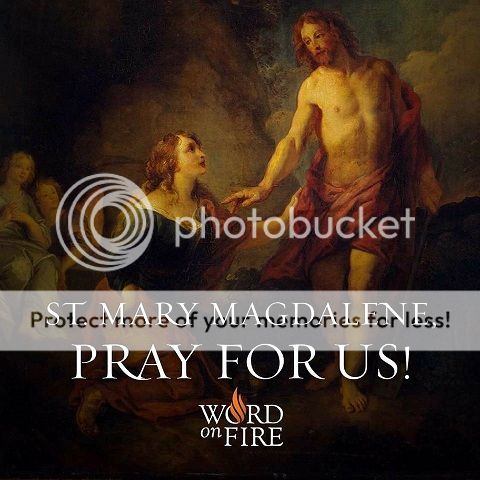
Woman, Why are you weeping? Twice this is asked in the story. The angels first question Mary of Magdala outside the tomb. The second time Jesus asks it when she turns around.

Mary’s response is the same. It comes from the wrong premise that the Lord’s body has been stolen or that the gardener has transferred it somewhere. Is it enough reason to cry? People weep to express sadness over the death of their loved ones. Mary weeps out of anger and frustration.

At any rate, Mary stops weeping when she recognizes Jesus. This happens when Jesus calls her by name. It is not the timber of Jesus’ voice or His new look that makes her recognize him but her personal name as pronounced by Jesus Himself. That may be how Jesus called her, and it has made her recall their former master-disciple relationship.

What can be more interesting than weeping? Well, in that joyous encounter that involves touching like Thomas, Jesus asks her to inform the Apostles of His ascension to heaven. Thus, Mary becomes the first woman missionary of the risen Lord, the first to announce His future whereabouts.

user posted image

user posted image

SOURCE: “365 Days with the Lord 2017,” ST. PAULS Philippines, 7708 St. Paul Rd., SAV, Makati City (Phils.) http://www.ssp.ph/

This post has been edited by khool: Jul 22 2017, 08:56 AM
khool
post Jul 22 2017, 09:00 AM

Getting Started
**
Junior Member
225 posts

Joined: Mar 2008


user posted image

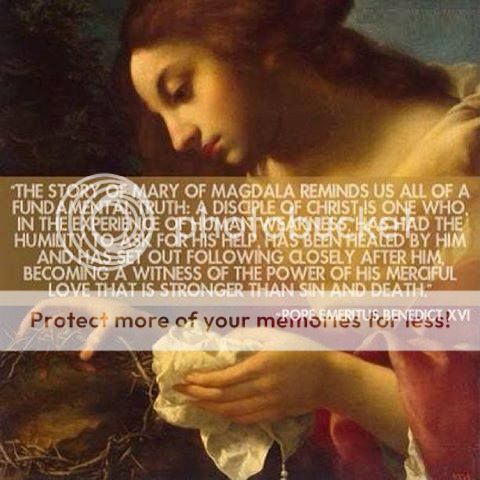
The feast of St. Mary Magdalene is considered one of the most mystical of feasts, and it is said that of all the songs of the saints, that of Mary Magdalene is the sweetest and strongest because her love was so great. That love was praised by Jesus Himself who said that because much was forgiven her, she loved much.

❝She whom Luke calls the sinful woman, whom John calls Mary, we believe to be the Mary from whom seven devils were ejected according to Mark. What did these seven devils signify, if not all the vices? It is clear, that the woman previously used the unguent to perfume her flesh in forbidden acts. What she therefore displayed more scandalously, she was now offering to God in a more praiseworthy manner. She had coveted with earthly eyes, but now through penitence these are consumed with tears. She displayed her hair to set off her face, but now her hair dries her tears. She had spoken proud things with her mouth, but in kissing the Lord’s feet, she now planted her mouth on the Redeemer’s feet. For every delight, therefore, she had had in herself, she now immolated herself. She turned the mass of her crimes to virtues, in order to serve God entirely in penance.❞

user posted image

—St. Gregory the Great, Pope and Doctor of the Church.

This post has been edited by khool: Jul 22 2017, 09:08 AM
khool
post Jul 23 2017, 11:27 AM

Getting Started
**
Junior Member
225 posts

Joined: Mar 2008


Sixteenth Sunday in Ordinary Time
Lectionary: 106

user posted image

Reading 1 (WIS 12:13, 16-19)

There is no god besides you who have the care of all,
that you need show you have not unjustly condemned.
For your might is the source of justice;
your mastery over all things makes you lenient to all.
For you show your might when the perfection of your power is disbelieved;
and in those who know you, you rebuke temerity.
But though you are master of might, you judge with clemency,
and with much lenience you govern us;
for power, whenever you will, attends you.
And you taught your people, by these deeds,
that those who are just must be kind;
and you gave your children good ground for hope
that you would permit repentance for their sins.

Responsorial (Psalm PS 86:5-6, 9-10, 15-16)

R. Lord, you are good and forgiving.

You, O LORD, are good and forgiving,
abounding in kindness to all who call upon you.
Hearken, O LORD, to my prayer
and attend to the sound of my pleading.
R. Lord, you are good and forgiving.

All the nations you have made shall come
and worship you, O LORD,
and glorify your name.
For you are great, and you do wondrous deeds;
you alone are God.
R. Lord, you are good and forgiving.

You, O LORD, are a God merciful and gracious,
slow to anger, abounding in kindness and fidelity.
Turn toward me, and have pity on me;
give your strength to your servant.
R. Lord, you are good and forgiving.

Reading (2 ROM 8:26-27)

Brothers and sisters:
The Spirit comes to the aid of our weakness;
for we do not know how to pray as we ought,
but the Spirit himself intercedes with inexpressible groanings.
And the one who searches hearts
knows what is the intention of the Spirit,
because he intercedes for the holy ones
according to God's will.

Alleluia (MT 11:25)

R. Alleluia, alleluia.
Blessed are you, Father, Lord of heaven and earth;
you have revealed to little ones the mysteries of the kingdom.
R. Alleluia, alleluia.

Gospel (MT 13:24-43 )

Jesus proposed another parable to the crowds, saying:
"The kingdom of heaven may be likened
to a man who sowed good seed in his field.
While everyone was asleep his enemy came
and sowed weeds all through the wheat, and then went off.
When the crop grew and bore fruit, the weeds appeared as well.
The slaves of the householder came to him and said,
'Master, did you not sow good seed in your field?
Where have the weeds come from?'
He answered, 'An enemy has done this.'
His slaves said to him,
'Do you want us to go and pull them up?'
He replied, 'No, if you pull up the weeds
you might uproot the wheat along with them.
Let them grow together until harvest;
then at harvest time I will say to the harvesters,
"First collect the weeds and tie them in bundles for burning;
but gather the wheat into my barn."'"

He proposed another parable to them.
"The kingdom of heaven is like a mustard seed
that a person took and sowed in a field.
It is the smallest of all the seeds,
yet when full-grown it is the largest of plants.
It becomes a large bush,
and the 'birds of the sky come and dwell in its branches.'"

He spoke to them another parable.
"The kingdom of heaven is like yeast
that a woman took and mixed with three measures of wheat flour
until the whole batch was leavened."

All these things Jesus spoke to the crowds in parables.
He spoke to them only in parables,
to fulfill what had been said through the prophet:
I will open my mouth in parables,
I will announce what has lain hidden from the foundation
of the world.

Then, dismissing the crowds, he went into the house.
His disciples approached him and said,
"Explain to us the parable of the weeds in the field."
He said in reply, "He who sows good seed is the Son of Man,
the field is the world, the good seed the children of the kingdom.
The weeds are the children of the evil one,
and the enemy who sows them is the devil.
The harvest is the end of the age, and the harvesters are angels.
Just as weeds are collected and burned up with fire,
so will it be at the end of the age.
The Son of Man will send his angels,
and they will collect out of his kingdom
all who cause others to sin and all evildoers.
They will throw them into the fiery furnace,
where there will be wailing and grinding of teeth.
Then the righteous will shine like the sun
in the kingdom of their Father.
Whoever has ears ought to hear."
user posted image

Homily (Excerpt): from Father Michael Chua Kim Wah

Today’s set of three parables are bent on frustrating these would-be Saviours of the world. They go against the grain because it seems to be soft on evil. In light of recent terrorist attacks, it seems not only naive, but it leaves us with few good options. Kill all the terrorists! We don’t have to look too far. There are the progressive-liberals within the Church who certainly believe that the Church would be much better off without all the conservative fuddy-duddies who seem to hold back the Church in her progress, and the defenders of Tradition who feel frustrated that God doesn’t seem to be doing anything about the liberal heretics who are ruining the Church and dragging her to hell. It even looks like God is either asleep on the job or His incompetent cousin is running things from the parlour. And we’re left to wonder who’s in charge out there?

In the first parable, in response to the servants’ desire to root out the darnel, to fix the problem, the Master orders, “Let them both grow till the harvest.” This is a stunning proposal: Just leave the weeds alone? You mean, “Let them have their way?” On the surface, the parable seems to be calling for passivity in the face of evil or worse, the tolerance of evil. Why would the master say what he said to his servants?

The counsel of Jesus is prudent. It is a reminder that life can be messy and we need not and should not play God or vigilantes. Since this is God’s Kingdom, He should be in charge. He sets the agenda, He lays out the path, and He determines the deadline. The problem is that the difference between the wheat and darnel is not always going to be obvious, and that there is potential danger of mistaking the good for the bad, the will of man for that of the will of God. Furthermore, one may find both wheat and darnel mixed up within every person. Goodness and evil, love and hate, prosperity and adversity, joy and sorrow all are so intimately intertwined. We may risk getting rid of the good in our zealous desire to root out the bad. Destroy the possibility of evil and you also destroy the possibility of goodness.

The patience of the farmer in letting the darnel grow on until harvest time, exemplifies the infinite mercy of God toward sinners. The parable reminds us that sinners are to be dealt with patiently, it offers us assurance that in the end God’s way will be victorious. That one day “the virtuous will shine like the sun in the kingdom of their Father”. The darnel could not change its nature, but the sinner can change his ways and God gives him every chance and every help to do this, up to his last moment of life. But in the end, there will be Judgment.

We must learn a double lesson of patience from this parable. First, to be patient with those who make our spiritual progress more difficult for us—they are actually helping us to be better Christians if we bear with patience the injuries they inflict on us. Second, we must try to imitate the patience God shows in His dealings with sinners. Such patience, however, can never be interpreted as mere passivity. I don’t think God wants us to wait ‘patiently,’ twiddle our thumbs and do nothing. We should never tire of striving against evil. While we must not approve of evil deeds or sins of others, we must still look on them as our brothers and sisters and do all in our power to put them back on the right road to heaven. We can do this by good example, and by fervent prayer for their conversion. We should also be rooting evil and sin within ourselves by making frequent confessions. Where it is opportune, to engage the other in fraternal correction, for it is an act of mercy to admonish the sinner and instruct the ignorant.

The additional two parables of the mustard seed and the leaven reinforce the message of the first. Rather than expecting smooth unhindered growth, we must accept that the growth of the Kingdom is always a messy affair and something beyond our perception. Don’t panic when you only perceive chaos. God remains in charge. Everything may seem to be getting completely out of control. But God remains in control. God does not only tolerate the messiness but in fact subverts the messiness and uses it as the raw material of His Kingdom. He often chooses and uses the defective, the rejects, the marginalised, the sinners, “the mustard seed(s)” and “leaven of this world” to be His instruments of grace.

We long for the time when the Kingdom will be complete, but that perfection would not be found in any earthly or human Utopia. For now we have to recognise that this is the way that God creates and works, and brings good life. God allows the mess. He demonstrates the value of the mess through the death of His Son on the cross. At the moment of the cross, it becomes clear that evil is utterly subverted for good. The Kingdom is built on the blood of martyrs, rather than on success stories. Persecution cannot destroy the Church, it can only make it stronger.

These parables provide enormous encouragement to all of us – God is in-charge! There is a story told about Pope St John XXIII, the architect of the Second Vatican Council, whose personal name was Angelo Giuseppe Roncalli. When he prayed, he had a habit of ending his lengthy prayers each night, by talking to himself. After a day of laborious church-work, he’d ask himself this question after struggling with insolvable church problems: “So who governs the church? You or God? Very well, then Angelo, go to sleep.” He got it right. Let God be God and let Him take charge. It’s comforting to know that although we are not able to fix everything, solve every problem, find closure to every issue, there is someone who can. Good to remember, “who governs the world, who governs the Church? You or God? Very well, go to sleep!”
user posted image

Source: http://michaelckw.blogspot.my/

This post has been edited by khool: Jul 23 2017, 11:34 AM

khool
post Jul 23 2017, 11:35 AM

Getting Started
**
Junior Member
225 posts

Joined: Mar 2008


user posted image

user posted image

TSyeeck
post Jul 23 2017, 01:16 PM

Look at all my stars!!
*******
Senior Member
3,573 posts

Joined: Apr 2006


What Protestantism and the New Atheism Have in Common
Karlo Broussard July 21, 2017

user posted image

If someone asked you, “What does the New Atheism have in common with Protestantism?” you might say, “Nothing!” It would seem that devout Bible believing Christians such as Protestants would be as far away from atheists as possible.

Yet there is more to this comparison than meets the eye. Protestants may not be similar to modern atheists in the content of their belief (e.g., God exists, Jesus is God, we will rise from the dead, etc.), but their approach to arriving at knowledge of their subject matter is similar.

A tale of two “onlys”
Consider how modern atheists restrict their rational inquiry about reality to science. For example, in a 2012 debate with former Archbishop Rowan Williams of Canterbury, popular atheist Richard Dawkins asserted that appealing to God to explain the universe in the place of science is “a phony substitute for an explanation” and “peddles false explanations where real explanations could have been offered.”

For Dawkins, science is the only thing that counts as a real explanation, and thus scientific knowledge is the only real form of knowledge. This view has led many to deny God’s existence based on the reason that there is no “evidence” for God. Take a recent caller to Catholic Answers Live for example. He expressed his doubt in the supernatural due to a lack of evidence.

When Trent Horn replied with the question, “Are you saying there is no evidence of the supernatural because science has not detected the supernatural?” the caller answered, “Correct.” For the caller, science is the only tool available for detecting the supernatural. And since he hasn’t found God with that tool, he chooses not to believe in God.

In a similar way, Protestants have a restrictive approach to arriving at knowledge of God’s revelation. They believe that the Bible alone is the infallible guide for knowing revealed truth, a belief we know as sola scriptura or “Scripture alone.”


Just as science is the only tool Dawkins and company are willing to use to arrive at knowledge of the natural truth, Protestants use only the Bible for determining what is revealed truth. And as many modern atheists reject anything that science cannot detect, so too do Protestants reject any teaching that is not found explicitly in the Bible. Where Dawkins and others like him are science-only atheists, Protestants are Bible-only Christians.

Not a real form of knowledge
A second note of similarity is that both scientism and sola scriptura are self-refuting ideas.

The statement, “Scientific knowledge is the only legitimate form of knowledge,” is not scientific knowledge—that’s to say, we cannot determine the truth-value of this statement using the scientific method. With what sense can we observe the truth of this statement? Or what scientific tests can we perform to prove this statement? The truth-value of scientism is not empirically verifiable nor quantifiably measurable, and consequently is not subject to scientific inquiry—it’s an assumption.

But this is a fatal problem for the believer in scientism—namely, scientism is not real knowledge. If science can’t verify the truth of scientism, then how can scientism itself be a legitimate form of knowledge?

The answer is, It can’t.

Why should anyone believe scientism is true if it’s not real knowledge? If scientism is not real knowledge, as implied in scientism itself, then it’s self-refuting, and thus should not be accepted as a reasonable worldview.

Similar to scientism, the Protestant doctrine of sola scriptura is self-refuting.

As mentioned, sola scriptura teaches that the Bible is the only infallible source for knowing God’s revelation. Therefore, if a teaching is not found explicitly (or perhaps even implicitly) in the Bible, then it’s not part of God’s revealed truth and thus not binding for salvation.

But notice the doctrine presupposes knowledge of what scriptura is. It presupposes knowledge of exactly which books are inspired by God and which books are not, and thus which books are to be counted as Scripture and which are not.

The problem for the Protestant is that his knowledge of exactly which books belong in the canon cannot be derived from the Bible. In other words, nowhere do we find in the Old Testament or the New Testament a list of historical books among the Jews or Christians that are believed to be inspired by God. There is no inspired table of contents.

So, if the Bible is the only source of infallible knowledge concerning God’s revelation, and the Bible never tells us which books are inspired by God, then how can a Protestant have infallible knowledge of which books are inspired by God? How could he know what scriptura is?

Even if a Protestant develops extra-biblical positive criteria for determining whether a specific writing is inspired (e.g., written by an apostle or prophet that performed miracles and claimed to be inspired), he would still not be able to rule out other writings that don’t fit his criteria—e.g., Mark and Luke’s Gospel, Hebrews, the Didache, the Epistle of Clement, the Epistle of Barnabas, and the Shepherd of Hermas.

Furthermore, to appeal to such extra-biblical criteria would be to violate the doctrine of sola scriptura, since such an appeal would be relying on a non-biblical guide for determining God’s revelation.

The bottom line is that a Protestant can’t have infallible knowledge of exactly which writings belong in the canon of Scripture within the framework of sola scriptura. And if he can’t know what scripture is, then Scripture can’t be the only infallible source for knowing God’s revelation. In other words, sola scriptura can’t be true.

The need for an infallible voice
The only way to know exactly which books are inspired by God is if there exists an infallible authority outside the Bible that can speak on God’s behalf. Catholic hold that authority to exist in the pope and the bishops in union with him. But Protestants reject this idea, which gives rise to another conundrum.

If no infallible voice outside the Bible exists, and Protestants believe that our knowledge of which books are inspired is infallible, then we would have an infallible effect produced by a fallible cause, which is absurd.

I highlight the incoherencies of these foundational beliefs of the New Atheism and Protestantism because, as happens so often with erroneous beliefs, they are based on false assumptions. And it is these false assumptions that stand in the way of people coming to know the fullness of truth subsisting in the Catholic Church.

If we can expose these false assumptions, then we put those whom we’re evangelizing one step closer to experiencing the joy God intends for them to experience in the Catholic Church.
khool
post Jul 24 2017, 09:34 AM

Getting Started
**
Junior Member
225 posts

Joined: Mar 2008


Monday of the Sixteenth Week in Ordinary Time
Lectionary: 395


user posted image

Reading 1 (Ex 14:5-18)

When it was reported to the king of Egypt
that the people had fled,
Pharaoh and his servants changed their minds about them.
They exclaimed, "What have we done!
Why, we have released Israel from our service!"
So Pharaoh made his chariots ready and mustered his soldiersB
six hundred first-class chariots
and all the other chariots of Egypt, with warriors on them all.
So obstinate had the LORD made Pharaoh
that he pursued the children of Israel
even while they were marching away in triumph.
The Egyptians, then, pursued them;
Pharaoh's whole army, his horses, chariots and charioteers,
caught up with them as they lay encamped by the sea,
at Pi-hahiroth, in front of Baal-zephon.

Pharaoh was already near when the children of Israel looked up
and saw that the Egyptians were on the march in pursuit of them.
In great fright they cried out to the LORD.
And they complained to Moses,
"Were there no burial places in Egypt
that you had to bring us out here to die in the desert?
Why did you do this to us?
Why did you bring us out of Egypt?
Did we not tell you this in Egypt, when we said,
'Leave us alone. Let us serve the Egyptians'?
Far better for us to be the slaves of the Egyptians
than to die in the desert."
But Moses answered the people,
"Fear not! Stand your ground,
and you will see the victory the LORD will win for you today.
These Egyptians whom you see today you will never see again.
The LORD himself will fight for you; you have only to keep still."

Then the LORD said to Moses, "Why are you crying out to me?
Tell the children of Israel to go forward.
And you, lift up your staff and, with hand outstretched over the sea,
split the sea in two,
that the children of Israel may pass through it on dry land.
But I will make the Egyptians so obstinate
that they will go in after them.
Then I will receive glory through Pharaoh and all his army,
his chariots and charioteers.
The Egyptians shall know that I am the LORD,
when I receive glory through Pharaoh
and his chariots and charioteers."

Responsorial Psalm (Ex 15:1bc-2, 3-4, 5-6)

R. Let us sing to the Lord; he has covered himself in glory.

I will sing to the LORD, for he is gloriously triumphant;
horse and chariot he has cast into the sea.
My strength and my courage is the LORD,
and he has been my savior.
He is my God, I praise him;
the God of my father, I extol him.
R. Let us sing to the Lord; he has covered himself in glory.

The LORD is a warrior,
LORD is his name!
Pharaoh's chariots and army he hurled into the sea;
the elite of his officers were submerged in the Red Sea.
R. Let us sing to the Lord; he has covered himself in glory.

The flood waters covered them,
they sank into the depths like a stone.
Your right hand, O LORD, magnificent in power,
your right hand, O LORD, has shattered the enemy.
R. Let us sing to the Lord; he has covered himself in glory.

Alleluia (Ps 95:8)

R. Alleluia, alleluia.
If today you hear his voice,
harden not your hearts.
R. Alleluia, alleluia.

Gospel (Mt 12:38-42)

Some of the scribes and Pharisees said to Jesus,
"Teacher, we wish to see a sign from you."
He said to them in reply,
"An evil and unfaithful generation seeks a sign,
but no sign will be given it
except the sign of Jonah the prophet.
Just as Jonah was in the belly of the whale three days and three nights,
so will the Son of Man be in the heart of the earth
three days and three nights.
At the judgment, the men of Nineveh will arise with this generation
and condemn it, because they repented at the preaching of Jonah;
and there is something greater than Jonah here.
At the judgment the queen of the south will arise with this generation
and condemn it, because she came from the ends of the earth
to hear the wisdom of Solomon;
and there is something greater than Solomon here."

user posted image

REFLECTION

There is something greater than Jonah… Solomon here. The scribes and Pharisees refuse to believe in Jesus though they have witnessed His miracles and heard His teachings. They demand still another sign.

Jesus does not take the bait; He knows they are just playing games with Him. In fact, His reply sounds harsh. He considers them an evil and unfaithful generation unworthy of miracles. Enough is enough. Another miracle will be useless, for they will not believe and repent anyway. The people of Nineveh fared much better; they repented when they heard Jonah preach. Earlier, the pagan Queen of Sheba traveled far to listen to the wisdom of Solomon. The Pharisees do not realize that Jesus is greater than Jonah and Solomon.

The Jews have a rich spiritual heritage. They have the prophets like Jonah and sages like Solomon. But their religious leaders do not accept Jesus and His good news.

We Christians acknowledge Jesus as our greatest teacher. Yet many of us still demand miracles. The message of Jonah should suffice: Repent and believe.

Do you just consider Jesus as the greatest miracle calling you to life? What greater sign can there be for us Christians than His resurrection?

SOURCE: “365 Days with the Lord 2017,” ST. PAULS Philippines, 7708 St. Paul Rd., SAV, Makati City (Phils.) http://www.ssp.ph/

khool
post Jul 24 2017, 09:39 AM

Getting Started
**
Junior Member
225 posts

Joined: Mar 2008


The Saint who Died Rather than Give Up his Rosary

Blessed Ceferino Giménez Malla seemed like just another old man devoted to prayer … but he ended up a martyr.

Towards the end of his life, Blessed Ceferino Giménez Malla (1861-1936) probably looked like a thousand other old men praying the Rosary after daily Mass. But his path to holiness wasn’t typical, nor was his pursuit of virtue. When he was shot for praying that same Rosary, nobody who knew him was surprised that in the end he had given his life for God.

The very fact that Ceferino’s holiness was taken for granted is remarkable given his ethnicity; Malla was Romani (a people often pejoratively referred to as Gypsies) and grew up in a world that looked down on him for his origin and lifestyle. Rather than become embittered or abandon his people, Ceferino embraced the Roma way of life and acted as a bridge between Kalos (his particular tribe) and Spaniards.

user posted image

Ceferino was raised in a poor, wandering family of basket-weavers who moved from village to village in Spain and southern France. Though he was baptized as an infant, accounts of Ceferino’s youth tell us little about his faith life. The fact that he prayed in Catalan indicates that he likely learned his prayers when living in Catalonia as a child, but his marriage outside the Church at 18 could indicate that his religious formation wasn’t terribly strong.

He may not have known his faith, but Ceferino strove nevertheless for goodness. After he and his wife Teresa were married in a traditional Roma ceremony, Ceferino became a horse trader, a profession known for its dishonesty. But Ceferino, though he was talented and successful, refused to deceive. His natural virtue made him a good businessman, despite the fact that he had no formal schooling and was entirely illiterate, and his generosity and willingness to risk himself for others made him many friends. Once the former mayor of Barbastro, the city in which Ceferino and his wife eventually settled, began coughing up blood in the public square. Fearful of tuberculosis, those around him fled, but Ceferino, known as El Pelé (“the strong one” or “the brave one”), helped the man home. His grateful family gave El Pelé a large sum of money, which he used to make quite a fortune as a horse trader.

As the years went by, Ceferino went from good to holy. Thirty-two years after his tribal marriage to Teresa, the couple finally celebrated the sacrament of Marriage in the Church. Soon El Pelé was a daily Communicant, praying the Rosary daily and acting as a peacemaker between Kalos and Spaniards. Though he and his wife were unable to have children, they adopted Teresa’s niece Pepita and Ceferino was a marvelous father and later a grandfather who delighted in his grandchildren.

Ceferino was once accused of selling stolen horses but was able to present documents clearing his name. When he was acquitted, his lawyer proclaimed, “El Pelé is not a thief, he is Saint Ceferino, patron of Gypsies.” Ceferino walked on his knees to the cathedral to give thanks, but there were no jeers or rolled eyes; the people of Barbastro knew that El Pelé was something special.

In 1922 Ceferino’s wife died, but he didn’t allow his sorrow to push him from God. He became a Third Order Franciscan and a member of the Society of St. Vincent de Paul, so generous that despite his great fortune he became quite poor later in life, “ruined” by his refusal to allow others, particularly poor Roma, to go without. Though he was illiterate, he knew the faith well and became a catechist, telling stories of Jesus to captivated children before giving them a piece of chocolate and sending them on their way. He wore elegant clothes and loved dancing, village fairs, and Roma feasts. All in all, he was a kind and generous old man much like many kind and generous old men in every parish in the world.

But Ceferino was also a Catholic living in Spain during the Spanish Civil War at a time when anti-Catholic sentiment was enshrined in law. One day he saw a priest being arrested and called for the soldiers to stop. They turned on him, asking if he had a weapon. “Only this,” El Pelé answered, holding up his rosary. He was beaten for it and dragged to jail.

In prison, he prayed the Rosary faithfully, antagonizing his anti-Catholic captors. He was advised by an anarchist that if he stopped praying so obviously his life might be saved. His daughter visited, begging him to give up his rosary. But for El Pelé to do so, he felt, would be to deny his faith. And so the dignified grandfather was executed and thrown in a mass grave. Sixty years later, he became the first of the Romani ever to be beatified.

On May 4, his feast day, let’s ask his intercession for the strengthening of marriage, for adoptive parents, and for the Romani people.

Blessed Ceferino Giménez Malla, pray for us!

Source: http://catholicamen.com/saint-died-rather-give-rosary/

khool
post Jul 24 2017, 02:06 PM

Getting Started
**
Junior Member
225 posts

Joined: Mar 2008


Who Should We Pray For?

user posted image

God is always attentive to the humble supplication of a pure and sincere heart. Jesus commanded us to pray with these words: “Ask and you will receive; seek and you will find; knock and the door will be opened to you…” (Mt. 7:7) Therefore, obeying the command of the Lord Himself we should ask, seek, and knock trusting that we will be heard and our prayers granted.

Prayer is an open communication with God; prayer is a conversation with Someone who we know listens to us and loves us most ardently; prayer is communication and dialogue with a Friend; prayer is the pious lifting up of the mind and the heart to God. What air is to the lungs, so prayer is to the soul; it is essential! The great Saint Augustine expresses prayer using this poetic and rhythmic expression: “He who prays well, lives well; he who lives well, dies well; he who dies well, all is well.” In other words, the salvation of our immortal soul depends upon a fervent and dynamic prayer life.

Still, there is the burning question: who then should we pray for? Is there a certain hierarchy or a list in priority as to whom we should pray for first? The response: we can and should pray for everybody in the entire world. This for the simple reason that God created all people on the face of the earth to know Him, love Him, and serve Him in this life, so as to be happy with Him in Heaven. All were created for eternal Beatitude—meaning happiness—in heaven.

A group of persons very dear to the Sacred Heart of Jesus, as well as the Immaculate Heart of the Blessed Virgin Mary, would be sinners, especially those sinners whose souls are in most danger of being lost for all eternity.

Our Lady of Fatima, as well as Our Lady of Lourdes, both insisted on prayer, but most especially praying for the conversion of poor sinners. After each decade of the Rosary Our Lady of Fatima insisted that we pray: “O my Jesus, forgive us our sins; save us from the fires of hell and lead all souls to heaven, especially those most in need of your mercy.”

Therefore, so as to enrich your prayer of intercession we will propose a list of certain sinners that we should have most close to our heart as we pray. We might use Saint Monica as a model for prayer of intercession for the conversion of sinners. Due to her prayers, her mother-in-law, her husband Patricius, and finally her wayward son, Saint Augustine—all of them were converted, and of course one became a great saint!

Who Should We Pray For?

1. Those blind to their condition. We should lift up our prayers on high for that group of persons—and there are many, very many today—who actually deny that they have any sin whatsoever. Pope Pius XII asserted:“The sin of the century is the loss of the sense of sin.” Jesus came to save sinners. If we deny that we are sinners, then how can Jesus the Savior actually save us. Never forget: Jesus came to save sinners!

2. Slaves to addiction. On our list of priorities, we should definitely implore the Lord’s abundant mercy for those who are slaves to addictions, those who seem unable to break the chains of sin that are enslaving them. Addictions today are many: drugs, drink, sex, porn, gambling, buying, stealing, and many more. May Jesus attain for them the true freedom of the sons and daughters of God by helping them to smash the chains of these addictions!

3. Despairing Souls. Another very critical category of souls to pray for is those who are despairing, those who have lost all hope. These are those souls who believe that their sins are so serious and many that they go beyond the pale of God’s mercy. Actually, the worst of all sins, as expressed in the Diary of Mercy In My Soul by Saint Faustina Kowalska, is the failure to trust in the infinite mercy that flows from the loving Heart of Jesus, pierced by the lance on that first Good Friday.

4. Anger and Hatred. Another very important group of souls who make up part of our prayer of intercession are those souls who have been so beaten, wounded, pummeled and lacerated in life by others that they are filled with gaping wounds of anger and hatred that are so deep, foul, and festering that they do not even want to turn to the Divine Physician to be healed and saved. Of course we know that one of the primary missions of the Lord Jesus was to heal wounded humanity. The blind, the deaf, the mute, the lepers, and the paralytics were drawn to Jesus like a magnet and because of their faith they were healed.

Let us pray for those who are deeply wounded by anger and hatred, that they will turn to Jesus and be healed and renewed. Of course the best model to follow for those who have been literally blinded by anger and hatred because of those who have wounded them, is Jesus Himself as He hung on the cross. Basically the Body of Jesus was a gaping wound from head to foot. Yet Jesus taught us the power of love, mercy, and forgiveness with these words: “Father, forgive them, for they know not what they are doing.” Let us turn to Jesus! Either we are wounded wounders or we are wounded healers! May those embittered by past wounds turn to Jesus for healing so that they can one day become wounded healers in a broken and wounded world.

5. Those who are dying. Of primary importance we should lift our fervent and zealous prayers for this very important category: sinners who are about to die; we call them deathbed sinners! These are individuals who are dying in the state of mortal sin, thereby separating themselves from God. Now, if they die in this state of unrepentant mortal sin they will lose their soul for all eternity—the worse fate that could befall any person! What can we do? Jesus promised in the Diary of Saint Faustina that when we pray the Chaplet of Divine Mercy for those who are dying, then these souls in some mysterious way will be saved for all eternity. Therefore, if you are ever present at the deathbed of any person, and this could be a fallen away Catholic, Christian, Moslem, Buddhist or Hindu, agnostic or even atheist, then for the love of God and for the eternal salvation of this soul pray the Chaplet of Divine Mercy. If done, Jesus promised in the Diary of Divine Mercy that this person’s soul will be saved.

In conclusion, let us pray, and pray often and fervently. However, let us make it a point to pray in a very special way for sinners. Our Lady of Fatima stated that many souls are lost because there is nobody to pray for them. Let us pray through the Immaculate Heart of Mary for the salvation of countless sinners. May they turn to the merciful Heart of Jesus and be saved for all eternity!

Source: http://catholicexchange.com/who-should-we-pray-for

khool
post Jul 25 2017, 10:36 AM

Getting Started
**
Junior Member
225 posts

Joined: Mar 2008


Feast of Saint James, Apostle
Lectionary: 605


user posted image

Reading 1 (2 Cor 4:7-15)

Brothers and sisters:
We hold this treasure in earthen vessels,
that the surpassing power may be of God and not from us.
We are afflicted in every way, but not constrained;
perplexed, but not driven to despair;
persecuted, but not abandoned;
struck down, but not destroyed;
always carrying about in the body the dying of Jesus,
so that the life of Jesus may also be manifested in our body.
For we who live are constantly being given up to death
for the sake of Jesus,
so that the life of Jesus may be manifested in our mortal flesh.

So death is at work in us, but life in you.
Since, then, we have the same spirit of faith,
according to what is written, I believed, therefore I spoke,
we too believe and therefore speak,
knowing that the one who raised the Lord Jesus
will raise us also with Jesus
and place us with you in his presence.
Everything indeed is for you,
so that the grace bestowed in abundance on more and more people
may cause the thanksgiving to overflow for the glory of God.

Responsorial Psalm (Ps 126:1bc-2ab, 2cd-3, 4-5, 6)

R. Those who sow in tears shall reap rejoicing.

When the LORD brought back the captives of Zion,
we were like men dreaming.
Then our mouth was filled with laughter,
and our tongue with rejoicing.
R. Those who sow in tears shall reap rejoicing.

Then they said among the nations,
"The LORD has done great things for them."
The LORD has done great things for us;
we are glad indeed.
R. Those who sow in tears shall reap rejoicing.

Restore our fortunes, O LORD,
like the torrents in the southern desert.
Those that sow in tears
shall reap rejoicing.
R. Those who sow in tears shall reap rejoicing.

Although they go forth weeping,
carrying the seed to be sown,
They shall come back rejoicing,
carrying their sheaves.
R. Those who sow in tears shall reap rejoicing.

Alleluia (Jn 15:16)

R. Alleluia, alleluia.
I chose you from the world,
to go and bear fruit that will last, says the Lord.
R. Alleluia, alleluia.

Gospel (Mt 20:20-28)

The mother of the sons of Zebedee approached Jesus with her sons
and did him homage, wishing to ask him for something.
He said to her,
"What do you wish?"
She answered him,
"Command that these two sons of mine sit,
one at your right and the other at your left, in your Kingdom."
Jesus said in reply,
"You do not know what you are asking.
Can you drink the chalice that I am going to drink?"
They said to him, "We can."
He replied,
"My chalice you will indeed drink,
but to sit at my right and at my left, this is not mine to give
but is for those for whom it has been prepared by my Father."
When the ten heard this,
they became indignant at the two brothers.
But Jesus summoned them and said,
"You know that the rulers of the Gentiles lord it over them,
and the great ones make their authority over them felt.
But it shall not be so among you.
Rather, whoever wishes to be great among you shall be your servant;
whoever wishes to be first among you shall be your slave.
Just so, the Son of Man did not come to be served
but to serve and to give his life as a ransom for many."

user posted image

REFLECTION

Whoever wishes to be first among you shall be your slave. This Jesus’ saying is prompted by a mother, the wife of Zebedee. She must be following the group of Jesus, maybe paying special attention only to her sons, James and John. Though she has been with the group, she has not yet learned much from Jesus. So she asks a special favor for her sons as they draw near Jerusalem where Jesus will be exalted in His Kingdom. For her, it will be payback time for sacrificing her two sons for Jesus.

Jesus grabs this occasion to teach all the disciples in her hearing about the first or greatest. God’s standard for greatness is entirely different from that of the world. It is the slave, the servant of all, who is the first. For Jesus, to be a disciple is to follow the path of servanthood. Serving the needs of the brothers on a journey is a sign of greatness. It is not about sitting at his left or right later. Greatness is possible now.

Jesus will soon demonstrate on Mount Calvary what He ultimately means. As a servant, He will submit Himself to death. He will give His life to ransom sinners. He will take on the punishments due to them.

Are you a servant willing to suffer for others or do you want to be honored without paying the price?

user posted image

SOURCE: “365 Days with the Lord 2017,” ST. PAULS Philippines, 7708 St. Paul Rd., SAV, Makati City (Phils.) http://www.ssp.ph/

khool
post Jul 25 2017, 03:28 PM

Getting Started
**
Junior Member
225 posts

Joined: Mar 2008


St. James the Greater
APOSTLE AND PATRON SAINT OF SPAIN


Feast Day: July 25
Born: 1st century
Died: 44, Judea
Major Shrine: Cathedral of Santiago de Compostela, Galicia (Spain)
Patron of: Veterinarians, equestrians, furriers, tanners, pharmacists

user posted image

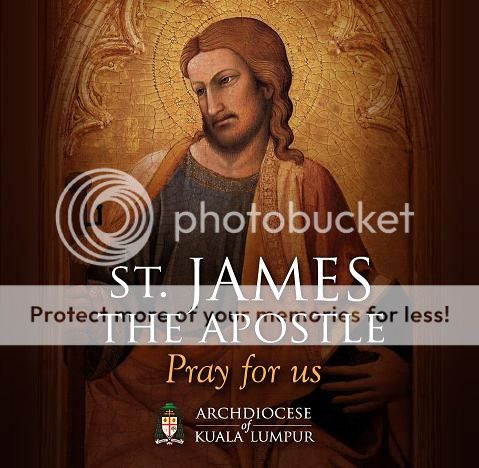
July 25 is the feast day of St. James the Greater. St. James is known as the Greater, in order to distinguish him from the other apostle James, our Lord’s cousin. St. James the Greater was one of the apostles of Jesus Christ, the son of Zebedee and Salome, the brother of John the Evangelist, and, like him, a fisherman. James and John came to be called “Sons of Thunder” (Mark 3:17) — a name given to them by Jesus Himself — due to their passionate preaching style and their evangelical zeal.

St. James the Greater and his brother John were repairing the nets on their boats on the Sea of Galilee when Jesus called them to follow Him to become “fishers of men.” With Peter and John, he witnessed the cure of Peter’s mother-in-law, the raising of Jairus’ daughter, Jesus’ Transfiguration, and Christ’s Agony in the garden of Gethsemani.

In his own ministry, James spread the gospel message to Samaria, Judea, and Spain. He returned to Jerusalem, where he was beheaded by the sword under King Herod Agrippa I in the year 44, becoming the first of the apostles to be martyred.

Tradition tells us the remains of St James were miraculously brought to Spain after his martyrdom and a chapel was built over it. Santiago de Compostela in Galicia grew in importance and has become the greatest pilgrimage site in Western Europe.

St. James the Greater is the patron saint of: arthritis and rheumatoid sufferers, blacksmiths, equestrians, furriers, pharmacists, pilgrims, soldiers, tanners, and veterinarians.

Prayer to St. James the Greater

O Glorious St. James, because of your fervor and generosity Jesus chose you to witness his glory on the Mount and His agony in the Garden. Obtain for us strength and consolation in the unending struggles of this life. Help us to follow Christ constantly and generously, to be victors over all our difficulties, and to receive the crown of glory in heaven.

Source: http://www.jeanmheimann.com/2017/07/st-jam...er-son-thunder/

The son of Zebedee (q.v.) and Salome (q.v. Cf. Matt., xvii, 56; Mark, xv, 40; xvi, 1). Zahn asserts that Salome was the daughter of a priest. James is styled "the Greater" to distinguish him from the Apostle James "the Less," who was probably shorter of stature. We know nothing of St. James's early life. He was the brother of John, the beloved disciple, and probably the elder of the two. His parents seem to have been people of means as appears from the following facts. Zebedee was a fisherman of the Lake of Galilee, who probably lived in or near Bethsaida (John, 1, 44), perhaps in Capharnaum; and had some boatmen or hired men as his usual attendants (Mark, 1, 20). Salome was one of the pious women who afterwards followed Christ and "ministered unto him of their substance" (cf. Matt., xxvii, 55, sq.; Mark, xv, 40; xvi, 1; Luke, viii, 2 sq.; xxiii, 55-xxiv, 1). St. John was personally known to the high-priest (John, xviii, 16); and must have had wherewithal to provide for the Mother of Jesus (John, xix, 27). It is probable, according to Acts, iv, 13, that John (and consequently his brother James) had not received the technical training of the rabbinical schools; in this sense they were unlearned and without any official position among the Jews. But, according to the social rank of their parents, they must have been men of ordinary education, in the common walks of Jewish life. They had frequent opportunity of coming in contact with Greek life and language, which were already widely spread along the shores of the Galilean Sea. Some authors, comparing John, xix, 25, with Matt., xxviii, 56, and Mark, xv, 40, identify, and probably rightly so, Mary the Mother of James the Less and of Joseph in Mark and Matthew with "Mary of Cleophas" in John. As the name of Mary Magdalen occurs in the three lists, they identify further Salome in Mark with "the mother of the sons of Zebedee" in Matthew; finally they identify Salome with "his mother's sister" in John. They suppose, for this last identification, that four women are designated by John, xix, 25; the Syriac "Peshito" gives the reading: "His mother and his mother's sister, and Mary of Cleophas and Mary Magdalen." If this last supposition is right, Salome was a sister of the Blessed Virgin Mary, and James the Greater and John were first cousins of the Lord; this may explain the discipleship of the two brothers, Salome's request and their own claim to the first position in His kingdom, and His commendation of the Blessed Virgin to her own nephew. But it is doubtful whether the Greek admits of this construction without the addition or the omission of kai (and). Thus the relationship of St. James to Jesus remains doubtful.

The Galilean origin of St. James in some degree explains the energy of temper and the vehemence of character which earned for him and St. John the name of Boanerges, "sons of thunder" (Mark. iii, 17); the Galilean race was religious, hardy, industrious, brave, and the strongest defender of the Jewish nation. When John the Baptist proclaimed the kingdom of the Messias, St. John became a disciple (John, i, 35); he was directed to "the Lamb of God" and afterwards brought his brother James to the Messias; the obvious meaning of John, i, 41, is that St. Andrew finds his brother (St. Peter) first and that afterwards St. John (who does not name himself, according to his habitual and characteristic reserve and silence about himself) finds his brother (St. James). The call of St. James to the discipleship of the Messias is reported in a parallel or identical narration by Matt., iv, 18-22; Mark, i, 19 sq.; and Luke, v, 1-11. The two sons of Zebedee, as well as Simon (Peter) and his brother Andrew with whom they were in partnership (Luke, v, 10), were called by the Lord upon the Sea of Galilee, where all four with Zebedee and his hired servants were engaged in their ordinary occupation of fishing. The sons of Zebedee "forthwith left their nets and father, and followed him" (Matt., iv, 22), and became "fishers of men". St. James was afterwards with the other eleven called to the Apostleship (Matt., x, 1-4; Mark, iii, 13-19; Luke, vi, 12-16; Acts, i, 13). In all four lists the names of Peter and Andrew, James and John form the first group, a prominent and chosen group (cf. Mark, xiii, 3); especially Peter, James, and John. These three Apostles alone were admitted to be present at the miracle of the raising of Jairus's daughter (Mark, v, 37; Luke, viii, 51), at the Transfiguration (Mark, ix, 1; Matt., xvii, 1; Luke, ix, 28), and the Agony in Gethsemani (Matt., xxvi, 37; Mark, xiv, 33). The fact that the name of James occurs always (except in Luke, viii, 51; ix, 28; Acts, i, 13—Gr. Text) before that of his brother seems to imply that James was the elder of the two. It is worthy of notice that James is never mentioned in the Gospel of St. John; this author observes a humble reserve not only with regard to himself, but also about the members of his family.

Several incidents scattered through the Synoptics suggest that James and John had that particular character indicated by the name "Boanerges," sons of thunder, given to them by the Lord (Mark, iii, 17); they were burning and impetuous in their evangelical zeal and severe in temper. The two brothers showed their fiery temperament against "a certain man casting out devils" in the name of the Christ; John, answering, said: "We [James is probably meant] forbade him, because he followeth not with us" (Luke, ix, 49). When the Samaritans refused to receive Christ, James and John said: "Lord, wilt thou that we command fire to come down from heaven, and consume them?" (Luke, ix, 54; cf. v. 49). On the last journey to Jerusalem, their mother Salome came to the Lord and said to Him: "Say that these my two sons may sit, the one on thy right hand, and the other on thy left, in thy kingdom" (Matt., xx, 21). And the two brothers, still ignorant of the spiritual nature of the Messianic Kingdom, joined with their mother in this eager ambition (Mark, x, 37). And on their assertion that they are willing to drink the chalice that He drinks of, and to be baptized with the baptism of His sufferings, Jesus assured them that they will share His sufferings (ibid., v. 38-39). James won the crown of martyrdom fourteen years after this prophecy, A.D. 44. Herod Agrippa I, son of Aristobulus and grandson of Herod the Great, reigned at that time as "king" over a wider dominion than that of his grandfather. His great object was to please the Jews in every way, and he showed great regard for the Mosaic Law and Jewish customs. In pursuance of this policy, on the occasion of the Passover of A.D. 44, he perpetrated cruelties upon the Church, whose rapid growth incensed the Jews. The zealous temper of James and his leading part in the Jewish Christian communities probably led Agrippa to choose him as the first victim. "He killed James, the brother of John, with the sword." (Acts, xii, 1-2). According to a tradition, which, as we learn from Eusebius (Hist. Eccl., II, ix, 2, 3), was received from Clement of Alexandria (in the seventh book of his lost "Hypotyposes"), the accuser who led the Apostle to judgment, moved by his confession, became himself a Christian, and they were beheaded together. As Clement testifies expressly that the account was given him "by those who were before him," this tradition has a better foundation than many other traditions and legends respecting the Apostolic labours and death of St. James, which are related in the Latin "Passio Jacobi Majoris", the Ethiopic "Acts of James", and so on. The tradition asserting that James the Greater preached the Gospel in Spain, and that his body was translated to Compostela, claims more serious consideration.

According to this tradition St. James the Greater, having preached Christianity in Spain, returned to Judea and was put to death by order of Herod; his body was miraculously translated to Iria Flavia in the northwest of Spain, and later to Compostela, which town, especially during the Middle Ages, became one of the most famous places of pilgrimage in the world. The vow of making a pilgrimage to Compostela to honour the sepulchre of St. James is still reserved to the pope, who alone of his own or ordinary right can dispense from it (see VOW). In the twelfth century was founded the Order of Knights of St. James of Compostela.

With regard to the preaching of the Gospel in Spain by St. James the greater, several difficulties have been raised:

• St. James suffered martyrdom A.D. 44 (Acts, xii, 2), and, according to the tradition of the early Church, he had not yet left Jerusalem at this time (cf. Clement of Alexandria, "Strom.", VI, Apollonius, quoted by Euseb., "Hist. Eccl." VI, xviii).

• St. Paul in his Epistle to the Romans (A.D. 58) expressed the intention to visit Spain (Rom., xv, 24) just after he had mentioned (xv, 20) that he did not "build upon another man's foundation."

• The argument ex silentio: although the tradition that James founded an Apostolic see in Spain was current in the year 700, no certain mention of such tradition is to be found in the genuine writings of early writers nor in the early councils; the first certain mention we find in the ninth century, in Notker, a monk of St. Gall (Martyrol., 25 July), Walafried Strabo (Poema de XII Apost.), and others.

• The tradition was not unanimously admitted afterwards, while numerous scholars reject it. The Bollandists however defended it (see Acta Sanctorum, July, VI and VII, where other sources are given).

The authenticity of the sacred relic of Compostela has been questioned and is still doubted. Even if St. James the Greater did not preach the Christian religion in Spain, his body may have been brought to Compostela, and this was already the opinion of Notker. According to another tradition, the relics of the Apostle are kept in the church of St-Saturnin at Toulouse (France), but it is not improbable that such sacred relics should have been divided between two churches. A strong argument in favour of the authenticity of the sacred relics of Compostela is the Bull of Leo XIII, "Omnipotens Deus," of 1 November, 1884.

Source: https://www.facebook.com/WeAreCatholics/pos...511187522261367

This post has been edited by khool: Jul 25 2017, 03:43 PM
khool
post Jul 26 2017, 09:18 AM

Getting Started
**
Junior Member
225 posts

Joined: Mar 2008


Memorial of Saints Joachim and Anne, Parents of the Blessed Virgin Mary
Lectionary: 397


user posted image

Reading 1 (Ex 16:1-5, 9-15)

The children of Israel set out from Elim,
and came into the desert of Sin,
which is between Elim and Sinai,
on the fifteenth day of the second month
after their departure from the land of Egypt.
Here in the desert the whole assembly of the children of Israel
grumbled against Moses and Aaron.
The children of Israel said to them,
"Would that we had died at the LORD's hand in the land of Egypt,
as we sat by our fleshpots and ate our fill of bread!
But you had to lead us into this desert
to make the whole community die of famine!"

Then the LORD said to Moses,
"I will now rain down bread from heaven for you.
Each day the people are to go out and gather their daily portion;
thus will I test them,
to see whether they follow my instructions or not.
On the sixth day, however, when they prepare what they bring in,
let it be twice as much as they gather on the other days."

Then Moses said to Aaron, "Tell the whole congregation
of the children of Israel:
Present yourselves before the LORD,
for he has heard your grumbling."
When Aaron announced this to the whole assembly of the children of Israel,
they turned toward the desert, and lo,
the glory of the LORD appeared in the cloud!
The LORD spoke to Moses and said,
"I have heard the grumbling of the children of Israel.
Tell them: In the evening twilight you shall eat flesh,
and in the morning you shall have your fill of bread,
so that you may know that I, the LORD, am your God."

In the evening quail came up and covered the camp.
In the morning a dew lay all about the camp,
and when the dew evaporated, there on the surface of the desert
were fine flakes like hoarfrost on the ground.
On seeing it, the children of Israel asked one another, "What is this?"
for they did not know what it was.
But Moses told them,
"This is the bread which the LORD has given you to eat."

Responsorial Psalm (Ps 78:18-19, 23-24, 25-26, 27-28)

R. The Lord gave them bread from heaven.

They tempted God in their hearts
by demanding the food they craved.
Yes, they spoke against God, saying,
"Can God spread a table in the desert?"
R. The Lord gave them bread from heaven.

Yet he commanded the skies above
and the doors of heaven he opened;
He rained manna upon them for food
and gave them heavenly bread.
R. The Lord gave them bread from heaven.

Man ate the bread of angels,
food he sent them in abundance.
He stirred up the east wind in the heavens,
and by his power brought on the south wind.
R. The Lord gave them bread from heaven.

And he rained meat upon them like dust,
and, like the sand of the sea, winged fowl,
Which fell in the midst of their camp
round about their tents.
R. The Lord gave them bread from heaven.

Alleluia

R. Alleluia, alleluia.
The seed is the word of God, Christ is the sower;
All who come to him will live for ever.
R. Alleluia, alleluia.

Gospel (Mt 13:1-9)

On that day, Jesus went out of the house and sat down by the sea.
Such large crowds gathered around him
that he got into a boat and sat down,
and the whole crowd stood along the shore.
And he spoke to them at length in parables, saying:
"A sower went out to sow.
And as he sowed, some seed fell on the path,
and birds came and ate it up.
Some fell on rocky ground, where it had little soil.
It sprang up at once because the soil was not deep,
and when the sun rose it was scorched,
and it withered for lack of roots.
Some seed fell among thorns, and the thorns grew up and choked it.
But some seed fell on rich soil, and produced fruit,
a hundred or sixty or thirtyfold.
Whoever has ears ought to hear."

user posted image

REFLECTION

Notice how the farmer in the parable sows the seed. This is no careful, prudent planter. Far from cautious, this farmer throws seed around with abandon. It flies in all directions and lands everywhere—on the hard path, over a rock-littered patch, into the thorn bushes, and on good, rich topsoil.

In other words, the farmer in this parable is not a normal planter; he is a farmer whose methods reflect the Kingdom of heaven. He sows the seed extravagantly, as widely as he can, oblivious to the risks, much as God lavishes his mercy upon humanity. To be sure, the farmer takes some losses—birds snatch the seed o the sunbaked pathway, the sun scorches the young plants springing up in the shallows of the rocky soil, and tender sprouts are no match for the choking thorns—but never mind. Despite the wasted efforts and the squandered seed, the farmer nonetheless achieves a bumper crop—a hundredfold, sixtyfold, or thirtyfold.

Like the work of the farmer, the Kingdom will take its share of blows and will have a series of seemingly overwhelming setbacks, but the abundant harvest is sure.

user posted image

SOURCE: “365 Days with the Lord 2017,” ST. PAULS Philippines, 7708 St. Paul Rd., SAV, Makati City (Phils.) http://www.ssp.ph/

khool
post Jul 26 2017, 09:23 AM

Getting Started
**
Junior Member
225 posts

Joined: Mar 2008


SAINTS JOACHIM & ANNE
FEAST DAY 26th JULY


St. Anne and Joachim are the parents of the Virgin Mary and grandparents of Jesus Christ. St. Joachim was a retired priest or holy man who was married to St Anne. St. Anne was of King David’s house and line. St. Anne was born in Bethlehem and her name is derived from Hannah, which means ‘grace’.

Sts. Joachim and Anne had been married for 20 years, but had not children. St Joachim pleaded with God to send them a child. After a period of fasting and prayer, an angel appeared to St Joachim and told him that his wife would give birth to a child whom they should call Mary and dedicate to God.

St. Joachim is the Patron Saint of fathers, grandfathers, grandparents, married couples, cabinet makers and linen traders.

St. Anne is the patron saint of Christian mothers and of women in labor.

user posted image

Dear St. Anne and St. Joachim, though I am but a prodigal child, I appeal to you and place myself under your great parental care. Please listen to my prayers and grant my requests....... (MENTION YOUR REQUEST)....... See my contrite heart, and show me your unfailing goodness.

Deign to be my advocate and recommend me to God’s infinite mercy. Obtain for me forgiveness of my sins and the strength to begin a new life that will last forever.

Blessed St. Anne and St. Joachim, I also beg of you the grace to love, to serve, and to honor your daughter, the most holy Virgin Mary. Please recommend me to her and pray to Her for me. She refuses none of your requests but welcomes with loving kindness all those for whom you intercede.

Say 1 OUR FATHER ... 1 HAIL MARY ...

O JESUS, HOLY MARY, ST. ANNE, ST. JOACHIM, help me now and at the hour of my death.

user posted image

khool
post Jul 27 2017, 09:05 AM

Getting Started
**
Junior Member
225 posts

Joined: Mar 2008


Thursday of the Sixteenth Week in Ordinary Time
Lectionary: 398


user posted image

Reading 1 (Ex 19:1-2, 9-11, 16-20b)

In the third month after their departure from the land of Egypt,
on its first day, the children of Israel came to the desert of Sinai.
After the journey from Rephidim to the desert of Sinai,
they pitched camp.

While Israel was encamped here in front of the mountain,
the LORD told Moses,
"I am coming to you in a dense cloud,
so that when the people hear me speaking with you,
they may always have faith in you also."
When Moses, then, had reported to the LORD the response of the people,
the LORD added, "Go to the people
and have them sanctify themselves today and tomorrow.
Make them wash their garments and be ready for the third day;
for on the third day the LORD will come down on Mount Sinai
before the eyes of all the people."

On the morning of the third day
there were peals of thunder and lightning,
and a heavy cloud over the mountain,
and a very loud trumpet blast,
so that all the people in the camp trembled.
But Moses led the people out of the camp to meet God,
and they stationed themselves at the foot of the mountain.
Mount Sinai was all wrapped in smoke,
for the LORD came down upon it in fire.
The smoke rose from it as though from a furnace,
and the whole mountain trembled violently.
The trumpet blast grew louder and louder, while Moses was speaking
and God answering him with thunder.

When the LORD came down to the top of Mount Sinai,
he summoned Moses to the top of the mountain.

Responsorial Psalm (Daniel 3:52, 53, 54, 55, 56)

R. Glory and praise for ever!

"Blessed are you, O Lord, the God of our fathers,
praiseworthy and exalted above all forever;
And blessed is your holy and glorious name,
praiseworthy and exalted above all for all ages."
R. Glory and praise for ever!

"Blessed are you in the temple of your holy glory,
praiseworthy and glorious above all forever."
R. Glory and praise for ever!

"Blessed are you on the throne of your Kingdom,
praiseworthy and exalted above all forever."
R. Glory and praise for ever!

"Blessed are you who look into the depths
from your throne upon the cherubim,
praiseworthy and exalted above all forever."
R. Glory and praise for ever!

"Blessed are you in the firmament of heaven,
praiseworthy and glorious forever."
R. Glory and praise for ever!

Alleluia (Mt 11:25)

R. Alleluia, alleluia.
Blessed are you, Father, Lord of heaven and earth;
you have revealed to little ones the mysteries of the Kingdom.
R. Alleluia, alleluia.

Gospel (Mt 13:10-17)

The disciples approached Jesus and said,
"Why do you speak to the crowd in parables?"
He said to them in reply,
"Because knowledge of the mysteries of the Kingdom of heaven
has been granted to you, but to them it has not been granted.
To anyone who has, more will be given and he will grow rich;
from anyone who has not, even what he has will be taken away.
This is why I speak to them in parables, because
they look but do not see and hear but do not listen or understand.
Isaiah's prophecy is fulfilled in them, which says:

You shall indeed hear but not understand,
you shall indeed look but never see.
Gross is the heart of this people,
they will hardly hear with their ears,
they have closed their eyes,
lest they see with their eyes
and hear with their ears
and understand with their hearts and be converted
and I heal them.


"But blessed are your eyes, because they see,
and your ears, because they hear.
Amen, I say to you, many prophets and righteous people
longed to see what you see but did not see it,
and to hear what you hear but did not hear it."

user posted image

REFLECTION

Why do you speak to the crowd in parables? The disciples ask this of Jesus; they themselves do not understand the meaning of His stories.

Jesus’ response is enigmatic. He is supposed to make things clear to people, but He seems to reserve some things for those who belong to His inner circle, the disciples. They are the only ones who deserve to know His “secrets.” He is like an artisan or a good cook who keeps his formula secret. He is just fulfilling what prophet Isaiah once predicted.

Certainly the hardheaded and the close-minded, even if they see and hear God, will not understand and appreciate the mystery of God. It will not make any sense to them.

We, the present-day listeners, do not consider this anymore as secret or an encrypted message to be deciphered. Through study, prayer, and the living interpretation of the Church, we have more or less gotten the meaning of the parables. Jesus Himself acknowledges the better status of His lowly followers who have been with Him all these times. “Blessed are your eyes… ears…” (v 16). God has given them a privilege that even the deserving holy ones of old did not have.

Are you also at a loss as to the meaning of the parables? Strive to enter the inner circle of Jesus.

SOURCE: “365 Days with the Lord 2017,” ST. PAULS Philippines, 7708 St. Paul Rd., SAV, Makati City (Phils.) http://www.ssp.ph/

This post has been edited by khool: Jul 27 2017, 01:42 PM

65 Pages « < 7 8 9 10 11 > » Top
 

Change to:
| Lo-Fi Version
0.0348sec    0.68    6 queries    GZIP Disabled
Time is now: 1st December 2025 - 01:06 PM