Welcome Guest ( Log In | Register )

15 Pages « < 7 8 9 10 11 > » Bottom

Outline · [ Standard ] · Linear+

 LYN Catholic Fellowship V02 (Group), For Catholics (Roman or Eastern)

views
     
TSyeeck
post Jul 23 2018, 02:59 PM

Look at all my stars!!
*******
Senior Member
3,573 posts

Joined: Apr 2006


QUOTE(zamorin @ Jul 23 2018, 02:47 PM)
That's even more absurd.

First you say: Humanity represent evil.
Now you say: Human nature is inherently good

You are blatantly contradicting yourself.

If god cannot create something/anything (including evil), then he is not omnipotent as the religions claim.

I am not trying to insult you but pointing out the errors. Apologies if it hurts you. Don't take it personally, it's easy to do so when it comes to religion.
*
I did not say humanity represent evil, that was a quote from Haledoch. That's why I said you should read carefully before firing away aimlessly.

This post has been edited by yeeck: Jul 23 2018, 02:59 PM
TSyeeck
post Jul 23 2018, 03:06 PM

Look at all my stars!!
*******
Senior Member
3,573 posts

Joined: Apr 2006


You probably have one at your house—perhaps a drawer or a shelf in the hall closet. It’s that not-so-secret place where we save things we’re really not sure what to do with. For one reason or another we keep hanging onto that stuff forgetting we have it until we accidently stumble upon it while looking for something else.


Unfortunately, we manage to do the same sort of thing with our lives as well. We shuffle the odds and ends of our lives—the things we’re not sure what to do with, the things we want to forget on purpose, the things we feel have no purpose—we shuffle all of it into that place, some dark, obscure corner of the soul. And there it stays, because we’re really not sure what to make of it all.


Perhaps that’s where our story can be of help. Lazarus and his sisters Mary and Martha were intimate friends with Jesus. He liked to visit their home in Bethany on occasion. So, it comes as no surprise that when Lazarus’ health takes a turn for the worse, the sisters send for Jesus. When He finally arrives at the tomb, Lazarus, who has been dead for four days, is brought back to life. Jesus is the giver of life. The story raises a few questions for me about what it means for Jesus to give life to us.


The first question is regarding Jesus’ command to those gathered that they remove the stone. I wonder why Jesus would need anyone to take away the stone from Lazarus’ grave. He could have done it himself. But he chose not to. But here’s the point: God does his greatest work with our cooperation, with our involvement, with our participation. Our God is one who has chosen to work with creation; He commands and then we obey. God doesn’t expect us just to believe in miracles; he wants us to be miracles. Think back to the story of the Exodus. Surely God could have freed Israel from bondage in Egypt without any help at all. But God chose to use Moses to get the job done by leading his people out of slavery and into the “Land of Milk and Honey.” But of course, before Moses became a great leader, God had to deal with Moses and all his reservations and objections. God told Moses in a sense, roll away the stone and let what you’ve buried come out, for I will bring it to life. Having something to hope for helps us to live more abundantly.


The second question relates to what really happens when the stone is rolled away? For one thing, it lets in light that has been blocked out. It’s amazing what comes into view when light shines upon it. God can work with the things we have given up on. Take note that when it got right down to it, even Mary and Martha weren’t sure what Jesus could do with old, dead Lazarus as Martha reminds Jesus, “He’s been dead four days.” Maybe we’re not sure what God can do with our old, dead hopes. History is ripe with stories of people whose gifts matured late in their lives.


Rolling away the stone can also shed light on our talents and abilities we’ve tucked away in the closet thinking they’re of little use to anyone else. You recall in the parable of the talents that a man was going away so he entrusted some talents to his employees. Each received a talent in keeping with his abilities—one received five, another two, and the last, one. The first two invested their talents and put them to good use, and as a result got a return on their investment. The third, however, buried his and got no return at all. How many of us are like the third employee? We minimize what we have been given, thinking it of little or no value. Or maybe we leave it to others to pick up the slack, making something of what they have while we bury what we have. Each of us is gifted as no one else is. Some are obvious, displayed and utilized in the market place. Others are behind-the-scenes gifts—the gifts of love, faith, encouragement. Some have the gift of help and simply do good to others. Take away the stone! Own up to what God has given each of us. Shine light on them and let God call them forth and see what he can do with them.

This is the answer to those who teach that all you need to is just believe and do nothing. Not to God, He wants you to cooperate.
TSyeeck
post Jul 25 2018, 12:23 PM

Look at all my stars!!
*******
Senior Member
3,573 posts

Joined: Apr 2006


LatAm debunks persistent myth about anti-Christian persecution
John L. Allen Jr.Jul 20, 2018

user posted image
Friends and family carry the coffin with the body of Jose Esteban Sevilla Medina, who died after he was shot in the chest at a barricade during an attack by the police and paramilitary forces, in Masaya, Nicaragua, Monday, July 16, 2018. (Credit: AP Photo/Cristobal Venegas.)

News Analysis
Recent developments in the Central American nations of Nicaragua and Venezuela both offer not only sobering indications about the direction of those societies, but also a thorough debunking of one of the most persistent myths about anti-Christian persecution in the early 21st century.

Since the subject first arose as a matter of political and media chatter in the 1990s, conversation about anti-Christian persecution has gone through several phases of denial.

The first was that there was such a thing at all, fueled by suspicion in some cultural and media circles that “anti-Christian persecution” had been ginned up by conservative Western Christians looking to win sympathy for socially unpopular positions on matters such as homosexuality and women.

After the rise of ISIS in Iraq and Syria that position became unsustainable, and most people were willing to recognize that Christians are being persecuted today at the hands of Islamic radicalism in various parts of the Middle East.

More recently, news of a possible breakthrough in Vatican-China relations has refocused attention on the fact that there is a persecuted, underground church in China, and that it’s not just radical Muslims who sometimes see Christianity as a threat.

The remaining type of denial, and one that’s proven surprisingly enduring, is that Christians are at risk of persecution only where they’re a minority. In largely Christian societies, or so the myth goes, individual Christians ought to be safe - and if they’re not, whatever they’re suffering isn’t really “religious” persecution.

Even a moment’s reflection, however, is enough to demonstrate that it’s not just places where Christians are a minority that form the front lines of this war, and it never has been.

The Center for the Study of Global Christianity estimates that of the seventy million Christians who have been martyred since the time of Christ, forty-five million died in the twentieth century alone. By far the largest concentration was in the Soviet Union, with as many as twenty-five million killed inside Russia and an additional eight million in Ukraine. Both Russia and Ukraine are profoundly Christian societies and have been for centuries, even during the period in which they were governed by officially atheistic regimes.

Many of the most celebrated martyrs of the late twentieth century came in Latin America, among Christians who resisted the police states of the region. A reminder of that history will come in October, when Pope Francis officially canonizes Archbishop Oscar Romero of El Salvador, who was shot to death while saying Mass in 1980 for his advocacy of the poor and victims of human rights abuses.

Other examples of these “majority martyrs” include American Sister Dorothy Stang, the great “martyr of the Amazon” in overwhelmingly Catholic Brazil, and Maria Elizabeth Macías Castro, a leader in the Scalabrinian lay movement and a popular blogger, beheaded in Mexico in 2011 for exposing the activities of a drug cartel.

Today, Latin America is once more in the forefront of exposing the “only a minority” myth, due to literal violence in Nicaragua and mounting political and legal harassment in Venezuela.

Yesterday, Crux’s Inés San Martín offered a chilling tick-tock of recent attacks on Church personnel or sites in Nicaragua, where forces loyal to Sandinista President Daniel Ortega and his wife, Vice President Rosario Murillo, are increasingly inclined to see Catholic clergy and activits as the enemy.

RELATED: Nicaragua’s bishops to pray for exorcism amid Ortega crackdown

On Tuesday, according to the auxiliary bishop of Managua, the country’s capital, the neighborhood of Monimbo in the southeast city of Masaya was under attack. He said gunfire reached the parish of St. Mary Magdalene, where a Catholic priest was seeking refuge.
On Saturday, the Divine Mercy Church in Managua was under siege for 16 hours. It had become a refuge for students who, while protesting at a nearby university, were attacked by pro-government forces. Pictures posted to social media showed the church had been pockmarked by bullets.
On Sunday, the car of a bishop was shot at as he was on his way to the northern city of Nindiri, where he had hoped to stop an attack by the military. He wasn’t wounded, but the tires and windows of the car were destroyed.
On the same day, the house of a priest in Masaya was ransacked by the police. Belongings were taken with no explanation given.
On Monday, a center of the papal charity Caritas was set aflame in the northern city of Sébaco.
On July 9, a cardinal, a bishop and the papal representative were among clergy from Managua attacked as they attempted to protect St. Sebastian Basilica in the nearby city of Diriamba from a pro-government mob.
In Venezuela, meanwhile, the country’s bishops emerged undaunted from their July 7-11 general assembly, calling the government of President Nicolás Maduro no more than a “de facto regime” due to its failures to respect both the national constitution and also the “highest principles of the dignity of the people.”

RELATED: Facing crises inside and out, Latin America’s Church is hands-on

While so far there have been few incidents of violent attacks on Catholic targets, in January Maduro called on prosecutors to charge two Catholic bishops with “hate crimes” for delivering homilies in which they denounced widening hunger and corruption. The hate crimes statute he invoked, by the way, had been adopted by a legislature the bishops have denounced as illegitimate, and the law has been denounced by human rights groups as a tool for clamping down on political opposition.

No formal charges against the bishops ensued, but it was a clear signal the government is watching. One of the prelates, Archbishop Antonio López Castillo of Barquisimeto, later said he’d received a phone call of support from Pope Francis.

Nicaragua and Venezuela, needless to say, are both heavily Catholic societies in which the Church long has occupied a dominant position.

They both happen to be in Latin America, but there are plenty of examples elsewhere. In the overwhelmingly Catholic Philippines on Thursday, for instance, a 71-year-old Australian nun was ordered to be deported due to her participation in protests against a brutally violent anti-drug crackdown launched by President Rodrigo Duterte. Across the country, Catholic activists have been targeted by pro-Duterte forces.

What recent developments confirm is that anywhere Christians profess their faith openly, anywhere they take controversial stands in favor of social justice and human rights on the basis of their convictions, they are exposed to danger. Indeed, martyrdom is at least as likely where Christians are in the majority, for the simple reason that it’s more probable that the activists and voices of conscience who stir opposition will be Christians.

Put differently, the core truth of Christian life remains as true in the 21st century as it was in the first: The Gospel is always disruptive, so anyone who takes it seriously and is willing to put his or her life on the line for it isn’t likely to have guarantees of safety, no matter where they live.
TSyeeck
post Jul 26 2018, 05:18 PM

Look at all my stars!!
*******
Senior Member
3,573 posts

Joined: Apr 2006


THE "GOOD WINE" OF THE WEDDING AT CANA: WHAT'S "WINE ON THE LEES"? IS THE BIBLE ANTI-ALCOHOL?
SCOTT SMITH JULY 04, 2018

Why does the steward at the Wedding at Cana praise the "good wine"? Did you know this fulfilled a Messianic prophesy from Isaiah? And from Moses?

Is the Bible against drinking alcohol? Is the wine at the Wedding at Cana non-alcoholic, as some Protestants argue? Ever heard of "wine on the lees" or aging wine "sur lie"? This is where your Catholic knowledge can inform your wine knowledge and vice-versa.

Jesus turns the water to wine at the Wedding at Cana, right? This is his first public miracle and will be connected to his "last miracle" before his death on the Cross. We remember Jesus turning the water into wine, but what comes after?

THE WEDDING AT CANA: THE TESTING OF THE WINE

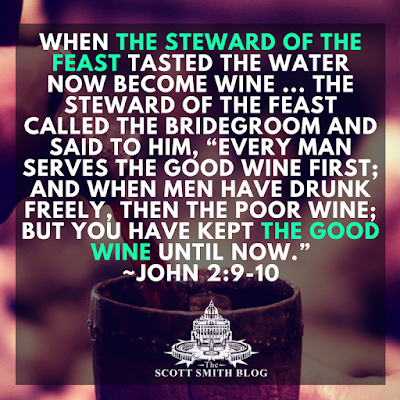
There was a very significant scene after Jesus turned the water into wine. Do you remember the testing of the wine at the Wedding at Cana? The steward of the feast says something to the bride-groom, i.e. the groom. What does he say?

user posted image

The Steward says, as seen above, "Every man serves the good wine first; and when men have drunk freely, then the poor wine; but you have kept the good wine until now."

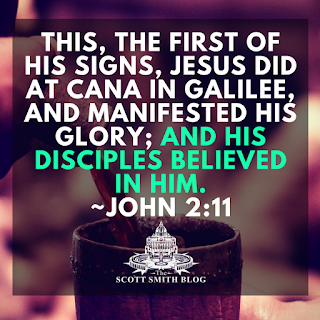
After the Steward of the Feast says this, something strange happens. What's the next line of the Gospel?

user posted image

This may not appear strange. Jesus just turned water into wine - why wouldn't his disciples start believing in him, right? But why? There is more going on here than just water turning into wine.

JESUS IS THE NEW MOSES

First off, Jesus' miracle shows he is the New Moses. What was Moses' first "public" miracle? That is, what was the first of the plagues of Egypt?

user posted image

The first plague of Egypt was the turning of the Nile into blood. It wasn't just the water of the Nile that Moses turned into blood, it was all the water in Egypt. Even the water in the stone jars, such as those at the Wedding at Cana!

Jesus adds a twist to the turning of water into blood. He first turns it into wine, then blood. When does Jesus turn wine into blood, his blood? This might seem obvious. The Last Supper, right? Yes, but Jesus does this throughout his final celebration of the Passover. He also drinks wine on the Cross which, at his death, becomes the blood that pours forth from his side.

This is one reason the disciples are struck by Jesus' actions. He is proving himself to be the New Moses. The Messiah was prophesied to be a prophet "like unto" Moses, and Jesus is doing just that. But there's more ...

BUT THAT'S NOT ALL! JESUS ALSO FULFILLS ISAIAH'S PROPHESY

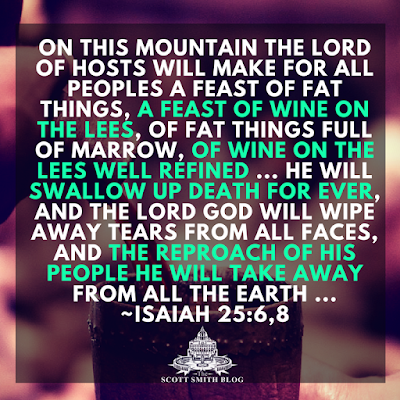
At Isaiah 25, Isaiah prophesies about the coming Messiah. The Messiah will destroy death ("swallow up death for ever") and forgive sins (take away "the reproach of his people").

But how will the Messiah do this? What will the Messiah use to do this?

user posted image

Note: This is from the Revised Standard Version Catholic Edition (RSV-CE) translation.

With WINE! The Messiah will do this with a feast of wine!

But not just any wine ...

The finest and most refined of wines. It will be a feast of "wine on the lees."

Isaiah prophesies that the Lord will deliver His people from oppression with a "a feast of fat things, a feast of wine on the lees, of fat things full of marrow, of wine on the lees well refined." Basically, God promises the best of the best of the best wine.

Jesus delivers on that promise at the Wedding at Cana. This is the meaning of the steward's words! This is why the disciples are so moved. They were well aware of Isaiah's prophesy.

Of course, Jesus will out-do himself at the Last Supper and on the Cross when he gives us his own blood as this wine. What better wine could there be, than wine which is God, Himself? That's no mere symbol!

BUT WHAT ARE "LEES"? WINEMAKING SIDENOTE

Are you still wondering what "lees" are? Lees are bits of yeast from grape skins that settle at the bottom of a wine vat. There's a bit of extra taste to be gained from aging wine "sur lie" or "on the lees" with the lees settling at the bottom of the wine vat. The lees are then filtered out of the "choice wine" thus created.

user posted image
Lees from red wine

Interestingly, the lees are bits of dead yeast - isn't it interesting that death will flavor this new wine, when it is Christ's death which ultimately provides the new wine? And what did Isaiah say? The Messiah "will swallow up death forever" with this wine. You see ... every detail of Scripture is important!

APOLOGETIC NOTE: NON-ALCOHOLIC WINE? IS THE BIBLE AGAINST DRINKING ALCOHOL?

It should be noted: many Protestants are anti-alcohol and attempt to interpret the wine used in the Bible as unfermented wine, i.e. non-alcoholic grape juice. This isn't just false; it's crazy.

For one, the lees were involved in producing the alcohol in the wine. What are they doing there if the wine isn't alcoholic?

The alcohol in wine is produced through the process of fermentation. Yeast is the agent of fermentation. The lees are bits of fermented yeast and the grape skins the yeast grew on. Clearly, this is fermented grape juice - and not just that, extra-fermented. The lees were kept in to get that last bit of flavor and fermentation.

Jesus can't be against the drinking of alcoholic wine if he just made the wedding party, who had already been drinking for days, six full stone jars of wine - that's about 600 hundred more bottles of wine!

LAST POINT: SO WHY DOES THE STEWARD TALK ABOUT SAVING THE "GOOD WINE" UNTIL THE LAST?

This is a reference to the wine of the Old Covenant versus the wine of the New Covenant. This tells us about God's plan of salvation. The greatest of all comes, not at the beginning, but at the end. The greatest of all is Jesus, not the prophets and patriarchs who preceded him. It is Jesus' own wine, his own blood, which is the "good wine" that is saved for last.

user posted image
TSyeeck
post Aug 2 2018, 06:19 PM

Look at all my stars!!
*******
Senior Member
3,573 posts

Joined: Apr 2006


Modernism as a Thought Crime

Plato said that God is thought thinking thought. As Father Leonard Feeney wrote, this is about as close as a philosopher can get to the knowledge of the Holy Trinity with his unaided intellect, and it is a loose approximation at best, for the Trinity is unknowable without the benefit of revelation. But Plato’s insight is remarkable, for God is the primordial Intellect, the uncreated Mind, without Whom there could be no knowledge, no thought.

As man was created to God’s image and likeness, he is capable of knowledge and of thought, even of that highly systematized thought we call “science.” But our knowing faculty was created for something much greater still, and that is the knowledge of the Triune God that we have thanks to the excellent knowledge of Jesus Christ Our Lord. That knowledge, begun by Faith in this life — where it is also perfected by the gifts of understanding and knowledge — terminates in the Beatific Vision in Heaven.

The knowledge that we have by Faith is both divine and human. Brother Francis puts it this way:

The body of Catholic doctrine is something both divine and human, and as such is a faithful image of the God-Man. As divine, it rests on the highest authority. As human, it is adapted to our manner and employs all our powers; it is preserved largely by human methods and is defended by human weapons.

The idea that the Faith is both divine and human like Jesus Christ Himself is not an orignal one, but it is a subject of meditation that promises much fruit. The Second Person of the Divine Trinity is the one Word uttered by the Father, His perfect and adequate self-expression. When He was clothed in our flesh He showed us in a human way how to be divine, becoming both the exemplar and the efficient cause of that human divinization we know to be divine adoption by grace. While remaining God’s internal and eternal Word, He became at the moment of the Incarnation that Word translated into human utterance.

And that Word taught: “In these days [God] hath spoken to us by his Son” (Heb. 1:2). And the words of the Word (the verba verbi) are true, with a divine guarantee.

Hence the blasphemy of the Modernist notions of dogma. Pope Saint Pius X distilled Modernism to three essential parts: (1) a philosophical agnosticism that denies man’s ability to know reality as it is; (2) belief in a “vital immanence” whereby man has an innate religious sense that is a highly subjective, intuitive, and aprioristic notion of God and moral truth; this more fundamental religious knowledge finds its expression in the “secondary formulas” we call doctrines, but such doctrines are not perfect expressions of the vital immanence; and (3) a radical evolution of dogma.

To learn more of this, and how Modernism is dependent on the philosophy of Kant, the liberal Protestant “baptism” of Kant by Schleiermacher, and the evolutionism of Hegel, please see What did St. Pius X mean when he called Modernism “the synthesis of all heresies”?

Needless to say, these heretical notions are still with us, albeit in an attenuated and nuanced form.

Implicit in the Modernist heresy is the older error of indifferentism. Since religious doctrines are mere approximations of what is immanent in me, all religions are more-or-less true and more-or-less false. Whichever one most closely approximates my own subjective religious sense becomes “my truth.” Sound familiar? “You have your truth, I have mine” is the vulgar popularization of this heresy, and it shocks us that some folks can actually say it with a straight face.

Thus, man is free to believe whatever religion he wants, another essentially liberal error, and one condemned earlier by Blessed Pope Pius IX.

No, man is free to accept and profess only the true religion, and in so doing, he becomes truly free. “You shall know the truth, and the truth shall make you free” (John 8:32), said Truth Incarnate. The first hearers of that divine utterance were offended by the implication that they were not free since they were the sons of Abraham and had never been slaves to any man. Our Lord gave them this rejoinder: “whosoever committeth sin, is the servant of sin … [but] If therefore the son shall make you free, you shall be free indeed,” and He invited them to believe in Him (for Faith in Him is necessary for this freedom!), but they preferred to take up stones to stone Him, showing just how enslaved they were at that moment. Perhaps some of them converted later, I do not know. The whole fascinating exchange is found in John 8.

Having prayed for His Apostles in the Garden, just before His agony and arrest, Jesus commissioned them to preach His truth after the Resurrection:

And Jesus coming, spoke to them, saying: All power is given to me in heaven and in earth. Going therefore, teach ye all nations; baptizing them in the name of the Father, and of the Son, and of the Holy Ghost. Teaching them to observe all things whatsoever I have commanded you: and behold I am with you all days, even to the consummation of the world. (Matt. 28:18-20)

Note that, in giving these mere creatures of His their teaching mission, Our Lord invokes His own power. This should indicate to us just how reliable is the transmission of Christian truth from that day to this.

But for the Biblical Modernist, even this promise is not reliable. What, then, is? Nothing, except perhaps this sad man’s innate sense of religion, for which no doctrinal formulae are adequate. Oh, but he is so cocksure of his conclusions in the domain of Biblical Science!

Hypocrite!

Our Catholic dogmatic formulae are reliable because the Infallible Magisterium of the Catholic Church is the beneficiary of that promise to the Apostles of “all power” given to the Man-God, which no doubt includes the promise of the Holy Ghost.

The Catholic Church is, after all, Christ’s own Mystical Body, and the Holy Ghost is the soul of that Body.

Living as we are in a day when scandal piles atop of scandal, so that the faithful are barraged with examples of crass moral filth by the upper echelons of the sacred hierarchy, we must hold fast to these truths and live accordingly. For, it is in questioning Catholic Faith and Morals, and jettisoning tradition, that the clergy begin to become perverts. After all, their sacred vocation is founded on these very things.

Let us strive, then, to become saints, loving and living Catholic tradition, and God will surely bless the Church with priests after His own Sacred Heart.

In the Immaculate Heart of Mary,
Brother André Marie, M.I.C.M.
TSyeeck
post Aug 7 2018, 12:47 PM

Look at all my stars!!
*******
Senior Member
3,573 posts

Joined: Apr 2006


Catholic at Last: From Eastern Orthodox to the One True Faith
Stefanie Nicholas

user posted image

When I was invited to write this piece for OnePeterFive, Steve Skojec wanted to know why I was becoming Catholic now.

After all, I was obviously a conservative. An outspoken counter-jihad activist. A vehement defender of the existence of only two sexes. Hardly the sort of person with a high tolerance for the progressivism and relativism embedded within so much of the modern Catholic culture.

On top of that, I was baptized Greek Orthodox. I was catechized Greek Orthodox. Four hundred-plus-year-old liturgy or bust! I come from an incense-scented Byzantine world that would be horrified to see what passes for liturgy in so much of our aching, suffering, post-Vatican II (I find Belloc’s “knavish imbecility” comments somewhat comforting in such times) Holy Mother Church.

Why did I make my way to Catholicism instead of reverting to my Orthodox roots?

I left Orthodoxy and ran off for years to act (in varying degrees) like a pagan, a Buddhist, a Muslim, an atheist, a Protestant, a Jew. Yet for all the running I did from Orthodoxy, I never could quite outrun orthodoxy. I never lost the certainty in my heart that the Truth, one truth that was right and all others wrong, must be out there, and that if I looked for it long enough, I would find it.

Instead, I found sin, confusion, and a life that brought me much pain.

The Truth, fortunately, found me.

Anyone who knows my personality at all would think I must have “read my way” into Catholicism. Many recent converts I have seen – particularly former Protestants who share my penchant for study – have taken that path across the Tiber. But this was not the road to Rome in my case, to my astonishment.

Catholicism was the one faith I had never considered, intellectually or otherwise. If anyone had told me even seven months ago that I would be converting to Catholicism soon – let alone dedicating so much of my life to learning and talking about the faith! – I would have looked at him as if he had just informed me that Muhammad was actually a women’s rights activist.

My journey to Catholicism will be a constant reminder in my heart that I myself am nothing – anything I achieve and any gifts I posses in order to do so belong entirely to the Lord.

The simplest explanation for my conversion? God showed me people – broken, sinning, imperfect people – who embodied 1 Peter 3:15, people who had a hope in them that ripped the scales from my eyes despite me. I had to know the reason for why I gazed upon them and felt a stirring in my soul – a memory and a promise of new birth, all at once.

In other words? They possessed the light of Christ, and I knew I had to seek what they reflected.

I walked by my parish a hundred times and never thought I’d be walking in there for the first time around the start of Lent, realizing I was home, realizing I was crying, and having no explanation for why I was there at all except that God had told me to show up.

My son was baptized and I was received into the Church on March 31, 2018, at the stunning Easter Vigil Mass. I will cherish that day for the rest of my life.

My life today holds a joy that I have never experienced before – even as by the standards of the world it has become more difficult since my conversion. I live at all times as part of one universal Church, and it is the wild expanse of the Summa Theologiae, the history of the saints, the depth of theological speculation, the history, the art, the music. Everything, for the Church has touched the world in every sphere. The Church is space to let my indefatigable curiosity roam for what seems like forever.

And yet, it is also beautiful constraint. Sometimes, the Church is simply my Father’s house. My parish, very modern, very Novus Ordo, is not where I would choose to attend but clearly where the Lord wants me in this season of my life.

This is my Father’s house, where I try to be respectful, where sometimes my two-year-old makes too much noise and I’m reminded to ask Mary to help me mother better, where sometimes I kneel quietly in deep prayer and sometimes I feel as if my amazing little boy and I are a detriment to everyone’s peace, but where always I receive the simple ordinary “anything” that is made everything by the power of God: the Bread that is Life.

I am a Catholic because the Catholic Church is Christianity as spoken of in the Acts of the Apostles. Not some weak, hazy concept of Christianity like what so many cling to today, but something tangible and solid and unwavering.

Even when, at times, it seems hard to know where exactly to hold on in this difficult age of the Church, I trust in the same Savior who brought me home to keep my soul safe.

I see the pain of so many Catholics today, people who have kept this treasure alive long enough for me to find it at the eleventh hour. Long enough for me to show up and think I could possibly make a difference, could possibly hold a place of useful service within the Church Militant. I see a longing toward the Eastern Orthodox, with their reverence and their indifference to the concerns of Protestants and modernists on liturgical matters, among other things.

I am profoundly thankful for being made Orthodox from the cradle. It made my journey to Rome so very gentle and quick compared to many converts, for in many ways, I feel more like a revert due to the closeness of our faiths. For me, guitars at Mass was always bizarre. I could sense the crisis within the Church from day one, and as much as it has made me a little more hawk-eyed than many a convert, I’m thankful for my ability to see easily why reverence matters to zeal.

I love our Orthodox brothers and sisters – most of all, my father, whose prayers, along with those of my now deceased Yiayia and Papou, almost certainly availed much in saving my soul. I love the Orthodox – so I study the Great Schism that I live every day in miniature with care, to be ready to defend Rome whenever called upon in my day-to-day life.

Someday, I pray that our separated brethren will flock to us in droves, and it would be an immeasurable joy to my heart to be used by the Spirit to help even one come home.

St. Ignatius of Antioch had this to say. It spoke to me.

Make no mistake, my brothers, if anyone joins a schismatic he will not inherit God’s Kingdom. If anyone walks in the way of heresy, he is out of sympathy with the Passion. Be careful, then, to observe a single Eucharist. For there is one flesh of our Lord, Jesus Christ, and one cup of his blood that makes us one, and one altar, just as there is one bishop along with the presbytery and the deacons, my fellow slaves. In that way whatever you do is in line with God’s will.

The Orthodox have much to teach us about liturgy and tradition. However, they are still obligated (even by their own idea of the papal “primacy of honor”) to be in communion with the See of Peter, the Rock. Without this, they can never be the true Church. A house divided cannot stand.

The Orthodox rejection of doctrinal development is precisely why they have directly changed doctrine. I do not, and cannot, worship God within a body that chooses to change His commandments.

The Orthodox have changed in doctrine. This is simply a fact of history.

Their most blatant change is, ironically enough, the one thing I feared most when I was called home: the orthodox, Catholic teaching on divorce and “remarriage.” I realized that if I became Catholic and could not get a declaration of nullity, I would have to spend the rest of my life as a single mother – no small thing to consider at 26 years old.

In Orthodoxy, divorce and remarriage falls within the realm of “oikonomia” (household economy). In practice, the Orthodox today believe that bishops have the authority to bless their flock to act in a way that is contradictory to the direct words of Christ and call it pastoral care.

This seems particularly stunning in light of the common modern Orthodox claim that they do not require the visible universal head of the pope, for Christ alone is their Head, and yet they can’t even seem to obey Him when His words are at their most plain.

What God has stitched together, let no man separate. Be that one man and one woman – or one Christ and one Bride.

I also found the Catholic teaching on birth control, the fact that we are the single Christian institution on this Earth which continues to regard contraception as intrinsically evil, incredibly convicting compared to yet another case of Orthodox “oikonomia.”

Orthodoxy is, in a sense, the easy way out of the morass we find ourselves in as Catholics in a post-Catholic world. It’s a church with a more elastic ecclesiology, where we don’t have to place our trust and obedience at the feet of a chair that so many times in our history was filled by a corrupt and broken man. (Now, in many ways, I see that things are much worse.)

It’s tempting. It really, truly is. And yet, Proverbs 3:5-6 echoes in my head often. “Trust in the Lord with all your heart, and do not lean on your own understanding. In all your ways acknowledge him, and he will make straight your paths.” The more I deepen my study of Catholic and Orthodox ecclesiology – and particularly the Four Marks of the Church – the more I am certain that I am in the steadfast ship that will carry me home from my exile.

And yet, study is not the main reason for this trust I feel. It’s something beyond that. It’s a supernatural certainty unlike anything I’ve ever experienced. The kind of internal anchoring of joy that I rarely can explain without having to simply say “trust me” – a frightening thing when I am talking to non-Catholics about the fate of their souls. For who am I that anyone should trust my words?

However, despite my total unworthiness of your trust, I hope you will trust God working in me and pray for me that my life will be worthy of being called a good example. Pray for me that my faith will encourage Catholics looking east to hold fast in the storm. The Lord has done great things for me, and holy is His Name.

The greatest thing the Lord has given me is an unshakable feeling of assurance that I am in the One True Church – though feeling is not even the right word. This is a knowing. It’s the kind of knowing I’ve experienced only one time before my conversion – when I gave birth to my son and I knew that motherhood is the greatest miracle on Earth, except perhaps the Eucharist.

I had to be Catholic – the one Church on the entire planet that has held fast to the commands of our Savior, in dogma if not always in adherence.

As human and broken as our current holy father may be, he sits on the same Seat of Saint Peter that has kept the universal Church from heresy since the time of Christ and the Apostles. The pinnacle of our faith is the Eucharist – one Eucharist.

I have to believe that what I see in the Church today is not an end of days, but the beginning of a new age. It is an age of chastisement, perhaps, and certainly an age where we witness the Passion of the Church herself, but an age where it is exciting to be a Catholic. It is an age of new birth, with all the birthing pains expected.

If we fight our continuing battle against the principalities and powers by first taking up our spiritual arms, we will not fail. Our enemy is not even the most evil people within or outside Holy Mother Church.

Our enemy is Satan.

I know it’s clichéd to say these things. I know you’re tired. I’m tired, too. But this is a conversion we must all pray for – to remember in our hearts, in all we do and say, that we have a promise that no other Church on this planet has nor ever will have. A promise that has never – in 2,000 years – been broken. Christ does not lie, and the Holy Spirit will not allow for anything that would make Christ a liar.

All I know is that for the first time in my life, I gave my little fiat – and God moved mountains for me.

What more will he do for the tide of faithful believers rising in the Church today?

Never limit Him. We’ve already won.

TSyeeck
post Aug 7 2018, 06:21 PM

Look at all my stars!!
*******
Senior Member
3,573 posts

Joined: Apr 2006


QUOTE(judehow @ Jul 24 2018, 06:38 PM)
May I know what kinda prays for healing?
*
Healing of soul => Confession
Healing of body => Anointing of the sick / Extreme Unction
TSyeeck
post Aug 16 2018, 10:30 AM

Look at all my stars!!
*******
Senior Member
3,573 posts

Joined: Apr 2006


user posted image
TSyeeck
post Aug 16 2018, 05:25 PM

Look at all my stars!!
*******
Senior Member
3,573 posts

Joined: Apr 2006


Lessons to Learn from Clerical Scandals

It is not my custom to write about the latest scandal. There are good reasons for this. The world is fallen and scandals abound, even in the best of times. To dwell on them risks losing sight of the good we should be doing. Here, I will deliberately consider the recent clerical scandals for the purpose of deriving a lesson from them — a lesson from which we all, I hope, might profit.

Archbishop McCarrick. Lincoln. Boston. Pennsylvania. Honduras. Chile. Maynooth. The list and the links could go on and on.

What lessons do they teach us?

Among the most superficial: “Don’t be a pervert” and “Don’t let sodomites and other moral degenerates into the seminary.” Really!

For all their common sense, those superficial and immediate reactions are too controversial, too direct. In a effeminized clerical culture that generally shuns controversy, prefers indirection, and often brutally kills the messenger (sometimes not figuratively), such virile good sense is inadmissible. Almost exclusively, bureaucratic solutions — often expensive and rarely effective — are implemented to correct moral problems. The result is, predictably, more of the same.

But that is just the tip of the iceberg of the lessons that need to be learned. There is so much more. Certainly moral lessons of all sorts are there, and should be profited from, but so are more foundational doctrinal lessons that involve the very nature of the Church, of the priesthood, and of human nature as vitiated by the fall and healed by grace.

Here I would like to reflect on some of those lessons with the following concepts clearly in mind: the world, the Church, and modern errors that blur the distinction between the two.

Long before Vatican II, Father Feeney used to say (it is a paraphrase, but I know the gist of it is right): “Once the doctrine no salvation outside the Church is denied, many terrible problems will beset the Church. People will not think to trace these problems back to the denial of this doctrine; they will not see it, but this is the cause.”

I believe that the scandals above mentioned are among the terrible things Father Feeney foresaw. This will no doubt be difficult for many to accept, so I ask the reader’s forbearance as I attempt an apologia.

In Catholic ascetical and mystical literature, beginning with Holy Scripture itself, “the world” is spoken of in the most disparaging of terms. As an example, here is Dom Guéranger, whose full explanation of what the world is and why we must shun it is worthy of attentive reading:

The fundamental rule of Christian life is, as almost every page of the Gospel tells us, that we should live out of the world, separate ourselves from the world, hate the world. The world is that ungodly land which Abraham, our sublime model, is commanded by God to quit. It is that Babylon of our exile and captivity, where we are beset with dangers. The beloved disciple cries out to us: ‘Love not the world, nor the things which are in the world. If any man love the world, the charity of the Father is not in him’ (I John ii, 15). Our most merciful Jesus, at the very time when He was about to offer Himself as a sacrifice for all men, spoke these awful words: ‘I pray not for the world’ (John xvii, 9). When we were baptized, and were signed with the glorious and indelible character of Christians, the condition required of us, and accepted, was that we should renounce the works and pomps of the world (which we expressed under the name of Satan); and this solemn baptismal promise we have often renewed.

We are not Manicheans; the world that was created by God was and is good. But, as the learned Abbot goes on to explain, “the world,” in the pejorative sense is the collective of all men who resist grace and are therefore unregenerate: “Men were called after the object of their love. They shut their eyes to the light; they became darkness; God calls them ‘the world.’” (Emphasis mine.) Thus a Christian who adheres to non-Christian standards of thought and morality is called “worldly.”

“The world” is not only fallen; it is evil. This follows immediately from the definition of “the world” as unregenerate humanity that rejects God. Out of this world, God calls His Church (the Greek word for Church, ekklésia ἐκκλησία, means “called out”). Here, therefore, we have two cities: The City of Man, and the City of God, to use Saint Augustine’s figure. Or, if you prefer Saint Ignatius of Loyola’s: the Two Standards under which humanity marches, the banner of Lucifer, and the banner of Christ.

After Vatican II, with its three-fold “Counter-Syllabus” of Gaudium et Spes, Dignatitis Humanae, and Nostra Aetate, there was incessant chatter in the Church about “dialogue with the world,” one of whose eventual effects was the dissolution of this traditional notion of “the world.” Distinctions were blurred and, in the conciliar and post-conciliar milieu of “openness to the world,” unvarnished worldliness invaded the sanctuary of the Church — quite literally in the matter of liturgy, and figuratively in moral theology, the religious life, the clerical life, and Catholic living in general. How much of all this was justified by the actual texts of Vatican II is, of course, a subject of furious debate, but the fact of its occurrence is beyond dispute.

In this same theological atmosphere of the Council and post-Council, we also find a new and particular emphasis on “human dignity.” The Vatican II document that has those words in its title is devoted to discovering previously unimagined rights of those professing objective religious error. (The opening sentence begins with a quote from John XXIII: “A sense of the dignity of the human person has been impressing itself more and more deeply on the consciousness of contemporary man….”) Non-Catholics have a “right” not only to believe a false religion, but to practice it publicly, and to propagate it — and that right is founded on their human dignity. This is the new conception of “religious liberty,” and it is founded upon the personalist and novel conception of man’s dignity. Thus was the stage set decades ago for the latest pseudo-doctrinal development regarding capital punishment, the explanation of which appeals to “human dignity” (the word “dignity” appears ten times in Cardinal Ladaria Ferrer’s ten-paragraph letter explaining the new doctrine).

These new doctrines imply that religious error and sin (e.g., the capital crime of murder) do not vitiate man’s dignity. Instead of situating man amid the backdrop of a Catholic cosmology and the great mysteries of creation, the fall, redemption, and grace (as scholasticism did), the new doctrine considers all reality through the prism of the human person, informed, as it is, by philosophical personalism (like the “Lublin Existential Personalism” of Karol Józef Wojtyła).

The traditional doctrine, as taught by Saint Thomas, has it that man’s dignity comes from his being created to God’s image — and that, in three ways: as a being endowed with intellect and will, as possessing sanctifying grace in this life, and as possessing glory in heaven. Unbelief and sin destroy or at least tarnish God’s image in man in all three of those ways.

In considering human dignity, we are not free to do so without reference to the truths of the fall, original sin and its effects, actual sin and its effects, redemption, grace, and man’s supernatural finality — the “why” of his creation: “to know, love, and serve God in this life and be happy with him forever in the next.” Even naturally speaking, man has an objective dignity that is equal in all men because it follows from the possession of human nature, as well as a subjective dignity, which is unequal, and which comes from his being virtuous or vicious. This simple distinction is all too overlooked in all this talk of human dignity.

If we absolutize human dignity as the new doctrine does, it becomes a mega-heresy (e.g., it attempts to erase Hell), just as if we blur the distinction between the Church and the world, this too becomes a mega-heresy.

The weakening of the doctrine of no salvation outside the Church (via the heresy of indifferentism) helped to blur the distinction between the Church and the world, thus paving the way for the novel doctrines and praxis of religious liberty, ecumenism (whereby “unity” is not achieved by conversion, but by cordial relations between “the churches” and “the religions”), and an abstract, absolute notion of “human dignity” irrespective of man’s subjective dignity as virtuous or vicious, and irrespective of his correspondence to grace.

The Church that is supposed to unite all nations into Her unity and bosom, has, instead, become a dialogue partner with the world. But this is not the charge from Our Lord. This is why Brother Francis said, “The prime effect of the heresy of Liberalism is the destruction of the apostolicity of the Church.”

Some would argue that the moral revolution in the Church was rather caused by what happened in the very same decade as Vatican II, the sexual revolution, and that the flood of vile impurity in which Europe and America are currently still drowning is really to blame for the clerical scandals. I do not negate the effects of the sexual revolution on the scandals, but I would argue that there is a causality that we cannot ignore at work here. Let me recall again that the world is fallen humanity that rejects redemption and the Church is regenerated humanity that forms one Mystical Body with Jesus Christ. When we blur the clear distinction between the Church and the world, we do not sanctify the world; we rather facilitate the secularization of the Church. In other words, that force that should keep the evils of the world at bay has yielded to it. And perforce the darkness gets darker as the light wanes under a bushel basket. Evil makes progress, therefore the salt of the world loses its savor, becoming worthy of nothing but to be trodden under foot.

This is necessarily so because the world, the flesh, and the devil are always at hand to fill the void left by the absence of an authentic Catholic spiritual life. We are called the Church militant for a reason. We are in a spiritual combat, and we have real enemies. Putting down one’s Catholic arms does not make for peace; it makes for defeat.

Hence, the loss of the priestly identity. The priest is called out from among men to stand in persona Christi, that he might offer sacrifice to the true God, forgive sin, and sanctify the faithful with the sacraments, calling them out of the world and to greater holiness in union with Christ. When such a noble office is compromised by the novel doctrines considered here, the identity of the priest is more or less seriously mutated. Further, when his priestly formation has been compromised by poor spirituality, a lack of ascetical discipline, a relativizing progressivist moral theology, and harebrained psychology (alla Freud, Jung, Reich, Rogers, etc.), all the necessary ingredients for perversion are there.

Some might argue that the scandals of the Lincoln Diocese are proof against my contentions here, since Lincoln’s seminary was a bastion of orthodoxy. My response is that nothing short of a return to tradition is needed; neo-orthodoxy is not enough.

If those who love the Church in all her supernatural splendor do not derive the right lessons from these moral cataclysms, victory will go to the loud-mouthed liberals, who never let a crisis pass without profiting from it. They will continue to shriek for an end to priestly celibacy, to screech about the suppression of “toxic masculinity,” and to demand an end to the patriarchal power structures of the Church — all of which will only serve to make the status quo worse.

What we need are orthodox, holy, benevolent, virile, and apostolic fathers to save the day. May God send us those!

In the Immaculate Heart of Mary,
Brother André Marie, M.I.C.M.
TSyeeck
post Aug 27 2018, 01:29 PM

Look at all my stars!!
*******
Senior Member
3,573 posts

Joined: Apr 2006


user posted image
TSyeeck
post Aug 29 2018, 01:47 PM

Look at all my stars!!
*******
Senior Member
3,573 posts

Joined: Apr 2006


QUOTE(khool @ Aug 29 2018, 10:31 AM)
eh? not calling for Frankie's resignation? biggrin.gif
*
For once he got nothing to say on that on the plane...

Anyway, no one can canonically force the Pope to resign, only the Pope himself can do that on his own, or for God to remove him from office.

This post has been edited by yeeck: Aug 29 2018, 01:56 PM
TSyeeck
post Aug 29 2018, 02:41 PM

Look at all my stars!!
*******
Senior Member
3,573 posts

Joined: Apr 2006


QUOTE(khool @ Aug 29 2018, 02:37 PM)
Frankie was basically flipping the press then, and asking them to go do actual work, i.e. investigative journalism rather than being an echo chamber for some left libtard group.

And yes, you are spot on ... no one can call for the removal of the pontiff from office, except the Almighty Himself.

Peace brother! biggrin.gif
*
Note the distinction, anyone can ask for the Pope to resign, but they can't force him to do so. wink.gif
TSyeeck
post Sep 7 2018, 11:26 AM

Look at all my stars!!
*******
Senior Member
3,573 posts

Joined: Apr 2006


“May Thy continual mercy, O Lord, cleanse and defend Thy Church”

user posted image

Sermon for the Fifteenth Sunday after Pentecost
Rev. Canon Aaron B. Huberfeld
Institute of Christ the King Sovereign Priest


May Thy continual mercy, O Lord, cleanse and defend Thy Church.

It is always a joy to speak to you after the General Chapter of the Institute, when we priests have been filled with valuable counsels and words of encouragement from our superiors as we begin another year of priestly ministry. Those words could not be more timely, as are the divinely inspired lessons we receive from today’s Mass.

Like you, dear faithful, all loyal priests of Christ are tempted at this moment to be discouraged, despondent, angry and ashamed.

We have all had enough of false mercy, of this criminal abuse of so holy a word. True mercy does not turn its back on sin; does not cover up sin; does not say sin is not sin. The Church today is a weeping widow! The widow of whom the Gospel speaks today is not a woman mourning the death of her husband. No, apart from Good Friday, the Church does not weep for her Divine Spouse, for He has risen and can die no more. No! Holy Mother Church today weeps for her sons, lying in the death of mortal sin! The Gentle Healer is at hand, ready to restore them to life, if only they have the humility to accept the need for healing. As the prayer of today’s Mass tells us, the true mercy of Christ cleanses and defends. To the ailing son who begs of Christ this true mercy, He whispers to him, be of good courage; thy sins are forgiven thee; be made clean – and, go and sin no more.

Of the twelve apostles, we note that one betrayed, one denied, nine slipped away, and one stood by at the Cross. That is a terrifying statistic indeed for the Church hierarchy – roughly eight percent traitors, eight percent shameful cowards, seventy-five percent careful cowards, and eight percent courageous and faithful. But remember that all the cowards returned to Christ and died the holy death of martyrs! The answer to those who seem to be standing in the sidelines is not bitterness and harsh judgment, but prayer and encouragement.

To those of you who are angry, I say, good, be angry. Know that I and countless other priests are angry right along with you, and we hunger and thirst for justice. We know the Lord is not mocked, and so we cry out, Arise, Lord, and judge Thy cause!

But let us not forget the importance of true mercy. Let us heed the words of the Apostle which we hear today: If a brother is in any fault, correct him in a spirit of gentleness, taking heed lest you also be tempted. Think about all the faithful priests you know, around the world or right here in this diocese. I am thinking right now of all my generous and zealous fellow priests in the Institute of Christ the King, and the young and cheerful faces of all our seminarians in formation. You cannot look into their eyes and honestly think that the Catholic Church is finished. Thank the bishops who are standing up for what is right, and don’t hesitate to write to others and gently remind them that you’re counting on them to do likewise.

A word to all you young men considering the priesthood: do not be afraid to answer the call! The real men are still here, and we’re waiting for you. You are joining the greatest army that marches upon this earth: the priesthood of Jesus Christ. Be thankful that He is calling you to such an honor.

Like so many other priests, I take courage in this hour when I see your faith. You continue to come to Mass, request Masses, flood the confessional line, call priests to your hospital beds, raise your children in the true Faith and teach them to believe in the priesthood of Christ, the only religion that brings salvation. And so, let us be patient with one another, encourage one another. Bear one another’s burdens, and so you shall fulfill the law of Christ. Let us do good to all men, but especially to those who are of the household of the faith. Each one shall bear his own burden – each one shall have his own dread moment before the judgment seat of Christ. But if we have sown in the spirit – if we have placed ourselves before the true mercy of Christ which cleanses and defends us, then we shall not despair of seeing the triumph of Holy Mother Church, and reap life everlasting. Amen.
TSyeeck
post Sep 27 2018, 03:57 PM

Look at all my stars!!
*******
Senior Member
3,573 posts

Joined: Apr 2006


Weathering Sodom’s Brimstone Storm

THE news keeps coming fast and furious. Some recent samples: While a prominent and highly favored pro-homosexual Jesuit attacks faithful Catholics as “unorthodox” for opposing the sodomite agenda, a priest who opposes that same agenda is hounded by his Archbishop for his “psychiatric” problems. Ireland’s sole surviving seminary is revealed to be a “homosexual cesspool,” while good priests have bogus psych evaluations weaponized against them. Not a day goes by without some disturbing new thing coming to light about the clerical sodomite mafia’s decades-long attack upon the Bride of Christ.

Weather the storm, Catholics! In God’s ineffable providence, you were brought into the Church at this very time and in these very circumstances. Deal with it. Recognize that the will of God is your sanctification here and now. What we are beholding is the very beginning of the hail of brimstone that the ecclesiastical Sodom will have falling on its head. It’s good; it will be painful, but purgative.

Meanwhile, the loyal Catholics must keep our heads on, remain vigilant, stay faithful, and keep certain things as matters of conviction throughout this whole mess. Here are a few of those matters of conviction:

I. When you deny the necessity of the Church for salvation, when you say that God’s one true Church is not necessary for all the poor exiled children of Eve, then you deny that the light of Christ is necessary to dispel the darkness of sin and unbelief. Institutionally (and I speak here of her external structures and her human element only), this is the very reason that the Church has lost her sense of purpose and, to a large extent, her very identity. Sometimes, only a violent chastisement, a persecution, a plague, etc., can wake up lethargic Christians in such times. Preachers in every age have used such occasions to convey that very message: Wake up, Christians! Cast off indifferentism and embrace Catholic truth!

II. We were warned. Various approved apparitions and holy people warned of this kind of thing. Brian Kelly has an article on this very subject on our website. Father Feeney, who is only one of those mentioned in that article, warned that the jettisoning of unpopular doctrines and the heresy of indifferentism would produce horrible corruption inside the Church. He was right, in spades.

III. When churchmen and Catholics in general become slothful and indifferent to their God-given mission to evangelize, embracing instead the man-made and humanist plan of ecumenism, inter-religious dialogue, secular progressivist activism, and globalism, they invite a curse upon themselves. God does not bless these endeavors that He never authorized. He did authorize evangelism of all nations, of all peoples. In fact, He commanded it. This dereliction of duty includes the constant repetition for decades now of the lie that the Church has no mission to evangelize the Jewish people. This is a mandate of Jesus Christ Himself, included in the universal mandate to preach to all nations and all creatures, a mandate even the “Doctor of the Gentiles” took quite seriously. The Church is a leaven for the world; it is the salt that lends savor to humanity. But what does the Savior Himself say of salt that loses its savor? “It is good for nothing any more but to be cast out, and to be trodden on by men” (Matt. 5:13). It’s treading time. Let us have charity for Jews and Gentiles, the Christian charity that seeks their salvation.

IV. The Homosexual infection of the priesthood is a multifaceted problem. From one angle, the “homoheresy” is the most perfect instrument to undermine Catholic teaching on faith and morals. (For a detailed answer to why that is so, read my brief, “Why Ecclesiastical Homosexualism is Such an Issue.”) From another angle, this crisis is a highly-effective binary weapon: As the homosexuals inside the Church undermined the faith and the priesthood for decades, the anti-Catholic media (the ideological allies of the homosexualists in the Church) use the scandals perpetrated by pervert priests to attack the institution directly from outside. And let us keep repeating it over and over again, this problem is a problem of homosexuals in the clergy. While pedophilia has occurred, it represents a small percentage of the abuse cases, the vast majority of which are cases of homosexual predation pure and simple.

V. Beware of false solutions to a real problem! Priests have long been sent for “counseling” or “therapy” to the purveyors of ineffective and dangerous treatments. Many of these so-called “mental health professionals” are responsible for the pastoral recirculation of abusive perverts in the first place. The point was made above that psychology and psychiatry have been weaponized against good priests. This has been going on for decades, precisely the same decades that witnessed the miserable failure of these therapists and MD’s who advised our bishops to put the priests they healed back in the parishes. Only the priests weren’t healed; they continued their predatory ways. Considering their ineffectiveness in remedying the clerical abuse problems, their serious iatrogenic dangers, and their manipulative use as weapons against good priests, we need to be wary of the psychological and psychiatric fields in general. My two-part interview with Dr. G.C. Dilsaver (part one, part two) is very revealing here about the dangers of the mainstream mental health profession and what the genuine alternative to it is.

VI. The problem is diabolically inspired, no doubt. The genius of the “binary weapon” referred to above is sufficient to indicate the intelligence of fallen angels at work here. However, to affirm the diabolical character of the crisis is not to deny the complete moral responsibility of those guilty of sin: especially the pervert priests themselves. Incredibly, when I have referred to this crisis as “diabolical,” I have had Catholics lecture me about denying moral responsibility. We live in an irrational age when such false dichotomies come so easy to the faithful who should know better.

VII. The answers to the problem are spiritual. Prayer, fasting, penance, the restoration of authentic Catholic doctrine. In other words, tradition is the answer. None of this rules out prudent action within the duties of our state in life. The cardinal virtue of prudence is, after all, necessary for the life of Christian virtue.

VIII. Turn to Our Lady. She is the hammer of heretics and the refuge of sinners! She gave us the spiritual weapons for our times at Fatima. Use them!

In the Immaculate Heart of Mary,
Brother André Marie, M.I.C.M.
TSyeeck
post Oct 12 2018, 01:05 PM

Look at all my stars!!
*******
Senior Member
3,573 posts

Joined: Apr 2006


Divine Providence: A Doctrinal Overview

THE Holy Trinity, in total and sovereign freedom, created the entire universe out of nothing. That is to say, the Creator was without any necessity or compulsion in His act of creation. God’s sole motive in creating was His own benevolence, that is, His goodness and love. The ultimate purpose of Creation is God’s own Glory. (So far, each of these sentences constitutes an article of faith that is de fide definita.) Secondarily and subordinated to His own glory, God created for the beatification or happiness of His rational creatures, that is, for man. This truth is clearly taught in scripture and the fathers. It is de fide catholica. But man’s beatitude itself is directed to God’s glory, so these two ends — one primary and essential, the other secondary and subordinate — are really of a piece with one another.

So what is divine providence? According to Blessed Severinus Boethius, who is quoted by Saint Thomas in the Summa, “Providence is the divine plan itself, seated in the Supreme Ruler, which disposes all things.” According to Saint John Damascene, providence is “the will of God by which all things are ruled according to right reason.” Providence is primarily and in a more restricted sense the plan that exists in the Divine Intellect by which creation will achieve its end, namely (as we already said), His glory. Secondarily, and in a looser sense, Providence is God’s actual implementation of that plan. This secondary sense is more properly called God’s “governance” of creation.

The Dictionary of Catholic Theology by Parente, Piolanti, and Garofalo, gives us this nutshell definition:

providence, divine (Lat. providere or praevidere — “to see in advance”). The plan conceived in the mind of God, according to which He directs all creatures to their proper end. It is a part of prudence and refers mainly to the means to be chosen with reference to the end; it resides in the intellect, but presupposes the willing of the end; it precedes the government of things, which is the practical execution of providence.

Against the materialists, fatalists, pessimists, and deists of the eighteenth century, the Church defends divine providence (Vatican Council, DB, 1784), which shines out in the pages of Holy Scripture (cf. Wisd. 14, Matt. 6), and in the writings of the Fathers (…).

Reasons: (a) There is in the world an order and a tendency to the end; but this order, like all cosmic reality, must pre-exist intentionally in the mind of the First Cause. (b) God is not only the Efficient Cause, but also the Final Cause of all things, and as such must have conceived the means of directing back to Himself as to their supreme End, all created things. [Explain this sentence…]

No creature escapes this providential order, since providence is bound up with the divine causality and, like it, is universal. Therefore, free will also is subordinate to divine providence (Matt. 6:30), which does not disturb the order of nature, but conserves and directs it, using necessary causes to produce necessary effects and contingent causes, as human wills are, to obtain contingent and free effects. Physical and moral evil, which we see in the world, is not opposed to divine providence, if we consider: (1) that it is permitted, not caused directly by God; (2) that it depends on the deficiency of finite being; (3) that it is to be examined not in an isolated and particular way but in the framework of the universal order, which may demand the sacrifice of this or that particular thing.

Some of these ideas will be further explained as we proceed.

In 1208, the Waldensian heretics were given a profession of faith with contained the following:

“By the heart we believe and by the mouth we confess that the Father also and the Son and the Holy Spirit, one God, concerning whom we are speaking, is the creator, the maker, the ruler, and the dispenser of all things corporal and spiritual, visible and invisible. …” (Denz. 421)

The Council of Trent (on Justification) CANON VI, also teaches us about Divine Providence, under the aspect of God’s permissive will and evil:

“If any one saith, that it is not in man’s power to make his ways evil, but that the works that are evil God worketh as well as those that are good, not permissively only, but properly, and of Himself, in such wise that the treason of Judas is no less His own proper work than the vocation of Paul; let him be anathema.” [Break down.] Here we see the idea of God’s permissive will whereby He allows evil to exist without positively willing it.

Vatican I teaches us about the sweep of Divine Providence:

“God protects and governs by His Providence all things which He hath made, ‘reaching from end to end mightily, and ordering all things sweetly’ [Wisdom 8:1]. For ‘all things are bare and open to His eyes,’ even those which are yet to be by the free action of creatures” (Denz. 1784).

According to Saint Thomas, all things are subject to God’s providence. He cites as supporting text for this, the same passage from book of Wisdom we just saw used by Vatican I; that passage says of Wisdom, “She reacheth therefore from end to end mightily, and ordereth all things sweetly” (8:1) What Saint Thomas says in this connection regarding the presence of evil in the universe is worth quoting. It expands on what the author of the Dictionary of Theology wrote:

Since God, then, provides universally for all being, it belongs to His providence to permit certain defects in particular effects, that the perfect good of the universe may not be hindered, for if all evil were prevented, much good would be absent from the universe. A lion would cease to live, if there were no slaying of animals; and there would be no patience of martyrs if there were no tyrannical persecution. Thus Augustine says (Enchiridion 2): “Almighty God would in no wise permit evil to exist in His works, unless He were so almighty and so good as to produce good even from evil.

While God does not wish even physical evil in itself and directly, he does will it to procure some greater good, such as the punishment or conversion of a sinner. Moral evil he does not will at all, either as an end or as a means to an end. He permits it passively only in consideration of man’s freedom. As Ludwig Ott puts it, “In the final end, moral evil will serve the supreme aim of the world, the glorification of God, in as much as it reveals His mercy in forgiving and His justice in punishing.”

According to Saint Thomas, God has immediate providence over all things. This means, in the words of Msgr. Glenn that, “Since all positive being is from God, everything has a place in God’s providence. And this in no mere general way, but in particular, in individual, down to the last and least detail of being and activity.” Yet, we are not robots or pre-programmed androids, as divine providence does not impose necessity on all things that God infallibly foresees. Some things He foresees as necessary, but others, as contingent. Thanks to this distinction of necessary and contingent things, human liberty is preserved, for human acts are all contingent on man’s free will.

God’s Providence is fixed. It is a plan (that is, a type or schema) that has existed in God’s mind from eternity and is therefore immutable, or unchangeable. Upon learning of this, some people ask why we should pray, or attempt in any other way to change things for the better. The answer to this is what we just said: that God foreknows all, some things as necessary (which He has positively willed to be so), and some as contingent (including things contingent upon the free will of rational agents). For us not to pray because God foreknows what will happen is like not walking because God knows we will get there eventually or not eating because God knows we will not starve to death. God, in his Wisdom, foresees both the ends and the means — and many of those means are acts of our free will. So when we work in the apostolate, or do anything for God’s glory and the salvation of souls, we are freely cooperating with God’s eternally fixed plan for disposing all things for His glory.

Theologians distinguish between three gradations of providence based upon their object: “general providence” which extends to all creatures, even inanimate ones, followed by “special providence” which applies to rational creatures, followed lastly by God’s “most special providence,” which applies to the elect. In these last two categories, the doctrine of grace enters into the question, as directing man to his last end entails the supernatural end of the Beatific Vision, for which grace is necessary. Because of this, Dominicans and Jesuits have fought tooth-and-nail over the particulars of the doctrine. But we do not have the leisure to enter into that historical controversy here.

For Saint Thomas, the way that the rational creature is directed to his end is by law. So, both the natural law and the supernaturally revealed law of the Old and New Testaments were given to man by the heavenly law-giver so that man could achieve his end, which, as Saint Thomas explicitly says, is happiness or beatitude. This fits in perfectly with the purpose of all creation from eternity: giving glory to God. A Psalm verse comes to mind here: “The Lord is sweet and righteous: therefore he will give a law to sinners in the way” (Ps. 24:8).

In the Immaculate Heart of Mary,
Brother André Marie, M.I.C.M.
TSyeeck
post Oct 25 2018, 03:47 PM

Look at all my stars!!
*******
Senior Member
3,573 posts

Joined: Apr 2006


Viganò, the Homoheresy, and Spiritual Blindness

Not long ago, I was in an online controversy with a young woman who objected to something I wrote. We went back and forth a bit, but the discussion went nowhere fast. She was defending positions diametrically opposed to the Catholic Church’s moral teaching on grave matter. The longer the argument progressed, the more the woman revealed of herself, and it was disturbing, both considering where she started from, and where she ended up spiritually. At the same time, I was arguing with a young man of whom the very same may be said. Both are individuals who might variously be described as “lapsed,” “fallen-away,” or (the greatly misused term) merely “cultural Catholics.”

In the context of the online controversy, the young woman frankly and unashamedly admitted (without my asking her about it) that she routinely violates the sixth and ninth commandments, and chose to give up feeling guilty about it and going to confession. The young man, while not making such admissions, made statements indicating that he lives the same libertine sort of lifestyle. Regardless of his deeds, he defends immoral behavior in word.

My freethinking interlocutors resisted all arguments, not only from supernatural revelation, but also from the natural law, which one of them seemed to mistake for the “law of the jungle,” inasmuch as he actually pointed to the behavior of beasts to justify moral turpitude. Homosexual acts, he noted, are sometimes seen in the animal kingdom, a true claim, but one which says nothing about their probity. It is easily answerable by pointing out that we do not get our morals (including our sexual morals) from the beasts, who are incapable of moral acts anyway. As a child, I learned from a filicidal pet gerbil that rodents are not models of virtuous fatherhood.

When the Angel Raphael advises Tobias the younger not to be like those who “give themselves to their lust, as the horse and mule, which have not understanding” (Tob. 6:17), he speaks a language that even unbelievers acquainted with the animal kingdom can understand, presuming they consider that we “rational animals” are indeed superior to the brute beasts.

Back to my online argument with the two youths: the imperviousness to reason, to sound arguments drawn from the purpose of the human sexual faculties, and common sense, was striking. It led me to the conclusion — provisional, of course, not definitive — that I was dealing with two cases of what moral theologians call “spiritual blindness.”

Reading the “Third Testimony” of Archbishop Carlo Maria Viganò strikingly brought the same phenomenon to my mind.

An excellent, brief treatise on the subject of “spiritual blindness” may be found at the New Theological Movement website. The author, Father Ryan Erlenbus, cites Saint Thomas, who asks the question, “Whether blindness of mind and dulness of sense arise from sins of the flesh?” He answers in the affirmative, and here is part of his explanation:

Now it is evident that pleasure fixes a man’s attention on that which he takes pleasure in. Now carnal vices, namely gluttony and lust, are concerned with pleasures of touch in matters of food and sex; and these are the most impetuous of all pleasures of the body. For this reason these vices cause man’s attention to be firmly fixed on corporeal things, so that in consequence man’s operation in regard to the intelligible things is weakened; more, however, by lust than by gluttony, forasmuch as sexual pleasures are more vehement than those of the table. Wherefore lust gives rise to blindness of mind, which excludes almost entirely the knowledge of spiritual things. (ST II-II, q.15, a.3)

Reference to this phenomenon is common in traditional moral manuals and books of spiritual theology. Prayer and penance, fasting and other bodily mortifications are the effective remedies these traditional books recommend.

More modern works also reference the problem. There is this almost matter-of-fact reference in Michael E. Giesler’s relatively recent Guidebook for Confessors: “Lust can lead to spiritual blindness and even denial of the faith, since it often affects a person’s power to reason and to see the truth about other people and things.”

Taking the Doctor of Grace as his reference, Father John F. Harvey (founder of Courage), in his Moral Theology of the Confessions of Saint Augustine, writes along similar lines: “At the same time, it has not been forgotten that in the unity of the sinner’s person the elements of spiritual blindness, lust, and confusion are bound up with one another in a dynamically intimate way. In the vicious circle of blindness and vice, lust tends to create blindness quite as effectively as blindness contributes to the habit of lust.” Father Harvey goes on to explain that, in Saint Augustine’s thought, the sinner brings upon himself his own punishment, the terrible effects of sin (including blindness) being themselves a penalty for sin.

We all have to discipline our lower passions. This is a commonplace of the Catholic moral life. But we don’t often think of the consequences of giving in routinely, and especially in grave matters, to those passions. All sin darkens the intellect and weakens the will. But the sin of lust has a particular gravity to it — and here I don’t mean gravity in the technical sense of “grave [i.e., mortally sinful] matter,” but in the common sense of “weighing us down,” or “making us heavy and sluggish to rise up.” For the person burdened by these encumbrances, to elevate the mind to God, to supernatural mysteries, and to one’s Christian obligations, becomes progressively more difficult. And the more crass the sins of the flesh, the worse these effects will be.

Keep what has been written here in mind as you read the following paragraphs from Archbishop Viganò’s “Third Testimony,” published, as it is appropriately headlined, “On the Feast of the North American Martyrs.” (Note: On the Novus Ordo calendar, that feast is October 19, the day that one of them, Saint John de Lalande, died. The traditional calendar celebrates them on September 26, the liturgically available day nearest, I believe, to the “birthday” of the first of the martyrs to die, Saint René Goupil. He died on September 29, which was already taken by Saint Michael.)

Please note especially the passages I here underline in Archbishop Viganò’s latest text, which is a response to attempted rebuttals of his earlier testimonies, especially to that of Cardinal Ouellet:

In the public remonstrances directed at me I have noted two omissions, two dramatic silences. The first silence regards the plight of the victims. The second regards the underlying reason why there are so many victims, namely, the corrupting influence of homosexuality in the priesthood and in the hierarchy. As to the first, it is dismaying that, amid all the scandals and indignation, so little thought should be given to those damaged by the sexual predations of those commissioned as ministers of the gospel. This is not a matter of settling scores or sulking over the vicissitudes of ecclesiastical careers. It is not a matter of politics. It is not a matter of how church historians may evaluate this or that papacy. This is about souls. Many souls have been and are even now imperiled of their eternal salvation.

As to the second silence, this very grave crisis cannot be properly addressed and resolved unless and until we call things by their true names. This is a crisis due to the scourge of homosexuality, in its agents, in its motives, in its resistance to reform. It is no exaggeration to say that homosexuality has become a plague in the clergy, and it can only be eradicated with spiritual weapons. It is an enormous hypocrisy to condemn the abuse, claim to weep for the victims, and yet refuse to denounce the root cause of so much sexual abuse: homosexuality. It is hypocrisy to refuse to acknowledge that this scourge is due to a serious crisis in the spiritual life of the clergy and to fail to take the steps necessary to remedy it.

Unquestionably there exist philandering clergy, and unquestionably they too damage their own souls, the souls of those whom they corrupt, and the Church at large. But these violations of priestly celibacy are usually confined to the individuals immediately involved. Philandering clergy usually do not recruit other philanderers, nor work to promote them, nor cover-up their misdeeds — whereas the evidence for homosexual collusion, with its deep roots that are so difficult to eradicate, is overwhelming.

It is well established that homosexual predators exploit clerical privilege to their advantage. But to claim the crisis itself to be clericalism is pure sophistry. It is to pretend that a means, an instrument, is in fact the main motive.

Denouncing homosexual corruption and the moral cowardice that allows it to flourish does not meet with congratulation in our times, not even in the highest spheres of the Church.

He writes of “the corrupting influence of homosexuality in the priesthood and in the hierarchy.” If spiritual blindness results from repeated, habitual sins of lust, then it makes sense that worse sins of lust beget worse spiritual blindness. Homosexual acts being unnatural, they are worse than natural sins against the sixth and ninth commandments. The “worse” blindness is a blindness to a wider scope of spiritual truths, and even truths pertaining to natural virtue. Common features of homosexual clerics include their disregard for truth in matters of faith and morals, their passive-aggressive behavior, and an almost constitutional aversion to the cardinal virtue of justice. They also tend to be incorrigible liars. The “corrupting influence” of their vice is sickeningly palpable.

Sounding authentic supernatural notes of Catholic spiritual fatherhood, His Grace writes, “This is about souls. Many souls have been and are even now imperiled of their eternal salvation.” Who speaks like that now? This is a man, a bishop, who is preparing to meet the Just Judge. He knows that “one thing is necessary” (Luke 10:42), and that is union with God, the eschatological alternative to which is damnation — and yes, he even uses the “d-word” in his “Third Testimony,” twice! Clerical homosexualists tend to dismiss such a challenging and bracing orthodoxy about the last things. The preferred homosexual eschatology would be more Balthasarian in its orientation: universalism would, for instance, rule out such unpleasantness as the everlastingly burning sands and fiery rain that Dante assigns to the sodomites in Canto 7 of his Inferno.

His Grace goes on: “This is a crisis due to the scourge of homosexuality, in its agents, in its motives, in its resistance to reform. It is no exaggeration to say that homosexuality has become a plague in the clergy, and it can only be eradicated with spiritual weapons.” Here we have masculine and fatherly words. Archbishop Viganò points to a spiritual problem of massive proportions (which I here call the spiritual blindness of homosexual clerics) that requires spiritual solutions. Blind men who think they see, blind men who tell us lies about God and man, blind men who exert power even as they commit dark deeds are resistant to reform. What incentive, positive or negative, do they have to reform? Hell? See the above paragraph. The good of souls? They scoff at this. Heaven? But what concept of beatitude does such a carnal man have? At best, only that of the Muslim or Mormon, which they already enjoy here below in the ecclesiastical bordello they have created.

(The remedies are there, of course, as I mentioned above; they are found in the tradition of the Church: prayer and penance. And far be it from me to say that the healing power of grace cannot penetrate the heart of one of these evil men and make him good.)

He continues this same strong language here: “It is hypocrisy to refuse to acknowledge that this scourge is due to a serious crisis in the spiritual life of the clergy and to fail to take the steps necessary to remedy it.” Bureaucratic solutions, however popular among bureaucrats and however profitable for the companies that sell them to the bureaucrats at the expense of the faithful, will do little or no good. (Frank and erudite talk about the true remedies may be found in Ryan Grant’s revealing interview with Father Chad Ripperger on the priestly vocation in light of the McCarrick affair.)

Note the contrast drawn by His Grace between heterosexual “philandering clergy” and homosexual priests. Some will object to it, but it is reasonable. Philanderers are rotten, wicked priests, but the rot is comparatively contained, whereas, among those committing sins against nature, we find, “homosexual collusion, with its deep roots that are so difficult to eradicate.”

Let us grasp the full force of the crisis: If we have cardinals, bishops, pastors, confessors, seminary professors, catechists, high school teachers, etc., who are homosexual clerics, then we have spiritually blind men in lofty positions of teaching, governing and sanctifying Christ’s faithful — some in very high offices. In light of Our Lord’s sobering words about “the blind leading the blind,” the urgent tone and extreme measures of Archbishop Viganò are responses that are both prudent and proportional.

I have said it before and I will keep saying it. The crisis we are in will not be overcome by State interference, by media exposure, or even by the entirely justified and necessary anger of the faithful. In God’s providence, these things will all be catalysts, but the crisis will only be overcome by the polar opposite of homosexual priests, namely, by true spiritual fathers, men whose interior life and external good works correspond to that august title.

Let us ask the Eternal Father, “of whom all paternity in heaven and earth is named” (Eph. 3:15), to send us real men, real fathers, who are not blind, but who can see so well as to guide the faithful around the yawning pit of Hell, and whose spiritual vision was described by Jesus Himself in the sixth beatitude:

Blessed are the clean of heart: they shall see God.

In the Immaculate Heart of Mary,
Brother André Marie, M.I.C.M.
TSyeeck
post Oct 29 2018, 02:13 PM

Look at all my stars!!
*******
Senior Member
3,573 posts

Joined: Apr 2006


Are Catholics Born Again?

Catholics and Protestants agree that to be saved, you have to be born again. Jesus said so: "Truly, truly, I say to you, unless one is born again, he cannot see the kingdom of God" (John 3:3).

When a Catholic says that he has been "born again," he refers to the transformation that God’s grace accomplished in him during baptism. Evangelical Protestants typically mean something quite different when they talk about being "born again."

For an Evangelical, becoming "born again" often happens like this: He goes to a crusade or a revival where a minister delivers a sermon telling him of his need to be "born again."

"If you believe in the Lord Jesus Christ and believe he died for your sins, you’ll be born again!" says the preacher. So the gentleman makes "a decision for Christ" and at the altar call goes forward to be led in "the sinner’s prayer" by the minister. Then the minister tells all who prayed the sinner’s prayer that they have been saved—"born again." But is the minister right? Not according to the Bible.


The Names of the New Birth


Regeneration (being "born again") is the transformation from death to life that occurs in our souls when we first come to God and are justified. He washes us clean of our sins and gives us a new nature, breaking the power of sin over us so that we will no longer be its slaves, but its enemies, who must fight it as part of the Christian life (cf. Rom. 6:1–22; Eph. 6:11–17). To understand the biblical teaching of being born again, we must understand the terms it uses to refer to this event.

The term "born again" may not appear in the Bible. The Greek phrase often translated "born again" (gennatha anothen) occurs twice in the Bible—John 3:3 and 3:7—and there is a question of how it should be translated. The Greek word anothen sometimes can be translated "again," but in the New Testament, it most often means "from above." In the King James Version, the only two times it is translated "again" are in John 3:3 and 3:7; every other time it is given a different rendering.

Another term is "regeneration." When referring to something that occurs in the life of an individual believer, it only appears in Titus 3:5. In other passages, the new birth phenomenon is also described as receiving new life (Rom. 6:4), receiving the circumcision of the heart (Rom. 2:29; Col. 2:11–12), and becoming a "new creation" (2 Cor. 5:17; Gal. 6:15).


Regeneration in John 3


These different ways of talking about being "born again" describe effects of baptism, which Christ speaks of in John 3:5 as being "born of water and the Spirit." In Greek, this phrase is, literally, "born of water and Spirit," indicating one birth of water-and-Spirit, rather than "born of water and of the Spirit," as though it meant two different births—one birth of water and one birth of the Spirit.

In the water-and-Spirit rebirth that takes place at baptism, the repentant sinner is transformed from a state of sin to the state of grace. Peter mentioned this transformation from sin to grace when he exhorted people to "be baptized every one of you in the name of Jesus Christ for the forgiveness of your sins; and you shall receive the gift of the Holy Spirit" (Acts 2:38).

The context of Jesus’ statements in John 3 makes it clear that he was referring to water baptism. Shortly before Jesus teaches Nicodemus about the necessity and regenerating effect of baptism, he himself was baptized by John the Baptist, and the circumstances are striking: Jesus goes down into the water, and as he is baptized, the heavens open, the Holy Spirit descends upon him in the form of a dove, and the voice of God the Father speaks from heaven, saying, "This is my beloved Son" (cf. Matt. 3:13–17; Mark 1:9–11; Luke 3:21–22; John 1:30–34). This scene gives us a graphic depiction of what happens at baptism: We are baptized with water, symbolizing our dying with Christ (Rom. 6:3) and our rising with Christ to the newness of life (Rom. 6:4–5); we receive the gift of sanctifying grace and the indwelling of the Holy Spirit (1 Cor. 12:13; Gal. 3:27); and we are adopted as God’s sons (Rom. 8:15–17).

After our Lord’s teaching that it is necessary for salvation to be born from above by water and the Spirit (John 3:1–21), "Jesus and his disciples went into the land of Judea; there he remained with them and baptized" (John 3:22).

Then we have the witness of the early Church that John 3:5 refers to baptismal regeneration. This was universally recognized by the early Christians. The Church Fathers were unanimous in teaching this:

In A.D. 151, Justin Martyr wrote, "As many as are persuaded and believe that what we [Christians] teach and say is true . . . are brought by us where there is water and are regenerated in the same manner in which we were ourselves regenerated. For, in the name of God the Father . . . and of our Savior Jesus Christ, and of the Holy Spirit [Matt. 28:19], they then receive the washing with water. For Christ also said, ‘Unless you are born again, you shall not enter into the kingdom of heaven’ [John 3:3]" (First Apology 61).

Around 190, Irenaeus, the bishop of Lyons, wrote, "And [Naaman] dipped himself . . . seven times in the Jordan’ [2 Kgs. 5:14]. It was not for nothing that Naaman of old, when suffering from leprosy, was purified upon his being baptized, but [this served] as an indication to us. For as we are lepers in sin, we are made clean, by means of the sacred water and the invocation of the Lord, from our old transgressions, being spiritually regenerated as newborn babes, even as the Lord has declared: ‘Except a man be born again through water and the Spirit, he shall not enter into the kingdom of heaven’ [John 3:5]" (Fragment 34).

In the year 252, Cyprian, the bishop of Carthage, said that when those becoming Christians "receive also the baptism of the Church . . . then finally can they be fully sanctified and be the sons of God . . . since it is written, ‘Except a man be born again of water and of the Spirit, he cannot enter into the kingdom of God’ [John 3:5]" (Letters 71[72]:1).

Augustine wrote, "From the time he [Jesus] said, ‘Except a man be born of water and the Spirit, he cannot enter into the kingdom of heaven’ [John 3:5], and again, ‘He that loses his life for my sake shall find it’ [Matt. 10:39], no one becomes a member of Christ except it be either by baptism in Christ or death for Christ" (On the Soul and Its Origin 1:10 [A.D. 419]).

Augustine also taught, "It is this one Spirit who makes it possible for an infant to be regenerated . . . when that infant is brought to baptism; and it is through this one Spirit that the infant so presented is reborn. For it is not written, ‘Unless a man be born again by the will of his parents’ or ‘by the faith of those presenting him or ministering to him,’ but, ‘Unless a man be born again of water and the Holy Spirit’ [John 3:5]. The water, therefore, manifesting exteriorly the sacrament of grace, and the Spirit effecting interiorly the benefit of grace, both regenerate in one Christ that man who was generated in Adam" (Letters 98:2 [A.D. 408]).


Regeneration in the New Testament


The truth that regeneration comes through baptism is confirmed elsewhere in the Bible. Paul reminds us in Titus 3:5 that God "saved us, not because of deeds done by us in righteousness, but in virtue of his own mercy, by the washing of regeneration and renewal in the Holy Spirit."

Paul also said, "Do you not know that all of us who have been baptized into Christ Jesus were baptized into his death? We were buried therefore with him by baptism into death, so that as Christ was raised from the dead by the glory of the Father, we too might walk in newness of life" (Rom. 6:3–4).

This teaching—that baptism unites us with Christ’s death and resurrection so that we might die to sin and receive new life—is a key part of Paul’s theology. In Colossians 2:11–13, he tells us, "In [Christ] you were also circumcised, in the putting off of the sinful nature, not with a circumcision done by the hands of men but with the circumcision [of] Christ, having been buried with him in baptism and raised with him through your faith in the power of God, who raised him from the dead. When you were dead in your sins and in the uncircumcision of your sinful nature, God made you alive with Christ" (NIV).


The Effects of Baptism


Often people miss the fact that baptism gives us new life/new birth because they have an impoverished view of the grace God gives us through baptism, which they think is a mere symbol. But Scripture is clear that baptism is much more than a mere symbol.

In Acts 2:38, Peter tells us, "Repent, and be baptized every one of you in the name of Jesus Christ for the forgiveness of your sins; and you shall receive the gift of the Holy Spirit." When Paul was converted, he was told, "And now why do you wait? Rise and be baptized, and wash away your sins, calling on his name" (Acts 22:16).

Peter also said, "God’s patience waited in the days of Noah, during the building of the ark, in which a few, that is, eight persons, were saved through water. Baptism, which corresponds to this, now saves you, not as a removal of dirt from the body, but as an appeal to God for a clear conscience, through the resurrection of Jesus Christ" (1 Pet. 3:20–21). Peter says that, as in the time of the flood, when eight people were "saved through water," so for Christians, "aptism . . . now saves you." It does not do so by the water’s physical action, but through the power of Jesus Christ’s resurrection, through baptism’s spiritual effects and the appeal we make to God to have our consciences cleansed.

These verses showing the supernatural grace God bestows through baptism set the context for understanding the New Testament’s statements about receiving new life in the sacrament.


[B]Protestants on Regeneration


Martin Luther wrote in his Short Catechism that baptism "works the forgiveness of sins, delivers from death and the devil, and grants eternal life to all who believe." His recognition that the Bible teaches baptismal regeneration has been preserved by Lutherans and a few other Protestant denominations. Even some Baptists recognize that the biblical evidence demands the historic Christian teaching of baptismal regeneration. Notable individuals who recognized that Scripture teaches baptismal regeneration include Baptist theologians George R. Beasley-Murray and Dale Moody.

Nevertheless, many Protestants have abandoned this biblical teaching, substituting man-made theories on regeneration. There are two main views held by those who deny the scriptural teaching that one is born again through baptism: the "Evangelical" view, common among Baptists, and the "Calvinist" view, common among Presbyterians.

Evangelicals claim that one is born again at the first moment of faith in Christ. According to this theory, faith in Christ produces regeneration. The Calvinist position is the reverse: Regeneration precedes and produces faith in Christ. Calvinists (some of whom also call themselves Evangelicals) suppose that God "secretly" regenerates people, without their being aware of it, and thiscauses them to place their faith in Christ.

To defend these theories, Evangelicals and Calvinists attempt to explain away the many unambiguous verses in the Bible that plainly teach baptismal regeneration. One strategy is to say that the water in John 3:5 refers not to baptism but to the amniotic fluid present at childbirth. The absurd
implication of this view is that Jesus would have been saying, "You must be born of amniotic fluid and the Spirit." A check of the respected Protestant Greek lexicon, Kittel’s Theological Dictionary of the New Testament, fails to turn up any instances in ancient, Septuagint or New Testament Greek where "water" (Greek: hudor) referred to "amniotic fluid" (VIII:314–333).

Evangelicals and Calvinists try to deal with the other verses where new life is attributed to baptism either by ignoring them or by arguing that it is not actually water baptism that is being spoken of. The problem for them is that water is explicitly mentioned or implied in each of these verses.

In Acts 2:38, people are exhorted to take an action: "Be baptized . . . in the name of Jesus Christ," which does not refer to an internal baptism that is administered to people by themselves, but the external baptism administered to them by others.

We are told that at Paul’s conversion, "he rose and was baptized, and took food and was strengthened. For several days he was with the disciples at Damascus" (Acts 9:18–19). This was a water baptism. In Romans 6 and Colossians 2, Paul reminds his readers of their water baptisms, and he neither says nor implies anything about some sort of "invisible spiritual baptism."

In 1 Peter 3, water is mentioned twice, paralleling baptism with the flood, where eight were "saved through water," and noting that "baptism now saves you" by the power of Christ rather than by the physical action of water "removing . . . dirt from the body."

The anti-baptismal regeneration position is indefensible. It has no biblical basis whatsoever. So the answer to the question, "Are Catholics born again?" is yes! Since all Catholics have been baptized, all Catholics have been born again. Catholics should ask Protestants, "Are you born again—the way the Bible understands that concept?" If the Evangelical has not been properly water baptized, he has not been born again "the Bible way," regardless of what he may think.


NIHIL OBSTAT: I have concluded that the materials
presented in this work are free of doctrinal or moral errors.
Bernadeane Carr, STL, Censor Librorum, August 10, 2004

IMPRIMATUR: In accord with 1983 CIC 827
permission to publish this work is hereby granted.
+Robert H. Brom, Bishop of San Diego, August 10, 2004
TSyeeck
post Dec 22 2018, 03:29 PM

Look at all my stars!!
*******
Senior Member
3,573 posts

Joined: Apr 2006


Who Do You Expect?

WHO, and What, do we expect to come to us when our Advent is over? To put the question in His own words, “Whom [and What] do men say that the Son of man is?” (Matt. 16:13).

Protestants often ask us if we have accepted Jesus as our Personal Lord and Savior. But is He that? He is both Lord and Savior, as Holy Scripture amply teaches. It seems reasonable to concede that He is our personal Lord, if we accept His lordship over us. But three things come immediately to mind here. First, the words, “personal Lord” are not found together in the Bible, not in any of the numerous Protestant or Catholic translations I’ve checked. Second, acknowledging someone to be our “Lord” demands that we obey Him and keep His commandments, something most Protestants find unnecessary. Third, even if we do not receive Him as our Lord, He is still our Lord, because He has universal Dominion (i.e., “Lordship”). We can reason that He is our personal Savior (again, the words aren’t in the Bible) if we have freely cooperated with His gift of grace in this life, and, especially, when that gift is fulfilled in heavenly glory. Then, we are completely and irrevocably “saved.”

The terms are unbiblical, awkward, and inadequate. They also entail serious contradictions for the sola scriptura Protestants who throw them around so generously. Jesus is so much more that our “personal Lord and Savior” — and we true Christians have to accept that so much more. What can each one of us say that Jesus Christ is to us? And what, in return, ought we to be to Him?

First, He is — here and hereafter, I will be personal — my God. As one of the Holy Trinity, Jesus Christ is consubstantial with the Father. He is “My Lord and my God!” (John 20:28), as Saint Thomas called Him, and “the great God and Our Savior, Jesus Christ” (Titus 2:13), as wrote Saint Paul. If Jesus is my God, I ought to know, love, and serve Him as such, and render to Him those divine homages that are His due.

If He is my God, He is also my Creator, for all the works of the Holy Trinity in creation are done by all three Persons. In the words of Saint John, “All things were made by him: and without him was made nothing that was made” (John 1:3). He is “the image of the invisible God, the firstborn of every creature: For in him were all things created in heaven and on earth, visible and invisible, whether thrones, or dominations, or principalities, or powers: all things were created by him and in him. And he is before all, and by him all things consist” (Col. I:15-17). If Jesus is my Creator, I ought to be grateful to Him for the gift of my life and all the natural goods He put at my disposal.

To Saint Francis of Assisi, whose love of Lady Poverty detached him from creatures and united him so perfectly to God, Jesus is “my God and my All.” I believe we can only say that if we, like the Poverello, are detached from creatures, which too often prevent God from being “our All.” If Jesus is my All, I ought to remain detached from what is not He, especially those things that would sever me from Him.

He is my King. Yes, He is a king! He is, in truth, “the prince of the kings of the earth” (Apoc. 1:5), who “hath on his garment and on his thigh written ‘King of kings and Lord of lords!’” (Apoc. 19:16). Saint Gabriel told Mary that “of his kingdom there shall be no end” (Luke 1:33). Our Lord’s own narration of the final judgment in Saint Matthew’s Gospel is quite regal: “the Son of man shall come in his majesty, and all the angels with him, then shall he sit upon the seat of his majesty” (Matt. 25:31). Further along, He becomes more explicit: “And the king answering, shall say to them: Amen I say to you, as long as you did it to one of these my least brethren, you did it to me” (Matt. 25:40). Before Pilate, He unambiguously affirmed his Kingship (John 18:36-37). If Jesus is my King, I ought to be a loyal subject of so worthy a Monarch.

He is my Redeemer and my Savior. As Redeemer, Saint Paul says that Christ “gave himself for us, that he might redeem us from all iniquity, and might cleanse to himself a people acceptable, a pursuer of good works” (Titus 2:14). As Savior, the angel announces Him thus to the shepherds: “For, this day, is born to you a Saviour, who is Christ the Lord, in the city of David” (Luke 2:11).

What is the difference between these titles, “Redeemer” and “Savior”? Had we not fallen into sin, we would not need to be bought back from it, which is what redemption is. But, to go to Heaven, even had we not fallen, we would still need to be “saved” from a merely finite, natural existence. Heavenly Beatitude is not natural to man. We see the contrast between these two interrelated titles when we apply them to the angels. The good angels were never redeemed, as they had never fallen, and the evil angels were instantly damned — literally “beyond redemption.” Yet, all the good angels count Jesus as their Savior too, since through His mediation, they were spared an existence that was only natural, and were raised to a supernatural state of grace and glory. It is not Church doctrine, but a pious belief, notably of the Franciscan school, that the test of the angels was the plan announced to them whereby Jesus Christ, the Man-God would be their King, and Mary, the Mother of God, would be their Queen. The evil angels rejected this exaltation of a nature inferior to their own, while the good angels embraced God’s plan. Thus, Jesus is the Savior of all the saved, including the Holy Angels, but He is the Redeemer only of Man. If Jesus is my Redeemer, I ought to be grateful for the terrible price He paid, for I was “not redeemed with corruptible things as gold or silver… but with the precious blood of Christ” (I Pet. 1:19-19). If Jesus is my Savior, I ought to cooperate with His saving action in my soul.

He is my Mystical Head. Saint Paul writes that Our Lord is “the head of the body, the church, who is the beginning, the firstborn from the dead; that in all things he may hold the primacy” (Col. I:18-20). In his Epistle to the Ephesians, the Apostle compares Christ’s headship of the Church to the husband’s headship over his wife: “Because the husband is the head of the wife, as Christ is the head of the church. He is the saviour of his body.” (Eph. 5:23). A few verses later (5:30), he movingly writes that “we are members of his body, of his flesh, and of his bones.” If Christ is my Head, I ought to be a faithful member of His Body, and take the part He assigns to me, however uncomely or without honor it seems (Cf. I Cor. 12:14-31).

Our Lord is my Priest, as He offered and still offers, the perfect sacrifice to God on my behalf: “But Christ, being come an high priest of the good things to come, by a greater and more perfect tabernacle not made with hand, that is, not of this creation” (Heb. 9:11). He is “a high priest over the house of God” (Heb. 10:21). If Jesus is my priest I ought to be receptive to the fruits of His priesthood, as it was exercised on the Cross, and as it is exercised still through His ministerial priests in Holy Orders; further, I should honor the Catholic priesthood as God would have me do, neither being a clericalist nor an anti-clericalist.

I only have so much paper on which to write, and I don’t want the font size to be too small! Some things Jesus is to me can only be mentioned. He is the Victim for my sins (cf. Heb. 10:10), my Brother (Rom. 8:29), my Judge (John 5:22), my Benefactor (Phil. 1:6).

There is one last aspect under which I would like to consider Our Lord. He is my Friend. After giving His Apostles Holy Communion at the Last Supper (note that!), He says these sublime words to them: “This is my commandment, that you love one another, as I have loved you. Greater love than this no man hath, that a man lay down his life for his friends. You are my friends, if you do the things that I command you. I will not now call you servants: for the servant knoweth not what his lord doth. But I have called you friends: because all things whatsoever I have heard of my Father, I have made known to you” (John 15:12-15).

What a condescension! What a gift! He who is my God, Creator, King, Redeemer, Savior, Head, Priest, and all the rest, also wants to be my Friend! If He is my friend, I ought to keep His commandments and not be a fair-weather friend to Him. Moreover, I ought frequently to renew my friendship with Him throughout the day.

May His blessed friendship embrace you and yours now and always! And may God bless you and Mary keep you this Advent and Christmastide.

In the Immaculate Heart of Mary,
Brother André Marie, M.I.C.M.
TSyeeck
post Jan 3 2019, 04:25 PM

Look at all my stars!!
*******
Senior Member
3,573 posts

Joined: Apr 2006


Irreconcilable Doctrines on Justification

An article I came across recently quoted a very high-ranking churchman saying, not in so many words, that Martin Luther was right about the doctrine of Justification. It was alarming to see, though not entirely surprising in these days when ecumenism is the tail that wags the dog of Catholic thought.

What we might call the “classic” Catholic-Protestant controversy on justification was very clearly outlined for hundreds of years, and on both sides. That is to say, informed Catholics and informed Protestants generally agreed in saying that the other party was wrong. There was therefore a clear, certain, and bilateral agreement that what Catholics and Protestants believed on the subject was different — and by that I mean that Catholic and Protestant beliefs on the issue are contrary and logically irreconcilable. That clarity and certitude, along with other certitudes, has been obscured in the last half-century. This is especially the case since the signing, on October 31 of 1999 (Reformation Day), of the “Joint Declaration on the Doctrine of Justification” by the Lutheran World Federation and the Catholic Church.

Writing with a decade’s worth of hindsight, the Lutheran, Paul T. McCain, calls the Joint Declaration “a betrayal of the Gospel,” and goes further in claiming that, while the Catholic side made no concessions, the “mainline liberal Lutherans” (his words) sold out to Rome — which claim I find to be comical, but understandable, given the man’s perspective. Traditional Catholics, of course, also condemned the thing when it came out, and are still doing so — as indicated by a fairly recent traditionalist polemic that mentions the Declaration.

Further details about the history and reception of the document may be found at Wikipedia.

I bring up the Declaration only because its very existence would seem to be a contradiction of the thesis I advance in this Ad Rem. In response to that objection, I offer one solid refutation: whether it actually did so or not, the Declaration had no authority to contradict the Council of Trent in the matter; indeed, nobody could have invested it with such authority. As Mr. McCain informs us, Cardinal Cassidy confirmed this very fact:

Asked whether there was anything in the official common statement contrary to the Council of Trent, Cardinal Cassidy [who represented the Catholic side of the dialogue leading to the Joint Declaration as President of the Pontifical Council for Promoting Christianity Unity] said: ‘Absolutely not, otherwise how could we do it? We cannot do something contrary to an ecumenical council. There’s nothing there that the Council of Trent condemns” (Ecumenical News International, 11/1/99).

After a brief review of salient parts of the Church’s doctrine on grace, I would like to conclude this little offering with what Saint Thomas Aquinas says about “operating and cooperating grace,” for it is my conviction that both the Catholic and the Protestant of good will can find in this theology a highly satisfactory reconciliation of what is apparently in tension here: the doctrines of free will and merit one one side, and the doctrines of the primacy and absolute necessity of grace on the other. These lay at the root of half-millennial Catholic-Protestant polemics on justification and the related question of Faith and good works.

According to the Catholic Encyclopedia, Grace (in general) is “a supernatural gift of God to intellectual creatures (men, angels) for their eternal salvation, whether the latter be furthered and attained through salutary acts or a state of holiness.” This definition allows for both what we call “actual” and “sanctifying” grace. Actual grace is defined as “a supernatural help of God for salutary acts granted in consideration of the merits of Christ.” It is transient in nature, and terminates in the performance of a salutary act, either leading us to faith and justification, or (once in justification), leading us to merit. “Act” is the operative word here, since actual grace terminates (or is “spent”) in our performing a salutary act — or not, as we could fail to cooperate, in which case that grace did not achieve its purpose. In the technical language of theology, actual grace that does not achieve its purpose would be called merely “sufficient” and not “efficacious” grace (a distinction we cannot go into here).

Sanctifying Grace, or “Habitual Grace” in Saint Thomas’ lexicon, is defined as “a quality strictly supernatural, inherent in the soul as a habitus [habit], by which we are made to participate in the divine nature.” Sanctifying Grace is also called “justification,” but it is important to note that in Catholic theological parlance, “justification” has a distinct but related meaning, which I will explain shortly. Regarding sanctifying grace being a habit, what we mean is that it is a permanent (or “semi-permanent” as it can be lost by mortal sin) supernatural quality that inheres in the soul, which beautifies it, making it truly pleasing to God. The Council of Trent teaches that justification (meaning here the transfer into the state of sanctifying grace) “is not only a remission of sins but also the sanctification and renewal of the inward man through the voluntary reception of the grace and gifts whereby an unjust man becomes just and from being an enemy becomes a friend, that he may be an heir according to hope of life everlasting.”

This definition of justification was contrary to the Lutheran notion of “forensic justification,” which is also called “imputed justice.” According to that view, Christ’s justice is merely imputed to the sinner who is no different interiorly now than he was before. It is called “forensic” because it is a legal judgment — more of a legal fiction, really — by which a sinner is declared to be just and sentenced appropriately. Whether or not Luther actually compared the justified Christian soul to a snow-covered dunghill, that grotesque image is perfectly consonant with both Luther’s depraved ideas on imputed justice, and his scatological way of expressing himself.

The reader will hopefully see that the Catholic and Lutheran views on justification (in the sense of sanctifying grace) are mutually exclusive and logically irreconcilable.

That other meaning of the word “justification” is the “process of justification,” i.e., that succession of steps from the first utterly unmerited actual grace (often called prima gratia vocans, the “first grace of calling”) up to the actual translation into the state of sanctifying grace. So “justification” is both a state (as described above) and the process to get us into that state. The Council of Trent masterfully describes this process:

Now, they [the adults] are disposed to that justice when, aroused and aided by divine grace, receiving faith by hearing,[21] they are moved freely toward God, believing to be true what has been divinely revealed and promised, especially that the sinner is justified by God by His grace, through the redemption that is in Christ Jesus;[22] and when, understanding themselves to be sinners, they, by turning themselves from the fear of divine justice, by which they are salutarily aroused, to consider the mercy of God, are raised to hope, trusting that God will be propitious to them for Christ’s sake; and they begin to love Him as the fountain of all justice, and on that account are moved against sin by a certain hatred and detestation, that is, by that repentance that must be performed before baptism;[23] finally, when they resolve to receive baptism, to begin a new life and to keep the commandments of God.

At last, we come now to Saint Thomas’ doctrine of operating and cooperating grace. In response to the question, “Whether grace is fittingly divided into operating and cooperating grace?” he says:

I answer that, As stated above (I-II:110:2) grace may be taken in two ways; first, as a Divine help, whereby God moves us to will and to act; secondly, as a habitual gift divinely bestowed on us.

Now in both these ways grace is fittingly divided into operating and cooperating. For the operation of an effect is not attributed to the thing moved but to the mover. Hence in that effect in which our mind is moved and does not move, but in which God is the sole mover, the operation is attributed to God, and it is with reference to this that we speak of “operating grace.”

God is the sole mover here. The human mind is “moved and does not move.” In other words, man is passive (but receptive), while God is active. Here God operates in us, but we do not operate at all. Saint Thomas continues:

But in that effect in which our mind both moves and is moved, the operation is not only attributed to God, but also to the soul; and it is with reference to this that we speak of “cooperating grace.”

Here, the human soul both is moved (passively) and moves (actively). Because the motion of grace moves the soul to the good and the soul thus assisted moves itself, it now cooperates with God. Yet note, our grace-influenced motion is itself called a grace: “cooperating grace.” Saint Thomas goes on to explain this:

Now there is a double act in us. First, there is the interior act of the will, and with regard to this act the will is a thing moved, and God is the mover; and especially when the will, which hitherto willed evil, begins to will good. And hence, inasmuch as God moves the human mind to this act, we speak of operating grace. But there is another, exterior act; and since it is commanded by the will, as was shown above (I-II:17:9) the operation of this act is attributed to the will. And because God assists us in this act, both by strengthening our will interiorly so as to attain to the act, and by granting outwardly the capability of operating, it is with respect to this that we speak of cooperating grace.

What the Angelic Doctor is saying in that last sentence is that even our cooperation with grace is a grace, because God both assists and continually sustains us in the supernaturally salutary act. Here, it might be good to bring in what he elsewhere says about efficient causality, for it provides us with an illuminatingly analogous way of looking at nature and grace together. For Saint Thomas, to regard God as the efficient cause of things refers not only to His activity in the six days of creation (after which, no new natures were created), nor even to His bringing each new thing into existence. For Saint Thomas, God’s causing things to exist is a continual divine activity comparable to the presence of light in the air resulting from the sun’s continued illumination of the atmosphere. This, in fact is how Saint Thomas explains that God is “in all things.” The Catholic philosopher, Dr. Edward Feser, describes this sustained divine causality as a “deeper efficient cause” whereby God keeps all things “in existence here and now” (Five Proofs of the Existence of God, pg. 55). All that is in the order of nature. A fortiori, in the order of grace, we are radically dependent upon God to sustain us in doing the good.

Saint Thomas cites a passage from Saint Augustine to back up his doctrine of operating and cooperating actual grace:

Hence after the aforesaid words Augustine subjoins: “He operates that we may will; and when we will, He cooperates that we may perfect.” And thus if grace is taken for God’s gratuitous motion whereby He moves us to meritorious good, it is fittingly divided into operating and cooperating grace.

Now Saint Thomas goes on to explain how habitual grace (sanctifying grace) can be divided into operating and cooperating:

But if grace is taken for the habitual gift, then again there is a double effect of grace, even as of every other form; the first of which is “being,” and the second, “operation”; thus the work of heat is to make its subject hot, and to give heat outwardly. And thus habitual grace, inasmuch as it heals and justifies the soul, or makes it pleasing to God, is called operating grace; but inasmuch as it is the principle of meritorious works, which spring from the free-will, it is called cooperating grace.

As a “form” of the soul, habitual grace gives it a new, supernatural mode of being, but it also becomes the principle of operation in the supernatural order, the principle, that is, of supernaturally meritorious good works. Thus we see our radical dependence on grace before and during our performance of a good work. Thus are reconciled human freedom and the necessity of grace. This radical dependence upon grace before and during a good work is found in the Church’s lex orandi in many places, especially in her liturgical collects. Here is an oration from the Litany of the Saints:

Direct, we beseech thee, O Lord, our actions by thy holy inspirations, and carry them on by thy gracious assistance, that every prayer and work of ours may begin always from thee, and through thee be happily ended.

The Protestant heresies on grace have numerous disastrous ramifications. For one, they are contraceptive of any notion of growing in love and intimacy with God. This implies another result, one that actually becomes blasphemous: Because of their denial of free will, human cooperation with grace, and merit, adherents to the errors of Luther and Calvin fail to see anything special in the saints, and, especially, in the Blessed Virgin Mary.

May the Mother of Divine Grace lead these erring souls to the Catholic truth.

In the Immaculate Heart of Mary,
Brother André Marie, M.I.C.M.
TSyeeck
post Jan 14 2019, 10:05 AM

Look at all my stars!!
*******
Senior Member
3,573 posts

Joined: Apr 2006


QUOTE(Hades76 @ Jan 14 2019, 09:56 AM)
Well, it not nice to condemn anyone to hell regardless of the perspective. I am sure they see us the same in "worshiping" Mary, when there is only one God. I just pity some of the protestants as they are quite extreme in their ways.
*
Ultimately it is God who judges whether one goes to heaven or hell. He has given His Revelation and instituted the Church to guide us.

14 Q. Who are heretics?
A. Heretics are those of the baptised who obstinately refuse to believe some truth revealed by God and taught as an article of faith by the Catholic Church; for example, the Arians, the Nestorians and the various sects of Protestants.

15 Q. Who are apostates?
A. Apostates are those who abjure, or by some external act, deny the Catholic faith which they previously professed.

This post has been edited by yeeck: Jan 14 2019, 10:07 AM

15 Pages « < 7 8 9 10 11 > » Top
 

Change to:
| Lo-Fi Version
0.1100sec    0.43    7 queries    GZIP Disabled
Time is now: 3rd December 2025 - 03:37 PM