

LYN Catholic Fellowship V02 (Group), For Catholics (Roman or Eastern)
|
|
 Jun 7 2019, 12:10 PM Jun 7 2019, 12:10 PM
|
 
Junior Member
225 posts Joined: Mar 2008  
|
|
 Quote
Quote|
|
|
|
|
Jun 10 2019, 01:02 PM
|
|
Junior Member
225 posts Joined: Mar 2008
|
|
|
|
Jun 11 2019, 02:09 PM
|
|
Junior Member
225 posts Joined: Mar 2008
|
|
|
|
Jun 15 2019, 06:41 PM
|
|
Junior Member
225 posts Joined: Mar 2008
|
|
|
|
Jun 16 2019, 11:22 AM
|
|
Junior Member
225 posts Joined: Mar 2008
|
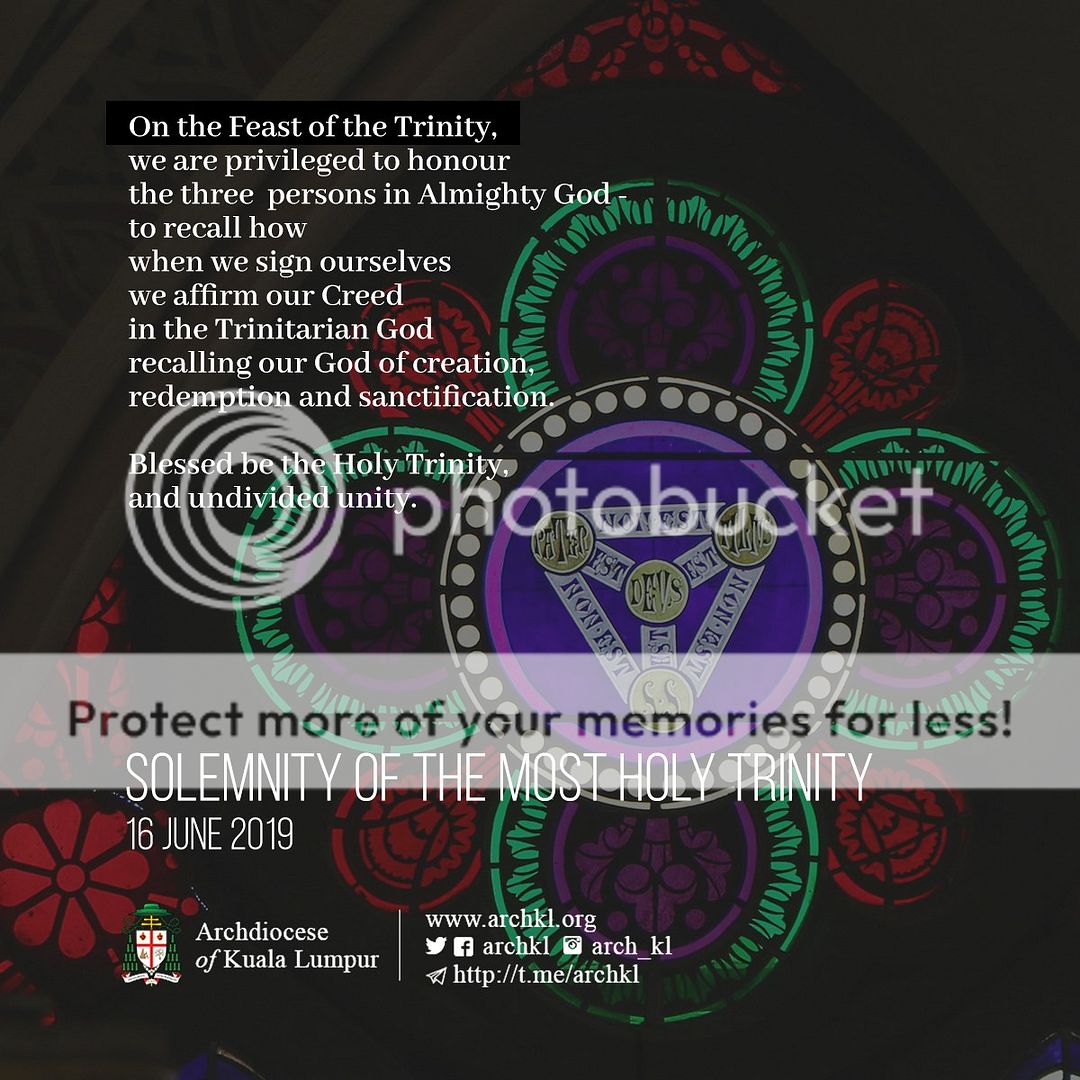 This post has been edited by khool: Jun 16 2019, 11:22 AM |
|
|
Jun 18 2019, 10:10 AM
|
|
Junior Member
225 posts Joined: Mar 2008
|
|
|
|
|
|
|
Jun 19 2019, 08:17 PM
|

Junior Member
611 posts Joined: Jun 2008
|
any catholic friends here? I need your prayer, my bro in law suddenly collapsed and passaway, my sister and him married for about 1 year only, no children and he is not a christian, but i do need prayer from you all, may God bless his soul and may God comfort my sister and my family and the in law's family too. This incident really breaks our heart and honestly all of us is unable to accept it.
Please pray for us and my brother in law's soul too. Thank you. |
|
|
Jun 20 2019, 09:01 AM
|

Junior Member
680 posts Joined: Jan 2012
|
QUOTE(daimon @ Jun 19 2019, 08:17 PM) any catholic friends here? I need your prayer, my bro in law suddenly collapsed and passaway, my sister and him married for about 1 year only, no children and he is not a christian, but i do need prayer from you all, may God bless his soul and may God comfort my sister and my family and the in law's family too. This incident really breaks our heart and honestly all of us is unable to accept it. Sorry for your loss. Keep your faith in the Lord for only He can heal us. Take care and I will pray for your family to overcome this great loss.Please pray for us and my brother in law's soul too. Thank you.  |
|
|
Jun 20 2019, 09:43 AM
|
|
Junior Member
611 posts Joined: Jun 2008
|
QUOTE(Hades76 @ Jun 20 2019, 09:01 AM) Sorry for your loss. Keep your faith in the Lord for only He can heal us. Take care and I will pray for your family to overcome this great loss. Appreciate that, thank you very much  |
|
|
Jun 20 2019, 12:34 PM
|

Senior Member
3,576 posts Joined: Apr 2006
|
May the Lord have mercy on his soul and may your family find solace and consolation.
|
|
|
Jun 20 2019, 08:38 PM
Show posts by this member only | IPv6 | Post
#1031
|

Senior Member
3,520 posts Joined: Feb 2017
|
QUOTE(daimon @ Jun 19 2019, 08:17 PM) ..... Bro, our deepest condolences and that we will do. First name of your deceased brother-in-law please ?Please pray for us and my brother in law's soul too. Thank you. |
|
|
Jun 20 2019, 08:56 PM
|
|
Junior Member
611 posts Joined: Jun 2008
|
QUOTE(Roman Catholic @ Jun 20 2019, 08:38 PM) Bro, our deepest condolences and that we will do. First name of your deceased brother-in-law please ? His name is Sam...actually is a non believerbut part of his family is christian, but not catholic His departed really break my heart, and i feel sorry for him and my sister too He is a good guy, never drink smoke or do anything We are happy that my sis has a good husband and still young just turn 30 yrs old only Married for 1 year, both of them have so many things want to achieve.... But all gone...in law mother actually told my sis that she wants to move to a new house, staying at current house really make her miss the son.... And i am worried about him, i don't know where is he, I wish Jesus is with him, I only can rely Jesus to accompany him, only Jesus he is in safe hand. So, thank you very much for your prayer. |
|
|
Jun 23 2019, 12:47 AM
Show posts by this member only | IPv6 | Post
#1033
|
|
Junior Member
611 posts Joined: Jun 2008
|
thank you guys for your prayer , and thank you God for hearing our prayer.
I actually asked my friend to help me on this, he posted on his church prayer group on Sunday (last week) and on Wed, the in law family actually saw my bro in law soul smiling to the mother in church... Thank God |
|
|
|
|
|
Jun 24 2019, 09:04 AM
|
|
Junior Member
680 posts Joined: Jan 2012
|
QUOTE(daimon @ Jun 23 2019, 12:47 AM) thank you guys for your prayer , and thank you God for hearing our prayer. Awesome man. Happy you have seen the grace of God. Some ( like myself ) is still looking for His grace. I actually asked my friend to help me on this, he posted on his church prayer group on Sunday (last week) and on Wed, the in law family actually saw my bro in law soul smiling to the mother in church... Thank God Be strong and be there for your sis. |
|
|
Jun 24 2019, 09:48 AM
|
|
Junior Member
611 posts Joined: Jun 2008
|
QUOTE(Hades76 @ Jun 24 2019, 09:04 AM) Awesome man. Happy you have seen the grace of God. Some ( like myself ) is still looking for His grace. thank you. Be strong and be there for your sis. i believe everyone is living in His grace.... |
|
|
Jul 26 2019, 11:34 AM
|
|
Senior Member
3,576 posts Joined: Apr 2006
|
Priestly Celibacy: Apostolic Tradition, not a ‘Mere Discipline’
There are numerous indicators that the October 6-27 Synod on the Amazon will have as one of its effects the dismantling or mitigating of the Latin Church’s ancient discipline of priestly celibacy. At least that is what is being claimed in numerous quarters. Proposed as an ad hoc remedy to the pastoral situation in the Amazon — so the thinking goes — the camel’s nose of a married priesthood will securely place itself under the tent and eventually undo the bi-millennial tradition of priestly celibacy in the Church. Exceptions, whatever their reasons, have a way of becoming the “new normal” to progressivist clerics. That tradition, make no mistake, is not a matter of mere discipline. A discipline it is, yes, but it is also a tradition of apostolic origin. Very weighty scholarship supports this claim (cf. Alfons Cardinal Stickler, The Case for Clerical Celibacy, and Christian Cochini, S.J., The Apostolic Origins of Priestly Celibacy.) Therefore, it is not a matter of indifference, for it is a thing that touches at the very heart of the Christian priesthood. Those who argue against the celibate priesthood speak of the absence of written laws on the matter in the early Church, and then, when laws do come about to address the question, mention is made of married deacons, priests, and even bishops. Case closed. Or is it? The fact is that custom was the Church’s first canon law. Being an institution steeped in tradition from her earliest days (cf. II Thess. 2:14), she simply went on doing what she always did. Such customs had the force of law. Legal historians will acknowledge that this description of custom as law conforms to the Roman legal traditions that the Church herself inherited and used for her own sacred purposes. English common law and modern legal positivism are alien to the Church’s legal tradition, and are therefore a poor lens through which to view these matters. When laws actually begin to be codified concerning the priesthood, marriage, and celibacy, what do we see? Evidence that completely overturns the arguments of the enemies of the celibate priesthood. There is no doubt, for it is a matter of historical fact, that married men were ordained to the priesthood in the early Church. Such was the case with some of the Apostles, including Saint Peter (an old joke has it that the Catholic Church was founded on Peter while Protestant sects were founded on Peter’s Mother-in-Law). The question is not whether they were married, but whether they continued to live more uxorio with their wives. And the answer to that question is a resounding no. When regional councils in Spain (Elvira) and Roman Africa (Hippo and Carthage) addressed the issue, the inflexible rule laid down was that once a man was ordained to the diaconate (some extended it down to the sub-diaconate), a married man could no longer have children or live in marital intimacy with his wife. His wife would be provided for by the Church — sometimes entering a convent, sometimes, not — but nevermore could the couple avail themselves of the use of matrimony. The same discipline was explicitly laid down by a succession of contemporary popes. In other words, while the men were still married sacramentally and were not previously celibate, they were now required, first by the law of custom and then by written law dating at least from the late fourth century, to live a life of absolute continence, i.e., celibacy. Call that a “married priesthood” if you will, but it is certainly not what is generally meant by those words today. Interestingly, in these early texts of popes and councils, aside from the apologia that priestly celibacy was apostolic in origin, the explanation as to why deacons, priests, and bishops ought to be completely continent was that they served at the altar — and therefore “handled” the sacred Mysteries, i.e., the Body and Blood of Our Lord, in the Holy Sacrifice of the Altar. And it is this that gives us the beginnings of a theology of priestly celibacy, which itself follows on the ancient praxis. But before I explore that question a bit further — the theology of priestly celibacy — let me address another objection of an historical nature to celibacy: While the Western discipline and canonical tradition concerning celibacy is easy to document as continuous, there is a contrary tradition that began in the Christian East, and that tradition eventually received the force of law in 692. Therefore, so the argument goes, priestly celibacy is merely a discipline that can be changed by positive law. But the matter is not so cut-and-dried, and that for several reasons. The break in continuity with the apostolic tradition of the celibate priesthood in the East was an abuse. The earlier Eastern tradition, the same as the West because sharing the same apostolic origin, was powerfully witnessed by many Eastern Fathers, including Saint Epiphanius of Salamis (310-404). Canon law in the Eastern Church was slower to develop and the abuse was never corrected (as abuses were corrected in the West, hence the above mentioned councils). In fact, the abuse eventually became enshrined in law in a regional council of the East that was never approved by the Pope, the famous Quinisext Council, or Trullan Council in 692. Those names deserve explanation: The first is owning to its being a sort of canonical follow-up to the fifth (quintus) and sixth (sextus) Ecumenical councils, which did not promulgate disciplinary canons; the second name comes from the fact that it met in the massive domed hall (troulos) of the Byzantine Imperial Palace in Constantinople. While this council was a mixed bag of good and bad, it was rejected by the pope of the day, Saint Sergius I (reigned 687-701), who was himself an Easterner, being of Syrian origin brought up in Palermo, Sicily, long part of “magna Graecia,” greater Greece, and was therefore Greek in its culture and liturgy (even today there are Byzantine Catholics in these areas of the Italo-Albanian Greek Rite). Saint Sergius said of the Council in Trullo that he preferred “to die rather than consent to erroneous novelties.” Quite the kerfuffle ensued when the Pope rejected certain of the Trullan canons; the Emperor Justinian II ordered him arrested. But the plan was, thank God, thwarted, thanks to the good men of the militia of the Exarchate of Ravenna, who probably did not want the Exarch to repeat the folly of the martyrdom of Pope St. Martin I (649-654), which took place roughly forty years earlier. But it is a matter of history that the Papacy tolerated this altered discipline in the East, and I do not contest that fact. It is noteworthy though that the Trullan discipline in the matter is not what modern advocates of a married priesthood would want. And to the degree that this is so, the mitigated discipline of Quinisext is a confirmation, in broad contours anyway, of the traditional argument for priestly celibacy. According to the Quinisext Council, a bishop cannot be married — or at least he cannot live as a married man more uxorio. Today, in Uniate Eastern Churches as well as the separated Orthodox communions, this is still respected, and bishops are selected from the monastic (celibate) clergy, or else from married priests whose wives have died or been put away. This is important because it tells us that in the bishop, the man who possesses “the fullness of the priesthood,” absolute continence — celibacy — is strictly obligatory. Further, a priest may not serve the Divine Liturgy (Byzantine language for “say Mass”) the day after he has had intimate relations with his wife. In other words, the Old-Testament discipline that, as long as a man was serving his turn at the altar he was to keep away from his wife, was made the norm in the Christian East. This Old-Testament discipline had explicitly been rejected in the West, and by popes, owing to the fact that the priest of the New Testament is to offer the divine sacrifice daily, while the priests of the Old Testament served short terms at the altar, there being many priests and only one Temple. This discipline governing their use of matrimony is why married priests of the East often do not celebrate the divine Mysteries daily. What modernist advocate of Episcopalian-style “married priests” wants that? It might be argued that continence in marriage is more difficult than outright celibacy. So we see that on these two counts — absolute celibacy for bishops and temporal continence for priests of the second rank — the mitigated discipline of the Eastern Churches points to the apostolic discipline of a priesthood that abstains from marriage. Given what was said earlier about deacons, it is very clear that what Pope Paul VI did in instituting a permanent diaconate that includes married men living more uxorio was not a “revival,” but a new thing. The respected Canon Law professor, Dr. Edward Peters, insists that married deacons are canonically obliged to continence. (Many object to his thesis, I know, but Dr. Peters at least highlights an inconsistency between accepted practice and ecclesiastical legislation, something that reflects the actual break in historical continuity with tradition.) Deacons, be it remembered, are major clerics who handle the sacred Mysteries. They touch the chalice at the traditional solemn Mass. The arguments given at Elvira, Hippo, Carthage, and elsewhere would therefore apply equally to them. Because my words will likely be scrutinized by many and twisted by some, let me be clear: I am not in a position to judge married deacons who disagree with Mr. Peters and who live accordingly, and I do not judge them. The Church must address the issue at some point. Neither do I look askance at Eastern Rite priests who are married, nor any other analogous clerics (such as Anglican Ordinariate clergy). In defending the venerable apostolic tradition, I have no intention to cast aspersions on anyone — excepting only those who want to dismantle that tradition which in the Latin Church has been so faithfully kept. These men are doing the work of Satan; they should be opposed. Theologically, the priest stands in persona Christi. This is especially so when he stands at the altar to confect the Eucharist, uttering the words of institution not in his own name, but in Christ’s: “This is MY Body… This is MY Blood.” All men are in the image of God; all the baptized are in the image of Christ; but the priest is in persona Christi Capitis, in the person of Christ the Head, the Divine Bridegroom who is chastely espoused to His Church. Not only that, but he is a man given over full-time to the work of prayer and sanctification. A common argument of an a fortiori variety used in defense of priestly celibacy is that if Saint Paul recommends (I Cor. 7:5) that the married lay faithful practice periodic continence that they may “give themselves to prayer,” how much more ought the priest be continent — he who daily serves at the altar, prays the divine office, frequently baptizes and shrives sinners. A priest’s “fatherhood” is real, and it is totally spiritual in character. This is why he must have an “undivided heart,” so that he may, like Saint Paul, beget children in Christ by the Gospel (by contrast, the Apostle says of the married man that “he is divided”). The priest begets offspring in his own chaste espousals to the Church, which he has espoused as one uniquely configured to Christ the Head, who Himself sanctifies His Bride, the Church in a chaste sacramental union. As Christ the Bridegroom is joined in a spiritual wedlock with His Bride, so too is the ministerial priest; it therefore behoves him to live in perpetual continence and chastity. Just as the Church has four marks, heretical and schismatic sects have certain marks. One of them is a hatred for purity and celibacy. The sixteenth-century revolutionaries jettisoned celibacy to marry, as Luther simulated matrimony with the Cistercian nun, Katharina von Bora (the marriage was invalid owing to his vows as a friar, her vows as a nun, and his priesthood!). The Anglican schismatics similarly did away with priestly celibacy. In the nineteenth century, both the Polish Nationals and the Old Catholics did the same. The list could be lengthened, but the point is made. Let us who belong to the true Church hold fast to this certain apostolic tradition of priestly celibacy. And may Our Lord Jesus Christ, the Eternal High Priest, have mercy on the Church! Most devotedly yours in the Hearts of Jesus and Mary, Brother André Marie, M.I.C.M. |
|
|
Sep 4 2019, 04:09 PM
|
|
Junior Member
225 posts Joined: Mar 2008
|
This post has been edited by khool: Sep 4 2019, 04:12 PM |
|
|
Sep 5 2019, 06:00 PM
|
|
Senior Member
3,576 posts Joined: Apr 2006
|
But Only One Church is ‘One’
There are many Christian confessions that recite, as part of their official worship, the Niceno-Constantinopolitan Creed, which professes faith in “one, holy, catholic, and apostolic Church.” But only one of those that confess this creed is, in reality, the Church so described by the fathers of the first two ecumenical councils. These four marks — “one, holy, catholic, and apostolic” — are attributes of the true Church of Jesus Christ. They are not mere external attributes, but intrinsic attributes. If, per impossible the Church ceased having all four marks or even any one of them, she would cease being the Church. Moreover, in Catholic theology, the four marks are also considered to be “notes,” that is — in the parlance of scholasticism — knowable attributes of an object. To be a note, an attribute has to be clearly manifest, for it helps us to know the object itself. When we say, for instance, that man is a rational, sentient, living, material substance, each of these five italicized terms is a note that identifies man. Lacking any of these, the object under consideration would not be a man (for instance, if the object lacked “rational” but had the other four notes, it would be a beast), but we see clearly that an object possessed of all five notes is a man, regardless of its size, shape, sex, color, etc. The humanity of the object is made known by these five notes. To what purpose does the Church have these notes of oneness, sanctity, catholicity, and apostolicity? It is so that she may be recognized for what she is, as Vatican I tells us in its decree “On Faith”: Since, then, without faith it is impossible to please God and reach the fellowship of his sons and daughters, it follows that no one can ever achieve justification without it, neither can anyone attain eternal life unless he or she perseveres in it to the end. So that we could fulfil our duty of embracing the true faith and of persevering unwaveringly in it, God, through his only begotten Son, founded the church, and he endowed his institution with clear notes to the end that she might be recognised by all as the guardian and teacher of the revealed word. To the catholic church alone belong all those things, so many and so marvellous, which have been divinely ordained to make for the manifest credibility of the christian faith. In this Ad Rem, I would like to consider the first of these marks, that of oneness, as a unique note of the Catholic Church. In these days when various new forms of unity are aggressively propagated, it is necessary for us to understand in what the unity of the Church consists, and how it is sharply contrasted with any number of humanly contrived “unities” such as religious ecumenism or political globalism. The first thing we should say, both to define the unity of the Church and to contrast it with these other unities, is that it is divinely authored. This unity is something that came to the Church not through human effort but by the grace of her Founder. Says Pope Leo XIII (Satis cognitum, 6): But He, indeed, Who made this one Church, also gave it unity, that is, He made it such that all who are to belong to it must be united by the closest bonds, so as to form one society, one kingdom, one body — ‘one body and one spirit as you are called in one hope of your calling’ (Eph. iv., 4). Here is how the BAC Sacrae Theologiae Summa treatise “On the Church of Christ” explains the note of oneness: Unity is the property by which something is undivided in itself and divided from everything else. Therefore unity excludes the inner division of the thing and does not allow it to be a part of some other whole thing. Social unity, which we are considering, is the working together of several persons for an end, under a supreme social power. In the Church a threefold social unity is distinguished: of faith, government, and worship, “of minds, wills and things to do,” as Leo XIII says in the Encyclical “Satis cognitum”: D 3305. Unity of faith is the agreement of minds in the same profession of faith under the supreme Magisterium of the Church. Unity of government is the agreement of wills working for the same social end under the supreme power of the Church of ruling. Unity of worship is harmony in the celebration of sacrifice and in the use of the sacraments and of liturgical acts, under the supreme power of the Church of sanctifying. Notice that the first paragraph of this excerpt says that unity constitutes something as undivided in itself yet divided from everything else. This unity is what I like to call “ontological one” as contrasted from “mathematical one.” Mathematical one is a number; it is divisible, and is so to a virtual infinity, for it can be divided by any number, producing long strings of numbers with a decimal point in front of them. By contrast, ontological unity is a oneness of being which is by its very nature indivisible. The Jesuit author of that BAC treatise above cited, Rev. Joachim Salaverri, tells us that the note of unity also divides an object from everything else. This means that the Catholic Church must, by virtue of her unity, necessarily be divided from all Churches that are not her. Otherwise, she is not truly one in herself, but subsists as part of a larger whole: a crazy idea that has in fact entered into Modernist ecclesiology. From this “divisive” aspect of Church unity, which is not sufficiently taught in our day, we may conclude that those who engage in ecumenical endeavors to achieve a generic, non-Catholic “unity” of Christians are actually obscuring the oneness of the Church. That, of course, is simply evil. Catholic unity embraces the threefold unity of faith, of government, and of worship that correspond to the three munera (offices) of the bishops: teaching, governing, and sanctifying. Taken together, these things keep the Church one in herself and divide her from all that is not the Catholic Church. I say “taken together” because it is possible for one to have the faith of the Church, and even the worship of the Church, while being in schism. An authentic schismatic, as distinguished from someone who is merely disobedient or even unjustly marginalized by the hierarchy, is one who rejects the governing authority of the pope or the bishops in communion with him. His is a sin not against faith, but against charity (cf. The Contradiction of Core). If the kind of unity that we describe as ontological and also as divinely authored is something possessed by the Catholic Church, then it is necessarily lacking in every other Christian body claiming the name Church — whether Protestants, Anglicans, or the Eastern Orthodox. None of these have unity in themselves, as seen by their historical “multiplication by division,” giving us not only the various sects, but even distinct synodal confessions within those sects (e.g., the Lutherans, Presbyterians, and Baptists, each of which has multiple permutations with differing professions of faith). Moreover, many of these sects are only insufficiently distinguished from each other, hence the history of sectarian amalgamation among these bodies, so that new, hyphenated sects sometimes arise that combine the old ones (e.g., the Unitarian-Universalists, the United Church of Christ, and various “federated congregations”). The Orthodox, of course, aside from having the seven sacraments and adhering to a greater number of Catholic doctrines, also have a greater cohesiveness among themselves. Yet, the fact that they do not accept any ecumenical councils after the first seven and are constitutionally incapable of holding one (even though these bodies have undergone the kind of historical crises that would call for ecumenical councils) is a sufficient indicator that they, too, are essentially divided from one another. The symbolic respect shown to the Patriarch of Constantinople does not prevent Moscow from frequently opposing and upstaging the older yet much smaller Orthodox body. It seems that the Third Rome often still thinks she has superseded the Second Rome. (For a glimpse at the state of unity among the Orthodox Churches, consider the so-called Pan-Orthodox Council and recent events in Ukraine.) The only way they can come into a genuine unity is if they come together under the pope and bishop of the first Rome, or “elder Rome,” as the city on the Tiber has been called by at least one ecumenical council (Constantinople III, cf., Roberto de Mattei, “The Heretic Pope”). One practical way the note of unity is manifested is the moral and political opposition that the Catholic Church suffers from all that is not Catholic. While we might not like being opposed, persecuted, or hated, this does serve to distinguish the one Church from what is not the one Church; it also fulfills the words of Our Lord about being hated like Him. For an interesting little study of this aspect of the Church’s oneness, see “Hatred Converted Me To Catholicism,” by the Catholic convert, Laramie Hirsch. To remind ourselves of the supernatural character of the Church’s oneness, we should meditate on the Scriptural proofs of this doctrine, including these passages: Matthew 12:25: “Every kingdom divided against itself shall be made desolate: and every city or house divided against itself shall not stand.” John 10:16: “And other sheep I have, that are not of this fold: them also I must bring, and they shall hear my voice, and there shall be one fold and one shepherd.” I Cor. 12:12: “For as the body is one, and hath many members; and all the members of the body, whereas they are many, yet are one body, so also is Christ.” And we cannot omit to mention the High Priestly Prayer of Our Lord recorded in John 17, especially verse 21, or Saint Paul’s lengthy and deep encomium of Church unity in Ephesians 4:1-16. This unity that Our Lord gave to His Church is found in our one faith taught by the Magisterium, our one government via the pope and the bishops in communion with him, and our unity of worship, which is manifested in the Church’s sacramental and liturgical rites, most especially the Holy Sacrifice of the Mass and the great Sacrament of Unity itself, the Holy Eucharist. It is fitting if I close out these lines with a tribute to this great Mystery of the Altar; Saint Paul, in I Corinthians (10:16-17), explains the supernatural unity of the Church in terms of Its very matter: The chalice of benediction which we bless, is it not the communion of the blood of Christ? And the bread we break, is it not the partaking of the body of the Lord? For we, being many, are one bread, one body: all that partake of one bread. And I will happily give the last word to Saint Augustine, who comments on this passage in his Sermon 272 (cited in Emile Mersch, S.J., The Whole Christ, pp. 426-427): But why is this mystery accomplished with bread? Let us offer no reason of our own invention, but listen to the Apostle speak of this sacrament, ‘We are one bread, one body.’ Understand this and rejoice. Unity, truth, piety, charity. ‘One bread.’ What is this one bread? It is one body formed of many. Remember that bread is not made of one wheat; at baptism water was poured over you, as flour is mingled with water, and the Holy Spirit entered into you like the fire which bakes the bread. Be what you see, and receive what you are. This is what the Apostle teaches concerning the bread. Though he does not say what we are to understand of the chalice, his meaning is easily seen. … Recall, my brothers, how wine is made. Many grapes hang from the vine, but the juice of all the grapes is fused into unity. Thus did the Lord Christ manifest us in Himself. He willed that we should belong to Him, and He has consecrated on His altar the mystery of our peace and unity. Most devotedly yours in the Hearts of Jesus and Mary, Brother André Marie, M.I.C.M. |
|
|
Sep 7 2019, 11:20 AM
|
|
Junior Member
225 posts Joined: Mar 2008
|
|
|
|
Sep 22 2019, 11:31 PM
|
|
Senior Member
3,576 posts Joined: Apr 2006
|
Holiness Becometh Thy House, O Lord
During a performance by a local amateur opera company in a small Italian town, an amusing thing happened. These were amateurs in the true sense, they performed out of love for the art, and not for pay. Now, love and virtuosity do not always coincide in the same person. And Italians do like their opera to be done well. Hence, the local baritone having botched his aria quite splendidly, he was met with a chorus of boos from the raucous audience. Inserting a dramatic aside not included in the score, he addressed his audience thus: “If you think that was bad, wait till you hear the Tenor!” This story came to mind when I was considering the subject at hand, which is the holiness of the Church, one of the four “marks” or “notes” of the Church mentioned in the Creed (see But Only One Church is ‘One’ for an explanation of what a “note” is). This note seems more concealed in our times than in others, owing to numerous scandals and crises, but we cannot be like the baritone and say, “If you think we’re bad, just look at the Unitarians! Compared to them, we’re saints!” No, that won’t do. The Church’s four marks are essential to Her, and must be manifest to those who are not Catholic. How, then, do we explain that the Church is holy even when many of her own priests and bishops have shown themselves to be particularly vile and unholy? That question will be answered as we proceed to explain the Church’s mark of holiness. Holiness is proper to God, of whom the books of Isaias and the Apocalypse say that He is “Holy, Holy, Holy,” a providentially trinitarian affirmation in a language (Hebrew) that lacks the comparative and superlative degrees of adjectives, thus necessitating this tripling to intensify the word “holy.” In God, holiness signifies two things, one negative and one positive: The complete absence in Him of all that is imperfect or creaturely (the Hebrew word for holy, qadosh, means separate or set apart), and His total, perfect adherence to His own goodness. (To see this idea developed, see Abbot Marmion’s Christ the Life of the Soul, pp. 14-16). In creatures, sanctity is a participated holiness, and is therefore radically contingent on God’s own holiness. We speak of creatures being holy in two distinct ways: ontologically and morally. In general things are said to be ontologically holy, while persons are said to be morally holy. Things that are set aside for the divine use are ontologically holy: such are holy rituals, scriptures, oblations, sacrifices, temples, churches, sacraments, offices (e.g., the priesthood, the episcopacy), etc. Persons are said to be morally holy by virtue of a twofold character: first, the negative quality of absence of sin or evil, and second, the positive quality of benevolent union with God Himself, who sanctifies the soul by the infusion of sanctifying grace, the theological and moral virtues, the gifts of the Holy Ghost, and actual grace so that the child of God may increase in sanctity by performing meritorious good works. As holiness differs from person to person, moral holiness is sometimes spoken of in three ascending gradations: ordinary (or “common”) holiness, perfect holiness, and heroic holiness. These degrees correspond to the descending gradations mentioned by Our Lord Himself, in the Parable of the Sower: “But he that received the seed upon good ground, is he that heareth the word, and understandeth, and beareth fruit, and yieldeth the one an hundredfold, and another sixty, and another thirty” (Matt. 13:23). Now, the Church is said to be holy in all these ways. She is ontologically holy as an institution for several reasons: by virtue of her union both with Christ who is her Head and Founder, and with the Holy Ghost, who is her Soul; by virtue of her purpose, which is the glory of God and the eternal salvation of souls; by virtue of her faith, morals, sacrifice, and sacraments; and, finally, by the fruits of all these things, which is grace, virtue, and charisms in her children. The Church is also morally holy in her children, and that in all three degrees. It is easy to prove her ordinary moral holiness when we consider her ontological holiness; the Church is that “good tree” (ontological) which must bear the “good fruit” of moral holiness in her children (Cf. Matt. 7:17-19). But Holy Scripture also speaks more directly of the moral holiness of the Church: To the church of God that is at Corinth, to them that are sanctified in Christ Jesus, called to be saints, with all that invoke the name of our Lord Jesus Christ, in every place of theirs and ours. (1 Cor. 1:2) And such some of you were [effeminates, nor liers with mankind, thieves, covetous, drunkards, railers, extortioners]; but you are washed, but you are sanctified, but you are justified in the name of our Lord Jesus Christ, and the Spirit of our God. (1 Cor. 6:11) Who gave himself for us, that he might redeem us from all iniquity, and might cleanse to himself a people acceptable, a pursuer of good works. (Titus 2:14) The Catholic faithful who remain in the state of grace are holy by at least ordinary moral holiness. They practice the commandments and the virtues, and avoid mortal sin. In short, they conform themselves to the New Law of Christ, whose purpose it to sanctify; therefore, they are holy. The BAC Sacrae Theologiae Summa tells us that “The proper end of the New Law, as contrasted with the Old, is perfect moral holiness. But such an end must be obtained unfailingly. Therefore the Church unavailingly will be holy also with perfect moral holiness.” To prove the major premise of that syllogism, the author, Father Salaverri, cites the exalted moral character of the Gospel as taught by Our Lord in the Sermon on the Mount, where we find multiple “elevations” of the moral standards of the New Law over the Old, including those clearly stated in six distinct phrases that follow a format like this: “You have heard that it was said to them of old… But I say to you….” (See this article for more detail, including the citation of all six of these verses.) Jesus offered the possibility of perfection to the rich young man when He challenged him in these words: “Jesus saith to him: If thou wilt be perfect, go sell what thou hast, and give to the poor, and thou shalt have treasure in heaven: and come follow me” (Matt. 19:21). We know that the rich young man went away sad, but we also know that generations of consecrated persons, beginning with the Apostles themselves (cf. Matt 19:27-29), went on to follow Our Lord in the life of the evangelical counsels, those “counsels of perfection” which are added to the observance of the commandments in order to live a life of perfect moral holiness. Not that moral perfection is exclusive to the religious state (neither do all religious achieve it), but that is its end: perfect moral holiness resulting from the free and voluntary embrace of the evangelical counsels, which, according to Saint Thomas, remove the chief obstacles to the observance of the commandments. This challenging Law taught by Jesus on the Mount of Beatitudes is something that the Apostles were commanded to teach, and did: “And Jesus coming, spoke to them, saying: All power is given to me in heaven and in earth. Going therefore, teach ye all nations; baptizing them in the name of the Father, and of the Son, and of the Holy Ghost. Teaching them to observe all things whatsoever I have commanded you: and behold I am with you all days, even to the consummation of the world” (Matt. 28:18-20). Based upon these promises, Father Salaverri argues, “Therefore the power will never be lacking efficaciously to obtain the moral perfection, which Christ willed and commanded to be observed in the Church; and consequently perfect holiness will also be found unfailingly in the Church.” Finally, we come to the third and highest tier of moral holiness, that described as “heroic.” Christ willed the Church as a Spouse worthy of Himself, as Saint Paul lucidly teaches in Ephesians 5:23-30, of which verse twenty-seven describes the Church as “a glorious church, not having spot or wrinkle, or any such thing; but that it should be holy, and without blemish.” From this passage, it follows that there must be those in the Church who actually are worthy of Christ by rising to what Christ intended His Church to be; such practice virtue to the heroic degree with the help of grace. They follow the precept and example of heroic charity given to the Church by Christ Himself, heeding the words of Saint John the Beloved: In this we have known the charity of God, because he hath laid down his life for us: and we ought to lay down our lives for the brethren.” (1 John 3:16). Indeed, they heed the words of the Word Himself: A new commandment I give unto you: That you love one another, as I have loved you, that you also love one another. By this shall all men know that you are my disciples, if you have love one for another. (John 13:34) This is my commandment, that you love one another, as I have loved you. Greater love than this no man hath, that a man lay down his life for his friends. (John 15:12-13) It was Tertullian who wrote, in his Apology: “Look,” they [the pagans] say, “how they love one another” (for they themselves hate one another); “and how they are ready to die for each other” (for they themselves are readier to kill each other). In that passage the African father shows that there were then living in North Africa Christians so heroic that they would follow the words of Christ and lay down their lives for their brethren in imitation of Him. Christ Our Lord promised that such things would happen, and the Apostles exhorted their own disciples in the same fashion (cf. Matt. 10:17-28; John 15:9-20; John 16:1-4, 20, and 33; and I Peter 2:21). The lives of the saints from every age since Apostolic times provide us with “so great a cloud of witnesses” (Heb. 12:1) to the holiness of the Church. The martyrs most readily come to mind: many millions of them date from the early centuries of persecution, but many millions of them also from modern times, thanks to the anti-Christian -isms of modernity going back to the French Revolution. As Christians were killed for their Faith in the early centuries, the Church continued to spread, such that Tertullian famously said, “the blood of Christians is seed.” That seed still germinates. But in addition to her millions of martyrs ancient and new, the Catholic Church shows her heroic sanctity in numerous confessors, virgins, ascetics, anchorites, monks, canons regular, nuns, friars, clerks regular, and lay faithful in every age. Many a pagan has been converted over the years by witnessing the holy lives of the missionaries the Church sent them. Our American Indians were shocked at the sanctity manifested by the missionaries of the Society of Jesus, especially as manifested by their celibate chastity, which seemed superhuman to the natives. “Savages” could see the sanctity of the Church as manifested in her missionaries. That is what a “note” is! And what of our own day, when scandals abound? Such scandals — and so many! Wherever the seed of the Faith has taken root in good soil it manifests at least “ordinary” sanctity. We see it — and sometimes more than it — in large Catholic families whose parents avoid the sin of onanism, are committed to raising their children properly, and put God’s holy will above the consumerism that surrounds them, opting out of the government indoctrination centers we call public schools, and instead teaching their children at home or stretching their means to send them to schools that are Catholic in fact (if not in law: cf. Can. 803 §3), passing on to their precious offspring that pearl of great price that they value above all else. There are many such people quietly going about the duties of their state in life. To encounter them is to be edified. There are those who wrestle with the vices so liberally advocated by the popular culture, who, having been seduced by their allurements, now do penance and bewail their former sins, living the life of grace. In our midst are new Augustines and Monicas, Magdalens and Margarets of Cortona. There yet remain those who flee the world to embrace the evangelical counsels, some in the most penitential of monastic communities, others in those congregations that show the sanctity of the Church is performing works of mercy. While the numbers are hardly proportioned to the general population (owing to a lack of generosity on our part, not God’s), the seeds of reform are present now in the Church. What produced a Thebaid, a Cluny, a Citeaux, a Grande Chartreuse, a Camoldoli, etc., still remains in the Church because Christ is Her Spouse and the Holy Ghost Her Soul. Today, we see many good priests persecuted for their fidelity to the priesthood. They suffer, and it is edifying to see them being conformed to Christ the Victim-Priest by their sufferings. If the corruption infecting the Mystical Body today has produced many Herods, Annases and Caiphases in the episcopacy, it is also occasioning the rise of new heroic imitators of Jesus and the Apostles in the priesthood. We were created and subsequently redeemed by the good God for His glory. Regardless of their state in life, those who see, love, and seek the Triune God in all things are possessed of piety; they glorify Him. His glory radiating into them through holy things — especially the Blessed Eucharist — makes them holy, and manifests itself excellently in the life of the Beatitudes. Such Catholics, by their holy lives, sing a canticle to the glory of God for all to hear (no matter how good or bad their voices are!): “Thy testimonies are become exceedingly credible: holiness becometh thy house, O Lord, unto length of days” (Ps. 92:5). Most devotedly yours in the Hearts of Jesus and Mary, Brother André Marie, M.I.C.M. |

| Change to: |  0.0357sec 0.0357sec
 0.63 0.63
 6 queries 6 queries
 GZIP Disabled GZIP Disabled
Time is now: 5th December 2025 - 01:48 AM |
All Rights Reserved © 2002- 2025 Vijandren Ramadass (~unite against racism~)
Powered by Invision Power Board © 2025 IPS, Inc.