This helicopter-plane hybrid aircraft could be a game changer for the US military
QUOTE
The US military's research and development office announced on Thursday the next phase in a bid to build an unmanned vertical takeoff and landing "X-Plane," and it could be a game changer for soldiers on the ground.
QUOTE
The X-Plane has similarities with the military's V-22 Osprey, which can takeoff and land like a helicopter and fly like an airplane, but the big difference this time is there's no pilot onboard. It would be flown remotely, much like the military's Predator and Global Hawk unmanned aerial systems.
QUOTE
the X-Plane could be used in more diverse missions, like transporting troops, rescuing wounded soldiers during medical evacuations, dropping off supplies, and special operations
QUOTE
If all goes well, it could reach a top speed of about 460 mph, all while being capable of carrying around 4,000 pounds of gear or troops.
All Hands On Deck: Russian Military Sets Up High-Tech Radar System in Syria
QUOTE
The Zoopark-1 missile and artillery ground reconnaissance complex is designed to automatically determine the coordinates of enemy artillery positions (mortars, field artillery, rocket volley fire systems and tactical missile launch positions) to provide target sighting information to its own countermeasure equipment, as well as to monitor its own firing results.
QUOTE
The Zoopark-1 intelligence and radar complex is completely autonomous and it takes about five minutes to deploy. The complex can conduct reconnaissance of positions of up to 17 kilometers and target artillery with a minimum bore size of 82-120 millimeters.
QUOTE
The complex is capable of detecting up to 70 firing positions in a minute, while tracking up to 12 targets.
‘Efficient, accurate’: Russian air warfare in Syria praised in classified NATO report
QUOTE
The document points out that Russia deployed 40 warplanes, performing some 75 sorties a day (until the ceasefire came into effect on February 27). The airstrikes, usually delivered on several targets during each combat flight, are “accurate and efficient,” the analysis reportedly says.
QUOTE
The US-led counterterrorist coalition, deploying about 180 warplanes against Islamic State (IS, former ISIS/ISIL), strikes only about 20 targets a day. The paper says the number of Russian fighter jets on the ground is “clearly inferior in number” to NATO’s group, but the higher frequency of the Russian air raids makes them more effective.
QUOTE
The US-led counterterrorist coalition has been operating in Iraq and Syria for over a year, while Russia launched its offensive on terrorist groups on September 30, 2015.
QUOTE
The Russian Air Force has turned the Syrian battlefield into a test ground for advanced military technologies, such as deploying ultra-modern Sukhoi Su-35 fighter jets to Syria’s Khmeimim airbase. The plane is believed by many experts to be superior to most existing warplanes, the report claims
QUOTE
According to NATO experts, only 20 percent of Russian airstrikes are delivered on IS militants. The other raids have been allegedly directed against anti-Assad militias, some of which are supported by the West.
The Stupidly Simple Spy Messages No Computer Could Decode
QUOTE
When I was ten years old, I found a shortwave radio in a crumbling old leather trunk where we kept family photos and other memorabilia. As I spun the dial, tinny, modulating noises, like the song of an electronic slide whistle, emanated from the radio’s small speaker.
QUOTE
“7…6…7…4…3.” Pause. “7…6…7…4…3.”
QUOTE
Listen. Hear me now. 7…6…7…4…3. Did you get that? 7…6…7…4…3.
QUOTE
But it would be another 25 years before I learned what I’d really heard on the shortwave radio. That man had been talking to someone. Not me. But someone in particular, who knew exactly what the Numbers Man was saying. I had intercepted a message to a spy.
QUOTE
“Facilities with giant antenna farms…were positioned at strategic locations in the United States and abroad,” according to the 2008 book Spycraft: The Secret History of the CIA’s Spytechs, from Communism to Al Qaeda,
QUOTE
For decades, numbers stations have been a favorite way for Cuban intelligence to make contact with their American agents. The practice didn’t fall out of fashion with the end of the Cold War. In the past 15 years, at least five Cuban spies who used numbers stations to communicate with their handlers in Havana have been sent to prison
QUOTE
But today, the Russians operate a large numbers network, both to communicate with spies—in Ukraine, for example—and to send messages to military forces. Now, those transmissions can he beard online via shortwave radios connected to the Internet.
QUOTE
The British are believed to have run a numbers station from a military base in Cyprus from the 1970s until 2008, probably to communicate with their spies in the Middle East and North Africa
QUOTE
The numbers stations have been all around us for decades, equally disturbing whether in English, Polish, or Mandarin
QUOTE
Even today, the most powerful supercomputers thrumming away in vast, refrigerated rooms at the National Security Agency couldn’t break the code that protected it. That computer the FBI wants to hook up to the iPhone used by one of the San Bernardino shooters to guess its password by “brute force?” Useless against the Numbers Man’s secret message
QUOTE
CIA or whatever intelligence agency was running him. These numbers were the key. Going number by number, he’d subtract row two from row one and come up with a third row. And those numbers corresponded to letters, which spelled out a message
QUOTE
But the numbers are just gibberish without that key, known in spycraft as a one-time pad. As its name suggests, it’s used only once. And that’s what makes it so secure.
QUOTE
The intelligence officer told me that some of the pages were designed to dissolve in water. The agent could flush it down a toilet or even drop it in a glass of water at a cafe. The CIA reportedly made other pad pages that turned into gum on contact with saliva. I don’t know if they were mint flavored.
QUOTE
Numbers stations have been located in Ukraine, transmitting in Russian and English. Poland operates a large number, in both Polish and English. Egypt has a network, in English and Arabic. Taiwan broadcasts in Mandarin into mainland China. China, in turn, runs its own numbers networks, and many of them are used for military purposes, such as communicating with deployed forces. South Korea and North Korea each run numbers stations, presumably to communicate with spies in each other’s countries, though it’ s possible that each is trying to convince the other that’s what it’s up to. Some numbers stations are believed to be set up only to confuse an adversary and give the appearance that his country must be crawling with spies, thus diverting time and money to hunting them.
The secrets of Pine Gap: Huge high-tech spy facility in the remote Australian outback tracks terrorists and is the most important intelligence gathering unit outside the US
QUOTE
It’s Australia’s top secret spy base that you may have heard of, but know nothing about.
Now in a series of reports, a group of determined researchers have studied the workings of Pine Gap, offering a closer look into what takes place at the most important western intelligence gathering unit outside the United States.
Pine Gap is a satellite tracking station 20 kilometers south-west of Alice Springs, Northern Territory, in the centre of Australia and is operated by both the Australian and the United States military.
INTERNATIONAL MILITARY REVIEW – SYRIA, MAR. 3, 2016
The Syrian Arab Army (SAA) launched a military operation to liberate at the strategic village of Kabani controled by Al-Nusra and its allies. Thus, the SAA’s 103rd Brigade attacked the southern flank of Kabani and the Syrian Marines continued an advance along the Aleppo-Latakia Highway (M-4). If Kabani is captured, the SAA will be able to advance on the Jisr Al-Shughour’s southern countryside. This town is a mid-term goal of the ongoing advance.
The SAA stormed the ISIS positions at the village of Fah and forced the terrorist group to pull forces back from the village and nearby farms in the Aleppo province.
Heavy clashes between the Kurdish militias and ISIS have been observed in the area between the border town of Tal Abyadh and al-Kantari and near the Raqqa-Turkey highway.
Meanwhile, the Syrian troops reportedly deployed in Southeastern and Northeastern areas of Aleppo and Hama provinces respectively are preparing to launch a joint anti-terrorism operation to free more lands in the province of Raqqa.
On Mar.2, ceasefire agreements were signed with four commanders of moderate rebel units, which control Kafar, Shams and Gabagib in the Daraa province. Total number of signed agreements has reached 40, talks with 11 more are underway.
The Russian centre for reconciliation of opposing sides also delivered 6 tons of humanitarian aid to the settlements of Kineiba, Vali-Sheikhan and Hansjaus.
SAUDI AIR FORCE DEPLOYS TO SUPPORT TURKEY’S MILITARY INTERVENTION IN SYRIA
Following the announcement by the Saudi Defense Ministry on Saturday February 14th that the kingdom intended to commit both air and ground forces to the fight against ISIS in Syria, the first four Royal Saudi Airforce F-15S strike fighters arrived at Incirlik air base on Friday February 26th. These jets were immediately proceeded by approximately thirty officers and men and supporting equipment aboard two C-130 transports. It is obvious that Saudi Arabia is sending air forces and possibly ground forces not to combat ISIS and Al- Nusrah Front, having funded them for years, but to ensure that the Syrian government is not able to regain sovereignty of the entirety of the nation.
Saudi Arabia has one of the most modern and well-equipped air forces in the region and has invested heavily in this military tool for over two decades and fields an impressive inventory of strike aircraft. The Saudi air force uses a mix of both U.S. and European aircraft, from the venerable F-15C and Tornado, to the relatively new Typhoon. The F-15Cs and Tornados have all recently been modernized and 48 units of the Typhoon have been delivered to the Kingdom from Britain. The F-15S is the Saudi version of the F-15E Strike Eagle strike fighter. It is planned to upgrade all of these units to the latest F-15SA standard over the next few years.
The Saudi Air Force has ordered a total of 72 Typhoon T-2 and T3A variants from BAE of the UK. Although this is a modern fighter with strike capabilities, it is rather unproven in combat compared to the F-15s and Tornados historically operated by the Saudis. Saudi aircraft will most likely only operate from Incirlik airbase, along with U.S. and other NATO air forces. This air base has the infrastructure and logistics in place to handle the aircraft of various NATO types. The base is also close to the proposed area of operations (Northern Syria) and is guarded by modern air defenses.
Any Saudi force would most likely only go into battle with the backing of a U.S. or NATO mandate, and the employment of U.S. and NATO aircraft in preliminary strikes. It remains to be seen if the United States and NATO will decide to support Turkey and Saudi Arabia in such an escalation of hostilities. Saudi Arabia’s threat of direct military intervention in Syria also signals the failure of their war by proxy. Their armed gangs of Islamic zealots and terrorists have largely collapsed as a viable threat on the battlefield and face a certain defeat. A failure in Syria along with a stalemate in Yemen may prove to be one failure too many for a Saudi monarchy that is suffering from internal division amongst itself and the hundreds of clans whose loyalty ensures their legitimacy.
It is very clear that any air campaign engaged upon by Turkey and Saudi Arabia alone will be met with a swift and effective Russian response with both ground and naval-based air defenses as well as the most modern and capable air superiority fighters in the region. Russia has made it extremely clear, in diplomatic yet unambiguous terms that it will not allow any outside forces to invade Syria to topple the government and secure their own aims in violation of Syrian sovereignty. Additionally, Russia has international law on its side in any dispute. It is carrying out military operations within Syria at the request of the legitimate government of that nation.
While the assets of the RSAF are modern and capable, they do not represent a technological or combat experience advantage over the forces that Russia can bring to bear in response. Russian air force and air defense forces based in Syria alone present a strong deterrent to any outside power seeking to violate the airspace of Syria without the expressed permission of the Syrian government. It is understood that any direct military confrontation between Saudi Arabia and Russia will further complicate and expand a costly regional conflict into a global one. The arrival of the first Saudi combat aircraft immediately prior to the start of the U.S.-Russia brokered ceasefire sends a clear message that neither Saudi Arabia nor Turkey desire a cessation of hostilities any time soon.
INTERNATIONAL MILITARY REVIEW – SYRIA, MAR. 4, 2016
ISIS militants have launched an advance on the Deir Ezzor Military Airport controlled by the government’s forces. On Mar.3 the ISIS force reached the southern gates of the airport following a successful firefight against the Syrian Arab Army (SAA). However, ISIS militants were unable to break the SAA’s defenses. The clashes are ongoing.
The SAA’s 555th Brigade of the 4th Mechanized Division is advancing in northeast Hama. The Zakiyah Crossroad, located west of the border between the provinces of Al-Raqqa and Hama, remains the goal of the loyalist forces. On Mar.3 the SAA seized Point 4, Point 5, Khirbat Al-Bayda, and several small hilltops on the way to it. Clashes were also observed at the Zakiyah village located located along the Salamiyah-Raqqa road.
Meanwhile, the SAA continued an advance towards the city of Palmyra securing the mountaintop of Jabal Jazal and its neighbouring oil fields. In South of Palmyra, the SAA moved to Wadi Al-Dhakara, seizing a part of the valley after a violent battle with ISIS.
We remember the pro-government group “Liwaa Suqour Al-Sahra” have deployed in the Palmyra front to strengthen the SAA’s force seeking to liberate the city.
On Mar.3, ISIS and al Nusra made an attempt to cut the Aleppo-Khanaser-Ithria road one more time. However, the SAA and its allies repealed this attack.
Since the Khanaser-Aleppo road is now free of danger, the pro-government forces, wich have been concentrated in the area, are preparing for a large military operation in Southeastern Aleppo. According to reports, the Syrian Army’s Central Command decided to deploy a significant force to the town of Ithriya. Ithriya is located in the Hama province’s Northeastern countryside. The town borders the Aleppo province to the North and it is situated 15 km West of Raqqa axis.
RUSSIA DEFENSE REPORT – MAR.3, 2016: RUSSIAN AEROSPACE FORCES IN SYRIA AND BEYOND
If the Russian Aerospace Forces’ performance took NATO by surprise, it is because earlier Russian operations did not suggest that level of ability. Russian aviation took serious losses in the 2008 conflict with Georgia: 7 aircraft shot down including a Tu-22M bomber, 4 damaged, or one loss per each 17 combat missions. There was practically no new aircraft procurement since 1994. Russian aircrews flew far fewer hours than their NATO counterparts.
But the Georgia conflict served as a wake-up call and led to reforms which proved both crucial and successful.
Russian airpower was reduced in numbers, and reorganized into 8 air bases, each supporting several air groups based on individual airfields, which allowed individual pilots to get more flying time. In 2012, the air bases and air groups were renamed divisions and regiments.
Starting with 2012, new and modernized aircraft began to enter service in large numbers. By 2014 and 2015, Russian air forces were receiving 100 new or thoroughly modernized aircraft a year, and that pace is expected to continue in 2016. By 2020, the Russian Aerospace Forces (VKS) are expected to have at their disposal about 1500 mostly modern combat aircraft, including 130 heavy bombers such as the Tu-160, Tu-95MS, and Tu-22M, over 800 fighters, and over 500 tactical bombers and attack aircraft.
These reforms led to the Russian VKS demonstrating a number of capabilities which seemed beyond its reach only seven years earlier:
The ability to deploy and sustain a force of 100 combat aircraft for several months in difficult conditions, and the ability to sustain a high rate of combat missions.
The ability to function in a “reconnaissance-strike complex” mode, which enables intelligence data obtained by a variety of sources, including aircraft, satellites, drones, and agents, to be converted into targeting data to allow even mobile targets, such as enemy mobile troop or supply columns to be quickly targeted.
The ability to conduct close air support as well as battlefield interdiction and suppression against an enemy practiced in concealment.
The ability to operate in any weather conditions, at any time of day.
The ability to use precision-guided munitions.
The ability to integrate long-range aerial early warning aircraft such as the A-50 and intelligence and ground surveillance aircraft, such as the Il-20 and Tu-214R, into the overall concept of operations.
The ability to use drones on a large scale and as part of an integrated aerial operation.
Granted, the picture is not perfect. Here is what Russian airpower has not demonstrated in Syria:
The ability to organize and operate large aerial “strike packages” against sophisticated aerial and anti-aircraft defenses. To be sure, while US and some NATO forces may have had that ability a decade ago, it has been degraded by NATO airpower being used in Afghanistan and Iraq.
The ability to use large numbers or a large variety of precision-guided munitions. Russian aircraft did use many satellite-guided KAB-500R bombs and Kh-29L laser-guided missiles. But most of the munitions dropped were unguided bombs and aerial rockets, aided by sophisticated on-board digital ballistic computers which allowed them to strike their targets with a fair degree of accuracy. Russia does not have tactical stand-off munitions like the SDB or AASM or the JASSM tactical cruise missile. Such weapons are in development and have been shown at MAKS-2015, but they will not be in service for years. On the other hand, perhaps there is a silver lining in this, because Russia is not over-reliant on satellite navigation systems to the same extent as NATO which might well experience a shock once it tries to use such weapons against opponents more sophisticated than the Taliban.
The maturity of some of the most modern aerial systems which entered service only very recently. The Su-30SM, Su-35S and Su-34 do appear to have at least minimum operational capabilities, as their performance in Syria did not give reason to doubt their performance. At the same time, the conflict did not push them to the edge of their performance, as most of the missions were performed equally well but much older though upgraded Su-24 bombers. Russian aircraft in Syria did not include the Mi-28N or Ka-52 attack helicopters, which raises questions about the degree of their operational maturity. However, nothing suggests these aircraft are failures in the same sense as the F-35, for example.
Everything suggests that the Russian VKS will not rest on their laurels but instead will continue to build on their strengths and eliminate weaknesses, so that it will be an even more capable force in the next conflict it has to fight.
Isis air strikes: Civilian death toll from western bombing 'set to reach 1,000 within days'
QUOTE
The civilian death toll from Western air strikes against Islamic State fighters is set to pass the 1,000 mark “within days”, independent monitors told The Independent on Sunday.
QUOTE
Britain has carried out 591 air strikes in Iraq and 36 in Syria – making up around a quarter of the 2,000 attacks carried out by countries other than the US in the international coalition against Isis. Russian air strikes are estimated to have killed up to 2,900 civilians.
Iran’s Basij Fighting Force Bolsters the Syrian Regime
QUOTE
The most obvious clue as to their presence is the fact that Iranian troops have died in the conflict, including high-profile commanders such as Brig. Gen. Hossein Hamedani of the Iranian Revolutionary Guards Corps
QUOTE
Iran’s Syrian military presence also heavily relies on the Basij — a paramilitary organization numbering between four to five million members
QUOTE
The Basij is most well known in the West for its terrifying human-wave tactics during the Iran-Iraq War
QUOTE
“[The Basij] carries out military training and surveillance, supervises public behavior, runs businesses, educates members, and propagandizes through physical space and social media,”
QUOTE
Officially, the Basij recruits fighters to defend the Sayyidah Zaynab Mosque in Damascus
Watch And Hear This Impressive Stream Of F-35s Blast Off Into The Evening Sky
QUOTE
Love it or hate it, these two facts that cannot be denied about the F-35—its F135 turbofan engine is very loud, and its afterburner plume is massive. Add in some twilight conditions and you have yourself quite the light and sound show, as can be seen in this video taken at Luke AFB as a bunch of F-35As take to the skies for a night training sortie.
Philippines: No involvement in joint patrols in disputed seas
QUOTE
MANILA, Philippines – Malacañang declared yesterday that it has nothing to do with the planned joint naval exercises of allies US, Japan and India in the disputed West Philippine Sea.
QUOTE
Washington has issued a warning to China following reports that five Chinese ships have surrounded and taken over a Philippine-held atoll, where they even prevented local fishermen from fishing.
Beijing said the Chinese ships have left the area.
Lawmaker asking why Navy SEALs don't have enough rifles
QUOTE
WASHINGTON (AP) — The tip of the spear may be losing its edge. Navy SEAL teams don't have enough combat rifles to go around, even as these highly trained forces are relied on more than ever to carry out counterterrorism operations and other secretive missions, according to SEALs who have confided in Rep. Duncan Hunter, R-Calif.
After SEALs return from a deployment, their rifles are given to other commandos who are shipping out, said Hunter, a former Marine who served three combat tours in Iraq and Afghanistan. This weapons carousel undercuts the "train like you fight" ethos of the U.S. special operations forces, they said.
There have been a number of reports, so far without any visual confirmation, that some 200 militants have switched sides and seized part of the city of Raqqa, which is usually referred to as the “ISIS capital.” One has to consider the distinctive possibility such reports represent an effort by local Sunni forces to establish a truce with at least one of the three forces marching in the general direction of Raqqa–the Syrian Arab Army, the Kurdish militias, and even the still more distant Iraqi forces which are currently aiming their offensive at Mosul. Given that ISIS has been declared beyond the pale by all the parties to the Syria peace process, it also means that the Sunni political actors in eastern Syria and western Iraq (and their foreign sponsors, such as Saudi Arabia and Qatar) who have provided a considerable portion of both the expertise and manpower for ISIS have to shed their ISIS label if they are to have a place of their own at the negotiating table. Not unlike Austria which was a rather enthusiastic component of the Third Reich, and which contrived to be “liberated” rather than “occupied” by the victorious powers of World War II, here too the Sunni tribes have to make it look like they are being liberated.
We have seen a very similar process unfold less than a decade ago in Iraq. Alarmed by the growing power of the Shia militias and political parties in Iraq, and also by the 2006 success of the Hezbollah against the IDF, the US decided to make a separate peace with the Sunni insurgents. This became the “Sunni Awakening”. However, the Sunnis were hardly “asleep” for the previous three years–they were in fact the insurgents, with only a small smattering of foreign fighters. Once the US came around and sought out the Sunnis as allies, the foreign fighters were mostly evacuated, a few most odious ones were “promoted” (to martyrdom), and the story became how the brave Sunni tribes defeated al-Qaeda which supposedly held them captive for three full years! This led to a series of US-brokered power-sharing deals among Iraq’s major ethnic groups before the arrangement broke down and gave us the Iraqi component of ISIS.
Now it looks like the Sunnis might be poised to repeat that disappearing trick, except that now they will “defeat” ISIS just as they “defeated” al-Qaeda” in 2006. They really have no other choice: the tide of the war has turned against them decisively, they are rapidly losing their logistical lifelines and oil revenues, and the foreign fighter component is already being evacuated for redeployment in more promising theaters–perhaps Libya, perhaps Afghanistan and Central Asia… The only question is, with whom will the ISIS Sunnis strike their deal? There really are only two options: Assad and Russia on the one hand, or US and the Kurds on the other. Erdogan seems to have wanted to become the third option, because a Turkish land invasion down the ISIS-controlled corridor would have had the effect of “liberating” the Sunnis from ISIS as well, but that never came to pass for reasons well discussed elsewhere. Therefore the second (US-backed) option seems like a better deal to them since it would still allow them to salvage something of their original project, namely Sunni autonomies in the two countries so extensive as to make the national border between them irrelevant (which is what ISIS proclaimed a couple of years ago when it declared the Sykes-Picot Treaty moot), to the point of these two autonomies really representing two halves of a de-facto Sunni state. Since the US wants to create a Sunni state between Iran and Syria in order to isolate Hezbollah and create a “pipeline corridor” between Saudi Arabia and Turkey, it has refrained from genuinely fighting ISIS and now would likely jump at the opportunity to strike a deal with them. Assad and the Russians, on the other hand, would hardly agree to a deal like that which makes them less attractive as negotiating partners. And the more inroads the SAA makes into the pro-ISIS Sunni areas, the more likely are the Sunnis to “liberate” themselves and then prostrate themselves before their US “saviors.”
That is most likely the reason ISIS has been trying so hard to take Deir-ez-Zor in recent days, in spite of heavy fighting on other fronts, and to resist the SAA advance on Palmyra. The presence of the Syrian military right in the heart of ISIS territory endangers the idea of Sunni separatism. We can expect ISIS to continue these attacks and focus their defensive efforts against the SAA rather than against US-backed forces in the region, much as Nazi Germany did in the final months of World War 2. However, if the SAA manages to reach Deir-ez-Zor and Raqqa ahead of the competition, it will undo this last-ditch Sunni effort to snatch a victory out of jaws of defeat
Satellite Imagery: China Expands Land Filling at North Island in the Paracels
QUOTE
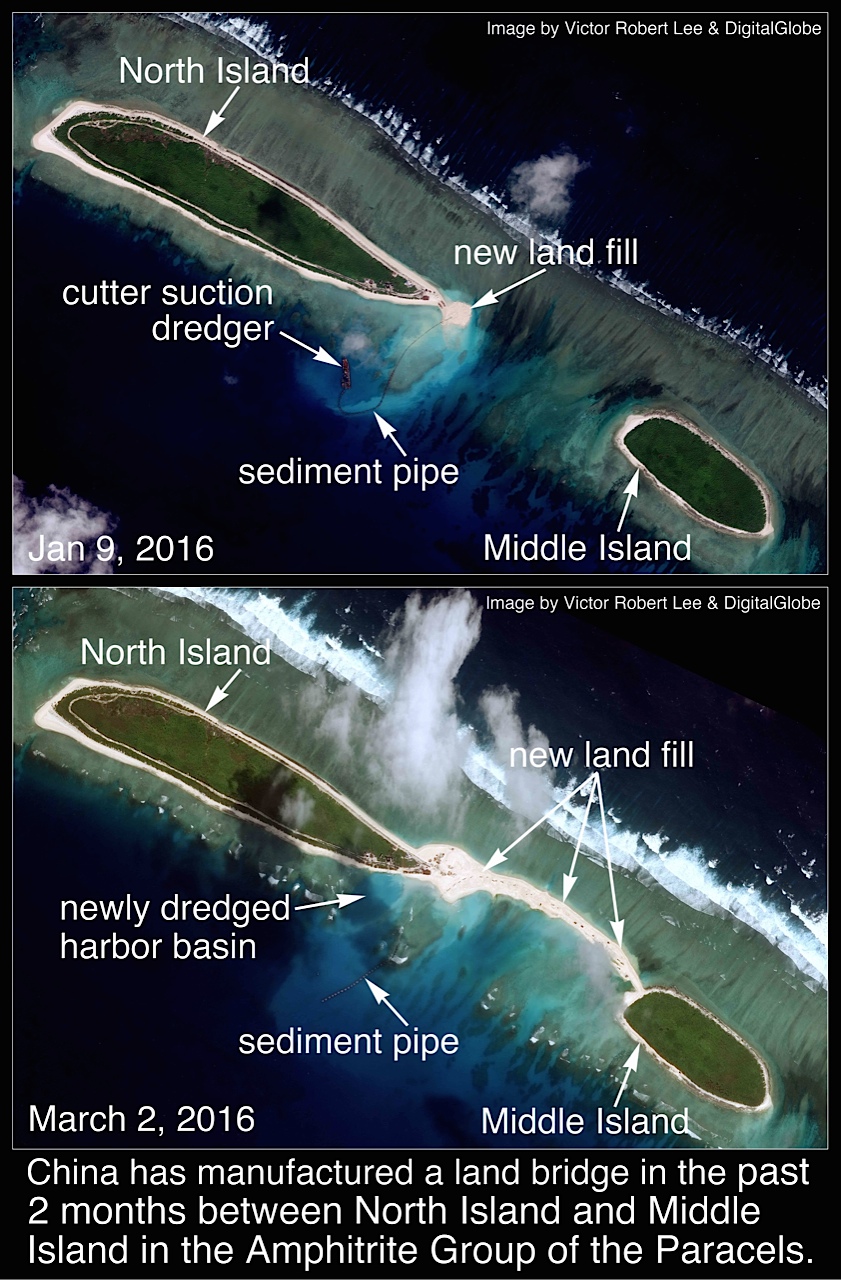
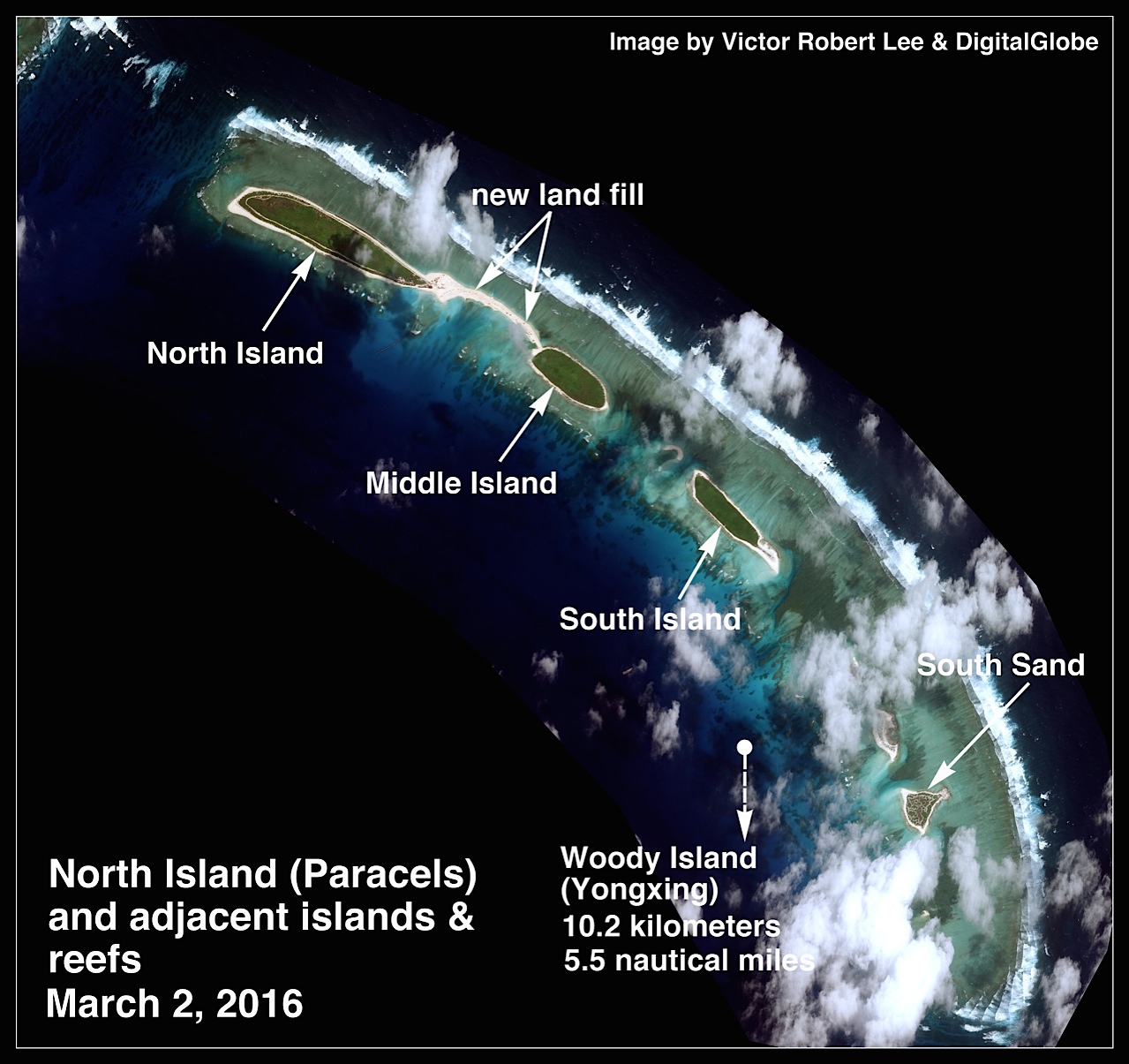
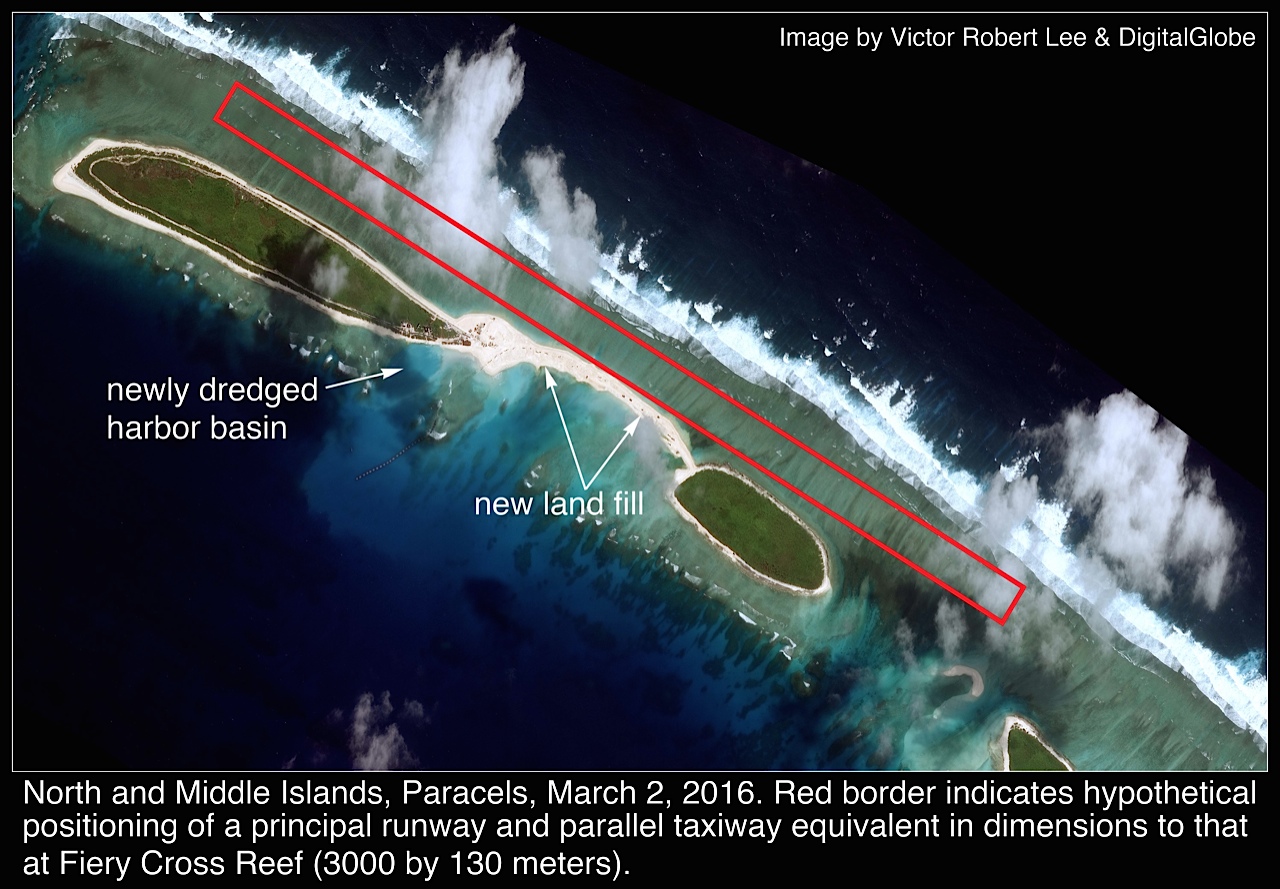
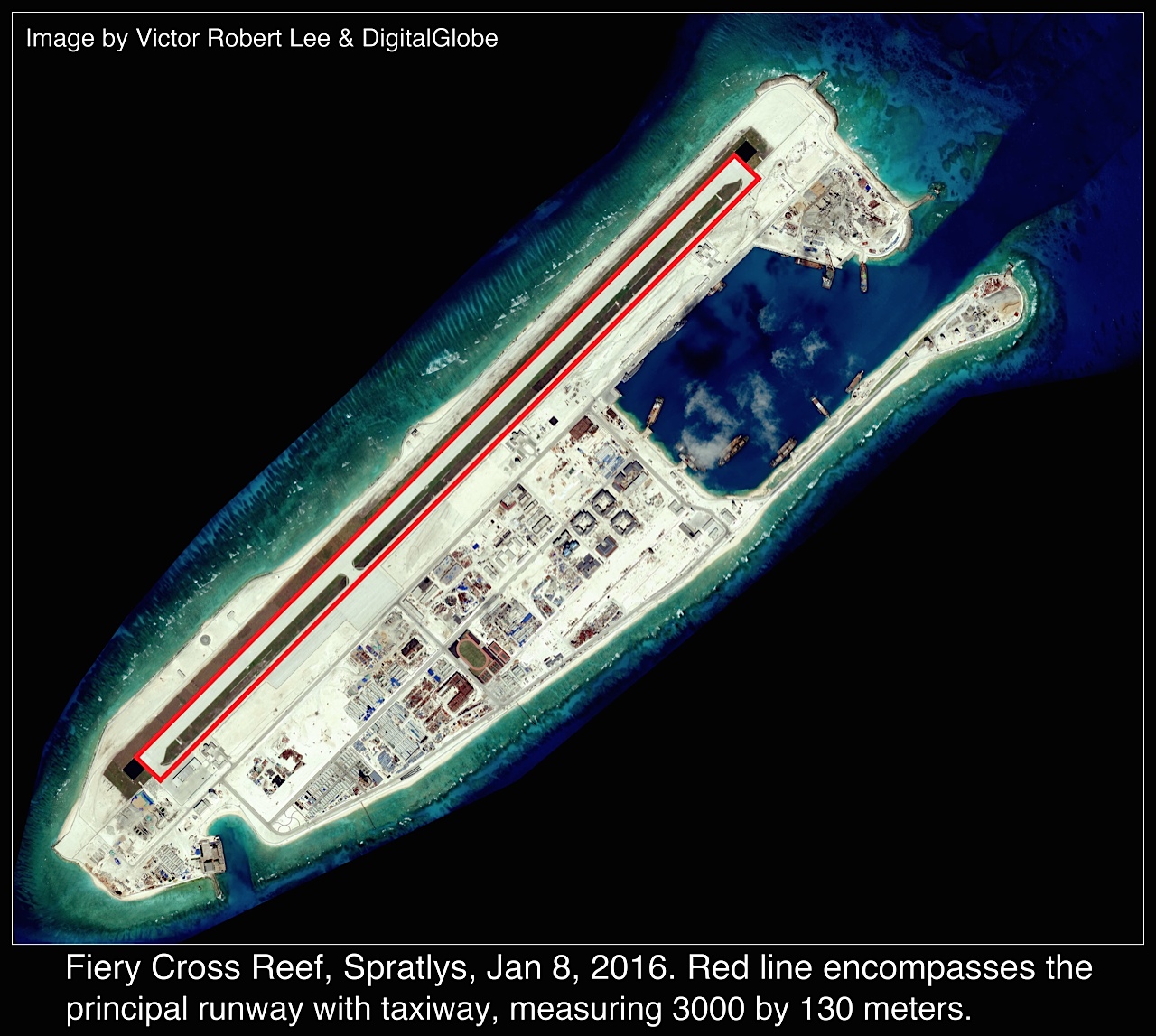
Satellite imagery from March 2, 2016 shows a marked expansion of China’s dredging and land filling at North Island in the Paracels. The newly manufactured terrain links North Island with Middle Island, along a long and straight reef structure that could accommodate a runway and parallel taxiway with dimensions equivalent to those recently built by China at Fiery Cross Reef in the Spratlys. The new land fill at North Island is 12 kilometers north of Woody (Yongxing) Island, the site of a military base and China’s sole airport in the Paracels. Woody Island was also the site of the PLA’s deployment of HQ-9 surface-to-air missiles last month.
QUOTE
The new land filling operations by China at North Island, first observed in satellite imagery from January 9, 2016, have in the past two months included dredging of the reef to create the beginnings of a harbor basin. The cutter suction dredger observed in January is absent in the current imagery, but the sediment pipe assembly for pumping dredged sand remains. The absence of the dredger in the most recent image probably does not represent any cessation of island building at this site, since the new terrain currently visible has yet to be fortified to survive storm action.
QUOTE
The island-building activities at North Island are at too early a stage for their purpose to be discerned. Lying at the northern edge of the Paracel Islands, 300 kilometers southeast of China’s Yulin/Longpo naval base, North Island is well situated for sensors to monitor an area through which Yulin-based surface and submarine vessels must frequently pass.
QUOTE
The reef complex that includes North and Middle islands has a favorable size and geometry for an airstrip, and it occupies a total area of approximately five square kilometers. The land fill area at Fiery Cross, for comparison, is just under three square kilometers, slightly smaller than Woody Island.
QUOTE
North Island’s proximity to the air base at Woody Island would seem to make it an unlikely candidate for an airstrip. However, Woody is already crowded with military and civilian facilities, and there is little adjoining reef to support an expansion. Woody’s congestion is illustrated by the placement of the recently deployed HQ-9 surface-to-air missiles. Although reported to be positioned on “a beach,” satellite images (not displayed here) show that the site was not a beach but newly filled-in terrain that had been an area of shallow fringing reef waters as recently as December 2015, and was only filled in during January 2016, probably just days before the SAM mobile launchers rolled onto it.
With a single, potentially over-stretched, air base in the strategically important Paracels, and already three airstrips in the Spratlys (at Fiery Cross, Subi and Mischief reefs), it would not be surprising if China were to build another air base in the Paracels, even if located near Woody Island.
What Role Will Russia Play in the US-Chinese South China Sea Drama?
QUOTE
The US-Chinese standoff in the South China Sea is heating up, with Washington dispatching a small armada to the area following reports that Beijing had reinforced a key island with fighters and air defenses. Much has been said and written about the dispute, with Russian analysts left pondering: if push comes to shove, what will Russia's role be?
QUOTE
The groups of islands are contested by China, Vietnam, the Philippines, Malaysia, Taiwan and Brunei. The US, for its part, cannot directly contest China's claims with sovereignty counterclaims, but has involved itself in the dispute under the guise of protecting its allies
QUOTE
"That the dispute between the two great powers is not just over the islands. China is fighting for global leadership, something which the US will not let go of so easily. After all, so long as Washington is recognized as the world's hegemonic power, US debt obligations can be exchanged for the fruits of the labor of countries all across the world."
QUOTE
Subsequently, the analyst noted, "the Chinese took full advantage of the conflict between Russia and the West. American resources were diverted to the European direction, and to Syria, Turkey and Ukraine. There was even talk of the possibility of war in Europe. The Americans escalated the situation around the Baltic. [Subsequently] they overlooked the fact that China might be strengthened as a result."
QUOTE
"What can the US do? Provoke a confrontation? Any collision with the Chinese would not be a cakewalk for the Americans. China now has enough strength to repel the attack of two or three [carrier-based US] aviation groups. Moscow could give the Chinese sea-based cruise missiles. So a US victory in a sea battle cannot be assured. And if the Americans lose, or even tie, US hegemony around the world would collapse like a house of cards. Therefore, Washington is taking a serious risk, and they know it."
QUOTE
"Now, we will see the maneuvering of forces. China will continue to increase its power in the region. America will need to show that it is still the world's most powerful sea power. The arms race will continue until one party runs out of steam –most likely, that will be the US. They have an enormous budget deficit, and a colossal public debt. And Washington will not be able to shoulder the burden if it has to engage in an arms race against Russia as well."
QUOTE
Ultimately, Alexandrov emphasized, "our goal is to create a polycentric system – that is, to push the US out of its position as global hegemon. Today, the US can dictate its terms and impose its decisions on others. In a multipolar world, it is possible to form tactical alliances in order to counter other players. That is, we are talking about a system promoting the balance of power –one that allows countries to maneuver, and does not allow any one power to hold a 'controlling stake' in world affairs."
"When this polycentric system is created, we will be able to judge whether continued cooperation with China is beneficial for Russia. At the current stage, it is advantageous."
U.S. military spending millions to make cyborgs a reality
QUOTE
The goal of the proposed implant is to "open the channel between the human brain and modern electronics" according to DARPA's program manager, Phillip Alvelda.
In January, DARPA announced it plans to spend up to $62 million on the project, which is part of its Neural Engineering System Design program.
The implant would be small -- no larger than one cubic centimeter, or roughly the size of two stacked nickels -- according to DARPA.
The implantable device aims to convert neurons in the brain into electronic signals and provide unprecedented "data-transfer bandwidth between the human brain and the digital world," according to a DARPA statement announcing the new project.
DARPA sees the implant as providing a foundation for new therapies that could help people with deficits in sight or hearing by "feeding digital auditory or visual information into the brain."
U.S. airstrike kills more than 150 at Somalia terrorist camp, military says
QUOTE
The United States launched a series of airstrikes on an al-Shabab training camp in Somalia Saturday, killing 150 militants and averting what a Pentagon official described as an “imminent threat” posed by the group to both U.S. and African Union troops stationed in the war-torn country
QUOTE
“The removal of these fighters degrades al-Shabab’s ability to meet the group’s objectives in Somalia, including recruiting new members, establishing bases, and planning attacks on U.S. and AMISOM forces,”
Turkey shelling Syrian Kurdish militia in northern Aleppo - YPG
QUOTE
Ankara continues to shell Kurdish forces in Syria, hampering their operations against Al-Nusra terrorists, and at the same time funneling supplies to militant-controlled areas around the border
QUOTE
The militants aimed to provoke the Turkish military to return fire and bring troops into Syria, which will inevitably lead to disruption of the peace process in the country
TUNIS - The Islamic State group (IS) in Libya is boosting its numbers by people-smuggling new recruits across Libya’s porous Southern borders and kidnapping migrant workers, Middle East Eye has learnt.
According to military sources as well as a former IS recruit, IS has been busy boosting numbers in Libya by kidnapping migrant workers at gunpoint and forcing them to train to be fighters or suicide bombers.
This has allowed them to swell their ranks quickly, with US intelligence assessments in February saying IS now had an estimated 6,000 fighters in Libya, more than double what was previously thought.
Week twenty-one of the Russian military intervention in Syria: the calm before the storm?
QUOTE
The ceasefire in Syria (which is not really a ceasefire, but rather a “focusing of combat operations”) is holding surprisingly well
QUOTE
This is primarily due to the brilliant tactic of forcing each fighting group in Syria to define itself either as a “good moderate”, and be guaranteed safety, or as as en “evil terrorist” and become an indisputably legitimate target which anybody can engage
QUOTE
By forcing each group to self-define itself the Russians have completely taken away any credibility from the rather ludicrous accusation that they were bombing the “good terrorists”
QUOTE
Thus anybody taking up arms against the Syrian government is “bad” and a legitimate target for total elimination. QED.
QUOTE
Ankara and Riyadh are giving all the signs of being up to no good. Not only does their rethoric remain bellicose, they are also playing all sorts of very dangerous military games: in a display of total irresponsibility and recklessness Saudi Arabia has reportedly engaged 150,000 troops in what the Saudis describe as “the 2nd largest military gathering since Desert Storm”. Other sources (here and here) speak of 350,000 troops (20 countries are now officially participating in these exercises). The Saudis have also moved 4 F-15S to the Incirlik air base in Turkey. This is not much, but this could be just a “tripwire force” which, if attacked, could justify the engagement of a much larger and reasonably modern Saudi Air Force (roughly 300 combat aircraft, 5 AWACS and 5 aerial refueling aircraft). Add in the Turkish Air Force (roughly 250 combat aircraft, 4 AWACS and 7 aerial refueling aircraft)
QUOTE
even if this “Wahabi coalition” brings in a lot of airpower, their ground forces, while large, are far away from the conflict zone and do not have what it takes to take on the Syrian-Iranian-Hezbollah forces on the ground
QUOTE
since the tiny Russian force in Syria cannot protect itself against such a large adversary, Russia would have no other option than to bring her long range strike capabilities (Aerospace Forces, cruise and ballistic missiles) into the fight
QUOTE
in case of such a brazen Saudi-Turkish attack on Russian Forces I would fully expect Russian MiG-31s (possibly operating from Iran) to engage enemy aircraft. At the end of the day, neither Iran nor Russia will allow the Wahabis to overrun Syria and thus the Turks and Saudis need to ask themselves if they really want a war against Russia, Iran, Syria and Hezbollah
QUOTE
A more likely scenario is that the US, Turkey and the Saudis are trying to find some way to rescue Daesh and to carve up some “Syrian Wahabistan”
QUOTE
It appears that we are in the proverbial “calm before the storm” and that the war in Syria will soon re-ignite with a possibility even bigger intensity than so far


 Military Thread V20
  Mar 5 2016, 07:55 PM


 Quote
Quote







 0.0676sec
 0.81
0.81
 7 queries
 GZIP Disabled