Strategic Weapons Review: MGR-1 'Honest John' unguided nuclear rocket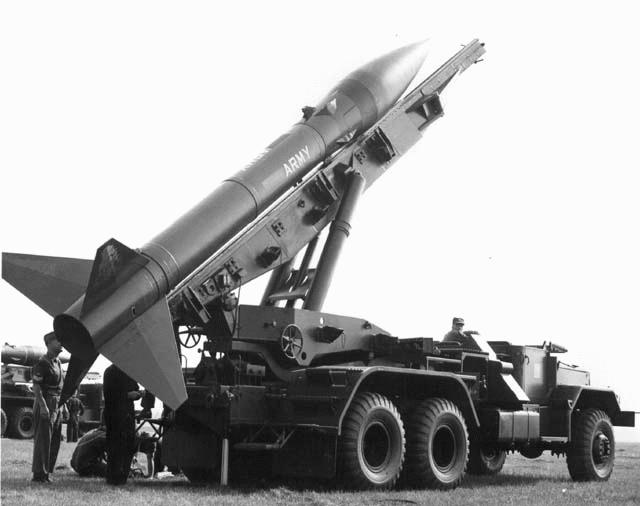 Technicians inspect an Honest John rocket
The MGR-1 'Honest John' rocket was the first nuclear-capable surface-to-surface missile in the US arsenal. Designated Artillery Rocket XM31, the first such rocket was tested 29 June 1951 and the first production rounds were delivered in January 1953. The designator was changed to M31 in September 1953.
The Honest John was a large but simple fin-stabilized, unguided artillery rocket weighing 2,640 kilograms (5,820 lb) in its initial M-31 nuclear-armed version. Mounted on the back of a truck, the rocket was aimed in much the same way as a cannon and then fired up an elevated ramp, igniting four small spin rockets as it cleared the end of the ramp.
The M-31 originally had a range of 24.8 kilometres (15.4 mi). As the rocket was unguided, accuracy is negligible with a circular error probability (CEP) of around 1,000 meters. Early tests exhibited more scatter on target than was acceptable when the rocket was conventionally armed. Development of an upgraded Honest John, M-50, was undertaken in 1960 to improve accuracy and extend range. This included the addition of booster rockets and smaller stabilizing fins to reduce wind deflection, this increased range to around 50 kilometers (31 mi) and the rocket's CEP was also improved to 250m.
The Honest John was armed with either a 2, 10 or 20kt nuclear warhead. There was also a 15kt airburst nuclear weapon designed to burst above the battlefield. Alternatively, the rocket could also be armed with a 1,500lb high-explosive warhead or a cluster bomblet dispenser. Chemical weapons containing Sarin gas canisters were also fitted to some Honest John rockets.
The Honest John was largely replaced in the 1970s with much more modern and capable weapons, but conventionally-armed Honest John units still served with many other US allies such as Greece or South Korea until the late 1980s.


 Military Thread V19
  Jan 29 2016, 11:01 AM


 Quote
Quote






 0.0652sec
 0.79
0.79
 7 queries
 GZIP Disabled