

 Military Thread V18
  Nov 23 2015, 02:11 PM


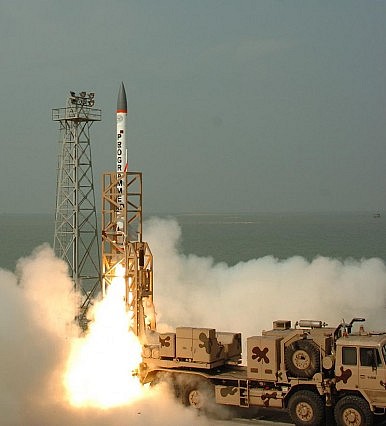
India Tests Supersonic Advanced Air Defense Missile
QUOTE
The AAD has been undergoing trials since 2007 and may ultimately serve as a project demonstrator. A full-scale BMD system in India will incorporate technology from both the PAD and AAD systems. The AAD interceptor is a 7.5 meter single-stage, solid fuel rocket, capable of Mach 4.5 supersonic flight. The AAD has an operational range between 150-200 kilometers and uses an inertial navigational aid system with active radar homing. So far, it has been test-launched from a transporter erector launcher (TEL).
As a short-range, ground-launched system capable of surface-to-air strikes against aircraft and unmanned aerial vehicles, the AAD will see some overlap with the more advanced Russian-made S-400 Triumph anti-ballistic missile system. Earlier this month, New Delhi approved the procurement of Russian S-400 systems, becoming the second foreign buyer of the advanced surface-to-air system after China. The S-400 outperforms India’s AAD on nearly all counts, including flight speed when fitted with the upgraded 48N6 interceptor.
India’s development of a BMD system was identified as one area of possible cooperation with the United States in 2012, when then-U.S. Deputy Secretary of Defense Ashton Carter said BMD cooperation would be an “an important potential area for our future cooperation.” After the United States, Russia, and Israel, India is the fourth state to indigenously develop a BMD system.
As a short-range, ground-launched system capable of surface-to-air strikes against aircraft and unmanned aerial vehicles, the AAD will see some overlap with the more advanced Russian-made S-400 Triumph anti-ballistic missile system. Earlier this month, New Delhi approved the procurement of Russian S-400 systems, becoming the second foreign buyer of the advanced surface-to-air system after China. The S-400 outperforms India’s AAD on nearly all counts, including flight speed when fitted with the upgraded 48N6 interceptor.
India’s development of a BMD system was identified as one area of possible cooperation with the United States in 2012, when then-U.S. Deputy Secretary of Defense Ashton Carter said BMD cooperation would be an “an important potential area for our future cooperation.” After the United States, Russia, and Israel, India is the fourth state to indigenously develop a BMD system.
http://thediplomat.com/2015/11/india-tests...efense-missile/
 Quote
Quote








 0.0593sec
 0.33
0.33
 7 queries
 GZIP Disabled