

QUOTE(pandazoro22 @ May 12 2016, 11:05 PM)

woohoo catholic tered

LYN Catholic Fellowship V01 (Group), For Catholics (Roman or Eastern)
|
|
 May 13 2016, 07:59 AM May 13 2016, 07:59 AM
Return to original view | Post
#401
|
 
Junior Member
225 posts Joined: Mar 2008  
|
QUOTE(pandazoro22 @ May 12 2016, 11:05 PM) woohoo catholic tered |
|
|
|
|
|
May 13 2016, 02:26 PM
Return to original view | Post
#402
|
|
Junior Member
225 posts Joined: Mar 2008
|
The Tight Purse Strings of Catholics
by Karl Keating May 9, 2016 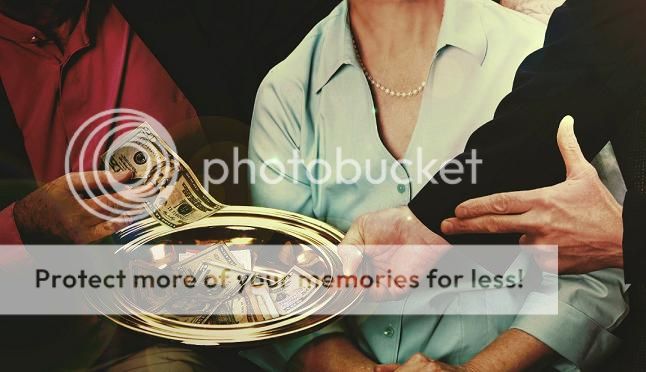 A slight detour on a cross-country trip took me to Possum Kingdom. The tiny community is in north-central Texas and lies nestled against the shore of a lake that attracts many people during the summer but few on the chilly day that I visited. I dropped in to see Bill and Mary Keeley, long-time friends of the family. When I was a teenager, they lived across the street from us, and I am godfather to two of their now-grown children. Bill had sent me an e-mail a few weeks earlier, seeking my ideas on the proper way for a diocese to arrange for its cathedraticum. The Catholic Encyclopedia defines cathedraticum (known nowadays in many dioceses as the stewardship fund) as “a certain sum of money to be contributed annually for the support of the bishop, as a mark of honor and in sign of subjection to the cathedral church, hence its name.” The money is paid by the parishes within the diocese and goes to support the bishop personally and to underwrite diocesan-wide expenditures. The practice goes back centuries. Covering diocesan needs Traditionally, the cathedraticum was a fixed-amount tax, each parish paying the same, regardless of income or membership. Since the second Plenary Council of Baltimore, held in 1866, in this country the cathedraticum also has come to refer to a tax proportionate to the income of the parish. We thus find both fixed-amount and proportionate-amount systems. Long ago the cathedraticum was a moderate tax, often hardly more than a token, but in modern times it has come to be relied on, in many places, to cover the basic needs of the diocese, and in the process it has become something other than moderate. In Bill’s diocese the cathedraticum is a fixed-amount tax. That’s a boon for large and growing parishes in the cities—the equivalent per capita tax is small—but a handicap for parishes such as the one in Possum Kingdom, which has so few members that it warrants only a Saturday-evening Mass and is served by a priest who drives out from Mineral Wells. I cannot say I was of much help to Bill, but I could sympathize with his concern. Consider the situation in San Diego’s Immaculate Conception parish. Although in the heart of San Diego, it is located in a state historic park called Old Town. Government tabulators say Old Town is the most visited historic park in California. I can believe it. On any given Sunday about three-quarters of the Mass-goers at Immaculate Conception are visitors. It works out that half of the parish income comes from out-of-towners. The parish is taxed on its total income, the diocese using the proportionate-amount system. In one sense the tax seems fair, in another unfair. Half of the parish income seems “free,” coming from visitors, so it seems there should be no complaint about having that half taxed. On the other hand, if one argues that each Catholic in the diocese should contribute the same to diocesan-wide expenditures (seminary, diocesan-sponsored charitable works, and so on), then this parish’s members are paying at twice the rate of those in other parishes. Raising necessary funds I see both sides of the argument and cannot say that either side has an open-and-shut case. Bill’s situation is different. If his little parish puts in the kitty the same amount the richest and most populous parish puts in, something seems askew. Although the parish amount is fixed, the per capita amount is not. The folks in Possum Kingdom are responsible, individually, for much more than are parishioners at St. Big Bucks. Canon law has something to say about taxes on parishes. Canon 1263 says a bishop “has the right to impose a moderate tax . . . which should be proportionate to [the] income” of the parish and which may be applied to “diocesan needs.” Note that this tax “should be proportionate” but, apparently, need not be. Thus fixed-amount taxes seem to be permissible. Canon 1266 refers to a different way to raise money. It says the bishop “may prescribe the taking up of a special collection for specific parochial, diocesan, national, or universal projects.” This collection is not a tax as such, and one may presume that the amount collected mirrors the income of the parishes. One thing all Catholics, I think, can agree on is that dioceses need to raise funds to pay for diocesan-wide activities. The disagreement concerns methodology. I have no solution to the dilemma but do have a suggestion that might ameliorate the situation. Catholics donate to their parishes at about half the rate Protestants do—one percent of family income versus two percent. I used to be an usher at a parish I no longer attend, and, frankly, I felt embarrassed for well-dressed and apparently well-off people who searched through a thick wad of bills to drop into the basket a single image of George Washington. It wasn’t so much that they were miserly but that they never were instructed on the duty of supporting the Church according to one’s means. How about a one percent increase? I’m not advocating that we give a hard sell on tithing ten percent, but I wouldn’t mind homilies urging us to try to match our Protestant brethren’s two percent. I realize that priests cringe at having to ask for money. They shouldn’t have to ask. Their congregants should be sufficiently generous that the parishes should have a bit of a surplus, but most parishes seem to be in perpetual financial straits, in large part because priests don’t ask their flocks to do what they ought to do in terms of parish support. I know Catholics who earmark ten percent of their income for the Church. They aren’t wealthy people who easily can spare the cash. It’s just that they make the Church a priority. Unfortunately, they represent a small minority among Catholics. I sometimes wonder what great things parishes could accomplish in terms of apologetics and evangelization if only they had the wherewithal. They often enough have the requisite knowledge and skills among the people in the pews, but they don’t have the financial means to carry out the sorts of projects that, ideally, every parish would undertake as a matter of course. Beyond that, if Catholic giving just rose to the level of Protestant giving, many parishes could afford to start (or keep) a Catholic school. We sorely need more, not fewer, Catholic schools, but we’re not likely to see new ones pop up unless Catholics learn to take seriously their obligation to support the Church with more than just good wishes. Source: http://www.catholic.com/blog/karl-keating/...gs-of-catholics |
|
|
May 14 2016, 10:04 AM
Return to original view | Post
#403
|
|
Junior Member
225 posts Joined: Mar 2008
|
QUOTE(yeeck @ May 13 2016, 11:37 PM) Interesting video on Ethiopian Orthodox Easter (Fasika). Christianity in Ethiopia dates to the 1st century AD, arguably the first nation in the world to accept Christianity (the other nation to debate this being Armenia) and this long tradition makes Ethiopia unique amongst sub-Saharan African countries. You can see the shared tradition of women being veiled in church, use of icons/sacred images, incense, etc. The only noticeable difference are the clapping and usage of drums. triangles, cymbals which is something peculiar to the Alexandrian Rite. Fantastic video!https://vimeo.com/165960002 They are in full communion with Rome, yes? |
|
|
May 14 2016, 10:19 AM
Return to original view | Post
#404
|
|
Junior Member
225 posts Joined: Mar 2008
|
10 Reasons Some Women Are Wearing Veils in Church Again
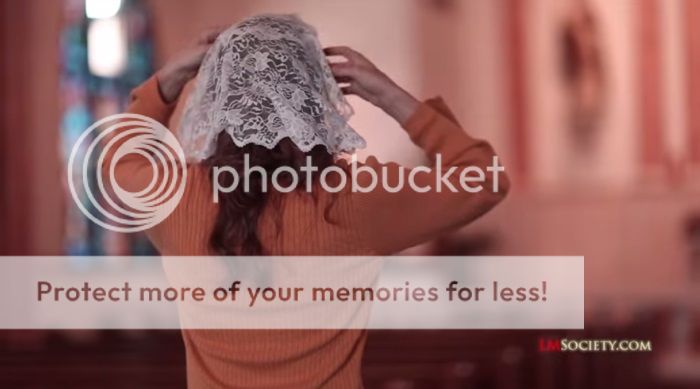 Not that long ago, Christian women always covered their heads at church, and now many are choosing to once again. While lots of women are going the route of the chapel veil, others are choosing things like hats, scarves, or stylish headbands. What are their reasons for doing this? 1) It’s in the New Testament Be imitators of me, as I am of Christ. I commend you because you remember me in everything and maintain the traditions even as I have delivered them to you. But I want you to understand that the head of every man is Christ, the head of a woman is her husband, and the head of Christ is God. Any man who prays or prophesies with his head covered dishonors his head, but any woman who prays or prophesies with her head unveiled dishonors her head–it is the same as if her head were shaven. For if a woman will not veil herself, then she should cut off her hair; but if it is disgraceful for a woman to be shorn or shaven, let her wear a veil. For a man ought not to cover his head, since he is the image and glory of God; but woman is the glory of man. (For man was not made from woman, but woman from man. Neither was man created for woman, but woman for man.) That is why a woman ought to have a veil on her head, because of the angels. (Nevertheless, in the Lord woman is not independent of man nor man of woman; for as woman was made from man, so man is now born of woman. And all things are from God.) Judge for yourselves; is it proper for a woman to pray to God with her head uncovered? Does not nature itself teach you that for a man to wear long hair is degrading to him, but if a woman has long hair, it is her pride? For her hair is given to her for a covering. If any one is disposed to be contentious, we recognize no other practice, nor do the churches of God. (1 Corinthians 11:1-16) Now, I know that this is a hotly debated passage, but let me try to explain. 2) The Church veils things that are sacred The tabernacle is veiled. The chalice is veiled. Altars are veiled. Moses veiled his face after he had seen God. A veiled woman shows reverence for God, symbolizing the veiled bride of the Church, but also honors herself as a woman before God. 3) Men and women are different Men represent Christ, the bridegroom, which is why we have the male priesthood. Women represent the Church, the bride. All laymen take part in the feminine nature of the Church, but women symbolize the Church as the bride. Veiling goes against a society that tells us that men and women are the same, that there are many genders, and that gender is not important when people want to marry. Veiling is an outward statement against modernity and its lies. A woman choosing to be submissive as a wife, as woman, to her husband is against all that our society tells us about man and woman. St. Paul talks about women submitting to their husbands, the Church submitting to Christ, Christ loving the Church to the point of his suffering and death, and husbands loving their wives in this same way. 4) Women and men are equal St. Paul said this, which went against his culture’s ideas about men and women: “Nevertheless, in the Lord woman is not independent of man nor man of woman; for as woman was made from man, so man is now born of woman. And all things are from God.” Christianity has made men and women equal in God, and St. Paul says this right in the middle of the passage where he talks about women covering their heads. It is important to remember that when Jesus and St. Paul talk about women in the Scriptures it is in a new way that was not normal to their cultures. Women veiling is not putting them lower than men, but must be seen in conjunction with men not covering their heads. It emphasizes the difference of men and women, and the symbol they are as the image of God. 5) A veil accentuates the natural beauty of a woman St. Thomas Aquinas explains in his commentary on veiling passage of 1 Corinthians that human beings in general naturally augment their natural beauty with clothing. Women naturally have beautiful hair, and a veil ornaments and accentuates that beauty. In general, we want to bring the best of ourselves to liturgy, and veiling is a way of doing so. 6) It is part of the tradition from the Apostles St. Paul writes that he wishes the Corinthians to “maintain the traditions even as I have delivered them to you.” He did not make this up just for their culture. Rather, he is passing on a tradition of women covering their heads and men not doing so. This tradition was from the Apostles and it was maintained until the 1960s when so many liturgical traditions were discarded. The 1917 Code of Canon law required women to cover their heads and forbade men from covering their heads. The 1983 Code of Canon law omitted the passage about women covering their heads, but maintained that men should not. It is unclear why the Code was changed, though it is clear that head covering by women is no longer required by Church law. It is also clear this has been a tradition passed down, and as laity there is no reason why we cannot continue that tradition even if it is not in the Code of Canon law. 7) Some women pray better that way Some are choosing to veil not just in church, but anytime they pray in private or in public. It is a way to help them focus. A prayer to pray when putting on a veil when entering a Church is, “Blessed am I whom am called to the marriage feast of the Lamb.” 8) Having a veil or hat immediately dresses one up for church Whether at church on a weekday or on a Sunday, when a woman puts something on her head, she is saying to herself and to others that she is dressed for church. A working woman can mentally distinguish between work wear an church wear by using a veil. A woman who wears “mommy clothes” all day, can instantly be dressed up for church when she puts on a veil. 9) Robing oneself in a beautiful veil in the presence of God feels right It makes the woman feel beautiful, and some husbands think that veils are “hot.” The beauty of the veil is something that honors God in the same way beautiful architecture or beautiful vestments do. They contribute to giving God the worship that is due to Him. 10) Because of the Angels St. Thomas Aquinas explains this statement from 1 Corinthians 11.10 simply by saying that it is because Angels are present at the Holy Sacrifice of the Mass. Men must show reverence as well as women. Women show reverence by covering their heads, and men show reverence by not covering their heads. Bonus Fact Women still cover their heads when they have an audience with the pope. Source: https://churchpop.com/2014/12/08/10-reasons...g-veils-church/ This post has been edited by khool: May 14 2016, 10:58 AM |
|
|
May 14 2016, 05:39 PM
Return to original view | Post
#405
|
|
Junior Member
225 posts Joined: Mar 2008
|
QUOTE(yeeck @ May 14 2016, 04:54 PM) Ethiopian Catholic Church (Ge'ez Rite), yes. Ethiopian Orthodox Tewahedo no. The video features both Churches correct? |
|
|
May 15 2016, 07:09 PM
Return to original view | Post
#406
|
|
Junior Member
225 posts Joined: Mar 2008
|
Bible Readings for May 15, 2016
Pentecost Sunday 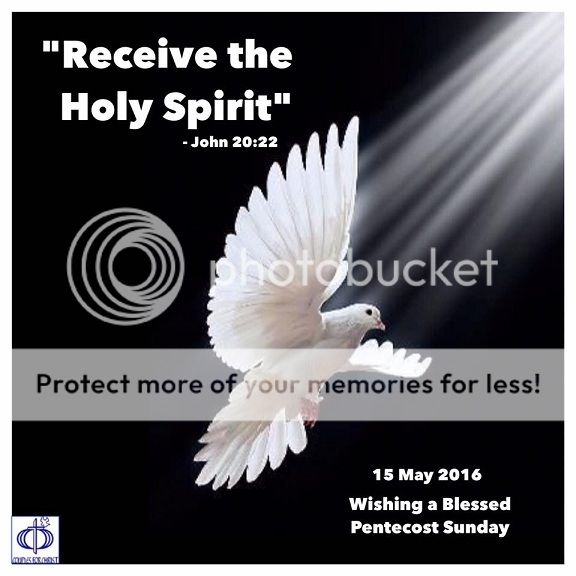 First Reading Acts 2:1-11 When the time for Pentecost was fulfilled, they were all in one place together. And suddenly there came from the sky a noise like a strong driving wind, and it filled the entire house in which they were. Then there appeared to them tongues as of fire, which parted and came to rest on each one of them. And they were all filled with the Holy Spirit and began to speak in different tongues, as the Spirit enabled them to proclaim. Now there were devout Jews from every nation under heaven staying in Jerusalem. At this sound, they gathered in a large crowd, but they were confused because each one heard them speaking in his own language. They were astounded, and in amazement they asked, “Are not all these people who are speaking Galileans? Then how does each of us hear them in his native language? We are Parthians, Medes, and Elamites, inhabitants of Mesopotamia, Judea and Cappadocia, Pontus and Asia, Phrygia and Pamphylia, Egypt and the districts of Libya near Cyrene, as well as travelers from Rome, both Jews and converts to Judaism, Cretans and Arabs, yet we hear them speaking in our own tongues of the mighty acts of God.” Responsorial Psalm Ps 104:1, 24, 29-30, 31, 34 R. (cf. 30) Lord, send out your Spirit, and renew the face of the earth. or: R. Alleluia. Bless the LORD, O my soul! O LORD, my God, you are great indeed! How manifold are your works, O LORD! the earth is full of your creatures; R. May the glory of the LORD endure forever; may the LORD be glad in his works! Pleasing to him be my theme; I will be glad in the LORD. R. If you take away their breath, they perish and return to their dust. When you send forth your spirit, they are created, and you renew the face of the earth. R. Second Reading 1 Cor 12:3b-7, 12-13 Brothers and sisters: No one can say, “Jesus is Lord,” except by the Holy Spirit. There are different kinds of spiritual gifts but the same Spirit; there are different forms of service but the same Lord; there are different workings but the same God who produces all of them in everyone. To each individual the manifestation of the Spirit is given for some benefit. As a body is one though it has many parts, and all the parts of the body, though many, are one body, so also Christ. For in one Spirit we were all baptized into one body, whether Jews or Greeks, slaves or free persons, and we were all given to drink of one Spirit. Or Rom 8:8-17 Brothers and sisters: Those who are in the flesh cannot please God. But you are not in the flesh; on the contrary, you are in the spirit, if only the Spirit of God dwells in you. Whoever does not have the Spirit of Christ does not belong to him. But if Christ is in you, although the body is dead because of sin, the spirit is alive because of righteousness. If the Spirit of the one who raised Jesus from the dead dwells in you, the one who raised Christ from the dead will give life to your mortal bodies also, through his Spirit that dwells in you. Consequently, brothers and sisters, we are not debtors to the flesh, to live according to the flesh. For if you live according to the flesh, you will die, but if by the Spirit you put to death the deeds of the body, you will live. For those who are led by the Spirit of God are sons of God. For you did not receive a spirit of slavery to fall back into fear, but you received a Spirit of adoption, through whom we cry, “Abba, Father!” The Spirit himself bears witness with our spirit that we are children of God, and if children, then heirs, heirs of God and joint heirs with Christ, if only we suffer with him so that we may also be glorified with him. Sequence - Veni, Sancte Spiritus Come, Holy Spirit, come! And from your celestial home Shed a ray of light divine! Come, Father of the poor! Come, source of all our store! Come, within our bosoms shine. You, of comforters the best; You, the soul’s most welcome guest; Sweet refreshment here below; In our labor, rest most sweet; Grateful coolness in the heat; Solace in the midst of woe. O most blessed Light divine, Shine within these hearts of yours, And our inmost being fill! Where you are not, we have naught, Nothing good in deed or thought, Nothing free from taint of ill. Heal our wounds, our strength renew; On our dryness pour your dew; Wash the stains of guilt away: Bend the stubborn heart and will; Melt the frozen, warm the chill; Guide the steps that go astray. On the faithful, who adore And confess you, evermore In your sevenfold gift descend; Give them virtue’s sure reward; Give them your salvation, Lord; Give them joys that never end. Amen. Alleluia. Alleluia R. Alleluia, alleluia. Come, Holy Spirit, fill the hearts of your faithful and kindle in them the fire of your love. R. Alleluia, alleluia. Gospel Jn 20:19-23 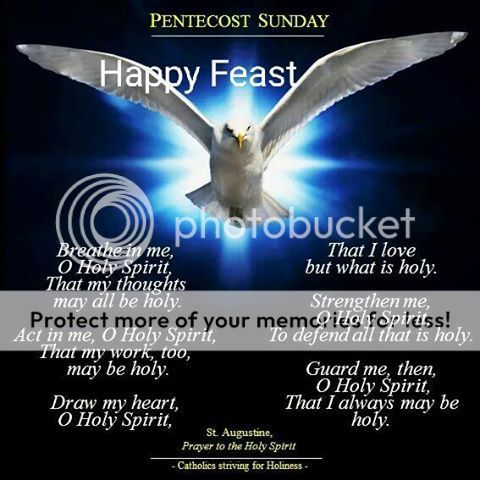 On the evening of that first day of the week, when the doors were locked, where the disciples were, for fear of the Jews, Jesus came and stood in their midst and said to them, “Peace be with you.” When he had said this, he showed them his hands and his side. The disciples rejoiced when they saw the Lord. Jesus said to them again, “Peace be with you. As the Father has sent me, so I send you.” And when he had said this, he breathed on them and said to them, “Receive the Holy Spirit. Whose sins you forgive are forgiven them, and whose sins you retain are retained.” Or Jn 14:15-16, 23b-26 Jesus said to his disciples: “If you love me, you will keep my commandments. And I will ask the Father, and he will give you another Advocate to be with you always. “Whoever loves me will keep my word, and my Father will love him, and we will come to him and make our dwelling with him. Those who do not love me do not keep my words; yet the word you hear is not mine but that of the Father who sent me. “I have told you this while I am with you. The Advocate, the Holy Spirit whom the Father will send in my name, will teach you everything and remind you of all that I told you.” The Gospel of the Lord. 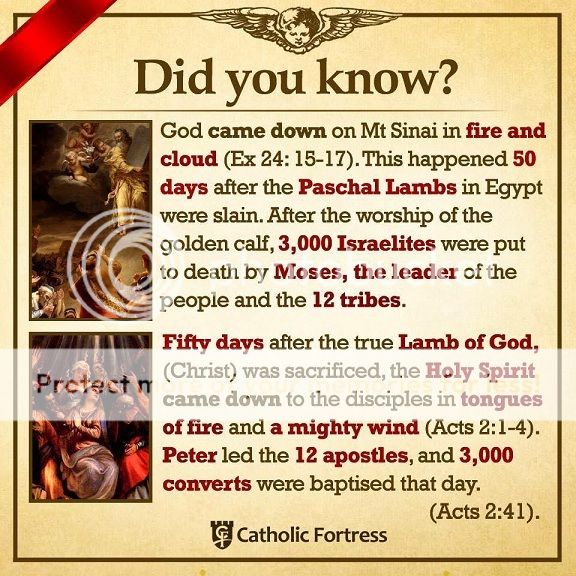 |
|
|
|
|
|
May 18 2016, 03:19 PM
Return to original view | Post
#407
|
|
Junior Member
225 posts Joined: Mar 2008
|
QUOTE(yeeck @ May 18 2016, 01:27 PM)  |
|
|
May 20 2016, 10:56 AM
Return to original view | Post
#408
|
|
Junior Member
225 posts Joined: Mar 2008
|
 |
|
|
May 21 2016, 09:13 AM
Return to original view | Post
#409
|
|
Junior Member
225 posts Joined: Mar 2008
|
QUOTE(yeeck @ May 21 2016, 12:46 AM) Hysterical/Leftist/Anarchist/Pro-Aborts Disrupt Peaceful Prayer Vigil for Life more like trying to get attention by histrionics and temper tantrumsThey looked like they're possessed. |
|
|
May 21 2016, 10:49 AM
Return to original view | Post
#410
|
|
Junior Member
225 posts Joined: Mar 2008
|
New State-Of-The-Art Church Promises Comforts Of The Future
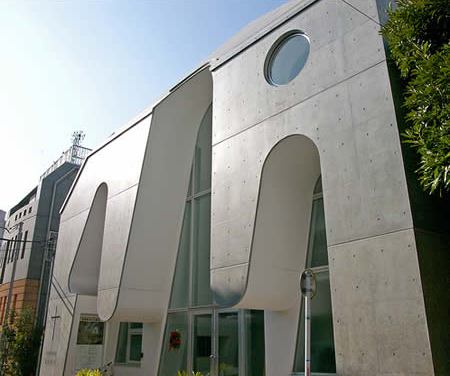 LONDON––A new state-of-the-art church in London opened today with Christmas/Easter size crowds eager for an opportunity to experience the next generation of churches. St. Joseph Cupertino Parish pastor Roger O’Malley gave Eye of the Tiber an exclusive tour of the mega Catholic Church. “As you can see everyone gets their own synthetic leather recliner, which includes storage space to keep foods and drinks cold during Mass,” O’Malley said. “One of the things we’re most excited about are these monitors on the back of each headrest which will allow parishioners easier viewing of the Mass. Of course each monitor will be equipped with Netflix and updated NFL scores.” The church also includes moving sidewalks to move parishioners up to communion without having to take unnecessary steps, as well as an option for a low dosage of Xanax to help ease nerves of those going through trials. Other features of the church will be communion dispensers to help stop the spread of germs, cyborgs for lone parishioners to hold hands with during the Our Father, and kneelers that automatically rise to touch parishioners’ knees while they remain reclining. . .. ... .... This is satire, that isn't a real church in the picture; chill! Pax!!  Source: http://www.eyeofthetiber.com/2012/10/29/ne...-of-the-future/ |
|
|
May 22 2016, 03:38 PM
Return to original view | Post
#411
|
|
Junior Member
225 posts Joined: Mar 2008
|
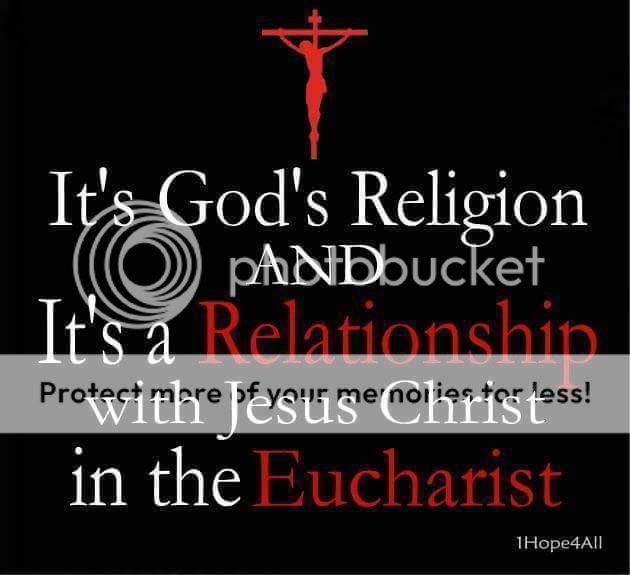 The mystery of Christianity is the mystery of the type in the meeting tent fulfilled in the heavenly reality of the Catholic Church. Judaism is the promise, Catholicism is the fulfilment of the promise. In the beginning was the word the word was with God the word was God. The word became flesh and dwelt among us. The flesh was glorified. The sacraments perpetuate the mystical body of Christ through time. Paul says spiritual things need to be spiritually examined and the sensual man percieveth not these things. You cannot get there through a literalist interpretation of scripture. The Son of man took on flesh and became sin so that we can rise above it. The just man lives by faith because you cannot live by truth faith unless you live as a just man. QUOTE Hosea 2:18-23 New Revised Standard Version Catholic Edition (NRSVCE) In justice because there are weeds In the wheat in the Kingdom of heaven. Forever because Christ will not separate from His bride His very flesh. The narrow gate is baptism into the sacramental life being nourished by the truth of milk and honey in the pillar and foundation of truth.I will make for you[a] a covenant on that day with the wild animals, the birds of the air, and the creeping things of the ground; and I will abolish[b] the bow, the sword, and war from the land; and I will make you lie down in safety. And I will take you for my wife forever; I will take you for my wife in righteousness and in justice, in steadfast love, and in mercy. I will take you for my wife in faithfulness; and you shall know the Lord. On that day I will answer, says the Lord, I will answer the heavens and they shall answer the earth; and the earth shall answer the grain, the wine, and the oil, and they shall answer Jezreel;[c] and I will sow him[d] for myself in the land.And I will have pity on Lo-ruhamah,[e] and I will say to Lo-ammi,[f] “You are my people”; and he shall say, “You are my God.” Footnotes: [a] Hosea 2:18 Heb them [b] Hosea 2:18 Heb break [c] Hosea 2:22 That is God sows [d] Hosea 2:23 Cn: Heb her [e] Hosea 2:23 That is Not pitied [f] Hosea 2:23 That is Not my people QUOTE 2 Corinthians 5:21 New Revised Standard Version Catholic Edition (NRSVCE) For our sake he made him to be sin who knew no sin, so that in him we might become the righteousness of God. QUOTE John 3:29 New Revised Standard Version Catholic Edition (NRSVCE) He who has the bride is the bridegroom. The friend of the bridegroom, who stands and hears him, rejoices greatly at the bridegroom’s voice. For this reason my joy has been fulfilled. QUOTE Hebrews 10:19-22 New Revised Standard Version Catholic Edition (NRSVCE) Therefore, my friends,[a] since we have confidence to enter the sanctuary by the blood of Jesus, by the new and living way that he opened for us through the curtain (that is, through his flesh), and since we have a great priest over the house of God, let us approach with a true heart in full assurance of faith, with our hearts sprinkled clean from an evil conscience and our bodies washed with pure water. Footnotes: [a] Hebrews 10:19 Gk Therefore, brothers QUOTE Ephesians 5:25-32 New Revised Standard Version Catholic Edition (NRSVCE) Husbands, love your wives, just as Christ loved the church and gave himself up for her, in order to make her holy by cleansing her with the washing of water by the word, so as to present the church to himself in splendor, without a spot or wrinkle or anything of the kind—yes, so that she may be holy and without blemish. In the same way, husbands should love their wives as they do their own bodies. He who loves his wife loves himself. For no one ever hates his own body, but he nourishes and tenderly cares for it, just as Christ does for the church, because we are members of his body.[a] “For this reason a man will leave his father and mother and be joined to his wife, and the two will become one flesh.” This is a great mystery, and I am applying it to Christ and the church. Footnotes: [a] Ephesians 5:30 Other ancient authorities add of his flesh and of his bones QUOTE Revelation 22:12-17 New Revised Standard Version Catholic Edition (NRSVCE) They will see and not see and hear and not hear.“See, I am coming soon; my reward is with me, to repay according to everyone’s work. I am the Alpha and the Omega, the first and the last, the beginning and the end.” Blessed are those who wash their robes,[a] so that they will have the right to the tree of life and may enter the city by the gates. Outside are the dogs and sorcerers and fornicators and murderers and idolaters, and everyone who loves and practices falsehood. “It is I, Jesus, who sent my angel to you with this testimony for the churches. I am the root and the descendant of David, the bright morning star.” The Spirit and the bride say, “Come.” And let everyone who hears say, “Come.” And let everyone who is thirsty come. Let anyone who wishes take the water of life as a gift. Footnotes: [a] Revelation 22:14 Other ancient authorities read do his commandments If our gospel be veiled it is veiled to those who are perishing. Humility is the key. The meek shall inherit the earth. “Like a bridegroom Christ went forth from his nuptial chamber…He came even to the marriage-bed of the cross, and sensed the creature sighing in her breath, he surrendered himself to torment for his bride in a communication of love. (Augustine, Sermo Suppositus, 120:3) It is consummated ... This post has been edited by khool: May 22 2016, 03:44 PM |
|
|
May 22 2016, 03:52 PM
Return to original view | Post
#412
|
|
Junior Member
225 posts Joined: Mar 2008
|
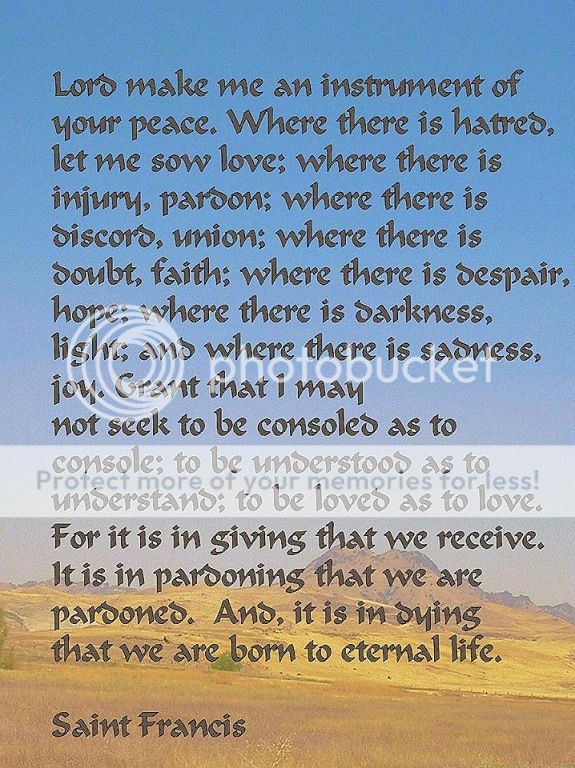
Thank you Father Rob Galea, for guiding us on how to lift up and bless the Holy Name of our Lord Jesus Christ
May you continue to always walk with us on our journey ... Amen!!! This post has been edited by khool: May 22 2016, 03:53 PM |
|
|
May 22 2016, 04:12 PM
Return to original view | Post
#413
|
|
Junior Member
225 posts Joined: Mar 2008
|
 |
|
|
|
|
|
May 22 2016, 04:39 PM
Return to original view | Post
#414
|
|
Junior Member
225 posts Joined: Mar 2008
|
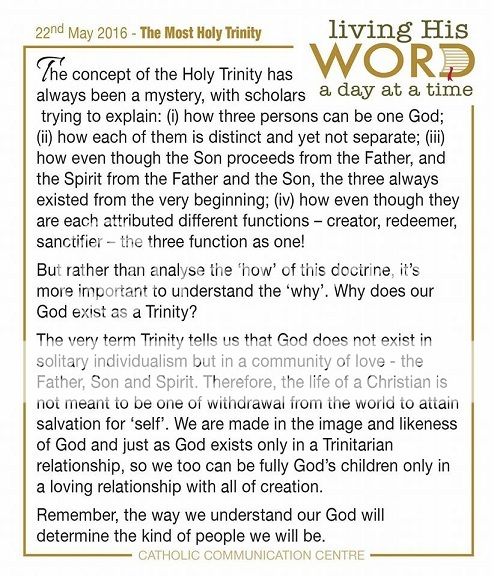
SOLEMNITY OF THE MOST HOLY TRINITY: Year C
(Proverbs 8:22-31; Psalms 8:4-9; Romans 5:1-5; John 16:12-15) We celebrate today one of the greatest mysteries of the Christian faith, that which distinguishes it from other monotheistic religions – that the same One God we all believe in exists and has revealed himself in three united, undivided, co-equal and co-eternal distinct but inseparable Persons, without conflict, confusion or division. The dogma that God is One (in substance) and yet Three is so fundamental to the Christian faith as on it rests every other thing, as we were all baptised in the name of the Blessed Trinity. It teaches that: There is only One God and in this One God there are three Divine Persons: the Father is God, the Son is God, the Holy Spirit is God. Yet there are not three Gods, but one, eternal, incomprehensible God. The Father is not more God than the Son, neither is the Son more God than the Holy Spirit. The Father is the first Divine Person, uncreated from eternity; the Son is the second Divine Person, begotten from the nature of the Father from eternity; the Holy Spirit is the third Divine Person, proceeding from the Father and the Son (CCC 234, 253-256). The Creed beautifully captures this in its tripartite formula in “the Almighty God, the Maker of heaven and earth,” and in Jesus Christ “eternally begotten of the Father, God from God, light from light, true God from true God,” “consubstantial with the Father” and in the “Holy Spirit who proceeds from the Father and the Son and together with the Father and Son is adored and glorified.” Today’s feast was introduced in the ninth century and was only inserted in the general calendar of the Church in the fourteenth century by Pope John XXII but its cultus and belief permeate our liturgy, especially in our often doxological invocation of the thrice-person holy God: Glory be to the Father, and to the Son, and to the Holy Spirit. Thus it is celebrated as a prolongation of the mysteries of Christ, a solemn expression of our faith in the triune life of the Divine Persons, to which we have been given access by adoption in baptism and in the redemptive victory of Christ’s paschal mysteries. The mystery so revealed has been active from the beginning of creation even unto the end of time, but only in heaven shall we fully understand what it means, in union with Christ, to share as sons/daughters in the very life of God. The theoretical articulation of this doctrine has always been puzzling and every attempt to use analogy to describe it stands the risk of failing human logic. Apart from different illustrations used to explain this, the popular story of St. Augustine and the boy at the seaside comes to mind. It is in this sense that we say that it is a mystery, not because we cannot think of it at all or it is an escapist way out from making rational argument for our faith, but that human logic, even at its best, still fails us before the great mystery, we seek to understand but this is possible only by faith. The scriptures and style of our liturgical worship/prayer are our best guides to understanding this mystery (see Gen. 1:26, 1-2; 3:22; 18:2; 11:7; Lk. 1: 26-38; Mt. 3: 16-17; 11:27; 28:19; John 1:1-3; 10:30, 38; 14:8-11; 17:5; 2 Cor. 13:14; 1 Pt. 1:2-3). Our readings today show the movement of God’s power even before creation, before the earth and the heavens were made, to the time of the coming of the promised Spirit upon the disciples, the new Chosen People of God, the new creation, the Church. This glorious procession of the power of God at work begins from before creation, before the moon, stars, oceans and other created things, is continued in the Church and human history, and fulfilled at the end of time. From the beginning of creation, Wisdom was eternally begotten, the first-born of God, and poured forth from of old according to the loving delight and design of the Father. It is even through Wisdom that the heavens were established and the foundations of the earth (its boundaries and limits) were fixed. Living in union with the Father right from the very beginning, Wisdom was his craftsman, architect of a sort, the artisan through whom and by which all things were made, taking special delight in the crowning glory of God's handiwork - the human race, the "sons of men." Thus the psalmist, while extolling the beauty of God’s creation and how the created order tells of the glorious splendour of God, reminds us that even humanity, thanks to the Wisdom of God (1 Cor 1:24) who came down from heaven, has been made a little less than a god or the angels. This is no doubt the basis of the later reference to him who comes down from heaven in this form among us as "the Son of Man" (Heb. 2:6-10). Since all things came to be through him, in him and for him, they have all been put under his feet so that in due course he will restore them all, especially the human race to the glory given to them from the beginning, the glory lost by sin. Therefore, when Christ embraced and tasted death, he did it so that we might be raised to life in him and through him, in the power of the Holy Spirit, be fully united with the Trinity. Thus living the life of the Trinity, the divine life, we have direct access, by grace, to the Father in the Spirit (Eph. 2:18), to make his wonderful name glorious in all the earth. In case you are in any doubt, the Spirit, the Love of God, the eternal bond between the Father and the Son, who proceeds from the Father and the Son since whatever the former has is the latter’s, has been poured out into our hearts (at baptism and just concluded Pentecost last week), so that by adoption we become true children of the Father, calling him Abba (Rom. 8:14-16). As promised by Jesus in today's Gospel, the Spirit comes as a divine gift from above, anointing us unto action (1 Jn. 2:27), leading us into the truth of the faith and showing us "the things that are coming," in the future, the things destined to be from the very beginning of time. United then with God, he lives in us as we live in him, sharing the life of the Trinity now as we look forward to its fullness in due course (Jn. 14:23; 17:21). Part of this revelation is the mystery of one God in three persons with the assurance of being led to the truth that, as Jesus and the Father are one, so Jesus and the Spirit are united. The Father sent his Son and they both send the Spirit, and all three work together in the economy of salvation to achieve the divine plan for our salvation. Having received the Spirit of love in our hearts, we are called to imitate the unity in the Trinity of love in our relationships, with family, partners, colleagues, friends and anybody, loving and living in holiness. We must work for unity in our diverse and sometimes divided society, with respect and dignified honour for others, even those who hold contrary opinions. Our families, Churches and society must mirror what we are called to be, a community of loving, reconciled and reconciling persons, as against sheer individualism, just as the Father, Son, and Holy Spirit are united in love, into which we were all baptised. We must make this Trinitarian spirituality real and concrete such that the Trinity does not only remain a mystery to be thought about or understood but a loving relationship to be lived out. Happy Sunday. Prayer: God our Father, who by sending into the world the Word of truth and the Spirit of sanctification made known to the human race your wondrous mystery, grant us, we pray, that in profession the true faith, we may acknowledge the Trinity of eternal glory and adore your Unity, powerful in majesty. Through our Lord Jesus Christ, your Son, who lives and reigns with you in the unity of the Holy Spirit, one God, for ever and ever. Amen. |
|
|
May 22 2016, 04:45 PM
Return to original view | Post
#415
|
|
Junior Member
225 posts Joined: Mar 2008
|
TRINITY SUNDAY ... 22nd MAY
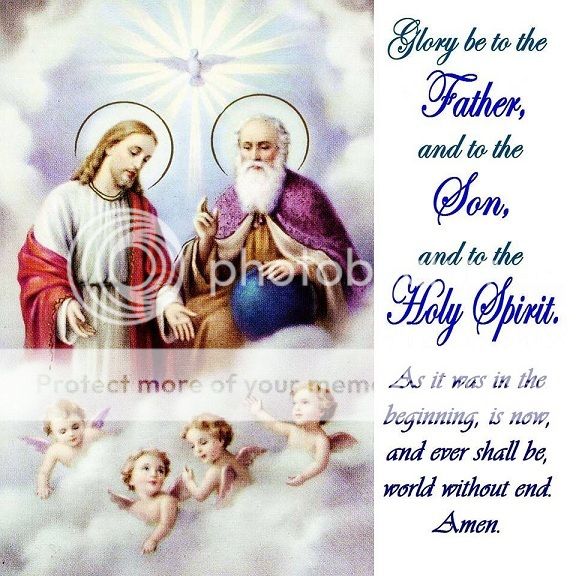 God our Father, who by sending into the world the Word of truth and the Spirit of sanctification made known to the human race your wondrous mystery, grant us, we pray, that in profession the true faith, we may acknowledge the Trinity of eternal glory and adore your Unity, powerful in majesty. Through our Lord Jesus Christ, your Son, who lives and reigns with you in the unity of the Holy Spirit, one God, for ever and ever, Amen. |
|
|
May 22 2016, 04:51 PM
Return to original view | Post
#416
|
|
Junior Member
225 posts Joined: Mar 2008
|
 |
|
|
May 23 2016, 09:13 AM
Return to original view | Post
#417
|
|
Junior Member
225 posts Joined: Mar 2008
|
QUOTE(yeeck @ May 23 2016, 12:23 AM) First Traditional Nuptial Mass officiated in the archdiocese of Kuala Lumpur after the post-conciliar reforms. Splendour of the Catholic liturgy which permeates all the senses. Our Lady of Guadalupe, Puchong ...  This post has been edited by khool: May 23 2016, 11:25 AM |
|
|
May 23 2016, 02:12 PM
Return to original view | Post
#418
|
|
Junior Member
225 posts Joined: Mar 2008
|
 |
|
|
May 24 2016, 01:04 PM
Return to original view | Post
#419
|
|
Junior Member
225 posts Joined: Mar 2008
|
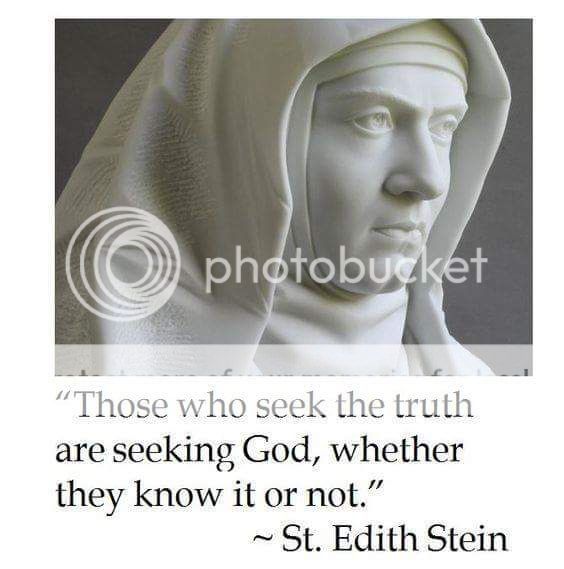 |
|
|
May 25 2016, 02:22 PM
Return to original view | Post
#420
|
|
Junior Member
225 posts Joined: Mar 2008
|
Isenheim Altarpiece ... always leads back to God, the Father, Son and Holy Spirit!!!
First View 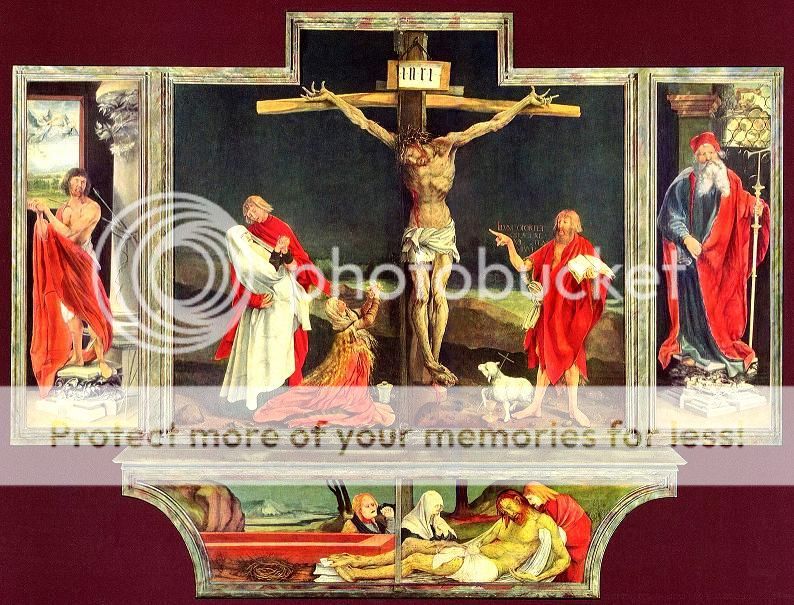 With the exception of certain holy days, the wings of the altarpiece were kept closed, displaying The Crucifixion framed on the left by the martyrdom of Saint Sebastian pierced by arrows, and on the right by Saint Anthony the Great, remaining placid although he is being taunted by a frightening monster. The two saints protect and heal the sick, Saint Anthony as the patron saint of the victims of Saint Anthony's fire and Saint Sebastian, whose aid was invoked to ward off the plague. Grünewald's Crucifixion stands as one of the most poignant representations of this scene in Western art due to the artist's masterful depiction of horrific agony, with Christ's emaciated body writhing under the pain of the nails driven through his hands and feet. This body covered with sores and riddled with thorns must have terrified the sick, but also left no doubt about Christ's suffering, thus comforting them in their communion with the Saviour, whose pain they shared. Mary, the mother of Jesus, is shown at Christ's right, collapsing in anguish in the arms of John, the beloved disciple of Christ, and shrouded in a large piece of white cloth. Detail At Christ's left, John the Baptist is accompanied by a lamb, symbolising the sacrifice of Jesus. The presence of John the Baptist is anachronistic. Beheaded by order of Herod in 29 AD, he could not possibly have witnessed the death of Christ. This last figure announces the New Testament by crying out in Latin, illum oportet crescere me autem minui (Vulgate, John 3:30), "He must increase, but I must decrease."[John 3:30] The inclusion of John the Baptist in this scene is symbolic, since he is considered as the last of the prophets to announce the coming of the Messiah. Second View 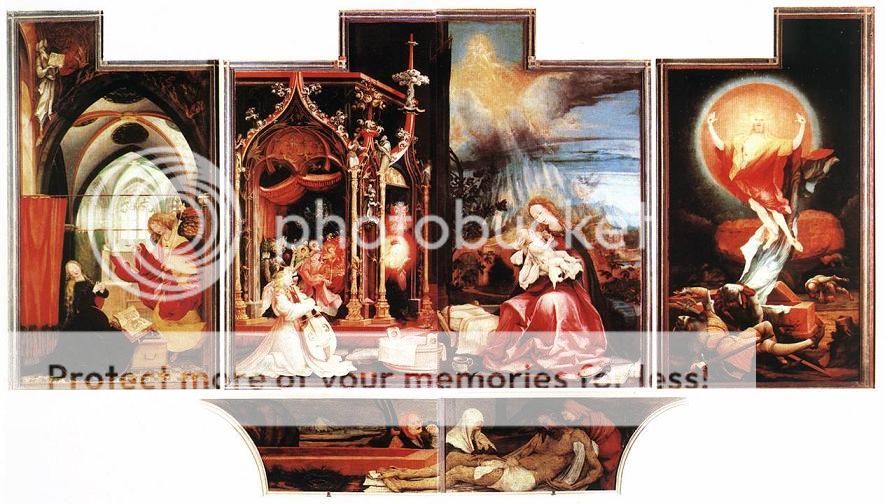 The outer wings of the Isenheim Altarpiece were opened for important festivals of the liturgical year, particularly those in honour of the Virgin Mary. Thus are revealed four scenes: the left wing represents the Annunciation during which the archangel Gabriel comes to announce to Mary that she will give birth to Jesus, the son of God. The Virgin Mary is depicted in a chapel to indicate the sacred character of the event. In the central corpus, the Concert of Angels and the Nativity are not independent scenes but instead fit within a unified concept: the viewer witnesses Christ's coming to earth as a newborn baby, who will be led to combat the forces of evil personified by certain of the angels, disturbing in their physical appearance. A number of symbols provide keys to aid in interpretation: the enclosed garden represents Mary's womb and is a sign of her perpetual virginity, the rose bush without thorns refers to her as free of original sin, the fig tree symbolises mother's milk. The bed, the bucket and the chamber pot underscore the human nature of Christ. Lastly, the right wing shows the Resurrection, in which Christ emerges from the tomb and ascends into Heaven bathed in light transfiguring the countenance of the Crucified into the face of God. The Resurrection and the Ascension are therefore encapsulated in a single image. Third View 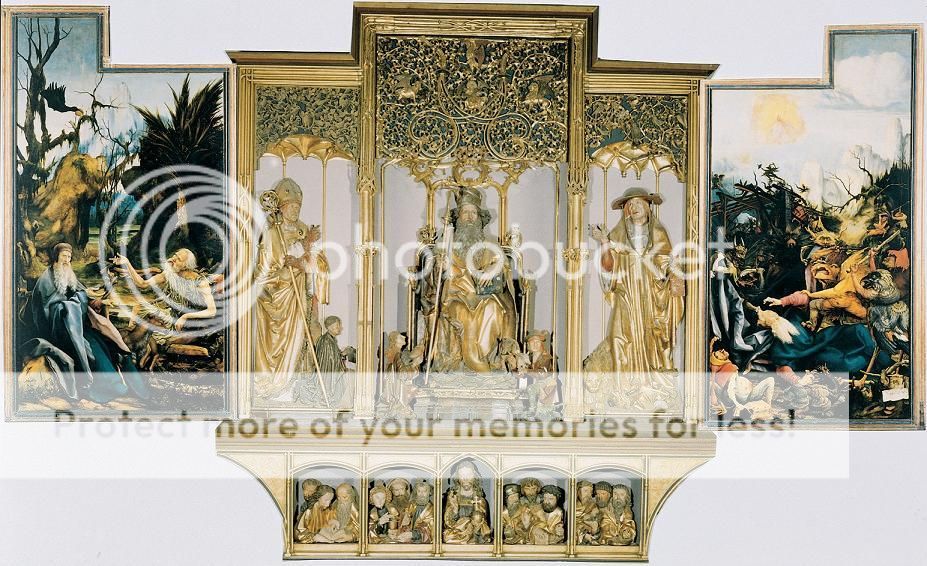 The sculptures of Saint Augustine and Guy Guers, Saint Anthony, Two Bearers of Offerings, Saint Jerome, Christ and the Twelve Apostles are by Niclaus of Haguenau. With its inner wings open, the altarpiece allowed pilgrims and the afflicted to venerate Saint Anthony, protector and healer of Saint Anthony's fire. Saint Anthony occupies the place of honour at the centre of the corpus and at his side a pig is depicted, the emblem of the Antonite order. On his left and right, two bearers of offerings illustrate these contributions in kind, an important source of income for the Antonites. This central section is framed by Saint Augustine and Saint Jerome, two of the four great fathers of the Latin Church. Guy Guyers, who had commissioned the Altarpiece, is depicted kneeling at the feet of Saint Augustine. Visit of Saint Anthony to Saint Paul the Hermit. The two hermits meet in a stunning landscape, intended to represent the Theban Desert. Grünewald created a fantastic universe, surrounding the date palm with a strange mixture of vegetation, in marked contrast with the calmness and tranquillity of the encounter, in which the animals in attendance take part, with the crow bringing two morsels of bread to the two recluses. In this dreamlike scene, medicinal plants, painted in naturalistic fashion, sprout at the feet of the two main figures. Saint Anthony Tormented by Demons. This panel depicts Saint Anthony being tormented by monstrous creatures sent by Satan. Trampled to the ground, beaten with sticks, torn by claws and bitten, Saint Anthony appeals to God for help who sends angels to combat these evil demons. In the lower left corner, the being with webbed feet and a distended belly seems to personify the disease caused by ergot poisoning, resulting in swelling and ulcerous growths. Iconography The iconography of the altarpiece has several unusual elements, several derived from closely following the accounts left by Saint Bridget of Sweden of her mystical visions. These had long had a significant influence on art, especially on depictions of the Nativity of Christ, a scene not included here. Recent history The altarpiece’s location in Alsace has meant that, in recent times, control of the work has alternated between Germany and France according to the fortunes of war.[3] Following the Franco-Prussian war of 1870-71 and the passing of control to Germany, German writers developed the concept that the altarpiece somehow represented the essential character of the German nation. The work subsequently became an object of extraordinary scenes of veneration in Munich during its temporary relocation there during the First World War, and again when Alsace passed back into French hands at the end of the War.[3] In the immediate postwar period the altarpiece, with its strong overtones of violent sensation and emotion, became a natural source of inspiration for many painters in the influential Expressionist school, such as George Grosz and Otto Dix.[4][5] It also provided the basis for Hindemith's modernist opera Mathis der Maler. In the later 1930s, it appears to have suffered a temporary decline in official esteem in Germany as a result of the National Socialists’ branding of both Expressionism and of Hindemith’s work as "degenerate".[6] Due to renovation work in the former convent and until April 2015, the Isenheim Altarpiece was on view in the local Dominican Church, located about 200 metres from the Unterlinden Museum. This temporary transfer offered an exceptional and unprecedented opportunity to present, alongside Grünewald and Haguenau’s monumental masterwork, all three painted works by the Colmar native Martin Schongauer held in Colmar: the Orlier Altarpiece (1470–1475), the Altarpiece of the Dominicans (c. 1480) and the Virgin of the Rose Bush (1473). The altarpiece depicting Saint Catherine and Saint Lawrence (c. 1510) and sculptures from the Late Middle Ages rounded out the presentation.[7] Source: https://en.wikipedia.org/wiki/Isenheim_Altarpiece |
|
Topic ClosedOptions
|
| Change to: |  0.1442sec 0.1442sec
 0.39 0.39
 7 queries 7 queries
 GZIP Disabled GZIP Disabled
Time is now: 8th December 2025 - 02:41 PM |
 Quote
Quote