Welcome Guest ( Log In | Register )

Bump Topic Topic Closed RSS Feed
55 Pages « < 49 50 51 52 53 > » Bottom

Outline · [ Standard ] · Linear+

 LYN Catholic Fellowship V01 (Group), For Catholics (Roman or Eastern)

views
     
TSyeeck
post Dec 3 2016, 01:42 AM

Look at all my stars!!
*******
Senior Member
3,576 posts

Joined: Apr 2006


QUOTE(friedricetheman @ Dec 2 2016, 11:09 PM)
Wah liow... just discovered that there is a Catholic thread and the first thing I bumped into is this.

First thing first, we believe that the soul enters the fetus at conception. So, even if you abort the fetus at a few days old, you are killing another human being.

With advancements in medical science, pregnant women are usually safe throughout their pregnancy. If complications do arise, it is the fetus that usually dies naturally and not the other way around.

We are pro-life. We believe that mothers, child, fetus are all equal and should be given a chance at living life to the fullest.

If in the case of mothers being in danger during pregnancy, a priest will be consulted on what is the best course of action. After Vatican 2, there are some exceptions to the rule and is usually decided on a case by case basis.
*
Can you explain more about the bolded part? I don't think there's any difference pre or post Vatican 2 when it comes to abortion. As far as I know, the principle is to avoid direct kiling. If in circumstances where saving the life of the mother means inadvertently losing the child, then I don't think that is a sin, but it is the direct intention to kill the child even at the flimsiest of reasons (such as an unwanted pregnancy) that is sinful.

This post has been edited by yeeck: Dec 3 2016, 01:56 AM
TSyeeck
post Dec 4 2016, 12:59 AM

Look at all my stars!!
*******
Senior Member
3,576 posts

Joined: Apr 2006


TSyeeck
post Dec 6 2016, 01:58 AM

Look at all my stars!!
*******
Senior Member
3,576 posts

Joined: Apr 2006


QUOTE(tinarhian @ Dec 5 2016, 02:23 AM)
But its easier to tell the women to just deal with it isn't it? The law just there to protect the coward rapists. How is that even better than the Talibans?  hmm.gif

Its not that I'm promoting abortions but the fact that there are so many unwanted pregnancies and Catholics don't EVEN use contraception.

So if a women use birth-control pills do you Catholics consider it as "killing the fetus" ?

Then everything else just revert back to "Thou shall not kill."  doh.gif

No wonder people like to keep old laws because it suit them and to suppress women.

We can discuss till the cows come home, to me this is just men's ego to protect themselves from being accounted for and not taking full responsibility for their cowardice actions.
*
Birth control pills kills the fertilized egg. nod.gif

How can you say the law is just there to protect the coward rapists? Which laws, may I ask? And how has this got to do with your favourite Talibans? laugh.gif

Rapists should indeed be punished severely. But killing the innocent babies is not the way of God.
TSyeeck
post Dec 6 2016, 02:46 AM

Look at all my stars!!
*******
Senior Member
3,576 posts

Joined: Apr 2006


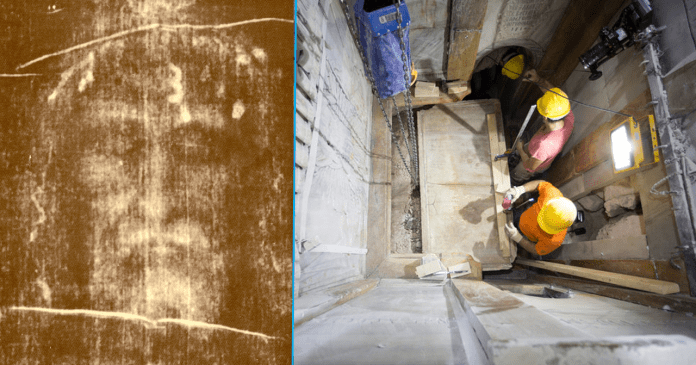
Scientists Who Opened Christ’s Tomb Detect Mysterious Readings That Support Shroud Theory
By uCatholic - December 5, 2016 11 3017

user posted image
During recent conservation efforts at The Church of Holy Sepulchre, the tomb of Christ was opened and inspected for the first time in centuries.

According to reports, some of the scientific instruments used by scientists for analysis and measurement were affected by strong electromagnetic disturbances when they were placed on the stone slab on which Christ’s body rested. The scientists report that their measuring devices either malfunctioned or ceased to work at all. According to an Aleteia report:


The phenomenon was confirmed by one of the scientists authorized to access the tomb. Later, one of the heads of the building and construction team, Antonia Moropoulou, indicated that it is really hard to imagine that someone would be willing to put in danger his or her reputation just because of a “publicity stunt.” Moreover, the journalist testifies to the scientists’ surprise during the opening of the slab: they hoped that the grave would be much lower than it was. Their conclusion: previously performed analyses with the instruments seemed to have been distorted by an electromagnetic disturbance.

The observation of these unusual electromagnetic anomalies at the tomb of Jesus may lend credence to a scientific hypothesis on the creation of the ghostly image on the Shroud of Turin. Italy’s National Agency for New Technologies, Energy and Sustainable Economic Development [ENEA] concluded during a five-year-long study that the Shroud of Turin could not be a ‘medieval fake’. The findings of ENEA study hypothesized that the image may have been created by an intense source of light, stronger than could be created by any technology currently available to man. The results of ENEA “show that a short and intense burst of VUV directional radiation can color a linen cloth so as to reproduce many of the peculiar characteristics of the body image on the Shroud of Turin, including shades of color, the surface color of the fibrils of the outer linen fabric, and the absence of fluorescence”.

The study noted “that the total power of VUV radiations required to instantly color the surface of linen that corresponds to a human of average height, body surface area equal to = 2000 MW/cm2 17000 cm2 = 34 thousand billion watts makes it impractical today to reproduce the entire Shroud image using a single laser excimer, since this power cannot be produced by any VUV light source built to date (the most powerful available on the market come to several billion watts )”.

In addition to the bizarre scientific readings, some observers who were present when the tomb was opened reported smelling “a sweet fragrance”. A sweet pleasant scent often accompanies the recounting of Marian apparitions and the tombs of Saints, and is referred to as “the odour of sanctity”. During the last partial opening, made by the architect Nikolaos Komnenos in 1809, the chronicler also made mention of a “sweet aroma.”
TSyeeck
post Dec 6 2016, 01:40 PM

Look at all my stars!!
*******
Senior Member
3,576 posts

Joined: Apr 2006


QUOTE(shioks @ Dec 6 2016, 09:08 AM)
So if Catholic is against birth control pills, I would assume Catholic also ban CONDOMS.  Would Roman Catholic Church excommunicates a catholic for promoting contraceptive then?
*
From wikipedia http://en.wikipedia.org/wiki/Excommunication

Automatic excommunication
There are a few offenses for which Latin Rite Roman Catholics are automatically excommunicated (the Latin term is Latæ Sententiæ):

Apostasy,
Heresy,
Schism,
Desecration of the Eucharist,
Physical force against the Pope,
Attempted sacramental absolution of a partner in adultery,
Ordination of a bishop without a Papal mandate (e.g. all bishops in the government-run Chinese Patriotic Church),
Violation of the sacramental seal of confession by a priest or bishop, and
Procurement of a completed abortion.
TSyeeck
post Dec 6 2016, 02:55 PM

Look at all my stars!!
*******
Senior Member
3,576 posts

Joined: Apr 2006


QUOTE(shioks @ Dec 6 2016, 01:52 PM)
aiyah...no excommunication ah.  Like that contraceptive pill or condoms are ok mah!  Do you use either of those? devil.gif
*
Still a sin, uncle. And contraceptive pills are abortifacients.

This post has been edited by yeeck: Dec 6 2016, 02:56 PM
TSyeeck
post Dec 9 2016, 12:21 AM

Look at all my stars!!
*******
Senior Member
3,576 posts

Joined: Apr 2006


user posted image

Mary's Immaculate Conception

by Father William G. Most

In teaching that Mary was conceived immaculate, the Catholic Church teaches that from the very moment of her conception, the Blessed Virgin Mary was free from all stain of original sin. This simply means that from the beginning, she was in a state of grace, sharing in God's own life, and that she was free from the sinful inclinations which have beset human nature after the fall.

History of the Doctrine

There are two passages in Scripture which point us to this truth. We look first at Genesis 3.15, in which we see the parallel between Mary and Eve of which the early Church Fathers already spoke: "I will put enmity between you and the woman, and between your seed and her seed: he shall bruise your head, and you shall bruise his heel." The Jews saw this passage as referring to the struggle between Christ and Satan, and so the Church see in "the woman" a prophetic foreshadowing of the Virgin Mary (Vatican II, Lumen gentium, # 55).

If there is to be complete enmity between the woman and the serpent, then she never should have been in any way subject to him even briefly. This implies an Immaculate conception.

We can also reason from the text of Lk 1:28, in which the angel calls her "full of grace". If we can validate the translation--we can, and will do so, shortly--then in this verse we can see even more strongly the complete enmity with the serpent--for God's grace is complete opposed to Satan's reign. But if Mary was "full of grace," it seems that she must have been conceived immaculate.

We turn to the early Fathers of the Church. First, many, not all of them, make sweeping statements about her holiness. That could imply an Immaculate Conception. Secondly, very many of them speak of her as the New Eve. They could have reasoned: the first Eve had an immaculate start in life--no sin was yet committed. So the New Eve, who was to share in undoing the harm of original sin, should have also an immaculate start. However, none of the Fathers actually followed this line of reasoning. (A few Fathers even tried to find sins she had committed, e.g. St. John Chrysostom, Homilies on John 21. PG 59. 130ff).

During the middle ages, authors such as St. Bernard of Clairvaux and St. Thomas Aquinas denied the doctrine. At this time, the data from Scripture and the Fathers was still not clear. In addition, the understanding of original sin was not as clear as it should have been--it was often thought of as having a positive element, instead of merely being an original lack of the grace to which God calls us. This positive element was thought to be transmitted from parents to children through the marital act (which was itself thought to be somehow sinful, though pardoned by God), and so it was hard to see how there could be an immaculate conception. This conception had been found in some, though by no means all, of the Fathers. Now of course we know it to be false. Finally, it was not generally seen at this time how an Immaculate conception of Mary would not take away from the universality of redemption through Christ.

After a while, however, the theological tide began to turn, and the objections which had long obscured the content of divine revelation began to be overcome. This was due especially to the work of the Franciscan, Venerable John Duns Scotus. He showed that for God to preserve Mary from original sin was a greater redemption than to allow her to fall into it and then rescue her. Scotus wrote (cited from J. B. Carol, Mariology I, 368): "Either God was able to do this, and did not will to do it, or He willed to preserve her, and was unable to do so. If able to and yet unwilling to perform this for her, God was miserly towards her. And if He willed to do it but was unable to accomplish it, He was weak, for no one who is able to honor his mother would fail to do so."

We also note again that behind most of the objections was the rather positive notion of original sin. If we jump ahead several centuries to the clearer understanding of original sin we have now, we can remove this objection. Pope John Paul II epressed this understanding in a General Audience on Oct 1, 1986: "In context it is evident that original sin in Adam's descendants has not the character of personal guilt. It is the privation of sanctifying grace in a nature which, through the fall of the first parents, has been diverted from its supernatural end. It is a 'sin of nature' only analogically comparable to 'personal sin'". In other words: It is only the lack, or privation, of that which God wanted us to have, which we should have inherited from our first parents."

Now back to our history. After that this change in theological tide had gone far towards removing objections, the Popes began to make statements of varying clarity. Sixtus IV in 1477 (DS 1400) praised the liturgical celebration of the Immaculate Conception. The same Pope added further support in 1483 (DS 1425-26), condemning those who said it was sinful to preach and believe the Immaculate Conception. The Council of Trent explicitly declared in its decree on original sin (DS 1516): "... it is not its intention to include in this decree ... the blessed and Immaculate Virgin Mary, Mother of God. Rather, the Constitutions of Sixtus [IV] of happy memory are to be observed."

After Trent, the attacks on the Immaculate Conception were greatly moderated. Then Pope St. Pius V, in 1567 (DS 1973) condemned the error of Baius who said Our Lady was subject to original sin. And in 1568 the same Pope put the feast of the Immaculate Conception on the calendar of the Roman breviary. Alexander VII in 1661 explained the doctrine much as Pius IX did later: DB 1100. Pope Clement XI in 1708 made December 8 a holyday of obligation. Further, the Sixth Provincial Council of Baltimore in the U. S. in 1846 declared Mary Immaculate to be Patroness of the United States, and Pius IX on Feb. 7, 1847 confirmed this dedication.

The result was that about a century and a half before the definition of 1854, the whole Church believed the Immaculate Conception. Finally, in Ineffabilis Deus, in 1854, Pius IX defined this doctrine and added that Mary was conceived immaculate by anticipation of the merits of Christ. This is not strange, for to the eye of God, all time is present.

Now the Church continues to elucidate the scriptural basis of the doctrine of the Immaculate Conception. Pius XII, in Fulgens corona, 1953 wrote: "... the foundation of this doctrine is seen in the very Sacred Scripture itself, in which God ... after the wretched fall of Adam, addressed the ... serpent in these words... 'I will put enmity....' But if at any time, the Blessed Virgin Mary, defiled in her conception with the hereditary stain of sin, had been devoid of divine grace, then at least, even though for a very brief moment of time, there would not have been that eternal enmity between her and the serpent ... but instead there would have been a certain subjection."

Preventive redemption

We have said that Mary needed redemption, although she was never subject to original sin. Nor did she have an "obligation" to contract it, as some have foolishly said: there can be no obligation to any sin. We can merely say she would have been in original sin in the sense just explained, i.e. , she would have been born without grace, were it not for the preventive redemption. The word "preventive" means anticipatory: the grace she received at her conception was given in anticipation (Latin praevenire) of Christ's merits, which earned that grace.

The nature of Mary's grace at the Immaculate Conception

In Lk 1:28 the archangel hails her as, "full of grace". Most versions today do not use that rendering, but greatly weaken it. Yet it is the correct translation as we can see from the Magisterium (Pius XII, Fulgens Corona, AAS 45, 579, and constant use of the Church) and also from philology.

For the Greek word in the Gospel is kecharitomene. It is a perfect passive participle of the verb charitoo. A perfect passive participle is very strong. In addition, charitoo belongs to a group of verbs ending in omicron omega. They have in common that they mean to put a person or thing into the state indicated by the root. Thus leukos means white, so leukoo means to make white. Then charitoo should mean to put into charis. That word charis can mean either favor or grace. But if we translate by favor, we must keep firmly in mind that favor must not mean merely that God, as it were, sits there and smiles at someone, without giving anything. That would be Pelagian: salvation possible without grace. So for certain, God does give something, and that something is grace, are share in His own life. So charitoo means to put into grace. But then too, kecharitomene is used in place of the name "Mary". This is like our English usage in which we say, for example, someone is Mr. Tennis. That means he is the ultimate in tennis. So then kecharitomene should mean "Miss Grace", the ultimate in grace. Hence we could reason that fullness of grace implies an Immaculate Conception.

Overflowing grace: Pius IX, in the document, Ineffabilis Deus, defining the Immaculate Conception in 1854 wrote: "He [God] attended her with such great love, more than all other creatures, that in her alone He took singular pleasure. Wherefore He so wonderfully filled her, more than all angelic spirits and all the Saints, with an abundance of all heavenly gifts taken from the treasury of the divinity, that she, always free from absolutely every stain of sin, and completely beautiful and perfect, presented such a fullness of innocence and holiness that none greater under God can be thought of, and no one but God can comprehend it."

What about the words of Jesus in Lk 11:27-28 (cf. Mt. 12:46-50 and Mk 3:35)? A woman in the crowd exclaimed: "Blessed is the womb that bore you...." He replied: "Rather blessed are they who hear the word of God and keep it."

The dignity of being Mother of God is a quasi infinite dignity, as we just saw from the words of Pius XI. Yet here, our Lord is teaching us that the holiness coming from hearing the word of God and keeping it is something greater still. Her holiness must indeed be great--so great that "none greater under God can be thought of, and no one but God can comprehend it."

Even though Mary was full of grace at the start of her life, yet she could still grow, for, as it were, her capacity for grace could increase.

In general, a soul will grow in proportion to these things: (1) The greater the dignity of the person, the greater the merit In her case, the dignity of Mother of God is the highest possible for a creature. (2) The greater the work, the greater the merit: her cooperation in the redemption was the greatest work possible to a creature. (3) The greater the love, the greater the merit. Love of God means the attachment of our will to His. Her will adhered supremely, with no obstacle at all, so that even ordinary household duties, which she saw as the will of the Father for her, were supremely valuable.

Excerpted and adapted from Theology 523: Our Lady in Doctrine and Devotion, by Father William G. Most.
Copyright © 1994 William G. Most.

This electronic text © Copyright EWTN 1996. All rights reserved.
TSyeeck
post Dec 9 2016, 02:40 PM

Look at all my stars!!
*******
Senior Member
3,576 posts

Joined: Apr 2006


QUOTE(shioks @ Dec 9 2016, 10:23 AM)
Uncle Yeeck, how do you explain this Jeremiah 44 passage on queen of heaven?

44 The word that came to Jeremiah for all the Jews living in the land of Egypt, those who were living in Migdol, Tahpanhes, Memphis, and the land of Pathros, saying, 2 “Thus says the Lord of hosts, the God of Israel, ‘You yourselves have seen all the calamity that I have brought on Jerusalem and all the cities of Judah; and behold, this day they are in ruins and no one lives in them, 3 because of their wickedness which they committed so as to provoke Me to anger by continuing to burn [a]sacrifices and to serve other gods whom they had not known, neither they, you, nor your fathers. 4 Yet I sent you all My servants the prophets, [b]again and again, saying, “Oh, do not do this abominable thing which I hate.” 5 But they did not listen or incline their ears to turn from their wickedness, so as not to burn [c]sacrifices to other gods. 6 Therefore My wrath and My anger were poured out and burned in the cities of Judah and in the streets of Jerusalem, so they have become a ruin and a desolation as it is this day. 7 Now then thus says the Lord God of hosts, the God of Israel, “Why are you doing great harm to yourselves, so as to cut off from you man and woman, child and infant, from among Judah, leaving yourselves without remnant, 8 provoking Me to anger with the works of your hands, burning [d]sacrifices to other gods in the land of Egypt, where you are entering to reside, so that you might be cut off and become a curse and a reproach among all the nations of the earth? 9 Have you forgotten the wickedness of your fathers, the wickedness of the kings of Judah, and the wickedness of their wives, your own wickedness, and the wickedness of your wives, which they committed in the land of Judah and in the streets of Jerusalem? 10 But they have not become [e]contrite even to this day, nor have they feared nor walked in My law or My statutes, which I have set before you and before your fathers.”’

11 “Therefore thus says the Lord of hosts, the God of Israel, ‘Behold, I am going to set My face against you for [f]woe, even to cut off all Judah. 12 And I will take away the remnant of Judah who have set their [g]mind on entering the land of Egypt to reside there, and they will all [h]meet their end in the land of Egypt; they will fall by the sword and meet their end by famine. Both small and great will die by the sword and famine; and they will become a curse, an object of horror, an imprecation and a reproach. 13 And I will punish those who live in the land of Egypt, as I have punished Jerusalem, with the sword, with famine and with pestilence. 14 So there will be no refugees or survivors for the remnant of Judah who have entered the land of Egypt to reside there and then to return to the land of Judah, to which they are [i]longing to return and live; for none will return except a few refugees.’”

15 Then all the men who were aware that their wives were burning [j]sacrifices to other gods, along with all the women who were standing by, as a large assembly, [k]including all the people who were living in Pathros in the land of Egypt, responded to Jeremiah, saying, 16 “As for the [l]message that you have spoken to us in the name of the Lord, we are not going to listen to you! 17 But rather we will certainly carry out every word that has proceeded from our mouths, [m]by burning [n]sacrifices to the queen of heaven and pouring out drink offerings to her, just as we ourselves, our forefathers, our kings and our princes did in the cities of Judah and in the streets of Jerusalem; for then we had plenty of [o]food and were well off and saw no [p]misfortune. 18 But since we stopped burning [q]sacrifices to the queen of heaven and pouring out drink offerings to her, we have lacked everything and have [r]met our end by the sword and by famine.” 19 “And,” said the women, “when we were burning [s]sacrifices to the queen of heaven and [t]were pouring out drink offerings to her, was it without our husbands that we made for her sacrificial cakes [u]in her image and poured out drink offerings to her?”
*
http://www.catholic-convert.com/wp-content...eenOfHeaven.pdf
TSyeeck
post Dec 9 2016, 05:05 PM

Look at all my stars!!
*******
Senior Member
3,576 posts

Joined: Apr 2006


Blessed be God in His angels and in His saints!
TSyeeck
post Dec 10 2016, 10:29 PM

Look at all my stars!!
*******
Senior Member
3,576 posts

Joined: Apr 2006


WHERE THE ROSARY APPEARS IN “THE LORD OF THE RINGS”

user posted image

In The Lord of the Rings, the Lady Galadriel gives Frodo a gift upon his departure from Lothlórien: a phial, somehow filled with the light of Eärendil, the star that serves as a sort of Polaris or Morning Star to guide the Eldar (elves) to the Undying Lands. When Galadriel gives Frodo the phial, she expresses her purpose for the gift: “May it be a light to you in dark places, when all other lights go out.” Frodo first uses the phial as a light in Shelob’s lair, a cave which bore a “sense of malice so intense that Frodo reeled” (Lord of the Rings, IV.9). As he raises the phial aloft, he exclaims “Aiya Eärendil Elenion Ancalima!” which translates to “Hail Eärendil, brightest of stars!” At his words, the light shines forth brighter. Later, when Sam uses the phial, he cries out:

O Elbereth Gilthoniel
o menel palan-diriel,
le nallon sí di’nguruthos!
A tiro nin, Fanuilos!


Oh Elbereth Starkindler,
from the high firmament gazing afar,
to thee do I cry amid this horror!
Look kindly upon me, Ever-pure Lady!”

For those who aren’t Tolkien geeks, Elbereth (or Varda) is the Queen of the Stars in Tolkien’s mythology. At Sam’s words, the light “flamed like a star that leaping from the firmament sears the dark air with intolerable light.”

Given by Lady Galadriel and a source of light through prayer, the phial is for us an image of the Rosary. The Blessed Virgin Mary, fairest of all women, gave us the Rosary as a light in dark places. In praying the Rosary, we cry out to Mary the Morning Star that she may guide us to Heaven in her Son. In whispering our Aves, we ask the Queen of Heaven, the Woman robed in stars, for Her aid in the darkest times of life. Even Sam’s prayer to Elbereth is suspiciously similar to the Hail Holy Queen, which we pray to end the Rosary: “Hail Holy Queen…to thee do we cry…in this valley of tears! Turn then, most gracious advocate, thine eyes of mercy towards us.”

We can identify three effects of the phial which also apply to the Rosary. First, the phial provides light to illuminate the hobbits’ path, lest they stumble: By praying the Rosary, we grow in grace and can thus understand better the way we should turn. We have faith that, by praying to God through the powerful intercession of the Mother of God, He will draw us closer to Himself, in Whom is all our joy. Second, the phial gives the hobbits hope. Despite the trials they are facing, the light of Eärendil reminds them of the great stories about how others have triumphed over evil and how, above all the gloom of Mordor, there is yet beauty and goodness and truth. The Rosary of Mary is a source of hope for us, for by meditating on the life of Christ and walking with Him, we come to understand all the more that death is not the end of life, that Christ has conquered death, and that He has promised His kingdom to those who follow Him. The Rosary is Mary’s humble way of leading us through this world while keeping us from despairing of the fullness of life to come. Third, the phial is a terror to evil ones. Shelob, an ancient evil in spider form, took to flight at the flame of the shining phial. Similarly, the Holy Rosary is a terror to demons, a sure weapon in our fight against our own vice and against the world’s evils. For proof, just take a close look at the lives of the saints.

But the Rosary itself is far more powerful than the phial. It’s a prayer that can be a petition, a meditation, a prayer of thanksgiving, a prayer of praise, even a prayer of reparation for sins. There is one thing, however, that the Rosary is not: an instant solution to all our problems. In the closing prayer to the Rosary, we pray that we might imitate what the mysteries contain and obtain what they promise. It is easy to forget about the former intention while praying fervently for the latter, but they are a package deal. We must imitate what the mysteries contain, all the mysteries, from the Annunciation through the Crucifixion to the Resurrection and beyond. The Rosary does not take away the pain of this life; rather it helps us to see our suffering in the Cross of Christ. So let us rejoice, knowing with a living hope that the Blessed Virgin Mary will lead us, through whatever may come our way, to her Son and our Lord, Jesus Christ.
TSyeeck
post Dec 10 2016, 11:15 PM

Look at all my stars!!
*******
Senior Member
3,576 posts

Joined: Apr 2006


QUOTE(khool @ Dec 10 2016, 10:52 PM)
Stella Maris ...  rclxm9.gif  rclxm9.gif  rclxm9.gif  icon_idea.gif  icon_idea.gif  icon_idea.gif
*
Stella Matutina...jeng jeng jeng.... biggrin.gif
TSyeeck
post Dec 12 2016, 10:36 PM

Look at all my stars!!
*******
Senior Member
3,576 posts

Joined: Apr 2006


QUOTE(tinarhian @ Dec 12 2016, 01:18 AM)
I think abortion should be allowed to those women who have been a rape victim or victim or incest. Unless you consider adoption as a temporary solution.

Really? You think Taliban laws protect women? You must been hiding in some Taliban caves.  brows.gif

If its a due to unprotected sex then I understand the morality of it.

In some countries the rapists even marry the victim. How is that even legal?  doh.gif

Plus the Catholics don't even believe in protection during sexual intercourse. No wonder so many unwanted pregnancies.

Then you conveniently blamed the women. haha..How convenient.

Its the Catholic way, you don't need to tell me that its not. Heck its either my way or the highway. Is that even a choice in the first place?

Then who help the poor mother? I get that abortion is not a shortcut but how is the consequences of the child's life? Even if the baby is not aborted, but baby dumping is increasing yearly due to unprotected sex, rapes, etc..

There's where the increase of generation of bitter youth with mixed emotion because of some idiot teenagers didn't have decency to use protection.
*
Huh? Did I say Taliban laws protect women? You and your Taliban fetish...lol.

Having sex outside of marriage is wrong. Killing another life because of the first wrong is another wrong. That is the Catholic position. Adoption is definitely acceptable.
TSyeeck
post Dec 12 2016, 10:42 PM

Look at all my stars!!
*******
Senior Member
3,576 posts

Joined: Apr 2006


QUOTE(shioks @ Dec 11 2016, 05:55 PM)
Uncle Yeeck, what do you think of Liberation Theology advocated by Catholic Church in Latin America?
*
lib·er·a·tion the·ol·o·gy
noun
a movement in Christian theology, developed mainly by Latin American Roman Catholics, that emphasizes liberation from social, political, and economic oppression as an anticipation of ultimate salvation.

That definition itself shows how wrong it is. Ultimate salvation is deliverance from sin and its consequences (i.e. Hell)
TSyeeck
post Dec 14 2016, 02:06 AM

Look at all my stars!!
*******
Senior Member
3,576 posts

Joined: Apr 2006


After King Henry VIII broke ties with the Catholic Church because of a dispute over marriage, Catholics were treated very badly. Bishops were locked up. Monasteries were closed. Tens of thousands were executed in the bloody turmoil of the English Reformation. All of which raises an interesting point: If the Church wouldn’t change its doctrine for the king of England, what makes others think they can change it?
TSyeeck
post Dec 14 2016, 09:51 PM

Look at all my stars!!
*******
Senior Member
3,576 posts

Joined: Apr 2006


QUOTE(shioks @ Dec 14 2016, 05:10 AM)
You lied again.

Roman Catholic changed its doctrines over the years but of course you can always claim they were not changed but merely more understandings and clarifications.  Here are some of the examples:

No infant baptism till 4th century:

A. There is no command or example of infant baptism in the Bible.

C. The Roman Catholic church admits baptism by immersion was practiced till 1311 AD:

    "There is no express mention of the baptism of infants in the New Testament" (Question Box, p. 23).
    "It is difficult to give strict proof from the scriptures in favor of it. [infant baptism]" (Catholic Dictionary, p. 61).
    "Ecclesiastical custom with regard to the administration of Baptism has undergone a change in the course of history. Whereas the early Church baptized adults only, the baptism of children soon became the usual practice." (Sanford, Alexander E., MD, Pastoral Medicine: Handbook for the Catholic Clergy, 1904, p 32-33)
    "Where in the fourth and fifth centuries the doctrine of original sin became better known, the practice of infant baptism progressed rapidly." (Legislation on the Sacraments in the New Code of Canon Law, p. 72).
    "When all fear of persecution had passed away, and the empire had become almost entirely Christian, the necessity for a prolonged period of trial and instruction no longer existed, about the same time the fuller teaching on the subject of original sin, occasioned by the Pelagian heresy, gradually led to the administration of baptism of infants." (Catholic Encyclopedia, Vol. V, p. 78).
    Infant baptism by immersion commanded of all infants in the Council Of Mela in 416 AD.

No Pope was considered infallible until 1870 AD

    Pope Adrian VI - It is certain that the Pontiff ... may err in those things which pertain to faith.
    Pope Paul IV - I do not doubt that I and my predecessors may sometimes have erred.
    Archbishop Purcell said in his debate with Alexander Campbell in Cincinnati on 1-13-1837: "the bishop of Rome, though he was not believed to be infallible. Neither is he now. No enlightened Catholic holds the pope's infallibility of be an article of faith. I do not; and none of my brethren, that I know of, do. The Catholic believes the pope ... to be as liable to error, as almost any other man in the universe. Man is man, and no man is infallible, either in doctrine or morals."

Catachism changed after 1870 AD:

"A Doctrinal Catechism," by Keenan, bearing the Imprimatur (official sanction) of Scotch Roman Catholic bishops, pre 1870: Must not Catholics believe the pope himself to be infallible? This is a Protestant invention; it is no article of the Catholic faith; no decision of his can oblige, under pain of heresy, unless it is received and enforced by the teaching body, that is, the bishops of the church. After 1870, this Q&A was dropped from Keenan's catechism.

Democracy vs Monarchy
- The church stood for the divine right of kings, and against the disposition of monarchs and the idea of popular sovereignty (i.e. rule by "the mob" rather than the divinely-appointed kings).

Usury - While the church prohibited money-lending with any interest whatsoever and even excommunicated people for it, the church now allows it.

Slavery - The Church not only explicitly condoned slavery and allowed it in Canon Law, but the Church actually owned slaves itself. The Church did not get around to condemning it until 1888 decades after most secular governments had already abolished it. Despite the fact that the Bible and the Church condoned it for centuries, John Paul II included slavery among matters that are ''intrinsically evil'' -- prohibited ''always and forever'' and ''without any exception'' -- a violation of a universal, immutable norm.
*
On infant baptism:

Peter explained what happens at baptism when he said, "Repent, and be baptized every one of you in the name of Jesus Christ for the forgiveness of your sins; and you shall receive the gift of the Holy Spirit" (Acts 2:38). But he did not restrict this teaching to adults. He added, "For the promise is to you and to your children and to all that are far off, every one whom the Lord our God calls to him" (2:39). We also read: "Rise and be baptized, and wash away your sins, calling on his name" (Acts 22:16). These commands are universal, not restricted to adults. Further, these commands make clear the necessary connection between baptism and salvation, a
connection explicitly stated in 1 Peter 3:21: "Baptism . . . now saves you, not as a removal of dirt from the body but as an appeal to God for a clear conscience, through the resurrection of Jesus Christ."

On infallibity:

When the Pope (1) intends to teach (2) by virtue of his supreme authority (3) on a matter of faith and morals (4) to the whole Church, he is preserved by the Holy Spirit from error. His teaching act is therefore called "infallible" and the teaching which he articulates is termed "irreformable". Therefore, to say that Popes may err in those things which pertain to faith, I absolutely agree with you that it may happen, but not when the Pope intends to the do 1,2,3,4 above.

On usury:

http://www.catholic.com/magazine/articles/...stance-on-usury

On slavery:

https://www.ewtn.com/library/ANSWERS/POPSLAVE.HTM
TSyeeck
post Dec 14 2016, 10:04 PM

Look at all my stars!!
*******
Senior Member
3,576 posts

Joined: Apr 2006


The Beautiful Church: Why Must Catholic Churches Be So Ornate?


user posted image

Offending Judas

One of the biggest stumbling blocks for many fundamentalists is the beautiful but opulent churches that are so commonly associated with the Catholic faith. The common refrain goes along of the lines of “look at all that money they wasted on building a church when they could have put it to use helping the poor.”

“Mary then took a pound of very costly perfume of pure nard, and anointed the feet of Jesus and wiped His feet with her hair; and the house was filled with the fragrance of the perfume. But Judas Iscariot, one of His disciples, who was intending to betray Him, said, “Why was this perfume not sold for three hundred denarii and given to poor people? “Now he said this, not because he was concerned about the poor, but because he was a thief, and as he had the money box, he used to pilfer what was put into it. Therefore Jesus said, “Let her alone, so that she may keep it for the day of My burial. For you always have the poor with you, but you do not always have Me.” (John 12:3-8 NASB)

Those who would criticize the Catholic church for its supposed vast riches and it’s use of large sums to built huge, ornate churches sound very much like the Apostle Judas, who criticized Jesus for allowing himself to be “pampered” with scented oil. Specifically, Judas lamented the fact that the oil could have been sold and given to the poor. That argument sounds oddly familiar, doesn’t it?


Now, in full disclosure, there was a time early on when I was pondering my reversion to Catholicism that I, too, saw the opulence of Catholic Churches to be a hindrance to my faith. Once I made the connection between the real presence and the church, though, I quickly took an opposite view. Amazingly, I have come to wish that more of our churches were as spectacular as those sprawling cathedrals of old.

It’s quite a change of heart, I know, but remember, as Christians we are first and foremost citizens of the Kingdom of God. It only makes sense, then, that the places in which we worship Him reflect His royal status.

A Kingly Palace

Many protestants and fundamentalists argue that God is everywhere, and that He is not limited to a church building. A building, after all, is just that. For protestants, this is true. For Catholics, though, it’s not. A catholic church building is the House of the Lord, not only figuratively but literally.

Catholics believe that during the Mass, the bread and wine truly become the physical flesh and blood of Jesus Christ. In the Mass, Jesus is spiritually present, yes, just as he must also be in a Protestant service since He promised that wherever two or more are gathered in His name He is in their midst. But in a Catholic church, He is also physically present. With this in mind, I’ve grown to believe that many of our churches are not near ornate enough.

Abhorrent to God?

So many times, I’ve heard the accusation levied that those wonderfully ornate churches go against God. Words like disgusting, evil, and abomination are all thrown around to describe just how off track Catholics have gotten with their churches. It was even suggested to me upon my reversion to the faith, by someone very close to me, that if Jesus returned today He would destroy the Vatican.

But would He? Does God abhor ornate church buildings? I have come to the conclusion that the overwhelming answer to this question is an emphatic “No!” A quick glance at 1Kings, chapter 7 would seem to suggest just the opposite, describing intricate workmanship, a golden altar and cherubim and pillars of copper or bronze for His temple. In fact, God was quite pleased with His house as His cloud settled into it and dwelt there.

And even more grand than King Soloman’s first temple was the temple Herod renovated in the time of Jesus. It was massive, and it was magnificent. And Jesus loved it. When he was 12 and went missing for days, Mary and Joseph found him in this same rich, ornate temple, which He called His Father’s house.

Giving All for the Temple Upkeep

When Jesus returned to Jerusalem with His Apostles, he witnesses scores of of rich people flaunting their blessings and making a show of giving huge gifts to the temple. He also saw a poor widow place two small copper coins, all that she had to offer, into the temple treasury. He made a point to make the apostles aware of this and said that she had put more into the treasury than all of the rich people, because she gave everything she had:

“And He looked up and saw the rich putting their gifts into the treasury. And He saw a poor widow putting in two small copper coins. And He said, “Truly I say to you, this poor widow put in more than all of them; for they all out of their surplus put into the offering; but she out of her poverty put in all that she had to live on.” (Luke 21:1-4 NASB)

The temple treasury existed for the upkeep of the temple itself; it wasn’t a poor box or place for almsgiving. It existed solely for the purpose of maintaing this opulent house of worship. And yet this Jesus, whom some would have us believe would hate the grand basilicas of the Catholic Church, commended the poor widow for giving all she had to this purpose. This flies in the face of the notion that big, beautiful churches are evil or are somehow abhorrent to God.

It also flies in the face that churches somehow exploit the poor by asking for donations for votive candles or other offerings. I’ve never heard of anyone being turned away from lighting a candle or receiving a blessing or prayer because they could not pay, and I’ll bet you haven’t, either.

At the same time, it takes money and resources to run a church, as any non-catholic minister or elder can certainly attest. Should the church, then, turn down the gifts and offerings that are freely given? Of course not. It should use these gifts to continue to do its good work.

Some may be inclined to point out that immediately after the incident with the woman in the temple, Jesus warned those who were commenting on it’s beauty that it would soon be torn down. The implication, they may say, is that Jesus was telling us that these houses of worship, beautiful as they may be, were doomed to destruction. And they would be right. They are the creations of man, made of earth and stone, and cannot stand forever.

But it would be too much to infer that Jesus disliked the temple all together. It’s one thing to point out their temporary nature, another entirely to suggest it is evil. Moreover, in the context of the coming new covenant, and in history, which soon bore out this prophecy, it becomes quite clear that Jesus is warning us to place our focus where it truly belongs: on God. And that is exactly what Catholic Church buildings help us do.

All For His Glory

Of course, all of this talk completely ignores the important purpose that beautiful and ornate churches serve in the first place. Where many non catholic Christians see money wasted on bricks and glass, I see acts of devotion and love of God. Where others choose to see what they call greed, I see droves of illiterate and uneducated faithful learning about the love that Christ had for us all.

First of all, let me ask an important question: who lives in a church? The answer, of course, is no one. What purpose, then, would such massive sanctuaries serve someone who is greedy? Churches do not bare the names of the people who donated to their cause. They can’t possibly benefit a distant Pope who will never see it.

Certainly, a priest or bishop can appreciate the opportunity to celebrate Mass in such a beautiful building. In the middle ages, though, these churches took so long to build that the bishops who commissioned them very often did not survive to see their completion.

Therein lies the beauty of the dedication it took to build those churches. These are true monuments to God, the very best work human hands could offer. People poured their money, their hearts and their souls into building those wondrous cathedrals and basilicas because they loved God. In the middle ages, before the reformation and the enlightenment, society truly was centered entirely around God. Everything that was done, by and large, was done for the Lord.
These churches weren’t built for the glory of man, but of God. Walking into one of these sanctuaries with the proper frame of mind can leave one awestruck. Instantly, there is sense that you are in a special place, one that requires reverence.

For Catholics, who believe that the communion bread and wine truly become the body and blood of Jesus Christ, it is unimaginable that, when able, we would not build the most splendid of homes for the blessed sacrament. Just as God desired His temple to be splendid, so too do we wish to give him the best we have to offer in everything we do, including in where we worship Him.

The Church as Teacher

There is another, more practical purpose at work here, as well. For the vast majority of the history of the world, and including that of Christianity, the general population was entirely illiterate. Only a very small percentage of the people were able to read. Most of those were the exceptionally wealthy members of the leisure class or were clergy already. For the rest, working to survive took precedence over reading.

The ability to read was respected, but not highly valued by the masses. The truth of the matter was that some things, like life, were more important. To compound this fact, reading did little good for most people because it was quite possible to live one’s entire life without ever laying eyes on a book.

This is the precise reason for those beautiful stained glass windows and yes, even those priceless statues and paintings. They are beautiful, yes, but even more so because they were the vehicle through which people were able to learn the great stories of the Bible and especially of the life of Christ.

Making Disciples of All

Those ornate, expensive stained glass windows depict stories from the Bible. They tell of Jesus’ ministry, of His life, death and resurrection, so that even a child who cannot read, or read well, can perceive an idea about who this Jesus is and what He did. They teach to those who cannot teach themselves, who cannot read for themselves what the Good Book says. Every image and every statue is an opportunity to learn and to start a conversation about God. “Oh,” you might find yourself saying, “if you think this church is beautiful, made with human hands, imagine how much more glorious Heaven must be!”

One of the first questions one of my children asked when we began attending Mass was about the Stations of the Cross, which adorned the walls of the church building. After 10 years in a fundamentalist community, he had not been made aware of exactly what Jesus had gone through for us on earth. In one 30-minute session of the stations, though, he was made intimately aware of the depth of God’s love for us and nearly wept when he realized the full reality and impact of the cross.

The fact is, these brilliant and beautiful churches serve a purpose, and it’s not to glorify man. It’s to point to God. There is immediately a sense of the sacred, of the Holy, that is communicated upon walking into a richly ornate church building. The images and statues around the interior, the crucifix at the altar, the tabernacle, the candles, all of these create an atmosphere that demands reverence. All of this serves a purpose, and all of it is pleasing to God.

This post has been edited by yeeck: Dec 14 2016, 10:06 PM

TSyeeck
post Dec 18 2016, 03:21 AM

Look at all my stars!!
*******
Senior Member
3,576 posts

Joined: Apr 2006


This post has been edited by yeeck: Dec 18 2016, 03:33 AM
TSyeeck
post Dec 22 2016, 12:59 AM

Look at all my stars!!
*******
Senior Member
3,576 posts

Joined: Apr 2006


TSyeeck
post Dec 25 2016, 03:01 AM

Look at all my stars!!
*******
Senior Member
3,576 posts

Joined: Apr 2006


TSyeeck
post Dec 27 2016, 05:35 PM

Look at all my stars!!
*******
Senior Member
3,576 posts

Joined: Apr 2006


QUOTE(khool @ Nov 29 2016, 02:24 PM)
Looks good, can't wait to watch it!


*
Scorsese’s Silence is not a Christian film by a Catholic filmmaker, but a justification of faithlessness: apostasy becomes an act of Christian charity when it saves lives, just as martyrdom becomes almost satanic when it increases persecution. “Christ would have apostatized for the sake of love,” Ferreira tells Rodrigues, and, obviously, Scorsese agrees.

55 Pages « < 49 50 51 52 53 > » Top
Topic ClosedOptions
 

Change to:
| Lo-Fi Version
0.1417sec    0.22    7 queries    GZIP Disabled
Time is now: 5th December 2025 - 03:31 AM