Welcome Guest ( Log In | Register )

Bump Topic Topic Closed RSS Feed

Outline · [ Standard ] · Linear+

 LYN Catholic Fellowship V01 (Group), For Catholics (Roman or Eastern)

views
     
TSyeeck
post Apr 10 2017, 01:22 PM

Look at all my stars!!
*******
Senior Member
3,573 posts

Joined: Apr 2006


"A single tear shed at the remembrance of the Passion of Jesus is worth more than a pilgrimage to Jerusalem, or a year of fasting on bread and water."
--St. Augustine


This post has been edited by yeeck: Apr 10 2017, 01:22 PM
TSyeeck
post Apr 12 2017, 03:08 AM

Look at all my stars!!
*******
Senior Member
3,573 posts

Joined: Apr 2006


Does God Want Sacrifice or Not?

When first introduced to praying the Psalms, I found some passages, especially of Psalms forty-nine and fifty, to be confusing on the subject of sacrifice. I knew they could not contradict either the rule of faith or each other, but I did not know how to resolve the apparent contradiction. In this case, as with most such cases, the resolution of a seeming contradiction in Holy Scripture brings with it some deeper insight into Divine Truth. This is probably a good example of what my friend Robert Hickson means when he says, as he often does, that “contrast clarifies the mind.”

Here, then, are the passages that used to give me trouble. We begin with Psalm 49:8-12:

[8] I will not reprove thee for thy sacrifices: and thy burnt offerings are always in my sight. [9] I will not take calves out of thy house: nor he goats out of thy flocks. [10] For all the beasts of the woods are mine: the cattle on the hills, and the oxen. [11] I know all the fowls of the air: and with me is the beauty of the field. [12] If I should be hungry, I would not tell thee: for the world is mine, and the fulness thereof. [13] Shall I eat the flesh of bullocks? or shall I drink the blood of goats? [14] Offer to God the sacrifice of praise: and pay thy vows to the most High. [15] And call upon me in the day of trouble: I will deliver thee, and thou shalt glorify me.

At this point the Psalmist has changed from his own voice to speaking in the person of God Himself. One superficial reading of this section of the Psalm would have it that God does not want blood sacrifice, or even, more radically, that He is mocking the entire concept of animal sacrifice. One might imagine an anachronistic Israelite PETA member marshaling the passage forth in his effort to end cruelty to animals in divine worship. The brief note of introduction in the Challoner-Douay version is none too helpful for resolving our dilemma: “Deus deorum. The coming of Christ: who prefers virtue and inward purity before the blood of victims.”

Reading that passage alone does not answer the question: Does God want sacrifice or not?

The next passage is from Psalm 50:17-20:

[17] O Lord, thou wilt open my lips: and my mouth shall declare thy praise. [18] For if thou hadst desired sacrifice, I would indeed have given it: with burnt offerings thou wilt not be delighted. [19] A sacrifice to God is an afflicted spirit: a contrite and humbled heart, O God, thou wilt not despise. [20] Deal favourably, O Lord, in thy good will with Sion; that the walls of Jerusalem may be built up.

This is the fourth, and probably the most famous, of the seven penitential Psalms. King David composed it after his two-fold sin of adultery and murder when he lay with Bethsabee and then arranged for the death of her husband, Urias the Hethite, when the woman conceived. It was a horrible crime, only heightened by the goodness and personal loyalty of Urias to the man who had cuckolded him. Thankfully, Nathan the Prophet was on hand to rebuke David and bring him to penance. Thus was composed Psalm 50, which has been beautifully set to music by Gregorio Allegri, J.D. Zelenka, W.A. Mozart (in A minor and C minor), Leonardo Leo, and many other composers.

As a penitential psalm, Psalm 50 is a beautiful expression of inward contrition and compunction of heart. But it does not answer our question, or, if the above passage does answer it, the answer would seem to be in the negative, for the penitent David declares, “For if thou hadst desired sacrifice, I would indeed have given it: with burnt offerings thou wilt not be delighted. A sacrifice to God is an afflicted spirit: a contrite and humbled heart, O God, thou wilt not despise.” Inward sacrifice, not the external rite is what God wants, and David seems to reject the latter with the contrary-to-fact clause, “if thou hadst desired sacrifice….”

But then, in the last verse of the Psalm, that reading seems to be contradicted entirely, when the Royal Prophet declares, “[21] Then [after Jerusalem is built up] shalt thou accept the sacrifice of justice, oblations and whole burnt offerings: then shall they lay calves upon thy altar.”

(Another passage from the Psalms, 39:7-10, would force me to go too long. Suffice it to say that Saint Paul, in Heb. 10:5-7, applies the Greek Septuagint version of this passage to Our Lord, thus giving us a deeper insight into what God wants by way of sacrifice.)

Taken together, these seemingly contrary sentiments of “God doesn’t want all these animal sacrifices but inward contrition” on the one hand and “God wants sacrifice of animals” on the other are not contrary, but complementary. God does want sacrifice — indeed, He had mandated it in the Mosaic Law, which was binding in David’s day — but He wants that sacrifice joined to inward virtues of humility and contrition, as well as inward acts of adoration, thanksgiving, reparation, and petition. Moreover, for the faithful of the Old Covenant, the external rite was supposed to signify and elicit those very interior things.

In speaking of “sacrifice,” so far, I been considering the various sacrifices of the Old Law. God clearly does not want those sacrifices any more. But does He still want sacrifice? Or are the Protestants right when they say that the Crucifixion of Our Lord settled that question once and for all, since the only acceptable Sacrifice was finally made, putting an end to all sacrifice?

Of course God wants sacrifice. Sacrifice is the highest act of the virtue of religion. From the earliest Fathers of the Church, and with a stunning explicitness in Saint Ambrose, we learn that the Christian Church always had the cult of sacrifice continued in the Holy Mass, which is the unbloody representation of the same Sacrifice of Jesus Christ on the Cross. The Sacrifice of the Mass differs from Calvary only in its manner of offering.

But what about other sacrifices? Does God want sacrifices from us?

Here, we must make a distinction between sacrifice in the proper sense, and sacrifice in the figurative sense. According to Father Nicholas Gihr, in his monumental The Sacrifice of the Mass, in its strict and proper sense, “Sacrifice is a special act of divine service, and, as such, differs essentially from all other acts of worship. … By sacrifice we understand the offering of a visible object, effected through any change, transformation or destruction thereof, in order effectually to acknowledge the absolute Majesty and Sovereignty of God as well as man’s total dependence and submission. … Not every gift offered to God is a sacrifice. It greatly depends on the way and manner of offering. Some change or destruction of the gift must take place to constitute a sacrifice. An entire destruction of the gift, or such as is at least morally equivalent, pertains essentially to the idea of sacrifice; hence its outward form. Whatever has not been liturgically transformed, e.g. destroyed, cannot be a real sacrifice (sacrificium), but is only a religious gift (oblatio), essentially different from sacrifice.”

In its figurative or broad sense, sacrifice can be applied to acts of virtue that both glorify God (as proper sacrifice does) and require some mortification of man’s sensual nature. As such, good acts peformed with a supernatural intention, that “cost” us some effort can be spoken of — improperly, figuratively, and broadly — as sacrifice. This is what Our Lady of Fatima called for when when She said, “pray much and make sacrifices for sinners, for many souls go to hell because there is no one to make sacrifices for them.” And also, “Sacrifice yourselves for sinners; and say often when you make some sacrifice, ‘My Jesus, it is for love of You, for the conversion of sinners, and in reparation for sins committed against the Immaculate Heart of Mary.’” Our Lord later told Sister Lucy that “The sacrifice required of every person is the fulfillment of his duties in life and the observance of My law. This is the penance that I now seek and require.”

When I say that this is a broad, figurative or improper use of the term, I am using the technical language of philosophy and theology. I am not saying that Our Lord or Our Lady used the terms incorrectly. The distinction between sacrifice in these senses if very important to our theology of the Mass, for it — being the unbloody re-presentation (as in “presenting again”) of the Sacrifice of Christ on the Cross — is the one and only sacrifice in the strict and proper sense that we have in the New Covenant.

So, to answer the question: Yes, from us, His Church, God still wants sacrifice in the strict sense, for what else did Jesus command at the Last Supper when He said, “Do this for a commemoration of me” (Luke 22:19)?

“But,” one might object, “only the priest can offer that sacrifice, I can’t.” Ah, but you can, not in the way the ordained ministerial priest at the altar can, but in the way any of the baptized can offer the sacrifice with and under the ministerial priest, who is acting in the Person of Christ. It is for this reason that the priest turns around at the Orate Fratres and says, “Pray brethren that my sacrifice and yours be acceptable to God the Father almighty.” The egregious mistranslation in the English Novus Ordo of “our sacrifice” rather than “my sacrifice and yours” obliterated this distinction. (This has thankfully been fixed.) The “and yours” makes reference to the faithful, as members of the “royal priesthood” (1 Pet. 2:9) of the baptized, being able to co-offer this unique New Testament sacrifice with God’s ordained minister at the altar. In the words of Father Gihr, “The Eucharist is the Sacrifice of the whole Church; it is not exclusively the priest’s Sacrifice, but the property of the faithful also. They partake in a variety of ways in in different degrees in the offering of the Eucharistic Sacrifice, while the priest in their name and for their benefit alone completes the sacrificial action itself.”

In the ancient Roman rite, the unbaptized catechumens, who were not yet deputed by Baptism to co-offer the Sacrifice of the Mass, were dismissed before the Canon of the Mass ever began. This is why the first part of the Mass is the “Mass of the Catechumens,” and the second, from the offertory on, is called the “Mass of the Faithful.” This custom still prevails in the Eastern Rites, where the dismissal of the catechumens is to this day sung by the deacon.

And to the question, “Does God want sacrifice in the figurative and improper sense?”, the answer is also in the affirmative, given what was said above about the Fatima message. Such is also the message of the whole New Testament.

In the Holy Mass, a sacrifice in the strict and proper sense of the word, the true religion still retains the cult of sacrifice. It is the immolation of the Man-God, whose merits, being divine, are of infinite value. Moreover, the very Manhood itself, that Sacred Humanity of Jesus, is sinless, spotless, and perfect in every way. Christ Our Lord’s action in the Mass is also an example to us. He who is both Priest and Victim offers Himself with a good and perfect Heart. By cultivating those virtues so beautifully expressed in the Psalms — faith, humility, hope, contrition, love of God, loyalty, promptitude in the divine service, etc. — our hearts will begin to resemble the Sacred Heart of Jesus, who, “by the Holy Ghost offered himself unspotted unto God” (Heb. 9:14) the Father for the glory of the Holy Trinity and for the salvation of men.

In the Immaculate Heart of Mary,
Brother André Marie, M.I.C.M.
TSyeeck
post Apr 21 2017, 02:46 PM

Look at all my stars!!
*******
Senior Member
3,573 posts

Joined: Apr 2006


Therefore, brethren, stand fast; and hold the traditions which you have learned, whether by word, or by our epistle. -- 2 Thessalonians 2:15
TSyeeck
post Apr 21 2017, 06:11 PM

Look at all my stars!!
*******
Senior Member
3,573 posts

Joined: Apr 2006


user posted image

Quasimodo Sunday. The first Sunday after Easter; so called because the “Introit” of the day begins with these words: “Quasi modo geniti infantes” (1 Pet. ii. 2). Also called “Low Sunday,” being the first Sunday after the grand ceremonies of Easter ("High Sunday").
TSyeeck
post Apr 24 2017, 02:14 AM

Look at all my stars!!
*******
Senior Member
3,573 posts

Joined: Apr 2006


user posted image

The Chinese government admitted its population control practices through four decades caused the abortion of 336 million unborn children.

The Financial Times reported that on March 14 the Chinese Health ministry published the following statistics since 1971:

336 million abortions performed;
196 million sterilizations conducted;
403 million intrauterine devices inserted.
The People’s Republic of China, the world’s most populous country and a Communist dictatorship, first set legal limits on population growth in 1971 and started its coercive “one-child” per couple program in 1979. This means that the country has carried out the largest single slaughter of human beings in the history of the world.

To put this death toll into perspective, the Financial Times cites an array of statistics: the number is greater than the entire population of the world at the time of the Crusades; it is the equivalent of the combined current populations of the United States and Australia; more deaths resulted from Chinese population control policies than were caused by the Bubonic Plague in Europe or the Great Chinese Famine, more than all the people killed in the ten deadliest wars in human history, more than all the children that will be born in the world over the next ten years.

Only God can truly apprehend the magnitude of this loss in just one country. (The American Life League estimates that there have been over 60 million elective abortions in the United States in the 44 years since the Roe v. Wade decision in 1973.) May God have mercy on our world.

Sources: Financial Times; The Gospel Coalition, American Life League
TSyeeck
post May 4 2017, 01:37 AM

Look at all my stars!!
*******
Senior Member
3,573 posts

Joined: Apr 2006


Jews & Muslims Don’t Eat Pork, But Christians Do. Here’s Why…

Raising pigs is a vital staple of many farmers around the world and a major source of food for many areas. For as nearly as long as humans have been domesticating animals, humans have been raising pigs. Archaeological evidence suggests that pigs were domesticated from wild boar as early as 13,000–12,700 BC in the Near East in the Tigris Basin.

But of the 3 major monotheistic faiths of the world – Christianity, Judaism, and Islam, only Christians consume pork, while the others consider the pig to be “unclean” or “haram”. Why is pork forbidden in those religions, but not in Christianity?


The religious restriction of pigs goes back millennia. Both the Torah (Leviticus 11:7) and the Quran (An-Naĥl 16:115) explicitly forbid eating pigs. The view of the pig in the ancient world was that pigs were unclean because of their nature, for example, rolling in mud. Additionally, it was likely that because of farming and improper cooking methods at the time, the flesh of pigs was a common cause of bacterial infections.

The view of pigs being unclean carried over to the very first Christians. Being that the Apostles were are all Jews, they followed the Old Covenant dietary laws. But as more and more gentiles were converted, there arose debate as to whether or not they were bound by Jewish dietary law also.

In Acts 10, though, things change. Cornelius, a God-fearing Roman centurion, has a vision in which he is instructed to send for Saint Peter. At the time, it was forbidden for Jews to eat or associate with Gentiles. The next day, while the men who were sent to deliver Cornelius’ message to Peter were on their way, Saint Peter also had a vision.

In his vision, “He saw heaven opened and something resembling a large sheet coming down, lowered to the ground by its four corners. In it were all the earth’s four-legged animals and reptiles and the birds of the sky. A voice said to him, “Get up, Peter. Slaughter and eat.” But Peter said, “Certainly not, sir. For never have I eaten anything profane and unclean.” The voice spoke to him again, a second time, “What God has made clean, you are not to call profane.” (Acts 10:11:15)

After his vision, the men sent by Cornelius arrived and Peter accompanied them back to the Centurion’s home. When arriving, despite the restriction of Jews and Gentiles eating together, Peter baptized Cornelius and his entire family, and stayed with him.

From that point on, and specifically decreed in Acts 15, Christians were not bound by the dietary restrictions against pork. This was the culmination of Jesus’ teaching in Matthew 15, where He says “It is not what enters one’s mouth that defiles that person, but what comes out of the mouth is what defiles one.”

Today, there are millions of people around the world, particularly in desperately poor areas, who directly depend on pigs for livelihood. In many areas, raising pigs is the only feasible source of meat and is the difference between starvation and life.


TSyeeck
post May 4 2017, 02:28 AM

Look at all my stars!!
*******
Senior Member
3,573 posts

Joined: Apr 2006


TSyeeck
post May 4 2017, 01:04 PM

Look at all my stars!!
*******
Senior Member
3,573 posts

Joined: Apr 2006


One of the most unusual true stories in the annals of Catholic hagiography is that of Bl. Carino, the assassin of the Saint whose feast is traditionally kept today, Peter the Martyr. Carino was one of the two men hired to kill Peter for his work against the Cathars, as he was traveling in the area of Milan; the other, Albertino, fled in fear at the moment of the attack, and it was Carino who dealt the martyr his death-blow with a knife to the skull, and fatally wounded his companion, brother Dominic. Carino was taken to Milan, where he would certainly have been tried and executed, if not lynched by popular uprising beforehand; the mayor of the city, however, was involved in the plot against St Peter, and arranged for Carino’s escape.

Intending to make his way to Rome and obtain a Papal pardon, he took gravely ill at Forlì, where he confessed his sin to the local Dominican prior. After recovering, he respected the promise made as part of his penance, to enter a religious house as a “conversus”; he then lived forty years in the Dominican house of Forlì. The totality of his conversion after his terrible deed, and the humility of his life of penance, were popularly recognized after his death in 1293. The story is told that at his own insistence, he was buried in the unconsecrated ground reserved for violent criminals, but the people of Forlì prevailed upon the Dominican Fathers to move him into their church, first in the sacristy, and later in a chapel with two other blesseds of the same house, James Salomoni and Marcolino Amanni.

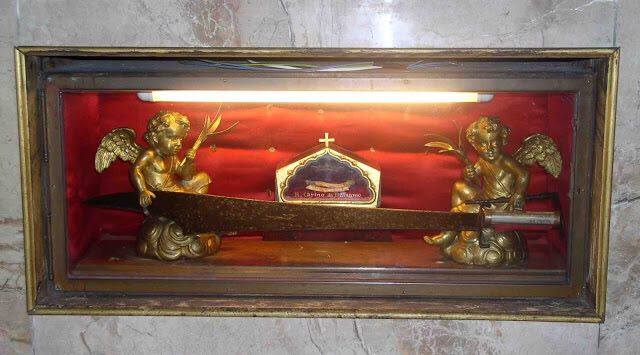
In 1879, before the Dominican house of Forlì was confiscated by the Italian state, the relics of Bl. Carino were moved to the cathedral. In 1934, at the behest of the Blessed Ildefonse Schuster, his head and part of his body were translated to the church of St Martin in Balsamo, his native town, to be followed by the rest of the relics thirty years later. The seminary of Seveso, close to where the actual martyrdom took place, retains one of the most particular relics in history, the weapon which he used to kill St Peter.

user posted image
The knife which Carino used to kill St Peter the Martyr
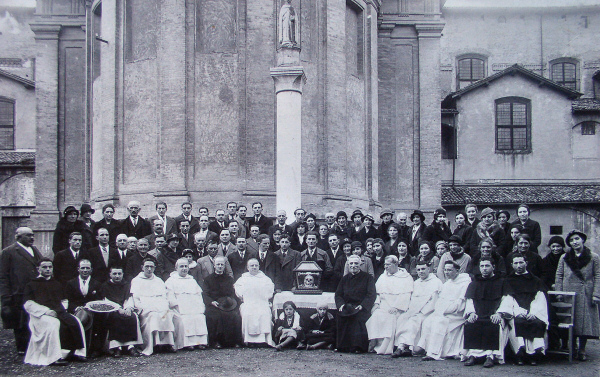
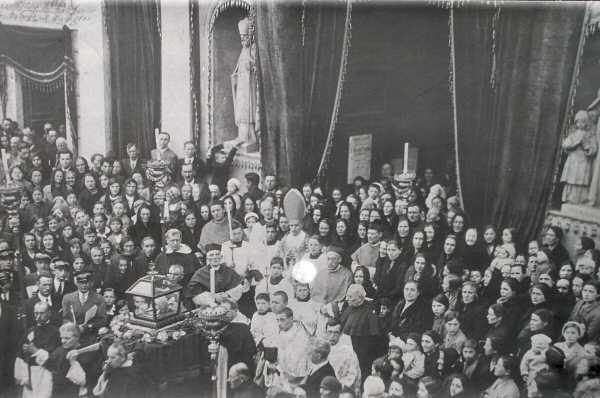
From Italian Wikipedia, two images of the translation of Carino’s relics in 1934, before their transfer, and newly arrived at San Martino in Balsamo.

user posted image

user posted image


TSyeeck
post May 11 2017, 12:17 PM

Look at all my stars!!
*******
Senior Member
3,573 posts

Joined: Apr 2006


Consoling Thoughts on Suffering

user posted image

All men suffer. The poor suffer because they lack the necessities of life. The rich suffer because of the “cares of the world, and the deceitfulness of riches” (Mark 4:19), which provoke thousands of anxieties. The young suffer because they don’t have the freedoms they wish to enjoy, or because they lack the intelligence to enjoy them well, while the old suffer because they have aches, pains, resentments, regrets, and ingratitude from the young.

Suffering is the universal lot of man. This truth has been said so many times and in such a variety of ways that its profundity and veracity risk being lost in a platitude.

What follows in a series of bulleted quotes are some thoughts that are in no way platitudes, because they come to us from God.

- “For the Spirit himself giveth testimony to our spirit, that we are the sons of God. And if sons, heirs also; heirs indeed of God, and joint heirs with Christ: yet so, if we suffer with him, that we may be also glorified with him. For I reckon that the sufferings of this time are not worthy to be compared with the glory to come, that shall be revealed in us.” — Romans 8:16-18
- “Amen, amen I say to you, unless the grain of wheat falling into the ground die, Itself remaineth alone. But if it die, it bringeth forth much fruit. ” — John 12:24-25
- “And we will not have you ignorant, brethren, concerning them that are asleep, that you be not sorrowful, even as others who have no hope.” — I Thessalonians 4:12
- “Persevere under discipline. God dealeth with you as with his sons; for what son is there, whom the father doth not correct? But if you be without chastisement, whereof all are made partakers, then are you bastards, and not sons.” — Hebrews 12:7-8
- “Now all chastisement for the present indeed seemeth not to bring with it joy, but sorrow: but afterwards it will yield, to them that are exercised by it, the most peaceable fruit of justice.” — Hebrews 12:11 (and the entire chapter!)
- “And who is he that can hurt you, if you be zealous of good? But if also you suffer any thing for justice’ sake, blessed are ye. And be not afraid of their fear, and be not troubled. But sanctify the Lord Christ in your hearts, being ready always to satisfy every one that asketh you a reason of that hope which is in you.” — I Peter 3:13-15
- “But if doing well you suffer patiently; this is thankworthy before God. For unto this are you called: because Christ also suffered for us, leaving you an example that you should follow his steps.” — I Peter 2:20-21
- “And he said to me: My grace is sufficient for thee; for power is made perfect in infirmity. Gladly therefore will I glory in my infirmities, that the power of Christ may dwell in me.” — 2 Corinthians 12:9
- “But if you partake of the sufferings of Christ, rejoice that when his glory shall be revealed, you may also be glad with exceeding joy.” — 1 Peter 4:13
- “But the God of all grace, who hath called us into his eternal glory in Christ Jesus, after you have suffered a little, will himself perfect you, and confirm you, and establish you.” — 1 Peter 5:10
- “I am the true vine; and my Father is the husbandman. Every branch in me, that beareth not fruit, he will take away: and every one that beareth fruit, he will purge it, that it may bring forth more fruit. — John 15:1-2
“Who now rejoice in my sufferings for you, and fill up those things that are wanting of the sufferings of Christ, in my flesh, for his body, which is the church.” — Colossians 1:24
- “Can a woman forget her infant, so as not to have pity on the son of her womb? and if she should forget, yet will not I forget thee.” — Isaias 49:15
- “My brethren, count it all joy, when you shall fall into divers temptations; Knowing that the trying of your faith worketh patience. And patience hath a perfect work; that you may be perfect and entire, failing in nothing.” — James 1:2-4
- “And God shall wipe away all tears from their eyes: and death shall be no more, nor mourning, nor crying, nor sorrow shall be any more, for the former things are passed away.” — Apocalypse 21:4

The Buddhists know of suffering. The Vedas, the Upanishads, and other sacred texts of the Orient speak of suffering. But, for all its faux Asiatic profundity, none of this esoteric pantheism can actually make sense of suffering. Suffering only makes sense in the light of the Cross. And it is there that it must be contemplated, as we with Mary behold Truth Incarnate, who suffered for us: “Looking on Jesus, the author and finisher of faith, who having joy set before him, endured the cross, despising the shame, and now sitteth on the right hand of the throne of God” (Hebrews 12:2).

In our highly commercial culture, advertisers work to profit from suffering, even as they augment it. They hold up to you your sadness, suffering, anxieties, and cares, and then promise you a product that will make you happy, painless, placid, and carefree, just like the actors in their commercials, whose real lives may well be more empty than your own. In the midst of your self-perceived inferiority to these happy denizens of a Capitalist Paradise, you are directed to find true joys only a click or a toll free number away. This is standard fare in the marketing world.

Consider this: If the guys on Madison Avenue know that this works (and it does!) — if, that is, they know how vulnerable the self-pitying sufferer is to their crass and profiteering commercial manipulations — then do not those far more intelligent beings, the fallen pure spirits we call demons, know at least as much?

Yes, we are vulnerable when we suffer. Perhaps this is what Saint James had in mind when he offered that simple advice, “Is any of you sad? Let him pray” (James 5:13). The childlike but generous abandonment of self to God at such moments — through Mary’s Immaculate Heart — can be very fruitful for the soul. If we become gloomy or morose, we become more vulnerable:

When Satan fails to make us bad,
He is most content to keep us sad;
For a heavy heart cannot contain
Buoyant thoughts from the high domain,
And must perforce gravitate
To matters of a lower state.


Our Lord admonishes us to “become as little children” (Matthew 18:3), who have confidence and trust in their parents. A similar confidence and trust, the result of supernatural faith, hope, and charity, is what God wants of us amid our suffering — and He is ready to give it to us if we ask for it.

In the Immaculate Heart of Mary,
Brother André Marie, M.I.C.M.
TSyeeck
post May 12 2017, 03:43 PM

Look at all my stars!!
*******
Senior Member
3,573 posts

Joined: Apr 2006


user posted image

user posted image
TSyeeck
post May 14 2017, 10:20 PM

Look at all my stars!!
*******
Senior Member
3,573 posts

Joined: Apr 2006


Fatima and the Atheists

https://cruxnow.com/commentary/2017/05/08/f...d-the-atheists/
TSyeeck
post May 14 2017, 11:55 PM

Look at all my stars!!
*******
Senior Member
3,573 posts

Joined: Apr 2006


I guess you didn't read the article because the video you posted debunked nothing about that.
TSyeeck
post May 15 2017, 04:53 PM

Look at all my stars!!
*******
Senior Member
3,573 posts

Joined: Apr 2006


QUOTE(Hoka Nobasho @ May 15 2017, 02:15 AM)
On the contrary, I have read the article, pointed out the logical fallacies, and the video shown was to show how miracles, in general, are never good arguments to prove anything in regards to the existence of god nor anything that resembles the notion of divine providence or intervention.

And since that article was about atheists, would you like to bring your thoughts into the LYN Atheist and Agnostics thread? I would rather show some respect to this thread as I understand it isn't specifically a place for debates held for theists and atheists alike.
*
On the contrary, I still think that you haven't read the article because you claimed "It's an old miracle that has been long debunked", yet what you posted above did not address Fatima specifically at all.

This post has been edited by yeeck: May 15 2017, 04:54 PM
TSyeeck
post May 22 2017, 10:31 AM

Look at all my stars!!
*******
Senior Member
3,573 posts

Joined: Apr 2006


QUOTE(Hoka Nobasho @ May 15 2017, 05:17 PM)
That's only because you may have conveniently glanced past the logical fallacies that I have pointed out and my explanation of why the video was posted in the first place. I did not put them in detail because I understand this thread isn't meant for debates.

Would you like to repost that in the LYN Ahtheist & Agnostics thread so that a debate can commence over there instead of over here? I will address the article directly with details if you wish, but like I said, not in this thread. This is a thread of fellowship among Catholics, no? So let's not turn it into another platform for a debate, lest I'll forget my manners and ended up interrupting the peace here.
*
So it's less of a fallacy to believe that a guy had a few days bad hangover after being scourged, crucified, pierced, wrapped with grave shroud, and went missing (supposedly stolen by his followers) even though the tomb was guarded by Roman soldiers. Great, just great.

This post has been edited by yeeck: May 22 2017, 04:51 PM
TSyeeck
post May 22 2017, 02:45 PM

Look at all my stars!!
*******
Senior Member
3,573 posts

Joined: Apr 2006


When you feel discouraged, read one of these stories; you will be amazed by the way Jesus touches a soul. Often the spiritual journey is not on a simple and
straight road, but eventually, to a person who genuinely seeks the Will of God, all roads lead to Rome, and to the solid faith of Peter.

Here below are some excerpts of conversion stories you
find in this website: http://whyimcatholic.com/

Evangelical Convert: Adam Crawford
“I have come to the conviction that it was indeed Christ
who founded His Church - not Luther, or Calvin, or
Zwingli, or the King of England, or John and Charles
Wesley, or Joseph Smith, or Chuck Smith, or anyone
else since that time. I have decided to trust in the plain
words of Christ preserved in the Scriptures for us. I
have, as a matter of fact, decided that
when He guaranteed His Church that He would be with
her always – even to the very end of the age; and that
when He promised her that He would preserve her
against the very gates of Hell - He meant it. I have
decided that if I am to be His disciple then I should
begin with obedience, and in obedience, belong to the
Church that He established. And finally, I have decided
that Christ is not into polygamy – He desires only one
bride.

I will leave you with the words of G.K. Chesterton who
wrote, ‘It is impossible to be just to the Catholic
Church. The moment a man ceases to pull against it
he feels a tug towards it. The moment he ceases to
shout it down he begins to listen to it with pleasure.
The moment he tries to be fair to it he begins to be
fond of it. But when that affection has passed a
certain point it begins to take on the tragic and
menacing grandeur of a great love affair’.”

Methodist Convert: Elliott Suttle
“I truly wanted to know God and his ways, so I began
watching and listening to EWTN. As I listened,
watched, and read, my heart began to be opened to the
truths that the Catholic Church professes. It took a long
time, possibly a year or more, but eventually a thought
occurred to me one day: “Why would you profess a
faith and not believe everything it teaches? That makes
no sense whatsoever.” I knew I was being given another
choice and this time I chose God. I resolved at that point
to believe all that the Church taught, without exception,
and live my life according to those principles. I won't lie
and say that made things easier, but it seemed then (as it
does now) that the choice was either to believe it all or
return to my Methodist roots.”

Agnostic Convert: Whitney Belprez
“There’s a saying that reality is stranger than fiction,
and I believe this is always true when we walk through
our life with the Lord. In my personal journey, there are
two lessons He is continually teaching me through His
Church: trust and obey. Always. Because He is God and
I am not. I have given up asking for what I want
because I know it’s a useless endeavour with Him.
Instead, I only ask for the strength to do His Will,
whatever that may be. And I am so much happier for it
– He offers us true happiness and true freedom if we
only listen to the wisdom of His Church. Following the
Way of the Cross is not easy, comfortable, or always
pleasant, but the Eternal Creator always knows what is
best for us - radical love, trust, and obedience to the
Living God that is Love.”

Episcopal Convert: David Ozab
Reporting his experience on visiting an Adoration
chapel after his decision of taking instructions to
become a Catholic:
“The consecrated host – nestled in a golden sunburst at
the heart of a large glass cross – sat atop an altar, and
several people knelt in quiet prayer. I knelt as well and
made the sign of the cross. As I did, I felt a wave of
electricity course through me, and at last I recognized
the voice I'd been hearing all along.
I found my love, my faith, and my church. God saved
me through beautiful whispers.”

TSyeeck
post May 22 2017, 09:25 PM

Look at all my stars!!
*******
Senior Member
3,573 posts

Joined: Apr 2006


TSyeeck
post May 22 2017, 10:37 PM

Look at all my stars!!
*******
Senior Member
3,573 posts

Joined: Apr 2006


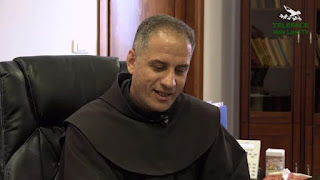
"The Jihadist Couldn't Behead Me and Asked: 'Who Are You?'" -- The Witness of Abuna Nirwan

user posted image

(Jerusalem) Abuna Nirwan is a Franciscan from Iraq. Before his ordination he had completed a medical examination. When he went to the Holy Land in 2004, the Dominican Women of the Rosary gave him a relic and a rosary from their founder, which Father Nirwan always carries with him.
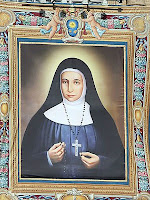
Maria Alfonsina Ghattas and the Dominican Women of the Rosary

user posted image

Maria Alfonsina Ghattas

The Dominican Women of the Rosary, a missionary order, were founded by Maria Alfonsina Danil Ghattas, a Palestinian Catholic who was born in 1843 in Jerusalem, which was still part of the Ottoman Empire. At a young age, she joined a French religious order, but in 1880, according to a vision, she founded her own order for Arab girls.The missionary community, now spread in eight countries of the Middle East, is the only order founded by the Latin Patriarchy, which was reestablished in 1847 in Jerusalem.
In 2009 Maria Alfonsina Danil Ghattas was beatified in Nazareth's preaching base. On May 17, 2015, she was canonized by Pope Francis. Her liturgical commemoration day is the 25th of March, when she died in 1927 in A Karim near Jerusalem (then the British League of Nations Mandate for Palestine).
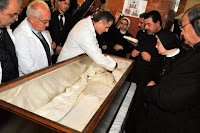
When Benedict XVI in 2009, had ordered the investigation for a miracle for the Beatification of the religious, as usual, he ordered the Exhumation of the Corpse. The local bishop instructs a doctor. With the exhumation of the body of Maria Alfonsina Danil Ghattas, Father Nirwan was commissioned because of his training, and he also wrote the medical report.

user posted image
Father Nirwan (center) as head of exhumation

As the Spanish Opus Dei priest Santiago Quemada, who lived in Jerusalem, reported on his blog Un sacerdote en Tierra Santa (A Priest in the Holy Land), two years before, extraordinary events had taken place. The report by Quemada has now been taken up by various media.
What was reported occurred on July 14, 2007. Abuna Nirwan, who had been working in the Holy Land for three years, paid a visit to his family in Iraq. In Jordan, he got in a taxi, as he explained it in spring 2016 in the sermon in the almost completely Christian Palestinian town of Beit Jalla near Bethlehem.
"It was not then possible to visit my family by plane. That was forbidden. As a means of transport, therefore, only the car could be considered. My intention was to get to Baghdad and from there to Mosul where my parents lived.

The driver was frightened because of the situation that prevailed in Iraq. A family - father and mother with a two-year-old girl - had asked if they could go with me. The taxi driver told me they had asked him to. I had no objection. They were Muslims. The driver was a Christian. He told them that there was room and they could come along. We stopped at a gas station, where another young Muslim asked if he could go to Mossul. Since there was still room, we also took him.
The border between Jordan and Iraq was closed until the morning. As the sun rose, the roadblock opened and the 50 or 60 vehicles were slowly moving in succession.
We continued our journey. After more than an hour we came to a checkpoint. We made our passports ready and stopped. The driver said, 'I am afraid of this group'. It was a military control post. However, as it turned out, an Islamic terrorist organization had killed the soldiers and taken control of the position.
When we were at the checkpoint, our passports were checked while we stayed in the car. Then they left with the passports. A person came back and said to me: 'Father, we need to continue to review. You can come to the office.' "Well," I said, "if we are to come, we'll come." We then walked a quarter of an hour, until we came to a barrack, which had been directed to us.
Once there, two men with hooded faces came out. One had a video camera in one hand and a knife in the other. The other held a Koran in his hand. They came to us, and one of them asked me, 'Father, where are you from?' I said, from Jordan. Then he repeated the question to the driver. Finally, he turned to the young man who traveled with us, grabbed him from behind and killed him with a knife. We were frozen. They tied my hands behind me and said to me, 'Father, we are recording everything for Al Jazeera . Do you want to say something? But no more than a minute.' I said, "No, I just want to pray." They let me pray for a minute.
Then a man pushed me down to my knees and said, 'You are a priest. It is forbidden for your blood to fall to the ground, that would be a sacrilege.' He fetched a bucket and came to cut my throat. I no longer know what prayers I prayed at this moment. I was very afraid. Then I said to Maria Alfonsina: 'If it is so, that the Lord takes me away, I am ready. But if that is not so, I ask you that no one else will die."
The man grabbed my head and guided his knife with the other hand. Then nothing happened. After a moment of silence, he said, 'Who are you?' I replied, 'A religious brother.' Then he said, 'Why can I not manage to set the knife? Who are you?'
Without answering, he left me and said, 'Father, you and all the others, return to the car.'
We did that and were able to continue the journey.
Since that moment, I have ceased to be afraid of death. I know I will die one day, but now I am really aware that this will be when God wants it. Since then, I am no longer afraid of anything and nobody. What happens to me will be done according to God's will. He will give me the strength to take His cross. What counts is faith. God accepts those who believe in Him."
TSyeeck
post Jun 19 2017, 02:35 PM

Look at all my stars!!
*******
Senior Member
3,573 posts

Joined: Apr 2006


Moving on to V2: https://forum.lowyat.net/topic/4298650

55 Pages « < 53 54 55Top
Topic ClosedOptions
 

Change to:
| Lo-Fi Version
0.1381sec    0.70    7 queries    GZIP Disabled
Time is now: 1st December 2025 - 03:03 PM