

 Jan 28 2015, 07:05 PM


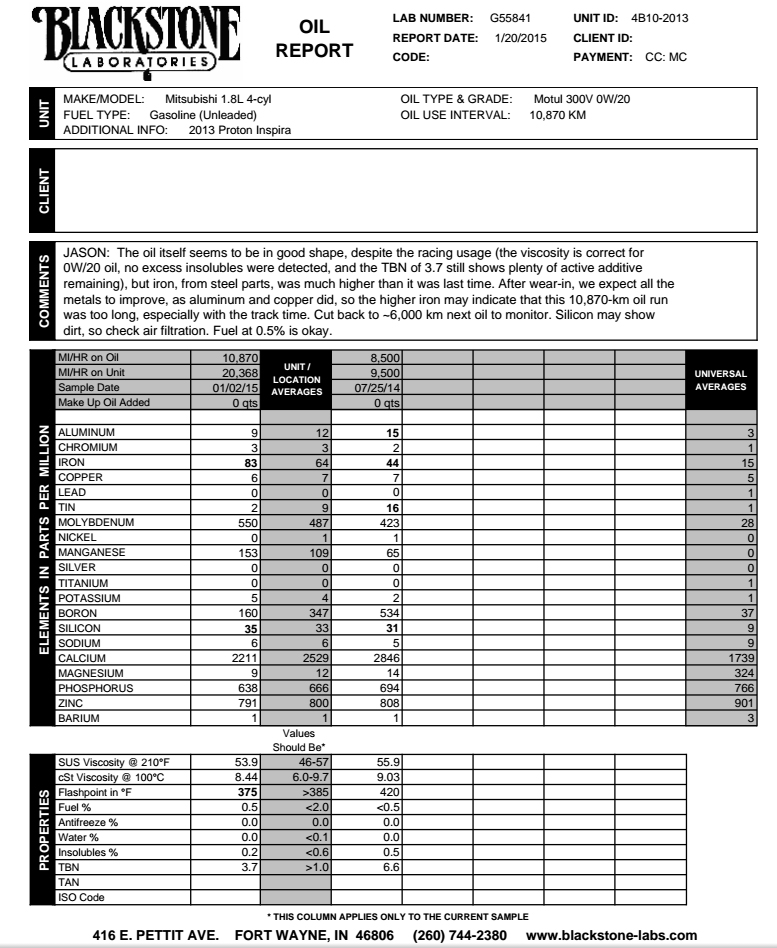
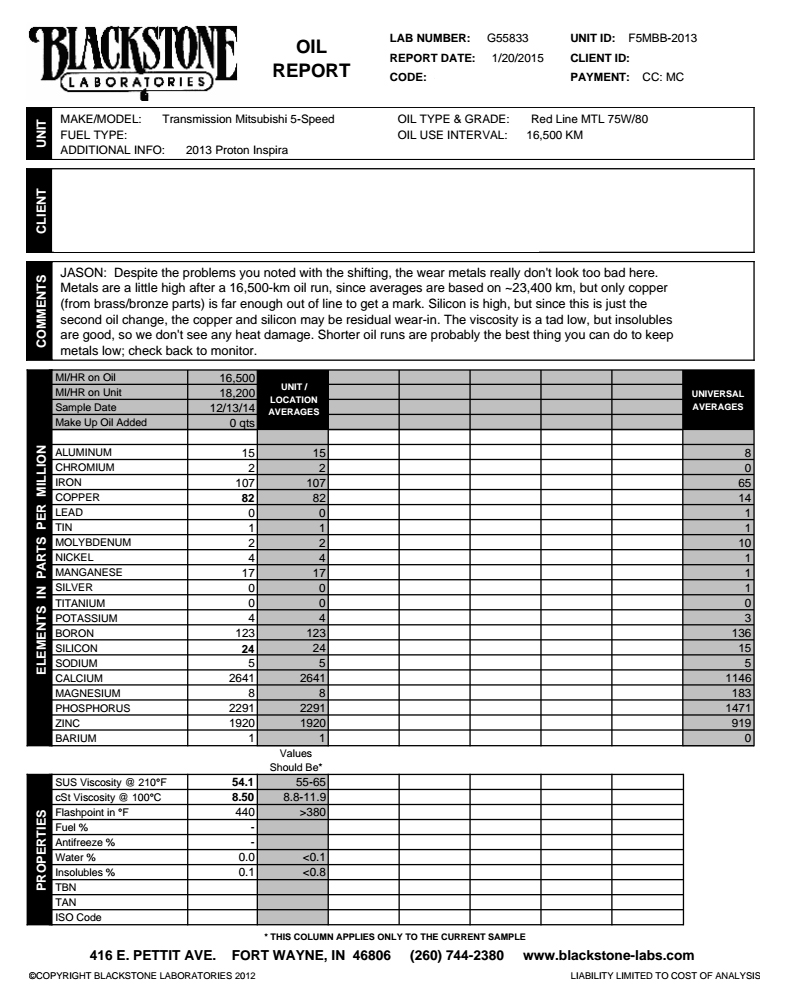
https://plus.google.com/u/0/+JasonLimQuazac...sts/bhQZhvzXheC Latest blackstone labs UOA report on my 4B10 engine/F5MBB 5 speed manual transmission

direct image link:
» Click to show Spoiler - click again to hide... «
engine
Transmission
prev youtube:
Transmission
prev youtube:
some Q&A from me to blackstone
» Click to show Spoiler - click again to hide... «
Gear oil/F5MBB Transmission:
Q: It seems that the viscosity is way off the mark and the high heat for prolonged period is most likely the cause of it. It's a relief that there are no permanent heat damage as per your comments, however it is still surprising to discover that the oil is no longer able to maintain its viscosity after heating it for too long twice. (as mentioned on the slip/email)
It was definitely a concern considering the hard shifts, which still persisted intermittently especially after aggressive driving/stuck in long traffic jams/hot weather and i am thankful that i have made the right decision to change the gear oil prior to my track days which could have caused a lot of damage had i stuck with the same oil.
As for the high metals, could it be due to my mis-shifts/gear (which i suppose synchronizers would be more appropriate/accurate) grinds be the cause of it? I've had a lot of mis-shifts/grinds as I've been driving the car very aggressively, track days aside.
http://youtu.be/dDdc3Emc2JI?t=22m0s
Would that be the main cause for the high metal wears?
A: I guess to your first point about the viscosity reading for the Red Line MTL, we don't really think the reading you got in this sample is too far out of line. The values that are referenced on most oils' MSDS or product data sheets are usually for virgin oil, and those tests are conducted under laboratory conditions. Then they report the median value as the "expected" viscosity of the fluid.
Once the oil is out of the bottle and sees use in the transmission, though, it's a whole different story. We expect an oil of a certain type to fall somewhere within a given range (in this case, between 8.8 and 11.9 cSt, when the data sheet reported 10.4 as the "typical" reading). Your reading was 8.5 cSt, which is just slightly below what we consider normal, but not at all what we'd call "way off the mark." That doesn't mean you were wrong to change it before your track days, of course -- fresh oil never hurts -- but we have a hard time saying there was a problem with the oil we tested, from a physical standpoint.
In addition, high heat usually tends to cause a multi-viscosity oil to "thicken up," so if there was heat damage to the oil, we'd expect a higher-than-normal viscosity reading (along with high insolubles and other issues), rather than a slightly low viscosity reading. That may just be normal use on the oil given how you've been driving this vehicle.
We do think the hard use could have contributed to the high wear, especially with the grinding you mentioned, but we doubt that any of these metals are high enough to call a problem level. Not all transmissions (or engines) can wear exactly like averages, and we'll have to see how trends develop over time to know if these slightly higher-than-average readings are just normal for your transmission and the use it sees.
Engine Oil/Mitsubishi 4B10:
Q: From the viscosity and flash point comparison, looks like my engine oil has thickened somewhat, in addition to having a lower flash point?
Any particular concerns on the flash point?
While this time around i have not used any engine oil additives unlike the previous sample, i have used fuel additives instead and are they the main cause for the viscosity/flash point changes, as well as possibly higher amount of Manganese as shown on the reports.
Would the higher silicon be of any concern?
I am using K&N drop in filters and i wonder if their filtration is inadequate?
What is the worse case scenario if your air filter is not providing sufficient filtration?
Would you suggest to continue oiling the filters or leave them un-oiled?
I have also previously used a neodymium magnet strapped on my oil filter, and it seems like it did not help and iron ppm has increased instead

Supposedly if the engine oil is still fine, a shorter interval would help on wear? What is the reasoning on that? Is it due to having higher amount of remaining additives which would help in reducing wear?
A: As to the engine oil, again, there's going to be a difference between the specs listed for virgin oil from the Product Data sheet, and measured readings from a real-world sample after it's seen use in an engine. The product data sheet lists a viscosity of 8.0 cSt, and our measured result was 8.44 cSt -- that's about as close a reading as you could hope for in a used oil. We consider anything between 6.0 and 9.7 cSt to be a good reading for 0W/20 oil.
Likewise, the flashpoint of used oil is always lower than the flashpoint of a virgin sample, which is what they're reporting on the product data sheet. Your flashpoint was a little lower than our "should be" value of 385°F, but only enough to show about 0.5% fuel dilution. That's not a harmful amount, and is probably just due to the type of usage your engine saw.
It's possible that an additive could cause a change in viscosity or flashpoint readings, but we doubt that's the case here if none was used during this sample interval. It's much more likely that the viscosity reading is just normal for this type of oil, and the flashpoint is due to a harmless amount of fuel.
Silicon is a concern if it's from dirt. If there's abrasive dirt getting into the engine due to poor air filtration, it can cause increased wear at any of the engines internal parts -- pistons/rings/cylinders, valves, bearings, etc. -- and increased wear, if left unchecked, could lead to those parts failing. However, there could also be other sources for this level of silicon, such as certain additives, lubricants, or sealers, so as long as the air filter appears clean and you don't detect any leaks or cracks in the hoses downstream of the filter, we're not certain that this is harmful. High silicon is perfectly normal in the first oil change, due to wear-in from sealers used during the engine's assembly, and the only reason we were even slightly concerned about your reading here is that silicon went up instead of down. Continue to use the K&N filter according to their specifications as far as when you should oil it, and we'll see if silicon improves next time around.
The magnet will pick up large pieces of iron ("large" meaning "visible to the naked eye"), but the iron that we measure in our tests is made up of microscopic particles suspended in the oil itself. Often, that won't be affected too much by a magnet (our tests have shown only slight differences of 1-2 ppm of iron when using a magnet vs. not using a magnet). The higher iron in this sample may be due to the usage the engine saw, or it could show wear at a steel part, either due to a mechanical problem, or due to abrasive dirt contamination. Again, we'll know more as trends develop.
The recommendation for the shorter oil run won't necessarily reduce the wear-rate of iron (how much metal is being produced per-km), but it will keep the metal from building up to a point that it would make the oil itself abrasive. If too much metal builds up in the fluid, those small particles of metal will cause even more wear at the parts they come in contact with, making wear even worse. Plus, if the iron is from a problem and if it's getting worse, the sooner we see the next sample, the sooner we'll know for sure.
 Quote
Quote


 macam so dangerous


 0.0503sec
 0.72
0.72
 7 queries
 GZIP Disabled