

 Nov 30 2016, 03:36 AM


QUOTE(JuneResources @ Nov 29 2016, 09:50 AM)
» Click to show Spoiler - click again to hide... «
Eventually this parabolic satellite dishes is extremely expensive (first time installation cost and equipment) and need to maintenance within 1 year or max 2 years. Especially for electric motor rotate 180 degree with parabolic satellite dishes.

[attachmentid=8158997]
Last time I experience need climb to the roof to put some grease oil (purpose for lubricate) yearly between the rotation motor with whole big satellite during switch channels from AsiaSat3S location to ST1 (Mostly taiwan channels). However, it is extremely high pressure and heavy to rotate from ST1 back to AsiaSat3S position. Sometimes, it experience of Position Frequency slightly shifted and need to climb to the roof to settle for this problem...

[attachmentid=8158998]
The red circle this "batang" is help to rotate whole satellite from east to west (something like that..
 ). But this "batang" rosak, your DisEqc motor the first picture tak boleh pakai already.
Previously under C Band, there are a lot of free channels (mostly are China channels and Indonesia channels, but less in Taiwan channels). Some Taiwan channels "Free view channels" on peak-season only (eg during Chinese New Year..) Exactly Astro copy this strategic from Taiwan payTV "Zhong Hua Dian Xin". However due to more and more payTV subscriber prefer to use Ku Band (Due to easily maintenance, not need Diseqc motor required), mostly all the channels moved to Ku Band.. Causing C band less and less channels already..

The most troublesome is regarding the frequency of channels. Some of the channels (especially taiwan channels) extremely trouble one. Need to manually deep to the website to change frequency/ TP numbering (don't know how to call that) in order to watch channels. Imagine there are 100 channels need to change frequency, I think you fainted already.. Press by using remote control until you feel tired..
In simple, only professional and technical can use this parabolic satellite dishes. Else, it will cause the decorder and Diseqc unable link and cause program channels messed up...

QUOTE(dannielshazmeer @ Nov 29 2016, 12:47 PM)
so better stick to KU band ..
QUOTE(nexona88 @ Nov 29 2016, 02:14 PM)
wah didn't know C band dish needs so many maintenance & adjustments done..
for sure, I cannot one because me not professional on this kind of stuff. kinda noobie
so I better stick to KU band..
As for JuneResources's case, it is completely different. Guys, please don't confuse with his encounter with C band satellite TV case as he uses universal satellite decoder to receive satellite TV channels, not a pay TV decoder. Okay since he mentioned this, I got to change subject into satellite TV topic.for sure, I cannot one because me not professional on this kind of stuff. kinda noobie
so I better stick to KU band..
Universal satellite decoder is where the decoder's job is pretty much "everything customize and manual" by yourself. (Take DVD player as an easy to understand example, where you put your own DVD disc to play your movie). What channels/satellites you want to watch/receive, it is all up to you to decide. Because it is customized by yourself, and if you messed up with the channels list, signal parameters and other satellite related settings, you may lose satellite signal, not because of faulty, it is because the user do not know to configure the settings correctly. If you want to scan for channels, you have to manually perform Auto Scan by yourself. Or, if you are so unfortunate that your satellite decoder (usually is older, cheap and low quality ones) doesn't support Auto Scan, then you will have to manually enter the signal parameters such as frequency, symbol rate, polarization, all by yourself, especially when the TV channel change frequency into another frequency or launch new channels. If you are not a tech savvy, and you are still using that decoder, I advice you to upgrade into newer ones that support HD and other new features. Universal satellite decoder is not a pay TV decoder like Astro, where the decoder software already "locked" that it only receive channels from the pay TV provider only and you can't receive channels from other satellites as you wish. Pay TV decoders will automatically update whatever settings, new channels and other stuff that you don't care about, unlike universal satellite decoder is the opposite and manual.
Plus, he is using satellite dish with motorize system, where there is a motor install at the satellite dish to be able to change satellite dish position whenever the user switches channels from different satellite than the current satellite position. With this, you can receive multiple satellite signals with different positions by using only 1 satellite dish, no need to install 2 separate satellite dishes that facing west and east respectively (for example). In his installation as what he described, he used to receive Asiasat 3S (located at 105 E, this satellite has retired, now replaced with Asiasat 7) and ST1 (located at 88 E, this satellite has retired, now replaced with ST2 satellite). Motorized satellite dish is completely optional (not compulsory) and it is up to you to use that equipment so that you can watch more TV channels from multiple satellites. And, Diseqc is also required to "combine" the signals from multiple satellites output from the LNB into one satellite input to the satellite decoder. As you described earlier, it seems that it is either the motor itself has been not moving for a long period of time, or the motor components inside is rusty or faulty or other problems. Because in general, motorize system do not require maintenance after you configure it correctly.
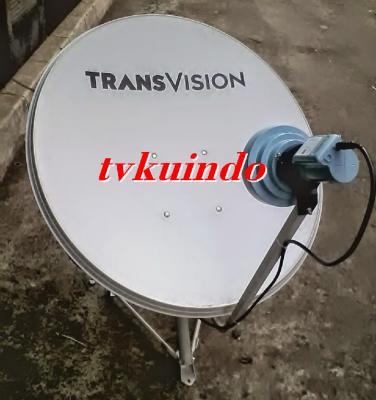
Parabolic satellite equipment indeed is more expensive in general compared to Ku band equipment. And whether do you need to fork out more money or do maintenance on your C band dish, all these depends on what equipment and it is up to your "creativity" on how you set up and install it. C band dish can be consumer-friendly like Astro Ku band dish, but at the same time it can be very challenging, complex, complicated, and requires time and skills for you to learn. If you use those universal satellite decoder, Diseqc, prime focus satellite dish (in simple words, the big ugly parabolic dishes that you saw the images above) and even motorized system like JuneResources did to receive signals from Asiasat 3S and ST1 during that time, of course it will be more challenging, unlike what I was referring my opinion my previous post about what if Astro uses C band for DTH service by using 90cm satellite dish with CSR just like what Transvision used to do. In addition to that, if you use cheap and low quality made in China equipment, then don't expect it will last for many years time, and no surprise that you may need regular maintenance to maintain the signal reception for that, or even equipment replacement. So choosing the right equipment with good quality is also important. Besides China, you can consider buying some parts of the equipment that is Thailand or Indonesia brand which is known to have better quality products than China ones.
Why C band channels are getting lesser nowadays compared to those days? Perhaps many viewers nowadays especially youngsters watches TV content via internet and watch less TV, this could be the reasons why channel provider are not so focused on C band to gain profit. However, C band TV will still be there for a long time as there are many other viewers still depends on TV as their main source of information and entertainment, and also many other technical advantages.
CONCLUSION (read this if above "essay" is too long for you to read):
Erm, is these stuff above is too complex for you to understand? That means installing C band for yourself to receive other satellite signals is not a DIY choice for you. Or, call an installer to install everything for you and you pay them the money and you will call installer when you got problem to settle for you. Otherwise, you better stick with pay TV service, either using Ku band (that has rain fade) or IPTV.
About my opinion that what if Astro interested to use C band to offer DTH service using other satellite, it will be different story compared to using universal satellite decoder as mentioned above. The possibility will be the upcoming Measat 2a satellite, located at 148 E and expected to be launch on end 2018. If Measat 2a satellite's C band beam is strong enough and can be receive by using 90cm offset dish with CSR exactly just like one of Indonesian pay TV, Transvision previously used to do, then it will be great as customers are not necessary to use big ugly parabolic dish to get the signal if the satellite power output is strong enough. Because of its smaller 90cm offset dish compared to parabolic dish, you don't need to bother about maintenance (unless the dish is not properly adjusted) just like Astro 65cm Ku band dish, and the cost will be way lesser compared to parabolic dish. If Astro use this method, customer may not need to fork out much money or perhaps just little higher than Ku band ones, for Astro C band DTH. And of course only Astro decoders can be used to receive the channels (not universal satellite decoder), so no need to think about manual channel updating, and whatsoever. Don't forget the main reason of using C band is you won't experience rain fade issue, as long you properly adjust the dish.
This one you can understand easily, right? Hope you can now understand and differentiate between the different uses of C band in satellite TV.
 Quote
Quote


 ). Eventually, their sales drop already and most of the customers switch to Unifi with Hypptv.







 0.0327sec
 0.23
0.23
 6 queries
 GZIP Disabled