Welcome Guest ( Log In | Register )

69 Pages < 1 2 3 4 5 > » Bottom

Outline · [ Standard ] · Linear+

 STPM 2014/2015

views
     
gky02
post Jul 2 2014, 06:03 PM

New Member
*
Newbie
3 posts

Joined: Jul 2014


Hi ! I m a new user n oso candidate of STPM 2014/2015 but I m taking arts stream(switched from sc stream).My pathway after stpm is planning to study law or economics( business tat part )"more interested".My subject combination are :
1.PP
2.PA
3.EKON
4.SEJ
Now I am in a dilemma of choosing either sej or acc as my stpm subject.My friends n skul counsellor suggest me to take account as they said more easy to handle..but sejarah is the entry requirement of LLB of UUM oni..(UM n UKM not require tat )Its the time to register subject of stpm recently..I sincerely hope someone cn give me some ideas..thank you vry much;) notworthy.gif
#my spm for sej n acc oso A+
limfreelance
post Jul 2 2014, 07:26 PM

Casual
***
Junior Member
343 posts

Joined: Jul 2011
From: Land of SaberLion :3
then,take both lo.
300thecat
post Jul 2 2014, 08:57 PM

Enthusiast
*****
Senior Member
790 posts

Joined: Mar 2012
You'd want Maths if you're serious about Economics. Swap out Business.
BlueMuffin
post Jul 2 2014, 11:23 PM

Getting Started
**
Junior Member
107 posts

Joined: Mar 2014
Just wanna refresh a bit. The cocu marks are only considered when there are two students applying for the same course in the same uni with the same CGPA is it?
Let's say graduates A and B have 3.50 CGPAs but A's cocu marks is 7/10 and B has 6/10. So A would be chosen for the course instead of B right?

Another thing is that do they choose a student with a 4.00 pointer with 6/10 cocu marks or another student with 3.84 but wtih 8/10 cocu marks?

Thanks a lot rclxms.gif I'm asking coz my school has only one club and I don't have any positions, so yeah i'm totally panicking cry.gif
Just Visiting By
post Jul 2 2014, 11:38 PM

Regular
******
Senior Member
1,846 posts

Joined: May 2013


QUOTE(BlueMuffin @ Jul 2 2014, 11:23 PM)
Just wanna refresh a bit. The cocu marks are only considered when there are two students applying for the same course in the same uni with the same CGPA is it?
Let's say graduates A and B have 3.50 CGPAs but A's cocu marks is 7/10 and B has 6/10. So A would be chosen for the course instead of B right?

Another thing is that do they choose a student with a 4.00 pointer with 6/10 cocu marks or another student with 3.84 but wtih 8/10 cocu marks?

Thanks a lot  rclxms.gif I'm asking coz my school has only one club and I don't have any positions, so yeah i'm totally panicking  cry.gif
*
Academic performance, your STPM pointer, contributes to 90% of total mark.

Ko-k contributes to the remaining 10%.

The final decision lies on how much your academic + ko-k pointer is, and how impressive is your ko-k achievements.


gky02
post Jul 3 2014, 03:05 PM

New Member
*
Newbie
3 posts

Joined: Jul 2014


QUOTE(limfreelance @ Jul 2 2014, 07:26 PM)
then,take both lo.
*
I m nt confident to do tat , sej take me much time n I scared I can't cover both~
gky02
post Jul 3 2014, 03:09 PM

New Member
*
Newbie
3 posts

Joined: Jul 2014


QUOTE(300thecat @ Jul 2 2014, 08:57 PM)
You'd want Maths if you're serious about Economics. Swap out Business.
*
Economics as an option ..but my skul nt providing math for arts stream student n math nt a must for economics so I thk its okla~~

sagethesausage
post Jul 3 2014, 09:36 PM

On my way
****
Junior Member
657 posts

Joined: Mar 2014
QUOTE(BlueMuffin @ Jul 2 2014, 11:23 PM)
Just wanna refresh a bit. The cocu marks are only considered when there are two students applying for the same course in the same uni with the same CGPA is it?
Let's say graduates A and B have 3.50 CGPAs but A's cocu marks is 7/10 and B has 6/10. So A would be chosen for the course instead of B right?

Another thing is that do they choose a student with a 4.00 pointer with 6/10 cocu marks or another student with 3.84 but wtih 8/10 cocu marks?

Thanks a lot  rclxms.gif I'm asking coz my school has only one club and I don't have any positions, so yeah i'm totally panicking  cry.gif
*
To tell the truth, if the course you want is popular (medicine/pharma/dentistry/etc), 4-flat also cannot get in local uni, because they give priority to Matriks and Asasi students. My friend's brother got 4-flat last year, and when he go interview for medicine course in UM the interviewer tell him to prepare backup plan because they only allocate 2 out of 80 total intake slots for STPM students. So unfair. After hearing that I don't have anymore incentive to work hard, just ready myself to get into private uni.

This post has been edited by sagethesausage: Jul 3 2014, 09:36 PM
BlueMuffin
post Jul 10 2014, 09:58 PM

Getting Started
**
Junior Member
107 posts

Joined: Mar 2014
QUOTE(sagethesausage @ Jul 3 2014, 10:36 PM)
To tell the truth, if the course you want is popular (medicine/pharma/dentistry/etc), 4-flat also cannot get in local uni, because they give priority to Matriks and Asasi students. My friend's brother got 4-flat last year, and when he go interview for medicine course in UM the interviewer tell him to prepare backup plan because they only allocate 2 out of 80 total intake slots for STPM students. So unfair. After hearing that I don't have anymore incentive to work hard, just ready myself to get into private uni.
*
Yeah its quite saddening, but for someone who's not pursuing in any of those critical courses I'm not too worried about it. But for those who wants it, its a cruel reality sad.gif
BlueMuffin
post Jul 10 2014, 10:09 PM

Getting Started
**
Junior Member
107 posts

Joined: Mar 2014
Hey guys, I'm now confused in drawing Lewis structures specifically the NO3- ion. When I follow the procedure in drawing the structure I will get this. Attached Image But some of my friends they would get a dative bond between the N atom and one of the O atom like this Attached Image. So i wanna ask which one is the correct structure?

The procedure I used is:
1) Draw the skeleton of the molecule or ion
2) Count total valence electrons of the molecule or ion
3) Fill all the atoms according to them octet rule
4) Count FC and see if need more than 1 bond formed.
RED-HAIR-SHANKS
post Jul 24 2014, 02:30 PM

On my way
****
Senior Member
654 posts

Joined: Apr 2013
From: Planet Earth


I need some explanation and clarification regarding these questions.

Q1) Ali was wearing his spectacle while driving in his car. When he was about to make a turn towards a roundabout in his right direction, he felt that his spectacle was sliding towards the left. What causes the spectacle to slide in that manner?
The correct answer:
» Click to show Spoiler - click again to hide... «


Now, I've superficially learned a thing or two about centripetal force, but why centrifugal force is not the appropriate answer for the above question? Centripetal force is a force that moves a body the towards the centre of the circle, which is the opposite of the centrifugal force, where a force that draws a rotating body away from the center of rotation. And if we were to refer back to the question, it clearly stated that his spectacle was sliding towards the left when Ali was about to make a turn towards the roundabout, which is in his right. It makes a perfect sense to me but why the answer is not centrifugal force,but instead it is inertia? Where did I go wrong? icon_question.gif

Q2)Which force does the work on a satellite orbiting around the Earth?
The correct answer:
» Click to show Spoiler - click again to hide... «
.

Why the answer for Q2) cannot be centripetal force? I sense that there are some similarities between both of these forces that causes the satellite to orbit around the Earth in such manner.... hmm.gif

Q3)If we spin a circular disk with a circular cavity on the top of it, it is found that the disk flips over. But the question is why does this happen?

I've approached a few of my classmates, and they told me that the correct reason would be due to friction and air resistance. They said that if we were to take a coin and flip it in the same manner, the coin will rotate rapidly in a circular motion and it will come to a stop when the air drag interrupts it's kinetic energy(The coin will only spin perpetually if it is in vacuum). On a another case, it will also stop spinning due to the friction between the coin and the table. I'm pleased with the feedback that I got, but is that really the complete explanation for the given question?

This post has been edited by RED-HAIR-SHANKS: Jul 24 2014, 02:32 PM
IReallyNeed Answers
post Jul 24 2014, 06:27 PM

Krazeybender
*****
Senior Member
921 posts

Joined: Jan 2008
From: Cheras


I was a form sixer once,

we were considered as some of the hardest, and toughest assessment around.

and we all survive, to consistently proof to others non-form sixer of our better developed capability.

sadly, the new format for form 6 now is just utter bullshit.
maximR
post Jul 24 2014, 07:05 PM

Remember who you are
*******
Senior Member
3,864 posts

Joined: Dec 2009


QUOTE(RED-HAIR-SHANKS @ Jul 24 2014, 02:30 PM)
I need some explanation and clarification regarding these questions.

Q1) Ali was wearing his spectacle while driving in his car. When he was about to make a turn towards a roundabout in his right direction, he felt that his spectacle was sliding towards the left. What causes the spectacle to slide in that manner?
The correct answer:
» Click to show Spoiler - click again to hide... «


Now, I've superficially learned a thing or two about centripetal force, but why centrifugal force is not the appropriate answer for the above question? Centripetal force is a force that moves a body the towards the centre of the circle, which is the opposite of the centrifugal force, where a force that draws a rotating body away from the center of rotation. And if we were to refer back to the question, it clearly stated that his spectacle was sliding towards the left when Ali was about to make a turn towards the roundabout, which is in his right. It makes a perfect sense to me but why the answer is not centrifugal force,but instead it is inertia? Where did I go wrong? icon_question.gif

Q2)Which force does the work on a satellite orbiting around the Earth?
The correct answer:
» Click to show Spoiler - click again to hide... «
.

Why the answer for Q2) cannot be centripetal force? I sense that there are some similarities between both of these forces that causes the satellite to orbit around the Earth in such manner.... hmm.gif

Q3)If we spin a circular disk with a circular cavity on the top of it, it is found that the disk flips over. But the question is why does this happen?

I've approached a few of my classmates, and they told me that the correct reason would be due to friction and air resistance. They said that if we were to take a coin and flip it in the same manner, the coin will rotate rapidly in a circular motion and it will come to a stop when the air drag interrupts it's kinetic energy(The coin will only spin perpetually if it is in vacuum). On a another case, it will also stop spinning due to the friction between the coin and the table. I'm pleased with the feedback that I got, but is that really the complete explanation for the given question?
*
Q1) Centrifugal force is not a 'force'. Even if you believe in this fictional force, where does it come from? Forces are a result of interaction, either between bodies or a body with a field. No force can ever manifest itself out of nothing. Plus it's not even mentioned in STPM books.

Q2) Again, what is this centripetal force? Gravitational force, of course!

Q3) You're an STPM student now, you need to eliminate vague and inaccurate Physics terms when describing something. How does friction act? On what does air resistance act? How does air drag 'interrupt' kinetic energy? Can you model this situation using Physics? This problem is from Brilliant, and you'd have to ask more people to come up with a rigorous answer.

Critical_Fallacy
post Jul 25 2014, 04:02 AM

∫nnộvisεr
Group Icon
VIP
3,713 posts

Joined: Nov 2011
From: Torino
QUOTE(RED-HAIR-SHANKS @ Jul 24 2014, 02:30 PM)
Q1) Ali was wearing his spectacle while driving in his car. When he was about to make a turn towards a roundabout in his right direction, he felt that his spectacle was sliding towards the left. What causes the spectacle to slide in that manner?

The correct answer: Inertia. It's because the spectacle resisted the change in the direction of the car (towards going right) by sliding to the left.

Now, I've superficially learned a thing or two about centripetal force, but why centrifugal force is not the appropriate answer for the above question? ... And if we were to refer back to the question, it clearly stated that his spectacle was sliding towards the left when Ali was about to make a turn towards the roundabout, which is in his right. It makes a perfect sense to me but why the answer is not centrifugal force, but instead it is inertia? Where did I go wrong? icon_question.gif
Quite incorrect. The inertia does not cause Ali’s glasses suddenly slid toward the opposite direction (left) of car's heading direction (right), as if there was a hidden repulsive force. That's an ILLUSION! cool2.gif

While the car moves in the circular arc at the roundabout, it is in uniform circular motion; that is, it has an acceleration that is directed toward the center of the roundabout. By Newton’s 2nd law, a force must cause this acceleration. Moreover, the force must also be directed toward the center of the roundabout. Thus, it is a centripetal force, which means center-seeking force, where the adjective indicates the direction. The centripetal force, in this case, is provided by the friction between the road and the car’s tires.

Because Ali drove the car, naturally, we assume that he strapped the seat belt on his car’s seat that held him firmly in the seat. This assumption is critical or else, Ali will slide across the seat toward the left and then jam against the car wall for the rest of the turn. Since Ali was wearing his glasses when he turned right, rounding the roundabout, and if his glasses was to move in uniform circular motion along with the car, there must also be a centripetal force on his glasses.

However, apparently the frictional forces on Ali’s glasses from his nose-bridge and ears were not great enough to make his glasses go in a circle with the car. The dirt and oil on Ali’s face could have affected the frictional force. Thus, Ali’s “face” slid beneath his glasses, until he pushes it up with his forefinger so that the frames sit rightly on the top of his nose. Then, the push that Ali provided the needed centripetal force on the glasses allows his glasses to join the car’s uniform circular motion.

If Ali does not attempt to prevent his glass from sliding to his left as he turns right, however, there won’t be a centripetal force acting on his glasses, which would slide off in the direction that is tangent to the circle due to it inertia (according to Newton’s 1st law). This gives Ali the sensation of his glasses slid toward his left. In fact, to a stationary observer, Ali’s glasses are sliding off in a straight line until it jams up against the left wall of the car. The centripetal force from the car wall is required to push the glasses inward along the car’s uniform circular path. icon_idea.gif

user posted image

This post has been edited by Critical_Fallacy: Jul 25 2014, 04:51 AM

Critical_Fallacy
post Jul 25 2014, 04:19 AM

∫nnộvisεr
Group Icon
VIP
3,713 posts

Joined: Nov 2011
From: Torino
QUOTE(RED-HAIR-SHANKS @ Jul 24 2014, 02:30 PM)
Q2)Which force does the work on a satellite orbiting around the Earth?

The correct answer: Gravitational force.

Why the answer for Q2) cannot be centripetal force? I sense that there are some similarities between both of these forces that causes the satellite to orbit around the Earth in such manner.... hmm.gif
As stated by maximR, a centripetal force is NOT a new kind of force. The name merely indicates the direction of the force. It's an adjective!! Therefore, it can be a frictional force, a gravitational force, the force from a car wall, the tension force from a string, or any other force in this universe you could name it.

user posted image

Artificial satellites are continually accelerating towards the Earth. This is because of the gravitational force of attraction between the satellite and the Earth. If a satellite stopped moving forwards, the Earth’s gravitational pull would make it fall to Earth. icon_rolleyes.gif

This post has been edited by Critical_Fallacy: Jul 25 2014, 04:25 AM
300thecat
post Jul 25 2014, 06:24 AM

Enthusiast
*****
Senior Member
790 posts

Joined: Mar 2012
Walau, you posted all these at 4am in the morning haha. Salute!
maximR
post Jul 25 2014, 02:18 PM

Remember who you are
*******
Senior Member
3,864 posts

Joined: Dec 2009


QUOTE(Critical_Fallacy @ Jul 25 2014, 04:19 AM)
As stated by maximR, a centripetal force is NOT a new kind of force. The name merely indicates the direction of the force. It's an adjective!! Therefore, it can be a frictional force, a gravitational force, the force from a car wall, the tension force from a string, or any other force in this universe you could name it.

user posted image

Artificial satellites are continually accelerating towards the Earth. This is because of the gravitational force of attraction between the satellite and the Earth. If a satellite stopped moving forwards, the Earth’s gravitational pull would make it fall to Earth. icon_rolleyes.gif
*
How are you? icon_rolleyes.gif
Critical_Fallacy
post Jul 25 2014, 03:04 PM

∫nnộvisεr
Group Icon
VIP
3,713 posts

Joined: Nov 2011
From: Torino
QUOTE(maximR @ Jul 25 2014, 02:18 PM)
How are you?  icon_rolleyes.gif
I'm “busy-body” as usual. laugh.gif

Recently I'm expanding my collection of books. A peculiar bibliophile, huh?. blush.gif

I noticed that your Physics of Motion is now at a whole new level after entering Sunway.

You were talking about “modeling”, a process that most scientists and engineers employ to represent and study a particular real-world system or phenomenon, when many Pre-U students are probably still struggling to understand its concept.

Keep up the good work! wink.gif
RED-HAIR-SHANKS
post Jul 25 2014, 03:23 PM

On my way
****
Senior Member
654 posts

Joined: Apr 2013
From: Planet Earth


QUOTE(Critical_Fallacy @ Jul 25 2014, 04:02 AM)
If Ali does not attempt to prevent his glass from sliding to his left as he turns right, however, there won’t be a centripetal force acting on his glasses, which would slide off in the direction that is tangent to the circle due to it inertia (according to Newton’s 1st law). This gives Ali the sensation of his glasses slid toward his left. In fact, to a stationary observer, Ali’s glasses are sliding off in a straight line until it jams up against the left wall of the car.

user posted image
*
According to the above statement, you've mentioned that Ali's glasses would slide off in the direction that is tangent to the circle due to Newton's First Law if there won't be a centripetal force acting on it. But now I have another question that bugs me.

If we consider a ball that moves in a circle due to the tension(T) of the string, which in this case, is the centripetal force, why it is said that the Newton's Second Law would cause the ball to move tangentially to the circle if the string snaps? unsure.gif Why inertia isn't the cause for the ball to behave in that way, considering the fact that once the string snaps, there won't be any more resultant force that acts on the ball? unsure.gif
user posted image

This post has been edited by RED-HAIR-SHANKS: Jul 25 2014, 03:27 PM
Critical_Fallacy
post Jul 25 2014, 05:18 PM

∫nnộvisεr
Group Icon
VIP
3,713 posts

Joined: Nov 2011
From: Torino
QUOTE(RED-HAIR-SHANKS @ Jul 25 2014, 03:23 PM)
why it is said that the Newton's Second Law would cause the ball to move tangentially to the circle if the string snaps? unsure.gif 
hmm.gif I'm wondering, what do they tell you about centripetal force in your Physics textbook?

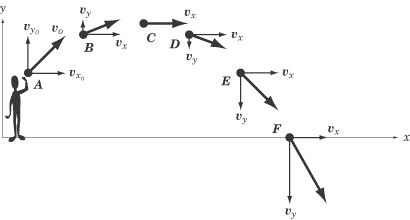
In reality, this is a Projectile motion. If you ignore air resistance and resolve the motion of the ball into vertical and horizontal components, you will see that the norm of the horizontal velocity vector stays the same, because the tension from the string is no longer acting on the ball (Newton's 1st Law). The varying vertical velocity vector shows the motion of the ball during its free fall and this is due to gravity acts on the ball (Newton's 2nd Law).

user posted image

69 Pages < 1 2 3 4 5 > » Top
 

Change to:
| Lo-Fi Version
0.0367sec    0.48    6 queries    GZIP Disabled
Time is now: 18th December 2025 - 09:52 PM