

http://i.imgur.com/0HHYJA1.jpg
STPM 2014/2015
STPM 2014/2015
|
|
 Aug 2 2014, 07:15 PM Aug 2 2014, 07:15 PM
|
 
Junior Member
657 posts Joined: Mar 2014 
|
|
|
|
|
|
|
Aug 2 2014, 07:18 PM
|
|
Junior Member
657 posts Joined: Mar 2014
|
Well that took longer than I expected. Was already typing half of the assignment when it suddenly uploaded the picture. Sorry for being slow
http://i.imgur.com/0HHYJA1.jpg This post has been edited by sagethesausage: Aug 2 2014, 10:42 PM |
|
|
Aug 2 2014, 10:40 PM
|

Senior Member
654 posts Joined: Apr 2013 From: Planet Earth 
|
QUOTE(sagethesausage @ Aug 2 2014, 11:46 AM) Anyone done their Maths T PBS assignment yet? Can give me a brief description on how to answer each question? My teacher don't want to teach about the assignment because have to catch up with syllabus. Not completely done yet.  In question 1(a), the  refers to the quinine in the body right after the nth dose, so, we assume that it's refers to the quinine in the body right after the nth dose, so, we assume that it's  . We have to find out the for when n=1,2,3,...,8. So,it's a finite series, you have to list down each of the quantity of quinine starting from . We have to find out the for when n=1,2,3,...,8. So,it's a finite series, you have to list down each of the quantity of quinine starting from  = = =50.0000,... to =50.0000,... to  . .The equation that I got from my friend is this: » Click to show Spoiler - click again to hide... « |
|
|
Aug 2 2014, 10:58 PM
|
|
Senior Member
654 posts Joined: Apr 2013 From: Planet Earth
|
QUOTE(sagethesausage @ Aug 2 2014, 07:18 PM) Well that took longer than I expected. Was already typing half of the assignment when it suddenly uploaded the picture. Sorry for being slow For the part for Introduction, Methodology, Results and Conclusion, you can refer to this sample of coursework. It's last year's coursework for third term, but I think you should be able to work your way through it after you have a look as the structure still holds the same for ours.http://i.imgur.com/0HHYJA1.jpg |
|
|
Aug 3 2014, 12:00 AM
|
|
Junior Member
657 posts Joined: Mar 2014
|
QUOTE(RED-HAIR-SHANKS @ Aug 2 2014, 10:58 PM) For the part for Introduction, Methodology, Results and Conclusion, you can refer to this sample of coursework. It's last year's coursework for third term, but I think you should be able to work your way through it after you have a look as the structure still holds the same for ours. Thank you! Your help is much appreciated.  I have something that I've always wanted to clarify, how many total assignments do we have for each subject? And how many do we need to do each term? Sorry if this makes me seem ignorant, I missed out on orientation due to PLKN and was too cowardly to ask my teachers and friends for fear of appearing stupid (I'll chg my behaviour and attitude on this I swear) This post has been edited by sagethesausage: Aug 3 2014, 12:05 AM |
|
|
Aug 3 2014, 01:35 AM
|
|
Senior Member
654 posts Joined: Apr 2013 From: Planet Earth
|
QUOTE(sagethesausage @ Aug 3 2014, 12:00 AM) Thank you! Your help is much appreciated. You shouldn't be thanking me actually, because my friend was the one who actually found out the equation for the quantity of the quinine. Anyway, he's out of reach currently, and that was why I couldn't meet him and get some clarification on how did he able to come up with that equation. I've tried numerous times myself, but I found out that the Qn that I came up with only holds to be true when n=2,3,... only, but it will lead to a wrong answer for the first term, and vice versa(one of the equation for Qn that I derived from the problem statement seems to be true for when the first term,a = 500.0000, but false when n > 1.) I have something that I've always wanted to clarify, how many total assignments do we have for each subject? And how many do we need to do each term? Sorry if this makes me seem ignorant, I missed out on orientation due to PLKN and was too cowardly to ask my teachers and friends for fear of appearing stupid (I'll chg my behaviour and attitude on this I swear) For example, when I use the equation 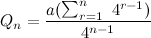 given by my friend to find the Qn for when a=50, n=1,2,3,4..., the result that I got is this: given by my friend to find the Qn for when a=50, n=1,2,3,4..., the result that I got is this:When: n=1,  n=2,  n=3,  n=4,  But, if I were to use my equation 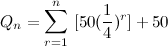 , the results that it yield are somewhat different from the above. , the results that it yield are somewhat different from the above.When: n=1,  n=2,  n=3,  You know, it would be helpful too if you're able to ask your teacher or someone that is good in Maths to possibly come up with another formula of Qn which is different than the one my friend gave. This post has been edited by RED-HAIR-SHANKS: Aug 3 2014, 03:28 AM |
|
|
|
|
|
Aug 3 2014, 03:44 AM
|
|
Senior Member
654 posts Joined: Apr 2013 From: Planet Earth
|
sagethesausage, for further enquiry pertaining to the assignments/PBS, you can always drop by on the MPM website, or you could just ask your teachers right away. And no, you're not ignorant, even most of us lack some information when it comes to these things.
So, how's your preparation for your first term if you don't mind I ask? We have roughly a month's worth of preparation left for our term 1 Trial and 101 days away till our first term examinations, and time is moving faster than ever when we're approaching the foreboding first term exams. |
|
|
Aug 3 2014, 05:45 AM
|
 
VIP
3,713 posts Joined: Nov 2011 From: Torino
|
QUOTE(RED-HAIR-SHANKS @ Aug 3 2014, 01:35 AM) You know, it would be helpful too if you're able to ask your teacher or someone that is good in Maths to possibly come up with another formula of Qn which is different than the one my friend gave. Your friend is sure stingy. Gave you formula but no explanation. Anyhow, look at my approach careful. The final formula in the outcome, I've eliminated the Σ sign from the general formula and it is replaced with a more efficient formula.  Part 1 ::  Part 2 ::  |
|
|
Aug 3 2014, 12:18 PM
|
|
Junior Member
657 posts Joined: Mar 2014
|
QUOTE(RED-HAIR-SHANKS @ Aug 3 2014, 03:44 AM) sagethesausage, for further enquiry pertaining to the assignments/PBS, you can always drop by on the MPM website, or you could just ask your teachers right away. And no, you're not ignorant, even most of us lack some information when it comes to these things. Everything is going to the dogs... For subjects like PA and Bio I've read through half the textbook but have yet to put in the effort to actually MEMORISE them. There's no time to do so either, as just completing Maths T exercises sucks away 90% of my free time. So, how's your preparation for your first term if you don't mind I ask? We have roughly a month's worth of preparation left for our term 1 Trial and 101 days away till our first term examinations, and time is moving faster than ever when we're approaching the foreboding first term exams. For Chemistry, I'm not too worried as I have a very good and helpful Chem tuition teacher. Wasting my whole holiday to hangout with classmates was a terrible idea, and I regret dicking around so much, sure it was fun, but now I'll probably flunk my exams. I need to learn to say no to my friends and prioritise what's important in my life. Hopefully I can still get back on track by starting to work hard starting today. How about you? |
|
|
Aug 3 2014, 12:51 PM
|

Senior Member
846 posts Joined: Jun 2014 From: Reality-escaping 2D world
|
QUOTE(RED-HAIR-SHANKS @ Aug 3 2014, 02:35 AM) You shouldn't be thanking me actually, because my friend was the one who actually found out the equation for the quantity of the quinine. Anyway, he's out of reach currently, and that was why I couldn't meet him and get some clarification on how did he able to come up with that equation. I've tried numerous times myself, but I found out that the Qn that I came up with only holds to be true when n=2,3,... only, but it will lead to a wrong answer for the first term, and vice versa(one of the equation for Qn that I derived from the problem statement seems to be true for when the first term,a = 500.0000, but false when n > 1.) My equation obtained is slightly different than yours. I got This For example, when I use the equation given by my friend to find the Qn for when a=50, n=1,2,3,4..., the result that I got is this:When: n=1, n=2, n=3, n=4, But, if I were to use my equation , the results that it yield are somewhat different from the above.When: n=1, n=2, n=3, You know, it would be helpful too if you're able to ask your teacher or someone that is good in Maths to possibly come up with another formula of Qn which is different than the one my friend gave.  Attached image(s)  |
|
|
Aug 3 2014, 12:52 PM
|
|
Senior Member
846 posts Joined: Jun 2014 From: Reality-escaping 2D world
|
QUOTE(Critical_Fallacy @ Aug 3 2014, 06:45 AM) Your friend is sure stingy. Gave you formula but no explanation. Anyhow, look at my approach careful. The final formula in the outcome, I've eliminated the Σ sign from the general formula and it is replaced with a more efficient formula. Thanks for the formula! But is that methodology or an explanation of results? Part 1 :: Part 2 :: |
|
|
Aug 3 2014, 12:55 PM
|
|
Senior Member
846 posts Joined: Jun 2014 From: Reality-escaping 2D world
|
QUOTE(sagethesausage @ Aug 3 2014, 01:00 AM) Thank you! Your help is much appreciated. Total assignment for all three terms I have something that I've always wanted to clarify, how many total assignments do we have for each subject? And how many do we need to do each term? Sorry if this makes me seem ignorant, I missed out on orientation due to PLKN and was too cowardly to ask my teachers and friends for fear of appearing stupid (I'll chg my behaviour and attitude on this I swear) PA: 2 Bio/Phy/Che: 15 experiments + 1 project (if you take Bio and chemistry means you have to do 30 experiments and 2 projects) Maths T: 3 projects Insane workload right?  |
|
|
Aug 3 2014, 12:59 PM
|
|
Senior Member
846 posts Joined: Jun 2014 From: Reality-escaping 2D world
|
Referring to post #101 by sagethesausage, I want to seek clarification for no 2 (A)
Do we need to list out all the values until Q8 or until Qn? |
|
|
|
|
|
Aug 3 2014, 01:12 PM
|
|
Senior Member
846 posts Joined: Jun 2014 From: Reality-escaping 2D world
|
QUOTE(RED-HAIR-SHANKS @ Aug 1 2014, 10:20 PM) Wait, what? So, your teachers want to give you all a hard time by making you all work and study perpetually in hoping that it will boost your academic progress in the long run? I really don't mind if it works, but considering the fact that first term trial is roughly 1 month away and that you've got your hands full with all those coursework, don't you think that it's too much? Thats too much but no teacher cares about it. They will think that 'I gave you a week to complete those homework, yet you failed to complete it', but they didn't think of other teachers who gave the same amount of homework too. Plus, it won't be a good investment for our studies at all if some of us just regard the homework as a work, and not some medium for practice and revise our knowledge.   |
|
|
Aug 3 2014, 06:42 PM
|
|
VIP
3,713 posts Joined: Nov 2011 From: Torino
|
QUOTE(scgoh123 @ Aug 3 2014, 12:52 PM) Thanks for the formula! But is that methodology or an explanation of results? It is an attempt to model the dynamic behavior of the concentration in a regularly-spaced drug administration system, as a function of time, t. For simplicity, the assignment requires the students to model the concentration as a function of number of dose, n.We know that a problem facing physicians is the fact that for most drugs, there is a floor concentration, q, below which the drug is ineffective and a ceiling concentration, Q, above which the drug is dangerous. Thus, the physician would like the have the concentration C(t) satisfy  This requirement helps determine the initial dose of a drug and when the next dose should be administered. Since we are assuming that when the drug is administered, it is diffused so rapidly throughout the bloodstream that, for all practical purposes, it reaches its highest concentration almost instantaneously, and we would see a spike in the concentration of the drug when the new dose is given, as shown in the piecewise functions below:  CODE plot Piecewise[{{0, x<0}, {50*e^(-1.368*x), 0<=x<1}, {62.5*e^(-1.368*(x-1)), 1<=x<2}, {65.625*e^(-1.368*(x-2)), 2<=x<3}, {66.4063*e^(-1.368*(x-3)), 3<=x<4}, {66.6016*e^(-1.368*(x-4)), 4<=x<5}}] As you can see below, the two concentrations (graphs) in the body just before and after every dose as functions of number of dose, are in fact the upper-bound and lower-bound envelopes of the exponential decay model. They are finite data, and not continuous graphs, which you must point out clearly in your assignment Q.1(b). It is advised to use dashed-lines instead of solid lines.  This post has been edited by Critical_Fallacy: Aug 3 2014, 06:47 PM |
|
|
Aug 4 2014, 02:47 AM
|
|
Senior Member
654 posts Joined: Apr 2013 From: Planet Earth
|
QUOTE(Critical_Fallacy @ Aug 3 2014, 05:45 AM) Your friend is sure stingy. Gave you formula but no explanation. Anyhow, look at my approach careful. The final formula in the outcome, I've eliminated the Σ sign from the general formula and it is replaced with a more efficient formula. An intricate steps of approach indeed, thanks for your amazing input as always Part 1 :: Part 2 ::  . Took me some time there to assimilate all of them . . Took me some time there to assimilate all of them . |
|
|
Aug 4 2014, 03:19 AM
|
|
Senior Member
654 posts Joined: Apr 2013 From: Planet Earth
|
QUOTE(sagethesausage @ Aug 3 2014, 12:18 PM) Everything is going to the dogs... For subjects like PA and Bio I've read through half the textbook but have yet to put in the effort to actually MEMORISE them. There's no time to do so either, as just completing Maths T exercises sucks away 90% of my free time. Right now, you're at which chapter in Chemistry and Maths T ? For Chemistry, I'm not too worried as I have a very good and helpful Chem tuition teacher. Wasting my whole holiday to hangout with classmates was a terrible idea, and I regret dicking around so much, sure it was fun, but now I'll probably flunk my exams. I need to learn to say no to my friends and prioritise what's important in my life. Hopefully I can still get back on track by starting to work hard starting today. How about you? It wasn't a terrible idea I think, and you should be glad because those moments that you spend with your classmates during the recent holiday just might be the final one until you complete the first term in November. For both Physics and Chemistry, our teachers are picking up speed and I guess that if I don't do anything to keep up with their rhythm, I might fall behind in those 2 subjects. There are lots of work to do, a plethora of new stuffs to uncover and even with the boost of speed in the coverage of said syllabus, I don't think that our class will manage to finish the entire syllabus before the trials. I'm quite alright with Maths T, but I really need more practice and that comes with a cost of huge amount of time like you've mentioned, and that goes the same for Physics and Chemistry. Besides, the scarcity of time seems to hinder me from doing my work. I'm toiling arduously to master most of the content in the Chapter 3 and 4 of Chemistry as of now. I'm really appalled by my recent performance in PA. I've read through some notes from the textbook and it didn't really help me much, especially when it comes to the essay section. It's pretty stagnant I'd say. Overall, my progress is going south. That has to be changed. |
|
|
Aug 4 2014, 03:34 AM
|
|
Senior Member
654 posts Joined: Apr 2013 From: Planet Earth
|
QUOTE(scgoh123 @ Aug 3 2014, 12:51 PM) My equation obtained is slightly different than yours. I got This Good. That just shows that my methods that I used to derive the equation for  must be wrong somewhere, and there are different approaches that will lead to different equations that yield the same result. must be wrong somewhere, and there are different approaches that will lead to different equations that yield the same result.QUOTE(scgoh123 @ Aug 3 2014, 12:59 PM) Referring to post #101 by sagethesausage, I want to seek clarification for no 2 (A) I think it should only be until Do we need to list out all the values until Q8 or until Qn?  , as question 2(a) is correlated with the first question about , where it's stated that n=1,2,3,...,8. , as question 2(a) is correlated with the first question about , where it's stated that n=1,2,3,...,8.This post has been edited by RED-HAIR-SHANKS: Aug 4 2014, 03:35 AM |
|
|
Aug 4 2014, 06:27 AM
|
|
VIP
3,713 posts Joined: Nov 2011 From: Torino
|
QUOTE(scgoh123 @ Aug 3 2014, 12:59 PM) Do we need to list out all the values until Q8 or until Qn? QUOTE(RED-HAIR-SHANKS @ Aug 4 2014, 03:34 AM) I think it should only be until The purpose of Q.2a(i) is to test your understanding and ability to calculate the steady-state concentrations of both the minimum effective level and the safe limit. In fact, there is no significant difference in concentration between , as question 2(a) is correlated with the first question about , where it's stated that n=1,2,3,...,8. and . You should be able to interpret the following graph: and . You should be able to interpret the following graph:From the function of the upper-bound envelope, we see that the time constant, τ = 0.7213 day. Using this info, we can predict that the concentration Q(t) will reach steady-state at 4τ = 2.8852 days, or about 3 hours before the 4th dose is given. This is consistent with the graph. 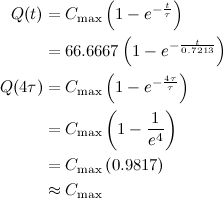 For this reason, in Q.2a(ii) and Q.2a(iii), you need to calculate the concentration of the dosage at least up to Q4 or the 4th dose, in order to determine the drug effectiveness of 50 mg daily dosage on a 35-kg person and a 60-kg person. If you want to, you can also calculate the time interval of ineffectiveness for a specific person before the 2nd dose is given, and justify whether this ineffective time window is acceptable or not. For example, the minimum effective level for a 35-kg person is 14 mg. And it takes roughly 22 hours from the initial dose 50 mg for the concentration to drop below 14 mg. Say if the 35-kg patient is given IV drip every morning 9:00 a.m., then the ineffective time window is between 7:00 a.m. (14.0 mg) to 9:00 a.m. (12.5 mg) or 2 hours before the 2nd dose is given. Is this acceptable from the physician's view?  This post has been edited by Critical_Fallacy: Aug 4 2014, 06:32 AM |
|
|
Aug 4 2014, 04:30 PM
|
|
Junior Member
657 posts Joined: Mar 2014
|
QUOTE(RED-HAIR-SHANKS @ Aug 4 2014, 03:19 AM) Right now, you're at which chapter in Chemistry and Maths T ? My Chemistry teacher is rushing through the syllabus like the world is going to end tomorrow...my class is at chp 6 now. As for Maths T, we're at the part about complex root. It wasn't a terrible idea I think, and you should be glad because those moments that you spend with your classmates during the recent holiday just might be the final one until you complete the first term in November. For both Physics and Chemistry, our teachers are picking up speed and I guess that if I don't do anything to keep up with their rhythm, I might fall behind in those 2 subjects. There are lots of work to do, a plethora of new stuffs to uncover and even with the boost of speed in the coverage of said syllabus, I don't think that our class will manage to finish the entire syllabus before the trials. I'm quite alright with Maths T, but I really need more practice and that comes with a cost of huge amount of time like you've mentioned, and that goes the same for Physics and Chemistry. Besides, the scarcity of time seems to hinder me from doing my work. I'm toiling arduously to master most of the content in the Chapter 3 and 4 of Chemistry as of now. I'm really appalled by my recent performance in PA. I've read through some notes from the textbook and it didn't really help me much, especially when it comes to the essay section. It's pretty stagnant I'd say. Overall, my progress is going south. That has to be changed. Also I noticed your posting time, "3:14AM". Bro do you even sleep??? This post has been edited by sagethesausage: Aug 4 2014, 04:31 PM |
| Change to: |  0.0298sec 0.0298sec
 1.27 1.27
 6 queries 6 queries
 GZIP Disabled GZIP Disabled
Time is now: 19th December 2025 - 01:21 PM |
 Quote
Quote