A century ago, an assassin, a Serbian nationalist, killed the heir to the throne of Austria-Hungary as he visited Sarajevo. This act was a catalyst that ignited a massive conflict that lasted for four years. More than 65 million soldiers were mobilized by more than 30 nations, with battles taking place around the world. Industrialization brought modern weapons, machinery, and tactics to warfare, vastly increasing the killing power of armies. Battlefield conditions were horrific, typified by the chaotic, cratered hellscape of the Western Front, where soldiers in muddy trenches faced bullets, bombs, gas, bayonet charges, and more. On this 100-year anniversary, I've gathered photographs of the Great War from dozens of collections, some digitized for the first time, to try to tell the story of the conflict, those caught up in it, and how much it affected the world.

Nine European Sovereigns at Windsor for the funeral of King Edward VII in May of 1910, four years before the war began. Standing, from left to right: King Haakon VII of Norway, Tsar Ferdinand of Bulgaria, King Manuel II of Portugal, Kaiser Wilhelm II of the German Empire, King George I of Greece and King Albert I of Belgium. Seated, from left to right: King Alfonso XIII of Spain, King-Emperor George V of the United Kingdom and King Frederick VIII of Denmark. Within the next decade, Kaiser Wilhelm II and Tsar Ferdinand's empires would engage in bloody warfare with the nations led by King Albert I and King George V. The war was also a family affair, as Kaiser Wilhelm II was a first cousin to King George V, and an uncle to King Albert I. Of the remaining monarchs pictured, over the next decade one would be assassinated (Greece), three would keep their nations neutral (Norway, Spain, and Denmark), and two would be forced out of power by revolutions. (W. & D. Downey) #

In 1914, Austria-Hungary was a powerful and huge country, larger than Germany, with nearly as many citizens. It had been ruled by Emperor Franz Joseph I since 1848, who had been grooming his nephew, Archduke Franz Ferdinand as the heir to the throne. In this photo, taken in Sarajevo on June 28, 1914, a visiting Archduke Franz Ferdinand and his wife, Czech Countess Sophie Chotek, are departing a reception at City Hall. Earlier that morning, on the way to the hall, their motorcade had been attacked by one of a group of Serbian nationalist assassins, whose bomb damaged one car and injured dozens of bystanders. After this photo was taken, the Archduke and his wife climbed into the open car, headed for a nearby hospital to visit the wounded. Just blocks away though, the car paused to turn around, directly in front of another assassin, who walked up to the car and fired two shots, killing both Franz Ferdinand and his wife. (AP Photo) #

Assassin Gavrilo Princip (left) and his victim Archduke Franz Ferdinand, both photographed in 1914. Princip, a 19 year old a Bosnian Serb who killed the Archduke, was recruited along with five others by Danilo Ilic, a friend and fellow Bosnian Serb, who was a member of the Black Hand secret society. Their ultimate goal was the creation of a Serbian nation. The conspiracy, assisted by members of Serbia's military, was quickly uncovered, and the attack became a catalyst that would soon set massive armies marching against each other around the world. All of the assassins were captured and tried. Thirteen received medium-to-short prison sentences, including Princip (who was too young for the death penalty, and received the maximum, a 20 year sentence). Three of the conspirators were executed by hanging. Four years after the assassination, Gavrilo Princip died in prison, brought down by tuberculosis, which was worsened by harsh conditions brought on by the war he helped set in motion. (Osterreichische Nationalbibliothek) #

A Bosnian Serb nationalist (possibly Gavrilo Princip, more likely bystander Ferdinand Behr), is captured by police and taken to the police station in Sarajevo, on June 28, 1914, following the assassination of Archduke Franz Ferdinand, heir to the Austrian-Hungarian throne, and his wife. (National Archives) #

Shortly after the assassination, Austria-Hungary issued a list of demands to Serbia, demanding they halt all anti-Austro-Hungarian activity, dissolve certain political groups, remove certain political officers, and arrest those within its borders who participated in the assassination, among other things -- with 48 hours to comply. Serbia, with the backing of their ally Russia, politely refused to fully comply, and mobilized their army. Soon after, Austria-Hungary, backed by their ally Germany, declared war on Serbia on July 28 1914. A network of treaties and alliances then kicked in, and within a month's time, Germany, Austria-Hungary, Russia, France, Britain, and Japan had all mobilized their armies and declared war. In this photo, taken in August of 1914, Prussian guard infantry in new field gray uniforms leave Berlin, Germany, heading for the front lines. Girls and women along the way greet and hand flowers to them. (AP Photo) #

A Belgian soldier smokes a cigarette during a fight between Dendermonde and Oudegem, Belgium, in 1914. Germany had hoped for a swift victory against France, and invaded Belgium in August of 1914, heading into France. The German army swept through Belgium, but was met with stiffer resistance than it anticipated in France. The Germans approached to within 70 kilometers of Paris, but were pushed back a ways, to a more stable position, which would become battlefields lined with trenches, fought over for years. In this opening month of World War I, hundreds of thousands of soldiers and civilians were killed or wounded -- France suffered its greatest single-day loss on August 22nd, when more than 27,000 soldiers were killed by rifle and machine-gun, thousands more wounded. (Bibliotheque nationale de France) #

Austro-Hungarian troops executing Serbian civilians, likely ca. 1915. Serbians suffered greatly during the war years, counting more than a million casualties by 1918, including losses in battle, mass executions, and the worst typhus epidemic in history.

The Japanese fleet off the coast of China in 1914. Japan sided with the United Kingdom and its allies, attacking German interests in the Pacific, including island colonies and leased territories on the Chinese mainland. (Bibliotheque nationale de France) #

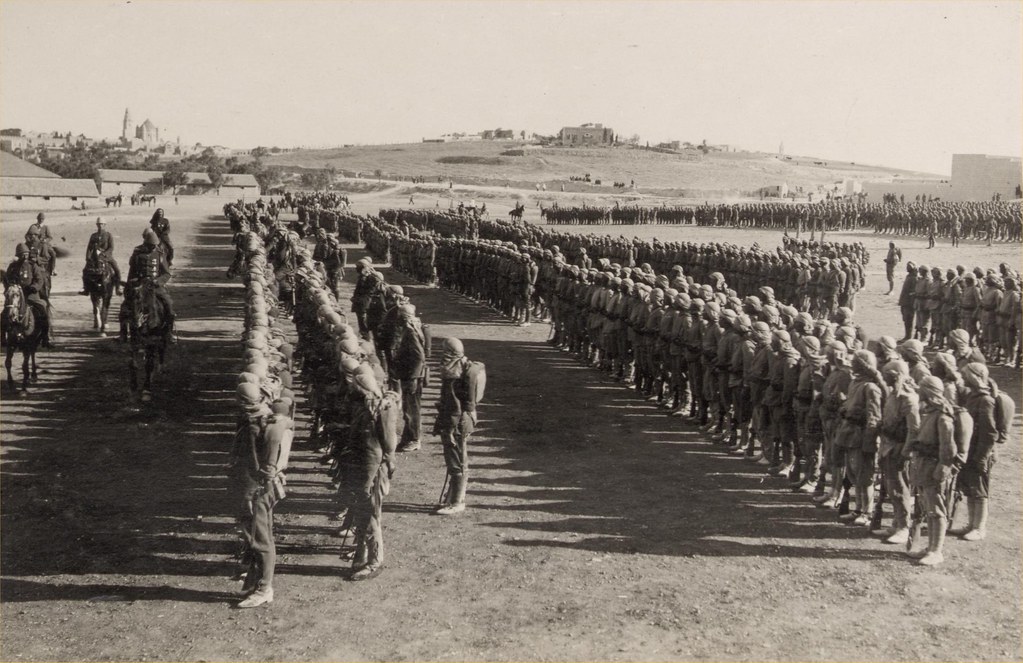
The Salonica (Macedonian) front, Indian troops at a Gas mask drill. Allied forces joined with Serbs to battle armies of the Central Powers and force a stable front throughout most of the war. (Nationaal Archief) #

Unloading of a horse in Tschanak Kale, Turkey, equipment for the Austro-Hungarian army. (Osterreichische Nationalbibliothek) #


 World War I in Photos : 100 years ago
  Apr 28 2014, 10:44 AM, updated 12y ago


 Quote
Quote






















 0.0342sec
 0.35
0.35
 5 queries
 GZIP Disabled