Welcome Guest ( Log In | Register )

Outline · [ Standard ] · Linear+

 Ask a Mathematical Physicist

views
     
studyboy
post Jan 2 2014, 11:20 PM

On my way
****
Senior Member
522 posts

Joined: Mar 2013
QUOTE(danny88888 @ Jan 2 2014, 10:31 PM)
Assume that the equation system
x*2 + sxy + y*2 - 1 = 0;
x*2 + y*2 - s*2 + 3 = 0
defi…ne x and y implicitly as differentiable functions of s.
(a) Differentiate the system (i.e. fi…nd the differentials) and fi…nd the values of x'(s) =dx/ds and y'(s)= dy/ds when x=0, y=1 and s=2

Can someone give me an insight of this?
*
Do you recall implicit differentiation? Have a look at the link below!

https://www.khanacademy.org/math/calculus/d...fferentiation-1
studyboy
post Jan 3 2014, 04:39 PM

On my way
****
Senior Member
522 posts

Joined: Mar 2013
QUOTE(v1n0d @ Jan 3 2014, 09:27 AM)
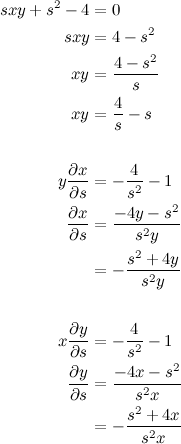
If it's just sxy, then the derivation should be straightforward. However, I combined both the equations because I can see that the user posted image terms cancel out, which yields the following:
user posted image
*
Aren't both x and y functions of s?

x=x(s), y=y(s)?

How could you differentiate sxy and only treat one as a function of s?
studyboy
post Jan 4 2014, 01:10 AM

On my way
****
Senior Member
522 posts

Joined: Mar 2013
QUOTE(Critical_Fallacy @ Jan 3 2014, 04:57 PM)
Luckily v1n0d and studyboy are here! laugh.gif

Sorry, I'm bad at discrete math. Can you check this working? sweat.gif

user posted image
*
sweat.gif Sorry, I wasn't really sure what the question wanted actually. But I suppose v1n0d managed to solve the puzzle! tongue.gif

Edit: This is actually quite new to me to be frank. I have never seen composition of functions being expressed in this form so good stuff! laugh.gif Learnt something new today!

This post has been edited by studyboy: Jan 4 2014, 01:14 AM
studyboy
post Jan 4 2014, 01:36 AM

On my way
****
Senior Member
522 posts

Joined: Mar 2013
QUOTE(kingkingyyk @ Jan 3 2014, 08:16 PM)
Owh, that clarifies everything.  nod.gif

Here's another question, according to the lecturer :
Question 1 :
How many ways to arrange all alphabets in M A T H E M A T I C S such that the vowels are together.
Consonents : M T H M T C S => 7
Vowels : A E A I => 1
Answer = (7+1)! = 8!

Question 2 :
How many different ways to arrange all alphabets in M A T H E M A T I C S such that the vowels are together.
Consonents : M T H M T C S => 7
Vowels : A E A I => 4
Answer = (8!/2!2!) x (4!/2!)

Do you know what is the difference?  sweat.gif I think they are the same (Question 1 answer should be same with Question 2 answer). wink.gif
*
Let me try to explain this,

1) For this, the arrangement of the vowels do not matter. As long as they are together, be it AEAI, AAEI, IEAA or etc, they count as 1 entity. Hence the are 8! ways of arranging M A T H E M A T I C S.

2) For the second question, let us think of it via a 2 stage process.

STAGE i) The band of vowels can be rearrange so we have 4!. However, as mentioned by v1n0d, given the 2 As we have to divide 4! by 2! so there are in total 4!/2! ways of arranging the A A E I.

STAGE ii) Now, from Question 1 we know that we have 8! ways of arranging M A T H E M A T I C S so that the vowels are together. However, there are 2 M's and 2 T's so in effect, we have 8!/2!2! ways of doing the arrangement.

Therefore, according to the multiplication principal, we will have (8!/2!2!) x (4!/2!) ways of arrangement.

Nevertheless, I have absolutely no idea how the words used in Question 1 implies the answer given. sweat.gif

Let us wait what there others have to say about this.

studyboy
post Jan 4 2014, 02:15 AM

On my way
****
Senior Member
522 posts

Joined: Mar 2013
QUOTE(danny88888 @ Jan 3 2014, 10:38 PM)
Can someone share some insight on this video about matrices?

http://www.sophia.org/tutorials/using-dete...3x3-matrices--4

I don't understand what the video is trying to convey to me! sad.gif

Cheers
*
There is quite a bit going on here in this 3 minute video.

1) The rule of Sarrus is used to compute the determinant of a 3x3 square matrix.

http://en.wikipedia.org/wiki/Rule_of_Sarrus

2) An illustration of how a matrix with a zero determinant will lead to a system Ax = b having no unique solutions. The example used is one pertaining to a diagonal matrix

http://en.wikipedia.org/wiki/Diagonal_matrix

Using the the rule of Sarrus, the determinant for a diagonal matrix is just the product of the main diagonal since all the non diagonal entries are zero. If we have a system of Ax = b such that after row reductions, we end up with an augmented matrix with a diagonal matrix for A, then a case where |A| = 0 means one of the diagonal entries is zero. Hence, a unique solution cannot be obtained since the system cannot be solved.

In a nutshell |A| not zero iff A is invertible. If A is invertible, a unique solution can be found for the system Ax = b.
studyboy
post Jan 19 2014, 09:33 PM

On my way
****
Senior Member
522 posts

Joined: Mar 2013
QUOTE(Y.J.S @ Jan 19 2014, 09:17 PM)
ohh 'delta' velocity/time = acceleration , am i right?
*
dv/dt = a (acceleration). Yes you are absolutely correct. smile.gif
studyboy
post Mar 2 2014, 01:00 AM

On my way
****
Senior Member
522 posts

Joined: Mar 2013
QUOTE(chocobo7779 @ Mar 2 2014, 12:46 AM)
? tan pi/2 is 0? sweat.gif
*
1 / tan (pi/2) = 0.


Change to:
| Lo-Fi Version
0.0531sec    1.66    7 queries    GZIP Disabled
Time is now: 18th December 2025 - 10:15 AM