Welcome Guest ( Log In | Register )

8 Pages < 1 2 3 4 5 > » Bottom

Outline · [ Standard ] · Linear+

 Ask a Mathematical Physicist

views
     
v1n0d
post Jan 3 2014, 06:58 PM

Another roof, another proof.
*******
Senior Member
3,197 posts

Joined: Mar 2007
From: Kuala Lumpur, Malaysia


QUOTE(Critical_Fallacy @ Jan 3 2014, 06:37 PM)
The question is from kingkingyyk. Perhaps we should let him clarify here. It is the notation for composite function.
*
Okay, I think I understand now. Instead of functions, we're working with sets in terms of their elements (x,f(x)).

I obtained SoD={(2,4),(3,3),(3,4),(4,2),(4,3),(4,4)}. hmm.gif

Critical_Fallacy I think your results are for DoS since SoD=S(D(x)).

P.S. Composition of Functions in Set Form

This post has been edited by v1n0d: Jan 3 2014, 08:10 PM
v1n0d
post Jan 3 2014, 08:02 PM

Another roof, another proof.
*******
Senior Member
3,197 posts

Joined: Mar 2007
From: Kuala Lumpur, Malaysia


QUOTE(kingkingyyk @ Jan 3 2014, 08:00 PM)
hmm.gif
According to the syllabus, this is under relation.
Meanwhile, there is another chapter called as function.

I wonder are they the same? hmm.gif
*
Ah, okay. Then the solution given in this post should be the correct one. You can refer to the link I attached for more details.

This post has been edited by v1n0d: Jan 3 2014, 08:05 PM
v1n0d
post Jan 3 2014, 08:10 PM

Another roof, another proof.
*******
Senior Member
3,197 posts

Joined: Mar 2007
From: Kuala Lumpur, Malaysia


QUOTE(kingkingyyk @ Jan 3 2014, 08:08 PM)
You have missed out (3,4)?  tongue.gif
(2,4)o(3,2) => (3,4)

By the way, does it mean that the working is same with the mapping of functions?
The lecturer made the things really blur, the ways she did in lecture note and tutorial answer are different doh.gif
*
Ah! Thank you. I've edited my post to reflect this.
Yes, it's the same as the composition of functions. The wiki page for this explains how the sets look like.
v1n0d
post Jan 3 2014, 08:27 PM

Another roof, another proof.
*******
Senior Member
3,197 posts

Joined: Mar 2007
From: Kuala Lumpur, Malaysia


QUOTE(kingkingyyk @ Jan 3 2014, 08:16 PM)
Owh, that clarifies everything.  nod.gif

Here's another question, according to the lecturer :
Question 1 :
How many ways to arrange all alphabets in M A T H E M A T I C S such that the vowels are together.
Consonents : M T H M T C S => 7
Vowels : A E A I => 1
Answer = (7+1)! = 8!

Question 2 :
How many different ways to arrange all alphabets in M A T H E M A T I C S such that the vowels are together.
Consonents : M T H M T C S => 7
Vowels : A E A I => 4
Answer = (8!/2!2!) x (4!/2!)

Do you know what is the difference?  sweat.gif I think they are the same (Question 1 answer should be same with Question 2 answer). wink.gif
*
In the first question, repetition is allowed. AAEI can be shuffled to yield AAEI again (by swapping the first and second letters). Similarly, there are 2 Ms and 2 Ts in the list of consonants, which can also be affected similarly.

In the second question, repeated results aren't counted, so we eliminate them by dividing by their individual factorials (hence the 8!/2!2! and 4!/2!).

If you're still having difficulty with this topic, I suggest reading these lecture notes. The instructor has made them quite easy to understand. smile.gif
v1n0d
post Jan 4 2014, 08:01 AM

Another roof, another proof.
*******
Senior Member
3,197 posts

Joined: Mar 2007
From: Kuala Lumpur, Malaysia


QUOTE(kingkingyyk @ Jan 3 2014, 08:30 PM)
I have no problem on such kind of question. Just wondering how did she manage to give such answer on question 1.  yawn.gif
Seems illogical to me. AEAI should have 4! right?
Without taking the repetition into account, we should get 8! x 4! instead.  hmm.gif
*
Yes, you're correct. If repetitions are allowed, the result should be 8!x4!. However, it seems that in the first question, your lecturer ignores the permutation within the vowel group (hence the missing 4!). In the second question, the repetition within the same group is taken into account, which is rather inconsistent. I'll take a guess and say that the question is probably just badly phrased. In any case, I'd suggest consulting your lecturer to clear this up.

QUOTE(kingkingyyk @ Jan 3 2014, 09:16 PM)
It was planned in the syllabus but end up lecturer didn't teach.  mega_shok.gif
*
My undergraduate FYP and portions of my current PhD thesis are on graph theory. I'd be happy to assist if there are any questions related to the field.
v1n0d
post Jan 4 2014, 07:12 PM

Another roof, another proof.
*******
Senior Member
3,197 posts

Joined: Mar 2007
From: Kuala Lumpur, Malaysia


QUOTE(maximR @ Jan 4 2014, 02:19 PM)
» Click to show Spoiler - click again to hide... «


Thank you for your detailed explanation , as always . I thought it would only involve simple trigonometry since the professor said " I will not derive it here , assuming that you're comfortable with this " . Now this clears things up in a way , I'd have to seriously start studying Matrices now since it's used extensively in Physics .

I purchased the STPM Math T book already , and I must admit that your tutorials are much more easier to follow , and compact ( Comparing notes for Complex Numbers ) . Whereas the book has concepts cluttered , plus the presentation sounds more like a typical reference book instead of a conversational textbook . Let's just hope I can understand the explanations on Matrices or else I'd need help from videos on youtube .

I find it odd that STPM stuffs a lot of topics in one chapter , namely Functions . I don't quite understand why Trigonometry is not given a separate treatment , everything including the trig identities and double angle formulas are found in the Functions chapter .  blink.gif

I'm a little bit disappointed with the Modern Physics part in STPM , Special Relativity is never mentioned , and I think they should have at least mentioned quarks in passing .
*
I've complained about the new STPM syllabus before, but in other threads. The new syllabus organization is quite poor, particularly so for mathematics. Core elements such as the treatment of numbers and sets are taught in the second semester, when they should be the first things you learn. Mathematics is a very systematic subject, and should be taught as such to minimize confusion.
v1n0d
post Jan 5 2014, 08:22 AM

Another roof, another proof.
*******
Senior Member
3,197 posts

Joined: Mar 2007
From: Kuala Lumpur, Malaysia


QUOTE(Critical_Fallacy @ Jan 4 2014, 09:50 PM)
Just want to clarify with v1n0d. Isn't the application of four-color theorem shown on the cover of the book? unsure.gif

user posted image
*
Yes, it is. Personally, my favorite part about graph theory is it's origin story, i.e. the Seven Bridges of Königsberg problem.
v1n0d
post Jan 8 2014, 09:17 AM

Another roof, another proof.
*******
Senior Member
3,197 posts

Joined: Mar 2007
From: Kuala Lumpur, Malaysia


QUOTE(sabrina222 @ Jan 7 2014, 10:34 AM)
Is there any ausmat syllabus discussed here?
*
I'm not sure about the physics course, but the mathematical discussions here should cover your syllabus (and more). smile.gif
v1n0d
post Jan 9 2014, 03:56 AM

Another roof, another proof.
*******
Senior Member
3,197 posts

Joined: Mar 2007
From: Kuala Lumpur, Malaysia


QUOTE(mumeichan @ Jan 8 2014, 08:29 PM)
Sorry la working already. If there are any specific questions I'd be glad to answer. But not a class la haha sweat.gif

Actually even for uni students alot of them don't need to bother with Excel. I don't think Excel is really important unless you're into modeling. Many companies do use excel, but on a very limited basis. It's just simple the spreadsheet and charting program that comes with Office. Most statistical analysis is easier done with statistical software. And those companies will have them as well. Excel is only good if you've a data set and you're not quite sure how you wanna structure it yet, or you want to make use of the formulas and macros which are not available in statistical packages.
*
+1 to this.

Personally, I find SPSS to be the best beginner suite out there. Has everything from KS-testing to non-linear curve fitting. Works for pretty much anything but directional distributions. laugh.gif
v1n0d
post Jan 9 2014, 05:57 PM

Another roof, another proof.
*******
Senior Member
3,197 posts

Joined: Mar 2007
From: Kuala Lumpur, Malaysia


QUOTE(mumeichan @ Jan 9 2014, 02:06 PM)
From the educational point of view. I disagree that people should start with SPSS. It seems to be very easy to use because it has a good graphical interface, but that's deceptive. A introductory statistics course normally teaches very little statistical theory and is application based. They also provide the students with a well structured data set.

In reality however, data is never well structured. The data collection has to be designed carefully or in the case where we get the data from secondary sources, structured properly to fit our analytical objectives. Diff structure = different results.

Also, the person should understand their data (nominal, ordinal, ratio), the distribution of their data (normal, exp, cyclic, parabolic).

Finally they need to understand what mathematical manipulation is being performed each statistical analysis. The math isn't hard and they don't need to be able to compute by hand, just understand what happens.

So using R or SAS is a better learning tool since it forces you to think about what you're really doing.
*
I've not used R or SAS before, but given that R is the only free option we've listed here, I'm now inclined to think that would be the best starting point.

For those who are interested, here are some other free programs you may find interesting:
Octave - essentially a free version of Matlab; almost identical functionality.
GAP - GAP stands for Groups, Algorithms, & Programming; the go-to software for those working in group theory.
v1n0d
post Jan 9 2014, 11:35 PM

Another roof, another proof.
*******
Senior Member
3,197 posts

Joined: Mar 2007
From: Kuala Lumpur, Malaysia


QUOTE(Critical_Fallacy @ Jan 9 2014, 09:27 PM)
A quick survey online shows a few popular statistics packages with R is a freeware, and the rest are commercial: Excel Analysis ToolPak, MiniTab, SAS, SPSS, STATA.

By the way, I believe that engineers and scientists in all disciplines should take at least one course in statistics. Unfortunately, because of other requirements, most engineers will only take one elementary statistics course, in which the essential materials cannot be covered in one semester.

How should we address this issue as we know it? unsure.gif
*
I fall into this category (sort of). I took basic and intermediate statistics. All further knowledge in the field I had to study on my own because it's necessary for the project I work on.
v1n0d
post Jan 13 2014, 11:51 PM

Another roof, another proof.
*******
Senior Member
3,197 posts

Joined: Mar 2007
From: Kuala Lumpur, Malaysia


QUOTE(maximR @ Jan 13 2014, 10:10 PM)
Critical_Fallacy

What does it mean to integrate differentials , like dy , or dx ?

Ex :

intg dy = y + c
*
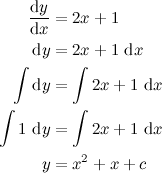
On it's own, the intergration of a differential user posted image has no meaning. In the context of a separable differential equation however, it looks like this:
user posted image
where c is an arbitrary constant.
v1n0d
post Jan 15 2014, 12:47 PM

Another roof, another proof.
*******
Senior Member
3,197 posts

Joined: Mar 2007
From: Kuala Lumpur, Malaysia


QUOTE(danny88888 @ Jan 15 2014, 02:50 AM)
I fully agree with you that the Malaysian education system is lagging behind badly. I am a product of the Malaysian eduction system and is currently at university, the singaporean here much better in almost every aspect from problem solving to critical thinking. I felt ashamed on our education system that has not prepare me vigorously for university education system. Our not up to standard education can be felt strong in university levels and it will be an eye opener and eye opener. Singaporean tend to be better with problem solving, they know how to apply the concept to solve problems of different condition and their thinking process is much faster. I would strongly recommend anyone to pursue their education of any level, from primary to university at Singapore, although it may be costly, but i would say it will be worth it because you will no struggle much. I'm truly sad, dissapointed and frustrated with the Malaysian edu standard on being not on par to prepare the young talent of tomorrow leaders to compete in the world arena.
*
This is a problem which I only see addressed in Form 6. The SPM syllabus focuses too much on repetition, and encourages spoonfeeding. It's quite common to see SPM top scorers do badly for their STPM because they're unable to cope with synthesis. Of all the government-administered examinations in Malaysia, STPM is the only one which is in my opinion, of good standing. Despite the newly-introduced syllabus being less organized, the examination questions still maintain their standards.

Sadly, the reality is very few students opt for the STPM for one simple reason - why take the risk of a 2-year course that's difficult to pass?

Anyhow, this is a discussion that is best left for another thread. I vote we get back to crunching numbers! icon_rolleyes.gif
v1n0d
post Jan 15 2014, 02:06 PM

Another roof, another proof.
*******
Senior Member
3,197 posts

Joined: Mar 2007
From: Kuala Lumpur, Malaysia


QUOTE(Critical_Fallacy @ Jan 15 2014, 01:37 PM)
If students rely on rote memorization, then much “learning” would surely disappear for most of them. In fact, it may be difficult to achieve consensus on an ideologically free conception of mathematics curriculum. Mathematics is constructed according to specific cultural, mathematical, pedagogical and political agendas, and its various features are a function of these diverse concerns. I'm not a Mathematics Teacher, but I'd propose the UK's National Numeracy Strategy, which I believe a “very useful” framework for supplementing the Mathematics curriculum in the Education System of Malaysia.

http://www.edu.dudley.gov.uk/primary/Strat...nsdocuments.htm
*
This part is key to how mathematics is taught. Infinity for example, was a concept introduced by Christian mathematicians with the object of portraying mathematics as the language of God. The idea of conveying both precision and abstraction simultaneously was considered divine, and the resulting method of how we teach calculus today is a result of the choice of definitions etc. that we have adopted over the years.

Alternative (some may argue more effective) teaching methods exist, yet they're not in use because they don't fit in with the bulk of the Western-dominated mathematical ideologies in existence. In an experiment conducted at USM, visiting professor CK Raju taught calculus via zeroism to a class of students with a background in SPM mathematics. In 2 weeks, they were able to answer questions that were set for first year university students, consisting of material that is usually taught over the course of a semester.

QUOTE(maximR @ Jan 15 2014, 01:42 PM)
v1n0d

Yesterday night when I was in bed thinking , it suddenly dawned on me that what you've shown me explains why  ∫ dy = y +c .

There is a hidden '1' in between the integral sign and dy !

∫ 1 dy = y + c

Thanks ! biggrin.gif
*
Haha, I thought you'd already noticed that. Welcome! biggrin.gif
v1n0d
post Jan 15 2014, 08:30 PM

Another roof, another proof.
*******
Senior Member
3,197 posts

Joined: Mar 2007
From: Kuala Lumpur, Malaysia


QUOTE(quovadis123 @ Jan 15 2014, 02:07 PM)
I learnt MS Office from my secondary school from Form1 to Form3 at school last time. 14years ago.
All students are compulsory to take MS Office.
That time, I'm exposed to learn those qwerty layout typing using correct method.

So, your point mean current education system in Malaysia is getting weaker.
For programming, I would say, learn more the math first before going to programming is better.
Strong foundations in logics and math algorithm are the correct way.
Unless what they learn is those markup languages, simple script languages.

Exposure to new technology always recommended. smile.gif
*
Exposure to tech varies from school to school. I was introduced to Logo at Standard 1. Been working with computers ever since. These days, kids get a lot more tech savvy due to parents having smartphones etc.
v1n0d
post Jan 16 2014, 04:36 PM

Another roof, another proof.
*******
Senior Member
3,197 posts

Joined: Mar 2007
From: Kuala Lumpur, Malaysia


QUOTE(danny88888 @ Jan 15 2014, 11:08 PM)
Hi guys, just studied probability, have a tough time with conditional probability and independent events, is there anyone here who have a technique on how to master this topic?? Dont mind treating them a drink for your effort!
*
I'm a little rusty, but I don't mind trying. Just post your questions here, even if I can't answer them, odds are someone else here can! biggrin.gif
v1n0d
post Jan 21 2014, 10:12 AM

Another roof, another proof.
*******
Senior Member
3,197 posts

Joined: Mar 2007
From: Kuala Lumpur, Malaysia


QUOTE(danny88888 @ Jan 19 2014, 02:51 AM)
Hello guys, I'm back with some maths difficulty
:'( , let's say you found the mean, variance and standard deviation for a set of data and if i were to add an extra number to the set of data, how would it affect the variance,sd etc. I'm pretty sure this question is very familiar to many of you, is there any notes for this kind of question? This is one example of question that i encounter: suppose there was a test and the mean mark for 100 student is 60 with standard deviation of 13. A new script is marked, without taking any calculation how do you think the standard deviation will be affected if the new script is marked at i)40 ii)48 iii)56 iv)64 v) 80. Here is my understanding on standard deviation since the mean is 60 and has a standard deviation of 13 which mean that the average mark lie between 47 to 73 (60-13, 60+13), so for 40 since it is below 47 hence the standard deviation rise, for 48 56 and 64 the standard deviation falls since they are closer to the mean value and for 80 the standard deviation rise because it is bigger than (73). Is my logic correct or wrong? If not how do i process this question? Thanks in advance! Cheers
*
I believe this should answer your question.

QUOTE(quovadis123 @ Jan 20 2014, 11:41 PM)
Hi Critical_Fallacy,

Do you come across A.I before? You have strong profile in Robotics and you live through World War 2 before.
I want to ask about some decision making process so I can utilise it in development.
Such as Markov, RL, Q-learning.
I think this is a math questions too.
Thanks.
*
I wonder what this has to do with AI. hmm.gif
Do post your questions here anyways, I'd like to see what you're working on. smile.gif
v1n0d
post Jan 21 2014, 12:00 PM

Another roof, another proof.
*******
Senior Member
3,197 posts

Joined: Mar 2007
From: Kuala Lumpur, Malaysia


QUOTE(quovadis123 @ Jan 21 2014, 11:46 AM)
My question may be subjective..
Want to ask what's the current new algorithm for decision making process?
For conventional method learnt last time, I learnt about Markov/Hidden Markov.
http://en.wikipedia.org/wiki/Markov_decision_process
As time passes, I think there should have more variants to Markov and new one.
I want to know the name of the new algorithm so I can research how it works in World Wide Web and apply it afterwards.

Thanks.
*
I'm unsure about the exact names of algorithms in use today, but a lot of focus is given to fuzzy decision making these days. Correct me if I'm wrong, but this is merely the fuzzy extension to a Markov decision process. It's employed heavily in artificial neural networks, coupled with Bayesian methods to train the system. Genetic algorithms may also be employed in lieu of Bayesian ones (GA removes the need for a priori information), but they're resource intensive and it only works for sufficiently large data sets (tens of thousands of data points).

I think your best bet would be to read through the last few issues of Journal of Machine Learning and see what methods people are currently working on.
v1n0d
post Jan 21 2014, 06:55 PM

Another roof, another proof.
*******
Senior Member
3,197 posts

Joined: Mar 2007
From: Kuala Lumpur, Malaysia


QUOTE(quovadis123 @ Jan 21 2014, 04:42 PM)
I learnt before for the A star, other than that... I was 1st time hear about fortune, D star, etc.

About the book you recommend, I read through it just now, and I couldn't understand what the book want to tell me about. For example in the chapter 3: Introduction to Markov Decision Process, really confusing and short explanation which rendered it very uninteresting. More or less like a reference book.  sad.gif
It makes an interesting topic become uninteresting. Just my honest opinion.

I'm looking for "How it works?". Thanks for the topics given, will research it soon.
Currently reading the book called "Artificial Intelligence - A modern Approach 3rd edition."
user posted image
*
QUOTE(Critical_Fallacy @ Jan 21 2014, 05:50 PM)
This textbook is fairly big and thick in my library shelf. sweat.gif

If you want a non-rigorous mathematical treatment of Markovian Decision Process, try reading Operations Research books because the prerequisites are basic knowledge of Markov chains, Linear programming, and Probabilistic dynamic programming. icon_idea.gif

user posted image
*
The mathematical dependency is there for a reason. Machine learning is one of the more complex fields at the moment, because they are heavily influenced by the geometric properties of the distribution employed during the learning process. It may start out as "boring" and very theoretical, but this is because suitable distributions are close to non-existent in practice. More often than not, tasks that were originally simple such as computing the parameters for a distribution become exceedingly difficult, particularly when dealing with high dimensional data.

quovadis123 you may choose to read that second book to gain an understanding on how decision making processes work as a whole, but the first book is unavoidable if you want an in-depth view of what's going on.

v1n0d
post Jan 21 2014, 10:21 PM

Another roof, another proof.
*******
Senior Member
3,197 posts

Joined: Mar 2007
From: Kuala Lumpur, Malaysia


QUOTE(acgerlok7 @ Jan 21 2014, 09:49 PM)
hi guys got 1-2 question tht got me cracking my head and banging on the floor...hope sifu can help shed some light on this...

SOLVE THE DE OF (2y+3x)dx + (y-x)dy =0

(12) (3x^3 - 2x^2(y)+3y^2(x))dx= 4xy^2 dy
*
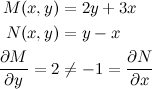
First, test for exactness:
user posted image

Since the equation given is not exact, you should introduce an integration factor. This guide should help you with completing the rest of the problem. Do post your results here so we can check. smile.gif

8 Pages < 1 2 3 4 5 > » Top
 

Change to:
| Lo-Fi Version
0.0663sec    0.87    7 queries    GZIP Disabled
Time is now: 19th December 2025 - 12:39 PM