

after reading about Surtsey Island, i remembered about Pulau Batu Hairan, which appeared near Sabah (if i remembered correctly) in 1980s.
 Facts Facts and Facts, v2 ~ 2013 ~ w00t w00t ~ updated.
Facts Facts and Facts, v2 ~ 2013 ~ w00t w00t ~ updated.
|
|
 Aug 24 2013, 08:46 PM Aug 24 2013, 08:46 PM
|
 
Junior Member
99 posts Joined: Jul 2008 
|
after reading about Surtsey Island, i remembered about Pulau Batu Hairan, which appeared near Sabah (if i remembered correctly) in 1980s.
|
|
|
Aug 24 2013, 09:40 PM
|

Junior Member
92 posts Joined: Jun 2012 From: hurr-durr 
|
QUOTE(noorimanyosh @ Aug 24 2013, 08:34 PM) time to move to finland the frontrunner of education in the world |
|
|
Aug 29 2013, 07:57 PM
|
|
Junior Member
92 posts Joined: Jun 2012 From: hurr-durr
|
 |
|
|
Aug 29 2013, 09:08 PM
|
|
Junior Member
92 posts Joined: Jun 2012 From: hurr-durr
|
 |
|
|
Aug 29 2013, 10:05 PM
|

Junior Member
42 posts Joined: Jan 2011 From: Kuala Lumpur
|
QUOTE(CeDhhVss @ Aug 29 2013, 07:57 PM)  |
|
|
Aug 29 2013, 10:11 PM
|

Senior Member
725 posts Joined: Apr 2008 From: Kuala Lumpur
|
charlotte web, i shed manly tears
|
|
|
Aug 30 2013, 08:57 AM
|

Senior Member
1,202 posts Joined: May 2007 From: Penang
|
QUOTE(CeDhhVss @ Aug 29 2013, 07:57 PM) QUOTE(CeDhhVss @ Aug 29 2013, 09:08 PM)  |
|
|
Sep 3 2013, 08:36 PM
|
|
Junior Member
92 posts Joined: Jun 2012 From: hurr-durr
|
 QUOTE Tilly Smith is a school girl just like any other except for the fact that she managed to save her family as well as hundred other people from the deadly tsunami that took the lives of hundreds during the 2004 disaster in Thailand. Then 10-year-old Tilly recognized the signs of a tsunami such as withdrawing water and foaming bubbles from a geography lesson she had had just two weeks before the accident. Because of her alerting the tourists and the staff of the hotel on Maikhao beach in Thailand, the place was evacuated and was one of the very few areas on the island with no records of casualties. Tilly was given the Thomas Gray Special Award of The Marine Society & Sea Cadets, appeared at the United Nations Special Envoy for Tsunami Relief 2005 event where she met Bill Clinton and also had an asteroid named after her. |
|
|
Sep 4 2013, 10:14 AM
|
|
Senior Member
1,202 posts Joined: May 2007 From: Penang
|
QUOTE(CeDhhVss @ Sep 3 2013, 08:36 PM)  |
|
|
Sep 5 2013, 02:58 AM
|
|
Junior Member
92 posts Joined: Jun 2012 From: hurr-durr
|
QUOTE(reijikageyama @ Sep 4 2013, 10:14 AM) now legally piap-able liao errr.... |
|
|
Sep 5 2013, 02:58 AM
|
|
Junior Member
92 posts Joined: Jun 2012 From: hurr-durr
|
 |
|
|
Sep 5 2013, 09:05 AM
|
|
Senior Member
1,202 posts Joined: May 2007 From: Penang
|
QUOTE(CeDhhVss @ Sep 5 2013, 02:58 AM) errr....  QUOTE(CeDhhVss @ Sep 5 2013, 02:58 AM) |
|
|
Sep 9 2013, 09:57 PM
|
|
Junior Member
92 posts Joined: Jun 2012 From: hurr-durr
|
Bone Cancer
 |
|
|
Sep 18 2013, 08:36 AM
|
|
Junior Member
92 posts Joined: Jun 2012 From: hurr-durr
|
 Have you ever wondered why school, highway and city buses don’t have seatbelts? The answer is simple – they don’t need them. Since buses have high flooring and their seats are placed higher than those in other vehicles, in case of collision the damage would happen under the seating, thus keeping the passengers safe. School buses have closely placed seating with high backs, which are padded. In the event of an accident, child would be pushed forward to what seems like an early version of the airbag. This also applies for highway buses. The padded backs and the elevated floors keep the passengers safe. Yet city buses don’t have such high floor plans and the distance between the seats is wider. However, placing seatbelts would require more space, which would mean less seats. And since many passengers are standing while traveling with city buses, seatbelts wouldn’t do much good. Not only that, placing seatbelts would cost between $8,000 and 15,000 for each bus! Nevertheless, all buses include a seatbelt for the driver to secure him during the drive in case any impact. |
|
|
Sep 18 2013, 08:38 AM
|

Senior Member
845 posts Joined: Apr 2007 From: the sins never die
|
QUOTE(CeDhhVss @ Sep 18 2013, 08:36 AM) Have you ever wondered why school, highway and city buses don’t have seatbelts? The answer is simple – they don’t need them. Since buses have high flooring and their seats are placed higher than those in other vehicles, in case of collision the damage would happen under the seating, thus keeping the passengers safe. School buses have closely placed seating with high backs, which are padded. In the event of an accident, child would be pushed forward to what seems like an early version of the airbag. This also applies for highway buses. The padded backs and the elevated floors keep the passengers safe. Yet city buses don’t have such high floor plans and the distance between the seats is wider. However, placing seatbelts would require more space, which would mean less seats. And since many passengers are standing while traveling with city buses, seatbelts wouldn’t do much good. Not only that, placing seatbelts would cost between $8,000 and 15,000 for each bus! Nevertheless, all buses include a seatbelt for the driver to secure him during the drive in case any impact. |
|
|
Sep 18 2013, 08:43 AM
|
|
Junior Member
92 posts Joined: Jun 2012 From: hurr-durr
|
QUOTE(EternalC @ Sep 18 2013, 08:38 AM) inb4 genting case itu gila. |
|
|
Sep 18 2013, 09:27 AM
|

Senior Member
1,810 posts Joined: Mar 2007
|
QUOTE(CeDhhVss @ Sep 18 2013, 08:36 AM) Have you ever wondered why school, highway and city buses don’t have seatbelts? The answer is simple – they don’t need them. Since buses have high flooring and their seats are placed higher than those in other vehicles, in case of collision the damage would happen under the seating, thus keeping the passengers safe. School buses have closely placed seating with high backs, which are padded. In the event of an accident, child would be pushed forward to what seems like an early version of the airbag. This also applies for highway buses. The padded backs and the elevated floors keep the passengers safe. Yet city buses don’t have such high floor plans and the distance between the seats is wider. However, placing seatbelts would require more space, which would mean less seats. And since many passengers are standing while traveling with city buses, seatbelts wouldn’t do much good. Not only that, placing seatbelts would cost between $8,000 and 15,000 for each bus! Nevertheless, all buses include a seatbelt for the driver to secure him during the drive in case any impact.  |
|
|
Sep 21 2013, 02:43 PM
|
|
Junior Member
92 posts Joined: Jun 2012 From: hurr-durr
|
Poon Lim, Cast Away, 1942
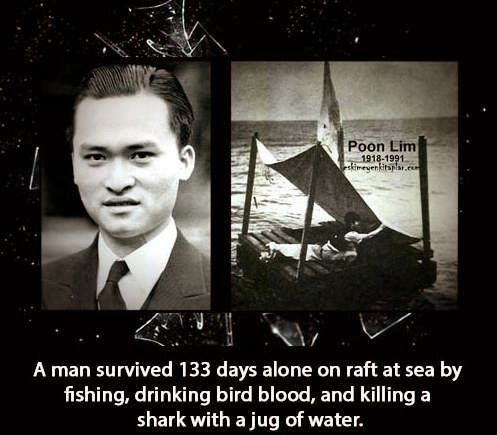 Chinese native Poon Lim was a steward on a British ship during World War II that was travelling from Cape Town to Surinam. The Germans intercepted the boat 750 miles east of the Amazon and two torpedoes sunk the boat in two minutes. Lim would be the only man of the 53 on board to survive the attack. After two hours in the water, Lim found an eight foot wooden raft which had tins of biscuits, a forty litre jug of water, chocolate, sugar, two flares and an electric torch on board. Once the reserves were finished he survived on catching rainwater on a canvas jacket and fishing. Nothing like a bit of resourcefulness. A MacGyver ahead of his time, Lim used a nail from the raft and the wire from the torch to make a fish hook, using the hemp rope as the fishing line. He managed to catch fish and small sharks with this crafty method and used a knife he made from the biscuit tin to cut the fish. A half-filled water jug was then used to kill the larger fish and sharks when he struggled to kill them with the knife. Ouch! Sharks were particularly fruitful and he drank the blood from their liver for survival. He even drank the blood from a bird he caught at a time when he was barely alive after a storm spoilt his fish and fouled his water. Poon had to deal with sunburn, seasickness and the agony of watching boats go by. First a freighter and then a squad of US Navy patrol planes went past, with Poon contending it was because he was Chinese that they didn’t offer assistance. It should also be noted that at the time that U-Boats often offered ‘dummy’ survivors to ambush their enemies. A German U-Boat also saw a stricken Poon but did not help. Poon counted the days by tying knots in a rope, but after spending so long at sea decided that there was no point in counting the days and simply began counting full moons. However after an incredible 133 days in the raft, three Brazilian fishermen discovered the raft. He had lost 9kg and spent four weeks in hospital but made a full recovery. To this day no-one has spent longer at sea in a raft and the US Navy teaches his survival techniques to its sailors. As Poon said about his record before his death, “I hope no one will have to break it”. Amen to that. |
|
|
Sep 30 2013, 12:07 PM
|
|
Junior Member
92 posts Joined: Jun 2012 From: hurr-durr
|
QUOTE 1. The average person wakes up about 6 times every night. 2. In Oklahoma, it’s actually illegal to take a bite out of another person’s hamburger. 3. Aside from the 3 monkeys that depict “see no evil, hear no evil, speak no evil” there’s also a 4th that symbolizes “do no evil.” 4. Zebras are actually black, with white stripes – If you were to shave one, it would be completely black. 5. Jackie Chan is actually a classically trained opera singer |
|
|
Sep 30 2013, 12:58 PM
|

Senior Member
1,439 posts Joined: Jan 2011 From: Ipoh, Perak 
|
Nice facts bro!
|
| Bump Topic Add ReplyOptions New Topic |
| Change to: |  0.0254sec 0.0254sec
 0.68 0.68
 5 queries 5 queries
 GZIP Disabled GZIP Disabled
Time is now: 15th December 2025 - 12:13 PM |
 Quote
Quote