Welcome Guest ( Log In | Register )

76 Pages « < 3 4 5 6 7 > » Bottom

Outline · [ Standard ] · Linear+

 Singapore REITS, S-REITS

views
     
SUSTOS
post Aug 7 2020, 11:15 PM

Look at all my stars!!
*******
Senior Member
8,667 posts

Joined: Aug 2019
From: Penang <-> Singapore


Important info for Sabana REIT shareholders (and ESR-REIT's too).

https://www.theedgesingapore.com/news/reits...ana-reit-merger

https://www.savesabanareit.com/

There is a new open letter being sent out today by Black Crane and Quartz today: https://e67b5536-3500-4e76-a4b1-1e47f7092aa...6b507e385fc.pdf

This post has been edited by TOS: Aug 7 2020, 11:19 PM
SUSTOS
post Aug 9 2020, 10:55 AM

Look at all my stars!!
*******
Senior Member
8,667 posts

Joined: Aug 2019
From: Penang <-> Singapore


Malls will no longer be the same after Covid-19

QUOTE
9 August 2020
The Straits Times
STIMES
English
© 2020 Singapore Press Holdings Limited
The pandemic is changing how shopping malls are built, in perhaps the most disruptive retail environment in modern times.

Developers have replaced the vacant big units with a mix of retail, dining, entertainment, fitness, co-working and healthcare options. They have also added apartments, hotels and offices to the properties - often to make better use of vacant parking lots and create built-in traffic generators - and they are beginning to create distribution and self-storage hubs at malls as more people purchase their goods online.

In June, Washington Prime Group agreed to turn a former Sears location at its Morgantown Mall into a logistics, distribution and fulfilment centre for a healthcare network serving West Virginia University.

"As more department stores become vacant, we do need to re-envision the future of mall properties," said Mr Greg Maloney, president and chief executive of the Americas retail unit of Jones Lang LaSalle.

"Will it be 100 per cent retail? No, but its success still comes down to location."

Long before the coronavirus arrived in the US, many malls, often overburdened with debt and struggling with vacancy and declining values, were fighting to stay alive.

The number of malls has declined to fewer than 1,000 today from 3,000 at the turn of the century, according to Mr Nick Egelanian, president of SiteWorks, a shopping centre and retail consultant. And, he predicts, only about 200 of the strongest malls with the best locations will be left by the end of the decade, if not sooner.

"The true mall of the future will incorporate a mix of uses," he said, "and the retail will be downsized: If it has 2 million sq ft today, it may only need 1 million sq ft tomorrow. But it's going to be painful getting there, and the ones that survive are going to need a lot of capital."

The ideal mall, he said, is one that is surrounded by offices, high-rise residences and hotels.

Some malls will emphasise luxury and cater to the affluent, observers add, while others will focus on middle-market consumers with stores that sell budget products.

This off-price strategy is one that malls of higher quality previously avoided, said Mr Vince Tibone, a senior analyst covering retail for Green Street Advisors.

"In the minds of the owners of top malls, there was a higher and better use for their properties," he said. "But there are a lot fewer options to backfill space today, and even those malls are looking to just get tenants into vacancies."

To better position itself for the future, one middle-market mall owner, Pennsylvania Real Estate Investment Trust, has sold 18 malls with significant department store exposure over the past five years and is reinvesting more than US$885 million (S$1.21 billion) in proceeds into its core assets.

Among other projects, the real estate trust sank US$210 million into the Fashion District, a 1.5 million sq ft mall in downtown Philadelphia that it owns with Macerich. A number of new tenants joined the roster when it reopened last year, including an AMC Theatres cineplex and flexible-office provider Industrious.

Other non-retail companies continue to show interest in the company's properties, said Mr Joseph Coradino, chief executive of Pennsylvania Real Estate Investment Trust, which is based in Philadelphia and owns 21 malls primarily on the East Coast.

"When you step back and look at malls, they typically have phenomenal locations at major intersections and highways," he said. "Certainly, the mall business today is different than it was a year ago or even six months ago. But I don't think the success of malls is a question of apocalypse or death. I think it's really an evolution."

Yet, like many malls that have been repositioned in the past decade, Fashion District boasts a high percentage of food and entertainment tenants. Plagued by questions over how soon consumers will feel safe returning to them, these businesses are operating at partial capacity nationwide, and some are closing.

Observers anticipate that entertainment and restaurants will continue to generate traffic over the long term, although they acknowledge that full recovery depends on a coronavirus vaccine.

Still, restaurants and entertainment have become so ubiquitous that they have failed to live up to the expectations of many mall owners, said Mr Scott Stuart, chief executive of the Turnaround Management Association, an organisation in Chicago that represents restructuring professionals.

"While the uses have filled gaps in malls, they're beginning to look like short-term solutions," he said. "Consumers have a choice to go to a mall or some other setting to experience them."

Some owners, however, will be forced to recognise that their locations no longer fit in the retail world, Mr Egelanian said. But that may produce opportunities to start new industrial, housing, office or mixed-use developments from scratch.

"There may not be any time in the last 100 years when so many 100-acre (40.5ha) sites located at that perfect intersection have been available for redevelopment within such a short period of time," he suggested. "They will have value for many uses and could be big economic generators for their communities."

NYTIMES

An artist's impression of the downtown Fashion District Philadelphia mall, where US$210 million was spent on renovations before it reopened last year with a number of new tenants. Some mall operators are spending big to better position themselves for the future.

Singapore Press Holdings Limited

SUSTOS
post Aug 15 2020, 07:33 AM

Look at all my stars!!
*******
Senior Member
8,667 posts

Joined: Aug 2019
From: Penang <-> Singapore


With Sabana Reit merger in question, will ESR move on to next target?

Nearly all other minorities will have to say yes to overcome Quarz and Black Crane's opposition to deal

QUOTE
Companies & Markets

HOCK LOCK SIEW; With Sabana Reit merger in question, will ESR move on to next target?
Lee Meixian
Lee Meixian , With Sabana Reit merger in question, will ESR move on to next target?

13 August 2020
Business Times Singapore
STBT
English
© 2020 Singapore Press Holdings Limited

AN observer to the tussle between ESR-Reit and activist unitholders at Sabana Reit has described the proposed merger between the two Reits as being "in the intensive care unit".

Getting the deal done would require the agreement of nearly all the minority unitholders of Sabana Reit, said Justin Tang, head of Asian research at United First Partners.

Fund managers Quarz Capital and Black Crane Capital, which have said they will not support the merger, collectively control 10 per cent of Sabana Reit.

Sabana Reit's sponsor ESR, meanwhile, holds 20.88 per cent. And Chinese tycoon Tong Jinquan holds 3.3 per cent. Both parties have said they will abstain from voting on the scheme of arrangement for the merger.

For the deal to go through, more than half of the individual unitholders present and voting at the EGM or scheme meeting must be in favour of the deal. On top of that, these unitholders must represent at least 75 per cent of Sabana Reit's ownership.

Given that typically only half of an issuer's unitholders or shareholders will turn up at such a meeting, Mr Tang said: "This means almost all other minorities have to say yes."

What are the factors that unitholders need to consider?

Playing it cool

Acquiring Sabana Reit would give ESR-Reit greater heft - an increasingly important attribute among real estate investment trusts. The combined Reit would have a better chance of making it into the EPRA NAREIT index, which would put it on the watch lists of more institutional investors.

But ESR-Reit appears to have no intention of bending over backwards to make the merger happen. ESR-Reit has already said that it will not - and in fact cannot - revise the offer price for Sabana Reit.

Meanwhile, the sponsor of ESR-Reit has gone back to accumulating units in another industrial Reit: Aims Apac Reit (AA Reit). On Aug 5, ESR Cayman bought 400,000 units in AA Reit for S$485,440. This took its stake from 12.95 per cent to 13 per cent.

ESR-Reit's sponsor has been quietly building its holdings in AA Reit. At the start of November last year, it had held just 5.24 per cent of AA Reit.

ESR-Reit's purchases of AA Reit bring to mind steady purchases of Sabana Reit before the proposed deal was announced.

Besides having other options available to it, ESR-Reit may also believe that its offer is a good one. Sabana Reit has historically traded at a discount to its net asset value. At its closing price of S$0.37 on Wednesday, it was still a 27 per cent discount to its net asset value of S$0.51 per unit as at end-June 2020.

More than just the price

Quarz and Black Crane also believe Sabana Reit shareholders have other options besides what they see as a merger that undervalues Sabana's assets.

Although they recognise the merits of a marriage - economies of scale, increased synergies, potential re-rating of the enlarged entity - they say Sabana Reit would be able to obtain some of the purported benefits of the merger via organic means.

For instance, Black Crane said it had written to Sabana Reit's board in June 2019 with suggestions on how the Reit can reduce the discount of its unit price to net asset value.

It had, for instance, suggested removing the Shariah compliance of the Reit so that it can refinance debt more cheaply. But Black Crane said none of its suggestions has been taken seriously or executed.

Quarz and Black Crane point out that ESR-Reit has now proposed that the Shariah compliance be dropped once the merger is completed.

"It raises concerns on whether the fiduciary duty of Sabana's board and management to act and protect all unitholders' interest has been potentially compromised," said Quarz and Black Crane in a letter.

Of course, the Shariah compliance factor may not be as significant a factor as size in determining Sabana Reit's borrowing costs or valuation. Smaller-sized Reits have long traded at a discount.

But Quarz and Black Crane have used this issue as one of several examples suggesting that Sabana Reit's manager has not done its best to explore the available options to boost the Reit's valuation.

In a call with The Business Times, Peter Kennan, chief investment officer at Black Crane, said: "Sabana Reit's management has steered themselves into a corner with not many options, and the independent financial adviser (IFA) would likely say, 'Given that you are in a corner, the best option is this', but the IFA wouldn't ask them why they got into that corner in the first place."

He said the manager has not been thinking "entrepreneurially", but has been following "more of a compliance mindset".

"There are other options to create value for Sabana unitholders which the manager has not fully explored," he said, adding that the Reit's choices quickly became limited when ESR bought control of the manager in 2019 and accumulated a 20 per cent position in the Reit over time.

Alternatives

Quarz and Black Crane have suggested Sabana Reit could run an auction for its assets or hold a beauty parade for potential offerors. The problem with these suggestions isn't, however, that they aren't good, but that they also require support from the Reit's manager and sponsor. Short of internalising the Reit manager, this will be a persistent difficulty.

Quarz and Black Crane will be counting on the support of other minority unitholders to push its suggestions through. But that will require other unitholders to agree that they are getting a raw deal. On that point, views differ.

Independent investment site Probutterfly.com said ESR-Reit seems to be taking advantage of the suppressed stock price of Sabana Reit to launch a takeover.

But Mr Tang from United First Partners said the risk for minorities should the deal fail is that Sabana could continue to underperform.

"Will history repeat? This is not the first time that a potential merger with Sabana Reit has failed. In November 2017, Sabana Reit had announced that talks of a possible sale to ESR-Reit had also fallen through.

"The question minorities have to ask themselves is what happens if the deal fails? Can they stand on their own feet and will they be able to accomplish what the minority activists say is possible?"

For the deal to go through, more than half of the individual unitholders present and voting at the EGM or scheme meeting must be in favour of the deal. On top of that, these unitholders must represent at least 75 per cent of Sabana Reit's ownership.

Singapore Press Holdings Limited


This post has been edited by TOS: Aug 15 2020, 07:35 AM
SUSTOS
post Aug 15 2020, 07:49 AM

Look at all my stars!!
*******
Senior Member
8,667 posts

Joined: Aug 2019
From: Penang <-> Singapore


Keppel Pacifc Oak US Reit's shareholders should read this:

TOPLINE; Reits in high-growth markets should gun for short leases: KORE CEO Snyder

user posted image

''I don't care if it's an up or down economy, WALEs should be short if you have good buildings in good markets. And that's because your (potential) rent growth should exceed what you can build into your leases,'' says Mr Snyder.


QUOTE
Lee Meixian
Lee Meixian , Reits in high-growth markets should gun for short leases: KORE CEO Snyder

10 August 2020
Business Times Singapore
STBT
English
© 2020 Singapore Press Holdings Limited
He believes this enabled Keppel Pacific Oak US Reit's portfolio to generate 14.7% rent reversions in H1.

DAVID Snyder, the CEO of Keppel Pacific Oak US Reit (KORE), doesn't believe in long weighted average lease expiries (WALEs), because he thinks it prevents landlords from realising positive rent increases for good properties located in strong markets.

"The stronger your market, the shorter lease terms you want," he said. "This is one of those myths that are perpetuated in the marketplace by office landlords who don't exist in strong markets and don't have good tenancies and ... say their WALE is really long, like that's a good thing."

Most Reits boast about long WALEs because it is an assurance of stability in their rental income in the medium term.

For H1 2020, the other two US office Reits listed in Singapore, Manulife US Reit and Prime US Reit, reported WALEs of 5.7 years and 4.8 years, respectively. They saw rental reversions of 7.9 per cent and 8.5 per cent, respectively.

But Mr Snyder said: "I don't care if it's an up or down economy, WALEs should be short if you have good buildings in good markets. And that's because your (potential) rent growth should exceed what you can build into your leases."

KORE's portfolio of 13 freehold office buildings and business campuses across eight suburban markets - in Seattle, Sacramento, Denver, Dallas, Austin, Atlanta, Houston and Orlando - has 2.6 per cent built-in average annual rent escalation.

But the portfolio's in-place rents are 10.8 per cent below asking rents in their markets. In fact, in H1 2020, the portfolio generated 14.7 per cent positive rental reversions. More than half the Reit's portfolio is located in the fast-growing technology hubs of Seattle, Denver and Austin.

"For the last couple of years, our markets have averaged 5 per cent rent growth per year. If we have been capturing 2.6 per cent (rental escalation) every year, we're still missing out on about 2.5 per cent," Mr Snyder said.

"If I sign a 10-year lease, I don't want to be 25 per cent below market at the end of that lease. Nobody should ever want a long WALE. It is a lousy idea for office Reits to have a long WALE if they have good buildings in good markets," he added.

KORE has a committed portfolio occupancy of 94.3 per cent and portfolio WALE of four years as at end-June 2020, compared to the six to 10 years leases signed by its competitors.

The winds are shifting though. Since Covid-19 struck this year, and with a second wave hitting some states such as Texas, commercial real estate research firm CoStar is projecting that average office rents in the US will decline 6 per cent over the next 12 months in gateway cities, and 5.5 per cent in KORE's key growth markets.

Mr Snyder, who is also chief investment officer of KORE's manager, said that the Reit did not see lower rents when it signed leases in July and August.

However, there aren't many businesses looking to lease new space right now, he added. "In March, touring pretty much stopped. Tenants are trying to figure out what their space needs will look like in the future, how much space they will need. Most are preferring to think about it later when they have better information."

The Reit thus saw more renewals than new leases signed in the first six months. Tenants are also negotiating for leases as short as 12 months.

Still, the Reit's properties are located in cities with higher than average growth in employment, population and GDP. Yet, these cities also boast lower taxes and costs of living compared to gateway cities.

These factors make them magnets for businesses trying to escape the high costs of California and New York. For instance, two years ago, healthcare giant McKesson announced plans to move its global headquarters from San Francisco to Las Colinas in the Dallas suburb of Irving, Texas.

"Californians in general have been looking for what they have in California but at much lower costs and they've found that in places like Seattle, Austin, Dallas," Mr Snyder said.

"New Yorkers tend to go other places. To some degree, some do go to Texas and Salt Lake City, but they tend to like moving to Florida, North Carolina and South Carolina."

Still, weaker economic growth in the US is bound to put pressure on businesses, especially if a surge in Covid-19 infections leads to further lockdowns. This will certainly lower rent growth and change tenants' space needs, Mr Snyder said.

Yet, the Reit has seen a "significant drop-off" in requests in rental relief since May, he added. To date, rental deferrals have impacted only 2.8 per cent of KORE's cash rental income (CRI).

Rent deferrals given to office tenants were generally for half a month's worth of rent, to be repaid over the next 12 to 18 months.

For affected retail tenants, deferrals are generally for a full month of rent, but as much as four months for some tenants. However, KORE's retail tenants account for less than 2 per cent of its CRI.

"If the second wave persists for months, I think we'll see more requests (from our tenants) and we'll have to work through that, just like every office landlord in the US," Mr Snyder said.

He added that office property dynamics and economic fundamentals in most of the Reit's key markets remain sound, with limited supply expected over the next few years. This will likely continue to support growth for the Reit.

Seattle, where properties accounting for almost two-fifths of KORE's portfolio CRI are located, has 65 per cent of its under-construction inventory pre-leased, and ranked first among all states in terms of 12-month absorption.

"Overall, we are expecting lower but positive rental reversions going forward, but this also depends on the length and severity of the epidemic," Mr Snyder said.

Another advantage KORE has is its large proportion of tech tenants who would find it harder to get employees to work from home given their need for testing and development lab space. They are therefore less likely to give up space compared to their financial and professional service counterparts.

Furthermore, KORE's suburban office buildings and business campuses also benefit from businesses' potential shift away from downtown, CBD locations and their need to de-densify due to Covid-19.

Asked about acquisition opportunities, Mr Snyder said that it will be difficult to buy new buildings in the near term, given the current lack of transactions in the market, which makes pricing difficult.

That said, Mr Snyder has been looking at "a couple" of buildings that Pacific Oak Strategic Opportunity Reit and Pacific Oak Strategic Opportunity Reit II will potentially make available in the next 12 to 18 months.

These are the entities from which it had purchased its initial portfolio. They are opportunistic investors that buy underperforming assets, add value to them, and turn them around to generate total returns in excess of 10 per cent.

Mr Snyder said KORE will continue to focus on cities that have worked well for it, including Houston, Florida; Salt Lake City, Utah; Nashville, Tennessee; Charlotte, North Carolina; and Phoenix, Arizona.

Units in KORE have fallen 8 per cent since the beginning of the year. The Straits Times Index is down 21 per cent, while the FTSE ST Reit Index is down 9 per cent. At their current level, units in KORE offer a forward yield of 8.6 per cent.

Singapore Press Holdings Limited

SUSTOS
post Aug 15 2020, 11:02 AM

Look at all my stars!!
*******
Senior Member
8,667 posts

Joined: Aug 2019
From: Penang <-> Singapore


CE REIT results:

https://links.sgx.com/1.0.0/corporate-annou...e1be8893f330a17

CE REIT Property valuation:

https://links.sgx.com/1.0.0/corporate-annou...c5e26bbcc8b135f


SUSTOS
post Aug 18 2020, 03:04 PM

Look at all my stars!!
*******
Senior Member
8,667 posts

Joined: Aug 2019
From: Penang <-> Singapore


One giant fish bought Parkway Life REIT just a moment ago, and the share price "explodes".

user posted image

https://www.sgx.com/securities/equities/C2P...ces%20&%20Chart

I don't see any special or significant announcement though that would drive the share price though.

This post has been edited by TOS: Aug 18 2020, 03:05 PM
SUSTOS
post Aug 21 2020, 05:46 PM

Look at all my stars!!
*******
Senior Member
8,667 posts

Joined: Aug 2019
From: Penang <-> Singapore


QUOTE(Havoc Knightmare @ Aug 18 2020, 05:44 PM)
It's just a matter of time before hunt for yield begins among the laege institutional investors again because bond yields are next to nothing now.. the REITs that show more resilience will benefit the most.
*
Parkway LIFE has been on a zigzag manner for the past 2-3 trading days, one day up 2-3%, the next day down 2-3%, then today up another 2-3%.

Doesn't seem like fund managers are playing with these kinds of game. Bulls and bears retailers are fighting among themselves?

This post has been edited by TOS: Aug 21 2020, 05:46 PM
SUSTOS
post Aug 21 2020, 09:05 PM

Look at all my stars!!
*******
Senior Member
8,667 posts

Joined: Aug 2019
From: Penang <-> Singapore


QUOTE(Havoc Knightmare @ Aug 21 2020, 06:38 PM)
Its important to not over analyze day to day moves. Liquidity is quite thin for this REIT despite its size.. it doesn't take a big buyer or seller to move the stock significantly.
*
I am a long term investor, so not that worried. Just curious. You are right that liquidity is thin and that wider bid-ask spread is one contributing factor too. Thanks for the heads-up.
SUSTOS
post Sep 20 2020, 09:20 PM

Look at all my stars!!
*******
Senior Member
8,667 posts

Joined: Aug 2019
From: Penang <-> Singapore


Sharing some The Edge articles related to S-REITs:

Corporate Watch: CapitaLand Financial: The ties that bind REITs and funds

QUOTE
Goola Warden
Stories by Goola Warden (goola.warden@bizedge.com)

7 September 2020
The Edge Singapore
EDGESI
English
© 2020 The Edge Publishing Pte Ltd. All Rights Reserved.
CapitaLand’s fund management business was one bright spot in an otherwise dreary results reporting season for the property behemoth. Fee income from its REITs and private funds rose 44% y-o-y to $146.4 million in 1HFY2020 ended June. To put that in context, CapitaLand’s total fee income in 1HFY2020 was $307 million, up 11.6% y-o-y.

In 1HFY2020, the CapitaLand group reported revenue of $2.03 billion, down 4.9% y-o-y. It also reported Ebit of $596.8 million, down 71.1% y-o-y; operating profit after tax and minority interest of $261.2 million, down 27.7% y-o-y; and Patmi of $96.6 million, down 89% y-o-y. The drastic declines in Ebit and Patmi were caused by revaluation losses for CapitaLand Mall Trust (CMT) and CapitaLand Commercial Trust (CCT), announced in July.

Indeed, fees from fund management are a modest but growing part of CapitaLand’s business. Fee income represents higher return on investment and return on equity as property investment is capital-intensive. Fee income also depends on AUMs, but tends to be relatively asset-light. And despite its modest size, most fee income goes to the bottomline and hence it is likely to be a larger portion of Ebit and operating Patmi.

CapitaLand is the largest fund manager in Asia Pacific and ranked 9th globally in 2019, according to the Fund Manager Survey jointly conducted by the Asian Association for Investors in Non-Listed Real Estate Vehicles, the European Association for Investors in Non-Listed Real Estate Vehicles and the National Council of Real Estate Investment Fiduciaries in the United States.

As at June 30, total AUM at CapitaLand stood at around $134.7 billion. Of this, $74.5 billion is from a combination of private funds ($24.8 billion) and REITs and business trusts ($49.7 billion). CapitaLand announced last year that it has a target of $100 billion in AUMs from its private funds and REITs to be attained in five years.

While fee income from CapitaLand’s REITs and funds remained resilient in 1HFY2020, it will be be a challenge for 2HFY2020 to match the $191.5 million fee income recorded in 2HFY2019.

In 2HFY2019, this included the merger of Ascendas Hospitality Trust with Ascott Residence Trust (ART), the largest transaction last year, not counting CapitaLand’s own merger with Ascendas Singbridge which was completed in 1HFY2019. In addition, Ascendas REIT (A-REIT) acquired a US portfolio of 28 properties, Nucleos and FM Global which cost $1.8 billion and raised $1.32 billion through a rights issue to fund the acquisition in November. CapitaLand China Retail Trust (CRCT) also raised around $273.4 million to partly fund the $505.4 million acquisition of three malls — CapitaMall Xuefu and CapitaMall Aidemengdun in Harbin, Heilongjiang province, as well as CapitaMall Yuhuating in Changsha, Hunan province.

“We did $3.8 billion of equity fund raising of which $1.92 billion was by the REITs, CRCT, Ascendas India Trust, Ascendas REIT, and a placement by CapitaLand Commercial Trust,” recounts Jonathan Yap, president of CapitaLand Financial, in a recent interview. CCT raised $220 million in a placement in July 2019 to partially pay for Frankfurt Main Airport Center. CCT’s acquisition of a 94.9% stake in the building cost EUR251.5 million or $387.1 million at that time. Lastly, Ascendas India Trust (a-iTrust) had also raised $150 million to part fund a business park in Bangalore.

In the face of Covid-19, real estate transactions have been muted in 1HFY2020. Similarly, CapitaLand had announced fewer deals. Ascendas REIT acquired a 25% stake in Galaxis for $103 million; CRCT divested CapitaMall Erqi in Zhengzhou for $151 million; and in January, CCT and CMT announced a merger. The deal is structured such that CMT acquires each CCT for 0.72 CMT units plus 25.9 cents to form CapitaLand Integrated Commercial Trust. The long stop date is Sept 30.

25 private funds and counting

As at June 30, CapitaLand was managing 25 private funds with AUM of $15.9 billion. Last year, CapitaLand raised just under $1.9 billion through three private funds, CREDO I China, CapitaLand Asia Partners (CAP 1) and Ascendas China Commercial Fund 3.

CREDO I, which raised US$750 million ($1.02 billion), is a debt fund which invests in offshore US dollar-denominated subordinated instruments for real estate in China’s first- and second-tier cities such as Beijing, Chengdu, Chongqing, Dongguan, Guangzhou, Hangzhou, Hong Kong, Nanjing, Shanghai, Shenzhen, Suzhou, Tianjin, Wuhan, Wuxi, and Xi’an.

CAP I has a broader remit. Its mandate is to invest in selected developed market cities such as Osaka, Tokyo, Singapore, Beijing, Shanghai, Guangzhou and Shenzhen. So far, CAP I has acquired two buildings in Shanghai, Innov Center in Shanghai’s Yangpu District at a price that takes into account an agreed property value of RMB3.1 billion ($621 million), and Pufa Tower in Lujiazui CBD, Pudong.

“It’s a discretionary fund. We bought two assets in Shanghai and one in Singapore at what we believe to be a good price,” Yap says. The Singapore commercial property was acquired at around $200 million he adds. “The asset needs work to be done on it, and it is not fully stable, hence it doesn’t make sense for a REIT. The investors like to be below the radar and that’s why they don’t buy REITs and we need to respect their desire to be below the radar,” Yap explains.

All in, CAP I raised over $700 million. Around $500 million was raised in the main fund, which holds the two Shanghai properties. “We have a ‘sidecar’ arrangement,” Yap says. This is a “side” investment vehicle where some of the investors in the main CAP I fund put in more money into the sidecar where the Singapore asset is parked. “Our first close was enough for the two Shanghai properties plus a small amount for the Singapore property. We are working on a second close for CAP I but held back because of Covid as prospective investors were not able to travel for due diligence. Nonetheless, sidecar arrangements remain possible for investors who are familiar with the markets they are investing into,” Yap elaborates.

Raffles City The Bund

In its 1HFY2020 results presentation, CapitaLand announced that increasing leasing activities are taking place at Raffles City The Bund and Raffles City Chongqing — both glamorous projects on or near famous sites. Raffles City The Bund is in the North Bund, which is across the Huangpu River from Oriental Pearl Tower and Lujiazui, and is the main asset in Raffles City China Investment Partners III (RCCIP III). RCCIP III has AUM of US$1.5 billion and a life of eight years from 2016. Co-investors include Singapore’s GIC and the Canadian Pension Plan Investment Board.

How will CapitaLand get to AUM of $100 billion? “It’s about growing the existing REITs and private funds. The pool of capital is there and the platform is there; but it’s also about raising new funds. Ultimately, when investors invest with us, it is for our execution capabilities. So we would start in sectors and geographies where we have a competitive advantage in capabilities and execution which means commercial offices, logistics assets, business parks, data centres,” Yap explains.

While CapitaLand focuses on its four key markets of Singapore, China, India and Vietnam, there is also a clear demand for markets like the UK, US, Australia and Japan. “It is matching what investors want and those markets where we have an on-the-ground presence.”

CapitaLand’s capital partners and investors in its private funds include sovereign wealth funds, pension funds, family offices, institutional investors, endowment funds. “These are possible co-investors we can partner with, on the private fund side,” Yap explains.

Local precinct plans

On Nov 21, 2019, both CapitaLand and City Developments (CDL) announced redevelopment plans for the Liang Court site. In May, the duo formed a 50:50 joint venture to acquire the mall at the Liang Court site from PGIM Real Estate Asia Retail Fund for $400 million. The acquisition paved the way for the redevelopment of the entire plot.

The CDL-CapitaLand joint venture will be developing two residential towers comprising a total of 700 residential units, and an 11,530 sq m retail mall. Together, these two components should have a gross development value of more than $1 billion based on current residential prices and retail mall valuations. The rest of the commercial GFA will be made up of a hotel and a serviced residence block held under CDL Hospitality Trusts (CDL-HT) and ART respectively.

“We can play the precinct game a lot better because scale gives us the opportunity to see what is not the most obvious,” Yap suggests. Although Singapore is a small market, there are big opportunities, he adds.

Other precinct plays could involve Bugis Junction, Bugis+ and Bugis Village. “They come as a Bugis precinct and we make sure the three properties are managed in a manner they are cohesive and exist as a single solution,” Yap says.

Elsewhere, he cites International Business Park and Jurong East as the next region that could offer redevelopment potential. “We need to engage the authorities before coming up with a plan,” he says. “We are trying to go beyond ownership and tenure to figure out what makes sense as a whole so that for all stakeholders there is mutual win across the board.”

During a results briefing in August, CapitaLand CEO Lee Chee Koon said the group is interested in further developing its data centre portfolio, which was acquired through its merger with Ascendas-Singbridge. “The challenge around data centres is it’s highly regulated because of the power it consumes and it’s not so easy to grow rapidly. We have a team and newly appointed CEO responsible to look at this asset class and hope to be able to share more good news once we build up a more substantive asset class,” says Lee.

At present, CapitaLand has four data centres in Singapore — three under Ascendas REIT (Telepark, Kim Chuan Telecommunications Complex and 38A Kim Chuan Road) and one under CapitaLand’s balance sheet (9 Tai Seng Drive). The Tai Seng Drive centre offers scalable solutions such as colocation services and is built-to-suit which offers design customisation. It is also a move-in-ready white space with its own power and cooling units and a 24/7 operations team.

CapitaLand will stick with its strategy of finding value, creating value and unlocking value. “I don’t think our strategy changed with Covid-19. What may change is our approach,” Yap says. For instance, retail as a human requirement does not disappear but the approach is different.

For example, CapitaLand is harnessing offline and online opportunities such as the implementation of eCapitaMalls, and seizing larger precinct opportunities to meet challenges including the cross-selling of services such as warehousing and retail space.

“Covid actually validates CapitaLand’s strategy,” Yap concludes.

The Edge Publishing Pte Ltd


Capital: Cover Story: With new mandate, ParkwayLife REIT readies for next growth phase

QUOTE
All stories by Goola Warden(goola.warden@bizedge.com)

24 August 2020
The Edge Singapore
EDGESI
English
© 2020 The Edge Publishing Pte Ltd. All Rights Reserved.
The hospital and nursing home REIT is eyeing new markets, game-changing acquisitions and the renewal of a longer master lease

ParkwayLife REIT (PLife REIT) has consistently been one of the top-five performing REITs among Singapore-listed REITs or S-REITs, along with Keppel DC REIT, Mapletree Industrial Trust, Mapletree Logistics Trust and Ascendas REIT.

Since its IPO at $1.28 cents in 2007, PLife REIT has returned more than $1.35 to unitholders during the past 13 years. And despite the Covid-19 pandemic, PLife REIT continues to trade at a premium to net asset value (NAV) of 1.85 times as at Aug 17.

With investors waiting on the sidelines to enter PLife REIT, its recently approved general mandate provides an opportunity to invest for those who felt that its yields were too low and premium to NAV too high. The general mandate also means an opportunity for growth.

The reason why PLife REIT has done so well is partly because it is in a defensive and a growth sector — healthcare. ParkwayLife REIT is unique among S-REITs in that it owns three hospitals in Singapore, and 48 nursing homes in Japan. But it has also had the same management team for a long time.

Among them is Yong Yean Chau, CEO of PLife REIT’s manager, who joined the company in 2008, and has overseen its performance for 12 of the past 13 years.

“We stressed to investors we need to recognise that our end goal is to make sure DPU is sustainable and gives a growth story. But the priority is sustainability of distributions and that drives our strategies including capital management,” he tells The Edge Singapore in a recent interview.

“We see acquisition as a means to achieve an end and not the end goal. It must serve to add to the resilience of cash flow and increase DPU, and is not for increasing our assets under management,” he adds pointedly.

This approach sets PLife REIT apart from many S-REITs, where sponsors and managers have encouraged acquisitions to increase AUM, arguing often that size matters.

To recap, PLife REIT listed in August 2007, with a gearing ratio of 4%. Within two years, it had acquired its first Japanese nursing home portfolio. As at June 30, PLife REIT owns Mount Elizabeth Hospital, Gleneagles Hospital and Parkway East Hospital. In Japan, PLife REIT has over the years acquired 48 nursing homes, and a pharmaceutical product distributing and manufacturing facility in Chiba Prefecture. It also owns strata-titled units in MOB Specialist Clinics Kuala Lumpur in Malaysia.

In his unassuming manner, Yong says the reason for the REIT’s performance is a focused strategy in three key areas. “We adopt a very targeted approach in investing and we have a clustering approach where we focus on growing within a market, for example Japan, where we have reached a stage where we can enjoy scale and cost savings,” he explains.

Secondly, the REIT manager works proactively with the nursing home operators if there is a need for asset enhancement initiatives (AEI) to improve revenue and bottom line. Yong is careful about choosing these nursing home operators. “With stronger operators, our tenant default risk will be much lower and over time rentals would increase,” he says.

The third principle is, of course, capital management. PLife REIT uses long-term debt and natural hedges in Japan to mitigate forex risk, and adopts cash flow hedges so that DPU remains stable.

While its gearing ratio is around 38%, PLife REIT has the highest interest cover ratio (ICR) of 15.8 times. This is a new metric required by the Monetary Authority of Singapore (MAS). In 1HFY2020 ended June, PLife REIT’s revenue from the Singapore hospitals was $34.6 million, 1.8% higher than in 1HFY2019, while the Japanese nursing homes recorded revenue of $24.5 million, up 10.4% from 1HFY2019. These took total revenue — including a small contribution from Malaysia — to $60.1 million, up 5.1% from a year ago. In its first full year after IPO, PLife REIT reported revenue of $53.9 million, of which only $5.2 million was from the Japanese properties.

The nursing home operators have signed long master leases for PLife REIT’s Japanese assets. For instance, in December 2019, when PLife REIT acquired three nursing rehabilitation facilities with experienced operators for JPY3.7 billion ($46.3 million), they came with long-dated master lease agreements of 20 years. The acquisition lengthened its Japanese WALE (weighted average lease expiry) to 11.56 years as at June 30.

Most of the Japanese properties come with an “up only” rental review provision. This usually means that the rent payable can only be reviewed upwards, and not downwards. Of the 48 Japanese nursing homes, 40 properties comprising 81.8% of Japanese gross rental income have market revisions with downside protection; seven properties have revisions every two-three years subject to lessor-lessee lease agreements; P-Life Matsudo is on a fixed rent for 10 years, and one property has rents linked to the Consumer Price Index (CPI), which measures inflation.

Overall, 95% of PLife REIT’s Singapore and Japan portfolios have downside revenue protection and 59% of the total portfolio is pegged to a CPI-linked revision formula.

General mandate wins favour

Since its IPO in 2007, the number of PLife REIT units outstanding has stood at 605.02 million. That is because PLife REIT was the only REIT that did not have a general mandate to issue new units. However, as gearing inched towards 38.2%, PLife REIT held an AGM in June to ask unitholders to approve a general mandate. Under the general mandate, the REIT can issue units up to 20% of the units outstanding in a given year. In a pro-rata situation which would involve equity fund raising or rights issue, the REIT can issue up to 50% of units outstanding in a calendar year. As expected, unitholders voted overwhelmingly in favour of a general mandate.

“Over the last few years, investors and different stakeholders have asked when we were going to do the first equity issuance. Since IPO, we have not done equity issuance because we started off with a gearing of 4% and there was no need to tap equity. In Japan, cheap cost of debt also meant it did not make sense to fund acquisitions with equity,” Yong explains. “We may not activate the general mandate, but it gives us the flexibility.”

Following a well-defined growth strategy, Yong is looking to expand into a third market, with PLife REIT well anchored in Singapore and Japan contributing to 41% of revenue. Earlier this year, at the height of Covid-19 pandemic in Asia, one of PLife REIT’s Japanese properties reported a confirmed Covid-19 case. The operator stepped in quickly to quarantine the staff and residents. Subsequent testing showed them negative. Operations have stabilised, but PLife REIT retained $850,000 as part of the $1.7 million set aside to help tenants contain and manage Covid-19.

“As a landlord, besides cash flow and rental relief, we look at how we can help tenants to contain and manage the current situation,” Yong says. “That explains why a third key market is important over the longer term and why a lot of focus is on development and establishing a foothold in it,” he explains.

More likely than not, PLife REIT’s third market is likely to be a developed market with a focus on an operator with strong credit metrics. “The operator is a particular focus and must be strong, and preferably with the opportunity for further synergies, someone we can potentially partner with, not only for acquisitions but for a pipeline,” Yong says.

Yong outlines a few conditions for potential moves into a third country. Ideally, the lease should be long, with downside protection such as a inflation-linked increase in rental every year. “In Europe, we see a lot of lease structures that are downside protected, that come with CPI-related increases. The occupancy cost should not be too high though,” Yong adds.

Since DPU sustainability is key to the strategy of PLife REIT, asset valuation and DPU accretion would also be a focus. “During Covid-19, all these measures are important for sustainability of revenue. It is also important not to be too urgent in search for growth, but to focus on the fundamentals. The last thing to do is to buy overvalued assets. We took pains to build [our portfolio] over the last 12–13 years and diversifying to a third market serves to strengthen the resilience of our cash flow,” Yong explains.

“Developing a third key market is mission-critical, while looking at incremental acquisitions in Japan to give yield accretion in the next 1–2 years. The general mandate came in, and that would enable us to come up with a more optimal capital structure,” he adds.

Mount Elizabeth Novena

The most interesting part of having a general mandate would be to make a transformational acquisition. PLife REIT’s sponsor is IHH Healthcare, which is dual-listed in Singapore and Malaysia and owns Mount Elizabeth Novena which opened in 2012. As at December 2019, Mount Elizabeth Novena has a valuation of RM3.9 billion ($1.27 million).

When asked about Mount Elizabeth Novena, Yong says: “The hospital remains a good potential pipeline subject to agreement in terms of pricing and valuation, and is something PLife REIT would be keen to look at, but would depend on whether the sponsor is ready to sell the asset.”

And despite plans for a third market, Singapore will still remain a core market, Yong confirms. “PLife REIT’s strategy is to buy a good yield-accretive asset, and this would be a good potential, but it would depend on IHH Healthcare. Hopefully, over dialogue we can work something out,” he adds.

As it stands, PLife REIT’s debt headroom is around $250.1 million based on its Dec 31, 2019, valuation of $1.96 billion. If Mount Elizabeth Novena is added to the REIT’s assets, debt headroom could rise to as high as $732 million, assuming transaction price is around $1.4 billion. For a lower gearing of around 42–43%, debt headroom would be correspondingly lower. PLife REIT is trading at around 1.85 times its NAV of $1.91, and has a yield of 3.8% based on its annualised DPU of 13.44 cents.

Assuming PLife REIT would need to raise around $700 million for a 50:50 debt-equity split which would involve either equity fund raising or a rights issue, the acquisition could still be accretive due to low cost of debt as well as PLife REIT’s DPU yield and P/NAV premium.

“We are 38% geared and with our low trading yield, we want to make sure any assets we buy are good assets. We have been hesitant in doing equity fund raising because we want to show the market we will only tap your money if it’s put to good use. From various feedback, investors are comfortable for us to have a general mandate. It allows us to have the flexibility and speeds up capitalising some of the opportunities there may be in the market,” Yong says.

“To be defensive, one should not be over-geared. We are looking at low 40s at most. But not to 45%. We will remain conservative. Around 40% should be optimal. Especially during Covid-19, all the more we don’t want to over-gear, running the risk in case there are asset devaluations,” Yong cautions.

Master lease renewal

PLife REIT’s formula of the rental income for its three Singapore hospitals is tied to CPI and includes downside protection. It comprises whichever is higher: A base rent of $30 million plus 3.8% of the hospital’s revenue or [1+(CPI+1%)] multiplied by total rent payable for the preceding year. Where CPI is negative, it will be deemed as zero. The first year’s rent was $45 million.

The 14th year minimum rent is set at 1.17% above the rent payable for the 13th year on the CPI+1% formula for the period Aug 23 to Aug 22, 2021.

The initial lease term of 15 years for the three Singapore hospitals ends in August 2022. The master lessee, Parkway Hospital Singapore, a subsidiary of Parkway Pantai owned by IHH Healthcare, has the option to extend the lease for a further 15 years.

When asked if a new lease would be signed, Yong is keeping his cards close to his chest. “We engaged two valuers to help us to make sure the rates we negotiate are fair. Negotiations are underway. I don’t want to run the risk of painting too optimistic or too pessimistic a picture.” At any rate, whatever the new lease structure is, the proposal has to be approved by unitholders since it is an interested party transaction and the sponsor and manager — IHH Healthcare — cannot vote.

“It is important to stress that between sponsor and PLife REIT, we’ve enjoyed a very good working relationship over many years. When tenants’ performance improves, it benefits us, and it’s in the interests of both parties to continue this relationship,” Yong says.

And it is not just about a new lease. According to Yong, the three hospitals have been operating for many years and are quite dated. “It’s important for us and IHH, while looking at reasonable rates, to rejuvenate the assets to make them more efficient for the operators,” Yong continues. “If we can put together a package where it helps to improve the efficiency of the hospitals, that also benefits PLife REIT.”

Among the various strategies would be an IHH-funded AEI which would need landlord approval. The other model is for the REIT to help pay for the funding at certain ROIs. “The end objective is to make sure the model is a sustainable one,” Yong says.

UOB Kay Hian is pretty upbeat about the lease renewal. “The lease structure with rental escalation of CPI + 1% would be maintained. Improved profitability for private healthcare operators provides an opportunity for ParkwayLife REIT to negotiate for higher base rents.The extension of lease could be finalised by end-2020/early-2021,” UOB Kay Hian says in a recent report.

While medical tourism took a dip this year, the three hospitals were used for overruns from Covid-19. During 1HFY2020, occupancy rates hovered around 90%, similar to the levels of the past 10 years. Looking past the pandemic, Yong sees demographic trends working in the favour of the REIT with an ageing population in Japan.

More importantly, PLife REIT is the only healthcare REIT listed on the SGX to date suitable for both retail and institutional investors because of its transparency and conservative management.

The Edge Publishing Pte Ltd


This post has been edited by TOS: Sep 20 2020, 09:43 PM

SUSTOS
post Sep 28 2020, 01:55 PM

Look at all my stars!!
*******
Senior Member
8,667 posts

Joined: Aug 2019
From: Penang <-> Singapore


BT Article: Wariness among Reit managers, trustees as contentious merger proposals move forward

QUOTE
Companies & Markets
MARK TO MARKET; Wariness among Reit managers, trustees as contentious merger proposals move forward
Ben Paul , Wariness among Reit managers, trustees as contentious merger proposals move forward

28 September 2020
Business Times Singapore
STBT
English
© 2020 Singapore Press Holdings Limited
CCT makes curious clarification; Sabana's trustee keeps mum; and annual report addendum shines light on director independence

THIS past week, there were at least three corporate announcements that would have piqued the interest of investors following the spate of real estate investment trust (Reit) mergers in the local market.

The strangest one, in my view, was from the manager of CapitaLand Commercial Trust (CCT), which is scheduled to seek unitholder approval to merge with CapitaLand Mall Trust (CMT) at an EGM on Sept 29.

The announcement sought to "clarify" a Sept 21 story in this newspaper headlined: "CCT: merger with CMT is between two equals, not a takeover".

The manager of CCT wanted it to be known that the description of the deal with CMT as a "merger of equals" only means that the two Reits are "similar in size and standing as best-in-class platforms".

The manager of CCT also wanted to ensure everyone understood that the deal is "not a takeover" only in the sense that it is not an all-cash buyout by CMT.

It went on to describe the deal as a "carefully considered, negotiated and agreed transaction between CCT and CMT, structured as an acquisition by CMT of all (CCT's units), with CCT becoming a private sub-trust of CMT upon completion".

The announcement left me scratching my head. How could the expression "merger of equals" be misinterpreted in a way that would be detrimental to any party involved in the deal? And, why was it necessary to explain the meaning of "not a takeover"?

Was the announcement supposed to help unitholders of CCT make a better informed decision when they vote this week? Or was its purpose to protect the manager of CCT from spurious accusations that it may have somehow misled investors?

It is understandable if the managers of CCT and CMT are feeling nervous. Intra-group Reit mergers have become highly contentious, and questions have been raised about conflicts of interest faced by Reit managers pursuing these transactions.

There is clearly a trend among corporate groups with multiple Reits to combine some of them. Through these mergers, their less successful Reits are weeded out and effectively become part of larger entities that might garner higher market valuations.

The key challenge in pulling off these deals is convincing unitholders that they will be better off having exposure to the enlarged Reit, even if they do not realise the full underlying value of the units they currently hold.

Reit managers are, of course, hardwired to come up with solutions that enlarge rather than reduce the size of their property portfolios. Significantly shrinking or completely liquidating the property portfolio would destroy the Reit manager's raison d'être.

By contrast, unitholders would not be averse to a poorly performing Reit winding itself up, if they were offered a compelling price for the underlying assets. They could quite easily re-invest the proceeds in a more successful Reit.

Still, even if Reit managers have been putting forward merger proposals that are ultimately self-serving, most unitholders have, so far, willingly accepted them.

In particular, the merger of Fraser Logistics & Industrial Trust (FLT) and Frasers Commercial Trust (FCOT) earlier this year received broad support from unitholders despite the terms being quite negative for FCOT.

The proposed merger of CMT and CCT is similarly expected to gain more than enough unitholder support this week.

Cautious trustee

Minority investors might make their presence felt when the proposed merger of Sabana Reit and ESR-Reit is put to a vote, though.

Quarz Capital Management and Black Crane Capital, which claim to have influence over more than 10 per cent of Sabana Reit, have said they will vote against the transaction. Their main contention is that the consideration being offered to unitholders of Sabana Reit is a steep discount to its NAV per share.

Yet, the efforts of Quarz and Black Crane to frame the whole transaction as being fundamentally unfair to unitholders of Sabana Reit is proving futile. The managers of Sabana Reit and ESR-Reit have doggedly maintained the narrative about creating a larger entity that would be better able to grow, while regulators have confirmed that everything has been done by the book.

On Sept 23, HSBC Institutional Trust Services (Singapore), which is the trustee of Sabana Reit, responded to an open letter from Quarz and Black Crane without directly answering the question asked of it.

In their open letter, dated Sept 3, Quarz and Black Crane had asked the trustee to "form an opinion as to whether the (manager of Sabana Reit) has failed to follow the terms of the trust deed".

The trustee merely outlined the steps Sabana Reit's manager took to evaluate the merger proposal, and restated the Monetary Authority of Singapore's assurance that safeguards are in place to mitigate conflicts of interest and other risks.

Annual report addendum

This brings me to the third corporate announcement over the past week that might have been of interest to investors following the spate of Reit mergers.

On Sept 21, the manager of Sabana Reit published an addendum to its 2019 annual report.

The addendum provides information about an independent director of Sabana Reit's manager named Ng Shin Ein, relating to her suitability to serve in her current role.

Specifically, the addendum notes that Ms Ng was deemed to be independent even though she was until Oct 25, 2019, a non-executive director of Blackwood Investment, which held a 45 per cent stake in Sabana Reit's manager.

The addendum also notes that Ms Ng had been deemed independent despite having received payments from a related company of the manager called InfinitySub in 2018 and 2019. These payments were for the sale of her shares in Blackwood to InfinitySub.

The addendum went on to provide information on how Ms Ng's independence, in spite of these factors, had been determined.

There was no explanation as to why all of this was not included in the original annual report, or how Sabana Reit's manager came to the realisation that the information needed to be disclosed.

It would be worrying, in my view, if it was only the current contentiousness about the proposed merger wth ESR-Reit that brought the information to light. These disclosures should have been made regardless.

In fact, Sabana Reit should arguably have gone further and disclosed the size of the payments that Ms Ng received from InfinitySub, as that might have a bearing on the market's view of her independence.

Whatever the case, unitholders of Sabana Reit opposed to the merger with ESR-Reit will probably seize on the annual report addendum as further evidence that more regulatory oversight is necessary for intra-group Reit mergers.

Singapore Press Holdings Limited

SUSTOS
post Sep 29 2020, 10:51 AM

Look at all my stars!!
*******
Senior Member
8,667 posts

Joined: Aug 2019
From: Penang <-> Singapore


All 3 resolutions for CMT+CCT merger passed for CMT side!
SUSTOS
post Sep 29 2020, 05:01 PM

Look at all my stars!!
*******
Senior Member
8,667 posts

Joined: Aug 2019
From: Penang <-> Singapore


CCT's side passed with overwhelming support as well!

CICT is alive!

https://links.sgx.com/FileOpen/20200929_Joi...t&FileID=633170
SUSTOS
post Sep 30 2020, 07:51 PM

Look at all my stars!!
*******
Senior Member
8,667 posts

Joined: Aug 2019
From: Penang <-> Singapore


MNACT Moody's rating withdrawn (likely another case of fallen angel, goes into junk category?)

https://links.sgx.com/FileOpen/MNACT_Credit...t&FileID=633515

CMT assigned A-, down from A in the past.

https://links.sgx.com/FileOpen/Credit_Ratin...t&FileID=633476
SUSTOS
post Oct 3 2020, 04:17 PM

Look at all my stars!!
*******
Senior Member
8,667 posts

Joined: Aug 2019
From: Penang <-> Singapore


Reits may have higher yields but Reit perps' payout more certain

user posted image
The bond-like stable yields of perps still appeal to a class of middle-aged investors in this low rate and volatile environment, said CFA Society Singapore's Chan Fook Leong. ST FILE PHOTO


QUOTE
Companies & Markets
HOCK LOCK SIEW; Reits may have higher yields but Reit perps' payout more certain
Lee Meixian

30 September 2020
Business Times Singapore
STBT
English
© 2020 Singapore Press Holdings Limited
WHY would investors buy perpetual bonds (perps) issued by real estate investment trusts (Reits), when the Reits themselves would deliver higher yields?

Case in point: Earlier this month Ascendas Reit, which is currently yielding 4-plus to 5 per cent, priced and sold its S$300 million green subordinated perpetual securities at an initial annual distribution rate of 3 per cent.

The eventual take-up by investors was split between institutionals at 80 per cent and high net worth individuals at 20 per cent. Yeow Kit Peng, head of capital markets & investor relations for Ascendas Reit, said this attests to the strong demand for the issuance.

Similarly, in August, Aims Apac Reit priced and sold S$125 million of perpetual securities at 5.65 per cent. The Reit itself is currently yielding 7-plus per cent, with a 12-month forward yield of 8.1 per cent.

Edmund Leong, head of group investment banking at United Overseas Bank, the sole dealer of the issue, said the perps pay a lower coupon when compared to the Reit's dividend yield for unitholders because perp holders rank ahead of Reit unitholders as creditors in a liquidation scenario.

In addition, the fixed coupons of perps are paid with more certainty every six months and can only be deferred in a non-cumulative manner if the Reit stops paying dividends altogether on its units.

Reit managers, on the other hand, have full discretion over how much dividends should be paid to unitholders. Although Reits need to pay out 90 per cent of their income to qualify for tax transparency, some new measures have recently been introduced offering Reit managers flexibility to deal with the pandemic.

Non-Reit issuers

The more attractive perps by comparison, however, could be those issued by non-Reit players.

"For example, Hotel Properties has been paying a higher distribution rate for its perp than (the dividend yield of its stock)," noted Wong Hong Wei, a credit research analyst at OCBC Global Treasury Research and Strategy.

"With the outbreak of Covid-19 impacting businesses, it is likely that dividends, and hence dividend yields, may not stay the same."

Generally speaking the price of perps tends to more stable than for equities, he added.

But there are risks to perps as well given that the underlying exposure from investing in perpetuals versus investing in stocks is completely different. Equity holders enjoy upside when a company does better, while the upside for perpetual holders is capped.

"I am inclined to think that perpetuals behave more like equity when times are bad," said Mr Wong, referring to how perpetuals can lose their bond-like features - such as having a maturity date and providing a fixed-income stream - in bad times.

This is because issuers may exercise prudence by not calling their perpetuals.

That has already happened this year. Both Ascott Residence Trust and Wing Tai Properties, in June and August this year, respectively, chose to miss the call of their perpetuals, because spreads had increased significantly due to Covid-19.

As a result, perpetuals can become a cheap form of equity to issuers, and it may make sense for issuers to keep them in their capital structures permanently, Mr Wong said.

Trevor Chuan, partner of debt capital markets practice at WongPartnership, added that legal characterisation aside, it helps to remember that a perp remains in essence a fixed income instrument.

"Its performance is much more aligned with that of a bond, and while there is an inverse relationship between bond prices and the movement of interest rates, one does not typically expect to enjoy capital appreciation from such instruments, unlike in the case of a stock."

Apples and oranges

Other examples of non-Reit perp issuers whose perpetual coupons were higher than their dividend yields at the point of pricing include Frasers Property, Wing Tai Holdings and CapitaLand, said Clifford Lee, DBS Bank's head of fixed income.

"In some cases, there are unlisted corporates who may not have the history of paying ordinary dividends, like ST Telemedia and ARA Asset Management," he added. The latter company delisted from the Singapore Exchange in 2017.

In the case of unlisted companies, perps could be investors' only options of gaining exposure to such companies' growth.

Proxy bonds

Mr Lee added that Reits differ from other corporate issuers in that Reits themselves already behave like "proxy bonds" with more dependable dividend payouts because of their regulatory obligations.

Theoretically, they are expected to be less volatile instruments because of their rental business models. But this also means that their chances for capital appreciation are lower, compared to other issuers which might be growth stocks with greater upside potential through price inclines.

Chan Fook Leong, executive director of advocacy at CFA Society Singapore, said that while the drama surrounding Hyflux's perpetual securities may have dampened appetite for this asset class, the bond-like stable yields of perps still appeal to a class of middle-aged investors in this low interest rate and volatile environment.

In essence, perp investors are looking for something completely different from equity investors.

Some perp investors also boost the return on their instruments using leverage.

Ms Yeow of Ascendas Reit said private banks do offer leverage to their clients, which can help to boost returns on the perps compared to what an all-cash investment would yield.

Of course, loans are offered to different levels for different clients based on the banks' risk assessments, and investing using leverage has inherent risks. But yield-hungry investors certainly have plenty of options. In the current environment, perps are one of them.

Singapore Press Holdings Limited


SUSTOS
post Oct 10 2020, 03:13 PM

Look at all my stars!!
*******
Senior Member
8,667 posts

Joined: Aug 2019
From: Penang <-> Singapore


Sabana and ESR REIT merger, as reported on Bloomberg news.

https://www.bloomberg.com/opinion/articles/...ore-reit-merger

(Trick to eliminate/break the paywall: Bloomberg stores some cookies when you are browsing its page, so only one Bloomberg news can be viewed each instance you open your browser. To view more than one article/news, or to view the same article more than once, just close your browser and reopen it, preferably in incognito/private mode, so that no cookies are stored or they are deleted upon closing the browser.)
SUSTOS
post Oct 15 2020, 07:31 PM

Look at all my stars!!
*******
Senior Member
8,667 posts

Joined: Aug 2019
From: Penang <-> Singapore


My darling made it!

Keppel DC REIT to be included in STI!

https://links.sgx.com/FileOpen/20201015_KDC...t&FileID=635391

That's just 6 years after IPO. An astonishing achievement. No wonder its share price rises suddenly in the past few days.

https://www.businesstimes.com.sg/stocks/kep...n-sti-on-monday

Actually, nothing short of a surprise. It has been the largest REIT in the STI reserve list for quite some time.

And we have our first REIT results from Soilbuild Business Space REIT:

https://links.sgx.com/1.0.0/corporate-annou...8b7eda1cff99969

I will post the calendar for S-REITs' earning results release in the next post.

This post has been edited by TOS: Oct 15 2020, 08:42 PM
SUSTOS
post Oct 15 2020, 08:38 PM

Look at all my stars!!
*******
Senior Member
8,667 posts

Joined: Aug 2019
From: Penang <-> Singapore


S-REIT earnings watch (for selected REITs):

Next week (Monday, 19th Oct to Friday, 23rd Oct):

Monday: Mapletree Logistics Trust, post-trading (after 5 p.m.)
Tuesday: Keppel DC REIT (one day after STI inclusion, can expect tremendous surge in price and volume akin to Parkway LIFE prior to FTSE NAREIT index inclusion)
Wednesday: Capitaland Commercial Trust, pre-open (before 9 a.m.)
Thursday: Capitaland Mall Trust (before 8.a.m.), Mapletree Commercial trust (post-trading)

Nothing on Friday

Week after next week (26th of Oct to 30th of Oct):

Monday: Ascendas REIT (post-trading)
Tuesday: Mapletree Industrial Trust (post-trading)
Wednesday: Starhill Global REIT (post-trading)
Thursday: Ascendas India Trust (Business Trust, not REIT, post-trading), Mapletree NAC Trust (post-trading)
Friday: Ascott Residence Trust (pre-open), Capitaland Retail China Trust (post-trading)

3rd week from now, first week of November (2nd of Nov to 6th of Nov.):

Monday: Nil
Tuesday: Frasers Centerpoint Trust (pre-open)
Wednesday: Parkway LIFE REIT (pre-open)
Thursday: Nil
Friday: Frasers Logistics and Commercial Trust (pre-open)

That's all I have for now. S-banks earnings to be updated in the SGX thread separately.
SUSTOS
post Oct 19 2020, 07:53 PM

Look at all my stars!!
*******
Senior Member
8,667 posts

Joined: Aug 2019
From: Penang <-> Singapore


On another round of buying spree for MLT:

https://links.sgx.com/1.0.0/corporate-annou...f3f702c1409b4da

Aggregate leverage drops to 37% pro-forma, down from 39%, at least some effort is seen at deleveraging.

Meanwhile, Keppel REIT's result and MLT's resulting coming in today:

Keppel REIT: https://links.sgx.com/1.0.0/corporate-annou...27b44290225ff38

MLT: https://links.sgx.com/1.0.0/corporate-annou...e4d3151bd455aa0

This post has been edited by TOS: Oct 19 2020, 08:00 PM
SUSTOS
post Oct 20 2020, 05:38 PM

Look at all my stars!!
*******
Senior Member
8,667 posts

Joined: Aug 2019
From: Penang <-> Singapore


Keppel DC REIT: https://links.sgx.com/FileOpen/KDCREIT%203Q...t&FileID=635771
SUSTOS
post Oct 20 2020, 07:54 PM

Look at all my stars!!
*******
Senior Member
8,667 posts

Joined: Aug 2019
From: Penang <-> Singapore


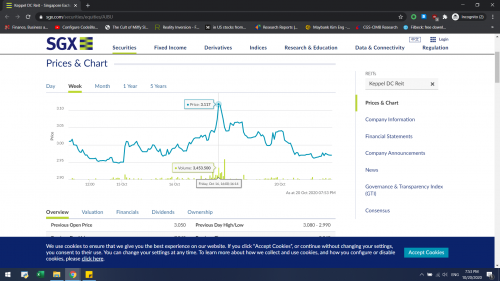
It did, but for a short while. Funds started buying in late afternoon, 3-4 p.m. as we all know.

user posted image

I guess Parkway LIFE's response was more aggressive to index inclusion as it is more illiquid and isn't included in many index as compared to K DC REIT prior to STI inclusion.

Plus it's kind of "overvalued" and market is still waiting for acquisition news for now. I am also closely monitoring when the moratorium for data centers in SG will end. A lot of REIT players want to convert industrial properties into data centers and this may erode KDC's position.

Currently from what I have studied, SG data center market is oligopolistic in nature. CR3 is about 40-50%, top 3 players, Singtel, Equinix and Keppel Data Centers control 40-50% of data center market share in Singapore.

Potential entrants include ESR, Capitaland family and Mapletree family of REITs.

This post has been edited by TOS: Oct 20 2020, 09:32 PM

76 Pages « < 3 4 5 6 7 > » Top
 

Change to:
| Lo-Fi Version
0.7957sec    0.58    7 queries    GZIP Disabled
Time is now: 1st December 2025 - 11:16 AM