

 Sep 1 2012, 10:48 AM


QUOTE
It's no longer a PenTile matrix like on the original Note (which had a slight crosshatch patter noticeable, but only if you look really closely). Perhaps these photos snapped with a digital microscope will help clear up the differences in pixel arrangements.
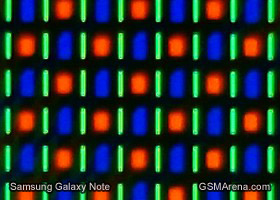
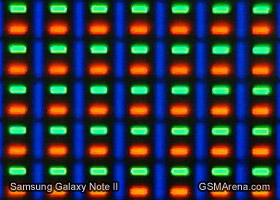
The pixels of the Note II have one tall Blue sub-pixel on the left and smaller Green and Red pixels stacked one on top of the other. It's an odd arrangement, but it has three subpixels per pixel. The reason for the different Blue pixel is that Blue AMOLEDs typically have a shorter life and making them bigger balances things out. Also, the Blue pixel doesn't shine as brightly, which also improves its life, but doesn't affect color balance (because it's bigger).
To illustrate how the different arrangement improves sharpness we used our microscope to snap a picture of very tiny text - the line width here is 1px, the font is white.
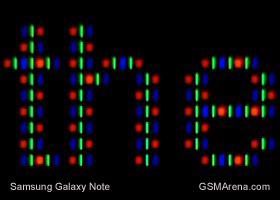
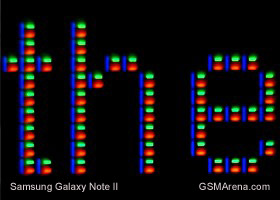
As you can see, the Galaxy Note II screen lights up individual pixels to display the 1px-wide lines. The old Galaxy Note, however, can't use a single pixel as each individual pixels can't make white, as it only has two of the three needed colors.
To fix that, the screen uses sub-pixel rendering, which "borrows" a subpixel from a neighboring pixel to make white. But now the line has become 1 2/3px wide.
This new arrangement seems to result in some very slight color aberrations around sharp edges, but it takes a great deal of eye-strain to try and see it.
The pixels of the Note II have one tall Blue sub-pixel on the left and smaller Green and Red pixels stacked one on top of the other. It's an odd arrangement, but it has three subpixels per pixel. The reason for the different Blue pixel is that Blue AMOLEDs typically have a shorter life and making them bigger balances things out. Also, the Blue pixel doesn't shine as brightly, which also improves its life, but doesn't affect color balance (because it's bigger).
To illustrate how the different arrangement improves sharpness we used our microscope to snap a picture of very tiny text - the line width here is 1px, the font is white.
As you can see, the Galaxy Note II screen lights up individual pixels to display the 1px-wide lines. The old Galaxy Note, however, can't use a single pixel as each individual pixels can't make white, as it only has two of the three needed colors.
To fix that, the screen uses sub-pixel rendering, which "borrows" a subpixel from a neighboring pixel to make white. But now the line has become 1 2/3px wide.
This new arrangement seems to result in some very slight color aberrations around sharp edges, but it takes a great deal of eye-strain to try and see it.
For more reading
http://www.gsmarena.com/samsung_galaxy_not...eview-806p2.php
This post has been edited by KuLi: Sep 1 2012, 10:49 AM
 Quote
Quote


 looking at the trend now it should be microsim as well
  It quite natural what
 0.0418sec
 0.47
0.47
 7 queries
 GZIP Disabled