Battle of Pasir Panjang, the Opium Hill StandToday on 14 Febuary 69 years ago, one company of the Malay Regiment has make their stand in the history.
How many of us remember this,
Me too, I for a moment I forget one of the most epic battle our own Malay Regiment has defending our land from the invasion of Japan,
This battle has take the name of the 1st Malay Regiment and Lt Adnan Saidi as a heroes that stand to the Japanese forces till the end.
QUOTE
The Battle of Opium Hill

By Nor-Afidah Abd Rahman written on 2004-06-14
National Library Board Singapore
Comments on article: InfopediaTalk
The Battle of Opium Hill (14 February 1942) at Pasir Panjang was one of the fiercest battles that took place in Singapore in World War II.
It pitted the invading Japanese Army against a brave but heavily outnumbered troop of the 1st Malay Brigade of the Malay Regiment.
The battle was also remembered for the heroism of Lieutenant Adnan Saidi, the leader of the brigade, who together with his men fought the Japanese to their grisly deaths.
Today, an interpretive centre, Reflections at Bukit Chandu, stands on the hill, commemorating the battle and the contributions of these men.
Background
Opium Hill, or Bukit Chandu in Malay, constituted the British final defence parameter against the invading Japanese army.
The Japanese campaign to invade Singapore had begun on 8 February 1942 with one strategic defensive position after another rapidly falling into Japanese hands. By 13 February,
the Japanese Imperial Army had shifted their attention to Pasir Panjang Ridge.
The ridge was important because it offered a passage to the Alexandra area where the British Military Hospital and the main British ammunition and ordinance depots were located.
The task for defending the ridge was assigned to Lieutenant Adnan Saidi and his men of the "C" Company of the 1st Malay Brigade.
They distinguished themselves by fighting on despite being heavily and continuously shelled by a regiment of the crack Japanese 18th Division.
Adnan and his men, stationed at Pasir Panjang Village, held the Japanese at bay for as long as they could and withdrew only in the late evening of 13 February when they were outstripped in strength. As they retreated,
they gave up the approach to Pasir Panjang Ridge known as the Gap.
Description
The Japanese continued their bombardment and infantry assault on the 1st Malay Brigade throughout 14 February.
This gallant troop, after being forced to yield the Pasir Panjang Ridge the night before, withdrew to Bukit Chandu or Opium Hill.
The hill was named so after an opium-processing factory that used to be at the bottom of the hill. Adnan ordered his men to fortify their new defence position by building a wall of sandbags all around.
In the early afternoon, "strange" troops were seen by Adnan as advancing uphill from Pepys Road. The troops were first thought of as Sikh soldiers from the Birtish-Indian Army because they were spotted with turbans. However, their grouping of four instead of three, which was the norm of the British Army, led Adnan to suspect that these were actually enemy troops disguised as British soldiers. Adnan ordered his men to open fire and 20 enemy men were mortally wounded, causing the Japanese to retreat. This victory for the Malay Brigade was however short-lived as two hours later, the Japanese launched a second all-out attack with more Japanese soldiers and heightened shelling by kamikaze planes. Fierce fighting ensued on Opium Hill, and when ammunition ran short, Adnan and his men resorted to hand-to-hand combat using their bayonets. Heavily outnumbered, the 1st Malay Brigade continued to hold their ground until they were completely overrun. They paid heavily for frustrating the Japanese army's attempts at victory for nearly 48 hours. Their lives ended in grisly deaths at Japanese hands. Adnan, the courageous leader, was hung by his legs to a tree and repeatedly bayoneted before his mutilated body was burnt.
The only Malay Regiment survivor was Corporal Yaakob. In the turmoil of fighting, he fell on top of a pile of dead bodies and lay there motionless to escape death by the Japanese. He witnessed the gruesome final moments of Lieutenant Adnan whose body was never recovered.
Aftermath
By the afternoon of 14 February, as the Malay Brigade fell, a tragedy followed. The Japanese captured Alexandra military hospital and subsequently massacred its occupants, leaving only a few to escape. On hindsight, it was said that the task of the 1st Malay Brigade in defending the Pasir Panjang/Alexandra district could have been made easier if its neighbouring Australian artillery had been more co-operative. Instead, to save on ammunition, they were told to fire only in defence of the Australian perimeter which was at higher ground than where the Malay Brigade was positioned. With a more commanding view of the battlefield, the guns could have taken on the advancing Japanese effectively along the south coast where the Malay Brigade was fighting.
Adnan received posthumous awards by the British government for his bravery and his heroic contingent is remembered for its role in defending the sovereignty of Singapore.
Variant Names
Malay name: Bukit Chandu or Bukit Candu meaning "Opium Hill".
Variant name: Battle of Pasir Panjang; Battle at Bukit Chandu.
Author
Nor-Afidah A Rahman & Nureza Ahmad

Original

location of the battle

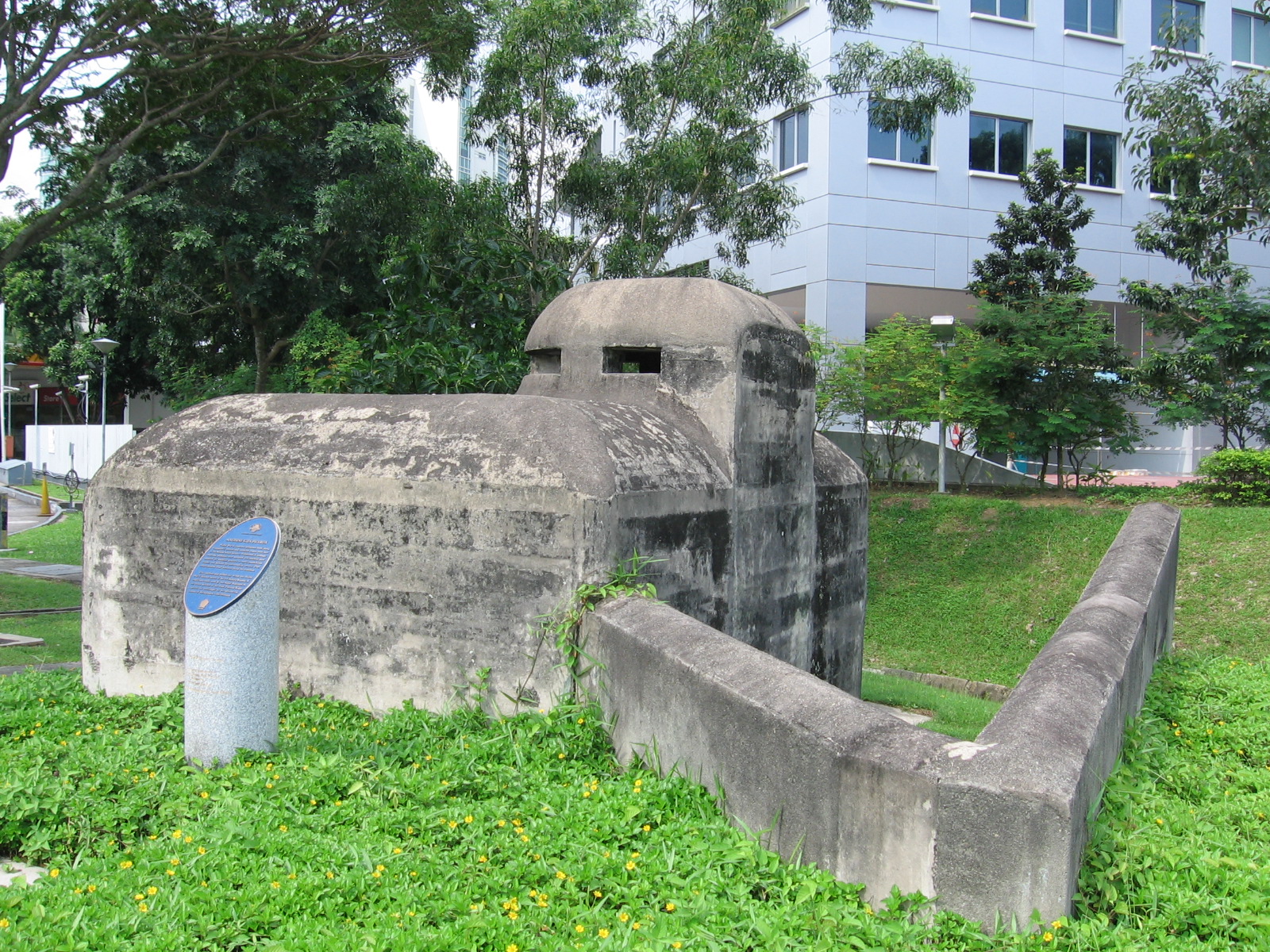
one of the pill box

Lt Adnan Saidi

Adnan Bin Saidi
In World War II (1915 - February 14, 1942), Lieutenant Adnan Bin Saidi was a Malayan hero during the Battle of Singapore. He was born in 1915 at Kajang, Selangor along the western Malay coast and was a Muslim of Minangkabau(Western Sumatra) descent. Minangkabau people belong to the Malay stock.When Adnan was 18, to join the army, Adnan ran away from home and because of his brave courage and intelligence his rank rose up.
QUOTE
Background
Adnan Bin Saidi, Lieutenant Adnan Saidi was the oldest in his family. His younger siblings, Ahmad Saidi and Amarullah Saidi were soldiers too. Ahmad Saidi was killed in action after he joined the navy in 1939. The Japanese sank his ship, the HMS Pelanduk, enroute to Australia. The younger Mr. Amarullah Saidi endured the war and is now retired and is now living in Kajang, Selangor.Lieutenant Adnan Saidi undergo his education in Pekan Sungei Ramal in the English medium. He was a hardworking student and excelled in his studies. Upon graduation, Adnan was chosen to be a trainee teacher and taught at his alma mater for over a year. Fate however had other plans for him. Adnan Saidi is a firm man who took discipline seriously, chose instead to pursue the military vocation.
In 1933, when he was 18 years old, Adnan Saidi joined the Malay Regiment. A year later, he was chosen as best recruit. In 1936, Adnan was promoted to the rank of Sergeant – a promotion that came fast for a bright young soldier. In 1937, he was chosen to represent his platoon in a military ceremonial parade in London to honour the ascension of King George VI to the throne. Shortly thereafter, Adnan Saidi was promoted yet again to Company-Sergeant-Major and headed for Singapore for an officers’ conversion course. Upon graduation as 2nd Lieutenant, Adnan Saidi became the leader of the 7th Platoon, ‘C’ Coy(Charlie Company).
The family man
Upon his return from London, Lieutenant Adnan Saidi fell in love with an Islamic religious teacher from his village and later married her. Madam Sophia Pakih Muda(name spelling's may not be precise) gave birth to three children: two sons, Mokhtar and Zainudin (now living in Seremban and Johore respectively), and a daughter. Youngest of the three siblings, the baby girl died in her early infancy shortly after Singapore fell.Despite his busy schedule as a career soldier, Lieutenant Adnan Saidi settled down quickly as a family man. He dotes his boys and would always try to find time for his kids. He brought them for walks or played games with them. The games that he played with his boys were rough and rugged. Adnan wanted his sons to grow up tough. In an interview with Berita Harian (9 Sept `95), Mokhtar Adnan described his father as thus:"My father did not talk a lot. He was a firm man and believed in discipline. He was always serious and fierce…yet had a good heart. There seemed to be a ‘light’ illuminating his face."In late 1941, Lieutenant Adnan Saidi was sended to Singapore and brought with him his family. They lived in a big house off Pasir Panjang, in an area reserved for the families of the Malay Regiment. When the rumblings of the war grew nearer and the Japanese began preparations to invade Singapore, Lieutenant Adnan sent his family back to their hometown in Kajang. It was a trying day for Lieutenant Adnan - his wife, Sophia was carrying their third child. The young boys kissed their father’s hand as their last respect and he reminded them to be good. It was to be their last moment together.
Aftermath
Kent Ridge Park, which was known as Pasir Panjang beside the site of the battle now bears a plaque in commemoration of Lt Adnan Bin Saidi. A museum at Bukit Chandu stands in memory of the bravery of Malay Regiment soldiers. This regiment would later become the Royal Malay Regiment of the Royal Malaysian Army.
Al-Fatihah and R.I.P
thanks to my dad and kurien for reminding me!.
References
» Click to show Spoiler - click again to hide... «
Owen, F. (2001). The fall of Singapore (pp. 192-203). London: Penguin Books.
(Call no.: SING 940.5425 OWE)
Warren, A. (2002). Singapore 1942: Britain's greatest defeat (pp. 255-261). Singapore: Talisman.
(Call no.: SING 940.5425 WAR)
Chan, K.S. (1998, July 11). Lt Adnan Saidi, hero of Malay Regiment. The Straits Times.
Goh, C.L. (2001, December 27). Stories of duty, honour, courage. The Straits Times.
He fell in Battle for Bukit Candu. (1996, February 14). The Straits Times, Life, p. 5.
WWII hero died fighting the Japanese. (1996, February 14). The Straits Times, Life, p. 5.
Liza Sahid. (1999). Adnan Saidi. Retrieved June 14, 2004, from www.knowledgenet.com.sg/singapore/SG/BI/BIADS001.asp?next=0
National Archives of Singapore. (2002). Reflections at Bukit Chandu. Retrieved July 22, 2004, from www.s1942.org.sg/bukit_chandu/homepage.htm
http://kaklongcomel.blogspot.com/2011/02/1...an-sejarah.htmlhttp://historyof07.blogspot.com/2007/08/ad...ar-ii-1915.html QUOTE
These young an untried soldier
acquitted themselves in a way which
bore comparison with the very best
troops in Malaya, in particular
by their stubborn defence of the
Pasir Panjang Ridge at the height
of the Battle of Singapore,
they set an example of steadfastness
and endurance which will become a great
tradition in the Regiment and an
inspiration for future generations".
Lt Gen A.E. Percival
GOC Malaya 1941-42
This post has been edited by atreyuangel: Feb 14 2011, 10:27 PM 

 Military Thread V6, Selamat Hari Raya dan Kemerdekaan ke-54
  Feb 14 2011, 03:27 PM


 Quote
Quote






 0.0252sec
 0.49
0.49
 5 queries
 GZIP Disabled