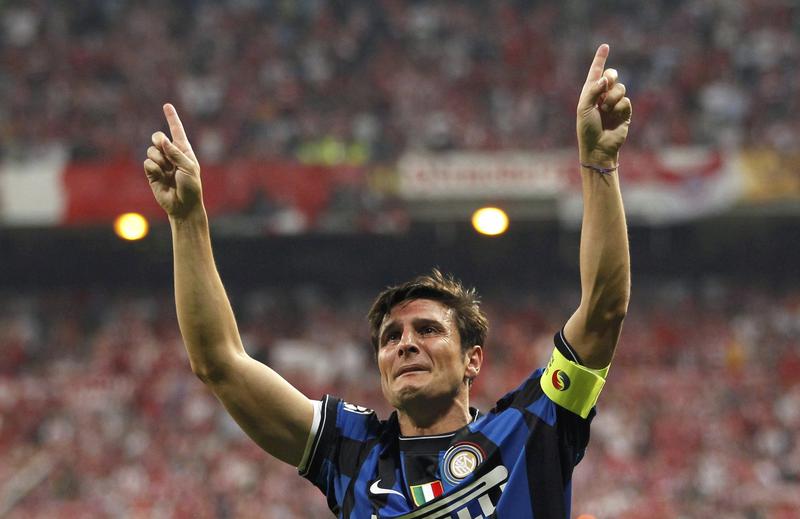
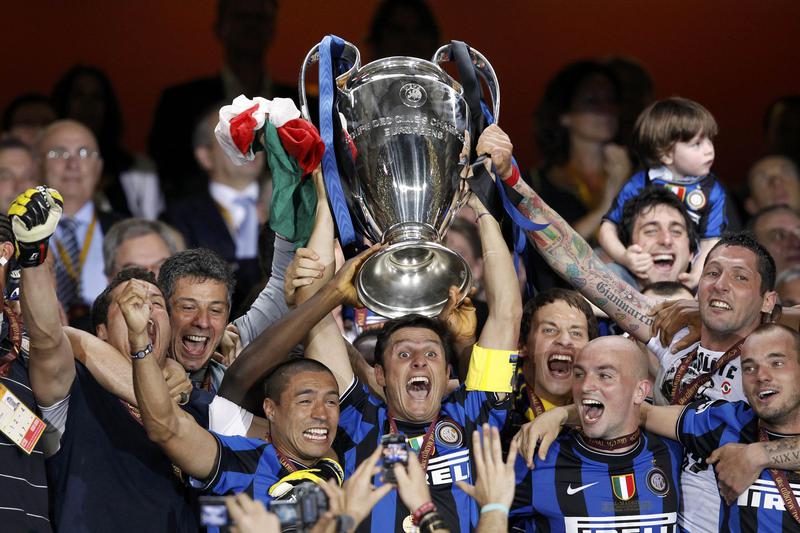
Inter have beaten the champions of England, Spain and Germany to be crowned more than deserved CHAMPIONS OF EUROPE!
For me personally, I have been a fan for more than 10 years and frankly, I thank Mourinho but he leaving is not a big problem for me, for me the only thing that matters is F.C Internazionale Milano
We will show Europe that even without Mourinho, we can challenge for the European Cup
I was already in this forum since they beat Barcelona.. I am a Juve fan..cant expect me to be here all the time.. I am here to congratulate you guys for restoring some much needed pride to our beleaguered Serie A and Serie A's fans..
Forgive and Forget, Living in the Past is Time Consuming
VIP
3,111 posts
Joined: Apr 2007
From: KL mali
QUOTE(pyroboy1911 @ May 23 2010, 03:10 PM)
Congratz to Inter on winning the UCL as well as the treble. two seasons in a row there's a treble winner. Now, wondering if Inter won the FIFA World Club Champions Cup in December as well, they gonna have Scudetto shield patch, Calcio patch, UCL sleeve badge and WCC Winners Badge...how are they all gonna fit on Inter's jersey next season?
I think one or some of the patches will be moved to the left sleeve, accompanying the Respect patch. Juve/Milan used to have their club emblems on the left sleeve to accommodate the Scudetto when they won it (late 90s IINM). Roma's kit also had the Coppa on the sleeve recently, so i think 1 or 2 would be moved there la, if not the front of the kit will be very crowded.
Alternatively, Inter may sport diff patches during European and Serie A games, maybe dropping European patches during Serie A games, and vice-versa.
Also, congrats on winning the treble, Jose had the luck in managing to bring the best out of Milito, when other strikers were either not on form, or in bad behaviour. Scoring deciding goals in deciding games require a big player, and Milito has proven he is just that.
Just before Internazionale's celebratory team photo with the European Cup, shy and retiring Jose Mourinho grabbed "Old Big Ears" and lifted it aloft towards the directors' box at the Santiago Bernabeu, where the Real Madrid president, Florentino Perez, was grinning broadly. Real had not been able to win the Champions League in their own stadium, so instead they got the chequebook out and bought the man who did.
A basic €40m (£36m) package brings Mourinho to Spain. He will be officially presented as Real's new coach this week, replacing Manuel Pellegrini, who will today finalise the terms of his departure from the club just 12 months into his two-year deal.
There will be no two-year deal for Mourinho. The man who has now won as many European Cups this century as the club he is taking charge of will sign a four-year contract and be paid €10m a season – double the length of the standard contract that Real give new coaches and double the money.
Immediately after Saturday night's victory Mourinho was telling Italian television that he was "not leaving Inter but leaving Italian football". He has felt unloved in Serie A and when he finally showed for the post-match press conference, after midnight local time, the Italian press were more interested in grilling him on the style of play – or the lack of it – and the fact that he had not used a single Italian in his starting line-up than congratulating him on the victory.
"Have you spoken to Perez?" Mourinho was asked by Madrid reporters. "No," came the reply. When asked when was the last time he had spoken to the Real president he said "the day after tomorrow". Not that there will be much to discuss today as Mourinho's agent, Jorge Mendez, is understood to have finalised his client's new contract last Friday and now Inter's compensation package is all that needs completing. "The two clubs have to sit down and talk," Mourinho added.
He signed off by defending the negative style in which his team had won. "Van Gaal had provoked me before the game," he said. "He is intelligent. He called my team defensive because he wanted us to react and play a different way. But I am also intelligent."
Intelligent enough to know that winning with just 33 per cent of possession will not be enough for Real Madrid fans. He will have better players at his disposal and the chance to disprove once and for all the view that he is a defensive coach. For now, none of the worthy discussions about his football philosophy matter. As one Madrid paper put it: "Bayern had the ball but Inter took home the Cup."
Inter have deservedly won the Champions League – beating this season’s champions of England, Spain and then Germany on the way to collecting the trophy. Jose Mourinho has conquered Europe again, Inter have won the treble for the first time in the history of Italian football, and Italy retains its four Champions League places ahead of Germany.
There were no surprises in the starting XIs – they were as predicted by ZM in the preview. Inter went with their 4-2-3-1, with Goran Pandev and Samuel Eto’o on the flanks very deep and Wesley Sneijder in the hole. Javier Zanetti was deployed in midfield, Christian Chivu at left-back, despite suggestions they could be the other way around.
Bayern also played their standard shape, a 4-4-2 / 4-2-3-1, with Arjen Robben hugging the touchline looking to come inside, and Hamit Altintop playing a slightly more central position on the opposite flank. Thomas Muller played behind Ivica Olic.
Sneijder key in the first half
The most notable feature of the game was how close Wesley Sneijder played to Diego Milito. Some have occasionally questioned why Inter’s shape is termed as a 4-2-3-1 rather than a 4-3-3 (the difference can often be subtle) but tonight showed why, because Sneijder spent the night ahead of the two wide players. Indeed, the shape often looked more like a 4-4-1-1, because whilst Pandev and Eto’o had strict defensive jobs, Sneijder had something approaching a free role.
His role is something sides have become slightly unaccustomed to facing; as outlined here before, there is a distinct lack of ‘classic’ No 10s in European football at the moment. Sneijder’s movement in behind the main striker caused Bayern no end of problems, which started because Bayern had a numerical disadvantage in midfield, 3 v 2. If Mark van Bommel got goalside of Sneijder, it would mean that Bastian Schweinsteiger would be forced to compete with Javier Zanetti and Esteban Cambiasso, conceding the midfield to Inter. Therefore, van Bommel was forced to step up ahead of Sneijder, meaning he and Schweinsteiger cancelled out Zanetti and Cambiasso, who (whilst not particularly creative players anyway) didn’t influence the game much in an offensive sense.
Sneijder, therefore, was left to be picked up by Martin Demichelis and Daniel van Buyten – who were preoccupied with stopping Diego Milito, one of those forwards with a tremendous ability to occupy two centre-halves at once. For the first goal, van Buyten got himself far too deep behind Demichelis. His positioning was actually OK if Bayern were simply dealing with Milito as the only threat, but Sneijder’s position so high up the pitch meant that van Buyten’s ‘covering’ position left Sneijder with space, and he passed the ball easily for Milito to finish brilliantly. A not dissimilar situation occurred just before half-time when the Dutchman shot straight at Butt in one-on-one situation – Bayern simply couldn’t cope with Sneijder.
Bayern dominated possession – Inter were fairly happy to let them have the ball in deep positions, and had a system of ‘casual’ pressing rather than the intense style used by Barcelona at points in this Champions League run. Bayern worked the ball well in wide areas, and whilst Eto’o and Pandev were doing good defensive jobs, Bayern’s wingers were dropping deep and their full-backs were pushing on, meaning Inter’s full-backs and wingers were sometimes forced to swap around. Not an ideal scenario for Inter, and Bayern had plenty of crossing opportunities.
Bayern were unable to take advantage of this, though. With neither Olic nor Muller great aerial targets at the best of times, let alone against Lucio and Walter Samuel, Bayern were slightly too keen to come inside and try and play through the congested centre of the pitch. When the wingers and full-backs did get down the line they often found themselves in great positions, but Arjen Robben, Philip Lahm and Hamit Altintop all wasted chances to put a killer ball in. In the case of Robben and Altintop, this is perhaps the price you pay for fielding inverted wingers – they can shoot, but they often find it difficult to cross.
Interestingly, the one time a Bayern player found himself free in a dangerous position was Mark van Bommel’s dragged shot wide in stoppage time at the end of the first half – not the player you’d expect to be causing an immediate goal threat. There is a sense that a ’surprise’ player in an attacking position is the best way to open up Inter when they’re defending solidly within their own area – against Barcelona, for example, they coped with everything Barca could throw at them, until Gerard Pique came up from the back and there appeared to be confusion about how to deal with him.
Waste Chances. That said, Bayern did create. Three decent chances fell to Thomas Muller, but the young forward was unable to convert them. Firstly a half-chance at the near post in the first ten minutes, secondly a clear one-on-one that he played straight at Julio Cesar, thirdly a volley he hit into the ground when in space on the penalty spot.
In terms of positioning, movement and work rate, Muller is excellent and is widely recognized as being a tremendous talent, but tonight showed that in front of goal, he’s not yet up to scratch. He has scored in just one game in this Champions League run – against Maccabi Haifa on the opening day – and has often failed to make things happen for Bayern in the penalty box, particularly against Fiorentina and against Manchester United when Bayern were slightly fortunate to progress.
His opportunities were no more presentable than Milito’s, both of which were dispatched excellently. The man signed from Genoa last summer wrapped the game up with his 70th minute strike, as Inter got the ball to him in space, allowing him to run at the hapless van Buyten. Samuel Eto’o will be praised for his defensive role, but he was a key part in the second goal. First he held off Badstuber, luring him into a crazy challenge he was never going to win. Then, he despatched the pass into feet for Milito. Finally, he got himself level with Milito and into the box, forcing Martin Demichelis to track him, rather than ’sweeping’ behind van Buyten. All this may sound fairly basic, but it is partly the fact that Eto’o is a forward playing out wide that helped him hold off the challenge, and then have the determination to get himself into the box. A winger may not have done the same.
Inter see the game out
As we have come to expect, Inter defended solidly and brilliantly within their own area. The two defensive midfielders sat extremely deep and never looked to get remotely forward in the second half, even when the more attack-minded Dejan Stankovic was brought on. Muller (dropping deep) and Schweinsteiger (moving forward) struggled to find space in that zone, and so the ball was generally held in wide areas. Bayern still struggled to test Inter too much considering the amount of possession they had, despite the arrival of Mario Gomez and Miroslav Klose, two players who like crosses. It was surprising that van Gaal did not opt to use Danijel Pranjic, a good crosser of the ball, who could have replaced Badstuber, a full-back reluctant to attack.
There was a feeling that if Inter scored the first goal, they would win the game. And so it proved – Lucio, Samuel and Cambiasso were absolutely superb, and whilst Mourinho should be rightly praised for organising his defence so well, we should not forget that Inter’s defenders are naturally superb players. Defensive organisation is vital in winning trophies but individual performances have shone through against Barcelona and Bayern – further emphasized by van Buyten’s nightmare at the other end.
Inter deserved European champions
The tie against Barcelona was ridiculously tight and could have gone either way, but it’s hard to fault Inter. Despatching the best teams from the three other major European leagues along the way, whilst wining their own domestic league, would suggest that this is a fitting triumph.
What is different from last year, where Mourinho’s Inter crumbled against Manchester United? Half the team. Of Mourinho’s favoured XI in the second half of the season, the five furthest forward players – Thiago Motta, Wesley Sneijder, Samuel Eto’o, Goran Pandev and Diego Milito, as well as Lucio, the centre-back, are all in their first season at the club. That’s 6 out of 11 players – last year’s side was not “Mourinho’s”, it was the players he had inherited. Creating such a successful side with so many new recruits is a remarkable achievement, as is managing to transform goal-hungry forwards like Eto’o and Pandev into hard-workers defensively, even if some will complain that this is robbing the world of some exciting attacking play. But Mourinho’s brief was to win the Champions League, and he has done that.
The final question about Inter: are they a defensive side? It’s easy to say that they are, especially considering the reputation of both Mourinho and Italian football in general. This has slightly clouded the judgement of many who haven’t watched them on a regular basis – they have played some excellent football, and characterizing a side as ‘defensive’ when they regularly play a Sneijder-Pandev-Eto’o-Milito quartet is rather harsh. Yet in the final three matches of this Champions League run they have had less than 35% of possession in each; Jonathan Wilson has discussed whether this (successful) approach will be a turning point in football.
The answer to that might have to wait for a few years, but the acclaim for Inter can begin immediately. Defensively brilliant, ruthless in the penalty area, and possessing some of the best players in the world, this is a superb Inter side that have equalled the achievements of the much-praised Barcelona side of last season.
This post has been edited by visionary1993: May 24 2010, 06:50 PM
The passing statistics after a Champions League game always make for interesting reading, particularly when Barcelona thrash a team, and we can point to the passing graphs and claim they sum up how much better Barcelona were, and how they won by passing the opposition off the pitch.
Inter’s situation is rather different – they seem to be happy to let the opposition have the ball, playing on the counter-attack when they need a goal, and frankly not bothering to attack when they don’t.
Bayern’s dominance is possibly even greater than you might expect, with their defenders and central midfielders completing the most passes, and every Bayern player (aside from the goalkeeper and Ivica Olic) completing more passes than every Inter player. The Olic statistic indicates how rarely Bayern managed to involve him in their build-up play.
The passing statistics after a Champions League game always make for interesting reading, particularly when Barcelona thrash a team, and we can point to the passing graphs and claim they sum up how much better Barcelona were, and how they won by passing the opposition off the pitch.
Inter’s situation is rather different – they seem to be happy to let the opposition have the ball, playing on the counter-attack when they need a goal, and frankly not bothering to attack when they don’t.
Bayern’s dominance is possibly even greater than you might expect, with their defenders and central midfielders completing the most passes, and every Bayern player (aside from the goalkeeper and Ivica Olic) completing more passes than every Inter player. The Olic statistic indicates how rarely Bayern managed to involve him in their build-up play.


 May 24 2010, 02:16 PM


 Quote
Quote





 i m happy 4 u 2 finally end the serie A slump in champs league







 0.0279sec
 0.33
0.33
 6 queries
 GZIP Disabled