Welcome Guest ( Log In | Register )

4 Pages  1 2 3 > » Bottom

Outline · [ Standard ] · Linear+

 Don't simply follow Warren Buffet's strategy, Investment Strategy

views
     
TSbenghooi
post Dec 17 2008, 11:41 AM, updated 18y ago

New Member
*
Junior Member
41 posts

Joined: Sep 2008


I heard an advertisement by a unit trust company on my way to work today. A person asked whether it is time for equity investment in view of gloomy economy and the other person clarified it is fine as the investment is for long term.

How true is the statement? Is long term investment strategy always the best?
user posted image

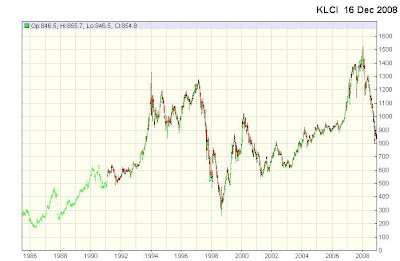
I graduated in year 2000. If I made regular monthly investment since I started working in year 2000, or if I made bullet investment in year 2005 from the saving I have made for working 5 years, the return would be WORSE than keeping the money in fixed deposit, which has much lower risk compared to equity investment.
user posted image

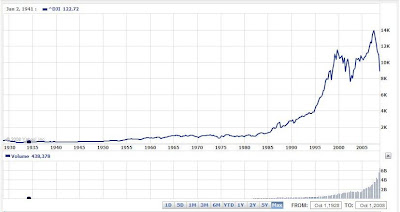
Some may quote Warren Buffet that "If, when making a stock investment, you're not considering holding it at least ten years, don't waste more than ten minutes considering it" and follow the investment principle blindly. The statement by Warren Buffet was applicable as the US stock market was having very long term bull run over a period of 80 years since 1929 great depression, as can be seen in the chart of Dow Jones Index since 1929. However, since the eruption of recently global financial crisis, it is still a question mark whether Dow Jones can stay above 8000 points and continue its uptrend.


If I made investment in US market about 10 years ago after I started working, I could have not earned any return from the investment and worse, lost some of the investment capital. A more conservative individual who saved his/ her money in fixed deposit would be much better off and I wonder how much longer does it take from current global financial crisis for the equity market investment to catch up with the return one would have earned if he/ she saved the money in fixed deposit since 10 years ago.

user posted image

I give you a classic example.

If one invest in Japanese stock market about 10 years ago when I started working, he/ she would have lost more than half of his/ her investment capital!

It is worse for those who invested in year 1989 when the Nikkei peaked at 38915.9 points. They would be left with less than a quarter of their initial investment capital.

How much longer they need to keep just to recover their capital?

Abstracted from : Don't follow Warren Buffet's investment strategy blindly

This post has been edited by benghooi: Dec 17 2008, 11:48 AM
skiddtrader
post Dec 17 2008, 12:11 PM

Suspicious
*******
Senior Member
3,037 posts

Joined: Jun 2007


Allow me to retort. You do realize if you were to chart the trend from 1997 at it's lowest and then post this in 2007 during the super peak, your theories will be completely in the opposite direction. Is it not? tongue.gif If you did this then, you would probably be praising Warren Buffet and his 10 year theory as 'factually and statistically correct!'.


It's just a matter of how and when you look at it. Using one statement from WB and you conclude that this man is not to be followed blindly, is a bit weak in my honest opinion. Especially when you're looking at a chart which is spiraling downwards. Like I said, if you were to quote the exact sentence and charted it in 2007 back to 1997, you would be completely wrong then, wouldn't you? hmm.gif

This post has been edited by skiddtrader: Dec 17 2008, 12:12 PM
neo1024
post Dec 17 2008, 12:12 PM

New Member
*
Junior Member
49 posts

Joined: Nov 2007


I disagree with you fundamentally on the following grounds

1, Practically, you're not buying all shares of composite index/averages. Therefore this is not a fair comparison.

2, You've totally ignored the residual incomes from the stocks which can be very substantial over long span of time, instead, choosing to focus alone on price movements.

3, Warren Buffet advocates long term shareholding, to prevent investors being blinded by market emotions. He never ask you to hold when market is offering you huge premiums over your shareholding.

Therefore, I think before you advice people not to follow his strategy blindly, you should have understood his strategy thoroughly.

Please do not mislead others.
darkknight81
post Dec 17 2008, 12:26 PM

$$$$$$$$$$
*******
Senior Member
3,944 posts

Joined: Jul 2008


<<<Some may quote Warren Buffet that "If, when making a stock investment, you're not considering holding it at least ten years, don't waste more than ten minutes considering it" and follow the investment principle blindly. The statement by Warren Buffet was applicable as the US stock market was having very long term bull run over a period of 80 years since 1929 great depression, as can be seen in the chart of Dow Jones Index since 1929. However, since the eruption of recently global financial crisis, it is still a question mark whether Dow Jones can stay above 8000 points and continue its uptrend.


If I made investment in US market about 10 years ago after I started working, I could have not earned any return from the investment and worse, lost some of the investment capital. A more conservative individual who saved his/ her money in fixed deposit would be much better off and I wonder how much longer does it take from current global financial crisis for the equity market investment to catch up with the return one would have earned if he/ she saved the money in fixed deposit since 10 years ago.
>>>

I am very sure you don fully understand what it means.....Yup you must not follow blindly as warren he pick up on fundamentally wise stock thats y he can hold it for long term with good returns. If you don know about stock and simply shoot a stock and hold for long term as i always say it is a doom for your wealth.....

Holding a good stock which give you good returns not by simply holding any rubbish stock.
By doing so you need :

1. extra cash
2. you must able to pick up a good stock.....

Give you few example

1. public bank
2. ytl corp
3. calrberg
....

If you bought at 1997, your return will be around 1000% even if you sold it today!!!!

Pls fully understand what the phrase really means before criticizing on other ppl....

This post has been edited by darkknight81: Dec 17 2008, 12:28 PM
chypher
post Dec 17 2008, 12:27 PM

Enthusiast
*****
Senior Member
859 posts

Joined: Jan 2003


QUOTE(neo1024 @ Dec 17 2008, 12:12 PM)
I disagree with you fundamentally on the following grounds

1, Practically, you're not buying all shares of composite index/averages. Therefore this is not a fair comparison.

2, You've totally ignored the residual incomes from the stocks which can be very substantial over long span of time, instead, choosing to focus alone on price movements.

3, Warren Buffet advocates long term shareholding, to prevent investors being blinded by market emotions. He never ask you to hold when market is offering you huge premiums over your shareholding.

Therefore, I think before you advice people not to follow his strategy blindly, you should have understood his strategy thoroughly.

Please do not mislead others.
*
I second neo1024

You are not buying all the shares of composite index. If you invest long enough you will see the price of quality shares are very much unaffected even when market is low. Even if the price are affected, the market will eventually realize it's value.

I guess before you advice people or talk about Warren Buffet's strategy you should do your homework.

If your intention were to warn people not to follow his strategy blindly and they should do their homework, you should do yours first.

or maybe, you are just blogwhoring whistling.gif
TSbenghooi
post Dec 17 2008, 12:56 PM

New Member
*
Junior Member
41 posts

Joined: Sep 2008


Well, I am not wrong and don't get me wrong.

I didn't say Warren Buffet and his investment principle was wrong.

I said don't SIMPLY follow the principle. It is wrong only when you follow BLINDLY.

On stockpicking, it is not easy to pick the right stock, more so at the right time. We even see so called blue chips tumbled and even went bankrupt. Example, Enron, MISC, UEM (used to be known as golden goose that lay golden eggs for its Penang Bridge and NS Expressway concessionaires). Even the quality of Maybank has deteriorated so much.

I have checked unit trust websites. The unit trust finds are managed by professionals. If I invested in the time I mentioned above, I still loose to one who keep his/ her money in fixed deposit.


Added on December 17, 2008, 12:57 pmThen can anyone defend the case in Japan?


Added on December 17, 2008, 1:00 pmChyper, easier said than done.

If so, how come If I invested in unit trust funds managed by the QUALIFIED PROFESSIONALS the time I mentioned above, I still loose to one who keep his/ her money in fixed deposit.

Please bear in mind that in year 2000, the stock market was neither high nor at the peak and I still loose to one who save in FD.

This post has been edited by benghooi: Dec 17 2008, 01:00 PM
skiddtrader
post Dec 17 2008, 01:30 PM

Suspicious
*******
Senior Member
3,037 posts

Joined: Jun 2007


QUOTE(benghooi @ Dec 17 2008, 12:56 PM)
Well, I am not wrong and don't get me wrong.

I didn't say Warren Buffet and his investment principle was wrong.

I said don't SIMPLY follow the principle. It is wrong only when you follow BLINDLY.

If so, how come If I invested in unit trust funds managed by the QUALIFIED PROFESSIONALS the time I mentioned above, I still loose to one who keep his/ her money in fixed deposit.

Please bear in mind that in year 2000, the stock market was neither high nor at the peak and I still loose to one who save in FD.
*
Yes, it is true you should not follow anyone blindly. Not only Warren Buffett, but ANYONE for that matter.

I like to say again, that if or rather when you sell your investments in whether unit trust OR stocks in the peak period of 2007, you would be arguing against yourself now. The KLCI from 700-800 of year 2000 range to 1400-1500 in 2007 is almost double.

To choose a time of convenience when markets are dropping, and say you are earning less than FD is a weak argument. When it can easily be completely opposite situation a year ago. If 2 years down the road, the crisis is over and the KLCI shoot back up to 1500 points, will you say the same thing? I highly doubt so.

All I'm saying is the basis of your conclusion is wrong, as you didn't include the aspect of timing and fair valuation.


Your mistake was ;
To choose a time-frame of 10 years with it ending at a time of global crisis and conclude that long term investments will earn less than FD even if professionals are handling your money. shakehead.gif


neo1024
post Dec 17 2008, 01:46 PM

New Member
*
Junior Member
49 posts

Joined: Nov 2007


It seems to me that you refused to learn, rather than couldn't learn. Therefore, explaining to you would be tiring and pointless. Efforts and time could be better channelled else where.

In all, I wish you the best in your FD savings.
kmarc
post Dec 17 2008, 01:47 PM

The future is here - Cryptocurrencies!
Group Icon
Elite
14,576 posts

Joined: May 2006
From: Sarawak


I think nobody would dispute the fact that investing in stocks is high risk but can also give high returns and vice versa.... I guess it depends on your risk appetite, if you feel that you are not willing to take the risk, then it is better not to buy stocks. Go for unit trust or FD/bonds. Lower risk but lower returns.

All the above are just different investments tools and the gains goes hand-in-hand with the risk....

@TS - If long-term investment strategy is not suitable, then what is? hmm.gif

This post has been edited by kmarc: Dec 17 2008, 01:47 PM
sampoo
post Dec 17 2008, 02:22 PM

Casual
***
Junior Member
453 posts

Joined: Nov 2008
rclxub.gif
cherroy
post Dec 17 2008, 02:32 PM

20k VIP Club
Group Icon
Staff
25,802 posts

Joined: Jan 2003
From: Penang


QUOTE(benghooi @ Dec 17 2008, 12:56 PM)
Well, I am not wrong and don't get me wrong.

I didn't say Warren Buffet and his investment principle was wrong.

I said don't SIMPLY follow the principle. It is wrong only when you follow BLINDLY.

On stockpicking, it is not easy to pick the right stock, more so at the right time. We even see so called blue chips tumbled and even went bankrupt. Example, Enron, MISC, UEM (used to be known as golden goose that lay golden eggs for its Penang Bridge and NS Expressway concessionaires). Even the quality of Maybank has deteriorated so much.

I have checked unit trust websites. The unit trust finds are managed by professionals. If I invested in the time I mentioned above, I still loose to one who keep his/ her money in fixed deposit.


Added on December 17, 2008, 12:57 pmThen can anyone defend the case in Japan?


Added on December 17, 2008, 1:00 pmChyper, easier said than done.

If so, how come If I invested in unit trust funds managed by the QUALIFIED PROFESSIONALS the time I mentioned above, I still loose to one who keep his/ her money in fixed deposit.

Please bear in mind that in year 2000, the stock market was neither high nor at the peak and I still loose to one who save in FD.
*
Follow blindly in whatever surely will bring one to "holland' that I can assure. biggrin.gif

MISC, UEM never ever being considered a gem in stock market, I knew some did back then especially a lot of investment bank. In fact all GLCs can't be considered a blue chip either (although most research houses did), any company survive or profit non based on its competitiveness strength in the free market is not appropriate to be considered a real gem or blue chip. That's why we called it GLCs or PLCs (political linked company). That's why I said in recent post Plus is not considered a good long term investment target.

You only invested in some company that is competitive and survive on its strength on its own, not because of preference or monopolised business.

Qualified professionals like fund managers don't mean they are good, even some forumers here with good knowledge and skills are qualified for the job as well. It is just a job to handle the fund only, it is not a sophiscated job that general people perceived.
Just like when we are computer noob time, we think those able to install, tweak and play with computer hardware some sort like very sophiscated and high skilled but once you already learned and known about, you will just see it is just another normal job out there.

Japan has the ultimate biggest bubble in the modern history, while they are reluctantly to pay the pain of it and restructuring and dragging until now. If US doesn't tackle well current crisis, it might end with identical to Japan. But it is unlikely, because of nature spending habit of both countries is totally different. If an economy can't grow then don't expect stock market can grow as well. By no mean stock market must grow over the long term, stock market only can grow because of improvement of corporate earning. So if one expect there is no growth ahead for the economy in the next 3-5 years or even longer, then stock market is not a good choice currently that I can 99% assure of.

Index is not a good indicator a particular investment target how well they are performing, it is just a reference or benchmark of a basket of it. Unless one is buying the index or buying the stock identical with index components, then yes, it is true. But most retailers are not buying all of it. Most retailers even fund managers (except index fund manager) won't be buying all of it, just like if one buy IOI, you don't care whether KLCI is 800 or 1,500, right? you care about how IOI is performing. Another example, when KLCI surged to 1,500, Plus, Maybank never reach its previous historical high either, in fact they are moving marginally like 10-20% gain only, so KLCI index surges to 2,000 also meaningless to those shareholders.

Yes, I agree on your points, if one is always tend to buy at peak then better put the money in the FD. Just like if investing period is 1996-2008, surely based on index, you will make a loss. But if one bought Pbbank, Genting or IOI, or others real blue chips, then you still make a gain even though you bought at 1996, but with signficant reduced gain. That's the different.
Also you need to compare where the FD rate is, if for Japan, FD rate is 0.1%, so put 10 years you only get 1% only.

What Warren Buffett good at is stock pick. Warren Buffett is not investing in index.

When to invest and which to invest are always the 2 most important element. You don't buy when stock is high, you only wish to buy when the stock is cheap, right? You don't buy when Genting has just surged from 4.00 to 8.00 in matter on 1 year period, right? or IOI surged from 2.00 to 8.00, in just 2 years time.

Also, that's why we always repeatively to advise only invest in good stocks, not all are the same.

Personal opinion, UT has several disadvatange, ie. high management fee and portfolio is not that flexible. You know why Public Mutual funds mostly and high % outperform other? because almost all their fund, Pbbank is their top choice of the portfolio, as simple as that.

But if doesn't know or sure which stock to invest, then surely FD is the better choice.

Data is a dead thing, human is flexible. One can choose peak to bottom (1996-1998 or 1996 - now) to show the poor performance of it. While another one can choose 1998 to 2007 to show how good it is. It depends on the individual selective choice, which both are right as well.
That's why I disagree fund prospectus to put up some historical performance to convince people to invest in it which often for those newly launched fund as they are very clever to be selective about it to show the good face of it. No offence. funds can be good investment target as well especially for those non-investment savy people.

No one is defending whether who is right or wrong or Warren Buffett investment philosophy is right, in fact he never claimed he is clever in the stock market or his philosophy is right.

Often we came across people to say he is old fashioned and outdated, better go for short term quick gain or time the market perfectly, like sell now, buy back tomorrow, then sell again when up.
But how many people become rich because of short term quick gain or in and out often in the market? how many people become rich because owning some good stocks for long term?
Just like everyone knew owning 1,000 Genting shares back 1970's mean you might be a millionaire now.

So, general people see the benefit on investing in good company stocks over the long term which has made a lot of people wealthy because of it. But it doesn't mean one must fall in love in a particular stock either, once it is too high, you still sell it or condition or fundamental no longer is the same. Never ever fall in love with it.

But if one intends to invest in all the stocks across, then most probably better stick with FD that you might get better return rate over the long term.
In fact, good stocks over the long term are not that many can be choosed from, particularly here.

Just my 2 cents.


TSbenghooi
post Dec 17 2008, 02:38 PM

New Member
*
Junior Member
41 posts

Joined: Sep 2008


QUOTE(skiddtrader @ Dec 17 2008, 01:30 PM)
Yes, it is true you should not follow anyone blindly. Not only Warren Buffett, but ANYONE for that matter.

I like to say again, that if or rather when you sell your investments in whether unit trust OR stocks in the peak period of 2007, you would be arguing against yourself now. The KLCI from 700-800 of year 2000 range to 1400-1500 in 2007 is almost double.

To choose a time of convenience when markets are dropping, and say you are earning less than FD is a weak argument. When it can easily be completely opposite situation a year ago. If 2 years down the road, the crisis is over and the KLCI shoot back up to 1500 points, will you say the same thing? I highly doubt so.

All I'm saying is the basis of your conclusion is wrong, as you didn't include the aspect of timing and fair valuation.
Your mistake was ;
To choose a time-frame of 10 years with it ending at a time of global crisis and conclude that long term investments will earn less than FD even if professionals are handling your money.  shakehead.gif
*
It is not easy to tell when the stock prices are at peak. The peak at 1400-1500 makes no difference if one did not liquidate the investment.

I am not choosing particular timing just to support my arguement. I took year 2000 as it is relevant to me. I didn't pick the entry point when market was peak.

Again, especially neo1024, I don't say Warren Buffet is wrong and I am not against long-term investment.

There are many investors thinking equity investment is safe as long as they hold the shares for long term.

Just want to share some examples and well, with some elaborated comments by everyone here, I hope members of this forum have benefits from the sharing of this topic.
wodenus
post Dec 17 2008, 02:45 PM

Tree Octopus
********
All Stars
14,990 posts

Joined: Jan 2003
You can't follow him because you're not him.
fergie1100
post Dec 17 2008, 02:59 PM

Regular
******
Senior Member
1,345 posts

Joined: Dec 2007
QUOTE(benghooi @ Dec 17 2008, 02:38 PM)
It is not easy to tell when the stock prices are at peak. The peak at 1400-1500 makes no difference if one did not liquidate the investment.

I am not choosing particular timing just to support my arguement. I took year 2000 as it is relevant to me. I didn't pick the entry point when market was peak.

Again, especially neo1024, I don't say Warren Buffet is wrong and I am not against long-term investment.

There are many investors thinking equity investment is safe as long as they hold the shares for long term.

Just want to share some examples and well, with some elaborated comments by everyone here, I hope members of this forum have benefits from the sharing of this topic.
*
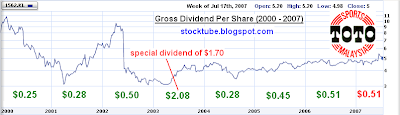
Let's say if u bought 1000 of PBBANK shares back then in 2000, did ur FD still making more $$? Even if u hold it until now, u still making $$ handsomely don't u?
user posted image
Another classic example would be BJTOTO (special thanks to stocktube for the image tongue.gif)
even the dividend alone can beat the rate of FD easily right? wink.gif

This post has been edited by fergie1100: Dec 17 2008, 03:07 PM
hanif444
post Dec 17 2008, 03:12 PM

Regular
******
Senior Member
1,523 posts

Joined: Dec 2007
From: Puchong...


I dun mind follow Warren Buffet's investment strategy blindly,if my fortune can have 1% from him...

Benhooi..how about u?i say Abstracted from : Don't follow Warren Buffet's investment strategy blindly...how many % of WB u have?or simple...How much u make compare with WB..
htt
post Dec 17 2008, 03:15 PM

Look at all my stars!!
*******
Senior Member
4,305 posts

Joined: Sep 2008


QUOTE(fergie1100 @ Dec 17 2008, 02:59 PM)
Let's say if u bought 1000 of PBBANK shares back then in 2000, did ur FD still making more $$? Even if u hold it until now, u still making $$ handsomely don't u?
user posted image
Another classic example would be BJTOTO (special thanks to stocktube for the image tongue.gif)
even the dividend alone can beat the rate of FD easily right?  wink.gif
*
All parties relax... cool2.gif
No one is definite right, neither definite wrong.
Some companies soar, some went bust, it's all up to the judgment of individual investor at the point of time.
Maybe your title get others wrong, as a lot of us are 'value investors' whose approach are similar to Buffet's style.
You got your point there but I don't think Buffet actually follow the index composite, else he might be just another joe next door, or average fund manager. His aim is to look for undervalued stock with potential and stick with them for a period of time.
No need to worry what others comment on you, just be humble and you will gain more than you lose. biggrin.gif
Just my 2 cents. rclxms.gif
cherroy
post Dec 17 2008, 03:17 PM

20k VIP Club
Group Icon
Staff
25,802 posts

Joined: Jan 2003
From: Penang


QUOTE(benghooi @ Dec 17 2008, 02:38 PM)
It is not easy to tell when the stock prices are at peak. The peak at 1400-1500 makes no difference if one did not liquidate the investment.

I am not choosing particular timing just to support my arguement. I took year 2000 as it is relevant to me. I didn't pick the entry point when market was peak.

Again, especially neo1024, I don't say Warren Buffet is wrong and I am not against long-term investment.

There are many investors thinking equity investment is safe as long as they hold the shares for long term.

Just want to share some examples and well, with some elaborated comments by everyone here, I hope members of this forum have benefits from the sharing of this topic.
*
No one knows it was a peak nor it is now a bottom. But generally we knew the market is high even after 1,300 level. Just like we feel now it is low (may not a bottom or market can still sink further) but the price right now is already discounting a lot of negative factor in it already. You are buying the something that already put some discount mechanism in it already, then if over the long term, if economy recovers, then those discounted negative news is the factor that you can gain significantly over the long term provided you pick the right stock.

Investment in equities never be a safe nor must generate return if hold for long term, again stock pick is one of the most important criteria.
It is wrong perception if one holds a stock for long term that can gain. The better or more correct perception should be hold a right stock and buying at low (not bottom, as nobody will buy at bottom), and hold for long term 95% of chance you can register some handsome gain which is much better than FD rate.

Another perspective is that dividend is seen very important factor for those long term investors as those dividend are the one comparable to FD interest rate.

We always welcomed any view. One doesn't need to agree on other, just speak out opinoin and fact of it only. smile.gif
wodenus
post Dec 17 2008, 03:26 PM

Tree Octopus
********
All Stars
14,990 posts

Joined: Jan 2003
QUOTE(fergie1100 @ Dec 17 2008, 02:59 PM)
Let's say if u bought 1000 of PBBANK shares back then in 2000, did ur FD still making more $$? Even if u hold it until now, u still making $$ handsomely don't u?
*
Okay let's consider inflation, which is probably about 10% a year. So in ten years in order to make any money you'd have to double the capital. What's the dividend like on PBBANK?

At this point you might be asking, do you mean to say FD's are exempt from inflation? of course not, but get this, I get 5% (average) every year and this is exempt from inflation because I get to spend it smile.gif if you put it in shares you don't get to spend it, so everything you make is eaten by inflation smile.gif

Let's assume 500K total.

Fixed Deposit

You get interest every six months from an FD. Now 5% of 500K = 25,000 a year right? okay so year one you hold a big dinner for my 89-year-old grandparents. You buy a washing machine and dryer. Or maybe you hire a maid to do all my washing and cleaning. You goof off on LYN everyday for ten years.

Shares

You keep it in shares and don't spend it. You do your own washing and cleaning. You work like a dog. Your grandparents have passed away, You didn't have the time and/or money to spend on them when they were alive. In the end you make about 7.5% a year (which is about 2% above the average FD rate). You cash out at the end of ten years and make 75%.. or have you? if inflation is 10% p.a. you'd actually have lost money. Also you'd have lost the opportunity to make your grandparents happy. You'd have lost the opportunity to goof off on LYN for ten years (which would be a real tragedy.)

So you tell me which one is better smile.gif

This post has been edited by wodenus: Dec 17 2008, 04:44 PM
fergie1100
post Dec 17 2008, 03:26 PM

Regular
******
Senior Member
1,345 posts

Joined: Dec 2007
QUOTE(htt @ Dec 17 2008, 03:15 PM)
All parties relax... cool2.gif
No one is definite right, neither definite wrong.
Some companies soar, some went bust, it's all up to the judgment of individual investor at the point of time.
Maybe your title get others wrong, as a lot of us are 'value investors' whose approach are similar to Buffet's style.
You got your point there but I don't think Buffet actually follow the index composite, else he might be just another joe next door, or average fund manager. His aim is to look for undervalued stock with potential and stick with them for a period of time.
No need to worry what others comment on you, just be humble and you will gain more than you lose. biggrin.gif
Just my 2 cents. rclxms.gif
*
Don't get me wrong..... i'm just giving examples as what he requested... tongue.gif
i'm still learning, i see it good for him to bring up such issue so that all of us can discuss & learn thumbup.gif
simplesmile
post Dec 17 2008, 03:42 PM

Look at all my stars!!
*******
Senior Member
2,991 posts

Joined: Jun 2007


I am fascinated with value investing. I would like to call myself a value investor. But I am lazy (or maybe dunno how) to calculate the intrinsic value. So now I just buy and sell shares like a speculator.

4 Pages  1 2 3 > » Top
 

Change to:
| Lo-Fi Version
0.0215sec    0.44    5 queries    GZIP Disabled
Time is now: 22nd December 2025 - 01:20 AM