

 Jun 21 2008, 08:59 PM, updated 17y ago


Real Madrid Club de Fútbol
About the Club
Real Madrid Club de Fútbol (commonly known as Real Madrid or Madrid) is a Spanish sports club best known for its football team. It is the most successful team in the world and has even been named "The Best Club of the 20th Century" by FIFA in 2000, having won a record 31 La Liga titles, 17 Spanish Cups, a record 9 European Cups and 2 UEFA Cups. Founded in 1902, Real Madrid has since spent all of its history in the top flight of Spanish football. The club's home colours are their legendary all white and they play their home games at the 80,354-capacity Santiago Bernabéu football stadium. Unlike most European football clubs, Real Madrid's members (socios) have owned and operated the club since its inception.
Added on
The Crest
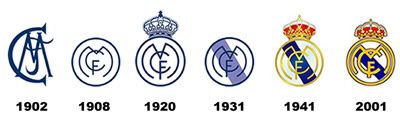
The first crest of Real Madrid had a simple design consisting of a decorative interlacing of the three initials of the club, "MCF" for Madrid Club de Fútbol, in dark blue on a white shirt. The first change in the crest occurred in 1908 when the letters adopted a more streamlined form and appeared inside a circle. The next change in the configuration of the crest did not occur until the presidency of Pedro Parages in 1920. At that time, King Alfonso XIII granted the club his royal patronage which came in the form of the title "Real", roughly translated as "Royal". Thus, the crown was added to the crest and the club styled itself Real Madrid Club de Fútbol. With the dissolution of the monarchy in 1931, all the royal symbols (the crown on the crest and the title of Real) were eliminated. The crown was replaced by the dark mulberry band of the Region of Castile. In 1941, two years after the end of the Civil War, the "Real Corona", or "Royal Crown", was restored while the mulberry stripe of Castile was retained as well. In addition, the whole crest was made full color, with gold being the most prominent, and the club was again called Real Madrid Club de Fútbol. The most recent modification to the crest occurred in 2001 when the club wanted to better situate itself for the twenty-first century and further standardize its crest. One of the modifications made was changing the mulberry stripe to a more bluish shade.
Added on
The Stadium
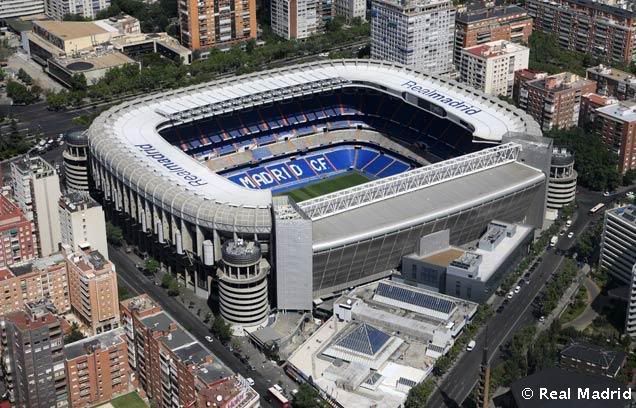
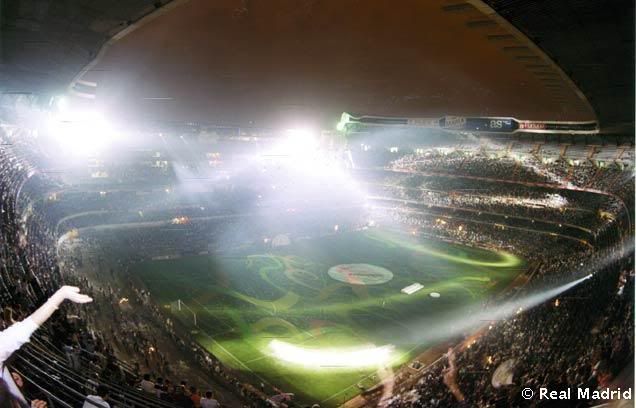

After moving between grounds the team moved to the "Campo de O'Donnell" in 1912, which remained its home ground for eleven years. The club then moved for one year to the Campo de Ciudad Lineal, a small ground with a capacity of 8,000 spectators. After that, Real Madrid moved its home matches to Estadio Chamartín which was inaugurated on 17 May 1923 with a match against Newcastle United. In this stadium, which hosted 22,500 spectators, Real Madrid celebrated its first Spanish league title.
After some successes, the 1943 elected president Santiago Bernabéu decided that the Estadio Chamartín was not big enough for the ambitions of the club. Work on the grounds started on October 27, 1944. Originally called Estadio Chamartín as well after Madrid's previous stadium, it was inaugurated in December 1947. Real Madrid officially adopted the present name, Estadio Santiago Bernabéu, on January 4, 1955 in honor of the club president Santiago Bernabéu. The first match held on the Bernabéu was played between Real Madrid and the Portuguese club Belenenses and won by The Whites with 3–1, the first goal being scored by Sabino Barinaga.
The capacity has changed frequently, peaking at 120,000 after a 1953 expansion. Since then, there have been a number of reductions due to modernizations (the last standing places went away in 1998–99 in response to UEFA regulations which forbids standing at matches in the UEFA competition), countered to some extent by expansions. The last change was an increase of about five thousand to a capacity of 80,354, effected in 2003.
The Santiago Bernabéu has recently been upgraded to Elite Football Stadium status by UEFA and even has its own Madrid Metro station along the 10 line. The stadium has hosted the 1964 European Championship final, the 1982 FIFA World Cup final, the 1957, 1969 and 1980 European Cup finals and is due to host the 2010 Champions League Final.
Capacity: 80,354
Length: 107 m
Width: 72 m
Surface: Grass
First match: Real Madrid vs. Os Belenenses (Portugal)
Address: Avenida de Concha Espina 1, E28036
Added on
The Kit


Real Madrid's traditional home colours are all white. The clubs' nicknames "Los Blancos" ("The Whites") and "Los Merengues" (after the dessert meringue) were influenced by it. The kit initially adopted a blue oblique stripe on the shirt; but unlike today, dark blue socks were worn. The striped shirt was replaced by an all-white version, modeled after the shirt worn by Corinthian F.C. in 1902. In the same year, the blue socks were replaced by black ones. By the early 1940s the manager changed the kit again by adding the club's crest on the left breast (which have remained ever since). On 23 November 1947, in a game against Atlético Madrid at the Metropolitano Stadium, Real Madrid became the first Spanish team to wear numbered shirts.
Madrid's traditional away colours are all black or all purple. The club's kit is currently manufactured by Adidas and their current shirt sponsor is bwin.com.
Added on
Real Madrid Hymn
Lyrics:
» Click to show Spoiler - click again to hide... «
This post has been edited by verx: Aug 25 2009, 05:57 AM
 Quote
Quote


 One can only dream ...


 0.0470sec
 0.55
0.55
 7 queries
 GZIP Disabled