Welcome Guest ( Log In | Register )

Outline · [ Standard ] · Linear+

 The Search for Missing "Ren" (仁) in the Modern Age, Discussion

views
     
TSnihility
post Apr 22 2025, 10:38 PM, updated 8 months ago

Regular
******
Senior Member
1,595 posts

Joined: Sep 2021


Nature observation ~ A lesson from a broken Samsung tablet incident

This observation came to me recently. Prior to my departure to another state for a work-related schedule over one week, the 3rd disciple came to me and reported that his electronic device (Samsung tablet) was almost broken. I was already aware of the 3rd disciple's intention and had prepared to get him a replacement device in the coming months, but I never revealed this to him—I wanted him to learn to be patient.

All this while, among all the fated disciples under my guidance, they were given their own device of choice (laptop, tablet, etc.) to familiarize themselves with the wave of digitalization in their generation. Each of them was given a personal device, as I feared it would be unfair if only a few were provided, and they were forced to share. I was worried they wouldn’t get quality exposure on their devices if asked to share. Furthermore, I feared that sharing might fuel dissatisfaction or feelings of unfairness among them.

Those were my initial worries. The dynamic among the disciples is generally good, but something seemed lacking. They were not as close or intimate as I remember being with my own siblings at that age. With the exception of the 1st and 2nd disciples (who are one year apart and share almost everything in life—school lessons, friends, clothing, etc.), the rest of the disciples seem mostly independent and detached. The concept of togetherness was missing.

A Beautiful Disruption

The day came for my departure. I was away for about one week. While I was gone, I remembered what the 3rd disciple had told me, and I had already purchased the replacement tablet. Upon my return, however, due to a busy schedule, I didn’t have a chance to speak directly with the 3rd disciple for the next three days. Yet, every time I came home, a magical scene caught my attention.

user posted image

The 3rd and 4th disciples were sitting together on the couch, viewing something together. The 3rd disciple was using the 4th disciple’s iPad! Both of them were in harmony, happily sharing the device. In the past, this scene was impossible—almost every disciple would be focused solely on their own device. This beautiful, simple moment struck me deeply. I couldn't get it out of my mind. I silently asked myself: Have I been doing it wrong all along?

That night, I spoke with the 1st disciple, who revealed that while I was away, the 3rd disciple’s tablet finally broke. With no device of his own, he had no choice but to communicate and interact with the 4th disciple. Though the two had often clashed before, they managed to find a common ground. The 4th disciple agreed to share her device—on conditions. The 3rd would need to teach her something in return and let her observe the game he was playing. I paused in silence. A simple, beautiful exchange. The younger generation, it seems, was teaching the me instead. They were learning to co-exist with "Ren" (仁) within the household. Perhaps, all this while, I had misunderstood.

A Teacher’s Mistake?

In my effort to provide for them and prevent resource-related feelings of incompleteness, I worried that asking them to share would result in a sense of unfairness. I wanted to give them as much as possible, so they wouldn't experience what I had experienced growing up. Yet, with good intention, I inadvertently created a poor outcome. By giving them "completeness," I removed the opportunity for them to learn co-existence through sharing. They grew overly independent—too strong to need each other, and therefore, unable to learn how to interact and compromise. Without needing each other, they had little cause to negotiate, to make room for Ren. In effect, I robbed them of the environment where humaneness is cultivated. The negotiation between the 4th and 3rd disciples—offering the tablet with conditions—was an early exercise in striking a deal, learning balance, and developing empathy. That was "Ren" being born, not in textbooks, but in lived interaction.

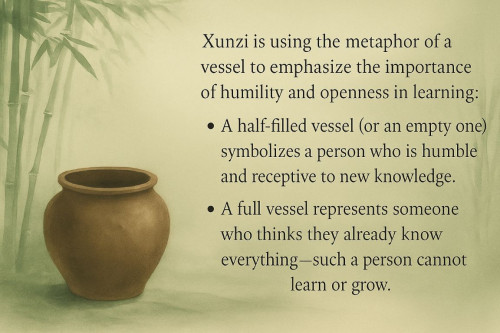
Xunzi once said:
“The half-filled vessel is open to receive; the full vessel has no room to grow.”
user posted image

In ancient wisdom, a half-filled vessel symbolizes a person humble and open to new learning. A full vessel, by contrast, represents someone who believes they are already complete—and thus rejects growth. This incident taught me a new application of the metaphor:

• A half-filled vessel is one whose needs create a bridge to another—they must learn to share, to negotiate, to connect.
• A full vessel is one who is self-sufficient and thus has no incentive to learn how to coexist. They live in completeness, but not in harmony.

Thus, when we remove all lack from a person’s life, we may also remove the environment where humaneness can take root. In striving to give them everything, I might have given them less.

“In what ways have I unintentionally prevented the cultivation of Ren by providing ‘too much’?"

As I reflect, I realize now that nurturing virtue may require creating spaces of incompletion—not to cause suffering, but to provide the soil in which empathy and connection grow.

After the incident, I chose not to give the new replacement tablet to the 3rd disciple right away. I’ll let them continue learning how to co-exist—learning the ancient value of "Ren" (仁)—in their own time, in their own way.

~

What is your thought of this observation?
Ralna
post Apr 23 2025, 07:16 PM

I love who I am
****
Junior Member
657 posts

Joined: Sep 2012
From: Selangor


Thank you for sharing this beautiful and insightful reflection on the delicate balance between providing and withholding, between giving fully and giving wisely. I truly admire the depth of thought and heart you've brought into your role as a guide to your disciples.

While I see the wisdom in delaying the replacement tablet to allow space for Ren (仁) to blossom naturally through sharing and negotiation, I also wondered: might there be a hidden cost? By not giving the 3rd disciple the new tablet while the others still have theirs, could this unintentionally lead to feelings of being left behind or singled out? In striving to teach Ren, we might accidentally create a sense of unfairness or exclusion. If the 3rd disciple doesn’t understand the broader intention behind the delay, he may not interpret it as an opportunity for growth, but rather as injustice or even neglect. That’s where wise, open dialogue matters.

I also wonder if Ren can be cultivated in the presence of abundance, not just in absence. It’s not always about breaking the device so they learn to share—it could be about creating experiences where sharing becomes meaningful, even when everyone has what they need. Cooperative goals, paired learning, or group challenges that require collaboration across devices could offer the best of both worlds.

Perhaps true Ren isn’t only born from lack, but also from how we intentionally design connection in the midst of sufficiency. With a little gentle guidance, they can experience autonomy and interdependence, self-sufficiency and empathy together.
kamfoo
post Apr 24 2025, 03:35 AM

Enthusiast
*****
Junior Member
845 posts

Joined: Nov 2010


very sad of western culture adoption have destroyed asian values
yehlai
post Apr 24 2025, 04:02 AM

tree lover
*******
Senior Member
4,539 posts

Joined: Feb 2006
From: LocOmoT|oN.L0co|oti0N


user posted image
gashout
post Apr 24 2025, 04:28 AM

⭐ My stars are growing ⭐
*******
Senior Member
5,741 posts

Joined: Apr 2019
QUOTE(kamfoo @ Apr 24 2025, 03:35 AM)
very sad of western culture adoption have destroyed asian values
*
as i grow older, i learn to appreciate most asian values. they are truly better than the west.


alanyuppie
post Apr 24 2025, 08:49 AM

Look at all my stars!!
*******
Senior Member
2,834 posts

Joined: Jul 2006
From: here


QUOTE(gashout @ Apr 24 2025, 05:28 AM)
as i grow older, i learn to appreciate most asian values. they are truly better than the west.
*
internet and socmed allowed us to observe and compare reaction of west and easten humans worldviews.. and the distinct cultural different really SUPER OBVIOUS:

west ; individualistic
east: community-centric


This is VERY APPARENT in reddit posts like AITA or marriage matters . Even in normal disagreement (part and parcel of a marriage) , most of the "suggestions" by western netizens swayed towards "please run, he's an a*hole and dont deserve you".

As for us in the east...we just treat it like another day, and making minor sacrifices for others at the expense of personal freedom is pretty much ingrained in us.


There's one thing as a youtuber , I noticed on how western and eastern folks write out their thoughts when they commented on my vids.

I get comments like " you SHOULD do this/that . It seemed like rude but eventually I've grown to understand thats their way of asking someone normally for favors.

for us in the east..... comments like "Please do this/that" is expected.

This post has been edited by alanyuppie: Apr 24 2025, 09:01 AM
TSnihility
post Apr 24 2025, 05:55 PM

Regular
******
Senior Member
1,595 posts

Joined: Sep 2021


QUOTE(Ralna @ Apr 23 2025, 07:16 PM)
Thank you for sharing this beautiful and insightful reflection on the delicate balance between providing and withholding, between giving fully and giving wisely. I truly admire the depth of thought and heart you've brought into your role as a guide to your disciples.

While I see the wisdom in delaying the replacement tablet to allow space for Ren (仁) to blossom naturally through sharing and negotiation, I also wondered: might there be a hidden cost? By not giving the 3rd disciple the new tablet while the others still have theirs, could this unintentionally lead to feelings of being left behind or singled out? In striving to teach Ren, we might accidentally create a sense of unfairness or exclusion. If the 3rd disciple doesn’t understand the broader intention behind the delay, he may not interpret it as an opportunity for growth, but rather as injustice or even neglect. That’s where wise, open dialogue matters.

I also wonder if Ren can be cultivated in the presence of abundance, not just in absence. It’s not always about breaking the device so they learn to share—it could be about creating experiences where sharing becomes meaningful, even when everyone has what they need. Cooperative goals, paired learning, or group challenges that require collaboration across devices could offer the best of both worlds.

Perhaps true Ren isn’t only born from lack, but also from how we intentionally design connection in the midst of sufficiency. With a little gentle guidance, they can experience autonomy and interdependence, self-sufficiency and empathy together.
*
Thank you deeply for your thoughtful response.

Regarding the “hidden cost” you mentioned—yes, I fully agree. If a decision risks making 3rd disciple feel unfairly treated or excluded, I must be especially careful. Every decision should be followed by open communication. Without explanation, misunderstandings will arise. After all, cultivating Ren (仁) is not a one-way effort—it’s a living, two-way dialogue between hearts. In that sense, your suggestion is both valid and essential.

As for your point about cultivating Ren (仁) even in the presence of abundance—I think there is no absolute right or wrong here. This is simply how I personally see it: I tend to choose the middle path—not full abundance, not complete absence, but a healthy balance of both.

Why? Because the home may not reflect the broader world. If disciples are raised in complete abundance, they may be unprepared for the real-life challenges of disappointment, inequality, or conflict. But total lack, too, can create resentment or insecurity. That’s why I believe in offering half abundance, half absence—just enough to keep the heart open to learning, sharing, and cooperation.

The goal of cultivating Ren (仁) is to help the disciple live with others in harmony—not only within the family, but out in the world, where they will face both abundance and absence in many forms.

Ultimately, I believe the key lies in balance. As the ancient sages said:

“The middle is the root of all things under Heaven; harmony is the path of the world.”
(中也者,天下之大本也;和也者,天下之达道也 – Doctrine of the Mean)


Thank you again for sharing your insight.
TSnihility
post Apr 24 2025, 06:00 PM

Regular
******
Senior Member
1,595 posts

Joined: Sep 2021


QUOTE(yehlai @ Apr 24 2025, 04:02 AM)
user posted image
*
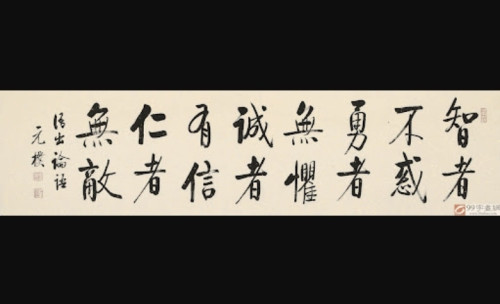
The translated version :-

智者不惑
“The wise are not confused.”
→ Those with wisdom see clearly. They understand principles and are not easily misled or puzzled.

勇者不懼
“The brave are not afraid.”
→ True courage removes fear. A courageous person faces danger or hardship without hesitation.

仁者無敵
“The benevolent have no enemies.”
→ A person of Ren (仁)—compassion and humanity—wins hearts and disarms opposition with virtue. Their moral force makes them undefeatable, not by power, but by harmony.

誠者有信
“The sincere are trusted.”
→ Sincerity (誠) builds trust. When someone is genuinely honest, others believe in them without doubt.
Ralna
post Apr 24 2025, 11:54 PM

I love who I am
****
Junior Member
657 posts

Joined: Sep 2012
From: Selangor


QUOTE(nihility @ Apr 24 2025, 05:55 PM)
As for your point about cultivating Ren (仁) even in the presence of abundance—I think there is no absolute right or wrong here. This is simply how I personally see it: I tend to choose the middle path—not full abundance, not complete absence, but a healthy balance of both.
....
Ultimately, I believe the key lies in balance. As the ancient sages said:

“The middle is the root of all things under Heaven; harmony is the path of the world.”
(中也者,天下之大本也;和也者,天下之达道也 – Doctrine of the Mean)


Thank you again for sharing your insight.
*
Yes, harmony truly lies in the balanced path.

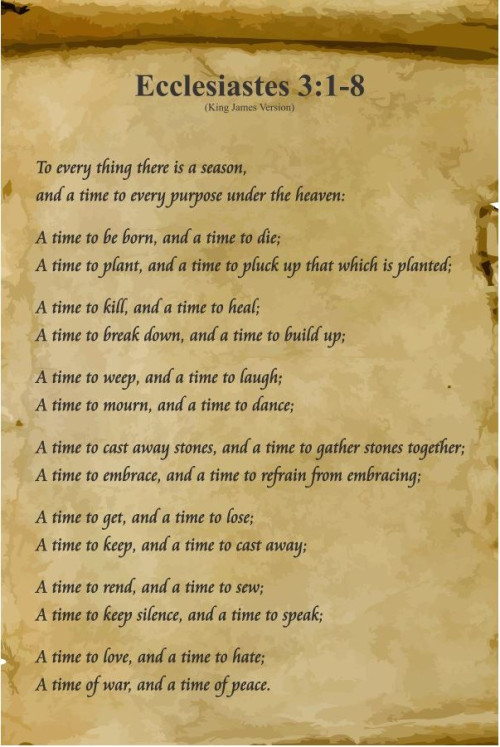
Your reflection reminds me of Ecclesiastes 3:1-8, which says “To everything there is a season, a time for every purpose under heaven.”

» Click to show Spoiler - click again to hide... «


Perhaps in the process of teaching Ren, it’s also about teaching the wisdom of the Tao, and embracing the cyclical nature of life. There are times for abundance and times for restraint, times for giving and times for receiving. Both are necessary for growth.

It’s through these cycles that true harmony emerges, where the act of teaching itself becomes a lesson in balance and flow.
TSnihility
post Apr 26 2025, 09:25 PM

Regular
******
Senior Member
1,595 posts

Joined: Sep 2021


QUOTE(Ralna @ Apr 24 2025, 11:54 PM)
Yes, harmony truly lies in the balanced path.

Your reflection reminds me of Ecclesiastes 3:1-8, which says “To everything there is a season, a time for every purpose under heaven.”

» Click to show Spoiler - click again to hide... «


Perhaps in the process of teaching Ren, it’s also about teaching the wisdom of the Tao, and embracing the cyclical nature of life. There are times for abundance and times for restraint, times for giving and times for receiving. Both are necessary for growth.

It’s through these cycles that true harmony emerges, where the act of teaching itself becomes a lesson in balance and flow.
*
Let me share a passage from Yan Family Instructions (颜氏家训), specifically from 《勉学篇》 (Chapter on Diligent Learning), for reflection and exchange.

“道无不在,师莫能尽。”
(Dào wú bù zài, shī mò néng jìn.)

Truth and learning (道 Dào) are vast and present in all things and places. No single teacher, book, or school can encompass everything. Thus, a true learner should cultivate humility, openness, and patience, recognizing that each person's knowledge remains partial.

Thank you for sharing Ecclesiastes 3:1–8 — a passage from the Old Testament that provides an opportunity for reflection and highlights meaningful parallels across traditions.

As for the topic of teaching, I must admit I have a personal motive for raising it. Allow me to borrow a quote from Xunzi (荀子) in his work 《大略篇》 (Chapter on Broad Principles):

(学以化之,行以定之,教以成之。)
(Xué yǐ huà zhī, xíng yǐ dìng zhī, jiào yǐ chéng zhī.)

"Learning transforms; practice stabilizes; teaching perfects."
Paradigmata
post Apr 28 2025, 10:32 PM

Casual
***
Junior Member
345 posts

Joined: Aug 2021
This forum itself is ren enough, everyone came here to share everything without monetary rewards.

In real life it's very hard to be ren, only can be ren if achieved multiple million or billions.
If don't have enough money, there won't be any human rights to begin with
TSnihility
post Apr 29 2025, 10:26 AM

Regular
******
Senior Member
1,595 posts

Joined: Sep 2021


QUOTE(Paradigmata @ Apr 28 2025, 10:32 PM)
This forum itself is ren enough, everyone came here to share everything without monetary rewards.

In real life it's very hard to be ren, only can be ren if achieved multiple million or billions.
If don't have enough money, there won't be any human rights to begin with
*
Thank you for your response — it led me to reflect more deeply on this important topic.

This forum being “Ren enough”
Thankful to Heaven that people continue to share freely without expecting anything in return. That itself is a small but genuine act of Ren — kindness, empathy, and community spirit flourishing among us.

"Hard to be Ren in real life"
You are absolutely right. Being kind and empathetic when life is easy is simple. But staying true to Ren — maintaining kindness when stressed, broke, or exhausted — that is where real cultivation begins.
Even Confucius reminded us: practicing Ren is not a moment you “achieve” and leave behind; it is a lifelong journey of self-cultivation.

"Only rich people can be Ren"
– Looking at the examples Confucius and Mencius shared, this idea feels quite different from their view of Ren.

Confucius’s beloved student, Yan Hui, lived in deep poverty — in a shabby alley, surviving on plain rice and water.

Most people would have found such hardship unbearable. Yet Yan Hui remained joyful, never complaining, and stayed focused on kindness and continuous self-improvement.

Confucius said, "Others could not endure it, but Yan Hui never changed his joy."

To Confucius, that was the true spirit of Ren — not measured by what you have, but by the richness of the heart you live with.

Later, Mencius described Ren beautifully — as a small sprout growing inside every person.
We are all born with it. Money might allow bigger acts of kindness, but whether rich or poor, that inner sprout exists.
It’s just a matter of whether we water it daily with good thoughts and actions — or neglect it until it withers.

So while money certainly affects many parts of life, Ren is something deeper — something already planted within us.

"No money, no human rights"
You rightly pointed out that in today’s world, lack of money can make life harder and more unfair. No question about that.
However, Ren is not something that depends on whether society or systems treat us fairly — it’s about how we choose to act toward others, even under difficult conditions.

It is hard. But it is also powerful — and it is where the true strength of character is born.

Thanks again for sparking this reflection — discussions like this help keep ancient ideas alive and meaningful in today's world.


Change to:
| Lo-Fi Version
0.0162sec    0.32    5 queries    GZIP Disabled
Time is now: 1st December 2025 - 10:40 PM