

 Apr 22 2025, 10:38 PM, updated 8 months ago


This observation came to me recently. Prior to my departure to another state for a work-related schedule over one week, the 3rd disciple came to me and reported that his electronic device (Samsung tablet) was almost broken. I was already aware of the 3rd disciple's intention and had prepared to get him a replacement device in the coming months, but I never revealed this to him—I wanted him to learn to be patient.
All this while, among all the fated disciples under my guidance, they were given their own device of choice (laptop, tablet, etc.) to familiarize themselves with the wave of digitalization in their generation. Each of them was given a personal device, as I feared it would be unfair if only a few were provided, and they were forced to share. I was worried they wouldn’t get quality exposure on their devices if asked to share. Furthermore, I feared that sharing might fuel dissatisfaction or feelings of unfairness among them.
Those were my initial worries. The dynamic among the disciples is generally good, but something seemed lacking. They were not as close or intimate as I remember being with my own siblings at that age. With the exception of the 1st and 2nd disciples (who are one year apart and share almost everything in life—school lessons, friends, clothing, etc.), the rest of the disciples seem mostly independent and detached. The concept of togetherness was missing.
A Beautiful Disruption
The day came for my departure. I was away for about one week. While I was gone, I remembered what the 3rd disciple had told me, and I had already purchased the replacement tablet. Upon my return, however, due to a busy schedule, I didn’t have a chance to speak directly with the 3rd disciple for the next three days. Yet, every time I came home, a magical scene caught my attention.

The 3rd and 4th disciples were sitting together on the couch, viewing something together. The 3rd disciple was using the 4th disciple’s iPad! Both of them were in harmony, happily sharing the device. In the past, this scene was impossible—almost every disciple would be focused solely on their own device. This beautiful, simple moment struck me deeply. I couldn't get it out of my mind. I silently asked myself: Have I been doing it wrong all along?
That night, I spoke with the 1st disciple, who revealed that while I was away, the 3rd disciple’s tablet finally broke. With no device of his own, he had no choice but to communicate and interact with the 4th disciple. Though the two had often clashed before, they managed to find a common ground. The 4th disciple agreed to share her device—on conditions. The 3rd would need to teach her something in return and let her observe the game he was playing. I paused in silence. A simple, beautiful exchange. The younger generation, it seems, was teaching the me instead. They were learning to co-exist with "Ren" (仁) within the household. Perhaps, all this while, I had misunderstood.
A Teacher’s Mistake?
In my effort to provide for them and prevent resource-related feelings of incompleteness, I worried that asking them to share would result in a sense of unfairness. I wanted to give them as much as possible, so they wouldn't experience what I had experienced growing up. Yet, with good intention, I inadvertently created a poor outcome. By giving them "completeness," I removed the opportunity for them to learn co-existence through sharing. They grew overly independent—too strong to need each other, and therefore, unable to learn how to interact and compromise. Without needing each other, they had little cause to negotiate, to make room for Ren. In effect, I robbed them of the environment where humaneness is cultivated. The negotiation between the 4th and 3rd disciples—offering the tablet with conditions—was an early exercise in striking a deal, learning balance, and developing empathy. That was "Ren" being born, not in textbooks, but in lived interaction.
Xunzi once said:
“The half-filled vessel is open to receive; the full vessel has no room to grow.”
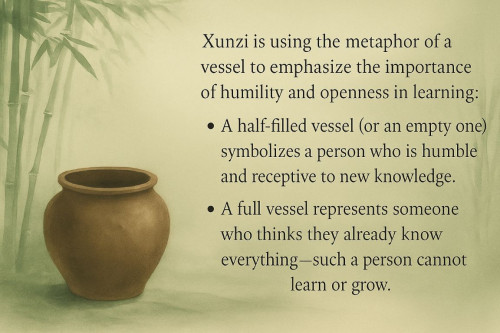
In ancient wisdom, a half-filled vessel symbolizes a person humble and open to new learning. A full vessel, by contrast, represents someone who believes they are already complete—and thus rejects growth. This incident taught me a new application of the metaphor:
• A half-filled vessel is one whose needs create a bridge to another—they must learn to share, to negotiate, to connect.
• A full vessel is one who is self-sufficient and thus has no incentive to learn how to coexist. They live in completeness, but not in harmony.
Thus, when we remove all lack from a person’s life, we may also remove the environment where humaneness can take root. In striving to give them everything, I might have given them less.
“In what ways have I unintentionally prevented the cultivation of Ren by providing ‘too much’?"
As I reflect, I realize now that nurturing virtue may require creating spaces of incompletion—not to cause suffering, but to provide the soil in which empathy and connection grow.
After the incident, I chose not to give the new replacement tablet to the 3rd disciple right away. I’ll let them continue learning how to co-exist—learning the ancient value of "Ren" (仁)—in their own time, in their own way.
~
What is your thought of this observation?
 Quote
Quote









 0.0150sec
 0.66
0.66
 5 queries
 GZIP Disabled